WIRELESS SENSOR 
Y O G E S H F U L A R A 
1 3 2 0 7 0 2 3 
P E C U N I V E R S I T Y O F T E C H N O L O G Y 
C H A N D I G A R H 
NETWORKS
INDEX 
• Wireless Communication 
• Need Of wireless Communication 
• Wireless Sensor Network 
• Why wireless sensor required now? 
• Characteristics 
• Architecture 
• Operating System for WSNs 
• Wireless Sensor Networks Application 
• Simulation Software 
• Some Technical Challenges 
• Manufacturing Company and their products 
• Summary and Conclusions
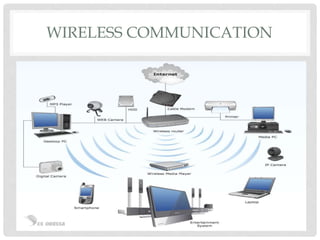
WIRELESS COMMUNICATION
WIRELESS COMMUNICATION 
Wireless communication is the transfer of information between two or 
more points that are not connected by an electrical conductor. 
Wireless communication is among technology’s biggest contributions 
to mankind. Wireless communication involves the transmission of 
information over a distance without help of wires, cables or any other forms 
of electrical conductors. The transmitted distance can be anywhere between a 
few meters (for example, a television’s remote control) and thousands of 
kilometres (for example, radio communication). 
Types of wireless communication 
• AM/FM 
• Infrared (IR) wireless communication 
• Wi-Fi 
• WiMAX 
• OpticalWireless Communication
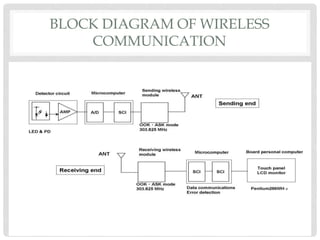
BLOCK DIAGRAM OF WIRELESS 
COMMUNICATION
NEED OF WIRELESS COMMUNICATION 
• Flexibility : the benefits of wireless networks over wired 
networks and one of the benefits of this flexibility, as radio 
waves go through walls and wireless computer you can be in 
any domain Point. 
• Increased mobility and collaboration 
• Roam without losing your connection 
• Work together more effectively 
• Improved responsiveness 
• Connect to the information you need when you need it 
• Provide better customer service
NEED OF WIRELESS COMMUNICATION 
• Better access to information 
• Connect hard-to-reach areas 
• Improve your processes 
• Easier network expansion 
• Add users quickly 
• Grow your network cost-effectively 
• Enhanced guest access 
• Give secure network access to customers and business 
partners 
• Offer a value-added service
WIRELESS NETWORK 
A wireless network is any type of computer network that uses 
wireless data connections for connecting network nodes 
• Types of Wireless Network 
• Wireless PAN (Personal Area Network) 
• Wireless LAN (Local Area Network) 
• Wireless mesh network 
• Wireless MAN (Metropolitan Area Networks) 
• Wireless WAN (Wide Area Network) 
• Cellular network 
• Wireless Sensor Network
WHAT IS A WIRELESS SENSOR 
NETWORK? 
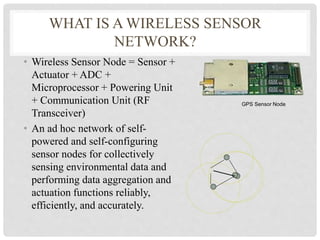
• Wireless Sensor Node = Sensor + 
Actuator + ADC + 
Microprocessor + Powering Unit 
+ Communication Unit (RF 
Transceiver) 
• An ad hoc network of self-powered 
and self-configuring 
sensor nodes for collectively 
sensing environmental data and 
performing data aggregation and 
actuation functions reliably, 
efficiently, and accurately. 
GPS Sensor Node
WIRELESS SENSOR NETWORK 
Definition 
“A wireless sensor network (WSN) is a wireless network 
consisting of spatially distributed autonomous devices using 
sensors to cooperatively monitor physical or environmental 
conditions, such as temperature, sound, vibration, pressure, 
motion or pollutants, at different locations.”
WIRELESS SENSOR NETWORKS 
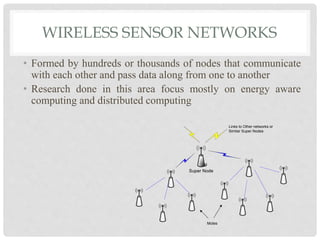
• Formed by hundreds or thousands of nodes that communicate 
with each other and pass data along from one to another 
• Research done in this area focus mostly on energy aware 
computing and distributed computing 
Super Node 
Links to Other networks or 
Similar Super Nodes 
Motes
WIRELESS SENSOR NETWORKS 
• Sensor networks are the key to gathering the information 
needed by smart environments, whether in buildings, 
utilities, industrial, home, shipboard, transportation systems 
automation, or elsewhere. Recent terrorist and guerilla 
warfare countermeasures require distributed networks of 
sensors that can be deployed using, e.g. aircraft, and have 
self-organizing capabilities. In such applications, running 
wires or cabling is usually impractical. A sensor network is 
required that is fast and easy to install and maintain.
WHY WIRELESS SENSORS NOW? 
• Moore’s Law is making sufficient CPU performance available 
with low power requirements in a small size. 
• Research in Materials Science has resulted in novel sensing 
materials for many Chemical, Biological, and Physical sensing 
tasks. 
• Transceivers for wireless devices are becoming smaller, less 
expensive, and less power hungry. 
• Power source improvements in batteries, as well as passive 
power sources such as solar or vibration energy, are expanding 
application options.
CHARACTERISTICS OF WSN’S 
The main characteristics of a WSNs Include 
• Easy to use 
• Power Consumption Constraints for nodes using batteries 
• Mobility of nodes 
• Scalability to large scale of development 
• Ability to withstand harsh environmental conditions 
• Cross Layer design 
• Ability to cope with node Failures
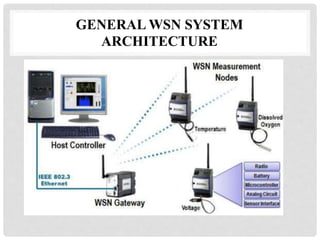
GENERAL WSN SYSTEM 
ARCHITECTURE
GENERAL WSN SYSTEM ARCHITECTURE 
– Constructing a platform for WSN falls into the area of embedded system 
development which usually consists of developing environment, hardware and 
software platforms. 
1. Hardware Platform 
Consists of the following four components: 
a) Processing Unit 
Associates with small storage unit (tens of kilo bytes order) and 
manages the procedures to collaborate with other nodes to carry out the 
assigned sensing task 
b) Transceiver Unit 
Connects the node to the network via various possible transmission 
medias such as infra, light, radio and so on
GENERAL WSN SYSTEM ARCHITECTURE 
1. Hardware Platform 
c) Power Unit 
Supplies power to the system by small size batteries which makes the 
energy a scarce resource 
d) Sensing Units 
Usually composed of two subunits: sensors and analog-to-digital 
Converters (ADCs). The analog signal produced by the sensors are 
converted to digital signals by the ADC, and fed into the processing unit
GENERAL WSN SYSTEM ARCHITECTURE 
2. Software Platform 
Consists of the following four components: 
a) Embedded Operating System (EOS) 
Manages the hardware capability efficiently as well as supports 
concurrency-intense operations. Apart from traditional OS tasks such as 
processor, memory and I/O management, it must be real-time to rapidly 
respond the hardware triggered events, multi-threading to handle 
concurrent flows 
b) Application Programming Interface (API) 
A series of functions provided by OS and other system-level components 
for assisting developers to build applications upon itself
OPERATING SYSTEM FOR WSN 
• Tiny Os 
• Lite Os 
• Contiki 
• Riot With C & C++ 
• EPIKA Enterprise
WORKING TOOL/ SIMULATOR 
• OPNET 
• OMNET++ 
• NETSIM 
• WSNET 
• NS2 
• MATLAB
APPLICATIONS OF WIRELESS 
SENSORS NETWORK
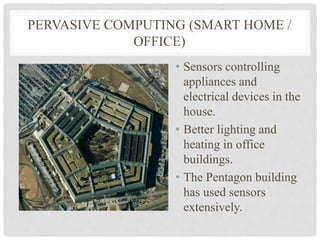
PERVASIVE COMPUTING (SMART HOME / 
OFFICE) 
• Sensors controlling 
appliances and 
electrical devices in the 
house. 
• Better lighting and 
heating in office 
buildings. 
• The Pentagon building 
has used sensors 
extensively.
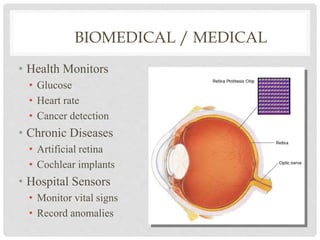
BIOMEDICAL / MEDICAL 
• Health Monitors 
• Glucose 
• Heart rate 
• Cancer detection 
• Chronic Diseases 
• Artificial retina 
• Cochlear implants 
• Hospital Sensors 
• Monitor vital signs 
• Record anomalies
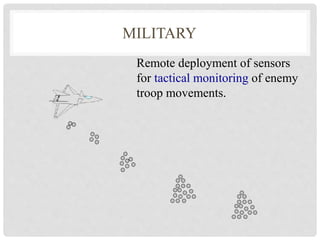
MILITARY 
Remote deployment of sensors 
for tactical monitoring of enemy 
troop movements.
INDUSTRIAL & COMMERCIAL 
• Numerous industrial and commercial applications: 
• Agricultural Crop Conditions 
• Inventory Tracking 
• In-Process Parts Tracking 
• Automated Problem Reporting 
• RFID – Theft Deterrent and Customer Tracing 
• Plant Equipment Maintenance Monitoring
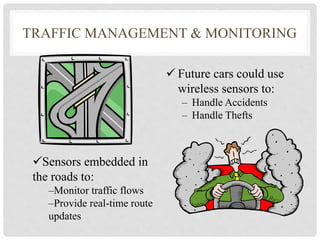
TRAFFIC MANAGEMENT & MONITORING 
 Future cars could use 
wireless sensors to: 
– Handle Accidents 
– Handle Thefts 
Sensors embedded in 
the roads to: 
–Monitor traffic flows 
–Provide real-time route 
updates
SOME TECHNICAL CHALLENGES
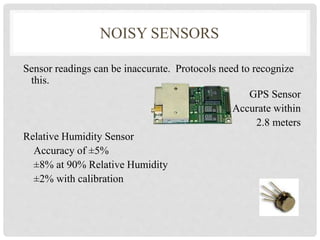
NOISY SENSORS 
Sensor readings can be inaccurate. Protocols need to recognize 
this. 
GPS Sensor 
Accurate within 
2.8 meters 
Relative Humidity Sensor 
Accuracy of ±5% 
±8% at 90% Relative Humidity 
±2% with calibration
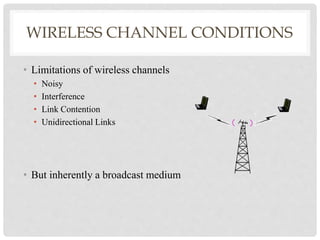
WIRELESS CHANNEL CONDITIONS 
• Limitations of wireless channels 
• Noisy 
• Interference 
• Link Contention 
• Unidirectional Links 
• But inherently a broadcast medium
ENVIRONMENTAL FACTORS 
• Wireless sensors need to operate in conditions 
that are not encountered by typical computing 
devices: 
• Rain, sleet, snow, hail, etc. 
• Wide temperature variations 
• May require separating sensor from electronics 
• High humidity 
• Saline or other corrosive substances 
• High wind speeds
NETWORKING ISSUES IN 
WIRELESS SENSOR NETWORKS
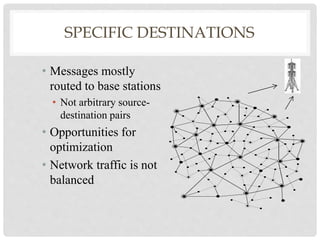
SPECIFIC DESTINATIONS 
• Messages mostly 
routed to base stations 
• Not arbitrary source-destination 
pairs 
• Opportunities for 
optimization 
• Network traffic is not 
balanced 
Sensing Zone with sensor-coordinator, 
sensing-collaborators, and backbone nodes
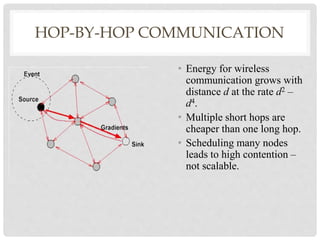
HOP-BY-HOP COMMUNICATION 
• Energy for wireless 
communication grows with 
distance d at the rate d2 – 
d4. 
• Multiple short hops are 
cheaper than one long hop. 
• Scheduling many nodes 
leads to high contention – 
not scalable.
TIME SYNCHRONIZATION 
• Data aggregation assumes time synchronization!!! 
• Need to know events at different sensors 
are temporally related. 
• Allows one to distinguish multiple targets. 
• Not trivial to accomplish in the 
constrained environment of sensor 
networks.
SCALABILITY! 
• Size of sensor networks will grow because: 
• Sensors more affordable as cost decreases 
• Redundant sensors provide 
• Reliability 
• Fault tolerance 
• Longer network lifetime 
• Protocols will support large networks 
• Applications will exist for larger networks
SERVICE DISCOVERY PROTOCOL 
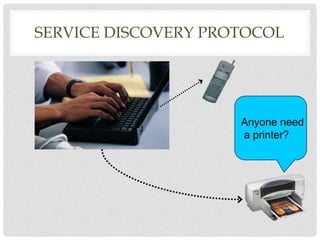
Anyone need 
a printer?
SERVICE DISCOVERY PROTOCOL 
• For a wireless sensor network, service discovery provides: 
• Automated calibration of new devices 
• Highly dynamic system configurations 
• Cooperation among resource poor devices 
• Solves resource sharing device 
• Storage and long-range networking services can be obtained 
from a nearby server 
• Reduces duplication of functionality 
• Supports novel interactions in the future
SECURITY ISSUES 
• Concerns about misuse and privacy 
• Privacy issues may slow consumer adoption of technology 
• User tracking – RFID concerns 
• Has not proved true on the Internet! 
• Authentication and privacy are not always complementary 
objectives 
• Do not want your medical sensor hacked!! 
• Data tampering and computer viruses could be a nightmare!
LIABILITY AND SAFETY CONCERNS 
Companies may adopt wireless sensors to 
reduce liability, but wireless sensors could 
also increase liability: 
– Use in critical applications could be limited 
• Imagine a medical sensor fails!! 
• Or an automotive theft deterrent system failure 
– Companies will be slow to adopt technology 
that increases their legal exposure 
• May delay adoption
MANUFACTURING COMPANY AND 
THEIR PRODUCTS 
• Cisco 
• Router/Switches(series 2900 to 5600) 
• Wi-Fi 
• Cisco Aironet 1552S Outdoor Access Point Data Sheet 
• Monitoring a chemical treatment plant while providing 
onsite security via wireless video surveillance 
• Monitoring the equipment and gauges on an oil rig while 
an onsite worker downloads schematics, blueprints, or 
work instructions to a handheld Wi-Fi tablet 
• Providing real-time information to an onsite engineer 
about changes to processes and equipment so that 
abnormalities can be dealt with immediately
IBM 
• Smart Water Sensors to monitor water quality in rivers, 
lakes and the sea | Libelium 
• Libelium launched a Smart Water wireless sensor platform to simplify 
remote water quality monitoring. Equipped with multiple sensors that 
measure a dozen of the most relevant water quality parameters, Wasp 
mote Smart Water is the first water quality-sensing platform to feature 
autonomous nodes that connect to the Cloud for real-time water control. 
• The water quality parameters measured include pH, dissolved oxygen 
(DO), oxidation-reduction potential (ORP), conductivity (salinity), 
temperature and dissolved ions (Na+, Ca+, F-, Cl, Br-, I-, Cu2+, K+, 
Mg2+, NO3-).
IBM 
Open Garden – Hydroponics & Garden Plants Monitoring 
for Arduino 
• The platform allows to control the state of the plants by sensing 
several parameters: 
• Soil moisture (Indoor & Outdoor kits) 
• Temperature + Humidity + Light (All kits) 
• Water sensors: pH, Conductivity, Temperature (Hydroponics kit 
• Then it uses different types of actuators to modify the state of the 
plants by irrigating them or activating lights and oxygen pumps: 
• Water pump + Droppers for Drip Irrigation (Indoor kit) 
• Electro valve + Sprinkler for Sprinkling (Outdoor kit) 
• Oxygen Pump + Growing Light (Hydroponics kit)
IBM 
• 400MHz RF transceiver geared for wireless smart 
energy apps 
• The transceiver is integrated with a highly configurable base band that 
enables users to customise transceiver performance for specific 
applications ranging from wireless smart energy management and 
security control in homes and buildings to long-range remote industrial 
monitoring. 
• To achieve low power consumption in RF transceiver, performance is 
typically sacrificed, resulting in degradations of sensitivity, channel 
selectivity and interference immunity during the wireless signal 
communication process.
LIBELIUM COMUNICACIONES DISTRIBUIDAS S.LTD 
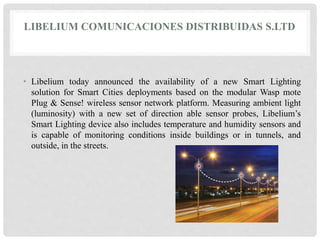
• Libelium today announced the availability of a new Smart Lighting 
solution for Smart Cities deployments based on the modular Wasp mote 
Plug & Sense! wireless sensor network platform. Measuring ambient light 
(luminosity) with a new set of direction able sensor probes, Libelium’s 
Smart Lighting device also includes temperature and humidity sensors and 
is capable of monitoring conditions inside buildings or in tunnels, and 
outside, in the streets.
• Wireless Sensor Networks to monitor food sustainability 
• Food security" refers to the ability of food systems to ensure that everyone has 
enough food to live a healthy life. To prevent food insecurity, we require reliable 
food systems at each stage of the food cycle: from food production and 
harvesting, during transport and distribution, at the shops we buy at and in the 
social settings wherever we consume food, and in the management of the 
resulting bio-waste outputs. Libelium's Wasp mote sensors can be used to 
monitor and control the whole food cycle.
• Some other products of Libelium 
• Nature Preservation by Monitoring and Studying the Habitat of Bats 
with Wasp mote 
• New e-Learning Platform for ZigBee sensor networks 
• Wireless Sensor Networks enhancing the efficiency and safety of 
logistics operations 
• Smart City project in Salamanca to monitor Air Quality and Urban 
Traffic with Wasp mote 
• E.t.c
COMPANY 
• As the world is growing day by day technology is enhancing 
per day for better environment, safe world and easy world. 
There are lot of company manufacturing in the field of 
wireless sensor 
• INTEL 
• Microsoft 
• Global Markets and Technologies for Wireless Sensors 
• and more
SUMMARY AND CONCLUSIONS 
• Wireless sensor networks have a bright future 
• Many applications have been proposed 
• Potential to revolutionize human-computer interactions 
• Availability of sensors will lead to new and exciting 
applications 
• A lot of research remains to be done 
• Many obstacles to overcome 
• Wireless sensors will not evolve into traditional 
computers 
• Allow realism to guide research efforts

Wireless sensor networks (Yogesh Chandra Fulara)

  • 1.
    WIRELESS SENSOR YO G E S H F U L A R A 1 3 2 0 7 0 2 3 P E C U N I V E R S I T Y O F T E C H N O L O G Y C H A N D I G A R H NETWORKS
  • 2.
    INDEX • WirelessCommunication • Need Of wireless Communication • Wireless Sensor Network • Why wireless sensor required now? • Characteristics • Architecture • Operating System for WSNs • Wireless Sensor Networks Application • Simulation Software • Some Technical Challenges • Manufacturing Company and their products • Summary and Conclusions
  • 3.
  • 4.
    WIRELESS COMMUNICATION Wirelesscommunication is the transfer of information between two or more points that are not connected by an electrical conductor. Wireless communication is among technology’s biggest contributions to mankind. Wireless communication involves the transmission of information over a distance without help of wires, cables or any other forms of electrical conductors. The transmitted distance can be anywhere between a few meters (for example, a television’s remote control) and thousands of kilometres (for example, radio communication). Types of wireless communication • AM/FM • Infrared (IR) wireless communication • Wi-Fi • WiMAX • OpticalWireless Communication
  • 5.
    BLOCK DIAGRAM OFWIRELESS COMMUNICATION
  • 6.
    NEED OF WIRELESSCOMMUNICATION • Flexibility : the benefits of wireless networks over wired networks and one of the benefits of this flexibility, as radio waves go through walls and wireless computer you can be in any domain Point. • Increased mobility and collaboration • Roam without losing your connection • Work together more effectively • Improved responsiveness • Connect to the information you need when you need it • Provide better customer service
  • 7.
    NEED OF WIRELESSCOMMUNICATION • Better access to information • Connect hard-to-reach areas • Improve your processes • Easier network expansion • Add users quickly • Grow your network cost-effectively • Enhanced guest access • Give secure network access to customers and business partners • Offer a value-added service
  • 8.
    WIRELESS NETWORK Awireless network is any type of computer network that uses wireless data connections for connecting network nodes • Types of Wireless Network • Wireless PAN (Personal Area Network) • Wireless LAN (Local Area Network) • Wireless mesh network • Wireless MAN (Metropolitan Area Networks) • Wireless WAN (Wide Area Network) • Cellular network • Wireless Sensor Network
  • 9.
    WHAT IS AWIRELESS SENSOR NETWORK? • Wireless Sensor Node = Sensor + Actuator + ADC + Microprocessor + Powering Unit + Communication Unit (RF Transceiver) • An ad hoc network of self-powered and self-configuring sensor nodes for collectively sensing environmental data and performing data aggregation and actuation functions reliably, efficiently, and accurately. GPS Sensor Node
  • 10.
    WIRELESS SENSOR NETWORK Definition “A wireless sensor network (WSN) is a wireless network consisting of spatially distributed autonomous devices using sensors to cooperatively monitor physical or environmental conditions, such as temperature, sound, vibration, pressure, motion or pollutants, at different locations.”
  • 11.
    WIRELESS SENSOR NETWORKS • Formed by hundreds or thousands of nodes that communicate with each other and pass data along from one to another • Research done in this area focus mostly on energy aware computing and distributed computing Super Node Links to Other networks or Similar Super Nodes Motes
  • 12.
    WIRELESS SENSOR NETWORKS • Sensor networks are the key to gathering the information needed by smart environments, whether in buildings, utilities, industrial, home, shipboard, transportation systems automation, or elsewhere. Recent terrorist and guerilla warfare countermeasures require distributed networks of sensors that can be deployed using, e.g. aircraft, and have self-organizing capabilities. In such applications, running wires or cabling is usually impractical. A sensor network is required that is fast and easy to install and maintain.
  • 13.
    WHY WIRELESS SENSORSNOW? • Moore’s Law is making sufficient CPU performance available with low power requirements in a small size. • Research in Materials Science has resulted in novel sensing materials for many Chemical, Biological, and Physical sensing tasks. • Transceivers for wireless devices are becoming smaller, less expensive, and less power hungry. • Power source improvements in batteries, as well as passive power sources such as solar or vibration energy, are expanding application options.
  • 14.
    CHARACTERISTICS OF WSN’S The main characteristics of a WSNs Include • Easy to use • Power Consumption Constraints for nodes using batteries • Mobility of nodes • Scalability to large scale of development • Ability to withstand harsh environmental conditions • Cross Layer design • Ability to cope with node Failures
  • 15.
    GENERAL WSN SYSTEM ARCHITECTURE
  • 16.
    GENERAL WSN SYSTEMARCHITECTURE – Constructing a platform for WSN falls into the area of embedded system development which usually consists of developing environment, hardware and software platforms. 1. Hardware Platform Consists of the following four components: a) Processing Unit Associates with small storage unit (tens of kilo bytes order) and manages the procedures to collaborate with other nodes to carry out the assigned sensing task b) Transceiver Unit Connects the node to the network via various possible transmission medias such as infra, light, radio and so on
  • 17.
    GENERAL WSN SYSTEMARCHITECTURE 1. Hardware Platform c) Power Unit Supplies power to the system by small size batteries which makes the energy a scarce resource d) Sensing Units Usually composed of two subunits: sensors and analog-to-digital Converters (ADCs). The analog signal produced by the sensors are converted to digital signals by the ADC, and fed into the processing unit
  • 18.
    GENERAL WSN SYSTEMARCHITECTURE 2. Software Platform Consists of the following four components: a) Embedded Operating System (EOS) Manages the hardware capability efficiently as well as supports concurrency-intense operations. Apart from traditional OS tasks such as processor, memory and I/O management, it must be real-time to rapidly respond the hardware triggered events, multi-threading to handle concurrent flows b) Application Programming Interface (API) A series of functions provided by OS and other system-level components for assisting developers to build applications upon itself
  • 19.
    OPERATING SYSTEM FORWSN • Tiny Os • Lite Os • Contiki • Riot With C & C++ • EPIKA Enterprise
  • 20.
    WORKING TOOL/ SIMULATOR • OPNET • OMNET++ • NETSIM • WSNET • NS2 • MATLAB
  • 21.
    APPLICATIONS OF WIRELESS SENSORS NETWORK
  • 22.
    PERVASIVE COMPUTING (SMARTHOME / OFFICE) • Sensors controlling appliances and electrical devices in the house. • Better lighting and heating in office buildings. • The Pentagon building has used sensors extensively.
  • 23.
    BIOMEDICAL / MEDICAL • Health Monitors • Glucose • Heart rate • Cancer detection • Chronic Diseases • Artificial retina • Cochlear implants • Hospital Sensors • Monitor vital signs • Record anomalies
  • 24.
    MILITARY Remote deploymentof sensors for tactical monitoring of enemy troop movements.
  • 25.
    INDUSTRIAL & COMMERCIAL • Numerous industrial and commercial applications: • Agricultural Crop Conditions • Inventory Tracking • In-Process Parts Tracking • Automated Problem Reporting • RFID – Theft Deterrent and Customer Tracing • Plant Equipment Maintenance Monitoring
  • 26.
    TRAFFIC MANAGEMENT &MONITORING  Future cars could use wireless sensors to: – Handle Accidents – Handle Thefts Sensors embedded in the roads to: –Monitor traffic flows –Provide real-time route updates
  • 27.
  • 28.
    NOISY SENSORS Sensorreadings can be inaccurate. Protocols need to recognize this. GPS Sensor Accurate within 2.8 meters Relative Humidity Sensor Accuracy of ±5% ±8% at 90% Relative Humidity ±2% with calibration
  • 29.
    WIRELESS CHANNEL CONDITIONS • Limitations of wireless channels • Noisy • Interference • Link Contention • Unidirectional Links • But inherently a broadcast medium
  • 30.
    ENVIRONMENTAL FACTORS •Wireless sensors need to operate in conditions that are not encountered by typical computing devices: • Rain, sleet, snow, hail, etc. • Wide temperature variations • May require separating sensor from electronics • High humidity • Saline or other corrosive substances • High wind speeds
  • 31.
    NETWORKING ISSUES IN WIRELESS SENSOR NETWORKS
  • 32.
    SPECIFIC DESTINATIONS •Messages mostly routed to base stations • Not arbitrary source-destination pairs • Opportunities for optimization • Network traffic is not balanced Sensing Zone with sensor-coordinator, sensing-collaborators, and backbone nodes
  • 33.
    HOP-BY-HOP COMMUNICATION •Energy for wireless communication grows with distance d at the rate d2 – d4. • Multiple short hops are cheaper than one long hop. • Scheduling many nodes leads to high contention – not scalable.
  • 34.
    TIME SYNCHRONIZATION •Data aggregation assumes time synchronization!!! • Need to know events at different sensors are temporally related. • Allows one to distinguish multiple targets. • Not trivial to accomplish in the constrained environment of sensor networks.
  • 35.
    SCALABILITY! • Sizeof sensor networks will grow because: • Sensors more affordable as cost decreases • Redundant sensors provide • Reliability • Fault tolerance • Longer network lifetime • Protocols will support large networks • Applications will exist for larger networks
  • 36.
    SERVICE DISCOVERY PROTOCOL Anyone need a printer?
  • 37.
    SERVICE DISCOVERY PROTOCOL • For a wireless sensor network, service discovery provides: • Automated calibration of new devices • Highly dynamic system configurations • Cooperation among resource poor devices • Solves resource sharing device • Storage and long-range networking services can be obtained from a nearby server • Reduces duplication of functionality • Supports novel interactions in the future
  • 38.
    SECURITY ISSUES •Concerns about misuse and privacy • Privacy issues may slow consumer adoption of technology • User tracking – RFID concerns • Has not proved true on the Internet! • Authentication and privacy are not always complementary objectives • Do not want your medical sensor hacked!! • Data tampering and computer viruses could be a nightmare!
  • 39.
    LIABILITY AND SAFETYCONCERNS Companies may adopt wireless sensors to reduce liability, but wireless sensors could also increase liability: – Use in critical applications could be limited • Imagine a medical sensor fails!! • Or an automotive theft deterrent system failure – Companies will be slow to adopt technology that increases their legal exposure • May delay adoption
  • 40.
    MANUFACTURING COMPANY AND THEIR PRODUCTS • Cisco • Router/Switches(series 2900 to 5600) • Wi-Fi • Cisco Aironet 1552S Outdoor Access Point Data Sheet • Monitoring a chemical treatment plant while providing onsite security via wireless video surveillance • Monitoring the equipment and gauges on an oil rig while an onsite worker downloads schematics, blueprints, or work instructions to a handheld Wi-Fi tablet • Providing real-time information to an onsite engineer about changes to processes and equipment so that abnormalities can be dealt with immediately
  • 41.
    IBM • SmartWater Sensors to monitor water quality in rivers, lakes and the sea | Libelium • Libelium launched a Smart Water wireless sensor platform to simplify remote water quality monitoring. Equipped with multiple sensors that measure a dozen of the most relevant water quality parameters, Wasp mote Smart Water is the first water quality-sensing platform to feature autonomous nodes that connect to the Cloud for real-time water control. • The water quality parameters measured include pH, dissolved oxygen (DO), oxidation-reduction potential (ORP), conductivity (salinity), temperature and dissolved ions (Na+, Ca+, F-, Cl, Br-, I-, Cu2+, K+, Mg2+, NO3-).
  • 42.
    IBM Open Garden– Hydroponics & Garden Plants Monitoring for Arduino • The platform allows to control the state of the plants by sensing several parameters: • Soil moisture (Indoor & Outdoor kits) • Temperature + Humidity + Light (All kits) • Water sensors: pH, Conductivity, Temperature (Hydroponics kit • Then it uses different types of actuators to modify the state of the plants by irrigating them or activating lights and oxygen pumps: • Water pump + Droppers for Drip Irrigation (Indoor kit) • Electro valve + Sprinkler for Sprinkling (Outdoor kit) • Oxygen Pump + Growing Light (Hydroponics kit)
  • 43.
    IBM • 400MHzRF transceiver geared for wireless smart energy apps • The transceiver is integrated with a highly configurable base band that enables users to customise transceiver performance for specific applications ranging from wireless smart energy management and security control in homes and buildings to long-range remote industrial monitoring. • To achieve low power consumption in RF transceiver, performance is typically sacrificed, resulting in degradations of sensitivity, channel selectivity and interference immunity during the wireless signal communication process.
  • 44.
    LIBELIUM COMUNICACIONES DISTRIBUIDASS.LTD • Libelium today announced the availability of a new Smart Lighting solution for Smart Cities deployments based on the modular Wasp mote Plug & Sense! wireless sensor network platform. Measuring ambient light (luminosity) with a new set of direction able sensor probes, Libelium’s Smart Lighting device also includes temperature and humidity sensors and is capable of monitoring conditions inside buildings or in tunnels, and outside, in the streets.
  • 45.
    • Wireless SensorNetworks to monitor food sustainability • Food security" refers to the ability of food systems to ensure that everyone has enough food to live a healthy life. To prevent food insecurity, we require reliable food systems at each stage of the food cycle: from food production and harvesting, during transport and distribution, at the shops we buy at and in the social settings wherever we consume food, and in the management of the resulting bio-waste outputs. Libelium's Wasp mote sensors can be used to monitor and control the whole food cycle.
  • 46.
    • Some otherproducts of Libelium • Nature Preservation by Monitoring and Studying the Habitat of Bats with Wasp mote • New e-Learning Platform for ZigBee sensor networks • Wireless Sensor Networks enhancing the efficiency and safety of logistics operations • Smart City project in Salamanca to monitor Air Quality and Urban Traffic with Wasp mote • E.t.c
  • 47.
    COMPANY • Asthe world is growing day by day technology is enhancing per day for better environment, safe world and easy world. There are lot of company manufacturing in the field of wireless sensor • INTEL • Microsoft • Global Markets and Technologies for Wireless Sensors • and more
  • 48.
    SUMMARY AND CONCLUSIONS • Wireless sensor networks have a bright future • Many applications have been proposed • Potential to revolutionize human-computer interactions • Availability of sensors will lead to new and exciting applications • A lot of research remains to be done • Many obstacles to overcome • Wireless sensors will not evolve into traditional computers • Allow realism to guide research efforts

Editor's Notes