HETEROGENEOUS WIRELESS
SENSOR NETWORK
GANDHI INSTITUTE FOR TECHNOLOGY
Guided by:
Prof.Subhransu sekhar panda
 Chinmoy kanta jena
 Chinmaya singh
 Krushna chandra sahoo
 Jyotiprakash mishra
 Kamalakanta behera
Team members
OBJECTIVE
To analyze the efficiency of heterogeneous
wireless sensor network over homogenous
wireless sensor network.
To analyze the stability, life time ,through put.
WIRELESS SENSOR NETWORK
A Wireless Sensor Network (WSN)
consists of distributed autonomous wireless
sensors nodes to monitor physical or
environmental conditions, such as
temperature, humidity, light
intensity, sound, vibration, pressure, motion etc.
Each node having sensing area of few
meters and radio range approximately 10 to 15
meters.
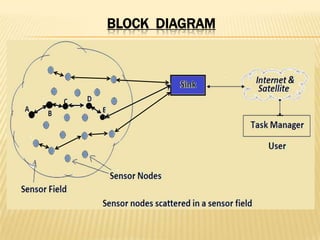
BLOCK DIAGRAM
WIRELESS SENSOR NETWORK …cntd.
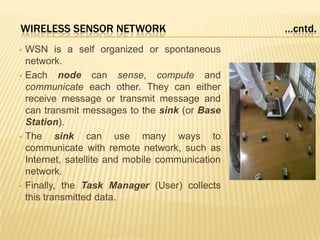
 WSN is a self organized or spontaneous
network.
 Each node can sense, compute and
communicate each other. They can either
receive message or transmit message and
can transmit messages to the sink (or Base
Station).
 The sink can use many ways to
communicate with remote network, such as
Internet, satellite and mobile communication
network.
 Finally, the Task Manager (User) collects
this transmitted data.
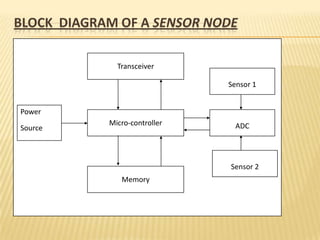
BLOCK DIAGRAM OF A SENSOR NODE
Transceiver
Sensor 1
Power
Source
Micro-controller
Memory
Sensor 2
ADC
Few Sensing inputs:
1. Temperature
2. Humidity
3. Light Intensity
4. Sound
5. Vibration
6. Pressure
7. Motion .
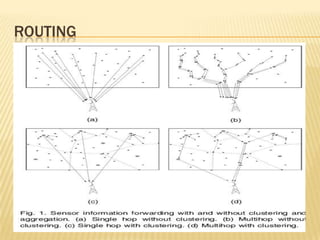
ROUTING
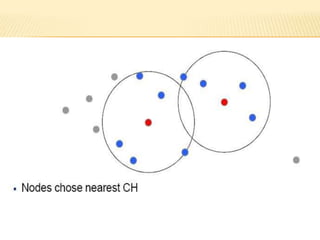
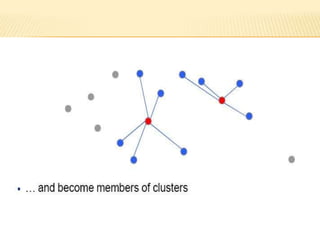
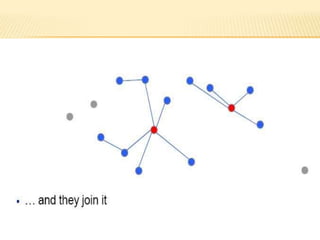
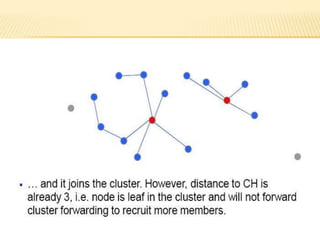
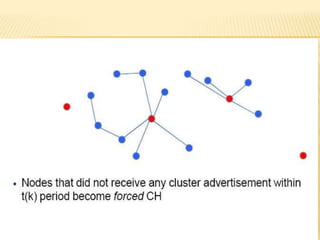
CLUSTERING ALGORITHM
Construction phase
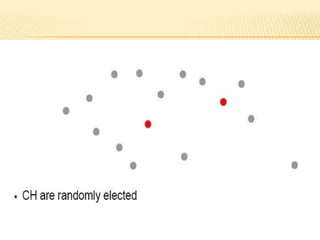
1. Each node tests whether to become CH or
not.
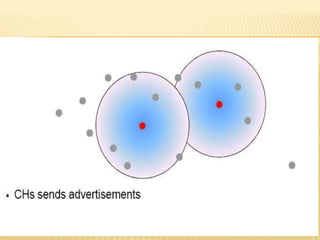
2. If node becomes CH then it sends cluster
advertisement and waits for response
3. If node decides not to be CH then listens for
CH
advertisements and responses to the closest
CH
CLUSTERING ALGORITHM (Cont…)
Maintenance phase
1. When cluster is established, CH
sends/transmits
data in schedule.
2. After certain time the cluster is disrupted and
new construction phase takes place (rotation
of CH) where new CH are elected
SELECTING CLUSTER-HEADS IN LEACH
 Node i chooses random number s between 0 and 1
 If s < T(i), node i becomes a cluster head in current
round where:
T(i)=
where: P = desired percentage of cluster heads
r=no. of round
CH SELECTION CRITERIA
Cluster head are selected according to
 Initial Energy
 Residual Energy
 Energy Consumption Rate
 Average Energy of the Network:
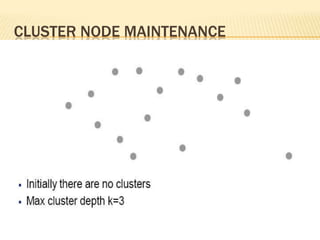
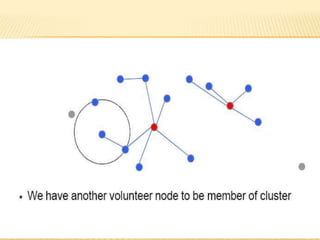
CLUSTER NODE MAINTENANCE
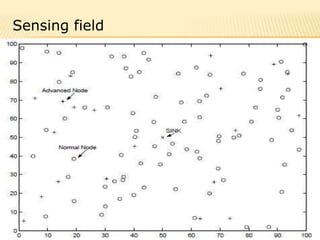
Sensing field
LEACH ASSUMPTION
 Synchronized network
 Base station is fixed and located far from the
sensors
 All nodes are homogeneous and energy
constrained
 All nodes can reach base station
LEACH PROPERTIES
 Distributed
Only local information
 CH role
Data aggregation from node
Forwards aggregated data to BS
 Inter-cluster communication via CH
 Simple
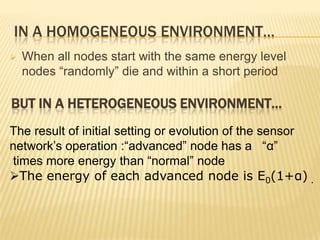
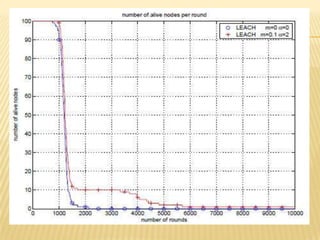
IN A HOMOGENEOUS ENVIRONMENT…
 When all nodes start with the same energy level
nodes “randomly” die and within a short period
The result of initial setting or evolution of the sensor
network’s operation :“advanced” node has a “α”
times more energy than “normal” node
The energy of each advanced node is E0(1+α) .
BUT IN A HETEROGENEOUS ENVIRONMENT…
A. Military fields.
B. Medical monitoring and Health care.
C. Industrial Control.
D. Ocean and wildlife monitoring.
E. Building safety.
F. Earthquake Early Warning and
Monitoring.
G. Environmental applications.
H. Intelligent green aircrafts.
I. Smart Roads.
APPLICATION DOMAINS OF WSNS
PERFORMANCE MEASURES
 Stability Period: Time until death of the first node
 Network lifetime: Time until death of the last alive
node
 Number of cluster-heads per round: Nodes which
will directly send aggregated information to the sink
 Throughput: Rate of data reporting to cluster-
heads and to sink
Thank you

Hetrogenous wireless sensor network

  • 1.
    HETEROGENEOUS WIRELESS SENSOR NETWORK GANDHIINSTITUTE FOR TECHNOLOGY Guided by: Prof.Subhransu sekhar panda
  • 2.
     Chinmoy kantajena  Chinmaya singh  Krushna chandra sahoo  Jyotiprakash mishra  Kamalakanta behera Team members
  • 3.
    OBJECTIVE To analyze theefficiency of heterogeneous wireless sensor network over homogenous wireless sensor network. To analyze the stability, life time ,through put.
  • 4.
    WIRELESS SENSOR NETWORK AWireless Sensor Network (WSN) consists of distributed autonomous wireless sensors nodes to monitor physical or environmental conditions, such as temperature, humidity, light intensity, sound, vibration, pressure, motion etc. Each node having sensing area of few meters and radio range approximately 10 to 15 meters.
  • 5.
  • 6.
    WIRELESS SENSOR NETWORK…cntd.  WSN is a self organized or spontaneous network.  Each node can sense, compute and communicate each other. They can either receive message or transmit message and can transmit messages to the sink (or Base Station).  The sink can use many ways to communicate with remote network, such as Internet, satellite and mobile communication network.  Finally, the Task Manager (User) collects this transmitted data.
  • 7.
    BLOCK DIAGRAM OFA SENSOR NODE Transceiver Sensor 1 Power Source Micro-controller Memory Sensor 2 ADC
  • 8.
    Few Sensing inputs: 1.Temperature 2. Humidity 3. Light Intensity 4. Sound 5. Vibration 6. Pressure 7. Motion .
  • 9.
  • 10.
    CLUSTERING ALGORITHM Construction phase 1.Each node tests whether to become CH or not. 2. If node becomes CH then it sends cluster advertisement and waits for response 3. If node decides not to be CH then listens for CH advertisements and responses to the closest CH
  • 11.
    CLUSTERING ALGORITHM (Cont…) Maintenancephase 1. When cluster is established, CH sends/transmits data in schedule. 2. After certain time the cluster is disrupted and new construction phase takes place (rotation of CH) where new CH are elected
  • 12.
    SELECTING CLUSTER-HEADS INLEACH  Node i chooses random number s between 0 and 1  If s < T(i), node i becomes a cluster head in current round where: T(i)= where: P = desired percentage of cluster heads r=no. of round
  • 13.
    CH SELECTION CRITERIA Clusterhead are selected according to  Initial Energy  Residual Energy  Energy Consumption Rate  Average Energy of the Network:
  • 14.
  • 25.
  • 26.
    LEACH ASSUMPTION  Synchronizednetwork  Base station is fixed and located far from the sensors  All nodes are homogeneous and energy constrained  All nodes can reach base station
  • 27.
    LEACH PROPERTIES  Distributed Onlylocal information  CH role Data aggregation from node Forwards aggregated data to BS  Inter-cluster communication via CH  Simple
  • 28.
    IN A HOMOGENEOUSENVIRONMENT…  When all nodes start with the same energy level nodes “randomly” die and within a short period The result of initial setting or evolution of the sensor network’s operation :“advanced” node has a “α” times more energy than “normal” node The energy of each advanced node is E0(1+α) . BUT IN A HETEROGENEOUS ENVIRONMENT…
  • 30.
    A. Military fields. B.Medical monitoring and Health care. C. Industrial Control. D. Ocean and wildlife monitoring. E. Building safety. F. Earthquake Early Warning and Monitoring. G. Environmental applications. H. Intelligent green aircrafts. I. Smart Roads. APPLICATION DOMAINS OF WSNS
  • 31.
    PERFORMANCE MEASURES  StabilityPeriod: Time until death of the first node  Network lifetime: Time until death of the last alive node  Number of cluster-heads per round: Nodes which will directly send aggregated information to the sink  Throughput: Rate of data reporting to cluster- heads and to sink
  • 32.