Presented
by
Parita
Parekh
Evaluation of NTP for clock
synchronization(Application layer)
Topic to cover :
 Introduction
 Overview of Time synchronization.
 GPS
 NTP
INTRODUCTION
 NTP is internet standard protocol used to synchronize the
clock of network with client and server.
 It is a networking protocol for clock synchronization
between computer systems over packet-switched,
variable-latency, data networks and it works on
Application Layer.
 The protocol uses the User Datagram Protocol (UDP) on
port number 123.
 It synchronize time in distributed environment for accuracy
in network.
Time synchronization means ….
 In a network context, switching between two system at the
same time so that event occurs in predetermine manner. For
Ex(Government , Financial institute and defence
department).
 Data logging, control & monitoring all rely on accurate time.
 Loss of single transmission path doesn’t prevent their portion
from obtaining correct time.
 Installing a network time server behind your firewall and
insulating it from the Internet provides the best security.
 Network to synchronize in real-time by UTC.
 Logical time nodes are synchronize to common reference
point in time.
 Time synchronization protocols are classified into two ways :
 Sender- Receiver
 Receiver-Receiver
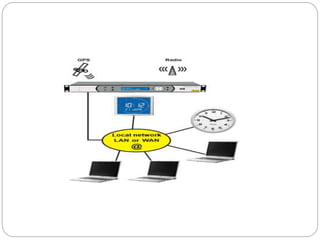
Time synchronization via GPS[3]
 GPS is made up of 24 active satellites orbiting above the
surface of earth deploy by US(DOD).
 As it intended as high accurate positioning & navigation.
 GPS antenna plays crucial role for obtaining accurate time
information.
 Accurate time rate is transmit continuously from each
satellites.
 Time is broadcast from each satellite as per UTC.
 There are number of factors that affect the GPS
performance that are not handled by human(climate
change): 1.atomspheric delay 2. satellite geometry.
Time synchronization via NTP[3]
 NTP is built on IP & UDP but it can also adopt some other
protocols.
 NTP message includes three time-stamp and fourth is
determine when message is arrived.
 This method is advantageous in the sense that the
transmission times and received message orders are not
important and it does not require reliable delivery.
 NTP is necessary to create & test real time computers using
time synchronization.
Network Time Protocol(NTP)
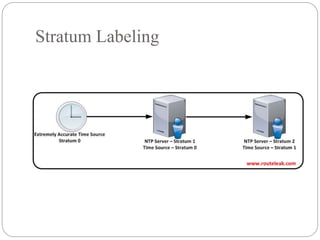
 NTP uses hierachical ,semi-layer structure term as Stratum.
 NTPv4 improves accuracy and reduce network overhead.
 The Network Time Protocol Daemon (NTPD) is an operating
system daemon which completely implements NTPv4.[3]
 SNTP is basically similar to NTP.
 NTP & SNTP are very similar TCP/IP protocols in that they
use the same time packet from a Time Server message to
compute accurate time.
 NTPD allow end users specify up to 9 NTP servers to
synchronize from & it classifies the servers according to stratum.
Stratum Labeling
Importance of NTP
 A NTP server appliance is a hardware device that
synchronizes to a hardware clock, such as GPS or
frequency broadcast(FNET).
 Local clock accuracy is achieved by using NTP.
 To maintain consistent time.
 Accurate clock is a crucial role in whole network.
 To end-up with loss of data using NTP.
Need of NTP
 Deliver accurate time over wide-area network.
 Synchronize time and frequency.
 Work with a variety of heterogonous system.
 Overcome problem of transmission delay.
 Loss of a single transmission path does not prevent other
portions from obtaining correct time.
 NTP assumes that there is correct time value and that
by using multiple sources, inaccurate values can be
discarded.
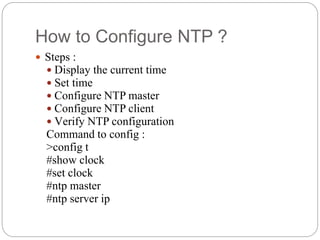
How to Configure NTP ?
 Steps :
 Display the current time
 Set time
 Configure NTP master
 Configure NTP client
 Verify NTP configuration
Command to config :
>config t
#show clock
#set clock
#ntp master
#ntp server ip
NTP test result
 The Windows XP operating system synchronizes its
clock using Windows Time Service, which is a subset
of NTP used to synchronize computer clocks in the
Internet.
 WTS set local clock into two different ways :
1.automatic mode(not suitable for large
applications)
2. static mode(accurate time poll)
NTPv4 Test Result
 The Network Time Protocol Daemon (NTPD) is an
operating system daemon which completely implements
NTP version 4 but also retains compatibility with past
versions of NTP.
 NTPD test result :
1.automic mode
2.static mode
 NTPD with 10 sec is more accurate for local
clock.(max_limit15 sec)
Conclusion
 Fixed interval poll in NTP version 4 implemented
with NTPD is best result.
 NTP accuracy is still lacking comparing to the
GPS but it has evolved to be more stable and
accurate since the early days of Windows Time
Service.
Latest Research of NTP
 Adaptive Hybrid Clock Discipline Algorithm for
the Network Time Protocol.
 Time Synchronization Testing with Roving
WLAN Network.
Reference
 Ian F Akyildiz and Mehmet Can Vuran. Wireless sensor
networks,
 volume 4. John Wiley & Sons, 2010.[2] Jianzhong Li
and Siyao Cheng. (", )-approximate aggregation
algorithms in dynamic sensor networks. Parallel and
Distributed Systems, IEEE Transactions on, 23(3):385–
396, 2012.
 [3] Liu Xiang, Jun Luo, and Athanasios Vasilakos.
Compressed data aggregation for energy efficient
wireless sensor networks. In Sensor, mesh and ad hoc
communications and networks (SECON), 2011 8th IEEE,
2011
 Web links :
1... http://www.timetoolsglobal.com/information/gps-time-
synchronization/(TIME SYNCHRONIZATION)
2....https://www.eecis.udel.edu/~ntp/ntpfaq/NTP-s-def.htm

Seminar

  • 1.
    Presented by Parita Parekh Evaluation of NTPfor clock synchronization(Application layer)
  • 2.
    Topic to cover:  Introduction  Overview of Time synchronization.  GPS  NTP
  • 3.
    INTRODUCTION  NTP isinternet standard protocol used to synchronize the clock of network with client and server.  It is a networking protocol for clock synchronization between computer systems over packet-switched, variable-latency, data networks and it works on Application Layer.  The protocol uses the User Datagram Protocol (UDP) on port number 123.  It synchronize time in distributed environment for accuracy in network.
  • 5.
    Time synchronization means….  In a network context, switching between two system at the same time so that event occurs in predetermine manner. For Ex(Government , Financial institute and defence department).  Data logging, control & monitoring all rely on accurate time.  Loss of single transmission path doesn’t prevent their portion from obtaining correct time.  Installing a network time server behind your firewall and insulating it from the Internet provides the best security.  Network to synchronize in real-time by UTC.  Logical time nodes are synchronize to common reference point in time.  Time synchronization protocols are classified into two ways :  Sender- Receiver  Receiver-Receiver
  • 6.
    Time synchronization viaGPS[3]  GPS is made up of 24 active satellites orbiting above the surface of earth deploy by US(DOD).  As it intended as high accurate positioning & navigation.  GPS antenna plays crucial role for obtaining accurate time information.  Accurate time rate is transmit continuously from each satellites.  Time is broadcast from each satellite as per UTC.  There are number of factors that affect the GPS performance that are not handled by human(climate change): 1.atomspheric delay 2. satellite geometry.
  • 7.
    Time synchronization viaNTP[3]  NTP is built on IP & UDP but it can also adopt some other protocols.  NTP message includes three time-stamp and fourth is determine when message is arrived.  This method is advantageous in the sense that the transmission times and received message orders are not important and it does not require reliable delivery.  NTP is necessary to create & test real time computers using time synchronization.
  • 8.
    Network Time Protocol(NTP) NTP uses hierachical ,semi-layer structure term as Stratum.  NTPv4 improves accuracy and reduce network overhead.  The Network Time Protocol Daemon (NTPD) is an operating system daemon which completely implements NTPv4.[3]  SNTP is basically similar to NTP.  NTP & SNTP are very similar TCP/IP protocols in that they use the same time packet from a Time Server message to compute accurate time.  NTPD allow end users specify up to 9 NTP servers to synchronize from & it classifies the servers according to stratum.
  • 9.
  • 10.
    Importance of NTP A NTP server appliance is a hardware device that synchronizes to a hardware clock, such as GPS or frequency broadcast(FNET).  Local clock accuracy is achieved by using NTP.  To maintain consistent time.  Accurate clock is a crucial role in whole network.  To end-up with loss of data using NTP.
  • 11.
    Need of NTP Deliver accurate time over wide-area network.  Synchronize time and frequency.  Work with a variety of heterogonous system.  Overcome problem of transmission delay.  Loss of a single transmission path does not prevent other portions from obtaining correct time.  NTP assumes that there is correct time value and that by using multiple sources, inaccurate values can be discarded.
  • 12.
    How to ConfigureNTP ?  Steps :  Display the current time  Set time  Configure NTP master  Configure NTP client  Verify NTP configuration Command to config : >config t #show clock #set clock #ntp master #ntp server ip
  • 13.
    NTP test result The Windows XP operating system synchronizes its clock using Windows Time Service, which is a subset of NTP used to synchronize computer clocks in the Internet.  WTS set local clock into two different ways : 1.automatic mode(not suitable for large applications) 2. static mode(accurate time poll)
  • 14.
    NTPv4 Test Result The Network Time Protocol Daemon (NTPD) is an operating system daemon which completely implements NTP version 4 but also retains compatibility with past versions of NTP.  NTPD test result : 1.automic mode 2.static mode  NTPD with 10 sec is more accurate for local clock.(max_limit15 sec)
  • 15.
    Conclusion  Fixed intervalpoll in NTP version 4 implemented with NTPD is best result.  NTP accuracy is still lacking comparing to the GPS but it has evolved to be more stable and accurate since the early days of Windows Time Service.
  • 16.
    Latest Research ofNTP  Adaptive Hybrid Clock Discipline Algorithm for the Network Time Protocol.  Time Synchronization Testing with Roving WLAN Network.
  • 17.
    Reference  Ian FAkyildiz and Mehmet Can Vuran. Wireless sensor networks,  volume 4. John Wiley & Sons, 2010.[2] Jianzhong Li and Siyao Cheng. (", )-approximate aggregation algorithms in dynamic sensor networks. Parallel and Distributed Systems, IEEE Transactions on, 23(3):385– 396, 2012.  [3] Liu Xiang, Jun Luo, and Athanasios Vasilakos. Compressed data aggregation for energy efficient wireless sensor networks. In Sensor, mesh and ad hoc communications and networks (SECON), 2011 8th IEEE, 2011  Web links : 1... http://www.timetoolsglobal.com/information/gps-time- synchronization/(TIME SYNCHRONIZATION) 2....https://www.eecis.udel.edu/~ntp/ntpfaq/NTP-s-def.htm

Editor's Notes

  • #5 Working of NTP :-