Wireless Sensor Network & Security
TEJAS WASULE
(IT 2nd
Year)
SURAJ JAIWAL
(IT 2nd
Year )
Presented by-
What is Wireless Sensor
Networks?
WSN combines sensing, computation,
and communication into single tiny
device called sensor node.
Group of sensors linked by wireless
media to perform distributed sensing
task
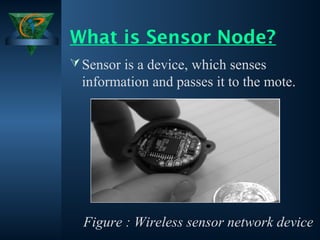
What is Sensor Node?
Sensor is a device, which senses
information and passes it to the mote.
Figure : Wireless sensor network device
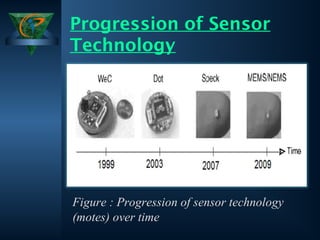
Progression of Sensor
Technology
Figure : Progression of sensor technology
(motes) over time
Architecture of a Sensor
Node
 A Power unit (Battery)
 Computational logic & Storage
 Sensor Transducer
 Communication
 Components of Sensor Node
1. HARDWARE
Architecture of a Sensor
Node
Figure : The architecture of a sensor node.
Contd..
2. SOFTWARE
Operating System Microcode
Sensor Drivers
Communication Processors
Communication Drivers
Data Processing Mini-Apps
Specific Sensor Node
Sensor Node:
Processor: 4Mhz
Memory: 128KB Flash & 4KB RAM
Radio: 916Mhz and 40Kbits/second.
Transmission Range: 100 Feet
TinyOS:
Operating System(small)
Open Source
Energy Efficient
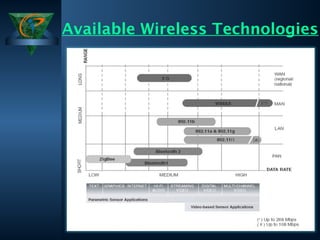
Available Wireless Technologies
Standard Data Rate Range Power
Consumption
ZigBee
(802.15.4)
20 kbps to
250 kbps
Up to 10 m Ultralow
Bluetooth
(802.15.1)
Up to 3 mbps 1m to 100 m low
Wi-Fi
(802.11)
54 mbps 45 m to 90
m
Medium
Contd…
Need of Security
 WSNs are becoming a cost effective,
practical way to go about deploying
sensor networks.
 Protecting confidentiality, integrity
and availability of communications.
 Large range of applications from
civilian to military purposes.
Need of Security
• Obstacles:
 Very-Limited Resources
 Unreliable Communication
 Unattended Operations
• Attacks:
 Sybil Attack
 Traffic Analysis Attacks
Need of Security
• Attacks:
1) Sybil Attack:
Introduced by “Brain Zill” in 2002
Subverted by Foreign identities in
peer-to peer Network
2) Traffic Analysis
Intercepting & Examine messages to
deduce info. from patterns in
Communications.
Able to detect Encrypted messages but
Not able to Decrypt it.
Security for Sensor Network
 SMACS :
Self organizing medium access
control for sensor networks.
 Encryption:
Encoding info. in such a way that
hackers can’t read it, but authorized
one can.
 Cryptography & Steganography:
Techniques for Secure
Communication in presence of Third
parties.
Application of WSN
 Home and Office Applications
 Environmental Applications
 Medical & Health Applications
 Military Applications
Advantages
 Implementation cost is cheaper
than wired network
Ideal for non-reachable places
 It avoids hell lot of wiring
It can accommodate new devices
at any time
Disadvantages
 Less secure because hacker's laptop
can act as Access Point.
 Lower speed as compare to wired
networks.
 Affected by surrounding. E.g.: walls
(blocking), microwave oven , far distance
Conclusion
 The low cost, flexibility, fault tolerance,
high sensing fidelity and rapid deployment
makes way for new applications on remote
sensing.
 Realization needs to satisfy the constraints
such as scalability, topology changes,
power consumption, environment etc.
 New wireless ad hoc networking
techniques are required to overcome this
constraints.
References
 Wireless Sensor Network (KAZEM
SOHRABY, DANIEL MINOLI,
TAIEB ZNATI)
 System Architecture for Wireless
Sensor Networks (Jason Lester Hill)
 http://today.cs.berkeley.edu/800dem
o/.s
 http://www.powerstream.com
 http://www.wikipedia.com
THANK
YOU..!
.....?

WIRELESS SENSOR NETWORK

  • 1.
    Wireless Sensor Network& Security TEJAS WASULE (IT 2nd Year) SURAJ JAIWAL (IT 2nd Year ) Presented by-
  • 2.
    What is WirelessSensor Networks? WSN combines sensing, computation, and communication into single tiny device called sensor node. Group of sensors linked by wireless media to perform distributed sensing task
  • 3.
    What is SensorNode? Sensor is a device, which senses information and passes it to the mote. Figure : Wireless sensor network device
  • 4.
    Progression of Sensor Technology Figure: Progression of sensor technology (motes) over time
  • 5.
    Architecture of aSensor Node  A Power unit (Battery)  Computational logic & Storage  Sensor Transducer  Communication  Components of Sensor Node 1. HARDWARE
  • 6.
    Architecture of aSensor Node Figure : The architecture of a sensor node. Contd..
  • 7.
    2. SOFTWARE Operating SystemMicrocode Sensor Drivers Communication Processors Communication Drivers Data Processing Mini-Apps
  • 8.
    Specific Sensor Node SensorNode: Processor: 4Mhz Memory: 128KB Flash & 4KB RAM Radio: 916Mhz and 40Kbits/second. Transmission Range: 100 Feet TinyOS: Operating System(small) Open Source Energy Efficient
  • 9.
  • 10.
    Available Wireless Technologies StandardData Rate Range Power Consumption ZigBee (802.15.4) 20 kbps to 250 kbps Up to 10 m Ultralow Bluetooth (802.15.1) Up to 3 mbps 1m to 100 m low Wi-Fi (802.11) 54 mbps 45 m to 90 m Medium Contd…
  • 11.
    Need of Security WSNs are becoming a cost effective, practical way to go about deploying sensor networks.  Protecting confidentiality, integrity and availability of communications.  Large range of applications from civilian to military purposes.
  • 12.
    Need of Security •Obstacles:  Very-Limited Resources  Unreliable Communication  Unattended Operations • Attacks:  Sybil Attack  Traffic Analysis Attacks
  • 13.
    Need of Security •Attacks: 1) Sybil Attack: Introduced by “Brain Zill” in 2002 Subverted by Foreign identities in peer-to peer Network 2) Traffic Analysis Intercepting & Examine messages to deduce info. from patterns in Communications. Able to detect Encrypted messages but Not able to Decrypt it.
  • 14.
    Security for SensorNetwork  SMACS : Self organizing medium access control for sensor networks.  Encryption: Encoding info. in such a way that hackers can’t read it, but authorized one can.  Cryptography & Steganography: Techniques for Secure Communication in presence of Third parties.
  • 15.
    Application of WSN Home and Office Applications  Environmental Applications  Medical & Health Applications  Military Applications
  • 16.
    Advantages  Implementation costis cheaper than wired network Ideal for non-reachable places  It avoids hell lot of wiring It can accommodate new devices at any time
  • 17.
    Disadvantages  Less securebecause hacker's laptop can act as Access Point.  Lower speed as compare to wired networks.  Affected by surrounding. E.g.: walls (blocking), microwave oven , far distance
  • 18.
    Conclusion  The lowcost, flexibility, fault tolerance, high sensing fidelity and rapid deployment makes way for new applications on remote sensing.  Realization needs to satisfy the constraints such as scalability, topology changes, power consumption, environment etc.  New wireless ad hoc networking techniques are required to overcome this constraints.
  • 19.
    References  Wireless SensorNetwork (KAZEM SOHRABY, DANIEL MINOLI, TAIEB ZNATI)  System Architecture for Wireless Sensor Networks (Jason Lester Hill)  http://today.cs.berkeley.edu/800dem o/.s  http://www.powerstream.com  http://www.wikipedia.com
  • 20.
  • 21.