Wireless sensor Network using Zero
Knowledge Protocol


 Under The Guidance of

  K.DURGA PRASAD
 ASSISTANT PROFESSOR
 IT DEPARTMENT                           By
                                      G.Arun Kumar
                                     10211D2502
Index


Abstract.
Introduction to domain.
Existing System.
Drawbacks.
Proposed System.
UML Diagrams.
Screen Shots
References.
Abstract
Wireless Sensor Networks (WSNs) offer an excellent opportunity to monitor
environments, and have a lot of interesting applications, some of which are quite
sensitive in nature and require full proof secured environment. In this paper, we
address some of the special security threats and attacks in WSNs.


We propose a scheme for detection of distributed sensor cloning attack and use
of zero knowledge protocol (ZKP) for verifying the authenticity of the sender
sensor nodes. The cloning attack is addressed by attaching a unique fingerprint
to each node that depends on the set of neighboring nodes and itself. The paper
presents a detailed analysis for various scenarios and also analyzes the
performance and cryptographic strength.
Advances in technology have made it possible to develop sensor nodes
which are compact and inexpensive. They are mounted with a variety of
sensors and are wireless enabled. Once sensor nodes have been deployed,
there will be minimal manual intervention and monitoring. But, when
nodes are deployed in a hostile environment and there is no manual
monitoring, it creates a security concern. Nodes may be subjected to
various physical attacks. The network must be able to autonomously
detect, tolerate, and/or avoid these attacks. One important physical attack
is the introduction of cloned nodes into the network.
When commodity hardware and operating systems are used, it is easy for an adversary to
capture legitimate nodes, make clones by copying the cryptographic information, and
deploying these clones back into the network.
These clones may even be selectively reprogrammed to subvert the network.


Individual sensor node contains a light weight processor, cheap hardware components,
less memory. Because of these constraints, general-purpose security protocols are hardly
appropriate.


Public key cryptography is based on RSA approach. The energy consumption and
computational latency makes RSA inappropriate for sensor network applications.


The goal of this paper is to develop a security model for wireless sensor networks. We
propose a method for identifying the compromised/cloned nodes and also verifying the
authenticity of sender sensor nodes in wireless sensor network with the help of zero
knowledge protocol.
Existing System

Existing Wireless sensor networks once sensor nodes
have been deployed, there will be minimal manual
intervention and monitoring.

 But, when nodes are deployed in a hostile environment
and there is no manual monitoring.
Proposed System

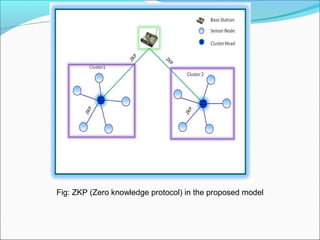
Nodes are divided into three categories; base station, cluster head
and member nodes. Some arbitrary nodes are selected as cluster
heads and generation of cluster heads is left to the clustering
mechanism (not dealt in this work).

Each cluster head knows about its member nodes, while every
member node knows its cluster head.

Base station stores information of all sensor nodes (including cluster
heads). The base station maintains complete topological information
about cluster heads and their respective members.

• Base station is powerful enough and cannot be compromised like
other nodes of the network.

• There is no communication among the member nodes.
Fig: ZKP (Zero knowledge protocol) in the proposed model
Main Modules:-

Implemented Modules
In clone attack, an adversary may capture a sensor node and copy the
cryptographic information to another node known as cloned node.

Then this cloned sensor node can be installed to capture the information
of the network.

The adversary can also inject false information, or manipulate the
information passing through cloned nodes.

Continuous physical monitoring of nodes is not possible to detect
potential tampering and cloning.

Thus reliable and fast schemes for detection are necessary to combat
these attacks.
The man-in-the-middle attack (MITM) is a form of active eavesdropping in
which the attacker makes independent connections with the victims and
relays messages between them, making them believe that they are talking
directly to each other over a private connection

The attacker will be able to intercept all messages exchanging between the
two victims and inject new ones.
Replay Attack
A replay attack is a form of network attack in which a
  valid data transmission is maliciously or fraudulently
  repeated or delayed. This is carried out either by the
  originator or by adversary who intercepts the data and
  retransmits it. This type of attack can easily overrule
  encryption
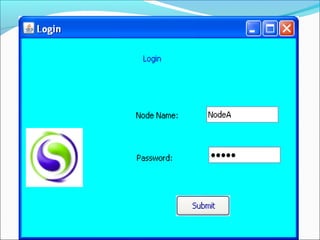
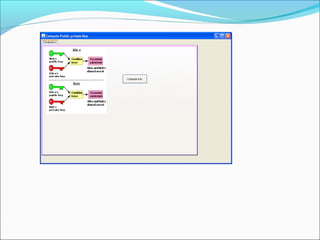
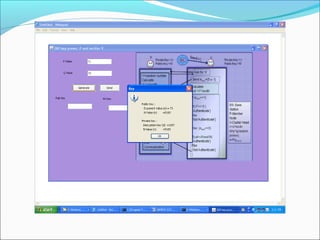
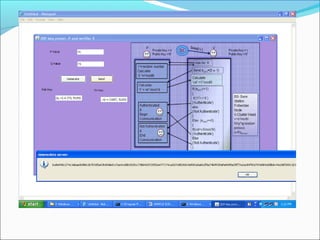
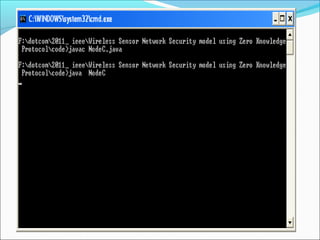
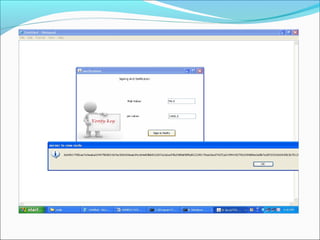
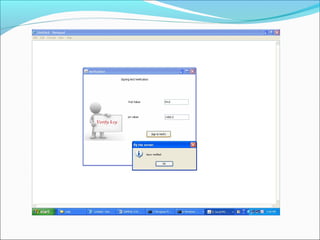
SAMPLE SCREENS

Screen shots
System Requirements:

Hardware Requirements:

System               : Pentium IV 2.4 GHz.
Hard Disk      : 40 GB.
Floppy Drive         : 1.44 Mb.
Monitor              : 15 VGA Colour.
Mouse                : Logitech.
Ram                  : 256 Mb.
Software Requirements:

Operating system :-   Windows XP Professional
JDK                   1.5/ 1.6 and above
Front End             :JAVA, Swing(JFC),
Database              :MS-Access
Tool                  :Eclipse 3.3
Conclusion
In this project, we proposed a new security model to address three
important active attacks namely cloning attack, MITM attack and Replay
attack. We used the concept of zero knowledge protocol which ensures
non-transmission of crucial information between the prover and verifier.

The proposed model uses social finger print based on s-disjunct code
together with ZKP to detect clone attacks and avoid MITM and replay
attack. We analysed various attack scenarios, cryptographic strength and
performance of the proposed model.
BIBLIOGRAPHY
 Kai Xing Fang, Liu Xiuzhen, Cheng David, H. C. Du, Real- Time
  Detection of Clone Attacks in Wireless Sensor Networks, Proceedings
  of the 28th International Conference on Distributed Computing
  Systems, 2008, Pages 3-10.

 Nikos Komninos, Dimitris Vergados, Christos Douligeris, Detecting
  Unauthorized and Compromised Nodes in Mobile Adhoc Networks
  Journal of Ad Hoc Networks, Volume 5, Issue 3, April 2007, Pages:
  289-298 .

 Klempous Ryszard, Nikodem Jan, Radosz Lukasz, Raus Norbert,
  Adaptive Misbehavior Detection in Wireless Sensors Network Based
  on Local Community Agreement, 14th Annual IEEE International
  Conference and Workshops on the Engineering of Computer- Based
  systems, ECBS’2007, 2007, Page(s):153-160.
Sites Referred:
http://java.sun.com
http://www.sourcefordgde.com
http://www.networkcomputing.com/
http://www.roseindia.com/
http://www.java2s.com
Thanking you.

Wireless sensor Network using Zero Knowledge Protocol ppt

  • 1.
    Wireless sensor Networkusing Zero Knowledge Protocol Under The Guidance of K.DURGA PRASAD ASSISTANT PROFESSOR IT DEPARTMENT By G.Arun Kumar 10211D2502
  • 2.
    Index Abstract. Introduction to domain. ExistingSystem. Drawbacks. Proposed System. UML Diagrams. Screen Shots References.
  • 3.
    Abstract Wireless Sensor Networks(WSNs) offer an excellent opportunity to monitor environments, and have a lot of interesting applications, some of which are quite sensitive in nature and require full proof secured environment. In this paper, we address some of the special security threats and attacks in WSNs. We propose a scheme for detection of distributed sensor cloning attack and use of zero knowledge protocol (ZKP) for verifying the authenticity of the sender sensor nodes. The cloning attack is addressed by attaching a unique fingerprint to each node that depends on the set of neighboring nodes and itself. The paper presents a detailed analysis for various scenarios and also analyzes the performance and cryptographic strength.
  • 4.
    Advances in technologyhave made it possible to develop sensor nodes which are compact and inexpensive. They are mounted with a variety of sensors and are wireless enabled. Once sensor nodes have been deployed, there will be minimal manual intervention and monitoring. But, when nodes are deployed in a hostile environment and there is no manual monitoring, it creates a security concern. Nodes may be subjected to various physical attacks. The network must be able to autonomously detect, tolerate, and/or avoid these attacks. One important physical attack is the introduction of cloned nodes into the network.
  • 5.
    When commodity hardwareand operating systems are used, it is easy for an adversary to capture legitimate nodes, make clones by copying the cryptographic information, and deploying these clones back into the network. These clones may even be selectively reprogrammed to subvert the network. Individual sensor node contains a light weight processor, cheap hardware components, less memory. Because of these constraints, general-purpose security protocols are hardly appropriate. Public key cryptography is based on RSA approach. The energy consumption and computational latency makes RSA inappropriate for sensor network applications. The goal of this paper is to develop a security model for wireless sensor networks. We propose a method for identifying the compromised/cloned nodes and also verifying the authenticity of sender sensor nodes in wireless sensor network with the help of zero knowledge protocol.


  • 6.
    Existing System Existing Wirelesssensor networks once sensor nodes have been deployed, there will be minimal manual intervention and monitoring. But, when nodes are deployed in a hostile environment and there is no manual monitoring.
  • 7.
    Proposed System Nodes aredivided into three categories; base station, cluster head and member nodes. Some arbitrary nodes are selected as cluster heads and generation of cluster heads is left to the clustering mechanism (not dealt in this work). Each cluster head knows about its member nodes, while every member node knows its cluster head. Base station stores information of all sensor nodes (including cluster heads). The base station maintains complete topological information about cluster heads and their respective members. • Base station is powerful enough and cannot be compromised like other nodes of the network. • There is no communication among the member nodes.
  • 8.
    Fig: ZKP (Zeroknowledge protocol) in the proposed model
  • 9.
  • 10.
    In clone attack,an adversary may capture a sensor node and copy the cryptographic information to another node known as cloned node. Then this cloned sensor node can be installed to capture the information of the network. The adversary can also inject false information, or manipulate the information passing through cloned nodes. Continuous physical monitoring of nodes is not possible to detect potential tampering and cloning. Thus reliable and fast schemes for detection are necessary to combat these attacks.
  • 11.
    The man-in-the-middle attack(MITM) is a form of active eavesdropping in which the attacker makes independent connections with the victims and relays messages between them, making them believe that they are talking directly to each other over a private connection The attacker will be able to intercept all messages exchanging between the two victims and inject new ones.
  • 12.
    Replay Attack A replayattack is a form of network attack in which a valid data transmission is maliciously or fraudulently repeated or delayed. This is carried out either by the originator or by adversary who intercepts the data and retransmits it. This type of attack can easily overrule encryption
  • 13.
  • 33.
    System Requirements: Hardware Requirements:  System : Pentium IV 2.4 GHz. Hard Disk : 40 GB. Floppy Drive : 1.44 Mb. Monitor : 15 VGA Colour. Mouse : Logitech. Ram : 256 Mb.
  • 34.
    Software Requirements: Operating system:- Windows XP Professional JDK 1.5/ 1.6 and above Front End :JAVA, Swing(JFC), Database :MS-Access Tool :Eclipse 3.3
  • 35.
    Conclusion In this project,we proposed a new security model to address three important active attacks namely cloning attack, MITM attack and Replay attack. We used the concept of zero knowledge protocol which ensures non-transmission of crucial information between the prover and verifier. The proposed model uses social finger print based on s-disjunct code together with ZKP to detect clone attacks and avoid MITM and replay attack. We analysed various attack scenarios, cryptographic strength and performance of the proposed model.
  • 36.
    BIBLIOGRAPHY  Kai XingFang, Liu Xiuzhen, Cheng David, H. C. Du, Real- Time Detection of Clone Attacks in Wireless Sensor Networks, Proceedings of the 28th International Conference on Distributed Computing Systems, 2008, Pages 3-10.  Nikos Komninos, Dimitris Vergados, Christos Douligeris, Detecting Unauthorized and Compromised Nodes in Mobile Adhoc Networks Journal of Ad Hoc Networks, Volume 5, Issue 3, April 2007, Pages: 289-298 .  Klempous Ryszard, Nikodem Jan, Radosz Lukasz, Raus Norbert, Adaptive Misbehavior Detection in Wireless Sensors Network Based on Local Community Agreement, 14th Annual IEEE International Conference and Workshops on the Engineering of Computer- Based systems, ECBS’2007, 2007, Page(s):153-160.
  • 37.
  • 38.