Ganesh Mali
03/19/15 1
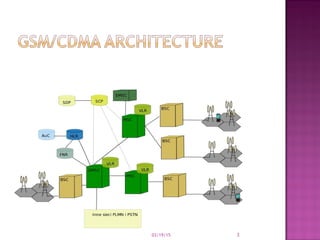
 GSM,CDMA are major implementation worldwide of cellular
networks and there are some customized versions
implementations of these used in China & Japan mainly.
 2G technologies were majorly focused circuit switched
voice, SMS & low speed data.
 It used in core SS7 (Signaling System 7 ) and in access
GSM /CDMA radio access.
 GSM is widely implemented compared to CDMA worldwide,
there are many reasons for it.
 Some are : CDMA Proprietary technology by Qualcomm, was
not user friendly in initial phase.
 India has both the cellular technologies offered by
communication providers.
 Frequency band used : 800,900,1800,1900 Mhz
03/19/15 2
03/19/15 3
 GSM was enhanced for somewhat higher speed of
data communications with introduction of packet
switched data technology in GSM network
architecture.
 Technologically changes were on core network to
integrate IP networks into GSM network.
 Many people call it as 2.5G/2.75G which were
giving download speed up to 256 to 386 Kbps.
 Technologies used were GPRS & EDGE in GSM &
in CDMA 1X CDMA
 These use the same GSM/CDMA frequency band in
optimized way for data.
 Protocol used : GTP, TCP/IP & RADIUS
03/19/15 4
03/19/15 5
 IMT 2000 are recommendations by ITU-T for defining 3G :
“It is expected that IMT-2000 will provide higher
transmission rates: a minimum data rate of 2 Mbit/s for
stationary or walking users, and 384 kbit/s in a moving
vehicle.”
 3GPP : Release 99 first defined UMTS as 3G technology
evolving from GSM.
UMTS versions: HSDPA,HSUPA,HSPA,HSPA+
 3GPP2 : Defined nearly same time 1x EV-DO & CDMA 2000
Versions CDMA : EVDO Rev 0 ,EVDV,EVDO Rev B
 Frequency Band : 2100 (IMT) and 2G ones are reused in
some countries
 Protocols used : TCP/IP, RADIUS/Diameter, SS7.
03/19/15 6
03/19/15 7
Features:
LTE is defined in 3GPP release 8 and LTE advanced is
defined in release 10
Expected speeds with LTE are Peak download rates up
to 299.6 Mbit/s and upload rates up to 75.4 Mbit/s
VoLTE (Voice Over LTE)
Simpler architecture
Low latency
High speed with good quality of experience
Protocols used will be TCP/IP ,SIP, RTP, Diameter etc.
03/19/15 8
 It uses protocols : SIP, RTP, Diameter
extensively based on TCP/IP model.
 It is not backward compatible with
predecessor 3G HSPA technologies.
 LTE is the natural upgrade path for carriers
with both GSM/UMTS networks and
CDMA2000 networks.
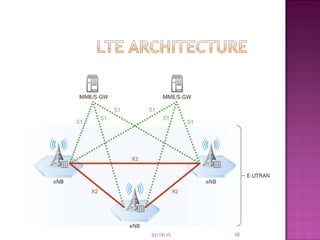
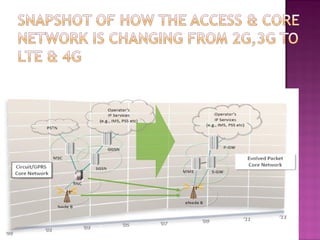
 In core it will use EPC(Evolved Packet core)
part of NGN. Detailed in later slides.
03/19/15 9
03/19/15 10
• A high degree of commonality of functionality worldwide
while retaining the flexibility to support a wide range of
services and applications in a cost-efficient manner
• Compatibility of services within IMT and with fixed
networks
• Capability of interworking with other radio access systems
• High-quality mobile services
• User equipment suitable for worldwide use
• User-friendly applications, services and equipment
• Worldwide roaming capability
• Enhanced peak data rates to support advanced services
and applications (100 Mbps for high and 1 Gbps for low
mobility were established as targets for research)
03/19/15 11
September 2009, the technology proposals were
submitted by 3GPP and others to the
International Telecommunication Union (ITU) as
4G candidates. Following two technologies were
emerged as contenders
 LTE Advanced standardized by the 3GPP
 802.16m standardized by the IEEE (i.e. WiMAX)
03/19/15 12
 Not 100 % but YES it meets major requirements of IMT
advanced.
 ITU has officially accepted LTE advanced as 4G
technology recently. However whole ecosystem will
evolve over the period in coming releases from 3GPP.
 There are two versions of LTE advanced defined by
3GPP :
 TDD-LTE Advanced
 FDD-LTE Advanced
 After lot of competition & discussions on various
forums , it looks like TDD-LTE has own the game and
its accepted by many Big telecom player as 4G
technology choice.
 E.g.: Sprint ,T-Mobile, AT &T, Vodafone etc.
03/19/15 13
03/19/15 14
 Telecommunications /Network Domain:
 Core networks(SS7, TCP/IP,MPLS etc.) planning,
installation, testing, assurance.
 Skills : CCNA/CCNP certification, network knowledge.
 Access Network( Radio network,WLL, Ethernet,
DSL, ATM, FTTx) planning, installation, testing,
assurance.
 Skills : Access network knowledge.
 Data Centre profiles :DB installation and
maintenance, OS installation and maintenance.
 Skills : DB and OS certifications.
 Legal, business analyst for CPs, OEMs.
03/19/15 15
 OSS(Operations Software
Systems)/BSS(Business Support Systems)
 Business Analyst/presales/Solution designer
 Skills : Good domain knowledge, Communication
Skills, SDLC knowledge.
 Developer/Software consultant:
 Skills : Good knowledge of software languages.
 Testing professional:
 Skills : Software testing knowledge, good
understanding of software language.
 Live Application Support
 Skills: Functional knowledge of domain.
03/19/15 16
 Communications Provider/Telecom Service provider:
 Vodafone, Airtel, Idea, Reliance, BSNL,British Telecom, AT
&T, Verizon, Sprint, China Mobile, so on.
 Original Equipment Manufactures/Vendors
 Huawei, Alcatel Lucent, ZTE, CISCO, Ciena, HP, Ericsson
 Network provider:
 Alcatel Lucent, NSN, British Telecom etc.
 OTT(Over The Top)/Content Provider:
 Mobile Apps providers, Facebook, Whatsapp, Google.
 OSS/BSS consultant/provider:
 Amdocs, Clarity, Tekelec, CSG International etc.
 OSS/BSS managed services
 Accenture, Infosys, TechM, Wipro, HCL
03/19/15 17
 SDN (Software Defined Networks)
 Software-defined networking (SDN) is an approach to
computer networking that allows network
administrators to manage network services through
abstraction of lower-level functionality. This is done
by decoupling the system that makes decisions about
where traffic is sent (the control plane) from the
underlying systems that forward traffic to the
selected destination (the data plane).
 IOT(Internet Of Things)
 Is the network of physical objects or "things"
embedded with electronics, software, sensors and
connectivity to enable it to achieve greater value and
service by exchanging data with the manufacturer,
operator and/or other connected devices
03/19/15 18
 Cloud Computing :
 Cloud computing involves deploying groups of remote
servers and software networks that allow centralized
data storage and online access to computer services or
resources
 NFV network function virtualization :
 is a network architecture concept that proposes using IT
virtualization related technologies to virtualize entire
classes of network node functions into building blocks
that may be connected, or chained, to create
communication services.
 Big Data:
 Big data is a broad term for data sets so large or
complex that traditional data processing applications
are inadequate.
 Challenges include analysis, capture, search, sharing,
storage, transfer, visualization, and information privacy.
The term often refers simply to the use of predictive
analytics or other certain advanced methods to extract
value from data, and seldom to a particular size of data
set.
03/19/15 19
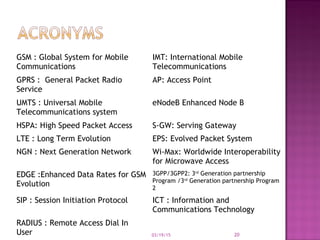
GSM : Global System for Mobile
Communications
IMT: International Mobile
Telecommunications
GPRS : General Packet Radio
Service
AP: Access Point
UMTS : Universal Mobile
Telecommunications system
eNodeB Enhanced Node B
HSPA: High Speed Packet Access S-GW: Serving Gateway
LTE : Long Term Evolution EPS: Evolved Packet System
NGN : Next Generation Network Wi-Max: Worldwide Interoperability
for Microwave Access
EDGE :Enhanced Data Rates for GSM
Evolution
3GPP/3GPP2: 3rd
Generation partnership
Program /3rd
Generation partnership Program
2
SIP : Session Initiation Protocol ICT : Information and
Communications Technology
RADIUS : Remote Access Dial In
User 03/19/15 20
Any Q ?
03/19/15 21

Wireless cellular technologies draft0.3

  • 1.
  • 2.
     GSM,CDMA aremajor implementation worldwide of cellular networks and there are some customized versions implementations of these used in China & Japan mainly.  2G technologies were majorly focused circuit switched voice, SMS & low speed data.  It used in core SS7 (Signaling System 7 ) and in access GSM /CDMA radio access.  GSM is widely implemented compared to CDMA worldwide, there are many reasons for it.  Some are : CDMA Proprietary technology by Qualcomm, was not user friendly in initial phase.  India has both the cellular technologies offered by communication providers.  Frequency band used : 800,900,1800,1900 Mhz 03/19/15 2
  • 3.
  • 4.
     GSM wasenhanced for somewhat higher speed of data communications with introduction of packet switched data technology in GSM network architecture.  Technologically changes were on core network to integrate IP networks into GSM network.  Many people call it as 2.5G/2.75G which were giving download speed up to 256 to 386 Kbps.  Technologies used were GPRS & EDGE in GSM & in CDMA 1X CDMA  These use the same GSM/CDMA frequency band in optimized way for data.  Protocol used : GTP, TCP/IP & RADIUS 03/19/15 4
  • 5.
  • 6.
     IMT 2000are recommendations by ITU-T for defining 3G : “It is expected that IMT-2000 will provide higher transmission rates: a minimum data rate of 2 Mbit/s for stationary or walking users, and 384 kbit/s in a moving vehicle.”  3GPP : Release 99 first defined UMTS as 3G technology evolving from GSM. UMTS versions: HSDPA,HSUPA,HSPA,HSPA+  3GPP2 : Defined nearly same time 1x EV-DO & CDMA 2000 Versions CDMA : EVDO Rev 0 ,EVDV,EVDO Rev B  Frequency Band : 2100 (IMT) and 2G ones are reused in some countries  Protocols used : TCP/IP, RADIUS/Diameter, SS7. 03/19/15 6
  • 7.
  • 8.
    Features: LTE is definedin 3GPP release 8 and LTE advanced is defined in release 10 Expected speeds with LTE are Peak download rates up to 299.6 Mbit/s and upload rates up to 75.4 Mbit/s VoLTE (Voice Over LTE) Simpler architecture Low latency High speed with good quality of experience Protocols used will be TCP/IP ,SIP, RTP, Diameter etc. 03/19/15 8
  • 9.
     It usesprotocols : SIP, RTP, Diameter extensively based on TCP/IP model.  It is not backward compatible with predecessor 3G HSPA technologies.  LTE is the natural upgrade path for carriers with both GSM/UMTS networks and CDMA2000 networks.  In core it will use EPC(Evolved Packet core) part of NGN. Detailed in later slides. 03/19/15 9
  • 10.
  • 11.
    • A highdegree of commonality of functionality worldwide while retaining the flexibility to support a wide range of services and applications in a cost-efficient manner • Compatibility of services within IMT and with fixed networks • Capability of interworking with other radio access systems • High-quality mobile services • User equipment suitable for worldwide use • User-friendly applications, services and equipment • Worldwide roaming capability • Enhanced peak data rates to support advanced services and applications (100 Mbps for high and 1 Gbps for low mobility were established as targets for research) 03/19/15 11
  • 12.
    September 2009, thetechnology proposals were submitted by 3GPP and others to the International Telecommunication Union (ITU) as 4G candidates. Following two technologies were emerged as contenders  LTE Advanced standardized by the 3GPP  802.16m standardized by the IEEE (i.e. WiMAX) 03/19/15 12
  • 13.
     Not 100% but YES it meets major requirements of IMT advanced.  ITU has officially accepted LTE advanced as 4G technology recently. However whole ecosystem will evolve over the period in coming releases from 3GPP.  There are two versions of LTE advanced defined by 3GPP :  TDD-LTE Advanced  FDD-LTE Advanced  After lot of competition & discussions on various forums , it looks like TDD-LTE has own the game and its accepted by many Big telecom player as 4G technology choice.  E.g.: Sprint ,T-Mobile, AT &T, Vodafone etc. 03/19/15 13
  • 14.
  • 15.
     Telecommunications /NetworkDomain:  Core networks(SS7, TCP/IP,MPLS etc.) planning, installation, testing, assurance.  Skills : CCNA/CCNP certification, network knowledge.  Access Network( Radio network,WLL, Ethernet, DSL, ATM, FTTx) planning, installation, testing, assurance.  Skills : Access network knowledge.  Data Centre profiles :DB installation and maintenance, OS installation and maintenance.  Skills : DB and OS certifications.  Legal, business analyst for CPs, OEMs. 03/19/15 15
  • 16.
     OSS(Operations Software Systems)/BSS(BusinessSupport Systems)  Business Analyst/presales/Solution designer  Skills : Good domain knowledge, Communication Skills, SDLC knowledge.  Developer/Software consultant:  Skills : Good knowledge of software languages.  Testing professional:  Skills : Software testing knowledge, good understanding of software language.  Live Application Support  Skills: Functional knowledge of domain. 03/19/15 16
  • 17.
     Communications Provider/TelecomService provider:  Vodafone, Airtel, Idea, Reliance, BSNL,British Telecom, AT &T, Verizon, Sprint, China Mobile, so on.  Original Equipment Manufactures/Vendors  Huawei, Alcatel Lucent, ZTE, CISCO, Ciena, HP, Ericsson  Network provider:  Alcatel Lucent, NSN, British Telecom etc.  OTT(Over The Top)/Content Provider:  Mobile Apps providers, Facebook, Whatsapp, Google.  OSS/BSS consultant/provider:  Amdocs, Clarity, Tekelec, CSG International etc.  OSS/BSS managed services  Accenture, Infosys, TechM, Wipro, HCL 03/19/15 17
  • 18.
     SDN (SoftwareDefined Networks)  Software-defined networking (SDN) is an approach to computer networking that allows network administrators to manage network services through abstraction of lower-level functionality. This is done by decoupling the system that makes decisions about where traffic is sent (the control plane) from the underlying systems that forward traffic to the selected destination (the data plane).  IOT(Internet Of Things)  Is the network of physical objects or "things" embedded with electronics, software, sensors and connectivity to enable it to achieve greater value and service by exchanging data with the manufacturer, operator and/or other connected devices 03/19/15 18
  • 19.
     Cloud Computing:  Cloud computing involves deploying groups of remote servers and software networks that allow centralized data storage and online access to computer services or resources  NFV network function virtualization :  is a network architecture concept that proposes using IT virtualization related technologies to virtualize entire classes of network node functions into building blocks that may be connected, or chained, to create communication services.  Big Data:  Big data is a broad term for data sets so large or complex that traditional data processing applications are inadequate.  Challenges include analysis, capture, search, sharing, storage, transfer, visualization, and information privacy. The term often refers simply to the use of predictive analytics or other certain advanced methods to extract value from data, and seldom to a particular size of data set. 03/19/15 19
  • 20.
    GSM : GlobalSystem for Mobile Communications IMT: International Mobile Telecommunications GPRS : General Packet Radio Service AP: Access Point UMTS : Universal Mobile Telecommunications system eNodeB Enhanced Node B HSPA: High Speed Packet Access S-GW: Serving Gateway LTE : Long Term Evolution EPS: Evolved Packet System NGN : Next Generation Network Wi-Max: Worldwide Interoperability for Microwave Access EDGE :Enhanced Data Rates for GSM Evolution 3GPP/3GPP2: 3rd Generation partnership Program /3rd Generation partnership Program 2 SIP : Session Initiation Protocol ICT : Information and Communications Technology RADIUS : Remote Access Dial In User 03/19/15 20
  • 21.

Editor's Notes

  • #13 Why is 4G so fast? 4G's impressive speed increase is achieved with the use of OFDM (Orthogonal Frequency Division Multiplexing), a transmission technology used by the likes of ADSL, Wi-Fi, DVB-T, DVB-H and DAB. Not only does it reduce latency, but it also minimizes interference and is able to cram greater amounts of data into the same slice of radio bandwidth. Simply put, this enables 4G/LTE phones and tablets to stream video and play online games like never before, largely because 4G has been designed primarily as a data network, rather than a voice one, and it uses the same TCP/IP protocols that underpin the internet. It's possible that further increases in speed could be achieved with MIMO (Multiple Input Multiple Output) technology, which uses multiple antennas on transmitters and receivers like 802.11n Wi-Fi equipment. Nokia has reportedly achieved 173Mbps from LTE with a 2x2 MIMO configuration (two antennas on both the transmitter and receiver), so a 4x4 arrangement could potentially offer as much as 326.4Mbps. Perhaps we'll see this on the iPhone 10.