Global 
System 
For 
Mobile 
Communication 
1
Discussion Points 
2 
• What is GSM? 
• Evolution of GSM 
• Worldwide Deployment of GSM 
• GSM vs. CDMA 
• Generations of GSM 
• GSM architecture 
• Services of GSM 
• Characteristics and features 
• Advantages of GSM 
• Disadvantages of GSM 
• Applications of GSM 
• Conclusion 
• References 
Prepared by :Avani Trambadiya
3 
What is GSM? 
• The Global System for Mobile communications is a 
digital cellular communications system. It was developed 
in order to create a common European mobile telephone 
standard but it has been rapidly accepted worldwide. 
– Formerly it was “Groupe Spéciale Mobile” (founded 
in 1982) 
– now: Global System for Mobile Communication. 
Prepared by :Avani Trambadiya
Evolution of GSM 
• 1982: Conference of European Post and 
Telecommunications (CEPT) formed Group Speciale 
Mobile called GSM. 
4 
Prepared by :Avani Trambadiya
Worldwide Deployment 
5 
• 930 networks in 222 countries and regions. 
• More than 3 billion subscribers worldwide. 
• More than 80% worldwide market share. 
Prepared by :Avani Trambadiya
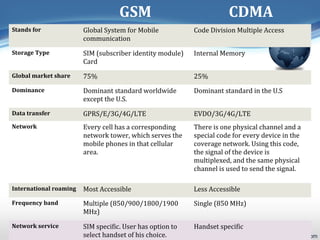
GSM CDMA 
6 
Stands for Global System for Mobile 
communication 
Code Division Multiple Access 
Storage Type SIM (subscriber identity module) 
Card 
Internal Memory 
Global market share 75% 25% 
Dominance Dominant standard worldwide 
except the U.S. 
Dominant standard in the U.S 
Data transfer GPRS/E/3G/4G/LTE EVDO/3G/4G/LTE 
Network Every cell has a corresponding 
network tower, which serves the 
mobile phones in that cellular 
area. 
There is one physical channel and a 
special code for every device in the 
coverage network. Using this code, 
the signal of the device is 
multiplexed, and the same physical 
channel is used to send the signal. 
International roaming Most Accessible Less Accessible 
Frequency band Multiple (850/900/1800/1900 
MHz) 
Single (850 MHz) 
Network service SIM specific. User has option to 
select handset of his choice. 
Handset specific
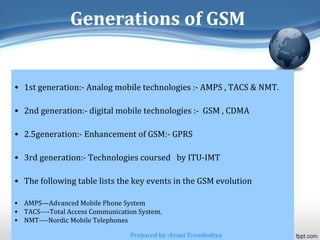
Generations of GSM 
• 1st generation:- Analog mobile technologies :- AMPS , TACS & NMT. 
• 2nd generation:- digital mobile technologies :- GSM , CDMA 
7 
• 2.5generation:- Enhancement of GSM:- GPRS 
• 3rd generation:- Technologies coursed by ITU-IMT 
• The following table lists the key events in the GSM evolution 
• AMPS—Advanced Mobile Phone System 
• TACS----Total Access Communication System. 
• NMT----Nordic Mobile Telephones 
Prepared by :Avani Trambadiya
GSM Architecture 
8 
• Mobile Station (MS) 
Mobile Equipment (ME) 
Subscriber Identity Module (SIM) 
• Base Station Subsystem (BSS) 
Base Transceiver Station (BTS) 
Base Station Controller (BSC) 
• Network Switching Subsystem (NSS) 
Mobile Switching Center (MSC) 
Home Location Register (HLR) 
Visitor Location Register (VLR) 
Authentication Center (AUC) 
Equipment Identity Register (EIR) 
Prepared by :Avani Trambadiya
Mobile Station (MS) 
The Mobile Station is made up of two entities: 
9 
1. Mobile Equipment (ME) 
2. Subscriber Identity Module (SIM) 
Prepared by :Avani Trambadiya
Mobile Station (MS) 
10 
Mobile Equipment 
• Portable hand held device 
• Uniquely identified by an IMEI Voice 
and data transmission 
• Monitoring power and signal quality of 
surrounding cells for optimum 
handover. 
Subscriber Identity Module (SIM) 
• Smart card contains IMSI 
• Allows user to send and receive calls. 
• Encoded network identification details 
- Key Ki,Kc and A3,A5 and A8 
algorithms 
• Protected by a password or PIN 
• Can be moved from phone to phone 
Prepared by :Avani Trambadiya
Base Station Controller (BSC) 
11 
Base Transceiver Station (BTS): 
• Encodes,encrypts,multiplexes,modulat 
es and feeds the RF signals to the 
antenna. 
• Frequency hopping 
• Communicates with MS and BSC 
• Consists of Transceivers (TRX) units 
Base Station Controller (BSC) 
• Manages Radio resources for BTS 
• Assigns Frequency and time slots for 
all MS’s in its area 
• Handles call set up 
• Transco ding and rate adaptation 
functionality 
• Handover for each MS 
• Radio Power control 
• It communicates with MSC and BTS Prepared by :Avani Trambadiya
Network Switching Subsystem (NSS) 
12 
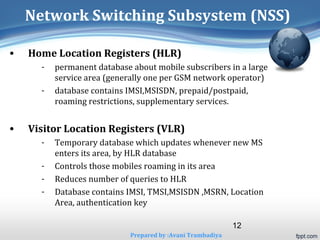
• Home Location Registers (HLR) 
- permanent database about mobile subscribers in a large 
service area (generally one per GSM network operator) 
- database contains IMSI,MSISDN, prepaid/postpaid, 
roaming restrictions, supplementary services. 
• Visitor Location Registers (VLR) 
- Temporary database which updates whenever new MS 
enters its area, by HLR database 
- Controls those mobiles roaming in its area 
- Reduces number of queries to HLR 
- Database contains IMSI, TMSI,MSISDN ,MSRN, Location 
Area, authentication key 
Prepared by :Avani Trambadiya
Network Switching Subsystem (NSS) 
13 
• Authentication Center (AUC) 
- Protects against intruders in air interface 
- Maintains authentication keys and algorithms and 
provides security triplets ( RAND, SRES, Kc) 
- Generally associated with HLR 
• Equipment Identity Register (EIR) 
- Database that is used to track handsets using the IMEI 
(International Mobile Equipment Identity) 
- Made up of three sub-classes: The White List, The Black 
List and the Gray List 
- Only one EIR per PLMN 
Prepared by :Avani Trambadiya
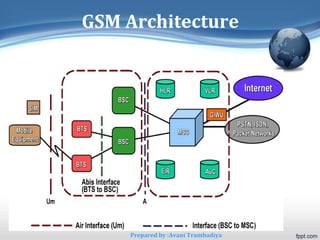
GSM Architecture 
14 
Prepared by :Avani Trambadiya
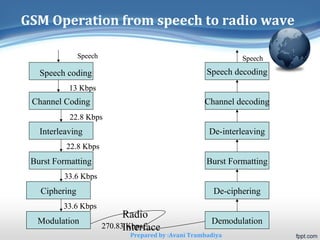
GSM Operation from speech to radio wave 
Speech Speech 
Speech Channel 15 
De-Burst De-Speech coding 
13 Kbps 
Channel Coding 
22.8 Kbps 
Interleaving 
22.8 Kbps 
Burst Formatting 
33.6 Kbps 
Ciphering 
Radio 
Interface 
33.6 Kbps 
Modulation Demodulation 
270.83 Kbps 
Speech decoding 
Channel decoding 
De-interleaving 
Burst Formatting 
De-ciphering 
Demodulation 
Prepared by :Avani Trambadiya
16 
GSM Services 
• Tele-services 
• Bearer or Data Services 
• Supplementary services 
Prepared by :Avani Trambadiya
17 
Tele-services 
• Telecommunication services that enable voice 
communication via mobile phones. 
• Offered services 
- Mobile telephony 
- Emergency calling 
Prepared by :Avani Trambadiya
18 
Bearer Services 
• Include various data services for information transfer 
between GSM and other networks like PSTN, ISDN etc at 
rates from 300 to 9600 bps 
• Short Message Service (SMS) 
– up to 160 character alphanumeric data transmission 
to/from the mobile terminal 
• Unified Messaging Services(UMS) 
• Group 3 fax 
• Voice mailbox 
• Electronic mail 
Prepared by :Avani Trambadiya
Supplementary Services 
19 
Call related services : 
• Call Waiting 
- Notification of an incoming call while on the handset 
• Call Hold 
- Put a caller on hold to take another call 
• Call Barring 
- All calls, outgoing calls, or incoming calls 
• Call Forwarding 
- Calls can be sent to various numbers defined by the user 
• Multi Party Call Conferencing 
- Link multiple calls together 
Prepared by :Avani Trambadiya
Characteristics of GSM 
20 
• Fully digital system. 
• Security against fraud 
• Enhance privacy 
• Full international roaming capability. 
• Support for new services. 
• Compatibility with ISDN. 
• Support of Short Message Service (SMS). 
• Good subjective voice quality. 
Prepared by :Avani Trambadiya
Advantages of GSM 
21 
• Better Quality of speech 
• Data transmission is 
supported 
• New services offered due 
to ISDN compatibility 
• International Roaming 
possible 
• Large market 
• Crisper, cleaner quieter 
calls 
Prepared by :Avani Trambadiya
Disadvantages of GSM 
22 
• Dropped and missed calls 
• Less Efficiency 
• Security Issues 
Prepared by :Avani Trambadiya
Applications of GSM 
23 
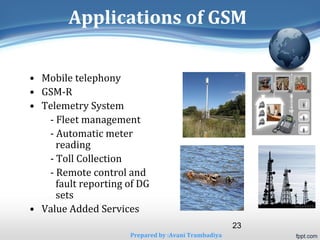
• Mobile telephony 
• GSM-R 
• Telemetry System 
- Fleet management 
- Automatic meter 
reading 
- Toll Collection 
- Remote control and 
fault reporting of DG 
sets 
• Value Added Services 
Prepared by :Avani Trambadiya
24 
Conclusion 
• The mobile telephony industry rapidly growing and 
that has become backbone for business success and 
efficiency and a part of modern lifestyles all over the 
world. 
• In this session I have tried to give and over view of the 
GSM system. I hope that I gave the general flavor of 
GSM and the philosophy behind its design. 
• The GSM is standard that insures interoperability 
without stifling competition and innovation among the 
suppliers to the benefit of the public both in terms of 
cost and service quality. 
Prepared by :Avani Trambadiya
25 
References 
• www.slideshare.com 
• www.wikipidia.com 
• www.seminarsonly.com 
• www.gsmarena.com 
• www.gsm-architecture.blogspot.com 
Prepared by :Avani Trambadiya
26

GSM Technology

  • 1.
    Global System For Mobile Communication 1
  • 2.
    Discussion Points 2 • What is GSM? • Evolution of GSM • Worldwide Deployment of GSM • GSM vs. CDMA • Generations of GSM • GSM architecture • Services of GSM • Characteristics and features • Advantages of GSM • Disadvantages of GSM • Applications of GSM • Conclusion • References Prepared by :Avani Trambadiya
  • 3.
    3 What isGSM? • The Global System for Mobile communications is a digital cellular communications system. It was developed in order to create a common European mobile telephone standard but it has been rapidly accepted worldwide. – Formerly it was “Groupe Spéciale Mobile” (founded in 1982) – now: Global System for Mobile Communication. Prepared by :Avani Trambadiya
  • 4.
    Evolution of GSM • 1982: Conference of European Post and Telecommunications (CEPT) formed Group Speciale Mobile called GSM. 4 Prepared by :Avani Trambadiya
  • 5.
    Worldwide Deployment 5 • 930 networks in 222 countries and regions. • More than 3 billion subscribers worldwide. • More than 80% worldwide market share. Prepared by :Avani Trambadiya
  • 6.
    GSM CDMA 6 Stands for Global System for Mobile communication Code Division Multiple Access Storage Type SIM (subscriber identity module) Card Internal Memory Global market share 75% 25% Dominance Dominant standard worldwide except the U.S. Dominant standard in the U.S Data transfer GPRS/E/3G/4G/LTE EVDO/3G/4G/LTE Network Every cell has a corresponding network tower, which serves the mobile phones in that cellular area. There is one physical channel and a special code for every device in the coverage network. Using this code, the signal of the device is multiplexed, and the same physical channel is used to send the signal. International roaming Most Accessible Less Accessible Frequency band Multiple (850/900/1800/1900 MHz) Single (850 MHz) Network service SIM specific. User has option to select handset of his choice. Handset specific
  • 7.
    Generations of GSM • 1st generation:- Analog mobile technologies :- AMPS , TACS & NMT. • 2nd generation:- digital mobile technologies :- GSM , CDMA 7 • 2.5generation:- Enhancement of GSM:- GPRS • 3rd generation:- Technologies coursed by ITU-IMT • The following table lists the key events in the GSM evolution • AMPS—Advanced Mobile Phone System • TACS----Total Access Communication System. • NMT----Nordic Mobile Telephones Prepared by :Avani Trambadiya
  • 8.
    GSM Architecture 8 • Mobile Station (MS) Mobile Equipment (ME) Subscriber Identity Module (SIM) • Base Station Subsystem (BSS) Base Transceiver Station (BTS) Base Station Controller (BSC) • Network Switching Subsystem (NSS) Mobile Switching Center (MSC) Home Location Register (HLR) Visitor Location Register (VLR) Authentication Center (AUC) Equipment Identity Register (EIR) Prepared by :Avani Trambadiya
  • 9.
    Mobile Station (MS) The Mobile Station is made up of two entities: 9 1. Mobile Equipment (ME) 2. Subscriber Identity Module (SIM) Prepared by :Avani Trambadiya
  • 10.
    Mobile Station (MS) 10 Mobile Equipment • Portable hand held device • Uniquely identified by an IMEI Voice and data transmission • Monitoring power and signal quality of surrounding cells for optimum handover. Subscriber Identity Module (SIM) • Smart card contains IMSI • Allows user to send and receive calls. • Encoded network identification details - Key Ki,Kc and A3,A5 and A8 algorithms • Protected by a password or PIN • Can be moved from phone to phone Prepared by :Avani Trambadiya
  • 11.
    Base Station Controller(BSC) 11 Base Transceiver Station (BTS): • Encodes,encrypts,multiplexes,modulat es and feeds the RF signals to the antenna. • Frequency hopping • Communicates with MS and BSC • Consists of Transceivers (TRX) units Base Station Controller (BSC) • Manages Radio resources for BTS • Assigns Frequency and time slots for all MS’s in its area • Handles call set up • Transco ding and rate adaptation functionality • Handover for each MS • Radio Power control • It communicates with MSC and BTS Prepared by :Avani Trambadiya
  • 12.
    Network Switching Subsystem(NSS) 12 • Home Location Registers (HLR) - permanent database about mobile subscribers in a large service area (generally one per GSM network operator) - database contains IMSI,MSISDN, prepaid/postpaid, roaming restrictions, supplementary services. • Visitor Location Registers (VLR) - Temporary database which updates whenever new MS enters its area, by HLR database - Controls those mobiles roaming in its area - Reduces number of queries to HLR - Database contains IMSI, TMSI,MSISDN ,MSRN, Location Area, authentication key Prepared by :Avani Trambadiya
  • 13.
    Network Switching Subsystem(NSS) 13 • Authentication Center (AUC) - Protects against intruders in air interface - Maintains authentication keys and algorithms and provides security triplets ( RAND, SRES, Kc) - Generally associated with HLR • Equipment Identity Register (EIR) - Database that is used to track handsets using the IMEI (International Mobile Equipment Identity) - Made up of three sub-classes: The White List, The Black List and the Gray List - Only one EIR per PLMN Prepared by :Avani Trambadiya
  • 14.
    GSM Architecture 14 Prepared by :Avani Trambadiya
  • 15.
    GSM Operation fromspeech to radio wave Speech Speech Speech Channel 15 De-Burst De-Speech coding 13 Kbps Channel Coding 22.8 Kbps Interleaving 22.8 Kbps Burst Formatting 33.6 Kbps Ciphering Radio Interface 33.6 Kbps Modulation Demodulation 270.83 Kbps Speech decoding Channel decoding De-interleaving Burst Formatting De-ciphering Demodulation Prepared by :Avani Trambadiya
  • 16.
    16 GSM Services • Tele-services • Bearer or Data Services • Supplementary services Prepared by :Avani Trambadiya
  • 17.
    17 Tele-services •Telecommunication services that enable voice communication via mobile phones. • Offered services - Mobile telephony - Emergency calling Prepared by :Avani Trambadiya
  • 18.
    18 Bearer Services • Include various data services for information transfer between GSM and other networks like PSTN, ISDN etc at rates from 300 to 9600 bps • Short Message Service (SMS) – up to 160 character alphanumeric data transmission to/from the mobile terminal • Unified Messaging Services(UMS) • Group 3 fax • Voice mailbox • Electronic mail Prepared by :Avani Trambadiya
  • 19.
    Supplementary Services 19 Call related services : • Call Waiting - Notification of an incoming call while on the handset • Call Hold - Put a caller on hold to take another call • Call Barring - All calls, outgoing calls, or incoming calls • Call Forwarding - Calls can be sent to various numbers defined by the user • Multi Party Call Conferencing - Link multiple calls together Prepared by :Avani Trambadiya
  • 20.
    Characteristics of GSM 20 • Fully digital system. • Security against fraud • Enhance privacy • Full international roaming capability. • Support for new services. • Compatibility with ISDN. • Support of Short Message Service (SMS). • Good subjective voice quality. Prepared by :Avani Trambadiya
  • 21.
    Advantages of GSM 21 • Better Quality of speech • Data transmission is supported • New services offered due to ISDN compatibility • International Roaming possible • Large market • Crisper, cleaner quieter calls Prepared by :Avani Trambadiya
  • 22.
    Disadvantages of GSM 22 • Dropped and missed calls • Less Efficiency • Security Issues Prepared by :Avani Trambadiya
  • 23.
    Applications of GSM 23 • Mobile telephony • GSM-R • Telemetry System - Fleet management - Automatic meter reading - Toll Collection - Remote control and fault reporting of DG sets • Value Added Services Prepared by :Avani Trambadiya
  • 24.
    24 Conclusion •The mobile telephony industry rapidly growing and that has become backbone for business success and efficiency and a part of modern lifestyles all over the world. • In this session I have tried to give and over view of the GSM system. I hope that I gave the general flavor of GSM and the philosophy behind its design. • The GSM is standard that insures interoperability without stifling competition and innovation among the suppliers to the benefit of the public both in terms of cost and service quality. Prepared by :Avani Trambadiya
  • 25.
    25 References •www.slideshare.com • www.wikipidia.com • www.seminarsonly.com • www.gsmarena.com • www.gsm-architecture.blogspot.com Prepared by :Avani Trambadiya
  • 26.