5G Cloud RAN & IoT Architecture
Contents
1. 5G Talk
2. 5G Time Frame
3. 3Gpp -5g initiative –SMARTER
4. 5G Milestones
5. Stages for 5G Milestones
6. New C-RAN/Fronthaul of 5G
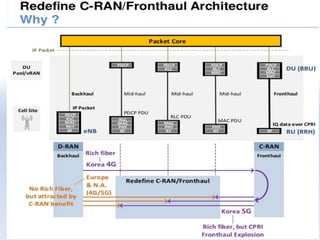
1. Why Redifne C-RAN/Fronthaul Architecture
2. Telecom Operator and Vendors view on 5G RAN A
rchitecture
8. IOT Getting Hot
1. Welcome, IOTs! Why Now?
2. Launch-Manage-Monetize
3. Challenges
4. IPR & Standardization
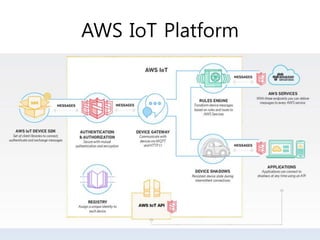
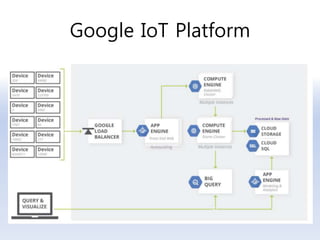
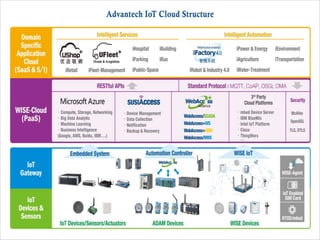
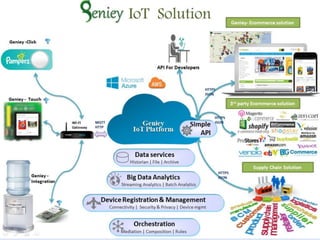
5. IoT Architecture
6. No. 1 Challenge.
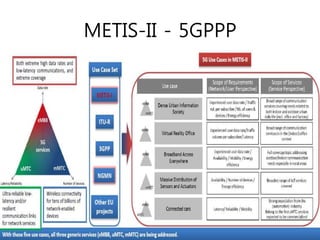
METIS-II - 5GPPP
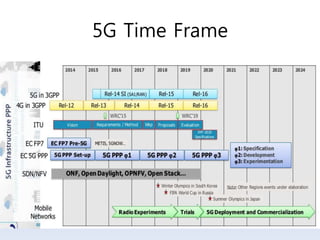
5G Time Frame
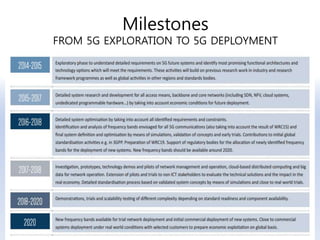
Milestones
FROM 5G EXPLORATION TO 5G DEPLOYMENT
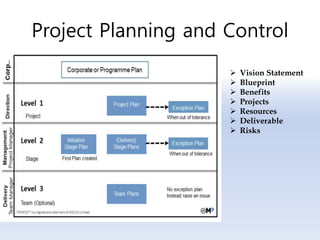
Project Planning and Control
 Vision Statement
 Blueprint
 Benefits
 Projects
 Resources
 Deliverable
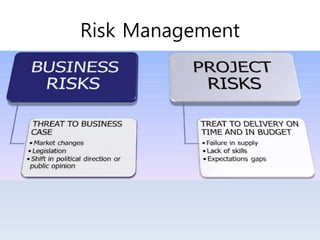
 Risks
New Cloud-RAN/Fronthaul of 5G
5G Requirement
• Ultra-high radio speed (20Gbps/UE) - New RAT, mm
Wave, massive MIMO, massive Aggregation
• Ultra-low latency (E2E few msec) - Tectile Internet, a
utonomous driving, remote controlled machine
• Massive connectivity (hundreds of millions of IoT dev
ices)
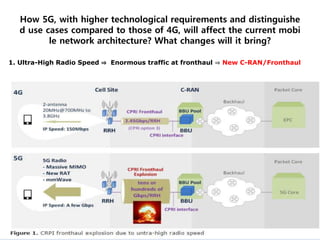
How 5G, with higher technological requirements and distinguishe
d use cases compared to those of 4G, will affect the current mobi
le network architecture? What changes will it bring?
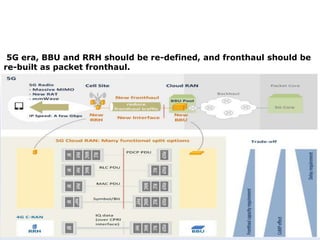
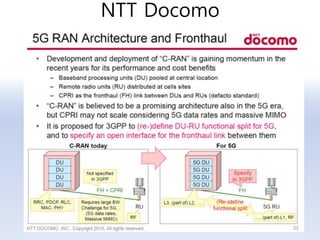
1. Ultra-High Radio Speed ⇒ Enormous traffic at fronthaul ⇒ New C-RAN/Fronthaul
5G era, BBU and RRH should be re-defined, and fronthaul should be
re-built as packet fronthaul.
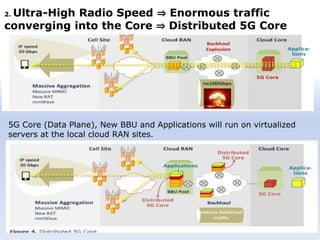
2. Ultra-High Radio Speed ⇒ Enormous traffic
converging into the Core ⇒ Distributed 5G Core
5G Core (Data Plane), New BBU and Applications will run on virtualized
servers at the local cloud RAN sites.
• Many agree that massive IoT and mission-critical IoT are t
he biggest difference between 4G and 5G.
• Mission-critical IoT (Ultra-reliable and low latency communi
cations) applications include remote controlled machine, aut
onomous driving (self-driving), etc. These types of ultra-real
-time services require radio latency of less than 1ms,
and end-to-end latency of less than a few ms.
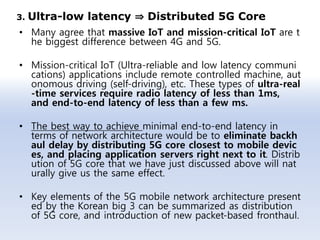
• The best way to achieve minimal end-to-end latency in
terms of network architecture would be to eliminate backh
aul delay by distributing 5G core closest to mobile devic
es, and placing application servers right next to it. Distrib
ution of 5G core that we have just discussed above will nat
urally give us the same effect.
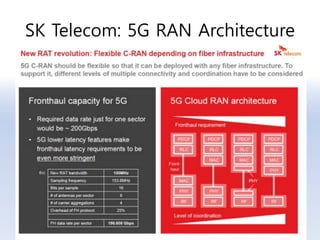
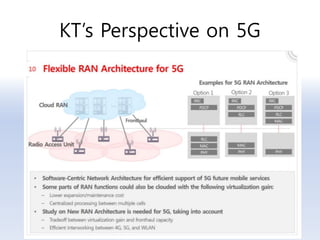
• Key elements of the 5G mobile network architecture present
ed by the Korean big 3 can be summarized as distribution
of 5G core, and introduction of new packet-based fronthaul.
3. Ultra-low latency ⇒ Distributed 5G Core
SK Telecom: 5G RAN Architecture
KT’s Perspective on 5G
NTT Docomo
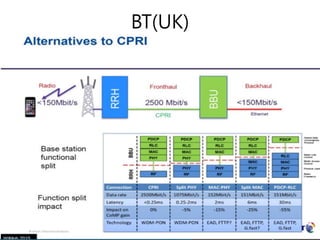
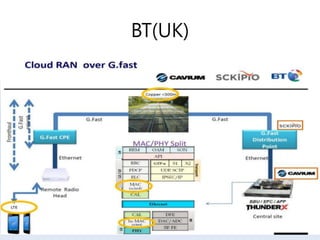
BT(UK)
BT(UK)
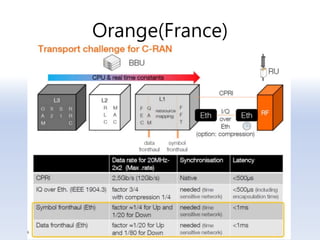
Orange(France)
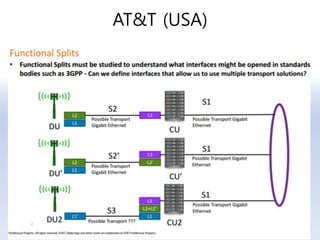
AT&T (USA)
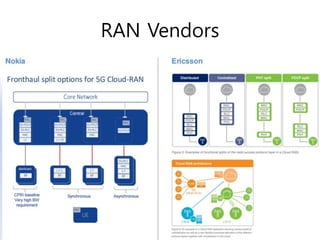
RAN Vendors
IoT Getting Hot
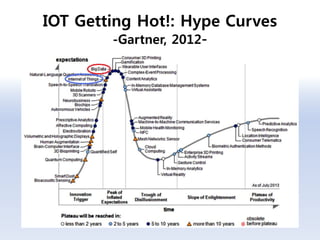
IOT Getting Hot!: Hype Curves
-Gartner, 2012-
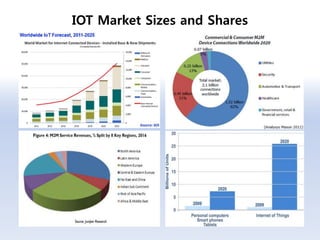
IOT Market Sizes and Shares
Welcome, IOTs! Why Now?
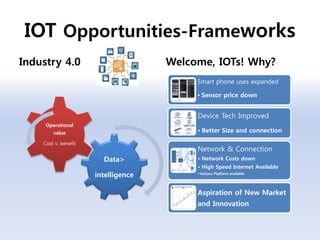
IOT Opportunities-Frameworks
Industry 4.0 Welcome, IOTs! Why?
Smart phone uses expanded
• Sensor price down
Device Tech Improved
• Better Size and connection
Network & Connection
• Network Costs down
• High Speed Internet Available
• Various Platform available
Aspiration of New Market
and Innovation
Data>
intelligence
Operational
value
Cost v. benefit
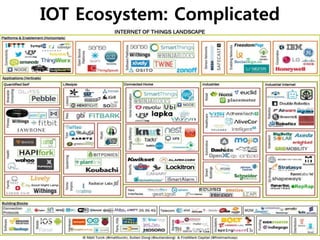
IOT Ecosystem: Complicated
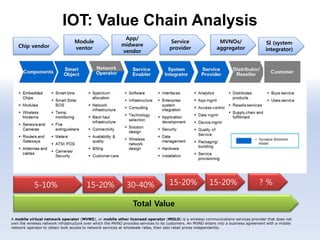
IOT: Value Chain Analysis
Chip vendor
Module
ventor
App/
midware
vendor
Service
provider
MVNOs/
aggregator
SI (system
integrator)
5-10% 15-20% 30-40% 15-20% 15-20%
Total Value
? %
A mobile virtual network operator (MVNO), or mobile other licensed operator (MOLO) is a wireless communications services provider that does not
own the wireless network infrastructure over which the MVNO provides services to its customers. An MVNO enters into a business agreement with a mobile
network operator to obtain bulk access to network services at wholesale rates, then sets retail prices independently.
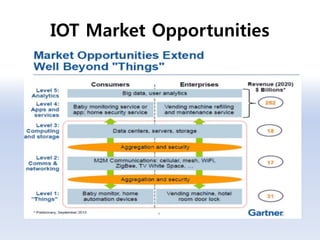
IOT Market Opportunities
Risk Management
Launch-Manage-Monetize
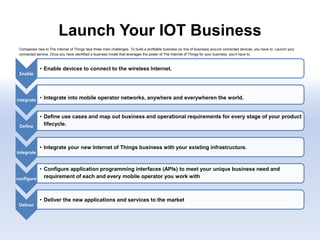
Launch Your IOT Business
Companies new to The Internet of Things face three main challenges. To build a profitable business (or line of business) around connected devices, you have to: Launch your
connected service. Once you have identified a business model that leverages the power of The Internet of Things for your business, you’ll have to:
.
Enable
• Enable devices to connect to the wireless Internet.
integrate • Integrate into mobile operator networks, anywhere and everywheren the world.
Define
• Define use cases and map out business and operational requirements for every stage of your product
lifecycle.
integrate
• Integrate your new Internet of Things business with your existing infrastructure.
configure
• Configure application programming interfaces (APIs) to meet your unique business need and
requirement of each and every mobile operator you work with
Deliver
• Deliver the new applications and services to the market
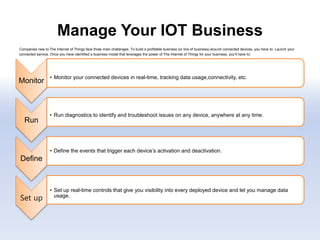
Manage Your IOT Business
Companies new to The Internet of Things face three main challenges. To build a profitable business (or line of business) around connected devices, you have to: Launch your
connected service. Once you have identified a business model that leverages the power of The Internet of Things for your business, you’ll have to:
.
Monitor
• Monitor your connected devices in real-time, tracking data usage,connectivity, etc.
Run
• Run diagnostics to identify and troubleshoot issues on any device, anywhere at any time.
Define
• Define the events that trigger each device’s activation and deactivation.
Set up
• Set up real-time controls that give you visibility into every deployed device and let you manage data
usage.
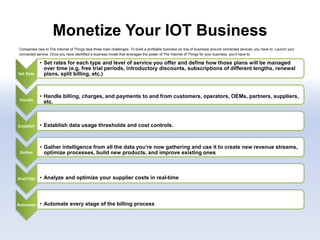
Monetize Your IOT Business
Companies new to The Internet of Things face three main challenges. To build a profitable business (or line of business) around connected devices, you have to: Launch your
connected service. Once you have identified a business model that leverages the power of The Internet of Things for your business, you’ll have to:
.
Set Rate
• Set rates for each type and level of service you offer and define how those plans will be managed
over time (e.g. free trial periods, introductory discounts, subscriptions of different lengths, renewal
plans, split billing, etc.)
Handle
• Handle billing, charges, and payments to and from customers, operators, OEMs, partners, suppliers,
etc.
Establish • Establish data usage thresholds and cost controls.
Gather
• Gather intelligence from all the data you’re now gathering and use it to create new revenue streams,
optimize processes, build new products, and improve existing ones.
Anal/Opt • Analyze and optimize your supplier costs in real-time
Automate • Automate every stage of the billing process
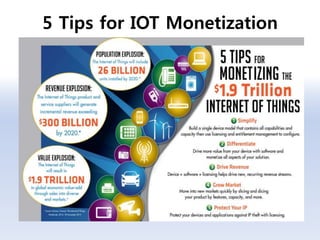
5 Tips for IOT Monetization
Challenges
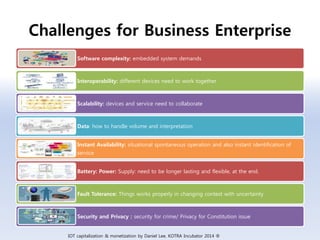
Challenges for Business Enterprise
Software complexity: embedded system demands
Interoperability: different devices need to work together
Scalability: devices and service need to collaborate
Data: how to handle volume and interpretation
Instant Availability: situational spontaneous operation and also instant identification of
service
Battery: Power: Supply: need to be longer lasting and flexible, at the end.
Fault Tolerance: Things works properly in changing context with uncertainty
Security and Privacy : security for crime/ Privacy for Constitution issue
IOT capitalization & monetization by Daniel Lee, KOTRA Incubator 2014 ®
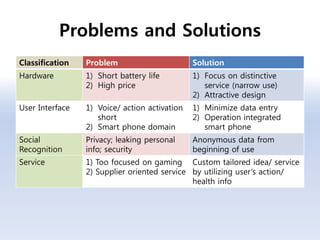
Problems and Solutions
Classification Problem Solution
Hardware 1) Short battery life
2) High price
1) Focus on distinctive
service (narrow use)
2) Attractive design
User Interface 1) Voice/ action activation
short
2) Smart phone domain
1) Minimize data entry
2) Operation integrated
smart phone
Social
Recognition
Privacy; leaking personal
info; security
Anonymous data from
beginning of use
Service 1) Too focused on gaming
2) Supplier oriented service
Custom tailored idea/ service
by utilizing user’s action/
health info
IPR & Standardization
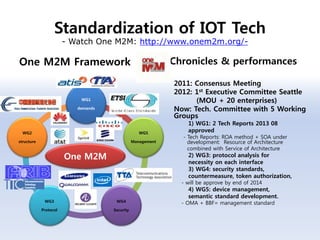
Standardization of IOT Tech
One M2M Framework
One M2M
WG1
demands
WG5
Management
WG4
Security
WG3
Protocol
WG2
structure
Chronicles & performances
2011: Consensus Meeting
2012: 1st Executive Committee Seattle
(MOU + 20 enterprises)
Now: Tech. Committee with 5 Working
Groups
1) WG1: 2 Tech Reports 2013 08
approved
- Tech Reports: ROA method + SOA under
development: Resource of Architecture
combined with Service of Architecture
2) WG3: protocol analysis for
necessity on each interface
3) WG4: security standards,
countermeasure, token authorization,
- will be approve by end of 2014
4) WG5: device management,
semantic standard development.
- OMA + BBF= management standard
- Watch One M2M: http://www.onem2m.org/-
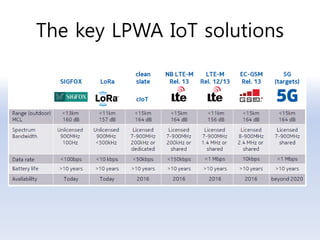
The key LPWA IoT solutions
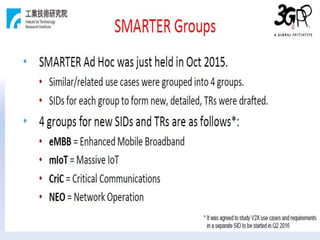
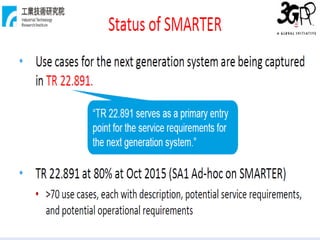
3GPP - SMARTER – NexGen(5G)
From SMARTER spec (TR 22.891),there are 14 use cases Related to IoT:
• Massive Internet of Things M2M and device identification
– Should be able to identify and address large number of devices
• Light weight device communication
– Provide Simple light-weight messaging for user to control IoT devices
• Telemedicine
– Method for prioritize critical data transmission
• Light weight device
– Support light weight device which may not equip IMS.
– Support light weight signalling for device configuration.
• wide area sensor
– critical triggering for event
• IoT initialization
– remote provide 3GPP subscription
• Wearable device communication
– connection switch between direct network connection and smartphone connection
• Industrial Factory Automation
– Communication between controller and sensors located in small area
– very low fail rate (< 10-9)
– support cycle times of [1ms to 2ms.]
IoT Architecture
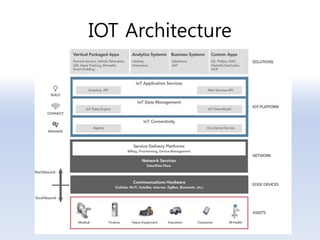
IOT Architecture
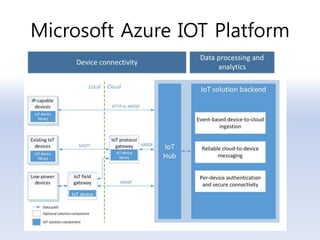
Microsoft Azure IOT Platform
AWS IoT Platform
Google IoT Platform
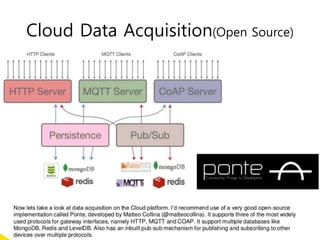
Cloud Data Acquisition(Open Source)
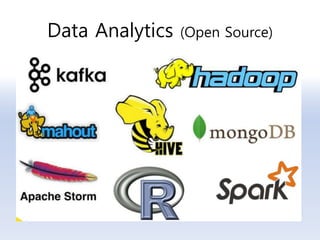
Data Analytics (Open Source)
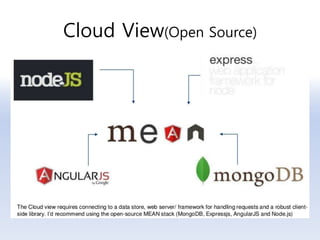
Cloud View(Open Source)
The No.1 Challenge
Thank you

5G Cloud RAN & IoT Architecture

  • 1.
    5G Cloud RAN& IoT Architecture
  • 2.
    Contents 1. 5G Talk 2.5G Time Frame 3. 3Gpp -5g initiative –SMARTER 4. 5G Milestones 5. Stages for 5G Milestones 6. New C-RAN/Fronthaul of 5G 1. Why Redifne C-RAN/Fronthaul Architecture 2. Telecom Operator and Vendors view on 5G RAN A rchitecture 8. IOT Getting Hot 1. Welcome, IOTs! Why Now? 2. Launch-Manage-Monetize 3. Challenges 4. IPR & Standardization 5. IoT Architecture 6. No. 1 Challenge.
  • 3.
  • 4.
  • 7.
  • 8.
    Project Planning andControl  Vision Statement  Blueprint  Benefits  Projects  Resources  Deliverable  Risks
  • 9.
  • 10.
    5G Requirement • Ultra-highradio speed (20Gbps/UE) - New RAT, mm Wave, massive MIMO, massive Aggregation • Ultra-low latency (E2E few msec) - Tectile Internet, a utonomous driving, remote controlled machine • Massive connectivity (hundreds of millions of IoT dev ices)
  • 11.
    How 5G, withhigher technological requirements and distinguishe d use cases compared to those of 4G, will affect the current mobi le network architecture? What changes will it bring? 1. Ultra-High Radio Speed ⇒ Enormous traffic at fronthaul ⇒ New C-RAN/Fronthaul
  • 12.
    5G era, BBUand RRH should be re-defined, and fronthaul should be re-built as packet fronthaul.
  • 13.
    2. Ultra-High RadioSpeed ⇒ Enormous traffic converging into the Core ⇒ Distributed 5G Core 5G Core (Data Plane), New BBU and Applications will run on virtualized servers at the local cloud RAN sites.
  • 14.
    • Many agreethat massive IoT and mission-critical IoT are t he biggest difference between 4G and 5G. • Mission-critical IoT (Ultra-reliable and low latency communi cations) applications include remote controlled machine, aut onomous driving (self-driving), etc. These types of ultra-real -time services require radio latency of less than 1ms, and end-to-end latency of less than a few ms. • The best way to achieve minimal end-to-end latency in terms of network architecture would be to eliminate backh aul delay by distributing 5G core closest to mobile devic es, and placing application servers right next to it. Distrib ution of 5G core that we have just discussed above will nat urally give us the same effect. • Key elements of the 5G mobile network architecture present ed by the Korean big 3 can be summarized as distribution of 5G core, and introduction of new packet-based fronthaul. 3. Ultra-low latency ⇒ Distributed 5G Core
  • 16.
    SK Telecom: 5GRAN Architecture
  • 17.
  • 18.
  • 19.
  • 20.
  • 21.
  • 22.
  • 23.
  • 24.
  • 25.
    IOT Getting Hot!:Hype Curves -Gartner, 2012-
  • 26.
    IOT Market Sizesand Shares
  • 27.
  • 28.
    IOT Opportunities-Frameworks Industry 4.0Welcome, IOTs! Why? Smart phone uses expanded • Sensor price down Device Tech Improved • Better Size and connection Network & Connection • Network Costs down • High Speed Internet Available • Various Platform available Aspiration of New Market and Innovation Data> intelligence Operational value Cost v. benefit
  • 29.
  • 30.
    IOT: Value ChainAnalysis Chip vendor Module ventor App/ midware vendor Service provider MVNOs/ aggregator SI (system integrator) 5-10% 15-20% 30-40% 15-20% 15-20% Total Value ? % A mobile virtual network operator (MVNO), or mobile other licensed operator (MOLO) is a wireless communications services provider that does not own the wireless network infrastructure over which the MVNO provides services to its customers. An MVNO enters into a business agreement with a mobile network operator to obtain bulk access to network services at wholesale rates, then sets retail prices independently.
  • 31.
  • 32.
  • 33.
  • 34.
    Launch Your IOTBusiness Companies new to The Internet of Things face three main challenges. To build a profitable business (or line of business) around connected devices, you have to: Launch your connected service. Once you have identified a business model that leverages the power of The Internet of Things for your business, you’ll have to: . Enable • Enable devices to connect to the wireless Internet. integrate • Integrate into mobile operator networks, anywhere and everywheren the world. Define • Define use cases and map out business and operational requirements for every stage of your product lifecycle. integrate • Integrate your new Internet of Things business with your existing infrastructure. configure • Configure application programming interfaces (APIs) to meet your unique business need and requirement of each and every mobile operator you work with Deliver • Deliver the new applications and services to the market
  • 35.
    Manage Your IOTBusiness Companies new to The Internet of Things face three main challenges. To build a profitable business (or line of business) around connected devices, you have to: Launch your connected service. Once you have identified a business model that leverages the power of The Internet of Things for your business, you’ll have to: . Monitor • Monitor your connected devices in real-time, tracking data usage,connectivity, etc. Run • Run diagnostics to identify and troubleshoot issues on any device, anywhere at any time. Define • Define the events that trigger each device’s activation and deactivation. Set up • Set up real-time controls that give you visibility into every deployed device and let you manage data usage.
  • 36.
    Monetize Your IOTBusiness Companies new to The Internet of Things face three main challenges. To build a profitable business (or line of business) around connected devices, you have to: Launch your connected service. Once you have identified a business model that leverages the power of The Internet of Things for your business, you’ll have to: . Set Rate • Set rates for each type and level of service you offer and define how those plans will be managed over time (e.g. free trial periods, introductory discounts, subscriptions of different lengths, renewal plans, split billing, etc.) Handle • Handle billing, charges, and payments to and from customers, operators, OEMs, partners, suppliers, etc. Establish • Establish data usage thresholds and cost controls. Gather • Gather intelligence from all the data you’re now gathering and use it to create new revenue streams, optimize processes, build new products, and improve existing ones. Anal/Opt • Analyze and optimize your supplier costs in real-time Automate • Automate every stage of the billing process
  • 37.
    5 Tips forIOT Monetization
  • 38.
  • 39.
    Challenges for BusinessEnterprise Software complexity: embedded system demands Interoperability: different devices need to work together Scalability: devices and service need to collaborate Data: how to handle volume and interpretation Instant Availability: situational spontaneous operation and also instant identification of service Battery: Power: Supply: need to be longer lasting and flexible, at the end. Fault Tolerance: Things works properly in changing context with uncertainty Security and Privacy : security for crime/ Privacy for Constitution issue IOT capitalization & monetization by Daniel Lee, KOTRA Incubator 2014 ®
  • 40.
    Problems and Solutions ClassificationProblem Solution Hardware 1) Short battery life 2) High price 1) Focus on distinctive service (narrow use) 2) Attractive design User Interface 1) Voice/ action activation short 2) Smart phone domain 1) Minimize data entry 2) Operation integrated smart phone Social Recognition Privacy; leaking personal info; security Anonymous data from beginning of use Service 1) Too focused on gaming 2) Supplier oriented service Custom tailored idea/ service by utilizing user’s action/ health info
  • 41.
  • 42.
    Standardization of IOTTech One M2M Framework One M2M WG1 demands WG5 Management WG4 Security WG3 Protocol WG2 structure Chronicles & performances 2011: Consensus Meeting 2012: 1st Executive Committee Seattle (MOU + 20 enterprises) Now: Tech. Committee with 5 Working Groups 1) WG1: 2 Tech Reports 2013 08 approved - Tech Reports: ROA method + SOA under development: Resource of Architecture combined with Service of Architecture 2) WG3: protocol analysis for necessity on each interface 3) WG4: security standards, countermeasure, token authorization, - will be approve by end of 2014 4) WG5: device management, semantic standard development. - OMA + BBF= management standard - Watch One M2M: http://www.onem2m.org/-
  • 43.
    The key LPWAIoT solutions
  • 44.
    3GPP - SMARTER– NexGen(5G) From SMARTER spec (TR 22.891),there are 14 use cases Related to IoT: • Massive Internet of Things M2M and device identification – Should be able to identify and address large number of devices • Light weight device communication – Provide Simple light-weight messaging for user to control IoT devices • Telemedicine – Method for prioritize critical data transmission • Light weight device – Support light weight device which may not equip IMS. – Support light weight signalling for device configuration. • wide area sensor – critical triggering for event • IoT initialization – remote provide 3GPP subscription • Wearable device communication – connection switch between direct network connection and smartphone connection • Industrial Factory Automation – Communication between controller and sensors located in small area – very low fail rate (< 10-9) – support cycle times of [1ms to 2ms.]
  • 45.
  • 46.
  • 47.
  • 48.
  • 49.
  • 52.
  • 53.
  • 54.
  • 55.
  • 57.