SHANU SINGH CHAUHAN
COMPUTER SCINCE
1
Contents
•Introduction
•History
•Objective
•Uses
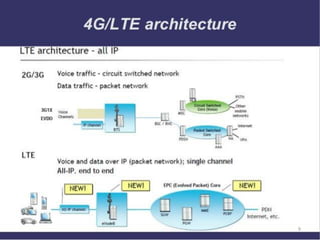
•Architecture
•Application
•Advantages
•Technologies
•Conclusion
•References
2
Introduction
4G
An abbreviation for Fourth-Generation
Provide wireless network access at a higher speed
approx. 100 mbps
Quick to surf the web on your mobile, tablets and
laptops
It uses different frequencies for transmit data
More faster because of Orthogonal Frequency-
Division Multiplexing (OFDM).
3
LTE
• Stands for Long Term Evolution
• It is a 4G wireless broadband technology by
the Third Generation Partnership Project
(3GPP), an industry trade group.
• The goal of LTE was to increase the capacity
and speed of wireless data networks using
new DSP (digital signal processing) techniques.
4
4G-LTE
• An accurate name for 4G LTE technology is 4G
candidate LTE.
• To use this technology we get the actual speed
of 4G network and become an accepted 4G
standard.
• Achieving higher speed in two ways-:
• uses existing bandwidth more efficiently than
older technologies
• they transmit and receive via multiple inputs
and outputs.
5
Objectives
• High network capacity.
• A nominal data rate of 100 Mbps while the client
physically moves at high speeds relative to the station,
and 1 Gbps while client and station are in relatively
fixed positions,
• A data rate of at least 100 Mbps between any two
points in the world.
• Seamless connectivity and global roaming across
multiple networks,
• High quality of service for next generation multimedia
support (real time audio, high speed data, HDTV video
content, mobile TV, etc)
6
History
• The first generation of mobile communications started
with the Advanced Mobile Phone Systems (AMPS),
which was an analogue system. AMPS can be thought
of as 1G.
• From there, we progressed to GSM and CDMA-one
(pretty much regarded as 2G) and then to UMTS and
EV-DO, which are 3G technologies.
• The latest technologies that are regarded as candidates
for 4G are LTE (from the 3GPP group) and 802.16m
(from the IEEE).
• LTE progresses through versions known as releases.
The latest release that qualifies as being 4G is release
10, often called LTE-Advanced.
7
Uses
• Large file transfer
• Rapid workplace set-up
• Rich machine to machine and remote
monitoring applications
• Videoconferencing, tele-presence and rich
media collaboration
• Remote access to business applications
8
9
Applications
• E-readers,
• Mobile IPTV,
• Mobile marketing and geo-targeted
advertising,
• Location-based mobile applications
embedded in social networking
10
Advantages
• It transmits and receives data very quickly.
• It provides considerably higher data
bandwidth, which means more data capacity
per user.
• Makes quick connections when changing cells,
and it doesn’t drop connections.
• It is compatible with previous generations of
mobile network technology as well future
versions.
11
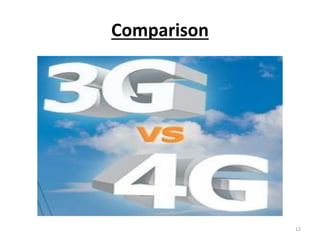
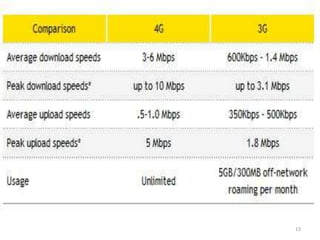
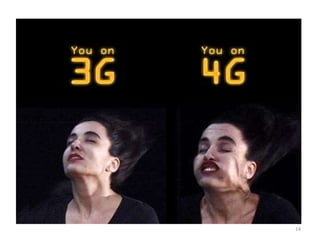
Comparison
12
13
14
Technologies
• Transfer capabilities
• DL and UL schemes
• Protocol Architecture
• Spectrum Flexibility
• Cell size support
• Network architecture
15
Conclusion
• LTE-A helps in integrating the existing
networks, new networks, services and
terminals to suit the escalating user demands
• LTE-Advanced will be standardized in the 3GPP
specification Release 10 (LTE-A) and will be
designed to meet the 4G requirements as
defined by ITU
16
References
• http://www.digitallanding.com/many-
advantages-of-4g-lte-mobile-networks/
• http://www.techrepublic.com/blog/smartpho
nes/the-history-and-evolution-of-4g/
• http://www.slideshare.net/zahidtg/the-path-
to-4g-lte-and-lteadvanced?related=1
• www.adl.com/4G_LTE_Benefits
17
18
• http://pediain.com/seminar/Advancements-
Towards-4G-Wireless-Technology.php.
• http://seminarprojecttopics.blogspot.in/2012/09/4g-
technology-seminar-topic.html.
• https://www.youtube.com/watch?v=wiWXQEkO5ws.
• http://www.webopedia.com/TERM/4/4G_LTE.html.
19
THANK YOU
20

Presentation on 4gLTE

Editor's Notes

  • #6 Both these methods of increasing speeds are evolutionary, but the idea of using multiple transmission paths lends itself to increasing the speed by multiplying the number of paths. http://www.digitallanding.com/many-advantages-of-4g-lte-mobile-networks/