PRESENTED BY :-
Samir Mohanty
C O N T E N T S
 Introduction to 5G.
 5G Experience be like.
 Brief Idea about 5G.
 Evolution from 1G to 5G.
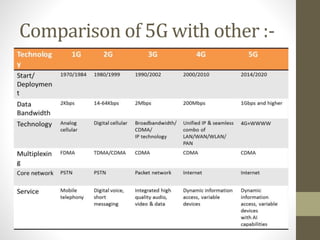
 Comparison table of features of 1G to 5G.
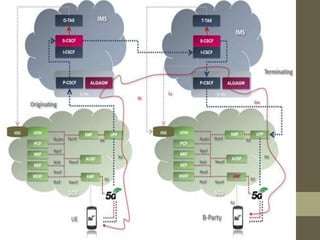
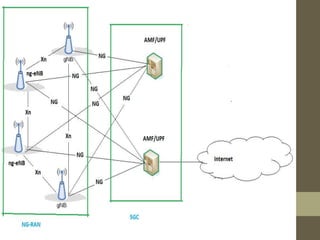
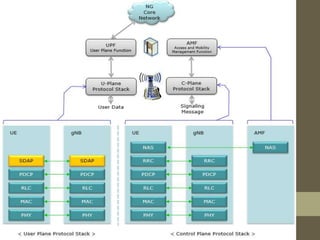
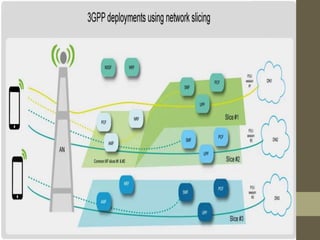
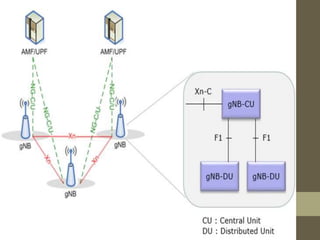
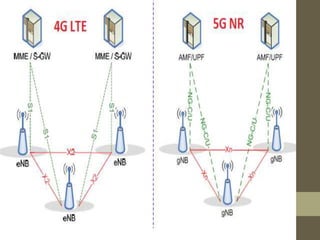
 Architecture of 5G.
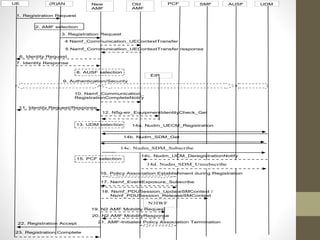
 CallFlow
 Functional Architecture of 5G.
 Hardware and Software of 5G.
 Advantages.
 Disadvantages.
 Applications.
 Conclusion.
 INTRODUCTION
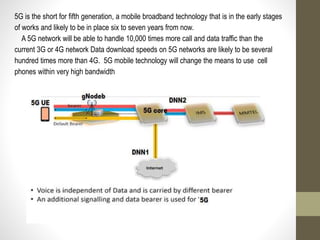
5G is the short for fifth generation, a mobile
broadband technology that is in the early stages
of works and likely to be in place six to seven
years from now.
 A 5G network will be able to handle 10,000
times more call and data traffic than the current
3G or 4G network.
 Data download speeds on 5G networks are
likely to be several hundred times more than 4G.
 5G mobile technology will change the means to
use cell phones within very high bandwidth.
 BRIEF IDEA ABOUT 5G
CURRENT STATUS OF 5G?
The European Telecommunications Standards Institute is
formulating 5G global technology standards, which are likely to be
formalized by 2019.
Telecom companies such as Nokia, Ericsson, NTT DoCoMo, Samsung,
Huawei and Fujitsu are driving bulk of the 5G-related innovations.
PEOPLE WILL BE ABLE TO EXPERIENCE WITH 5G.
5G networks are likely to be rolled out commercially between
2020 and 2025. If the global standards are finalized by 2019, the
earliest commercial deployments could happen by 2020.
3G AND 4G HANDSETS DOESN’T RUN ON 5G NETWORKS.
No. 5G will require new chipsets and devices capable of
supporting speeds upwards of 10 gigabits per second. 4G and 3G run
at a fraction of that speed.
 Evolution from 1G to 5G
1G (1980/1990)
2G/2.5G ( Late 90’S)
3G (2001)
4G (2010)
5G (Expected by 2017 in Indian
Market)
1G:- 1’st Generation
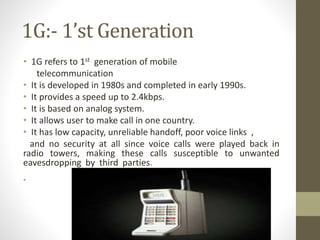
• 1G refers to 1st generation of mobile
telecommunication
• It is developed in 1980s and completed in early 1990s.
• It provides a speed up to 2.4kbps.
• It is based on analog system.
• It allows user to make call in one country.
• It has low capacity, unreliable handoff, poor voice links ,
and no security at all since voice calls were played back in
radio towers, making these calls susceptible to unwanted
eavesdropping by third parties. low capacity, unreliable handoff, poor
voice links, and no security a
• t all since voice calls were played back in radio towers, making these calls
susceptible to unwanted eavesdropping by third parties.
has low capacity, unreliable handoff, poor voice links, and no security at all since
voice calls were played back in radio towers, making these calls susceptible to
unwanted eavesdropping by third parties.
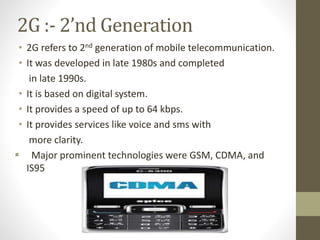
2G :- 2’nd Generation
• 2G refers to 2nd generation of mobile telecommunication.
• It was developed in late 1980s and completed
in late 1990s.
• It is based on digital system.
• It provides a speed of up to 64 kbps.
• It provides services like voice and sms with
more clarity.
 Major prominent technologies were GSM, CDMA, and
IS95
3G :- Third Generation
NTT DoCoMo launched the first commercial 3G network
on 1 October 2001, using the WCDMA technology
 bandwidth of 3G network is 128 Kbps for mobile
stations, and 2 Mbps for fixed applications
 The current trend in mobile systems is to support the
high bit rate data services at the downlink via High Speed
Downlink Packet Access (HSDPA)
4G:- 4’th Generation
• It was developed in the year 2010.
• It is faster and more reliable.
• It provides speed up to 100mbps.
• It provides high performance like uploading and downloading
speed.
• It provides easy roaming as compaired to 3G.
• Use of a higher Layer Protocol (IP) as transport medium
affords intelligence at every stage within the network relative
to a service
5G :- 5’th Generation
• It is the next major phase of mobile telecommunication &
wireless system.
• It is 10 times more faster than 4G.
• It has a expected speed of 1gbps.
• Lower cost than the previous version.
• It is expected to come around the year 2017.
Comparison of 5G with other :-
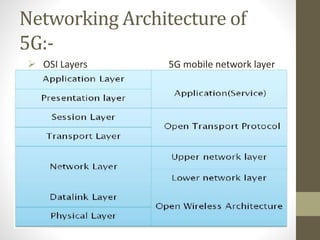
Networking Architecture of
5G:-
 OSI Layers 5G mobile network layer
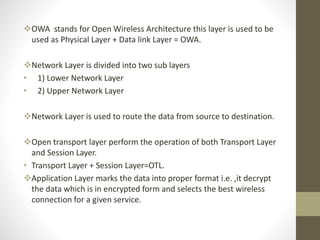
OWA stands for Open Wireless Architecture this layer is used to be
used as Physical Layer + Data link Layer = OWA.
Network Layer is divided into two sub layers
• 1) Lower Network Layer
• 2) Upper Network Layer
Network Layer is used to route the data from source to destination.
Open transport layer perform the operation of both Transport Layer
and Session Layer.
• Transport Layer + Session Layer=OTL.
Application Layer marks the data into proper format i.e. ,it decrypt
the data which is in encrypted form and selects the best wireless
connection for a given service.
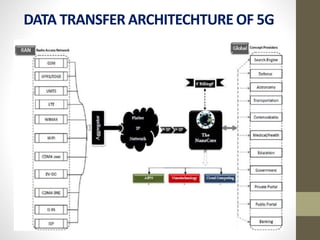
DATA TRANSFER ARCHITECHTURE OF 5G
RAN
A radio access network (RAN) is part of a mobile telecommunication system.
It implements a Radio Access Technology. Conceptually, it resides between a
device such as a mobile phone, a computer, or any remotely controlled
machine and provides connection with its core network.
FLAT IP NETWORK
Certainly Flat IP network is the key concept to make 5G acceptable for all kind
of technologies. To meet customer demand for real-time data applications
delivered over mobile broadband networks, wireless operators are turning to
flat IP network architectures.
5G NANOCORE
The 5G Nanocore is a convergence of below mention technologies. These
technologies have their own impact on exiting wireless network which makes
them in to 5G.
Nanotechnology.
Cloud Computing.
All IP Platform.
Nano Technology :-
Nanotechnology is the application of nano science to control process on
manometer scale. i.e. between 0.1 and100nm.The field is also known as molecular
nanotechnology(MNT). It deals with control of the structure of matter based on
atom-by-atom and molecule by molecule engineering. The term nanotechnology
was introduced by Nori Taniguchi in 1974 at the Tokyo international conference on
production engineering.
Cloud computing :-
Cloud computing is a technology that uses the internet and central remote
server to maintain data and applications. In 5G network this central remote server
will be our content provide. Cloud computing allows consumers and business to use
applications without installation and access their personal files at any computer with
internet access. The same concept is going to be used in Nanocore where the user
tries to access his private account form a global content provider through Nanocore
in form of cloud.
The All-IP Network(AIPN) :-
The All-IP Network(AIPN) is an evolution of the 3GPPsystem to meet the
increasing demands of the mobile telecommunications market. To meets customer
demand for real-time data applications delivered over mobile broadband networks,
wireless operators are turning to flat IP network architectures.
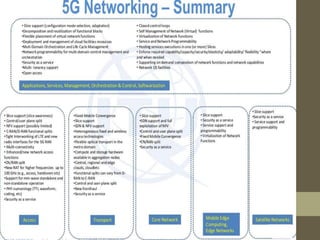
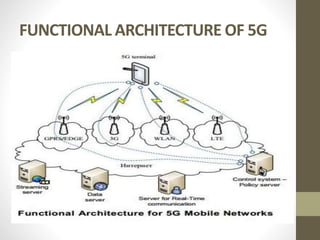
FUNCTIONAL ARCHITECTURE OF 5G
GPRS (General Packet Radio Service)
a) It is used to transmit data at 60kb/sec.
b) It consume less battery during sending & receiving mail or . . .
. browsing internet.
EDGE (Exchanged Data Rate for GSM Evolution)
a) It is an advance version of GPRS .
b) It provide a data speed of 473kb/sec.
3G
a) 3G makes it possible to do video call on mobile network.
b) It also provide efficient way to browse internet on mobile
networking.
WLAN( Wireless LAN)
a) Wireless LAN provides short range, high speed wireless data .
. connection between mobile data device using radio or signal.
 LTE(Long Term Evolution)
a) LTE is standard for mobile communication for high speed data
transmission for mobile network. Its Speed is up to 100mb/sec.
5G is the short for fifth generation, a mobile broadband technology that is in the early stages
of works and likely to be in place six to seven years from now.
A 5G network will be able to handle 10,000 times more call and data traffic than the
current 3G or 4G network Data download speeds on 5G networks are likely to be several
hundred times more than 4G. 5G mobile technology will change the means to use cell
phones within very high bandwidth
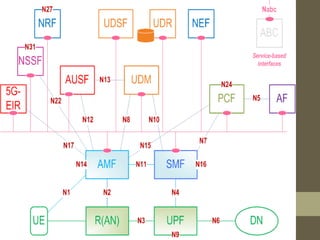
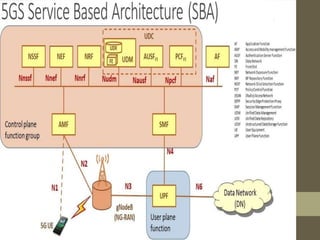
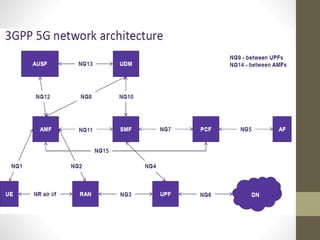
UE (R)AN UPF
AF
AMF SMF
PCF UDM
DNN6
NRFNEF
N3
N2 N4
AUSF
Nausf Namf Nsmf
NpcfNnrfNnef Nudm Naf
NSSF
Nnssf
AMF PCF
UE (R)AN UPF DN
N13
N7
N3 N6
N2 N4N1
AFN5SMFN11
N9
AUSF
N8N12
UDM
N10
N14 N15
NSSF
N22
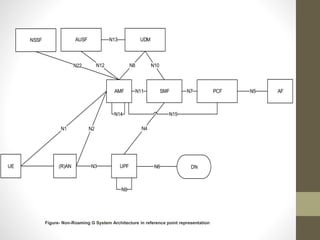
Figure- Non-Roaming G System Architecture in reference point representation
UE
N26
S8-U
S8-C
S6a
S11
N1
N4
N7
U
N2
S1-U
S1-MME
HSS +
UDM
N9
N3
HPLMN
VPLMN
N24
N16
N8
UE
SGW
E-UTRAN
N10
N11
N4
v-PCF
N15
AMF
N10
MME
NG-RAN
RAN
h-PCF +
h-PCRF
SMF +
PGW-C
UPF +
PGW-U
UPF
v-SMF
5QI
Value
Resource Type Default Priority Level Packet Delay Budget Packet Error
Rate
Default Maximum Data Burst Volume
(NOTE 2)
Default
Averaging Window
Example Services
10 Delay Critical GBR 11 5 ms 10-5 160 B TBD Remote control
(see TS 22.261 [2])
11
NOTE 4
12 10 ms
NOTE 5
10-5 320 B TBD Intelligent transport systems
12 13 20 ms 10-5 640 B TBD
16
NOTE 4
18 10 ms 10-4 255 B TBD Discrete Automation
17
NOTE 4
19 10 ms 10-4 1358 B
NOTE 3
TBD Discrete Automation
1
GBR
NOTE 1
20 100 ms 10-2 N/A TBD Conversational Voice
2 40 150 ms 10-3 N/A TBD Conversational Video (Live Streaming)
3 30 50 ms 10-3 N/A TBD Real Time Gaming, V2X messages
Electricity distribution – medium voltage, Process automation - monitoring
4 50 300 ms 10-6 N/A TBD Non-Conversational Video (Buffered Streaming)
65 7 75 ms
10-2
N/A TBD Mission Critical user plane Push To Talk voice (e.g., MCPTT)
66
20
100 ms
10-2
N/A TBD Non-Mission-Critical user plane Push To Talk voice
75 25 50 ms 10-2 N/A TBD V2X messages
E
NOTE 4
18 10 ms 10-4 255 B TBD Discrete Automation
F
NOTE 4
19 10 ms 10-4 1358 B
NOTE 3
TBD Discrete Automation
5 Non-GBR
NOTE 1
10 100 ms 10-6 N/A N/A IMS Signalling
6
60 300 ms 10-6
N/A N/A Video (Buffered Streaming)
TCP-based (e.g., www, e-mail, chat, ftp, p2p file sharing, progressive video, etc.)
7
70 100 ms 10-3
N/A N/A Voice,
Video (Live Streaming)
Interactive Gaming
8
80 300 ms
10-6
N/A N/A
Video (Buffered Streaming)
TCP-based (e.g., www, e-mail, chat, ftp, p2p file
9 90 N/A N/A sharing, progressive video, etc.)
69 5 60 ms 10-6 N/A N/A Mission Critical delay sensitive signalling (e.g., MC-PTT signalling)
70 55 200 ms 10-6 N/A N/A Mission Critical Data (e.g. example services are the same as QCI 6/8/9)
79 65 50 ms 10-2 N/A N/A V2X messages
80 66 10 ms 10-6 N/A N/A Low Latency eMBB applications Augmented Reality
NOTE 1: a packet which is delayed more than PDB is not counted as lost, thus not included in the PER.
NOTE 2: it is required that default Maximum Data Burst Volume is supported by a PLMN supporting the related 5QIs.
NOTE 3: This Maximum Burst Size value is intended to avoid IP fragmentation on an IPv6 based, IPSec protected, GTP tunnel to the 5G-AN node.
NOTE 4: A delay of 1 ms for the delay between a UPF terminating N6 and a 5G-AN should be subtracted from a given PDB to derive the packet delay budget that applies to the radio interface.
NOTE 5:The jitter for this service is assumed to be 20 msec as per TS 22.261 [2].
New
AMF
AUSFSMF(R)ANUE
4 Namf_Communication_UEContextTransfer
1. Registration Request
PCF
2. AMF selection
3. Registration Request
Old
AMF
6. Identity Request
7. Identity Response
8. AUSF selection
9. Authentication/Security
11. Identity Request/Response
EIR
12. N5g-eir_EquipmentIdentityCheck_Get
13. UDM selection
15. PCF selection
16. Policy Association Establishment during Registration
22. Registration Accept
23. Registration Complete
UDM
18. Nsmf_PDUSession_UpdateSMContext /
Nsmf_PDUSession_ReleaseSMContext
10. Namf_Communication_
RegistrationCompleteNotify
5 Namf_Communication_UEContextTransfer response
N3IWF
19. N2 AMF Mobility Request
20. N2 AMF MobilityResponse
14c. Nudm_UCM_DeregistrationNotify
14a. Nudm_UECM_Registration
14b. Nudm_SDM_Get
14c. Nudm_SDM_Subscribe
14d. Nudm_SDM_Unsubscribe
17. Namf_EventExposure_Subscribe
21. AMF-Initiated Policy Association Termination
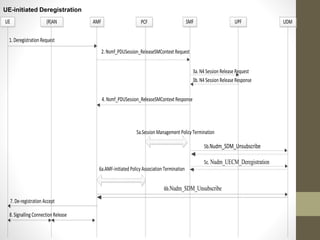
UE-initiated Deregistration
UE (R)AN AMF SMF UPFPCF
2. Nsmf_PDUSession_ReleaseSMContext Request
1. Deregistration Request
4. Nsmf_PDUSession_ReleaseSMContext Response
3a. N4 Session Release Request
3b. N4 Session Release Response
7. De-registration Accept
8. Signalling Connection Release
5a.Session Management Policy Termination
6a.AMF-initiated Policy Association Termination
UDM
5b.Nudm_SDM_Unsubscribe
6b.Nudm_SDM_Unsubscribe
5c. Nudm_UECM_Deregistration
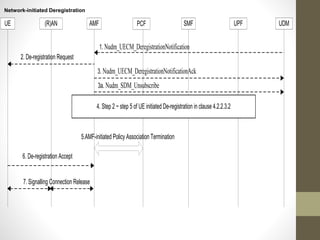
Network-initiated Deregistration
UE (R)AN AMF SMF UPFPCF
1. Nudm_UECM_DeregistrationNotification
6. De-registration Accept
7. Signalling Connection Release
2. De-registration Request
3. Nudm_UECM_DeregistrationNotificationAck
UDM
4. Step 2 ~ step 5 of UE initiated De-registration in clause 4.2.2.3.2
3a. Nudm_SDM_Unsubscribe
5.AMF-initiated Policy Association Termination
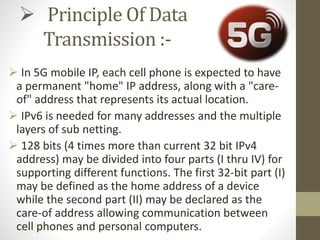
 In 5G mobile IP, each cell phone is expected to have
a permanent "home" IP address, along with a "care-
of" address that represents its actual location.
 IPv6 is needed for many addresses and the multiple
layers of sub netting.
 128 bits (4 times more than current 32 bit IPv4
address) may be divided into four parts (I thru IV) for
supporting different functions. The first 32-bit part (I)
may be defined as the home address of a device
while the second part (II) may be declared as the
care-of address allowing communication between
cell phones and personal computers.
 Principle Of Data
Transmission :-
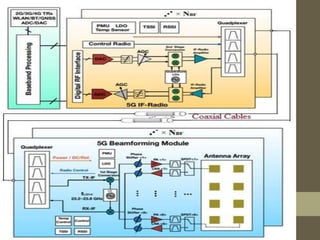
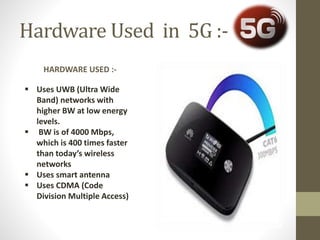
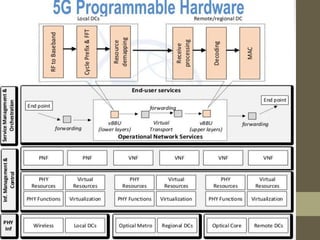
Hardware Used in 5G :-
HARDWARE USED :-
 Uses UWB (Ultra Wide
Band) networks with
higher BW at low energy
levels.
 BW is of 4000 Mbps,
which is 400 times faster
than today’s wireless
networks
 Uses smart antenna
 Uses CDMA (Code
Division Multiple Access)
Software Used in 5G :-
SOFTWARE USED
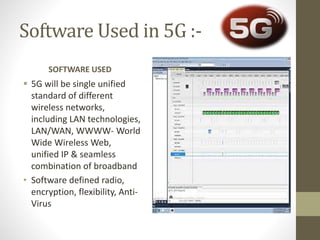
 5G will be single unified
standard of different
wireless networks,
including LAN technologies,
LAN/WAN, WWWW- World
Wide Wireless Web,
unified IP & seamless
combination of broadband
• Software defined radio,
encryption, flexibility, Anti-
Virus
ADVANTAGES :-
 Data Bandwidth of 1Gbps or higher.
 Dynamic information access.
 Available at low cost.
 Finest Quality Of Service(QOS).
 Pages will upload almost instantly.
 Support interactive multimedia, voice, streaming video, Internet, and
other broadband services.
DISADVANTAGE :-
 Since 5G services are likely to run on ultra-high spectrum bands, which
travel shorter distances compared with lower bands, they may be more
suited to enhanced indoor coverage.
 Higher frequencies could be blocked by buildings and they lose intensity
over longer distances. That means, offering wider coverage would be a
challenge.
APPLICATIONS
 Wireable devices with AI(Artificial Intelligence)capabilities.
 5G iPhones.
 With 6th Sense technology.
 Global Networks.
 VoIP(Voice Over IP) enabled devices.
 Radio resource management.
 Media independent handover.
CONCLUSION
5G technology is going to be a new revolution in wireless systems
market.
5G will be User Centric.
5G is the next frontier of innovation for entire mobile industry.
5G - a promising Generation of wireless communication that will
change people’s lives.
Any queries
Thank you

5g New Revolution

  • 1.
  • 2.
    C O NT E N T S  Introduction to 5G.  5G Experience be like.  Brief Idea about 5G.  Evolution from 1G to 5G.  Comparison table of features of 1G to 5G.  Architecture of 5G.  CallFlow  Functional Architecture of 5G.  Hardware and Software of 5G.  Advantages.  Disadvantages.  Applications.  Conclusion.
  • 3.
     INTRODUCTION 5G isthe short for fifth generation, a mobile broadband technology that is in the early stages of works and likely to be in place six to seven years from now.  A 5G network will be able to handle 10,000 times more call and data traffic than the current 3G or 4G network.  Data download speeds on 5G networks are likely to be several hundred times more than 4G.  5G mobile technology will change the means to use cell phones within very high bandwidth.
  • 4.
     BRIEF IDEAABOUT 5G CURRENT STATUS OF 5G? The European Telecommunications Standards Institute is formulating 5G global technology standards, which are likely to be formalized by 2019. Telecom companies such as Nokia, Ericsson, NTT DoCoMo, Samsung, Huawei and Fujitsu are driving bulk of the 5G-related innovations. PEOPLE WILL BE ABLE TO EXPERIENCE WITH 5G. 5G networks are likely to be rolled out commercially between 2020 and 2025. If the global standards are finalized by 2019, the earliest commercial deployments could happen by 2020. 3G AND 4G HANDSETS DOESN’T RUN ON 5G NETWORKS. No. 5G will require new chipsets and devices capable of supporting speeds upwards of 10 gigabits per second. 4G and 3G run at a fraction of that speed.
  • 5.
     Evolution from1G to 5G 1G (1980/1990) 2G/2.5G ( Late 90’S) 3G (2001) 4G (2010) 5G (Expected by 2017 in Indian Market)
  • 6.
    1G:- 1’st Generation •1G refers to 1st generation of mobile telecommunication • It is developed in 1980s and completed in early 1990s. • It provides a speed up to 2.4kbps. • It is based on analog system. • It allows user to make call in one country. • It has low capacity, unreliable handoff, poor voice links , and no security at all since voice calls were played back in radio towers, making these calls susceptible to unwanted eavesdropping by third parties. low capacity, unreliable handoff, poor voice links, and no security a • t all since voice calls were played back in radio towers, making these calls susceptible to unwanted eavesdropping by third parties. has low capacity, unreliable handoff, poor voice links, and no security at all since voice calls were played back in radio towers, making these calls susceptible to unwanted eavesdropping by third parties.
  • 7.
    2G :- 2’ndGeneration • 2G refers to 2nd generation of mobile telecommunication. • It was developed in late 1980s and completed in late 1990s. • It is based on digital system. • It provides a speed of up to 64 kbps. • It provides services like voice and sms with more clarity.  Major prominent technologies were GSM, CDMA, and IS95
  • 8.
    3G :- ThirdGeneration NTT DoCoMo launched the first commercial 3G network on 1 October 2001, using the WCDMA technology  bandwidth of 3G network is 128 Kbps for mobile stations, and 2 Mbps for fixed applications  The current trend in mobile systems is to support the high bit rate data services at the downlink via High Speed Downlink Packet Access (HSDPA)
  • 9.
    4G:- 4’th Generation •It was developed in the year 2010. • It is faster and more reliable. • It provides speed up to 100mbps. • It provides high performance like uploading and downloading speed. • It provides easy roaming as compaired to 3G. • Use of a higher Layer Protocol (IP) as transport medium affords intelligence at every stage within the network relative to a service
  • 10.
    5G :- 5’thGeneration • It is the next major phase of mobile telecommunication & wireless system. • It is 10 times more faster than 4G. • It has a expected speed of 1gbps. • Lower cost than the previous version. • It is expected to come around the year 2017.
  • 11.
    Comparison of 5Gwith other :-
  • 12.
    Networking Architecture of 5G:- OSI Layers 5G mobile network layer
  • 13.
    OWA stands forOpen Wireless Architecture this layer is used to be used as Physical Layer + Data link Layer = OWA. Network Layer is divided into two sub layers • 1) Lower Network Layer • 2) Upper Network Layer Network Layer is used to route the data from source to destination. Open transport layer perform the operation of both Transport Layer and Session Layer. • Transport Layer + Session Layer=OTL. Application Layer marks the data into proper format i.e. ,it decrypt the data which is in encrypted form and selects the best wireless connection for a given service.
  • 14.
  • 15.
    RAN A radio accessnetwork (RAN) is part of a mobile telecommunication system. It implements a Radio Access Technology. Conceptually, it resides between a device such as a mobile phone, a computer, or any remotely controlled machine and provides connection with its core network. FLAT IP NETWORK Certainly Flat IP network is the key concept to make 5G acceptable for all kind of technologies. To meet customer demand for real-time data applications delivered over mobile broadband networks, wireless operators are turning to flat IP network architectures. 5G NANOCORE The 5G Nanocore is a convergence of below mention technologies. These technologies have their own impact on exiting wireless network which makes them in to 5G. Nanotechnology. Cloud Computing. All IP Platform.
  • 16.
    Nano Technology :- Nanotechnologyis the application of nano science to control process on manometer scale. i.e. between 0.1 and100nm.The field is also known as molecular nanotechnology(MNT). It deals with control of the structure of matter based on atom-by-atom and molecule by molecule engineering. The term nanotechnology was introduced by Nori Taniguchi in 1974 at the Tokyo international conference on production engineering. Cloud computing :- Cloud computing is a technology that uses the internet and central remote server to maintain data and applications. In 5G network this central remote server will be our content provide. Cloud computing allows consumers and business to use applications without installation and access their personal files at any computer with internet access. The same concept is going to be used in Nanocore where the user tries to access his private account form a global content provider through Nanocore in form of cloud. The All-IP Network(AIPN) :- The All-IP Network(AIPN) is an evolution of the 3GPPsystem to meet the increasing demands of the mobile telecommunications market. To meets customer demand for real-time data applications delivered over mobile broadband networks, wireless operators are turning to flat IP network architectures.
  • 17.
  • 18.
    GPRS (General PacketRadio Service) a) It is used to transmit data at 60kb/sec. b) It consume less battery during sending & receiving mail or . . . . browsing internet. EDGE (Exchanged Data Rate for GSM Evolution) a) It is an advance version of GPRS . b) It provide a data speed of 473kb/sec. 3G a) 3G makes it possible to do video call on mobile network. b) It also provide efficient way to browse internet on mobile networking. WLAN( Wireless LAN) a) Wireless LAN provides short range, high speed wireless data . . connection between mobile data device using radio or signal.  LTE(Long Term Evolution) a) LTE is standard for mobile communication for high speed data transmission for mobile network. Its Speed is up to 100mb/sec.
  • 38.
    5G is theshort for fifth generation, a mobile broadband technology that is in the early stages of works and likely to be in place six to seven years from now. A 5G network will be able to handle 10,000 times more call and data traffic than the current 3G or 4G network Data download speeds on 5G networks are likely to be several hundred times more than 4G. 5G mobile technology will change the means to use cell phones within very high bandwidth
  • 40.
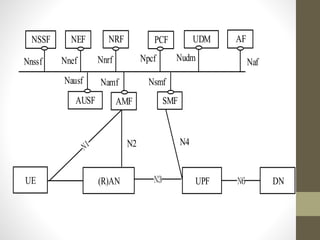
    UE (R)AN UPF AF AMFSMF PCF UDM DNN6 NRFNEF N3 N2 N4 AUSF Nausf Namf Nsmf NpcfNnrfNnef Nudm Naf NSSF Nnssf
  • 41.
    AMF PCF UE (R)ANUPF DN N13 N7 N3 N6 N2 N4N1 AFN5SMFN11 N9 AUSF N8N12 UDM N10 N14 N15 NSSF N22 Figure- Non-Roaming G System Architecture in reference point representation
  • 42.
  • 43.
    5QI Value Resource Type DefaultPriority Level Packet Delay Budget Packet Error Rate Default Maximum Data Burst Volume (NOTE 2) Default Averaging Window Example Services 10 Delay Critical GBR 11 5 ms 10-5 160 B TBD Remote control (see TS 22.261 [2]) 11 NOTE 4 12 10 ms NOTE 5 10-5 320 B TBD Intelligent transport systems 12 13 20 ms 10-5 640 B TBD 16 NOTE 4 18 10 ms 10-4 255 B TBD Discrete Automation 17 NOTE 4 19 10 ms 10-4 1358 B NOTE 3 TBD Discrete Automation 1 GBR NOTE 1 20 100 ms 10-2 N/A TBD Conversational Voice 2 40 150 ms 10-3 N/A TBD Conversational Video (Live Streaming) 3 30 50 ms 10-3 N/A TBD Real Time Gaming, V2X messages Electricity distribution – medium voltage, Process automation - monitoring 4 50 300 ms 10-6 N/A TBD Non-Conversational Video (Buffered Streaming) 65 7 75 ms 10-2 N/A TBD Mission Critical user plane Push To Talk voice (e.g., MCPTT) 66 20 100 ms 10-2 N/A TBD Non-Mission-Critical user plane Push To Talk voice 75 25 50 ms 10-2 N/A TBD V2X messages E NOTE 4 18 10 ms 10-4 255 B TBD Discrete Automation F NOTE 4 19 10 ms 10-4 1358 B NOTE 3 TBD Discrete Automation 5 Non-GBR NOTE 1 10 100 ms 10-6 N/A N/A IMS Signalling 6 60 300 ms 10-6 N/A N/A Video (Buffered Streaming) TCP-based (e.g., www, e-mail, chat, ftp, p2p file sharing, progressive video, etc.) 7 70 100 ms 10-3 N/A N/A Voice, Video (Live Streaming) Interactive Gaming 8 80 300 ms 10-6 N/A N/A Video (Buffered Streaming) TCP-based (e.g., www, e-mail, chat, ftp, p2p file 9 90 N/A N/A sharing, progressive video, etc.) 69 5 60 ms 10-6 N/A N/A Mission Critical delay sensitive signalling (e.g., MC-PTT signalling) 70 55 200 ms 10-6 N/A N/A Mission Critical Data (e.g. example services are the same as QCI 6/8/9) 79 65 50 ms 10-2 N/A N/A V2X messages 80 66 10 ms 10-6 N/A N/A Low Latency eMBB applications Augmented Reality NOTE 1: a packet which is delayed more than PDB is not counted as lost, thus not included in the PER. NOTE 2: it is required that default Maximum Data Burst Volume is supported by a PLMN supporting the related 5QIs. NOTE 3: This Maximum Burst Size value is intended to avoid IP fragmentation on an IPv6 based, IPSec protected, GTP tunnel to the 5G-AN node. NOTE 4: A delay of 1 ms for the delay between a UPF terminating N6 and a 5G-AN should be subtracted from a given PDB to derive the packet delay budget that applies to the radio interface. NOTE 5:The jitter for this service is assumed to be 20 msec as per TS 22.261 [2].
  • 54.
    New AMF AUSFSMF(R)ANUE 4 Namf_Communication_UEContextTransfer 1. RegistrationRequest PCF 2. AMF selection 3. Registration Request Old AMF 6. Identity Request 7. Identity Response 8. AUSF selection 9. Authentication/Security 11. Identity Request/Response EIR 12. N5g-eir_EquipmentIdentityCheck_Get 13. UDM selection 15. PCF selection 16. Policy Association Establishment during Registration 22. Registration Accept 23. Registration Complete UDM 18. Nsmf_PDUSession_UpdateSMContext / Nsmf_PDUSession_ReleaseSMContext 10. Namf_Communication_ RegistrationCompleteNotify 5 Namf_Communication_UEContextTransfer response N3IWF 19. N2 AMF Mobility Request 20. N2 AMF MobilityResponse 14c. Nudm_UCM_DeregistrationNotify 14a. Nudm_UECM_Registration 14b. Nudm_SDM_Get 14c. Nudm_SDM_Subscribe 14d. Nudm_SDM_Unsubscribe 17. Namf_EventExposure_Subscribe 21. AMF-Initiated Policy Association Termination
  • 55.
    UE-initiated Deregistration UE (R)ANAMF SMF UPFPCF 2. Nsmf_PDUSession_ReleaseSMContext Request 1. Deregistration Request 4. Nsmf_PDUSession_ReleaseSMContext Response 3a. N4 Session Release Request 3b. N4 Session Release Response 7. De-registration Accept 8. Signalling Connection Release 5a.Session Management Policy Termination 6a.AMF-initiated Policy Association Termination UDM 5b.Nudm_SDM_Unsubscribe 6b.Nudm_SDM_Unsubscribe 5c. Nudm_UECM_Deregistration
  • 56.
    Network-initiated Deregistration UE (R)ANAMF SMF UPFPCF 1. Nudm_UECM_DeregistrationNotification 6. De-registration Accept 7. Signalling Connection Release 2. De-registration Request 3. Nudm_UECM_DeregistrationNotificationAck UDM 4. Step 2 ~ step 5 of UE initiated De-registration in clause 4.2.2.3.2 3a. Nudm_SDM_Unsubscribe 5.AMF-initiated Policy Association Termination
  • 58.
     In 5Gmobile IP, each cell phone is expected to have a permanent "home" IP address, along with a "care- of" address that represents its actual location.  IPv6 is needed for many addresses and the multiple layers of sub netting.  128 bits (4 times more than current 32 bit IPv4 address) may be divided into four parts (I thru IV) for supporting different functions. The first 32-bit part (I) may be defined as the home address of a device while the second part (II) may be declared as the care-of address allowing communication between cell phones and personal computers.  Principle Of Data Transmission :-
  • 59.
    Hardware Used in5G :- HARDWARE USED :-  Uses UWB (Ultra Wide Band) networks with higher BW at low energy levels.  BW is of 4000 Mbps, which is 400 times faster than today’s wireless networks  Uses smart antenna  Uses CDMA (Code Division Multiple Access)
  • 60.
    Software Used in5G :- SOFTWARE USED  5G will be single unified standard of different wireless networks, including LAN technologies, LAN/WAN, WWWW- World Wide Wireless Web, unified IP & seamless combination of broadband • Software defined radio, encryption, flexibility, Anti- Virus
  • 61.
    ADVANTAGES :-  DataBandwidth of 1Gbps or higher.  Dynamic information access.  Available at low cost.  Finest Quality Of Service(QOS).  Pages will upload almost instantly.  Support interactive multimedia, voice, streaming video, Internet, and other broadband services.
  • 62.
    DISADVANTAGE :-  Since5G services are likely to run on ultra-high spectrum bands, which travel shorter distances compared with lower bands, they may be more suited to enhanced indoor coverage.  Higher frequencies could be blocked by buildings and they lose intensity over longer distances. That means, offering wider coverage would be a challenge.
  • 63.
    APPLICATIONS  Wireable deviceswith AI(Artificial Intelligence)capabilities.  5G iPhones.  With 6th Sense technology.  Global Networks.  VoIP(Voice Over IP) enabled devices.  Radio resource management.  Media independent handover.
  • 64.
    CONCLUSION 5G technology isgoing to be a new revolution in wireless systems market. 5G will be User Centric. 5G is the next frontier of innovation for entire mobile industry. 5G - a promising Generation of wireless communication that will change people’s lives.
  • 66.