Wireless Application Protocol


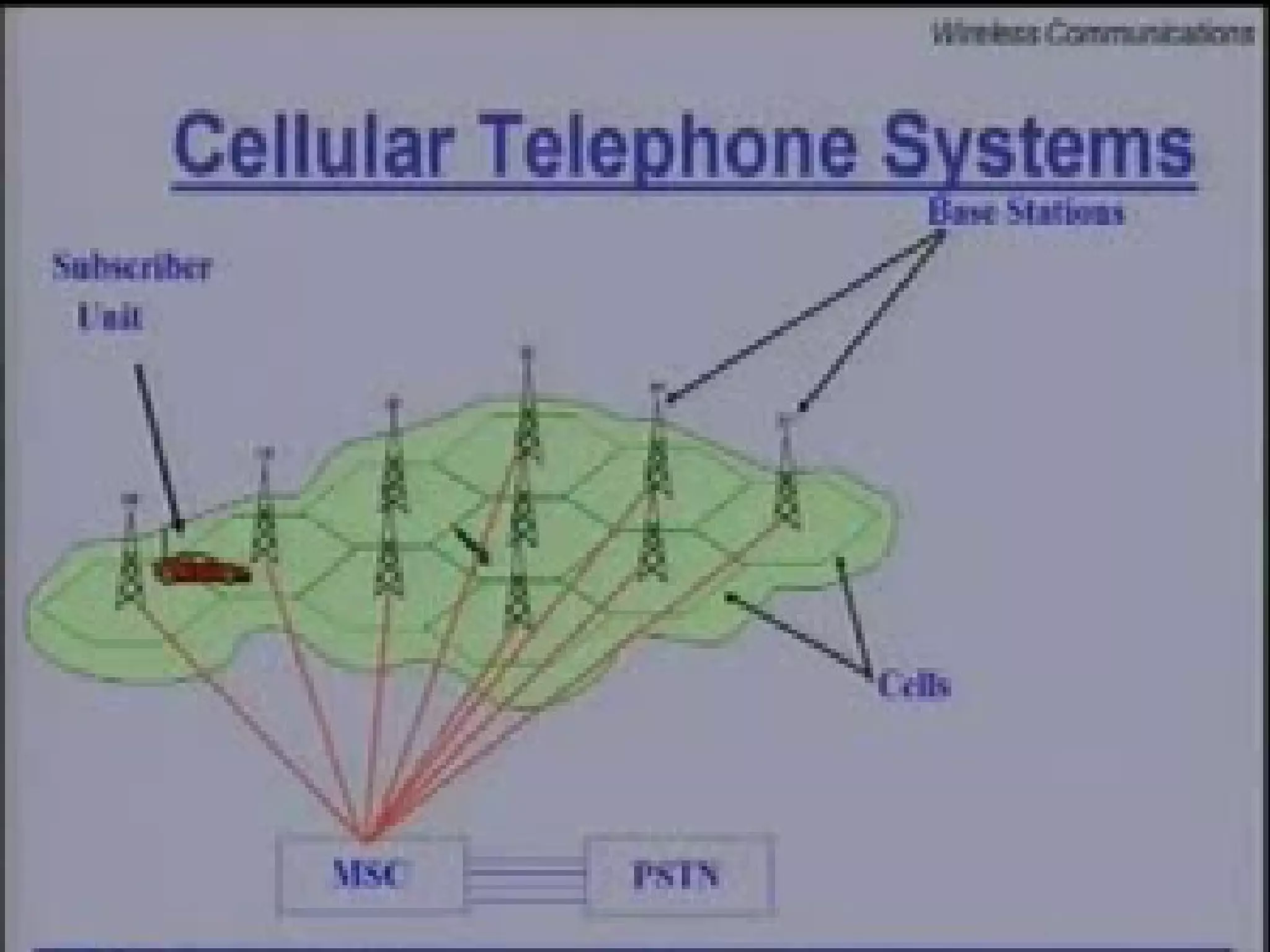
            Cellular Network
Introduction
   Early mobile system objective was to achieve a large
    coverage using single high power antenna
   Impossible to reuse the same frequencies in the same
    coverage area.
   For example, Bell mobile system in 1970 could support
    maximum of 12 simultaneous calls over a thousand square
    mile.
   The Govt regulatory could not make spectrum allocation
    proportion to the increasing demand
   Became imperative to restructure the telephone system to
    achieve high capacity with limited radio spectrum.
Cellular Concept
   Cellular concept was a major breakthrough in solving problem of spectrum
    and user capacity Offers high capacity without any major change in
    technology.
   Definition
    A cellular mobile communications system uses a large number of low-power
    wireless transmitters to create cells—the basic geographic service area of a
    wireless communications system. Variable power levels allow cells to be
    sized according to the subscriber density and demand within a particular
    region. As mobile users travel from cell to cell, their conversations are
    handed off between cells to maintain seamless service. Channels
    (frequencies) used in one cell can be reused in another cell some distance
    away. Cells can be added to accommodate growth, creating new cells in un
    served areas or overlaying cells in existing areas.
Cellular System Architecture

   To improve the quality of service and to support more users
    in their systems. Because the amount of frequency spectrum
    available for mobile cellular use was limited, efficient use of
    the required frequencies was needed for mobile cellular
    coverage.
   Rural and urban regions are divided into areas according to
    specific provisioning guidelines. Deployment parameters,
    such as amount of cell-splitting and cell sizes, are
    determined by engineers experienced in cellular system
    architecture.
Cellular System Architecture


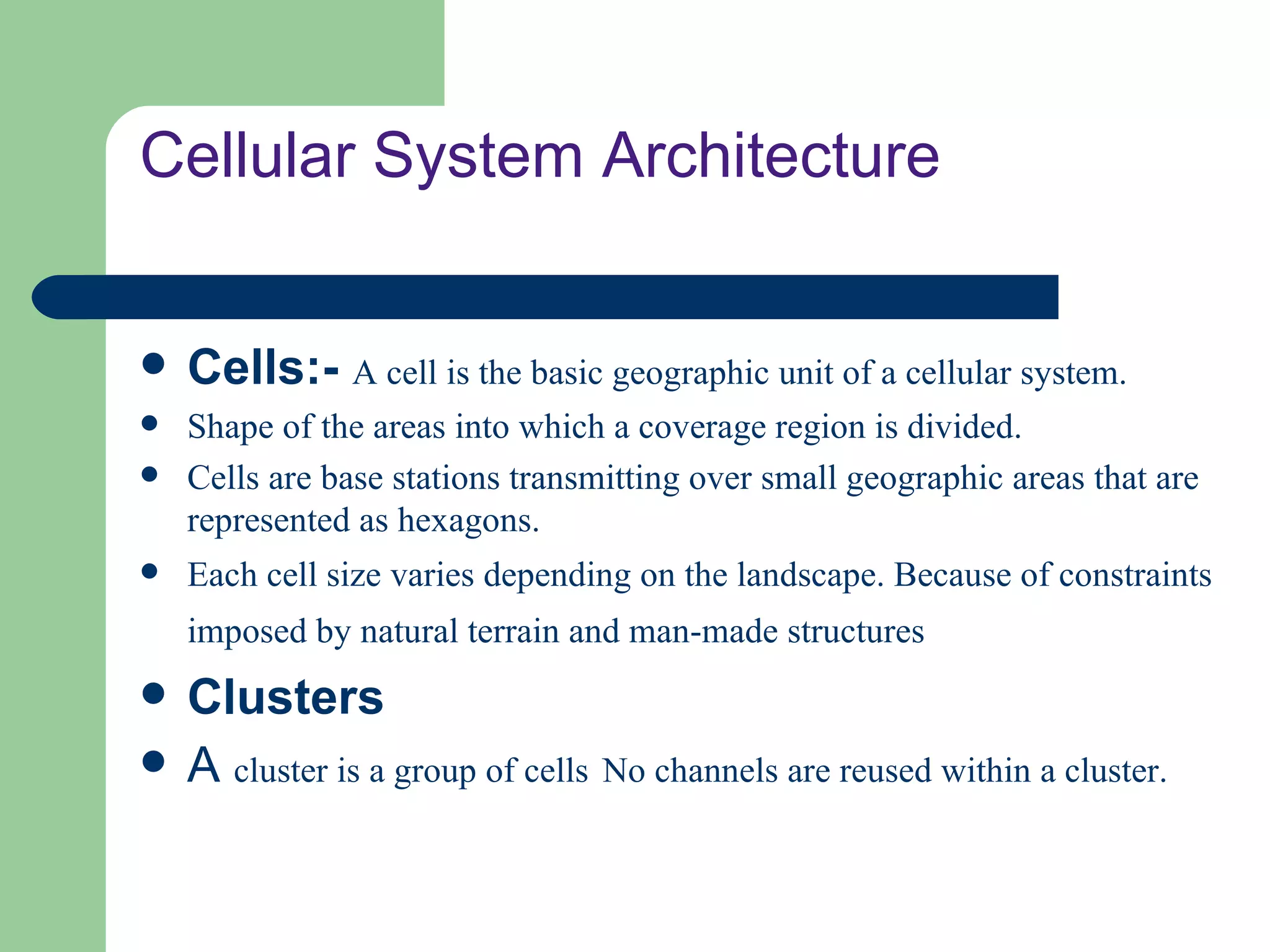
   Cells:- A cell is the basic geographic unit of a cellular system.
   Shape of the areas into which a coverage region is divided.
   Cells are base stations transmitting over small geographic areas that are
    represented as hexagons.
   Each cell size varies depending on the landscape. Because of constraints
    imposed by natural terrain and man-made structures
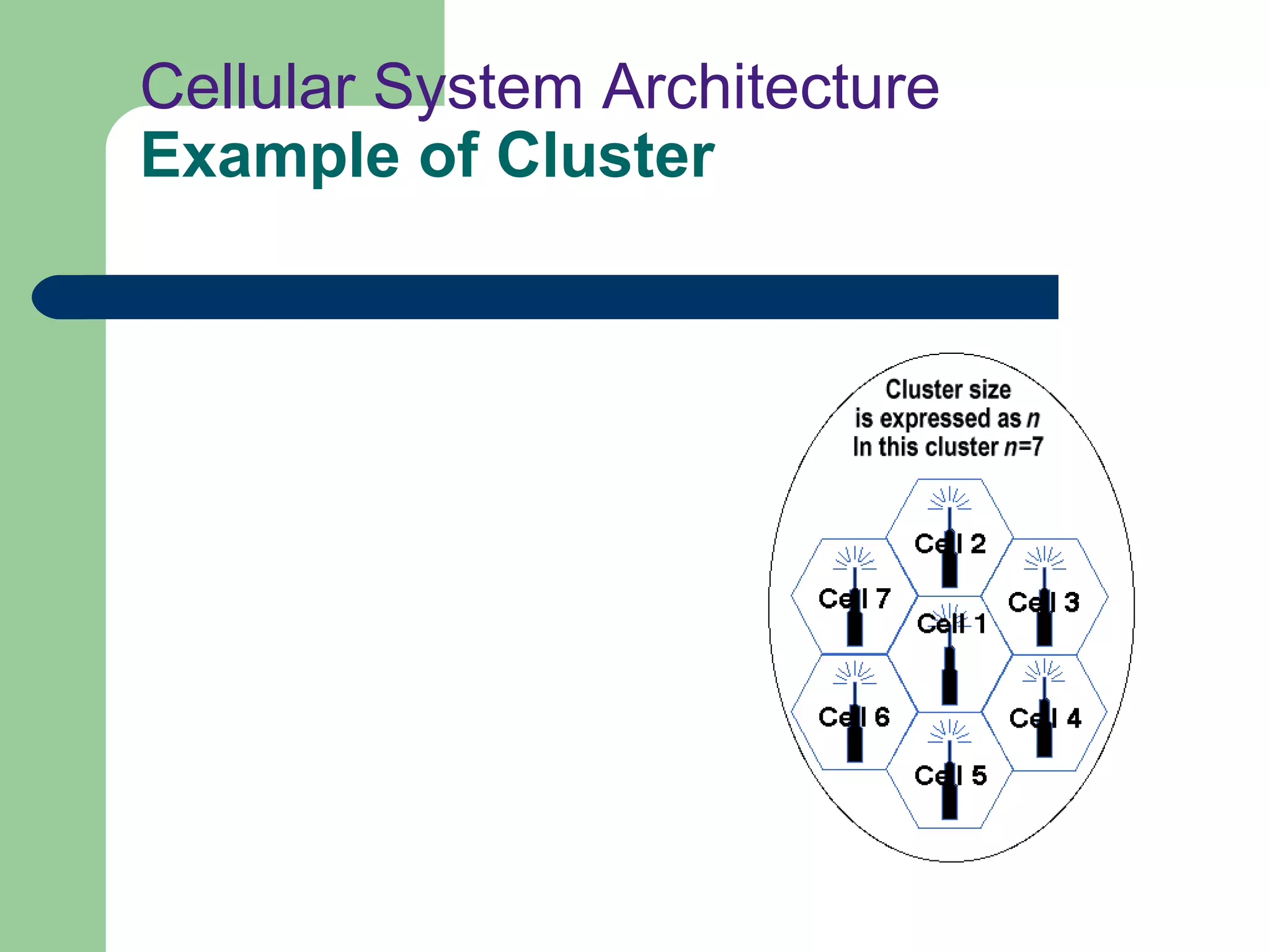
   Clusters
   A cluster is a group of cells No channels are reused within a cluster.
Cellular System Architecture
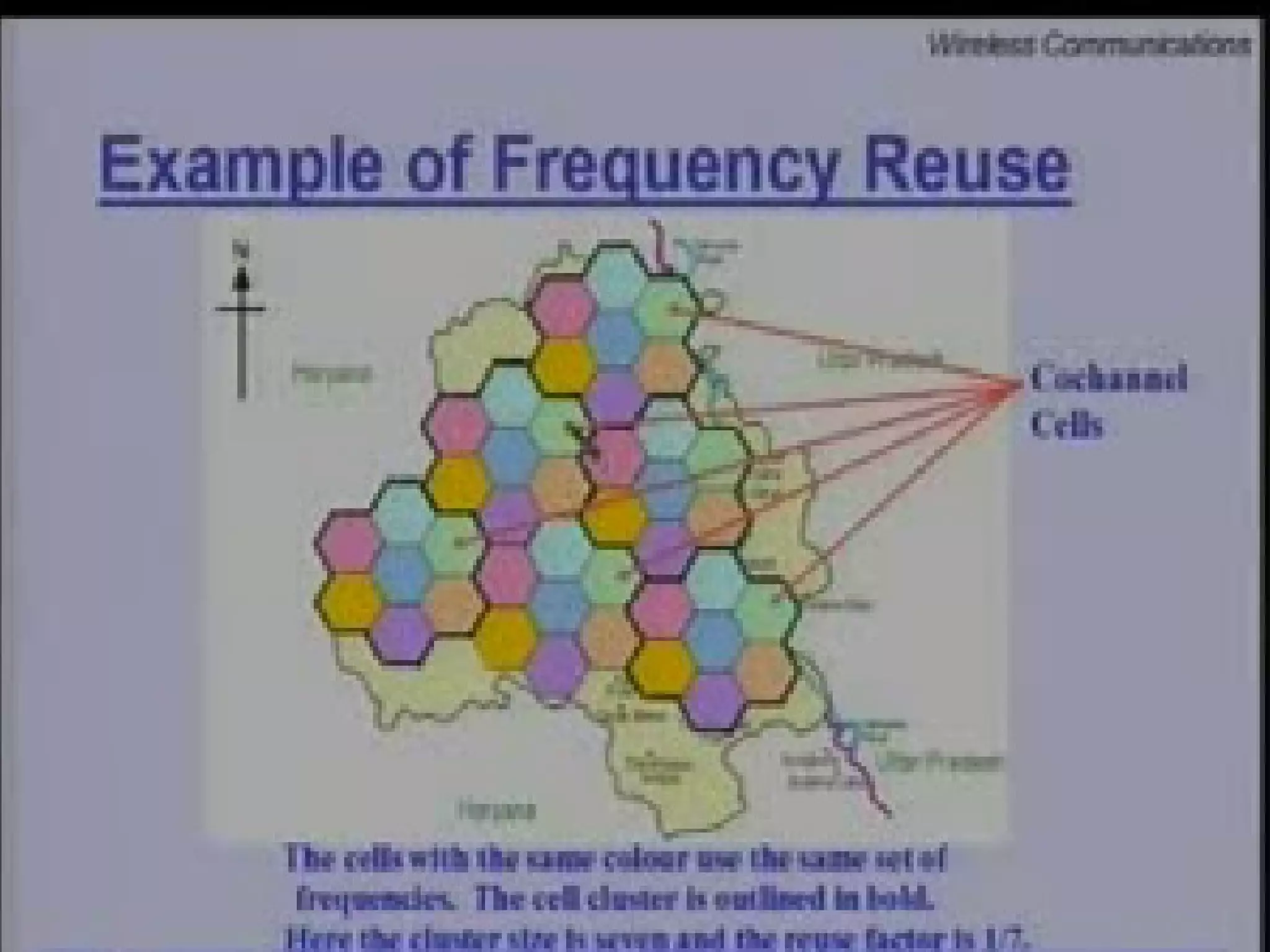
Example of Cluster
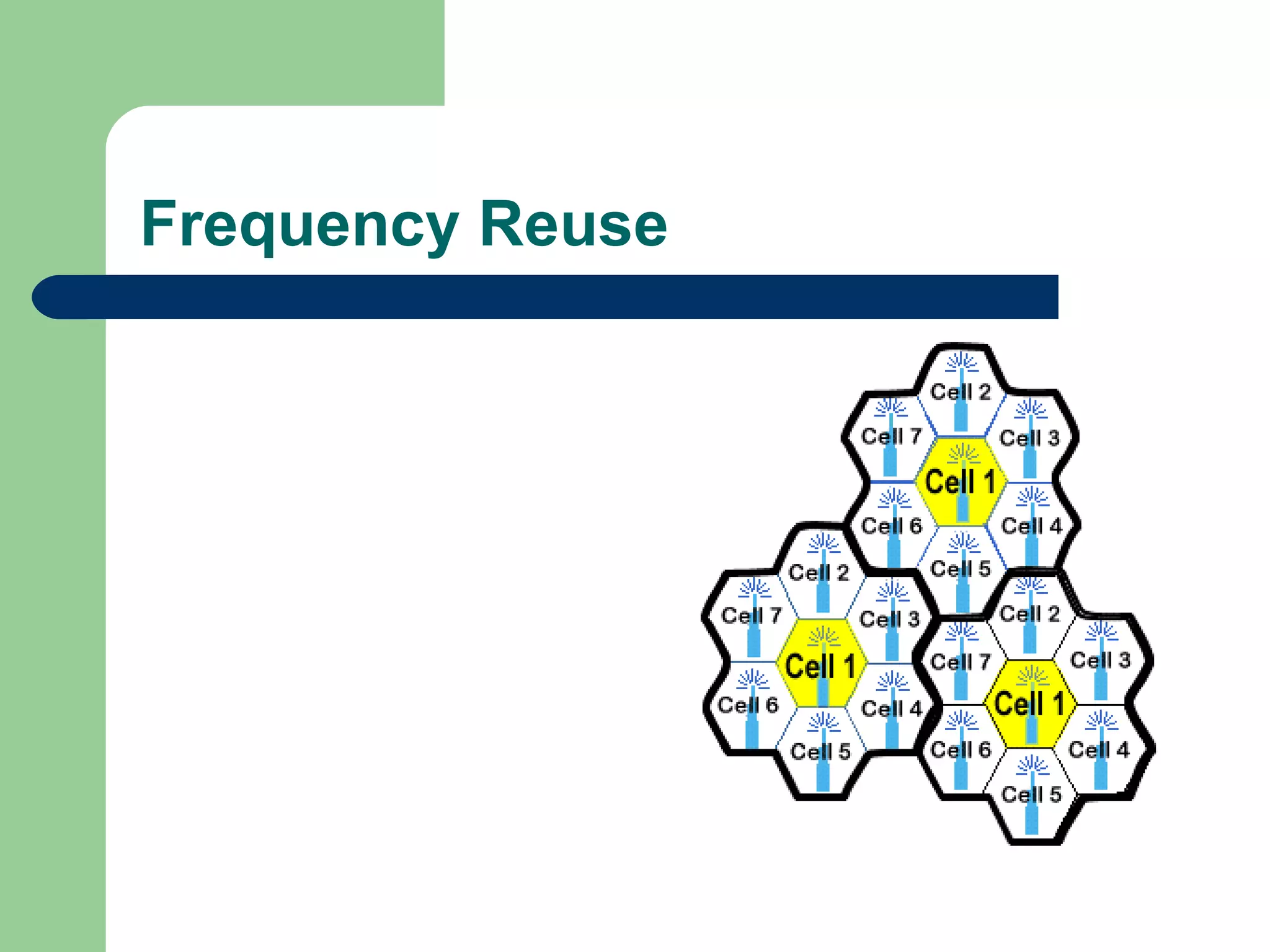
Frequency Reuse
   Small number of radio channel frequencies were available for mobile systems,
    The solution the industry adopted was called frequency planning or frequency
    reuse. Frequency reuse was implemented by restructuring the mobile telephone
    system architecture into the cellular concept.

   The concept of frequency reuse is based on assigning to each cell a group of
    radio channels used within a small geographic area. Cells are assigned a group
    of channels that is completely different from neighboring cells. The coverage
    area of cells is called the footprint. This footprint is limited by a boundary so
    that the same group of channels can be used in different cells that are far enough
    away from each other so that their frequencies do not interfere
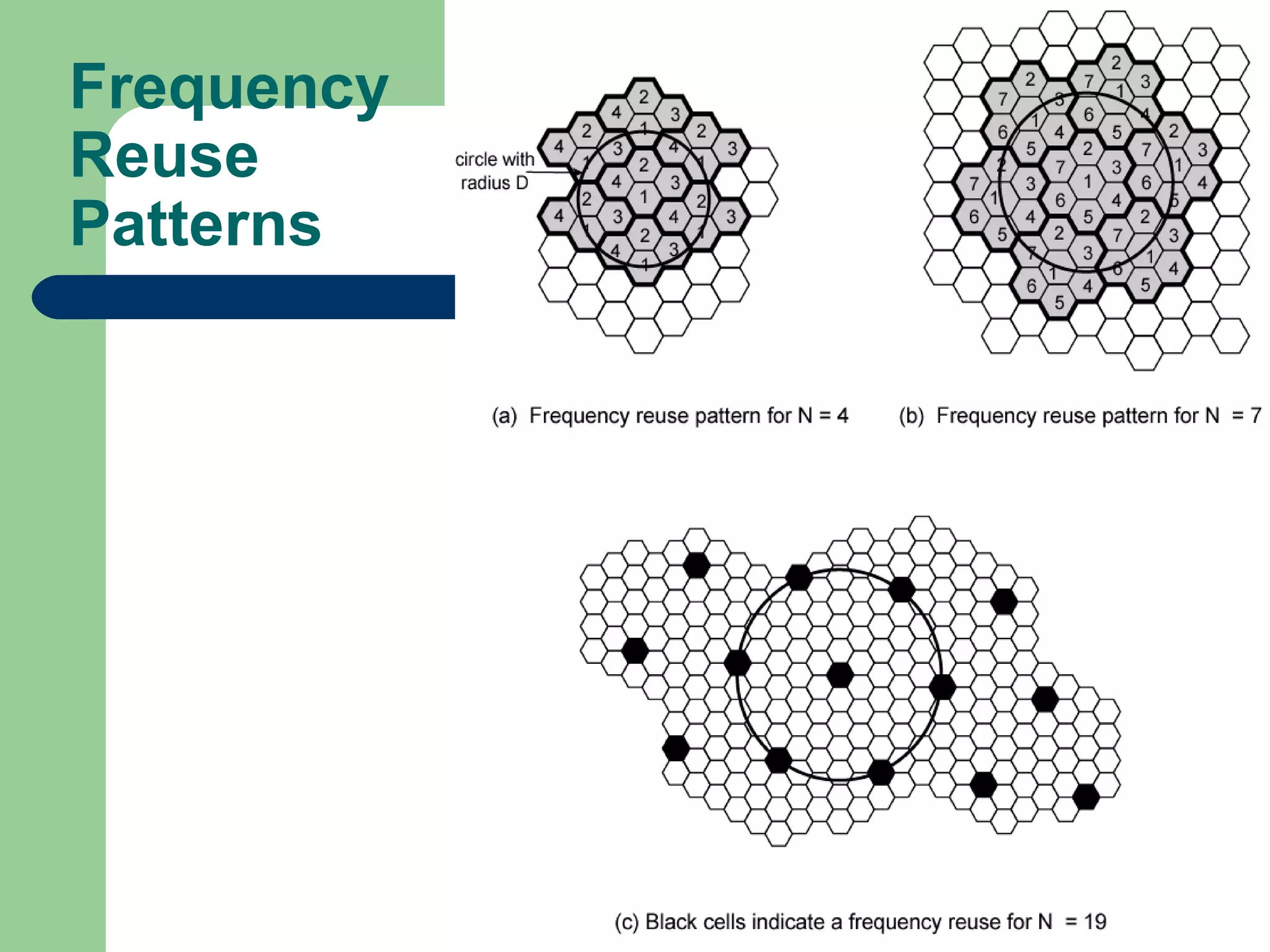
Frequency Reuse
Frequency
Reuse
Patterns
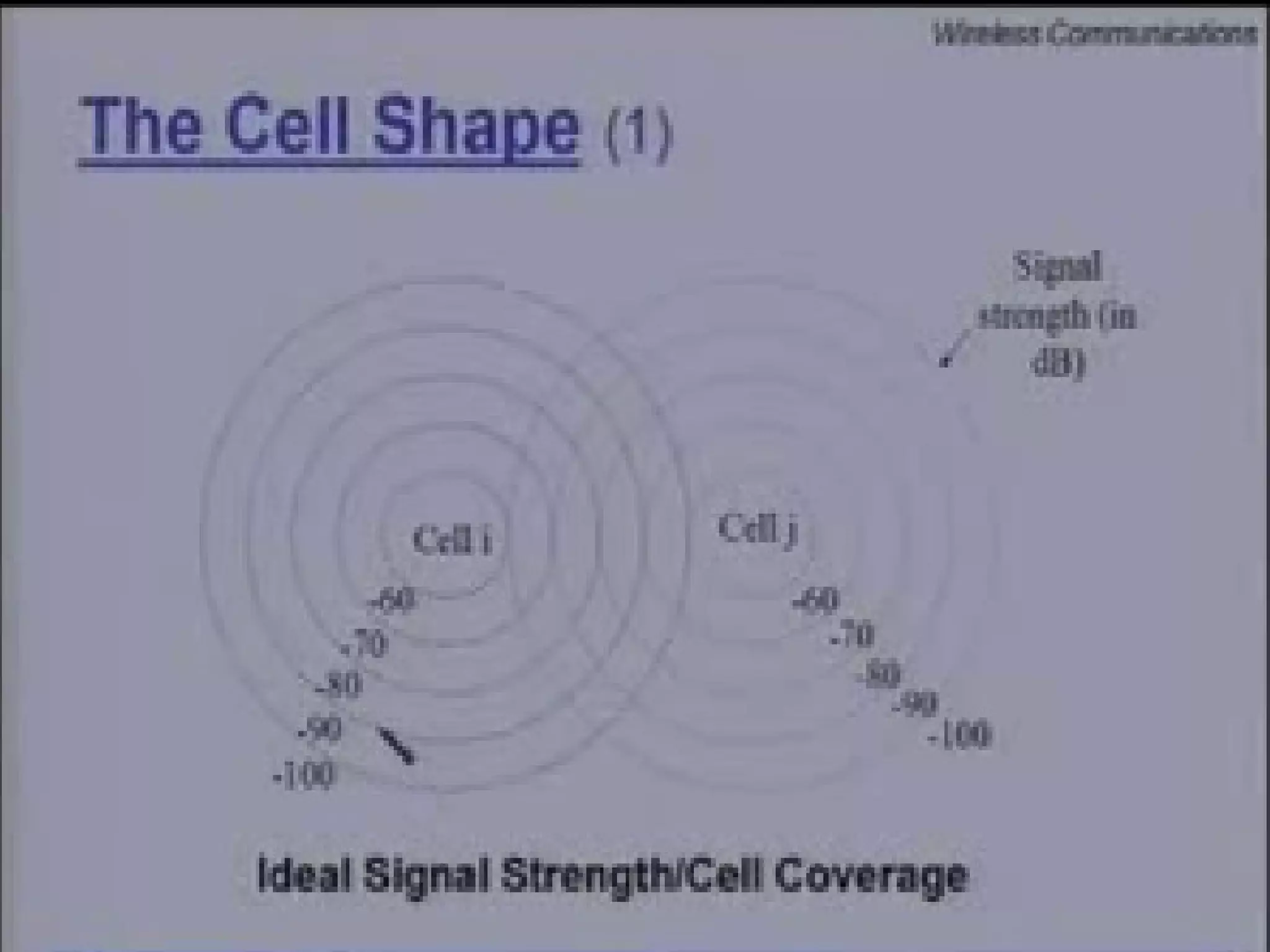
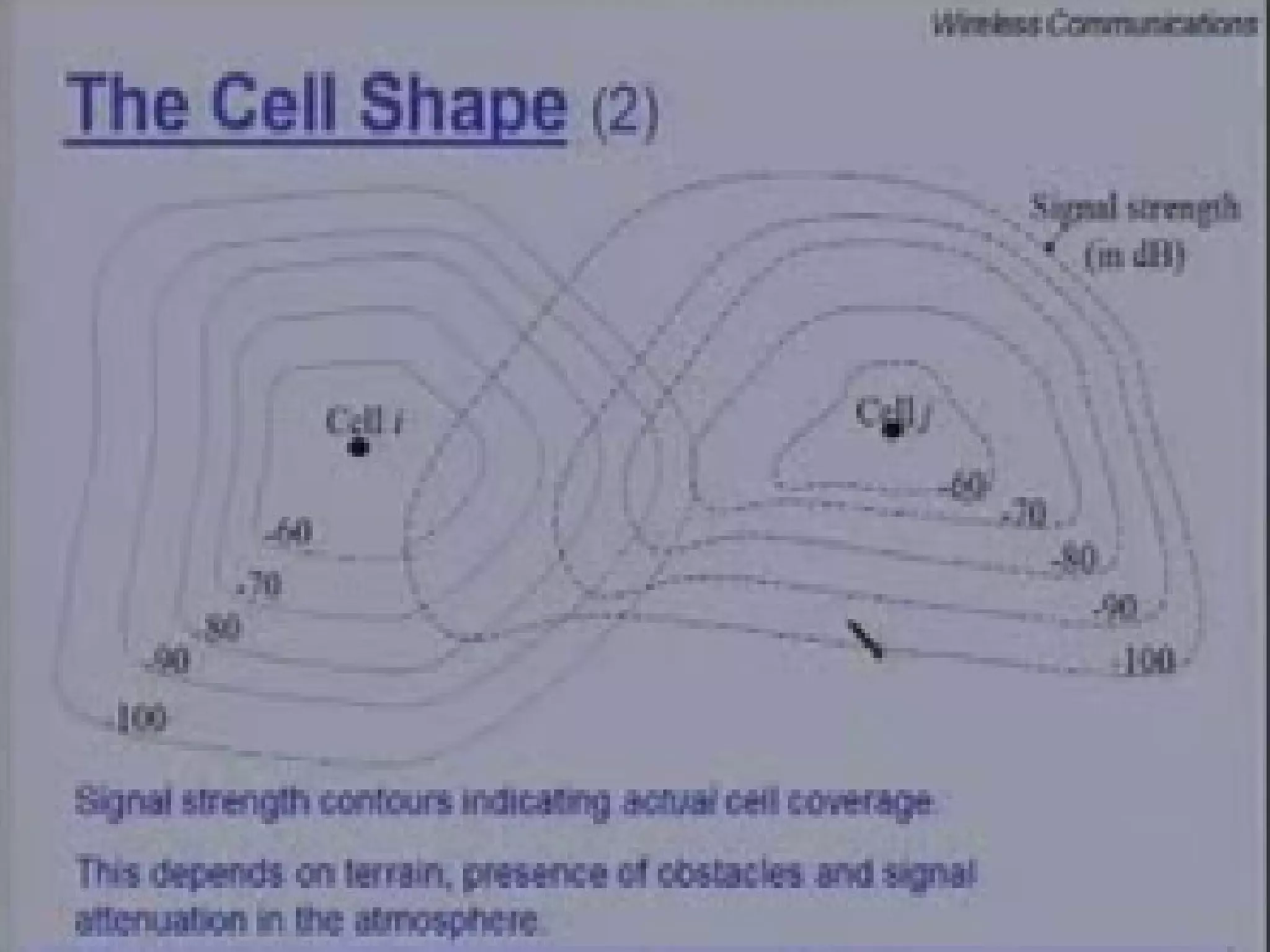
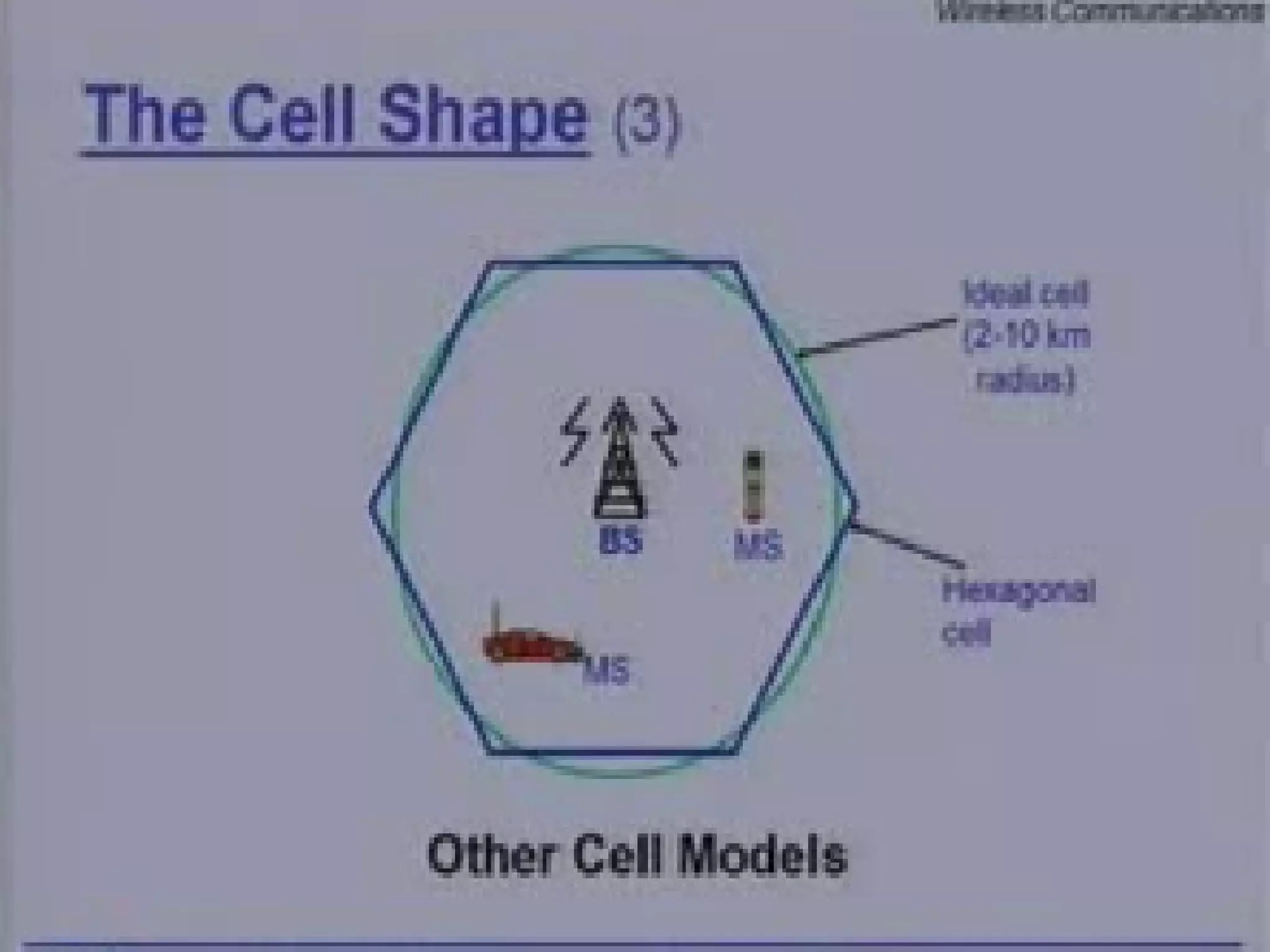
   The hexagonal shape representing a cell is
    conceptual and simplistic model of coverage.
   The actual radio coverage is known as the footprint
    and is determined from field measurement,
    propagation prediction models
    –   However a regular shape is needed for systematic system
        design and adaptation to future growth.
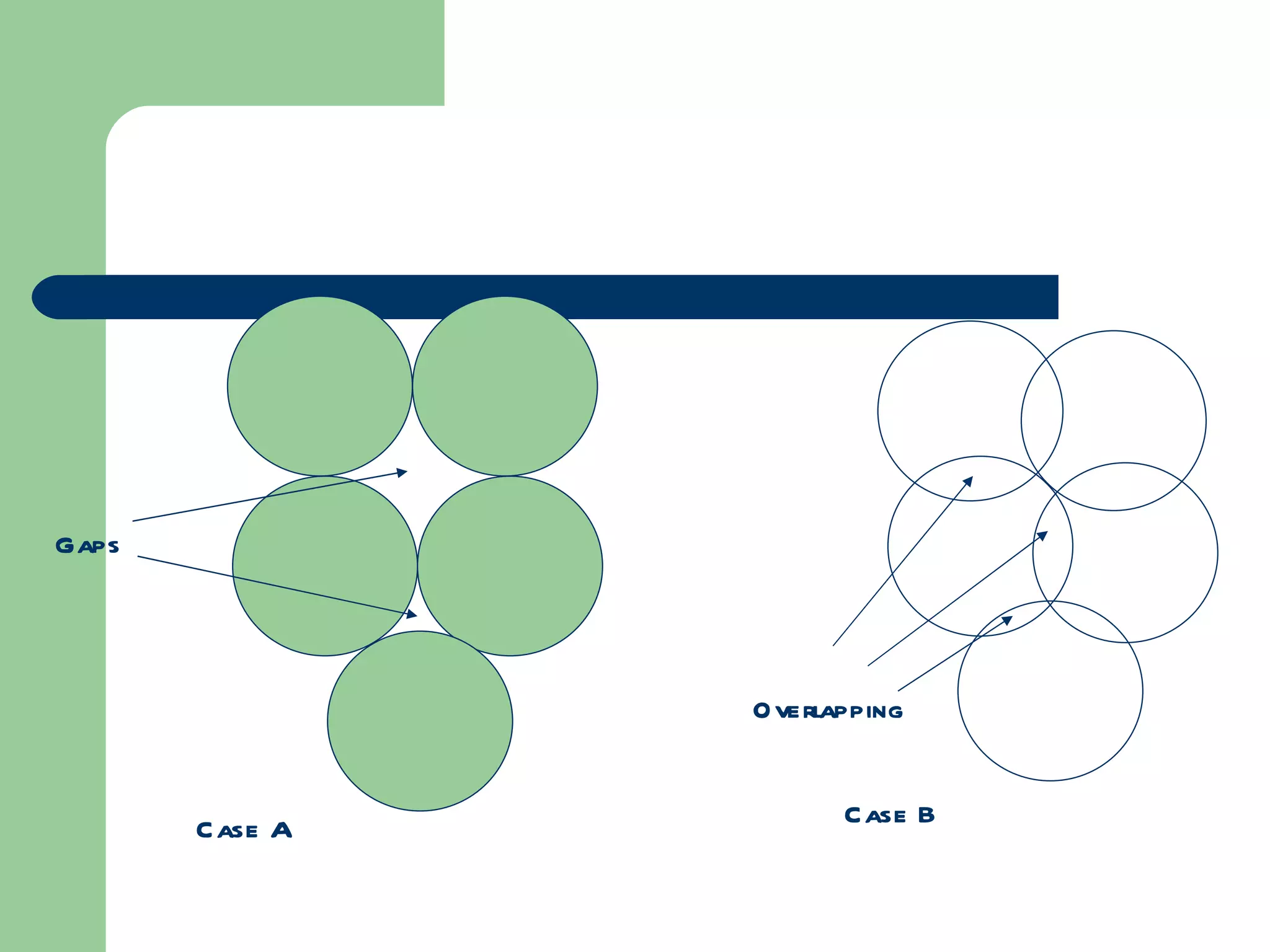
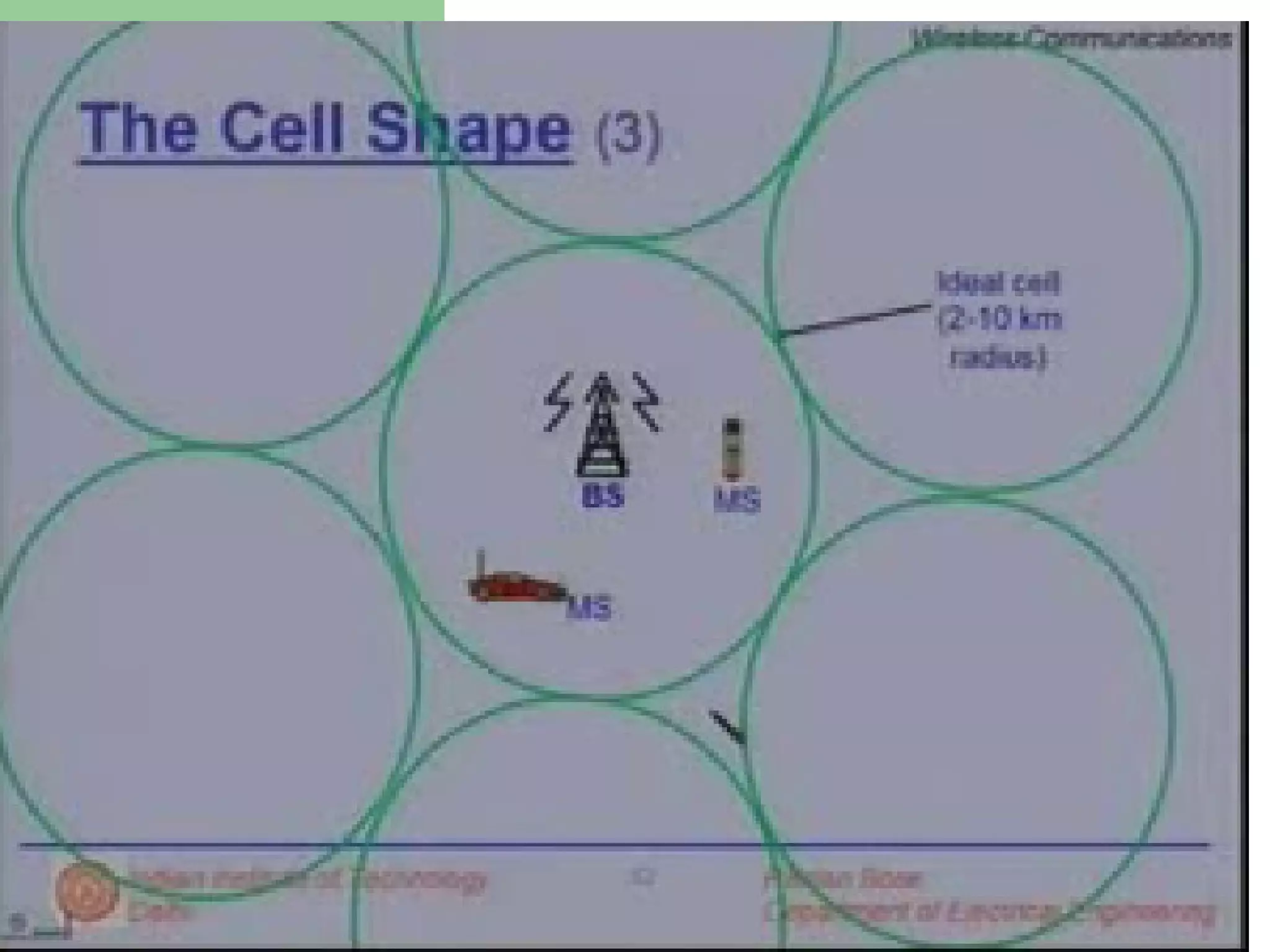
   It might be natural to choose a circle to represent
    coverage but adjacent circles cannot be overlaid upon
    a map without leaving gaps or creating overlapping.
Gaps


                Overlapping


       Case A         Case B
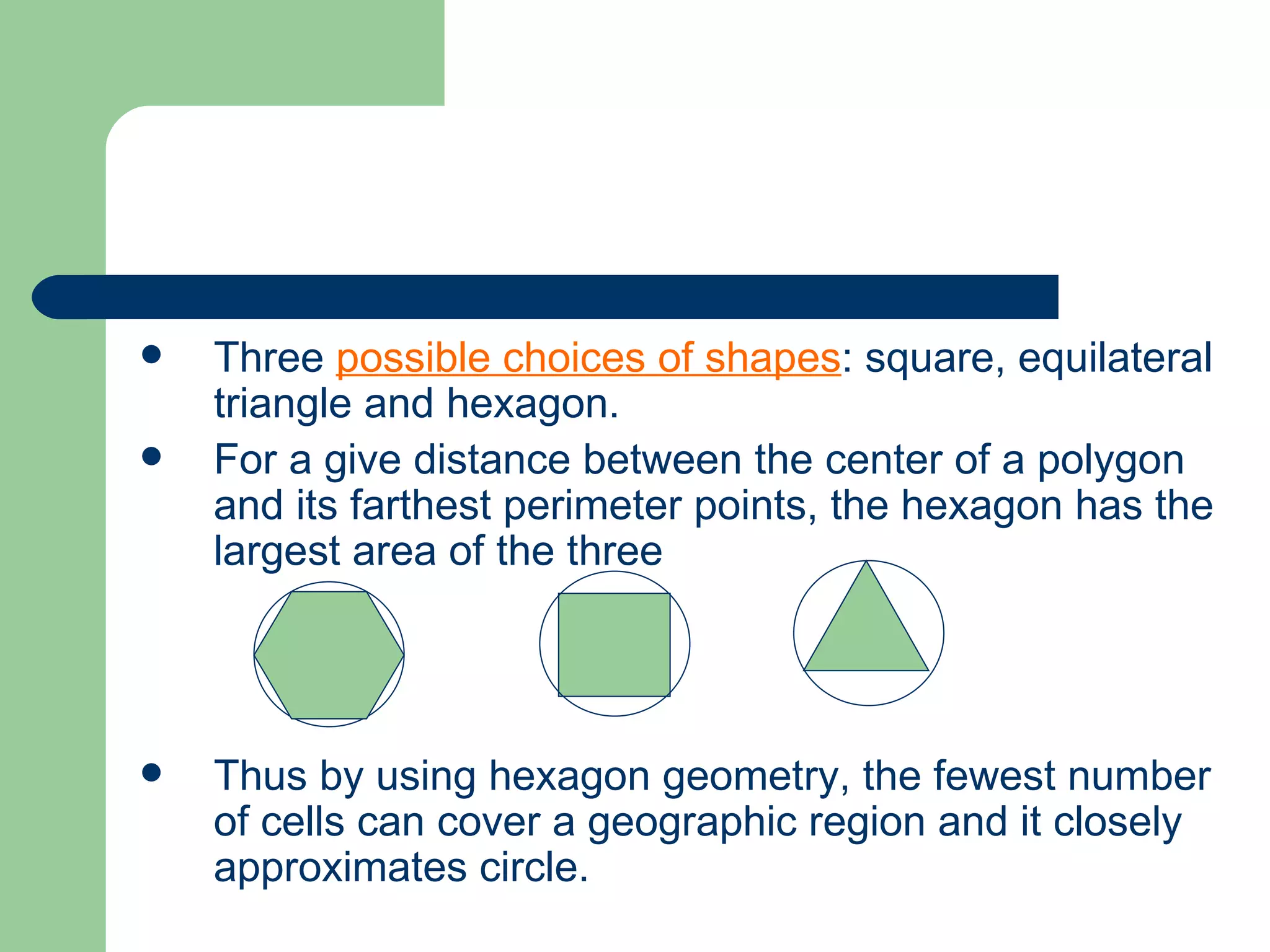
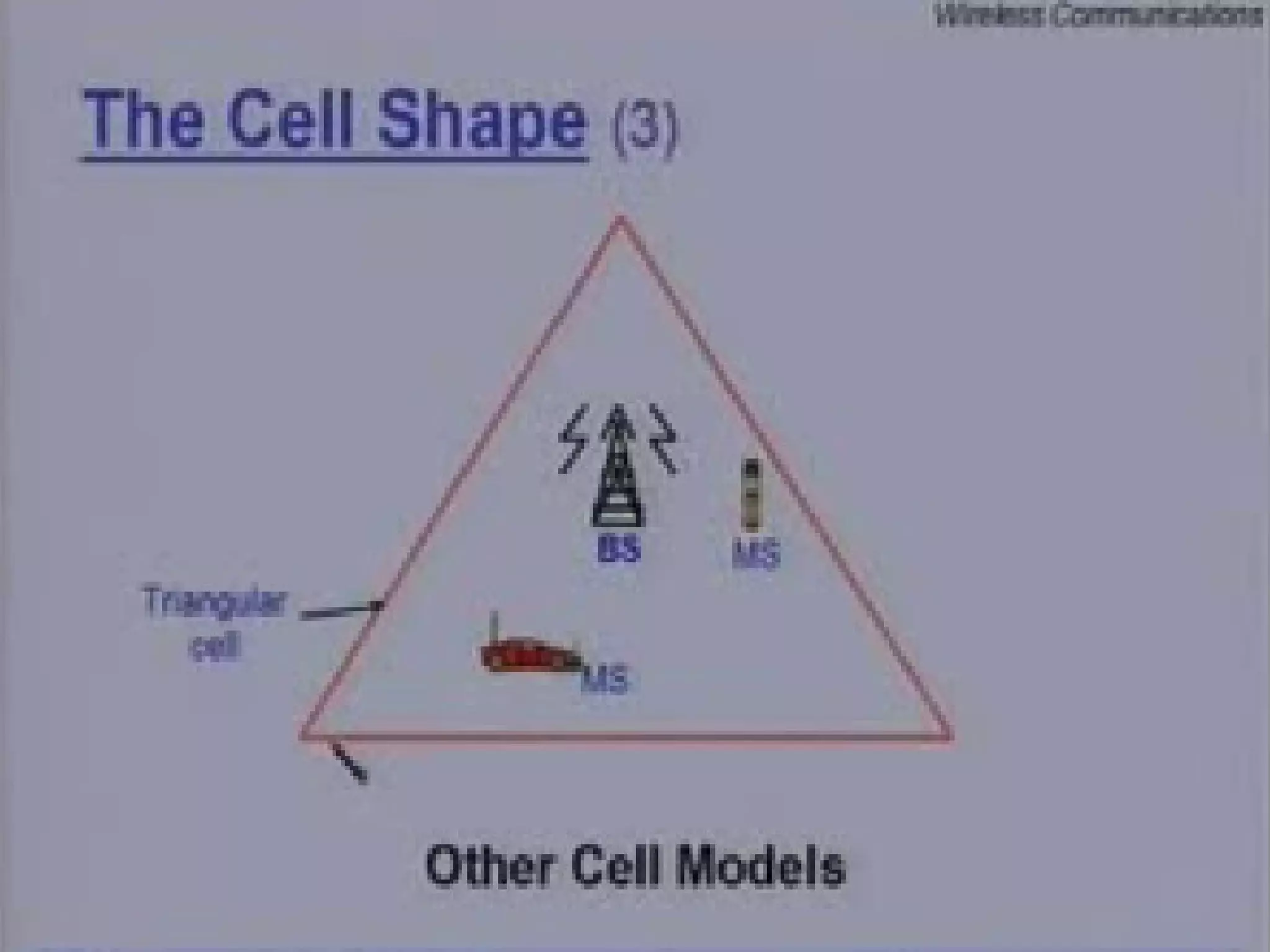
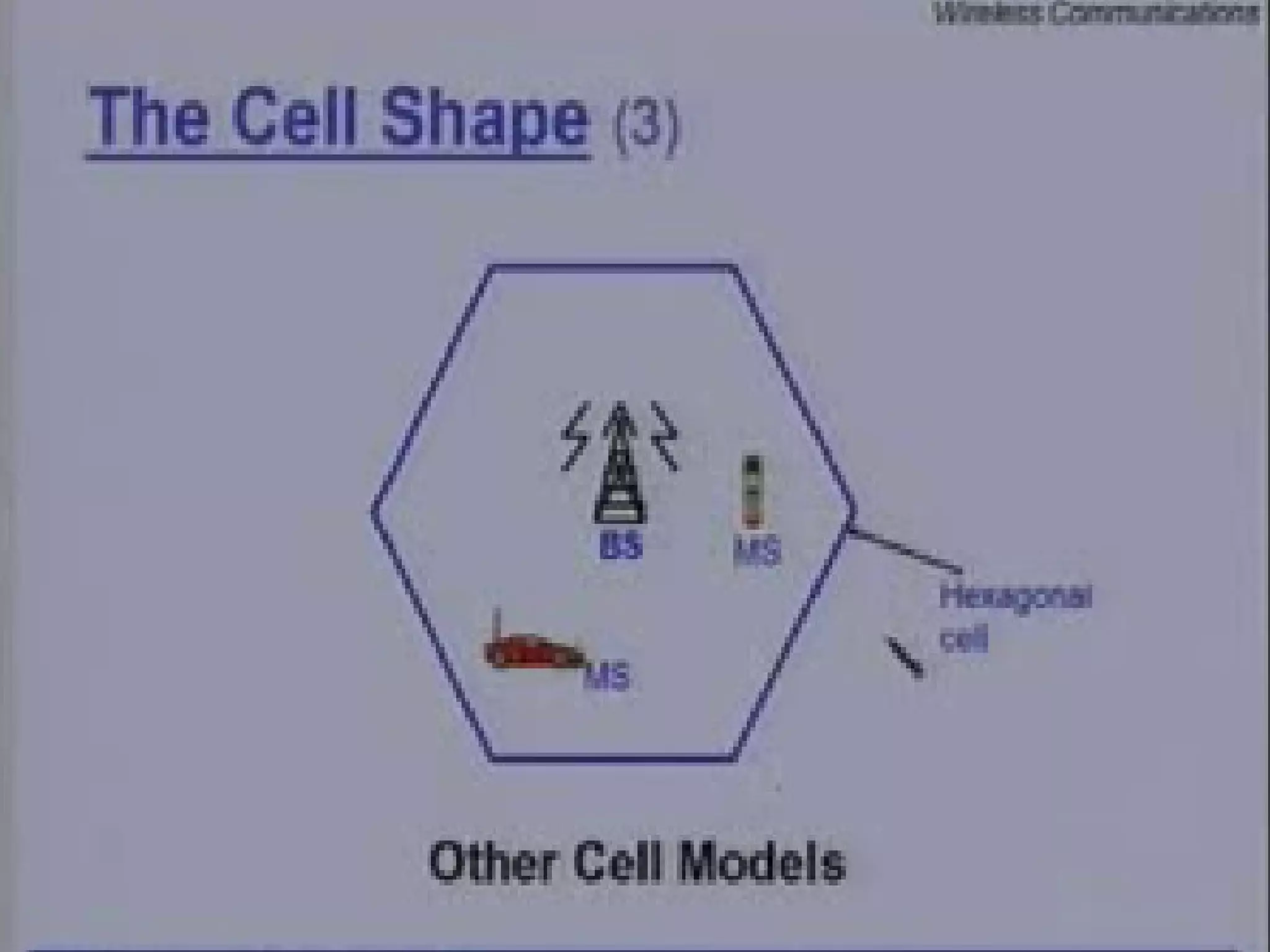
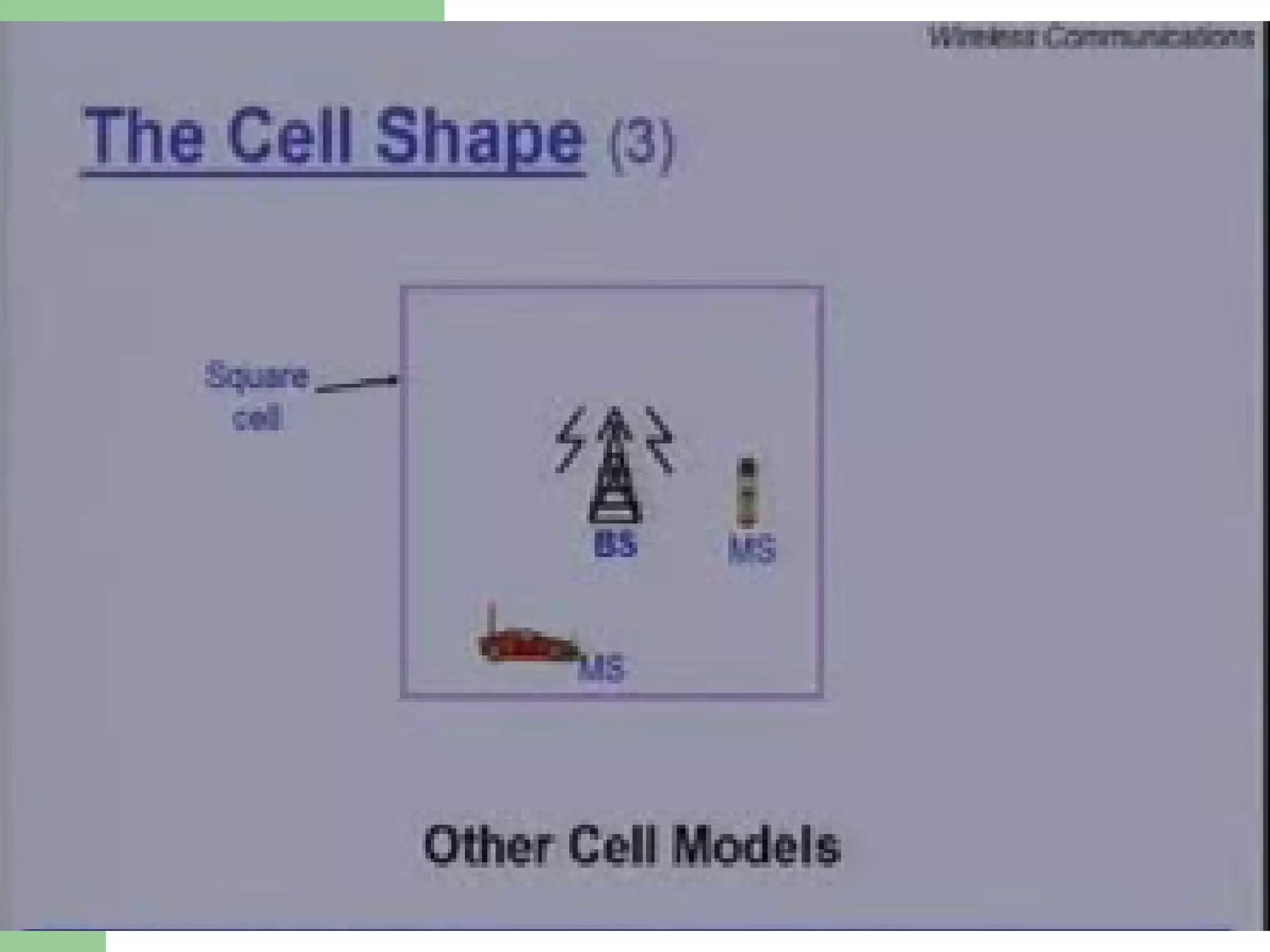
   Three possible choices of shapes: square, equilateral
    triangle and hexagon.
   For a give distance between the center of a polygon
    and its farthest perimeter points, the hexagon has the
    largest area of the three


   Thus by using hexagon geometry, the fewest number
    of cells can cover a geographic region and it closely
    approximates circle.
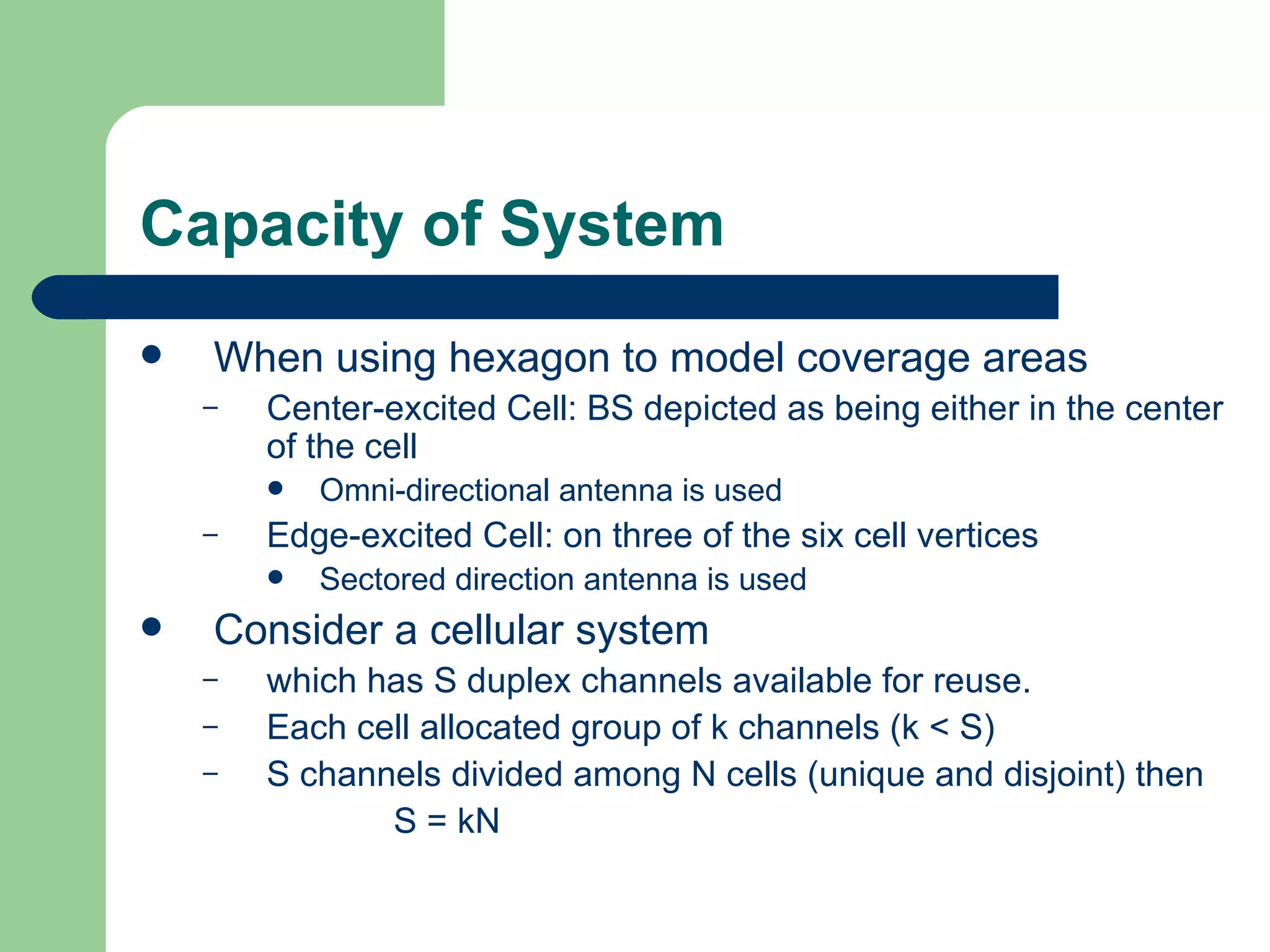
Capacity of System
   When using hexagon to model coverage areas
    –   Center-excited Cell: BS depicted as being either in the center
        of the cell
           Omni-directional antenna is used
    –   Edge-excited Cell: on three of the six cell vertices
           Sectored direction antenna is used
   Consider a cellular system
    –   which has S duplex channels available for reuse.
    –   Each cell allocated group of k channels (k < S)
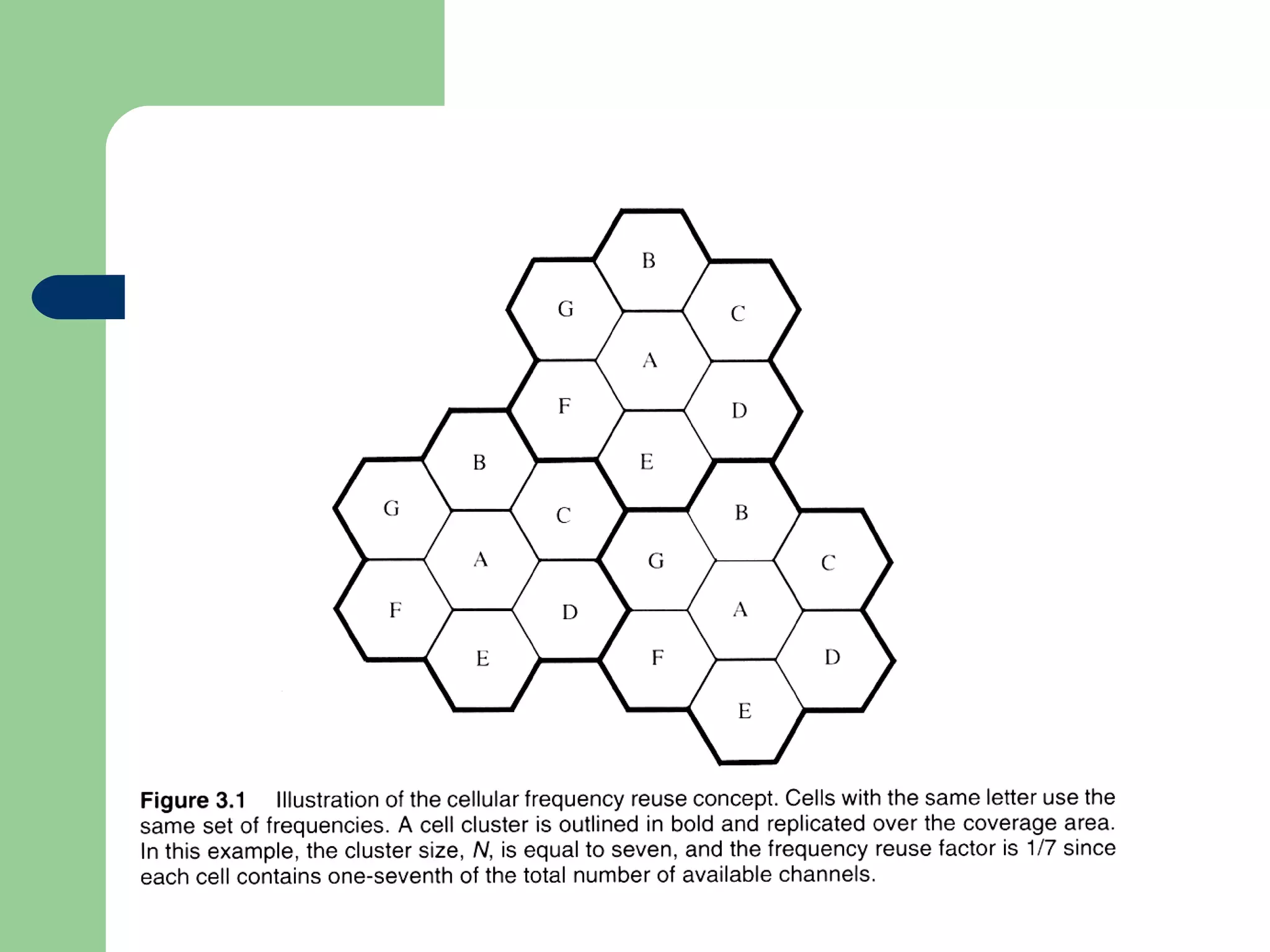
    –   S channels divided among N cells (unique and disjoint) then
               S = kN
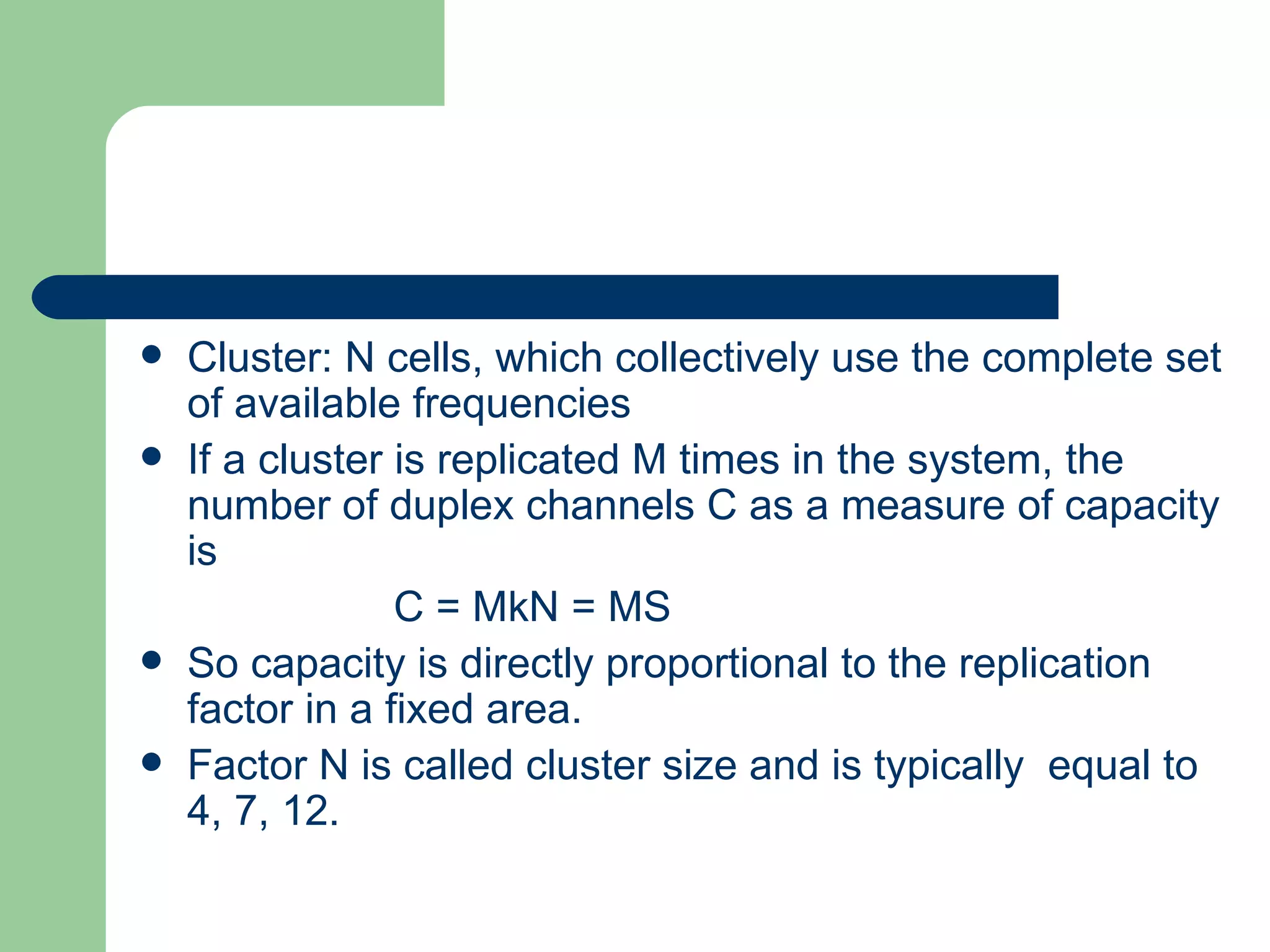
   Cluster: N cells, which collectively use the complete set
    of available frequencies
   If a cluster is replicated M times in the system, the
    number of duplex channels C as a measure of capacity
    is
                 C = MkN = MS
   So capacity is directly proportional to the replication
    factor in a fixed area.
   Factor N is called cluster size and is typically equal to
    4, 7, 12.
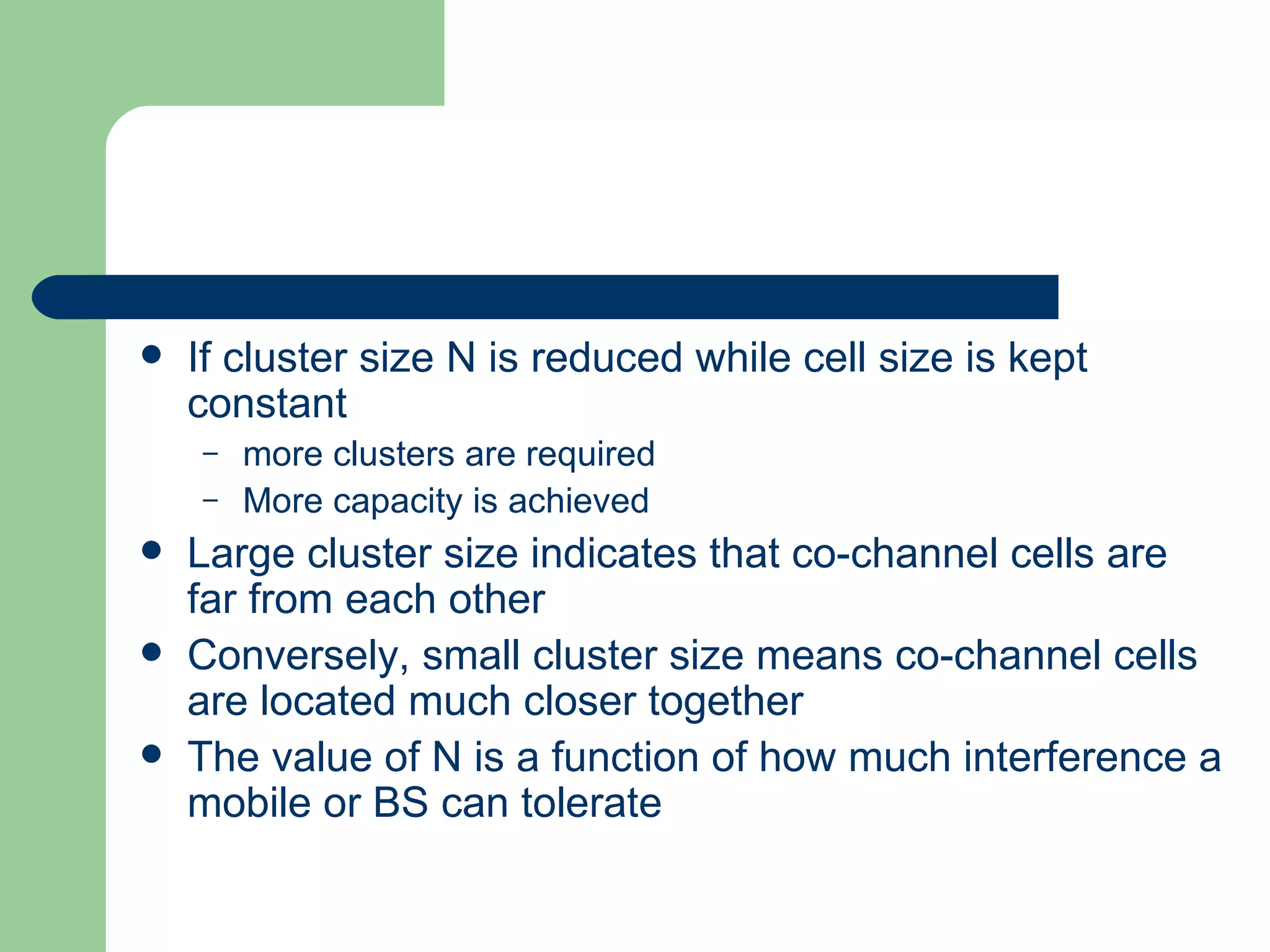
   If cluster size N is reduced while cell size is kept
    constant
    –   more clusters are required
    –   More capacity is achieved
   Large cluster size indicates that co-channel cells are
    far from each other
   Conversely, small cluster size means co-channel cells
    are located much closer together
   The value of N is a function of how much interference a
    mobile or BS can tolerate
   Clusters are inversely proportion to N
    –   Capacity is directly proportional to Clusters
    –   Thus frequency reuse factor is given by 1/N.
   In last fig, each hexagon has exactly six
    equidistant neighbors and that the lines joining
    the centers of any cell and its neighbors are
    separated by multiple of 60 degrees.
    –   There are only certain cluster sizes and layouts
        possible
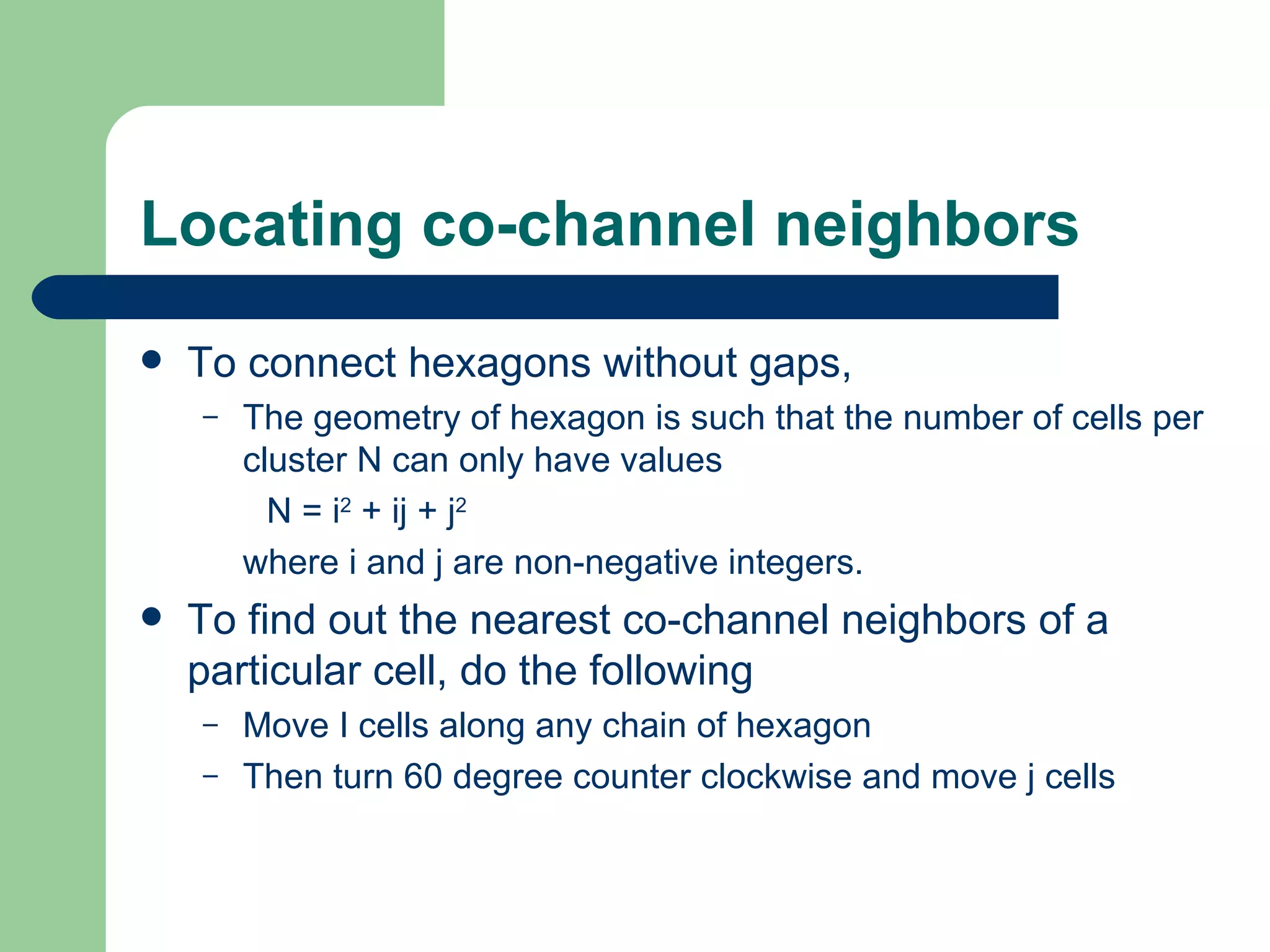
Locating co-channel neighbors
   To connect hexagons without gaps,
    –   The geometry of hexagon is such that the number of cells per
        cluster N can only have values
          N = i2 + ij + j2
        where i and j are non-negative integers.
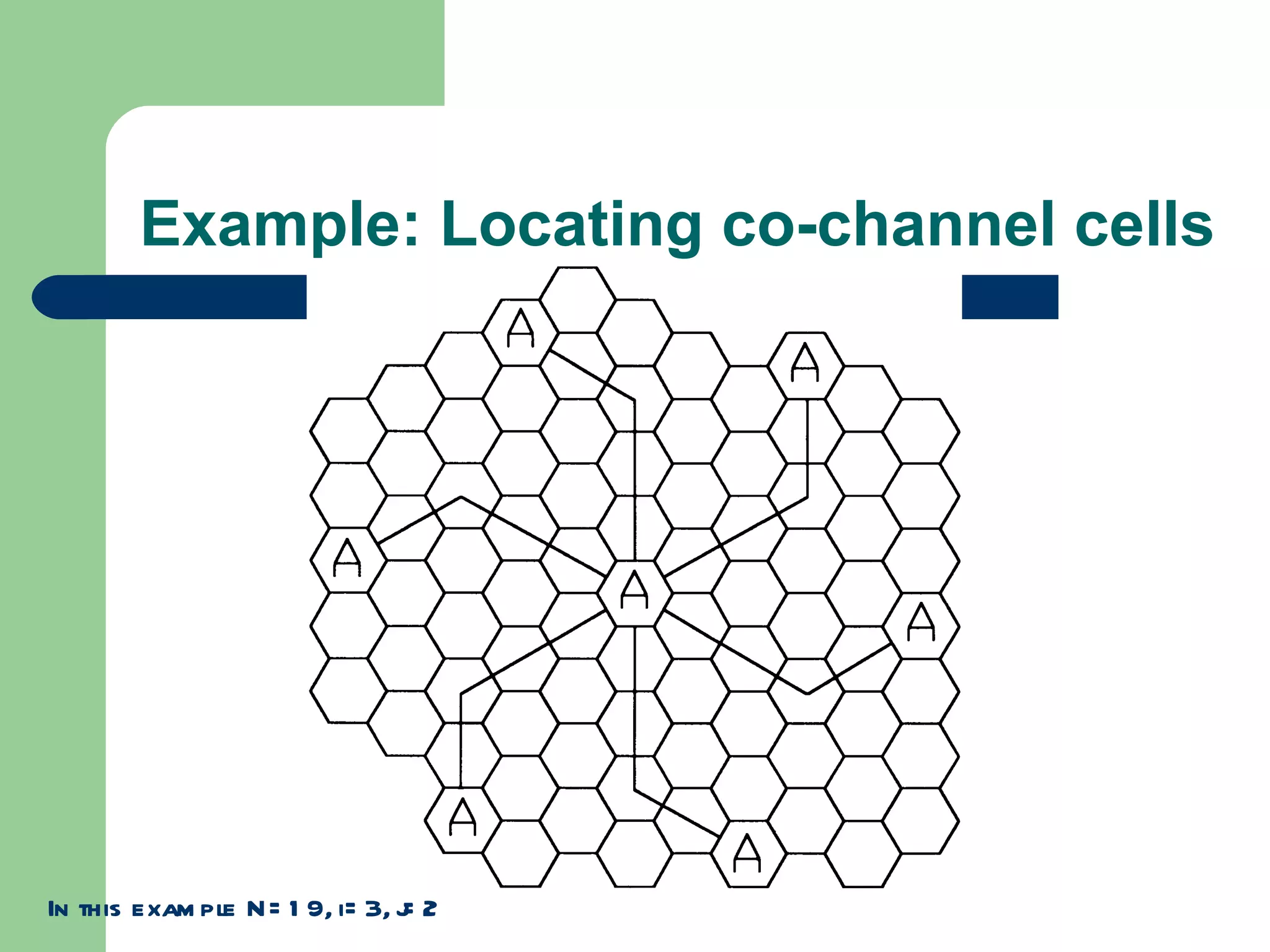
   To find out the nearest co-channel neighbors of a
    particular cell, do the following
    –   Move I cells along any chain of hexagon
    –   Then turn 60 degree counter clockwise and move j cells
Example: Locating co-channel cells


In this exam ple N= 1 9, i= 3, j 2
                               =
Example
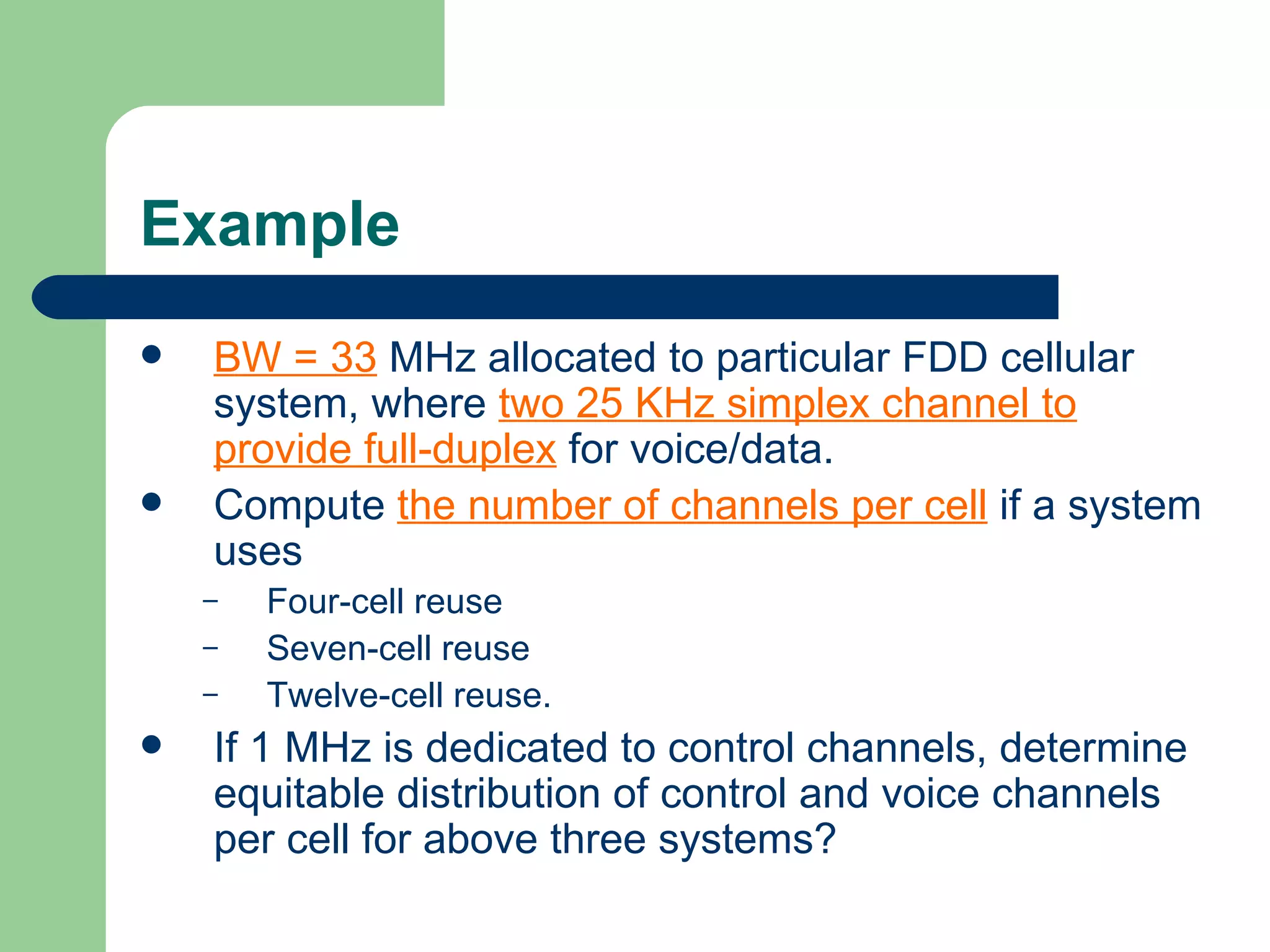
   BW = 33 MHz allocated to particular FDD cellular
    system, where two 25 KHz simplex channel to
    provide full-duplex for voice/data.
   Compute the number of channels per cell if a system
    uses
    –   Four-cell reuse
    –   Seven-cell reuse
    –   Twelve-cell reuse.
   If 1 MHz is dedicated to control channels, determine
    equitable distribution of control and voice channels
    per cell for above three systems?
Solution: Part I
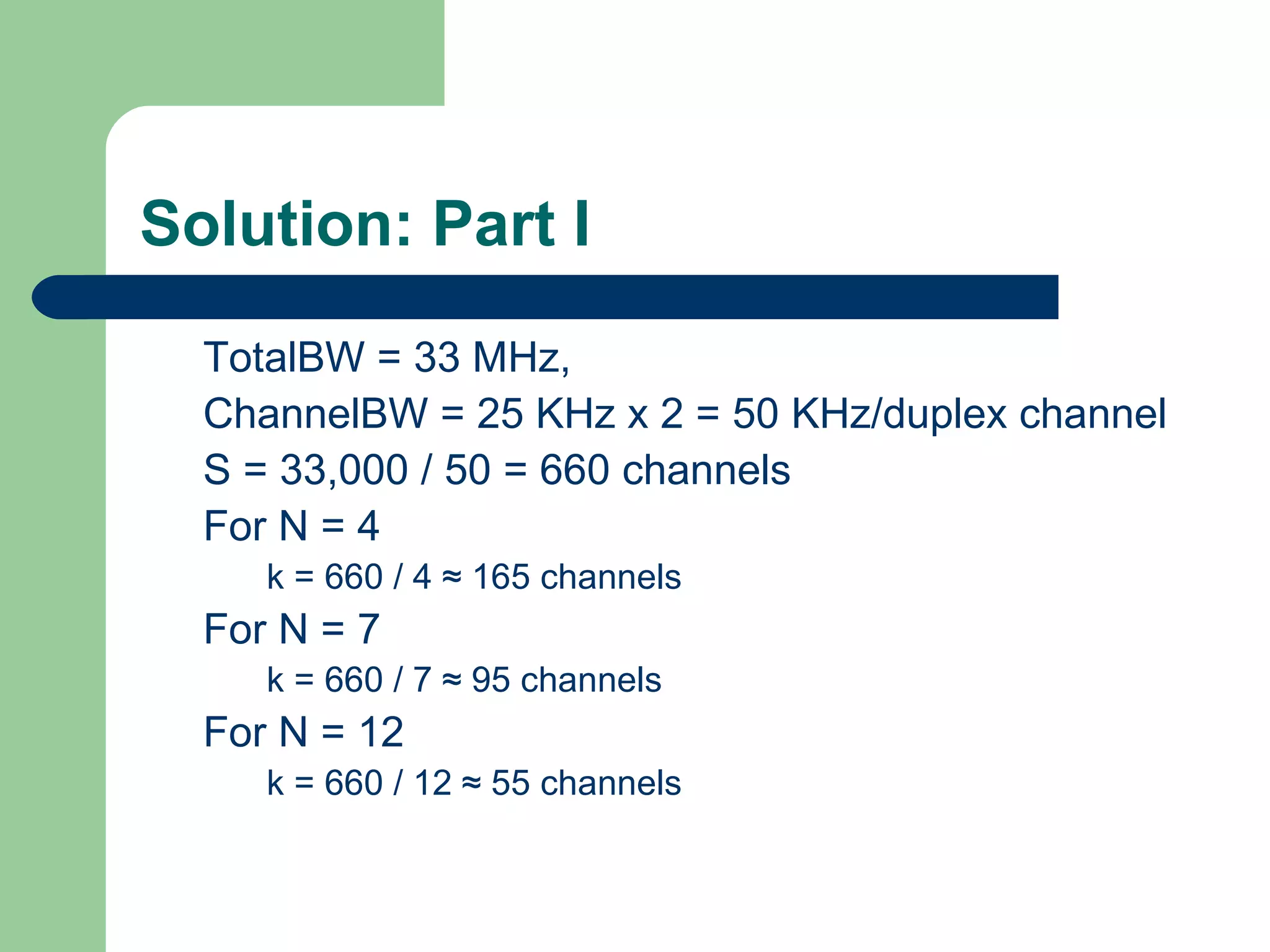
  TotalBW = 33 MHz,
  ChannelBW = 25 KHz x 2 = 50 KHz/duplex channel
  S = 33,000 / 50 = 660 channels
  For N = 4
     k = 660 / 4 ≈ 165 channels
  For N = 7
     k = 660 / 7 ≈ 95 channels
  For N = 12
     k = 660 / 12 ≈ 55 channels
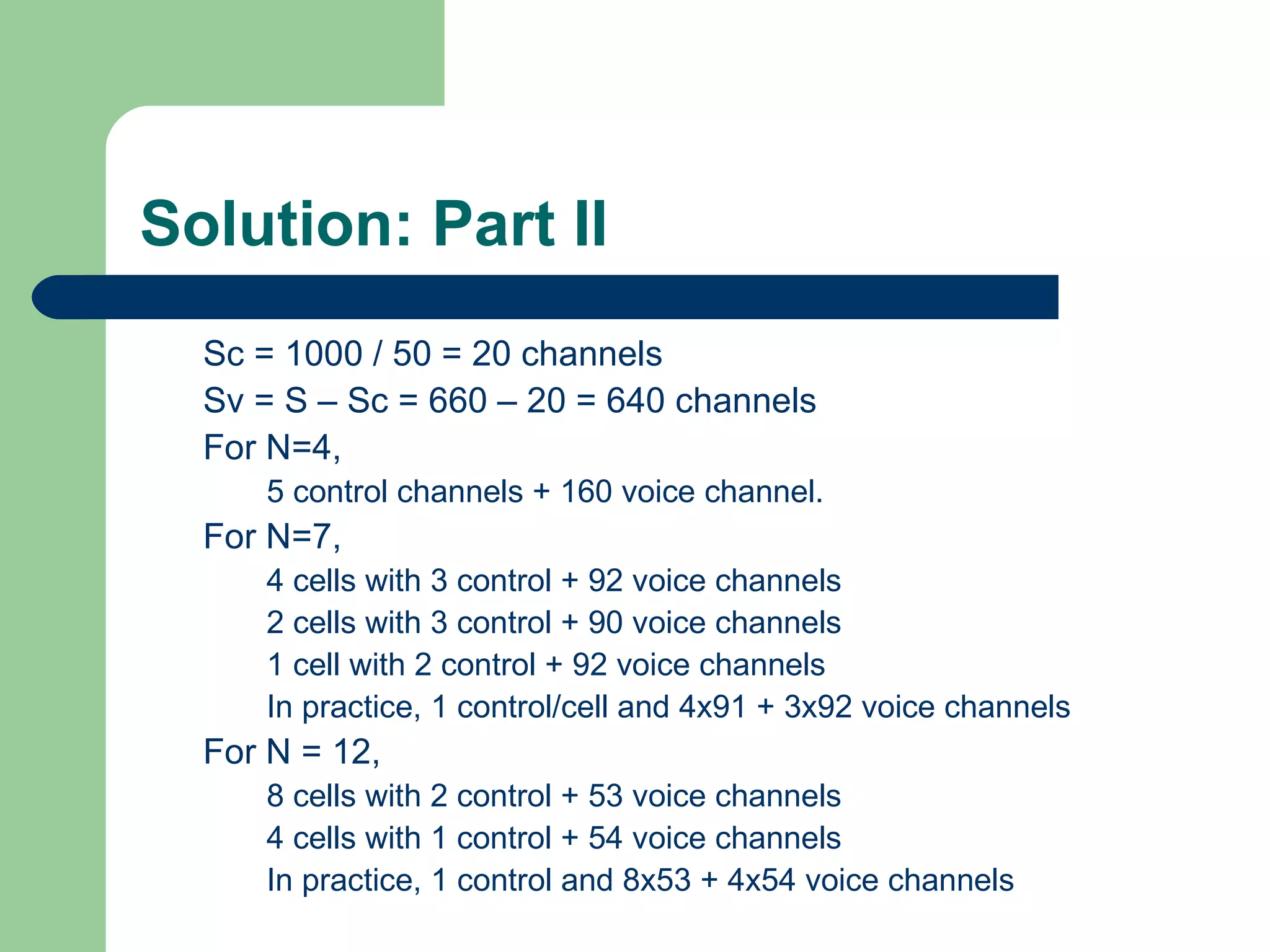
Solution: Part II
  Sc = 1000 / 50 = 20 channels
  Sv = S – Sc = 660 – 20 = 640 channels
  For N=4,
     5 control channels + 160 voice channel.
  For N=7,
     4 cells with 3 control + 92 voice channels
     2 cells with 3 control + 90 voice channels
     1 cell with 2 control + 92 voice channels
     In practice, 1 control/cell and 4x91 + 3x92 voice channels
  For N = 12,
     8 cells with 2 control + 53 voice channels
     4 cells with 1 control + 54 voice channels
     In practice, 1 control and 8x53 + 4x54 voice channels
Operation of Cellular Systems
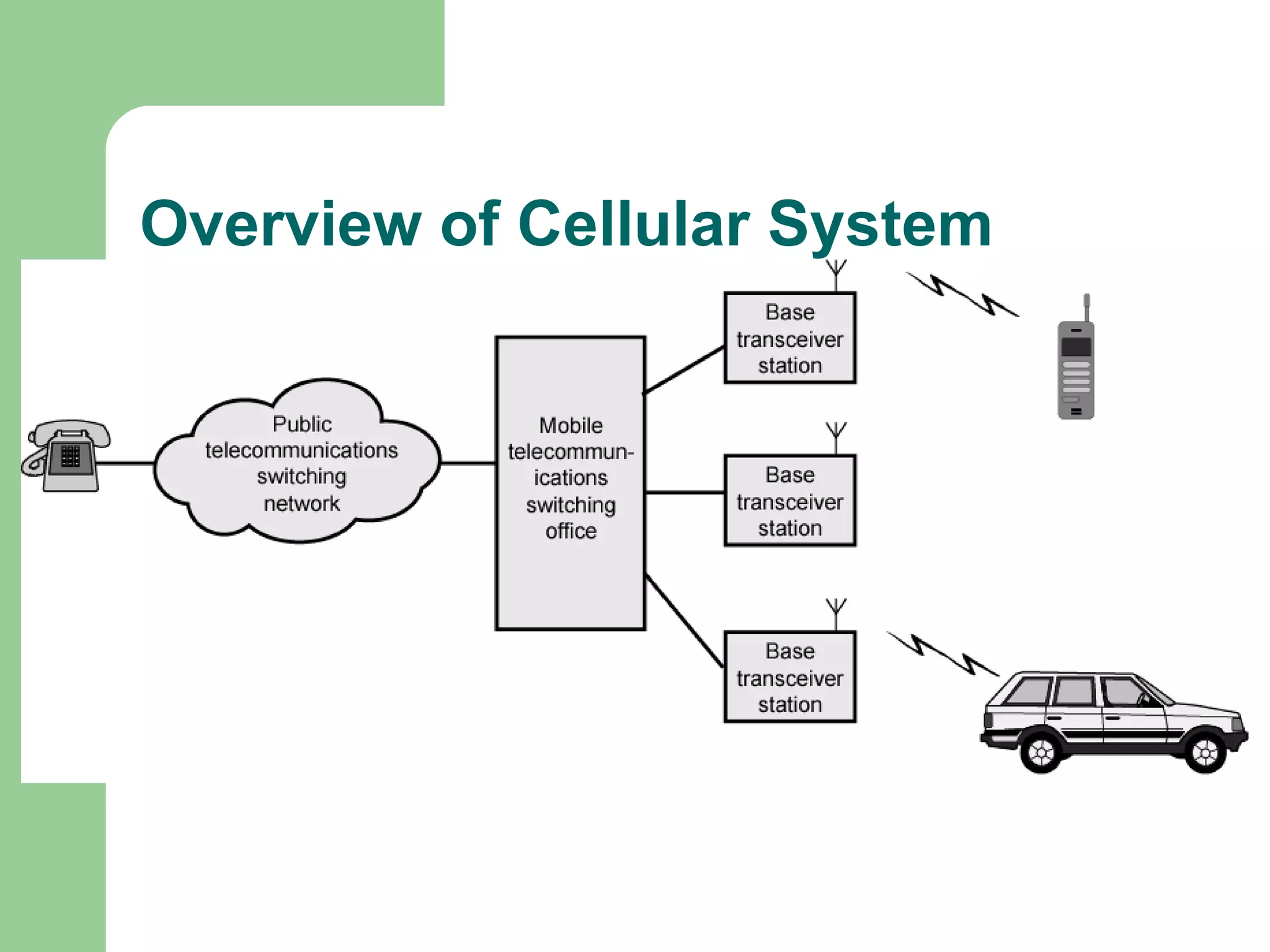
   Base station (BS) at center of each cell
     – Antenna, controller, transceivers
   Controller handles call process
     – Number of mobile units may in use at a time
   BS connected to mobile telecommunications switching office (MTSO)
     – One MTSO serves multiple BS
     – MTSO to BS link by wire or wireless
   MTSO:
     – Connects calls between mobile units and from mobile to fixed
       telecommunications network
     – Assigns voice channel
     – Performs handoffs
     – Monitors calls (billing)
Overview of Cellular System
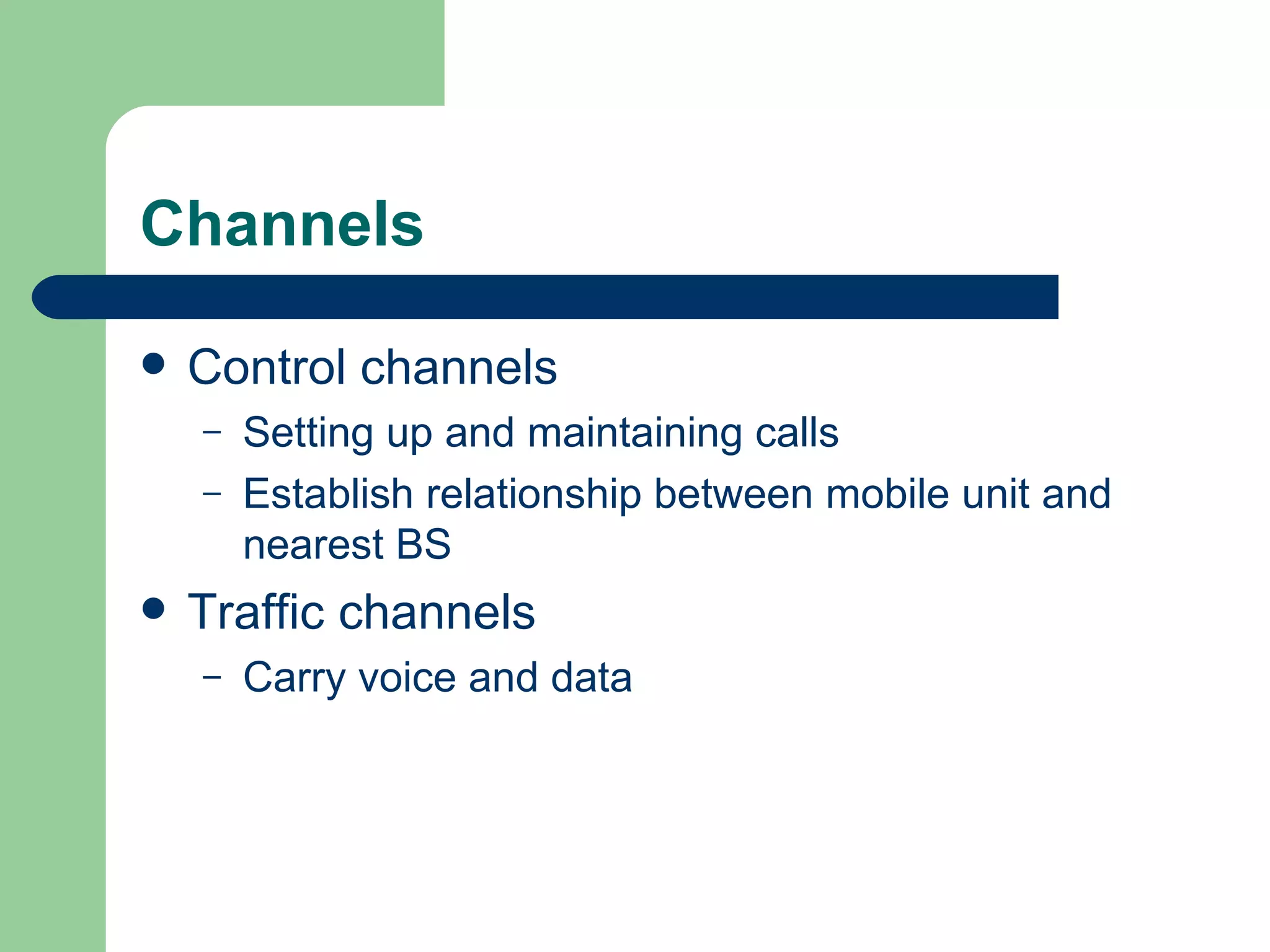
Channels

   Control channels
    –   Setting up and maintaining calls
    –   Establish relationship between mobile unit and
        nearest BS
   Traffic channels
    –   Carry voice and data
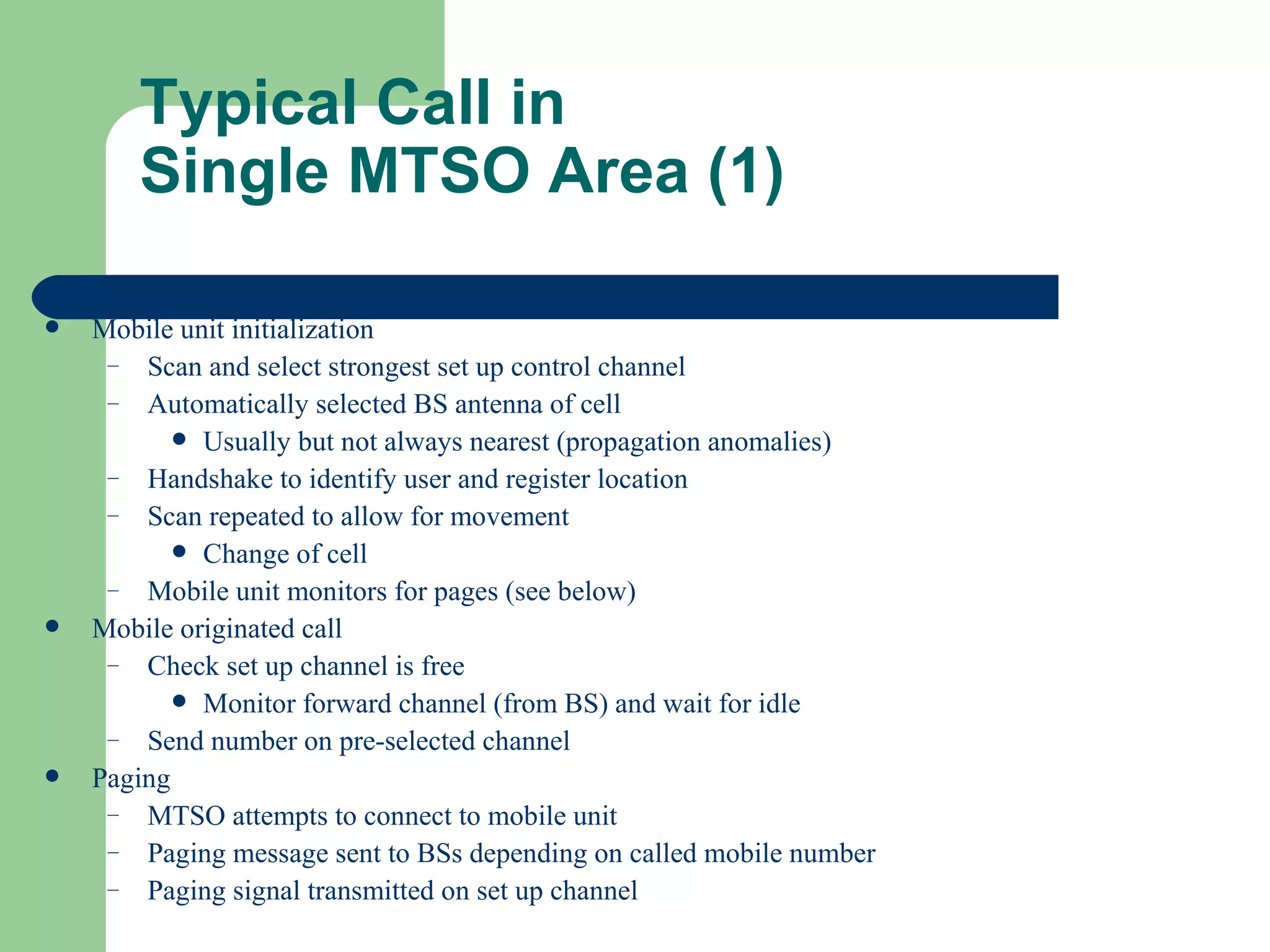
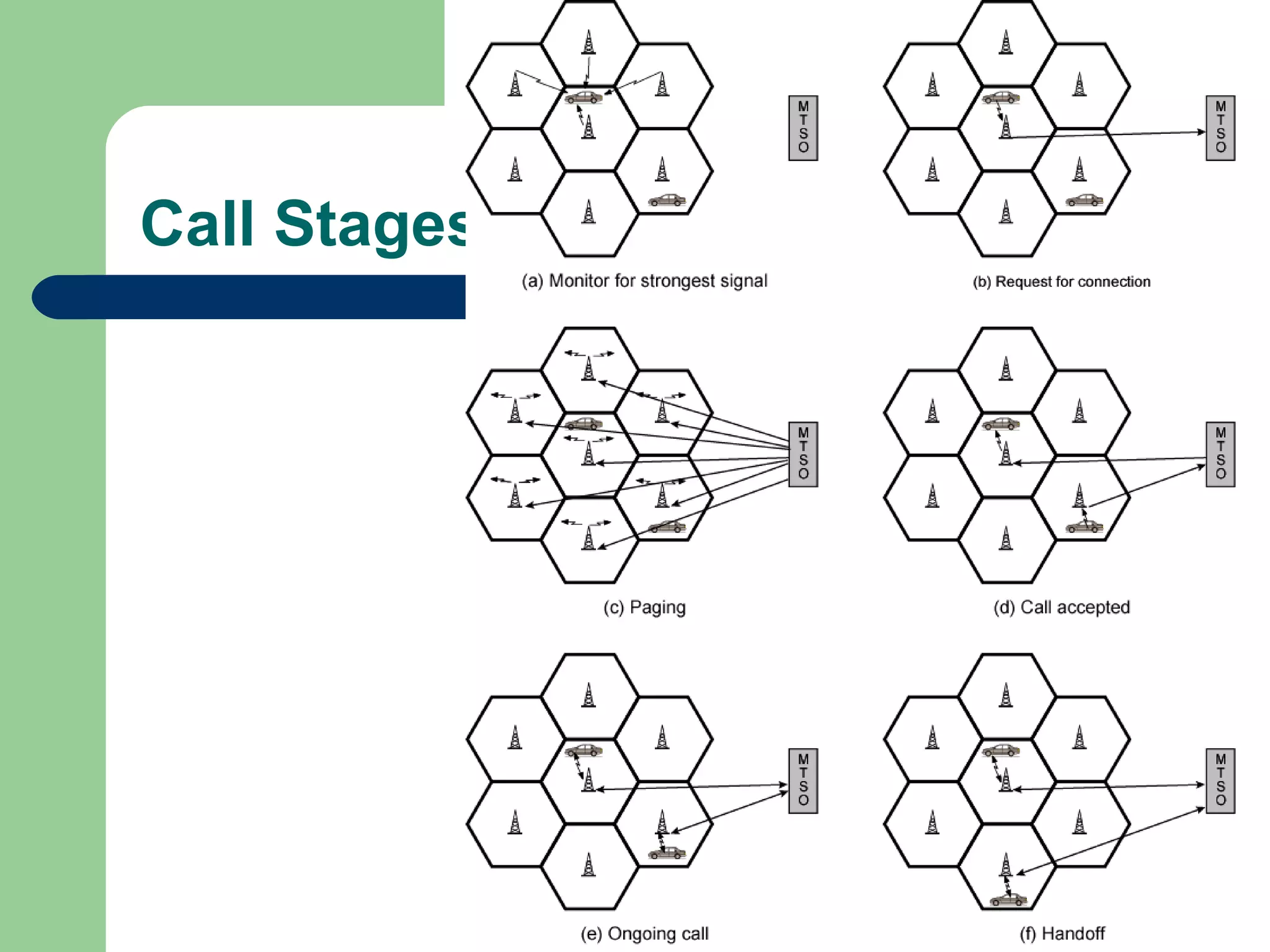
Typical Call in
       Single MTSO Area (1)

   Mobile unit initialization
     – Scan and select strongest set up control channel
     – Automatically selected BS antenna of cell
            Usually but not always nearest (propagation anomalies)
     – Handshake to identify user and register location
     – Scan repeated to allow for movement
            Change of cell
     – Mobile unit monitors for pages (see below)
   Mobile originated call
     – Check set up channel is free
            Monitor forward channel (from BS) and wait for idle
     – Send number on pre-selected channel
   Paging
     – MTSO attempts to connect to mobile unit
     – Paging message sent to BSs depending on called mobile number
     – Paging signal transmitted on set up channel
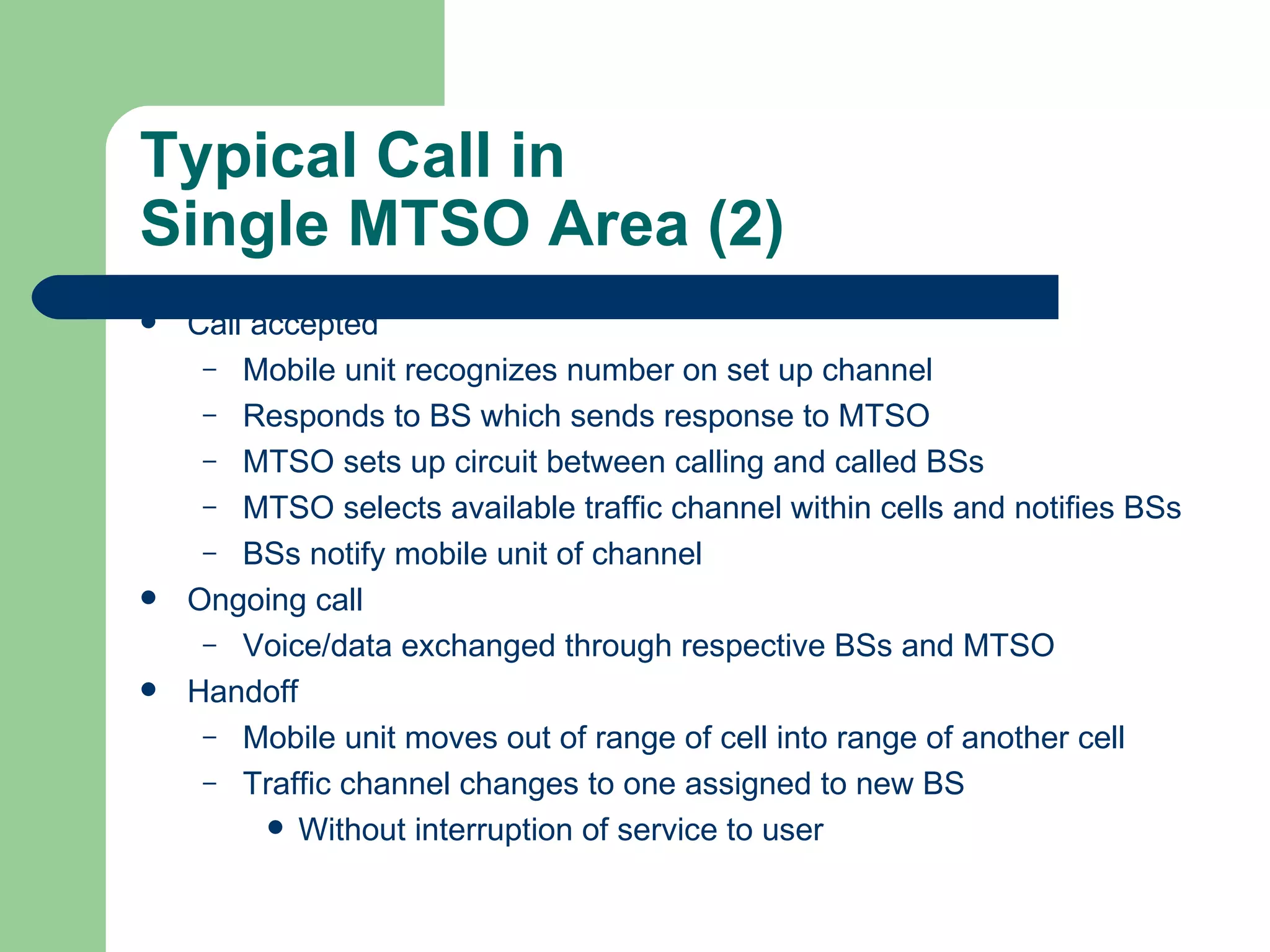
Typical Call in
Single MTSO Area (2)
   Call accepted
     – Mobile unit recognizes number on set up channel
     – Responds to BS which sends response to MTSO
     – MTSO sets up circuit between calling and called BSs
     – MTSO selects available traffic channel within cells and notifies BSs
     – BSs notify mobile unit of channel
   Ongoing call
     – Voice/data exchanged through respective BSs and MTSO
   Handoff
     – Mobile unit moves out of range of cell into range of another cell
     – Traffic channel changes to one assigned to new BS
           Without interruption of service to user
Other Functions
   Call blocking
     –   During mobile-initiated call stage, if all traffic channels busy, mobile
         tries again
     –   After number of fails, busy tone returned
   Call termination
     –   User hangs up
     –   MTSO informed
     –   Traffic channels at two BSs released
   Call drop
     –   BS cannot maintain required signal strength
     –   Traffic channel dropped and MTSO informed
   Calls to/from fixed and remote mobile subscriber
     –   MTSO connects to PSTN
     –   MTSO can connect mobile user and fixed subscriber via PSTN
     –   MTSO can connect to remote MTSO via PSTN or via dedicated lines
Call Stages
Cellular network

Cellular network

  • 1.
  • 2.
    Introduction  Early mobile system objective was to achieve a large coverage using single high power antenna  Impossible to reuse the same frequencies in the same coverage area.  For example, Bell mobile system in 1970 could support maximum of 12 simultaneous calls over a thousand square mile.  The Govt regulatory could not make spectrum allocation proportion to the increasing demand  Became imperative to restructure the telephone system to achieve high capacity with limited radio spectrum.
  • 3.
    Cellular Concept  Cellular concept was a major breakthrough in solving problem of spectrum and user capacity Offers high capacity without any major change in technology.  Definition A cellular mobile communications system uses a large number of low-power wireless transmitters to create cells—the basic geographic service area of a wireless communications system. Variable power levels allow cells to be sized according to the subscriber density and demand within a particular region. As mobile users travel from cell to cell, their conversations are handed off between cells to maintain seamless service. Channels (frequencies) used in one cell can be reused in another cell some distance away. Cells can be added to accommodate growth, creating new cells in un served areas or overlaying cells in existing areas.
  • 4.
    Cellular System Architecture  To improve the quality of service and to support more users in their systems. Because the amount of frequency spectrum available for mobile cellular use was limited, efficient use of the required frequencies was needed for mobile cellular coverage.  Rural and urban regions are divided into areas according to specific provisioning guidelines. Deployment parameters, such as amount of cell-splitting and cell sizes, are determined by engineers experienced in cellular system architecture.
  • 5.
    Cellular System Architecture  Cells:- A cell is the basic geographic unit of a cellular system.  Shape of the areas into which a coverage region is divided.  Cells are base stations transmitting over small geographic areas that are represented as hexagons.  Each cell size varies depending on the landscape. Because of constraints imposed by natural terrain and man-made structures  Clusters  A cluster is a group of cells No channels are reused within a cluster.
  • 6.
  • 10.
    Frequency Reuse  Small number of radio channel frequencies were available for mobile systems, The solution the industry adopted was called frequency planning or frequency reuse. Frequency reuse was implemented by restructuring the mobile telephone system architecture into the cellular concept.  The concept of frequency reuse is based on assigning to each cell a group of radio channels used within a small geographic area. Cells are assigned a group of channels that is completely different from neighboring cells. The coverage area of cells is called the footprint. This footprint is limited by a boundary so that the same group of channels can be used in different cells that are far enough away from each other so that their frequencies do not interfere
  • 14.
  • 18.
  • 19.
    The hexagonal shape representing a cell is conceptual and simplistic model of coverage.  The actual radio coverage is known as the footprint and is determined from field measurement, propagation prediction models – However a regular shape is needed for systematic system design and adaptation to future growth.  It might be natural to choose a circle to represent coverage but adjacent circles cannot be overlaid upon a map without leaving gaps or creating overlapping.
  • 20.
    Gaps Overlapping Case A Case B
  • 21.
    Three possible choices of shapes: square, equilateral triangle and hexagon.  For a give distance between the center of a polygon and its farthest perimeter points, the hexagon has the largest area of the three  Thus by using hexagon geometry, the fewest number of cells can cover a geographic region and it closely approximates circle.
  • 30.
    Capacity of System  When using hexagon to model coverage areas – Center-excited Cell: BS depicted as being either in the center of the cell  Omni-directional antenna is used – Edge-excited Cell: on three of the six cell vertices  Sectored direction antenna is used  Consider a cellular system – which has S duplex channels available for reuse. – Each cell allocated group of k channels (k < S) – S channels divided among N cells (unique and disjoint) then S = kN
  • 31.
    Cluster: N cells, which collectively use the complete set of available frequencies  If a cluster is replicated M times in the system, the number of duplex channels C as a measure of capacity is C = MkN = MS  So capacity is directly proportional to the replication factor in a fixed area.  Factor N is called cluster size and is typically equal to 4, 7, 12.
  • 32.
    If cluster size N is reduced while cell size is kept constant – more clusters are required – More capacity is achieved  Large cluster size indicates that co-channel cells are far from each other  Conversely, small cluster size means co-channel cells are located much closer together  The value of N is a function of how much interference a mobile or BS can tolerate
  • 33.
    Clusters are inversely proportion to N – Capacity is directly proportional to Clusters – Thus frequency reuse factor is given by 1/N.  In last fig, each hexagon has exactly six equidistant neighbors and that the lines joining the centers of any cell and its neighbors are separated by multiple of 60 degrees. – There are only certain cluster sizes and layouts possible
  • 34.
    Locating co-channel neighbors  To connect hexagons without gaps, – The geometry of hexagon is such that the number of cells per cluster N can only have values N = i2 + ij + j2 where i and j are non-negative integers.  To find out the nearest co-channel neighbors of a particular cell, do the following – Move I cells along any chain of hexagon – Then turn 60 degree counter clockwise and move j cells
  • 35.
    Example: Locating co-channelcells In this exam ple N= 1 9, i= 3, j 2 =
  • 36.
    Example  BW = 33 MHz allocated to particular FDD cellular system, where two 25 KHz simplex channel to provide full-duplex for voice/data.  Compute the number of channels per cell if a system uses – Four-cell reuse – Seven-cell reuse – Twelve-cell reuse.  If 1 MHz is dedicated to control channels, determine equitable distribution of control and voice channels per cell for above three systems?
  • 37.
    Solution: Part I TotalBW = 33 MHz, ChannelBW = 25 KHz x 2 = 50 KHz/duplex channel S = 33,000 / 50 = 660 channels For N = 4 k = 660 / 4 ≈ 165 channels For N = 7 k = 660 / 7 ≈ 95 channels For N = 12 k = 660 / 12 ≈ 55 channels
  • 38.
    Solution: Part II Sc = 1000 / 50 = 20 channels Sv = S – Sc = 660 – 20 = 640 channels For N=4, 5 control channels + 160 voice channel. For N=7, 4 cells with 3 control + 92 voice channels 2 cells with 3 control + 90 voice channels 1 cell with 2 control + 92 voice channels In practice, 1 control/cell and 4x91 + 3x92 voice channels For N = 12, 8 cells with 2 control + 53 voice channels 4 cells with 1 control + 54 voice channels In practice, 1 control and 8x53 + 4x54 voice channels
  • 39.
    Operation of CellularSystems  Base station (BS) at center of each cell – Antenna, controller, transceivers  Controller handles call process – Number of mobile units may in use at a time  BS connected to mobile telecommunications switching office (MTSO) – One MTSO serves multiple BS – MTSO to BS link by wire or wireless  MTSO: – Connects calls between mobile units and from mobile to fixed telecommunications network – Assigns voice channel – Performs handoffs – Monitors calls (billing)
  • 40.
  • 41.
    Channels  Control channels – Setting up and maintaining calls – Establish relationship between mobile unit and nearest BS  Traffic channels – Carry voice and data
  • 42.
    Typical Call in Single MTSO Area (1)  Mobile unit initialization – Scan and select strongest set up control channel – Automatically selected BS antenna of cell  Usually but not always nearest (propagation anomalies) – Handshake to identify user and register location – Scan repeated to allow for movement  Change of cell – Mobile unit monitors for pages (see below)  Mobile originated call – Check set up channel is free  Monitor forward channel (from BS) and wait for idle – Send number on pre-selected channel  Paging – MTSO attempts to connect to mobile unit – Paging message sent to BSs depending on called mobile number – Paging signal transmitted on set up channel
  • 43.
    Typical Call in SingleMTSO Area (2)  Call accepted – Mobile unit recognizes number on set up channel – Responds to BS which sends response to MTSO – MTSO sets up circuit between calling and called BSs – MTSO selects available traffic channel within cells and notifies BSs – BSs notify mobile unit of channel  Ongoing call – Voice/data exchanged through respective BSs and MTSO  Handoff – Mobile unit moves out of range of cell into range of another cell – Traffic channel changes to one assigned to new BS  Without interruption of service to user
  • 44.
    Other Functions  Call blocking – During mobile-initiated call stage, if all traffic channels busy, mobile tries again – After number of fails, busy tone returned  Call termination – User hangs up – MTSO informed – Traffic channels at two BSs released  Call drop – BS cannot maintain required signal strength – Traffic channel dropped and MTSO informed  Calls to/from fixed and remote mobile subscriber – MTSO connects to PSTN – MTSO can connect mobile user and fixed subscriber via PSTN – MTSO can connect to remote MTSO via PSTN or via dedicated lines
  • 45.