Fourth Generation Wireless (4G)
Definition - What does FourthGeneration Wireless (4G) mean?
Fourth generation wireless (4G) is an abbreviation for the fourth generation of cellular
wireless standards and replaces the third generation of broadband mobile
communications. The standards for 4G, set by the radio sector of the International
Telecommunication Union (ITU-R), are denoted as International Mobile
Telecommunications Advanced (IMT-Advanced).
An IMT-Advanced cellular system is expected to securely provide mobile service users
with bandwidth higher than 100 Mbps, enough to support high quality streaming
multimedia content. Existing 3G technologies, often branded as Pre-4G (such as mobile
WiMAX and 3G LTE), fall short of this bandwidth requirement. The majority of
implementations branded as 4G do not comply with the full IMT-Advanced standard.
FourthGeneration Wireless (4G)
The premise behind the 4G service offering is to deliver a comprehensive IP based
solution where multimedia applications and services can be delivered to the user
anytime and anywhere with a high data rate, premium quality of service and high
security.
Seamless mobility and interoperability with existing wireless standards is crucial to the
functionality of 4G communications. Implementations will involve new technologies such
as femtocell and picocell, which will address the needs of mobile users wherever they
are and will free up network resources for roaming users or those in more remote
service areas.
Two competing standards were submitted in September 2009 as technology candidates
for ITU-R consideration:
 LTE Advanced - as standardized by the 3GPP
 802.16m - as standardized by IEEE
These standards aim to be:
 Spectrally efficient
 Able to dynamically allocate network resources in a cell
 Able to support smooth handover
 Able to offer high quality of service (QoS)
 Based on an all-IP packet-switched network
WiMax is touted as the first 4G offering. It is an IP based, wireless broadband access
technology, also known as IEEE 802.16. WiMax services offer residential and business
customers with basic Internet connectivity.
Present implementations of WiMAX and LTE are largely considered a stopgap solution
offering a considerable boost, while WiMAX 2 (based on the 802.16m specification) and
LTE Advanced are finalized. Both technologies aim to reach the objectives traced by the
ITU, but are still far from being implemented.
4G LTE ADVANCED
LTE, Long Term Evolution, the successor to UMTS and HSPA is now being deployed and is the way
forwards for high speed cellular services.
In its first forms it was a 3G or as some would call it a 3.99G technology, but with further additions
the technology fulfilled the requirements for a 4G standard. In this form it was referred to as LTE
Advanced.
There has been a rapid increase in the use of data carried by cellular services, and this increase will
only become larger in what has been termed the "data explosion". To cater for this and the increased
demands for increased data transmission speeds and lower latency, further development of cellular
technology have been required
The UMTS cellular technology upgrade has been dubbed LTE - Long Term Evolution. The idea is that
3G LTE will enable much higher speeds to be achieved along with much lower packet latency (a
growing requirement for many services these days), and that 3GPP LTE will enable cellular
communications services to move forward to meet the needs for cellular technology to 2017 and
well beyond.
Many operators have not yet upgraded their basic 3G networks, and 3GPP LTE is seen as the next
logical step for many operators, who will leapfrog straight from basic 3G straight to LTE as this will
avoid providing several stages of upgrade. The use of LTE will also provide the data capabilities that
will be required for many years and until the full launch of the full 4G standards known as LTE
Advanced.
3G LTE evolution
Although there are major step changes between LTE and its 3G predecessors, it is nevertheless
looked upon as an evolution of the UMTS / 3GPP 3G standards. Although it uses a different form of
radio interface, using OFDMA / SC-FDMA instead of CDMA, there are many similarities with the
earlier forms of 3G architecture and there is scope for much re-use.
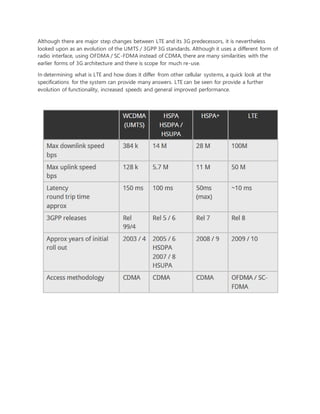
In determining what is LTE and how does it differ from other cellular systems, a quick look at the
specifications for the system can provide many answers. LTE can be seen for provide a further
evolution of functionality, increased speeds and general improved performance.

Fourth generation wireless

  • 1.
    Fourth Generation Wireless(4G) Definition - What does FourthGeneration Wireless (4G) mean? Fourth generation wireless (4G) is an abbreviation for the fourth generation of cellular wireless standards and replaces the third generation of broadband mobile communications. The standards for 4G, set by the radio sector of the International Telecommunication Union (ITU-R), are denoted as International Mobile Telecommunications Advanced (IMT-Advanced). An IMT-Advanced cellular system is expected to securely provide mobile service users with bandwidth higher than 100 Mbps, enough to support high quality streaming multimedia content. Existing 3G technologies, often branded as Pre-4G (such as mobile WiMAX and 3G LTE), fall short of this bandwidth requirement. The majority of implementations branded as 4G do not comply with the full IMT-Advanced standard. FourthGeneration Wireless (4G) The premise behind the 4G service offering is to deliver a comprehensive IP based solution where multimedia applications and services can be delivered to the user anytime and anywhere with a high data rate, premium quality of service and high security. Seamless mobility and interoperability with existing wireless standards is crucial to the functionality of 4G communications. Implementations will involve new technologies such as femtocell and picocell, which will address the needs of mobile users wherever they are and will free up network resources for roaming users or those in more remote service areas. Two competing standards were submitted in September 2009 as technology candidates for ITU-R consideration:  LTE Advanced - as standardized by the 3GPP  802.16m - as standardized by IEEE These standards aim to be:
  • 2.
     Spectrally efficient Able to dynamically allocate network resources in a cell  Able to support smooth handover  Able to offer high quality of service (QoS)  Based on an all-IP packet-switched network WiMax is touted as the first 4G offering. It is an IP based, wireless broadband access technology, also known as IEEE 802.16. WiMax services offer residential and business customers with basic Internet connectivity. Present implementations of WiMAX and LTE are largely considered a stopgap solution offering a considerable boost, while WiMAX 2 (based on the 802.16m specification) and LTE Advanced are finalized. Both technologies aim to reach the objectives traced by the ITU, but are still far from being implemented. 4G LTE ADVANCED LTE, Long Term Evolution, the successor to UMTS and HSPA is now being deployed and is the way forwards for high speed cellular services. In its first forms it was a 3G or as some would call it a 3.99G technology, but with further additions the technology fulfilled the requirements for a 4G standard. In this form it was referred to as LTE Advanced. There has been a rapid increase in the use of data carried by cellular services, and this increase will only become larger in what has been termed the "data explosion". To cater for this and the increased demands for increased data transmission speeds and lower latency, further development of cellular technology have been required The UMTS cellular technology upgrade has been dubbed LTE - Long Term Evolution. The idea is that 3G LTE will enable much higher speeds to be achieved along with much lower packet latency (a growing requirement for many services these days), and that 3GPP LTE will enable cellular communications services to move forward to meet the needs for cellular technology to 2017 and well beyond. Many operators have not yet upgraded their basic 3G networks, and 3GPP LTE is seen as the next logical step for many operators, who will leapfrog straight from basic 3G straight to LTE as this will avoid providing several stages of upgrade. The use of LTE will also provide the data capabilities that will be required for many years and until the full launch of the full 4G standards known as LTE Advanced. 3G LTE evolution
  • 3.
    Although there aremajor step changes between LTE and its 3G predecessors, it is nevertheless looked upon as an evolution of the UMTS / 3GPP 3G standards. Although it uses a different form of radio interface, using OFDMA / SC-FDMA instead of CDMA, there are many similarities with the earlier forms of 3G architecture and there is scope for much re-use. In determining what is LTE and how does it differ from other cellular systems, a quick look at the specifications for the system can provide many answers. LTE can be seen for provide a further evolution of functionality, increased speeds and general improved performance.