LTE – new challenges
Moscow, March 2014
Pawel Biskupski
Agenda
1. Why LTE?
2. 3GPP Standardization
3. UMTS to LTE improvements
4. Measurement equipment
5. KPI’s
6. LTE - examples of results
Why LTE?
Motivation for LTE
• Need for higher data rates and greater spectral efficiency
– Can be partialy achieved with HSDPA/HSUPA but fully with new air
interface defined by 3GPP LTE
• Need for Packet Switched optimized system
– Evolve UMTS towards packet only system
• Need for high quality of services
– Use of licensed frequencies to guarantee quality of services
– Always‐on experience (reduce control plane latency significantly)
– Reduce round trip delay
• Need for cheaper infrastructure
– Simplify architecture reduce number of network elements
Why LTE?
LTE performance requirements
• Data Rate:
– Instantaneous downlink peak data p rate of 100Mbit/s in a 20MHz
downlink spectrum (i.e. 5 bit/s/Hz)
– Instantaneous uplink peak data rate of 50Mbit/s in a 20MHz uplink
spectrum (i.e. 2.5 bit/s/Hz)
• Cell range
– 5 km ‐ optimal size
– 30km sizes with reasonable performance
– up to 100 km cell sizes supported with acceptable performance
• Cell capacity
– up to 200 active users per cell(5 MHz) (i.e., 200 active data clients)
Why LTE?
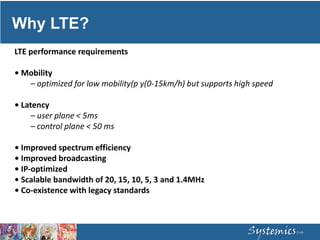
LTE performance requirements
• Mobility
– optimized for low mobility(p y(0‐15km/h) but supports high speed
• Latency
– user plane < 5ms
– control plane < 50 ms
• Improved spectrum efficiency
• Improved broadcasting
• IP‐optimized
• Scalable bandwidth of 20, 15, 10, 5, 3 and 1.4MHz
• Co‐existence with legacy standards
3GPP Standardization
GSM UMTS LTE
Version Released Info
Release 98 1998 Specified pre-3G GSM network
Release 99 2000 Q1
Specified the first version of UMTS, in- corporating a CDMA air
interface
Release 4 2001 Q2 aka. Release 2000, added all-IP Core Network
Release 5 2002 Q1 Introduced IMS and HSDPA
Release 6 2004 Q4
Integrated operation with Wireless LAN networks and added
HSUPA, MBMS, enhancements to IMS
Release 7 2007 Q4
Decreasing latency, improvements to QoS and real-time
applications, HSPA+ , NFC, EDGE Evolution.
Release 8 2008 Q4
First LTE release. All-IP Network (SAE), new OFDMA, FDE and
MIMO based radio interface.
Release 9 2009 Q4 SAES Enhancements, Wimax and LTE/UMTS Interoperability
Release 10 2011 Q1 LTE advanced
LTE architecture simplification
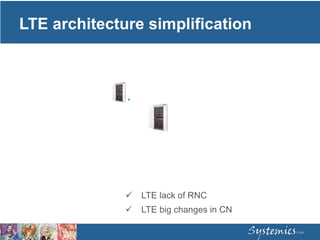
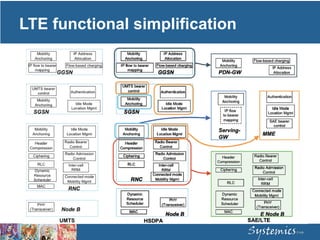
 LTE lack of RNC
 LTE big changes in CN
LTE functional simplification
UMTS and LTE services approach
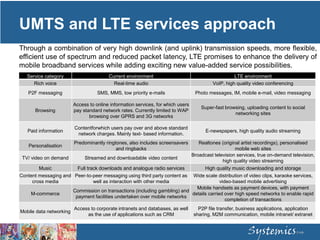
Through a combination of very high downlink (and uplink) transmission speeds, more flexible,
efficient use of spectrum and reduced packet latency, LTE promises to enhance the delivery of
mobile broadband services while adding exciting new value-added service possibilities.
Service category Current environment LTE environment
Rich voice Real-time audio VoIP, high quality video conferencing
P2F messaging SMS, MMS, low priority e-mails Photo messages, IM, mobile e-mail, video messaging
Browsing
Access to online information services, for which users
pay standard network rates. Currently limited to WAP
browsing over GPRS and 3G networks
Super-fast browsing, uploading content to social
networking sites
Paid information
Contentforwhich users pay over and above standard
network charges. Mainly text- based information.
E-newspapers, high quality audio streaming
Personalisation
Predominantly ringtones, also includes screensavers
and ringbacks
Realtones (original artist recordings), personalised
mobile web sites
TV/ video on demand Streamed and downloadable video content
Broadcast television services, true on-demand television,
high quality video streaming
Music Full track downloads and analogue radio services High quality music downloading and storage
Content messaging and
cross media
Peer-to-peer messaging using third party content as
well as interaction with other media
Wide scale distribution of video clips, karaoke services,
video-based mobile advertising
M-commerce
Commission on transactions (including gambling) and
payment facilities undertaken over mobile networks
Mobile handsets as payment devices, with payment
details carried over high speed networks to enable rapid
completion of transactions
Mobile data networking
Access to corporate intranets and databases, as well
as the use of applications such as CRM
P2P file transfer, business applications, application
sharing, M2M communication, mobile intranet/ extranet
UMTS and LTE comparison
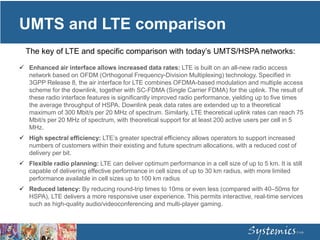
 Enhanced air interface allows increased data rates: LTE is built on an all-new radio access
network based on OFDM (Orthogonal Frequency-Division Multiplexing) technology. Specified in
3GPP Release 8, the air interface for LTE combines OFDMA-based modulation and multiple access
scheme for the downlink, together with SC-FDMA (Single Carrier FDMA) for the uplink. The result of
these radio interface features is significantly improved radio performance, yielding up to five times
the average throughput of HSPA. Downlink peak data rates are extended up to a theoretical
maximum of 300 Mbit/s per 20 MHz of spectrum. Similarly, LTE theoretical uplink rates can reach 75
Mbit/s per 20 MHz of spectrum, with theoretical support for at least 200 active users per cell in 5
MHz.
 High spectral efficiency: LTE’s greater spectral efficiency allows operators to support increased
numbers of customers within their existing and future spectrum allocations, with a reduced cost of
delivery per bit.
 Flexible radio planning: LTE can deliver optimum performance in a cell size of up to 5 km. It is still
capable of delivering effective performance in cell sizes of up to 30 km radius, with more limited
performance available in cell sizes up to 100 km radius
 Reduced latency: By reducing round-trip times to 10ms or even less (compared with 40–50ms for
HSPA), LTE delivers a more responsive user experience. This permits interactive, real-time services
such as high-quality audio/videoconferencing and multi-player gaming.
The key of LTE and specific comparison with today’s UMTS/HSPA networks:
UMTS and LTE comparison
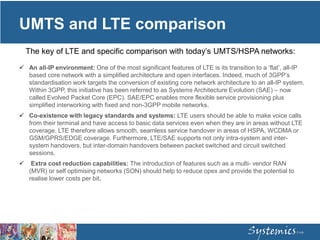
 An all-IP environment: One of the most significant features of LTE is its transition to a ‘flat’, all-IP
based core network with a simplified architecture and open interfaces. Indeed, much of 3GPP’s
standardisation work targets the conversion of existing core network architecture to an all-IP system.
Within 3GPP, this initiative has been referred to as Systems Architecture Evolution (SAE) – now
called Evolved Packet Core (EPC). SAE/EPC enables more flexible service provisioning plus
simplified interworking with fixed and non-3GPP mobile networks.
 Co-existence with legacy standards and systems: LTE users should be able to make voice calls
from their terminal and have access to basic data services even when they are in areas without LTE
coverage. LTE therefore allows smooth, seamless service handover in areas of HSPA, WCDMA or
GSM/GPRS/EDGE coverage. Furthermore, LTE/SAE supports not only intra-system and inter-
system handovers, but inter-domain handovers between packet switched and circuit switched
sessions.
 Extra cost reduction capabilities: The introduction of features such as a multi- vendor RAN
(MVR) or self optimising networks (SON) should help to reduce opex and provide the potential to
realise lower costs per bit.
The key of LTE and specific comparison with today’s UMTS/HSPA networks:
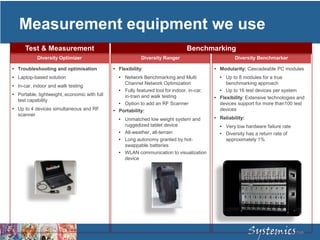
Test & Measurement
Diversity Optimizer Diversity Ranger Diversity Benchmarker
• Troubleshooting and optimisation
• Laptop-based solution
• In-car, indoor and walk testing
• Portable, lightweight, economic with full
test capability
• Up to 4 devices simultaneous and RF
scanner
• Flexibility:
• Network Benchmarking and Multi
Channel Network Optimization
• Fully featured tool for indoor, in-car,
in-train and walk testing
• Option to add an RF Scanner
• Portability:
• Unmatched low weight system and
ruggedized tablet device
• All-weather, all-terrain
• Long autonomy granted by hot-
swappable batteries
• WLAN communication to visualization
device
• Modularity: Cascadeable PC modules
• Up to 8 modules for a true
benchmarking approach
• Up to 16 test devices per system
• Flexibility: Extensive technologies and
devices support for more than100 test
devices
• Reliability:
• Very low hardware failure rate
• Diversity has a return rate of
approximately 1%
Benchmarking
Measurement equipment we use
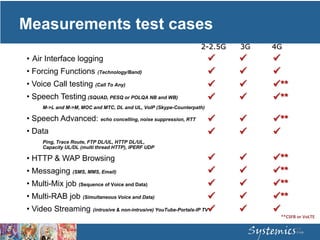
Measurements test cases
• Air Interface logging
• Forcing Functions (Technology/Band)
• Voice Call testing (Call To Any)
• Speech Testing (SQUAD, PESQ or POLQA NB and WB)
M->L and M->M, MOC and MTC, DL and UL, VoIP (Skype-Counterpath)
• Speech Advanced: echo concelling, noise suppression, RTT
• Data
Ping, Trace Route, FTP DL/UL, HTTP DL/UL,
Capacity UL/DL (multi thread HTTP), IPERF UDP
• HTTP & WAP Browsing
• Messaging (SMS, MMS, Email)
• Multi-Mix job (Sequence of Voice and Data)
• Multi-RAB job (Simultaneous Voice and Data)
• Video Streaming (intrusive & non-intrusive) YouTube-Portals-IP TV
2-2.5G 3G






















4G


**
**
**

**
**
**
**

**CSFB or VoLTE
13
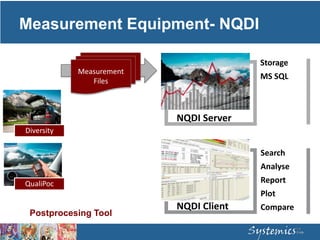
Measurement Equipment- NQDI
NQDI Server
Storage
MS SQL
NQDI Client
Search
Analyse
Report
Plot
Compare
Diversity
QualiPoc
Measurement
Files
14
Postprocesing Tool
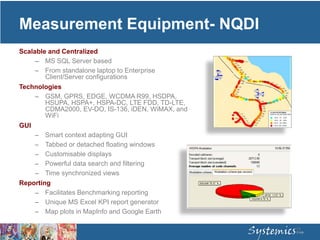
Measurement Equipment- NQDI
Scalable and Centralized
– MS SQL Server based
– From standalone laptop to Enterprise
Client/Server configurations
Technologies
– GSM, GPRS, EDGE, WCDMA R99, HSDPA,
HSUPA, HSPA+, HSPA-DC, LTE FDD, TD-LTE,
CDMA2000, EV-DO, IS-136, iDEN, WiMAX, and
WiFi
GUI
– Smart context adapting GUI
– Tabbed or detached floating windows
– Customisable displays
– Powerful data search and filtering
– Time synchronized views
Reporting
– Facilitates Benchmarking reporting
– Unique MS Excel KPI report generator
– Map plots in MapInfo and Google Earth
15
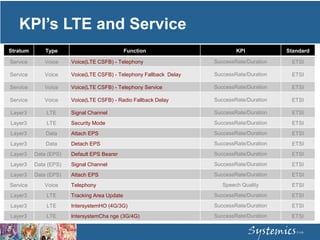
KPI’s LTE and Service
Stratum Type Function KPI Standard
Service Voice Voice(LTE CSFB) - Telephony SuccessRate/Duration ETSI
Service Voice Voice(LTE CSFB) - Telephony Fallback Delay SuccessRate/Duration ETSI
Service Voice Voice(LTE CSFB) - Telephony Service SuccessRate/Duration ETSI
Service Voice Voice(LTE CSFB) - Radio Fallback Delay SuccessRate/Duration ETSI
Layer3 LTE Signal Channel SuccessRate/Duration ETSI
Layer3 LTE Security Mode SuccessRate/Duration ETSI
Layer3 Data Attach EPS SuccessRate/Duration ETSI
Layer3 Data Detach EPS SuccessRate/Duration ETSI
Layer3 Data (EPS) Default EPS Bearer SuccessRate/Duration ETSI
Layer3 Data (EPS) Signal Channel SuccessRate/Duration ETSI
Layer3 Data (EPS) Attach EPS SuccessRate/Duration ETSI
Service Voice Telephony Speech Quality ETSI
Layer3 LTE Tracking Area Update SuccessRate/Duration ETSI
Layer3 LTE IntersystemHO (4G/3G) SuccessRate/Duration ETSI
Layer3 LTE IntersystemCha nge (3G/4G) SuccessRate/Duration ETSI
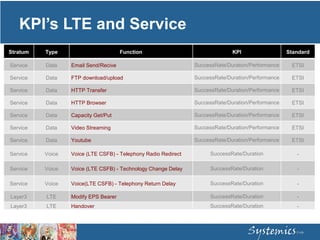
KPI’s LTE and Service
Stratum Type Function KPI Standard
Service Data Email Send/Recive SuccessRate/Duration/Performance ETSI
Service Data FTP download/upload SuccessRate/Duration/Performance ETSI
Service Data HTTP Transfer SuccessRate/Duration/Performance ETSI
Service Data HTTP Browser SuccessRate/Duration/Performance ETSI
Service Data Capacity Get/Put SuccessRate/Duration/Performance ETSI
Service Data Video Streaming SuccessRate/Duration/Performance ETSI
Service Data Youtube SuccessRate/Duration/Performance ETSI
Service Voice Voice (LTE CSFB) - Telephony Radio Redirect SuccessRate/Duration -
Service Voice Voice (LTE CSFB) - Technology Change Delay SuccessRate/Duration -
Service Voice Voice(LTE CSFB) - Telephony Return Delay SuccessRate/Duration -
Layer3 LTE Modify EPS Bearer SuccessRate/Duration -
Layer3 LTE Handover SuccessRate/Duration -
KPI’s for LTE new approaches
 High Speed Mobile Data Networks
 Algorithms for Voice and Video
 Video Streaming
 VoLTE
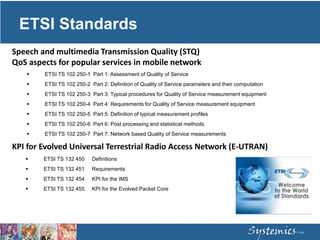
ETSI Standards
 ETSI TS 102 250-1 Part 1: Assessment of Quality of Service
 ETSI TS 102 250-2 Part 2: Definition of Quality of Service parameters and their computation
 ETSI TS 102 250-3 Part 3: Typical procedures for Quality of Service measurement equipment
 ETSI TS 102 250-4 Part 4: Requirements for Quality of Service measurement equipment
 ETSI TS 102 250-5 Part 5: Definition of typical measurement profiles
 ETSI TS 102 250-6 Part 6: Post processing and statistical methods
 ETSI TS 102 250-7 Part 7: Network based Quality of Service measurements
Speech and multimedia Transmission Quality (STQ)
QoS aspects for popular services in mobile network
 ETSI TS 132 450 Definitions
 ETSI TS 132 451 Requirements
 ETSI TS 132 454 KPI for the IMS
 ETSI TS 132 455 KPI for the Evolved Packet Core
KPI for Evolved Universal Terrestrial Radio Access Network (E-UTRAN)
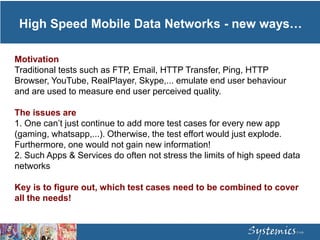
High Speed Mobile Data Networks - new ways…
Motivation
Traditional tests such as FTP, Email, HTTP Transfer, Ping, HTTP
Browser, YouTube, RealPlayer, Skype,... emulate end user behaviour
and are used to measure end user perceived quality.
The issues are
1. One can’t just continue to add more test cases for every new app
(gaming, whatsapp,...). Otherwise, the test effort would just explode.
Furthermore, one would not gain new information!
2. Such Apps & Services do often not stress the limits of high speed data
networks
Key is to figure out, which test cases need to be combined to cover
all the needs!
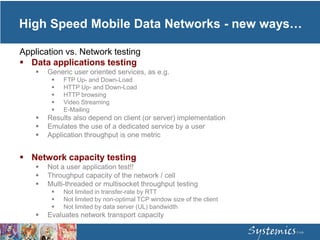
Application vs. Network testing
 Data applications testing
 Generic user oriented services, as e.g.
 FTP Up- and Down-Load
 HTTP Up- and Down-Load
 HTTP browsing
 Video Streaming
 E-Mailing
 Results also depend on client (or server) implementation
 Emulates the use of a dedicated service by a user
 Application throughput is one metric
 Network capacity testing
 Not a user application test!!
 Throughput capacity of the network / cell
 Multi-threaded or multisocket throughput testing
 Not limited in transfer-rate by RTT
 Not limited by non-optimal TCP window size of the client
 Not limited by data server (UL) bandwidth
 Evaluates network transport capacity
High Speed Mobile Data Networks - new ways…
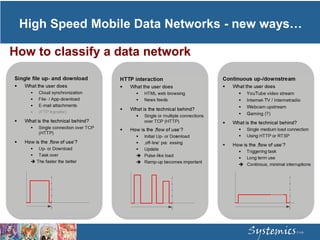
How to classify a data network
High Speed Mobile Data Networks - new ways…
 The application tests presents what a user would get
 It is not (always) an indicator for available capacity, especially in high-speed networks
High Speed Mobile Data Networks - new ways…
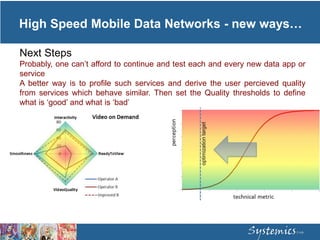
Next Steps
Probably, one can’t afford to continue and test each and every new data app or
service
A better way is to profile such services and derive the user percieved quality
from services which behave similar. Then set the Quality thresholds to define
what is ‘good’ and what is ‘bad’
High Speed Mobile Data Networks - new ways…
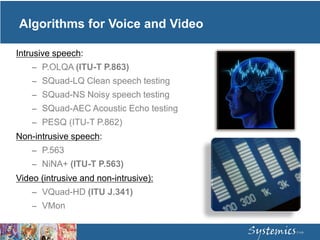
Algorithms for Voice and Video
Intrusive speech:
– P.OLQA (ITU-T P.863)
– SQuad-LQ Clean speech testing
– SQuad-NS Noisy speech testing
– SQuad-AEC Acoustic Echo testing
– PESQ (ITU-T P.862)
Non-intrusive speech:
– P.563
– NiNA+ (ITU-T P.563)
Video (intrusive and non-intrusive):
– VQuad-HD (ITU J.341)
– VMon
Video Streaming... technology is changing:
adaptive bitrate streaming
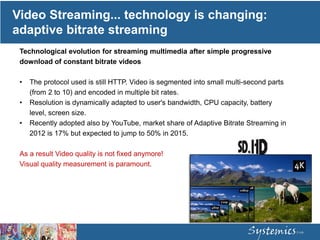
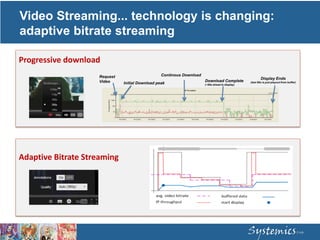
Technological evolution for streaming multimedia after simple progressive
download of constant bitrate videos
• The protocol used is still HTTP. Video is segmented into small multi-second parts
(from 2 to 10) and encoded in multiple bit rates.
• Resolution is dynamically adapted to user's bandwidth, CPU capacity, battery
level, screen size.
• Recently adopted also by YouTube, market share of Adaptive Bitrate Streaming in
2012 is 17% but expected to jump to 50% in 2015.
As a result Video quality is not fixed anymore!
Visual quality measurement is paramount.
Video Streaming... technology is changing:
adaptive bitrate streaming
Progressive download
Adaptive Bitrate Streaming
Request
Video Initial Download peak
Continous Download
Download Complete
(~90s ahead to display)
Display Ends
(last 90s is just playout from buffer)
Video Streaming... technology is changing:
adaptive bitrate streaming
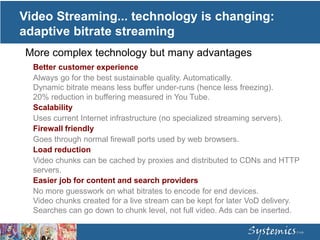
Better customer experience
Always go for the best sustainable quality. Automatically.
Dynamic bitrate means less buffer under-runs (hence less freezing).
20% reduction in buffering measured in You Tube.
Scalability
Uses current Internet infrastructure (no specialized streaming servers).
Firewall friendly
Goes through normal firewall ports used by web browsers.
Load reduction
Video chunks can be cached by proxies and distributed to CDNs and HTTP
servers.
Easier job for content and search providers
No more guesswork on what bitrates to encode for end devices.
Video chunks created for a live stream can be kept for later VoD delivery.
Searches can go down to chunk level, not full video. Ads can be inserted.
More complex technology but many advantages
Video Streaming... technology is changing:
adaptive bitrate streaming
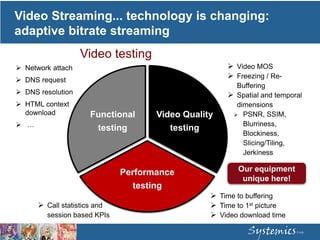
Video Quality
testing
Performance
testing
Functional
testing
 Network attach
 DNS request
 DNS resolution
 HTML context
download
 …
 Video MOS
 Freezing / Re-
Buffering
 Spatial and temporal
dimensions
 PSNR, SSIM,
Blurriness,
Blockiness,
Slicing/Tiling,
Jerkiness
 Call statistics and
session based KPIs
 Time to buffering
 Time to 1st picture
 Video download time
Our equipment
unique here!
Video testing
Video Streaming... Swissqual Test Equipment
Video applications in mobile testing
Video Streaming – VoD incl, progressive download
Video Streaming – live TV
Video Telephony
Testing platforms
PC client (UE as modem)
User Equipment (Android)
Quality metrics
Video MOS
Freezing / Re-Buffering
Spatial and temporal dimensions (PSNR, Blurriness, Blockiness, Slicing/Tiling, Jerkiness,...)
Call statistics and session based KPIs
Algorithms
Full-reference VQuad / VQuad-HD compares a reference video with an received video
No-reference VMon evaluates a received video on its own
‚Hybrid‘ VMon-B VMon but evaluating bitstream information
Freezing evaluates a received video only for freezing/rebuffering
Bitstream models predicts quality based on information of the bitstream
VoLTE
The Voice over LTE, VoLTE scheme was devised as a result of operators
seeking a standardised system for transferring voice traffic over LTE.
Originally LTE was seen as a completely IP cellular system just for carrying
data, and operators would be able to carry voice either by reverting to 2G /
3G systems or by using VoIP.
VoLTE Technology Status
 VoLTE is still in it’s infancy, well, maybe grown a bit and in the teenage now!
 Still a lot of dynamics on the device side!
 …but we know how and what measure QUALITY !
VoLTE
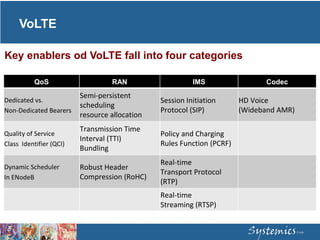
QoS RAN IMS Codec
Dedicated vs.
Non-Dedicated Bearers
Semi-persistent
scheduling
resource allocation
Session Initiation
Protocol (SIP)
HD Voice
(Wideband AMR)
Quality of Service
Class Identifier (QCI)
Transmission Time
Interval (TTI)
Bundling
Policy and Charging
Rules Function (PCRF)
Dynamic Scheduler
In ENodeB
Robust Header
Compression (RoHC)
Real-time
Transport Protocol
(RTP)
Real-time
Streaming (RTSP)
Key enablers od VoLTE fall into four categories
VoLTE
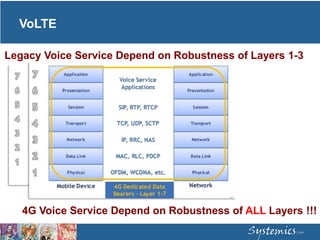
Legacy Voice Service Depend on Robustness of Layers 1-3
4G Voice Service Depend on Robustness of ALL Layers !!!
VoLTE
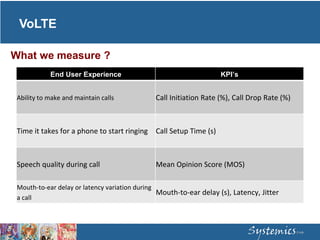
End User Experience KPI’s
Ability to make and maintain calls Call Initiation Rate (%), Call Drop Rate (%)
Time it takes for a phone to start ringing Call Setup Time (s)
Speech quality during call Mean Opinion Score (MOS)
Mouth-to-ear delay or latency variation during
a call
Mouth-to-ear delay (s), Latency, Jitter
What we measure ?
LTE - examples of results
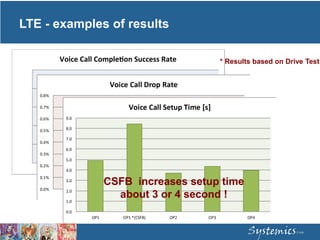
Voice… only Op1 has CSFB
CSFB increases setup time
about 3 or 4 second !
* Results based on Drive Test
LTE - examples of results
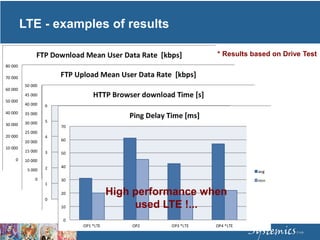
OP2 doesn’t use LTE
* Results based on Drive Test
High performance when
used LTE !...
LTE
СПАСИБО
P.Biskupski@syspab.eu

session_2_lte new challenge biskupski.pdf

  • 1.
    LTE – newchallenges Moscow, March 2014 Pawel Biskupski
  • 2.
    Agenda 1. Why LTE? 2.3GPP Standardization 3. UMTS to LTE improvements 4. Measurement equipment 5. KPI’s 6. LTE - examples of results
  • 3.
    Why LTE? Motivation forLTE • Need for higher data rates and greater spectral efficiency – Can be partialy achieved with HSDPA/HSUPA but fully with new air interface defined by 3GPP LTE • Need for Packet Switched optimized system – Evolve UMTS towards packet only system • Need for high quality of services – Use of licensed frequencies to guarantee quality of services – Always‐on experience (reduce control plane latency significantly) – Reduce round trip delay • Need for cheaper infrastructure – Simplify architecture reduce number of network elements
  • 4.
    Why LTE? LTE performancerequirements • Data Rate: – Instantaneous downlink peak data p rate of 100Mbit/s in a 20MHz downlink spectrum (i.e. 5 bit/s/Hz) – Instantaneous uplink peak data rate of 50Mbit/s in a 20MHz uplink spectrum (i.e. 2.5 bit/s/Hz) • Cell range – 5 km ‐ optimal size – 30km sizes with reasonable performance – up to 100 km cell sizes supported with acceptable performance • Cell capacity – up to 200 active users per cell(5 MHz) (i.e., 200 active data clients)
  • 5.
    Why LTE? LTE performancerequirements • Mobility – optimized for low mobility(p y(0‐15km/h) but supports high speed • Latency – user plane < 5ms – control plane < 50 ms • Improved spectrum efficiency • Improved broadcasting • IP‐optimized • Scalable bandwidth of 20, 15, 10, 5, 3 and 1.4MHz • Co‐existence with legacy standards
  • 6.
    3GPP Standardization GSM UMTSLTE Version Released Info Release 98 1998 Specified pre-3G GSM network Release 99 2000 Q1 Specified the first version of UMTS, in- corporating a CDMA air interface Release 4 2001 Q2 aka. Release 2000, added all-IP Core Network Release 5 2002 Q1 Introduced IMS and HSDPA Release 6 2004 Q4 Integrated operation with Wireless LAN networks and added HSUPA, MBMS, enhancements to IMS Release 7 2007 Q4 Decreasing latency, improvements to QoS and real-time applications, HSPA+ , NFC, EDGE Evolution. Release 8 2008 Q4 First LTE release. All-IP Network (SAE), new OFDMA, FDE and MIMO based radio interface. Release 9 2009 Q4 SAES Enhancements, Wimax and LTE/UMTS Interoperability Release 10 2011 Q1 LTE advanced
  • 7.
    LTE architecture simplification LTE lack of RNC  LTE big changes in CN
  • 8.
  • 9.
    UMTS and LTEservices approach Through a combination of very high downlink (and uplink) transmission speeds, more flexible, efficient use of spectrum and reduced packet latency, LTE promises to enhance the delivery of mobile broadband services while adding exciting new value-added service possibilities. Service category Current environment LTE environment Rich voice Real-time audio VoIP, high quality video conferencing P2F messaging SMS, MMS, low priority e-mails Photo messages, IM, mobile e-mail, video messaging Browsing Access to online information services, for which users pay standard network rates. Currently limited to WAP browsing over GPRS and 3G networks Super-fast browsing, uploading content to social networking sites Paid information Contentforwhich users pay over and above standard network charges. Mainly text- based information. E-newspapers, high quality audio streaming Personalisation Predominantly ringtones, also includes screensavers and ringbacks Realtones (original artist recordings), personalised mobile web sites TV/ video on demand Streamed and downloadable video content Broadcast television services, true on-demand television, high quality video streaming Music Full track downloads and analogue radio services High quality music downloading and storage Content messaging and cross media Peer-to-peer messaging using third party content as well as interaction with other media Wide scale distribution of video clips, karaoke services, video-based mobile advertising M-commerce Commission on transactions (including gambling) and payment facilities undertaken over mobile networks Mobile handsets as payment devices, with payment details carried over high speed networks to enable rapid completion of transactions Mobile data networking Access to corporate intranets and databases, as well as the use of applications such as CRM P2P file transfer, business applications, application sharing, M2M communication, mobile intranet/ extranet
  • 10.
    UMTS and LTEcomparison  Enhanced air interface allows increased data rates: LTE is built on an all-new radio access network based on OFDM (Orthogonal Frequency-Division Multiplexing) technology. Specified in 3GPP Release 8, the air interface for LTE combines OFDMA-based modulation and multiple access scheme for the downlink, together with SC-FDMA (Single Carrier FDMA) for the uplink. The result of these radio interface features is significantly improved radio performance, yielding up to five times the average throughput of HSPA. Downlink peak data rates are extended up to a theoretical maximum of 300 Mbit/s per 20 MHz of spectrum. Similarly, LTE theoretical uplink rates can reach 75 Mbit/s per 20 MHz of spectrum, with theoretical support for at least 200 active users per cell in 5 MHz.  High spectral efficiency: LTE’s greater spectral efficiency allows operators to support increased numbers of customers within their existing and future spectrum allocations, with a reduced cost of delivery per bit.  Flexible radio planning: LTE can deliver optimum performance in a cell size of up to 5 km. It is still capable of delivering effective performance in cell sizes of up to 30 km radius, with more limited performance available in cell sizes up to 100 km radius  Reduced latency: By reducing round-trip times to 10ms or even less (compared with 40–50ms for HSPA), LTE delivers a more responsive user experience. This permits interactive, real-time services such as high-quality audio/videoconferencing and multi-player gaming. The key of LTE and specific comparison with today’s UMTS/HSPA networks:
  • 11.
    UMTS and LTEcomparison  An all-IP environment: One of the most significant features of LTE is its transition to a ‘flat’, all-IP based core network with a simplified architecture and open interfaces. Indeed, much of 3GPP’s standardisation work targets the conversion of existing core network architecture to an all-IP system. Within 3GPP, this initiative has been referred to as Systems Architecture Evolution (SAE) – now called Evolved Packet Core (EPC). SAE/EPC enables more flexible service provisioning plus simplified interworking with fixed and non-3GPP mobile networks.  Co-existence with legacy standards and systems: LTE users should be able to make voice calls from their terminal and have access to basic data services even when they are in areas without LTE coverage. LTE therefore allows smooth, seamless service handover in areas of HSPA, WCDMA or GSM/GPRS/EDGE coverage. Furthermore, LTE/SAE supports not only intra-system and inter- system handovers, but inter-domain handovers between packet switched and circuit switched sessions.  Extra cost reduction capabilities: The introduction of features such as a multi- vendor RAN (MVR) or self optimising networks (SON) should help to reduce opex and provide the potential to realise lower costs per bit. The key of LTE and specific comparison with today’s UMTS/HSPA networks:
  • 12.
    Test & Measurement DiversityOptimizer Diversity Ranger Diversity Benchmarker • Troubleshooting and optimisation • Laptop-based solution • In-car, indoor and walk testing • Portable, lightweight, economic with full test capability • Up to 4 devices simultaneous and RF scanner • Flexibility: • Network Benchmarking and Multi Channel Network Optimization • Fully featured tool for indoor, in-car, in-train and walk testing • Option to add an RF Scanner • Portability: • Unmatched low weight system and ruggedized tablet device • All-weather, all-terrain • Long autonomy granted by hot- swappable batteries • WLAN communication to visualization device • Modularity: Cascadeable PC modules • Up to 8 modules for a true benchmarking approach • Up to 16 test devices per system • Flexibility: Extensive technologies and devices support for more than100 test devices • Reliability: • Very low hardware failure rate • Diversity has a return rate of approximately 1% Benchmarking Measurement equipment we use
  • 13.
    Measurements test cases •Air Interface logging • Forcing Functions (Technology/Band) • Voice Call testing (Call To Any) • Speech Testing (SQUAD, PESQ or POLQA NB and WB) M->L and M->M, MOC and MTC, DL and UL, VoIP (Skype-Counterpath) • Speech Advanced: echo concelling, noise suppression, RTT • Data Ping, Trace Route, FTP DL/UL, HTTP DL/UL, Capacity UL/DL (multi thread HTTP), IPERF UDP • HTTP & WAP Browsing • Messaging (SMS, MMS, Email) • Multi-Mix job (Sequence of Voice and Data) • Multi-RAB job (Simultaneous Voice and Data) • Video Streaming (intrusive & non-intrusive) YouTube-Portals-IP TV 2-2.5G 3G                       4G   ** ** **  ** ** ** **  **CSFB or VoLTE 13
  • 14.
    Measurement Equipment- NQDI NQDIServer Storage MS SQL NQDI Client Search Analyse Report Plot Compare Diversity QualiPoc Measurement Files 14 Postprocesing Tool
  • 15.
    Measurement Equipment- NQDI Scalableand Centralized – MS SQL Server based – From standalone laptop to Enterprise Client/Server configurations Technologies – GSM, GPRS, EDGE, WCDMA R99, HSDPA, HSUPA, HSPA+, HSPA-DC, LTE FDD, TD-LTE, CDMA2000, EV-DO, IS-136, iDEN, WiMAX, and WiFi GUI – Smart context adapting GUI – Tabbed or detached floating windows – Customisable displays – Powerful data search and filtering – Time synchronized views Reporting – Facilitates Benchmarking reporting – Unique MS Excel KPI report generator – Map plots in MapInfo and Google Earth 15
  • 16.
    KPI’s LTE andService Stratum Type Function KPI Standard Service Voice Voice(LTE CSFB) - Telephony SuccessRate/Duration ETSI Service Voice Voice(LTE CSFB) - Telephony Fallback Delay SuccessRate/Duration ETSI Service Voice Voice(LTE CSFB) - Telephony Service SuccessRate/Duration ETSI Service Voice Voice(LTE CSFB) - Radio Fallback Delay SuccessRate/Duration ETSI Layer3 LTE Signal Channel SuccessRate/Duration ETSI Layer3 LTE Security Mode SuccessRate/Duration ETSI Layer3 Data Attach EPS SuccessRate/Duration ETSI Layer3 Data Detach EPS SuccessRate/Duration ETSI Layer3 Data (EPS) Default EPS Bearer SuccessRate/Duration ETSI Layer3 Data (EPS) Signal Channel SuccessRate/Duration ETSI Layer3 Data (EPS) Attach EPS SuccessRate/Duration ETSI Service Voice Telephony Speech Quality ETSI Layer3 LTE Tracking Area Update SuccessRate/Duration ETSI Layer3 LTE IntersystemHO (4G/3G) SuccessRate/Duration ETSI Layer3 LTE IntersystemCha nge (3G/4G) SuccessRate/Duration ETSI
  • 17.
    KPI’s LTE andService Stratum Type Function KPI Standard Service Data Email Send/Recive SuccessRate/Duration/Performance ETSI Service Data FTP download/upload SuccessRate/Duration/Performance ETSI Service Data HTTP Transfer SuccessRate/Duration/Performance ETSI Service Data HTTP Browser SuccessRate/Duration/Performance ETSI Service Data Capacity Get/Put SuccessRate/Duration/Performance ETSI Service Data Video Streaming SuccessRate/Duration/Performance ETSI Service Data Youtube SuccessRate/Duration/Performance ETSI Service Voice Voice (LTE CSFB) - Telephony Radio Redirect SuccessRate/Duration - Service Voice Voice (LTE CSFB) - Technology Change Delay SuccessRate/Duration - Service Voice Voice(LTE CSFB) - Telephony Return Delay SuccessRate/Duration - Layer3 LTE Modify EPS Bearer SuccessRate/Duration - Layer3 LTE Handover SuccessRate/Duration -
  • 18.
    KPI’s for LTEnew approaches  High Speed Mobile Data Networks  Algorithms for Voice and Video  Video Streaming  VoLTE
  • 19.
    ETSI Standards  ETSITS 102 250-1 Part 1: Assessment of Quality of Service  ETSI TS 102 250-2 Part 2: Definition of Quality of Service parameters and their computation  ETSI TS 102 250-3 Part 3: Typical procedures for Quality of Service measurement equipment  ETSI TS 102 250-4 Part 4: Requirements for Quality of Service measurement equipment  ETSI TS 102 250-5 Part 5: Definition of typical measurement profiles  ETSI TS 102 250-6 Part 6: Post processing and statistical methods  ETSI TS 102 250-7 Part 7: Network based Quality of Service measurements Speech and multimedia Transmission Quality (STQ) QoS aspects for popular services in mobile network  ETSI TS 132 450 Definitions  ETSI TS 132 451 Requirements  ETSI TS 132 454 KPI for the IMS  ETSI TS 132 455 KPI for the Evolved Packet Core KPI for Evolved Universal Terrestrial Radio Access Network (E-UTRAN)
  • 20.
    High Speed MobileData Networks - new ways… Motivation Traditional tests such as FTP, Email, HTTP Transfer, Ping, HTTP Browser, YouTube, RealPlayer, Skype,... emulate end user behaviour and are used to measure end user perceived quality. The issues are 1. One can’t just continue to add more test cases for every new app (gaming, whatsapp,...). Otherwise, the test effort would just explode. Furthermore, one would not gain new information! 2. Such Apps & Services do often not stress the limits of high speed data networks Key is to figure out, which test cases need to be combined to cover all the needs!
  • 21.
    Application vs. Networktesting  Data applications testing  Generic user oriented services, as e.g.  FTP Up- and Down-Load  HTTP Up- and Down-Load  HTTP browsing  Video Streaming  E-Mailing  Results also depend on client (or server) implementation  Emulates the use of a dedicated service by a user  Application throughput is one metric  Network capacity testing  Not a user application test!!  Throughput capacity of the network / cell  Multi-threaded or multisocket throughput testing  Not limited in transfer-rate by RTT  Not limited by non-optimal TCP window size of the client  Not limited by data server (UL) bandwidth  Evaluates network transport capacity High Speed Mobile Data Networks - new ways…
  • 22.
    How to classifya data network High Speed Mobile Data Networks - new ways…
  • 23.
     The applicationtests presents what a user would get  It is not (always) an indicator for available capacity, especially in high-speed networks High Speed Mobile Data Networks - new ways…
  • 24.
    Next Steps Probably, onecan’t afford to continue and test each and every new data app or service A better way is to profile such services and derive the user percieved quality from services which behave similar. Then set the Quality thresholds to define what is ‘good’ and what is ‘bad’ High Speed Mobile Data Networks - new ways…
  • 25.
    Algorithms for Voiceand Video Intrusive speech: – P.OLQA (ITU-T P.863) – SQuad-LQ Clean speech testing – SQuad-NS Noisy speech testing – SQuad-AEC Acoustic Echo testing – PESQ (ITU-T P.862) Non-intrusive speech: – P.563 – NiNA+ (ITU-T P.563) Video (intrusive and non-intrusive): – VQuad-HD (ITU J.341) – VMon
  • 26.
    Video Streaming... technologyis changing: adaptive bitrate streaming Technological evolution for streaming multimedia after simple progressive download of constant bitrate videos • The protocol used is still HTTP. Video is segmented into small multi-second parts (from 2 to 10) and encoded in multiple bit rates. • Resolution is dynamically adapted to user's bandwidth, CPU capacity, battery level, screen size. • Recently adopted also by YouTube, market share of Adaptive Bitrate Streaming in 2012 is 17% but expected to jump to 50% in 2015. As a result Video quality is not fixed anymore! Visual quality measurement is paramount.
  • 27.
    Video Streaming... technologyis changing: adaptive bitrate streaming Progressive download Adaptive Bitrate Streaming Request Video Initial Download peak Continous Download Download Complete (~90s ahead to display) Display Ends (last 90s is just playout from buffer)
  • 28.
    Video Streaming... technologyis changing: adaptive bitrate streaming Better customer experience Always go for the best sustainable quality. Automatically. Dynamic bitrate means less buffer under-runs (hence less freezing). 20% reduction in buffering measured in You Tube. Scalability Uses current Internet infrastructure (no specialized streaming servers). Firewall friendly Goes through normal firewall ports used by web browsers. Load reduction Video chunks can be cached by proxies and distributed to CDNs and HTTP servers. Easier job for content and search providers No more guesswork on what bitrates to encode for end devices. Video chunks created for a live stream can be kept for later VoD delivery. Searches can go down to chunk level, not full video. Ads can be inserted. More complex technology but many advantages
  • 29.
    Video Streaming... technologyis changing: adaptive bitrate streaming Video Quality testing Performance testing Functional testing  Network attach  DNS request  DNS resolution  HTML context download  …  Video MOS  Freezing / Re- Buffering  Spatial and temporal dimensions  PSNR, SSIM, Blurriness, Blockiness, Slicing/Tiling, Jerkiness  Call statistics and session based KPIs  Time to buffering  Time to 1st picture  Video download time Our equipment unique here! Video testing
  • 30.
    Video Streaming... SwissqualTest Equipment Video applications in mobile testing Video Streaming – VoD incl, progressive download Video Streaming – live TV Video Telephony Testing platforms PC client (UE as modem) User Equipment (Android) Quality metrics Video MOS Freezing / Re-Buffering Spatial and temporal dimensions (PSNR, Blurriness, Blockiness, Slicing/Tiling, Jerkiness,...) Call statistics and session based KPIs Algorithms Full-reference VQuad / VQuad-HD compares a reference video with an received video No-reference VMon evaluates a received video on its own ‚Hybrid‘ VMon-B VMon but evaluating bitstream information Freezing evaluates a received video only for freezing/rebuffering Bitstream models predicts quality based on information of the bitstream
  • 31.
    VoLTE The Voice overLTE, VoLTE scheme was devised as a result of operators seeking a standardised system for transferring voice traffic over LTE. Originally LTE was seen as a completely IP cellular system just for carrying data, and operators would be able to carry voice either by reverting to 2G / 3G systems or by using VoIP. VoLTE Technology Status  VoLTE is still in it’s infancy, well, maybe grown a bit and in the teenage now!  Still a lot of dynamics on the device side!  …but we know how and what measure QUALITY !
  • 32.
    VoLTE QoS RAN IMSCodec Dedicated vs. Non-Dedicated Bearers Semi-persistent scheduling resource allocation Session Initiation Protocol (SIP) HD Voice (Wideband AMR) Quality of Service Class Identifier (QCI) Transmission Time Interval (TTI) Bundling Policy and Charging Rules Function (PCRF) Dynamic Scheduler In ENodeB Robust Header Compression (RoHC) Real-time Transport Protocol (RTP) Real-time Streaming (RTSP) Key enablers od VoLTE fall into four categories
  • 33.
    VoLTE Legacy Voice ServiceDepend on Robustness of Layers 1-3 4G Voice Service Depend on Robustness of ALL Layers !!!
  • 34.
    VoLTE End User ExperienceKPI’s Ability to make and maintain calls Call Initiation Rate (%), Call Drop Rate (%) Time it takes for a phone to start ringing Call Setup Time (s) Speech quality during call Mean Opinion Score (MOS) Mouth-to-ear delay or latency variation during a call Mouth-to-ear delay (s), Latency, Jitter What we measure ?
  • 35.
    LTE - examplesof results Voice… only Op1 has CSFB CSFB increases setup time about 3 or 4 second ! * Results based on Drive Test
  • 36.
    LTE - examplesof results OP2 doesn’t use LTE * Results based on Drive Test High performance when used LTE !...
  • 37.