3G Networks
IS 373
James Grate
1
Cellular Standards
 “Generations”
• Early
 1G – analog, for voice only
 2G – digital, for voice
• Converts analog into digital before modulating
and transmitting
• Most cellular providers currently use this
technology
• Now
 Change in the needs of communication
2
Evolution from 2G to 3G
 GPRS
• Best-effort packet switched service used
for data transfer.
• Provides data rates from 56 kbps up to
114 kbps.
 EDGE
• Evolved from GPRS.
• Can be used for packet switched
applications.
3
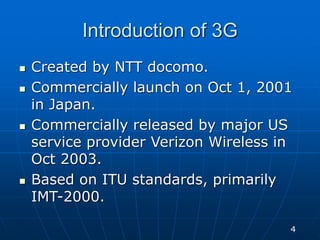
Introduction of 3G
 Created by NTT docomo.
 Commercially launch on Oct 1, 2001
in Japan.
 Commercially released by major US
service provider Verizon Wireless in
Oct 2003.
 Based on ITU standards, primarily
IMT-2000.
4
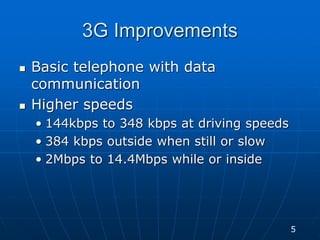
3G Improvements
 Basic telephone with data
communication
 Higher speeds
• 144kbps to 348 kbps at driving speeds
• 384 kbps outside when still or slow
• 2Mbps to 14.4Mbps while or inside
5
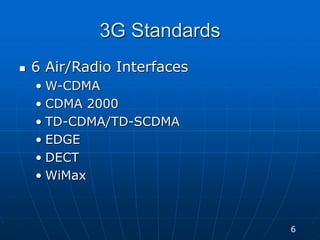
3G Standards
 6 Air/Radio Interfaces
• W-CDMA
• CDMA 2000
• TD-CDMA/TD-SCDMA
• EDGE
• DECT
• WiMax
6
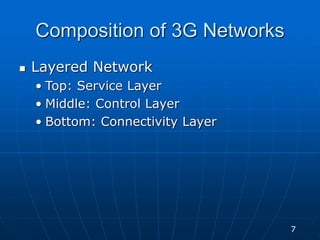
Composition of 3G Networks
 Layered Network
• Top: Service Layer
• Middle: Control Layer
• Bottom: Connectivity Layer
7
Privacy and Security
 User Authentication
 Network Authentication
 Device Authentication
 Data Monitoring
 End to End
Reliability and Robustness
 Cost of Service & Phones.
 Different Service Standards and
Costs.
 Cost vs. Revenue.
 Lack of Mobile Users.
 International Obstacles.
9
Interoperability and Support
 3G Enabled Devices
 3G Networks
 The Standard (IMT-2000)
 ITU and Member Support
• National Members
• ITU
• Carriers
Maintainability and Ease of Use
 3G Enabled Devices
 3G Networks
 The Standard (IMT-2000)
4G
 Technology that allows you to
connect anywhere
 Automatic access technology
switches while maintaining TCP
connections
 System support for voice and video
over IP
12
4G Possibilities
Competitors for 4G
 Long-Term Evolution (LTE)
• 4G path for Wideband Code Division Multiple
Access/Universal Mobile Telecommunications
System (W-CDMA/UMTS)
 Ultra Mobile Broadband (UMB)
• 4G path for CDMA2000 operators
 IEEE 802.16m
• WiMax
All based on… OFDMA (Orthogonal Frequency Division
Multiple Access) designed for 100+Mbps in wide-area
mobile apps
13
Progressing to 4G
 HSDPA/HSUPA
• High-Speed Downlink and Uplink Packet
Access
• “3.5G” – considered so because of high
speeds
 WiMax
• Some say this can also be 4G (Sprint)
• With OFDMA, this is faster than other
ways of connecting in 3G
14
4G Requirements
 High Quality of Service (QoS)
• Video and other services require this
• IP/MPLS can be used to guarantee this
 Spectrum
• 4G requires 20MHz or more in a swath
of spectrum
• Limited, mobile communications already
have allocated spectrum!
15
4G Spectrum
 700 Mhz band
• Benefit
 60% fewer cell sites
• Downside
 More customers = More $
 New frequency? New handsets/devices!
• US Federal Communications Commission
 Part of the band has been set aside for public
safety priority access
16
4G Implementation
 New, all-IP network
 LTE
• MIMO- Multiple Input Multiple Output
 Higher data rates with multiple antennas
 More reliability
 CDMA supporters (Verizon) may switch
 Pseudo wires
• 60% less expensive then TDM or ATM
per bit
17
4G Conclusion
 Until 4G is officially defined, the idea
behind it is to predict what end users
want
• Knowing that, networks need to be able
to deliver the desired services in high
quality.
18
References
 Kurose, James F. and Keith W. Ross. Computer Networking: A Top-
Down Approach Featuring the Internet. 3rd ed. New York: Pearson
Education, 2005.
 Luna, Lynnette. "The Long Road to 4G." Telephony (11 Dec.
2007): 12-18. Academic Search Premier. EBSCO. Van Houten
Library, Newark, NJ. 3 May 2009
<http://search.ebscohost.com/login.aspx?direct=true&db=aph&A
N=28053259&site=ehost-live>.
 THRYFT, ANN. "3G WIRELESS DATA: about to break?." EDN 53.23
(13 Nov. 2008): 40-48. Academic Search Premier. EBSCO. Van
Houten Library, Newark, NJ. 3 May 2009
<http://search.ebscohost.com/login.aspx?direct=true&db=aph&A
N=35457796&site=ehost-live>.
 Kaplan, Peter. “Verizon and AT&T dominate airwaves auction.”
Reuters. 20 March 2008. 3 May 2009
<http://www.reuters.com/article/technologyNews/idUSN2042023
420080320?feedType=RSS&feedName=technologyNews>
19
Questions?
20

3G.ppt

  • 1.
  • 2.
    Cellular Standards  “Generations” •Early  1G – analog, for voice only  2G – digital, for voice • Converts analog into digital before modulating and transmitting • Most cellular providers currently use this technology • Now  Change in the needs of communication 2
  • 3.
    Evolution from 2Gto 3G  GPRS • Best-effort packet switched service used for data transfer. • Provides data rates from 56 kbps up to 114 kbps.  EDGE • Evolved from GPRS. • Can be used for packet switched applications. 3
  • 4.
    Introduction of 3G Created by NTT docomo.  Commercially launch on Oct 1, 2001 in Japan.  Commercially released by major US service provider Verizon Wireless in Oct 2003.  Based on ITU standards, primarily IMT-2000. 4
  • 5.
    3G Improvements  Basictelephone with data communication  Higher speeds • 144kbps to 348 kbps at driving speeds • 384 kbps outside when still or slow • 2Mbps to 14.4Mbps while or inside 5
  • 6.
    3G Standards  6Air/Radio Interfaces • W-CDMA • CDMA 2000 • TD-CDMA/TD-SCDMA • EDGE • DECT • WiMax 6
  • 7.
    Composition of 3GNetworks  Layered Network • Top: Service Layer • Middle: Control Layer • Bottom: Connectivity Layer 7
  • 8.
    Privacy and Security User Authentication  Network Authentication  Device Authentication  Data Monitoring  End to End
  • 9.
    Reliability and Robustness Cost of Service & Phones.  Different Service Standards and Costs.  Cost vs. Revenue.  Lack of Mobile Users.  International Obstacles. 9
  • 10.
    Interoperability and Support 3G Enabled Devices  3G Networks  The Standard (IMT-2000)  ITU and Member Support • National Members • ITU • Carriers
  • 11.
    Maintainability and Easeof Use  3G Enabled Devices  3G Networks  The Standard (IMT-2000)
  • 12.
    4G  Technology thatallows you to connect anywhere  Automatic access technology switches while maintaining TCP connections  System support for voice and video over IP 12
  • 13.
    4G Possibilities Competitors for4G  Long-Term Evolution (LTE) • 4G path for Wideband Code Division Multiple Access/Universal Mobile Telecommunications System (W-CDMA/UMTS)  Ultra Mobile Broadband (UMB) • 4G path for CDMA2000 operators  IEEE 802.16m • WiMax All based on… OFDMA (Orthogonal Frequency Division Multiple Access) designed for 100+Mbps in wide-area mobile apps 13
  • 14.
    Progressing to 4G HSDPA/HSUPA • High-Speed Downlink and Uplink Packet Access • “3.5G” – considered so because of high speeds  WiMax • Some say this can also be 4G (Sprint) • With OFDMA, this is faster than other ways of connecting in 3G 14
  • 15.
    4G Requirements  HighQuality of Service (QoS) • Video and other services require this • IP/MPLS can be used to guarantee this  Spectrum • 4G requires 20MHz or more in a swath of spectrum • Limited, mobile communications already have allocated spectrum! 15
  • 16.
    4G Spectrum  700Mhz band • Benefit  60% fewer cell sites • Downside  More customers = More $  New frequency? New handsets/devices! • US Federal Communications Commission  Part of the band has been set aside for public safety priority access 16
  • 17.
    4G Implementation  New,all-IP network  LTE • MIMO- Multiple Input Multiple Output  Higher data rates with multiple antennas  More reliability  CDMA supporters (Verizon) may switch  Pseudo wires • 60% less expensive then TDM or ATM per bit 17
  • 18.
    4G Conclusion  Until4G is officially defined, the idea behind it is to predict what end users want • Knowing that, networks need to be able to deliver the desired services in high quality. 18
  • 19.
    References  Kurose, JamesF. and Keith W. Ross. Computer Networking: A Top- Down Approach Featuring the Internet. 3rd ed. New York: Pearson Education, 2005.  Luna, Lynnette. "The Long Road to 4G." Telephony (11 Dec. 2007): 12-18. Academic Search Premier. EBSCO. Van Houten Library, Newark, NJ. 3 May 2009 <http://search.ebscohost.com/login.aspx?direct=true&db=aph&A N=28053259&site=ehost-live>.  THRYFT, ANN. "3G WIRELESS DATA: about to break?." EDN 53.23 (13 Nov. 2008): 40-48. Academic Search Premier. EBSCO. Van Houten Library, Newark, NJ. 3 May 2009 <http://search.ebscohost.com/login.aspx?direct=true&db=aph&A N=35457796&site=ehost-live>.  Kaplan, Peter. “Verizon and AT&T dominate airwaves auction.” Reuters. 20 March 2008. 3 May 2009 <http://www.reuters.com/article/technologyNews/idUSN2042023 420080320?feedType=RSS&feedName=technologyNews> 19
  • 20.