HISTORY OF COMMUNICATION
- CONTENT
-communication systems overview
- Introduction to Cellular Fundamentals
- Network Architecture
- GSM Air Interface
- Digital Mobile Elements
- GSM Network Protocols
HISTORY OF COMMUNICATION
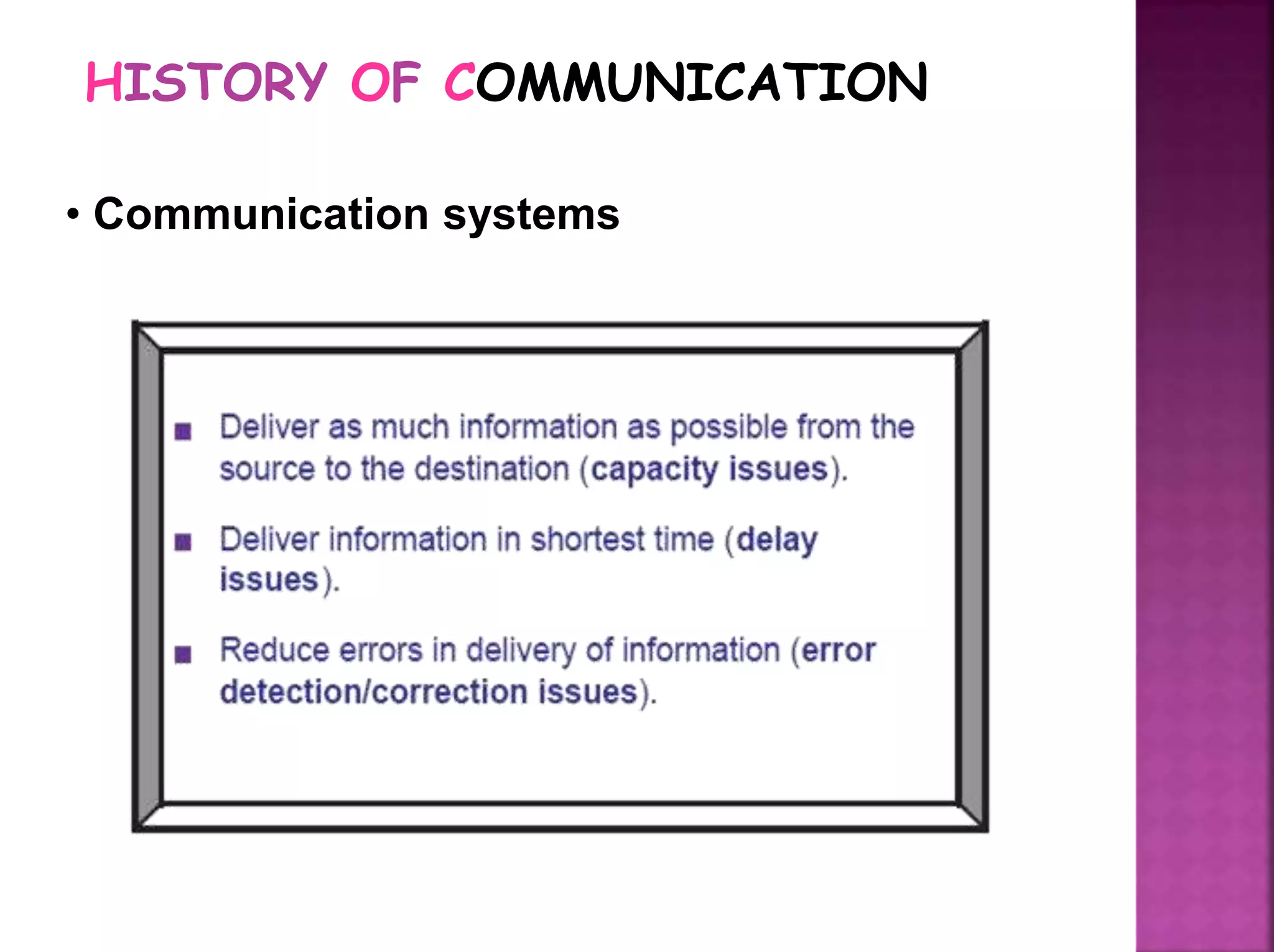
• Communication systems
HISTORY OF COMMUNICATION
Voice Communications
HISTORY OF COMMUNICATION
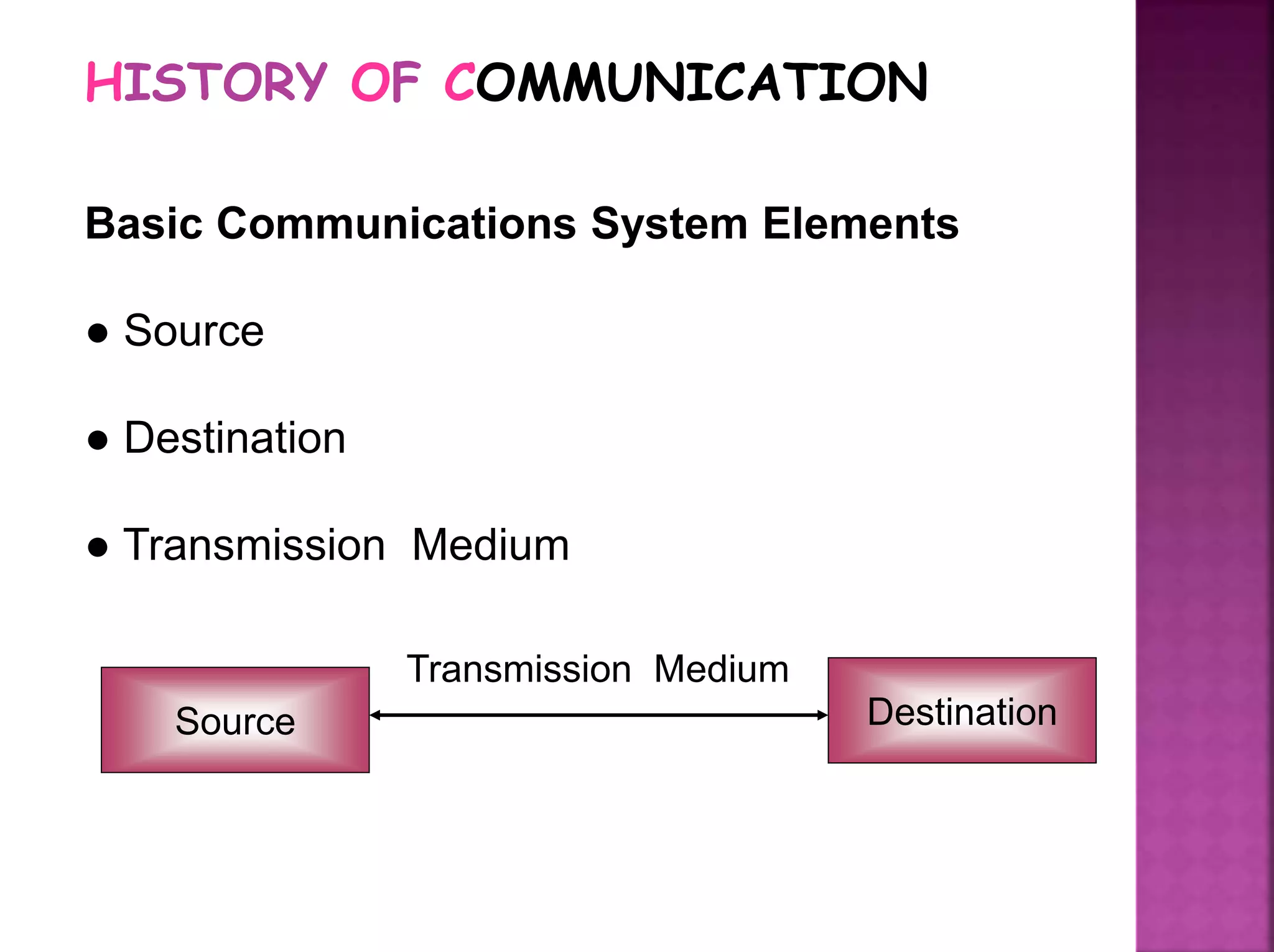
Basic Communications System Elements
● Source
● Destination
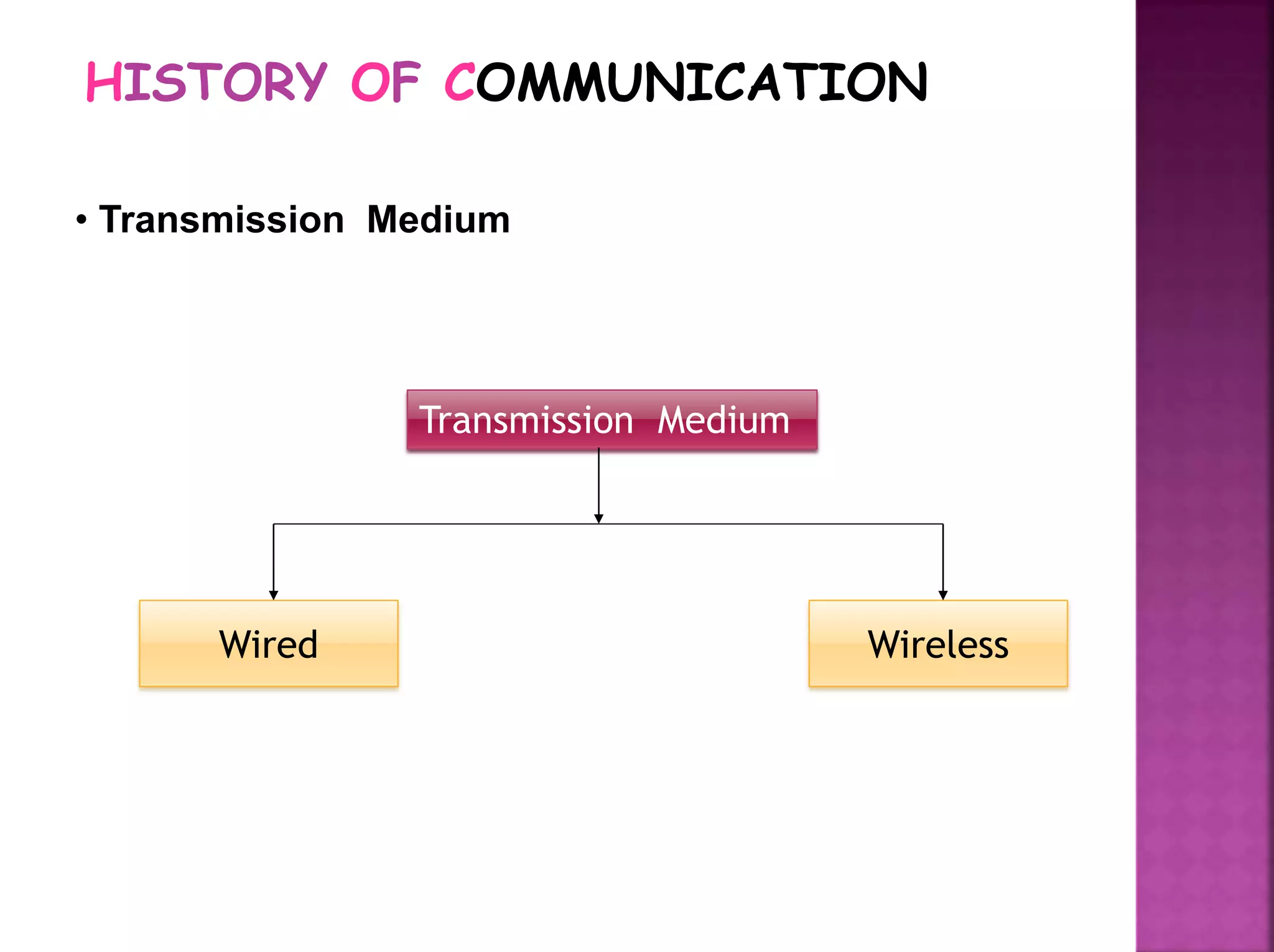
● Transmission Medium
Source Destination
Transmission Medium
HISTORY OF COMMUNICATION
Transmission Medium
Wired Wireless
• Transmission Medium
HISTORY OF COMMUNICATION
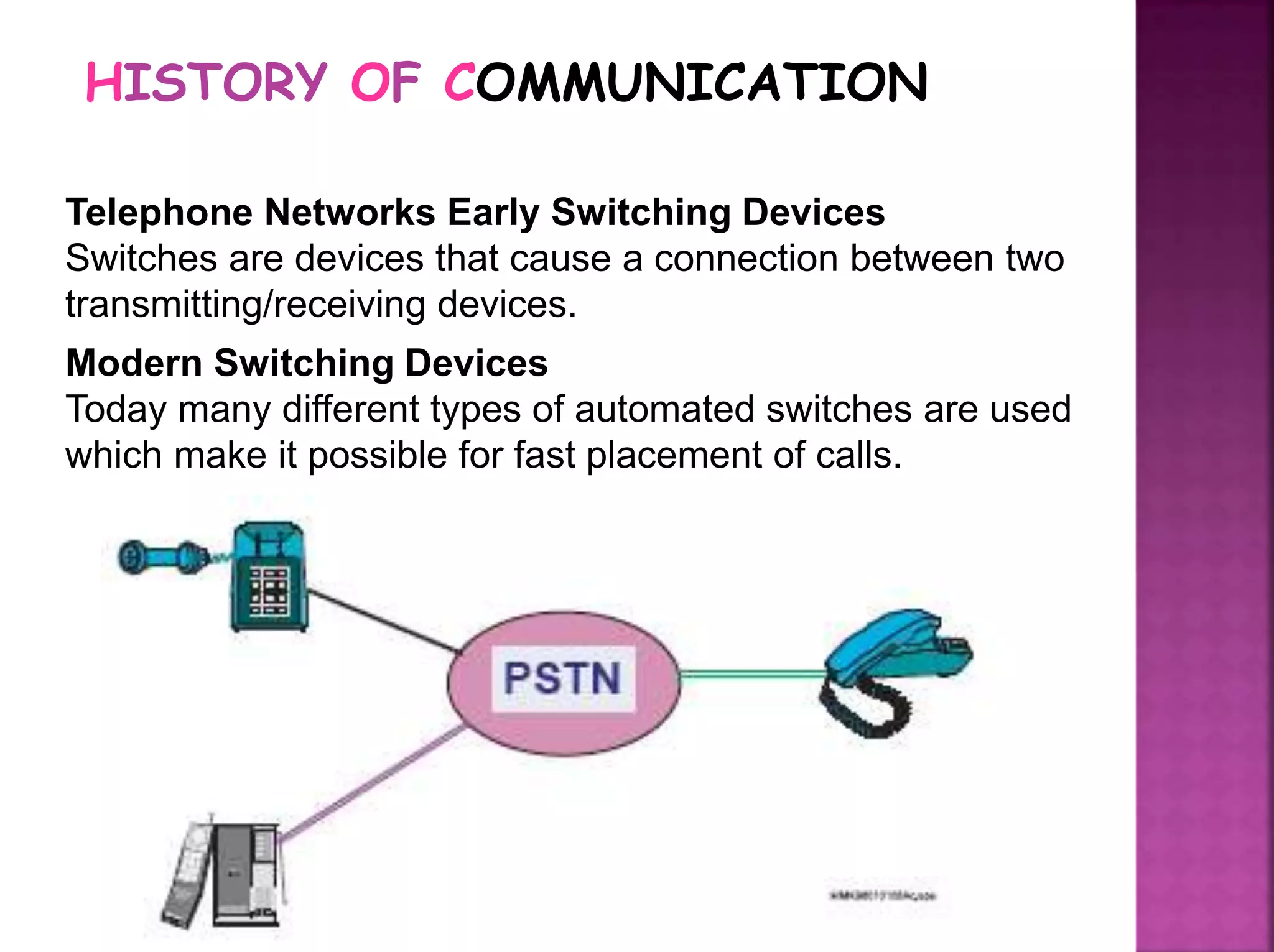
Telephone Networks Early Switching Devices
Switches are devices that cause a connection between two
transmitting/receiving devices.
Modern Switching Devices
Today many different types of automated switches are used
which make it possible for fast placement of calls.
HISTORY OF COMMUNICATION
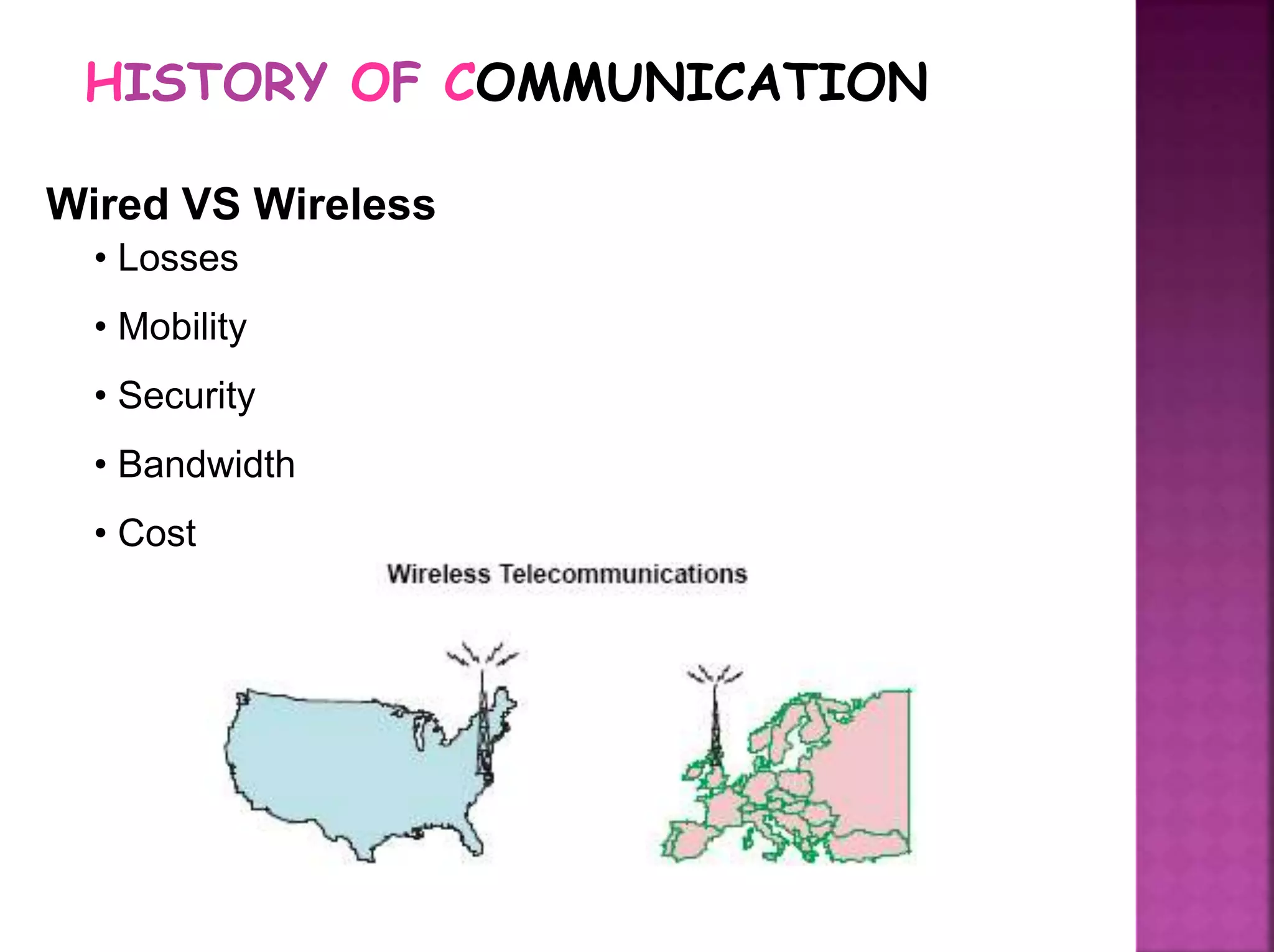
Wired VS Wireless
• Losses
• Mobility
• Security
• Bandwidth
• Cost
FUNDAMENTAL OF CELLULAR SYSTEM
Transition from analog to digital
• Capacity
Compression in digital gives more channels
• compatibility with other systems
As ISDN (Integrated service Digital Network)
• Cost
• Quality
• Security
 Some techniques used in wireless communication:
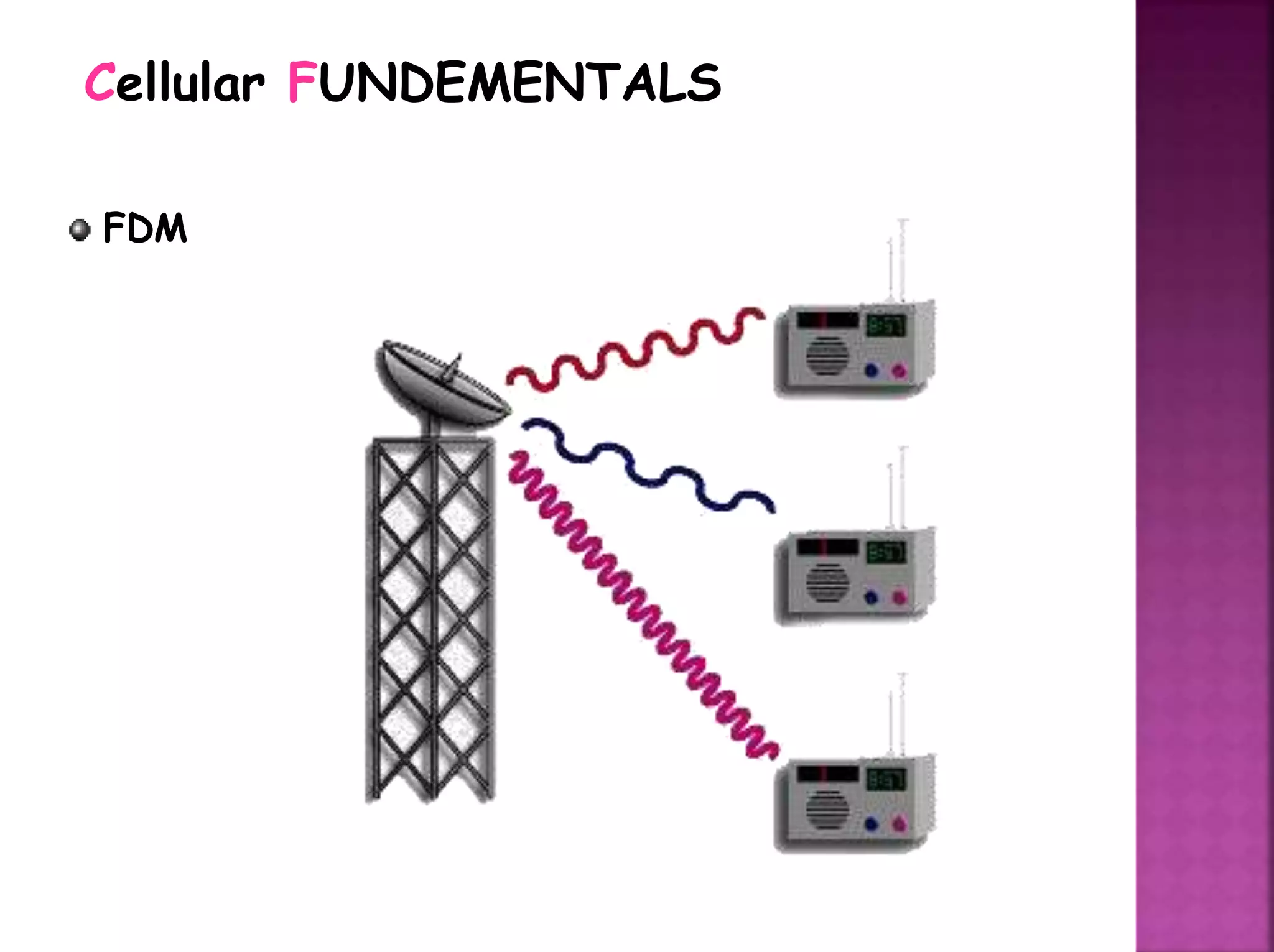
 FDM
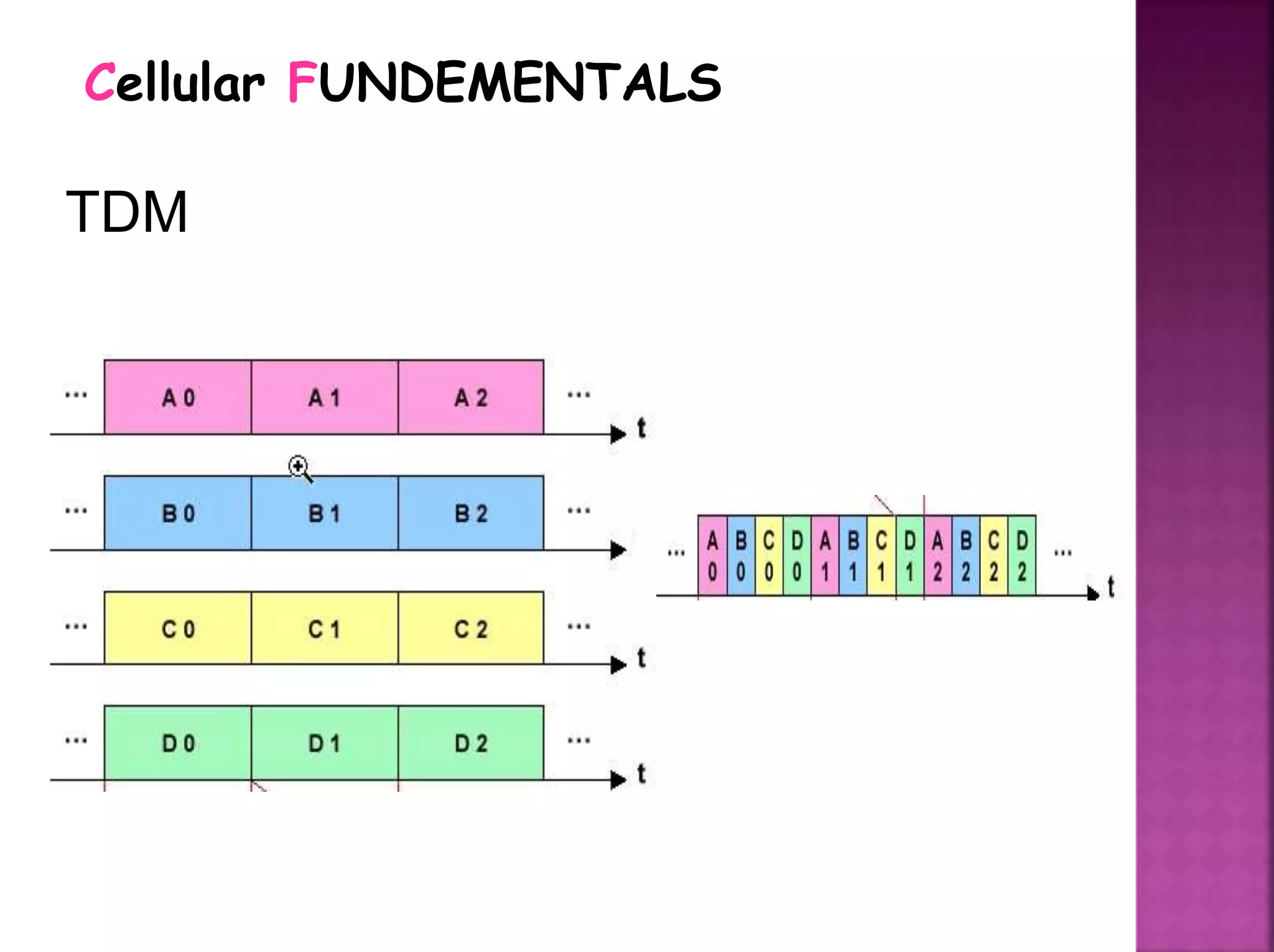
 TDM
 FDMA
 TDMA
Cellular FUNDEMENTALS
FDM
Cellular FUNDEMENTALS
TDM
Cellular FUNDEMENTALS
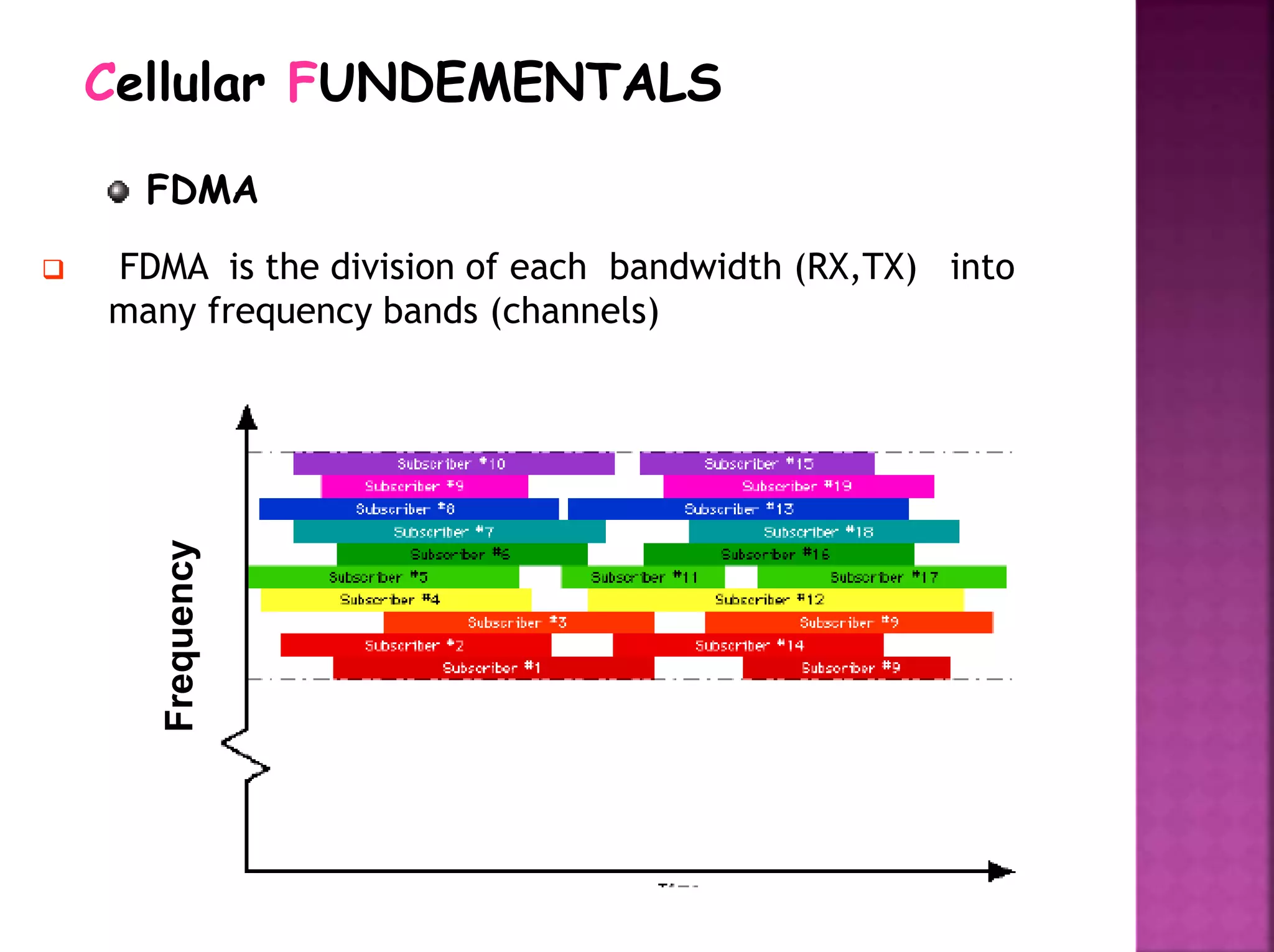
FrequencyFDMA
 FDMA is the division of each bandwidth (RX,TX) into
many frequency bands (channels)
Cellular FUNDEMENTALS
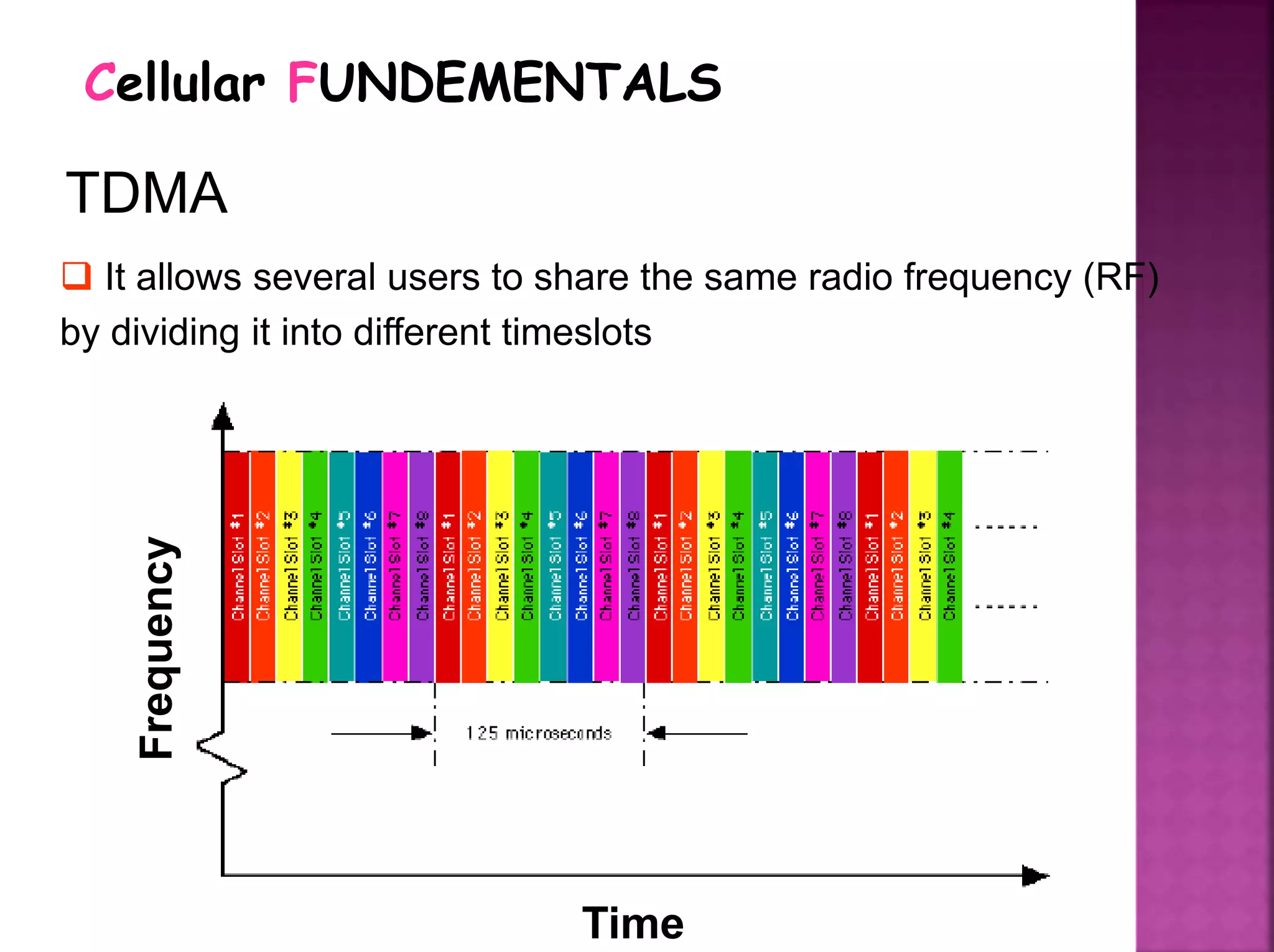
TDMA
 It allows several users to share the same radio frequency (RF)
by dividing it into different timeslots
Time
Frequency
Cellular FUNDEMENTALS
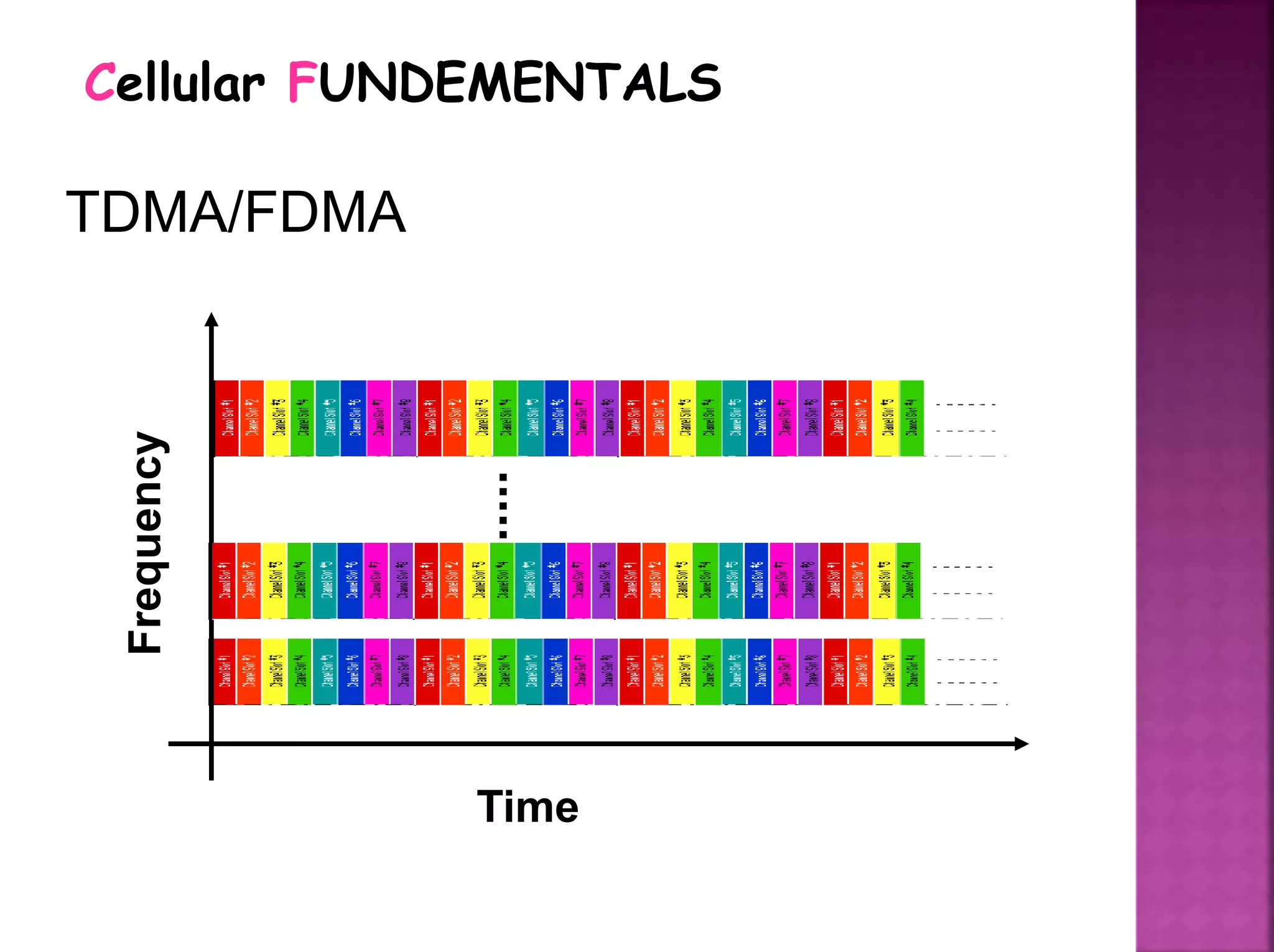
TDMA/FDMA
Cellular FUNDEMENTALS
Time
Frequency
Cellular FUNDEMENTALS
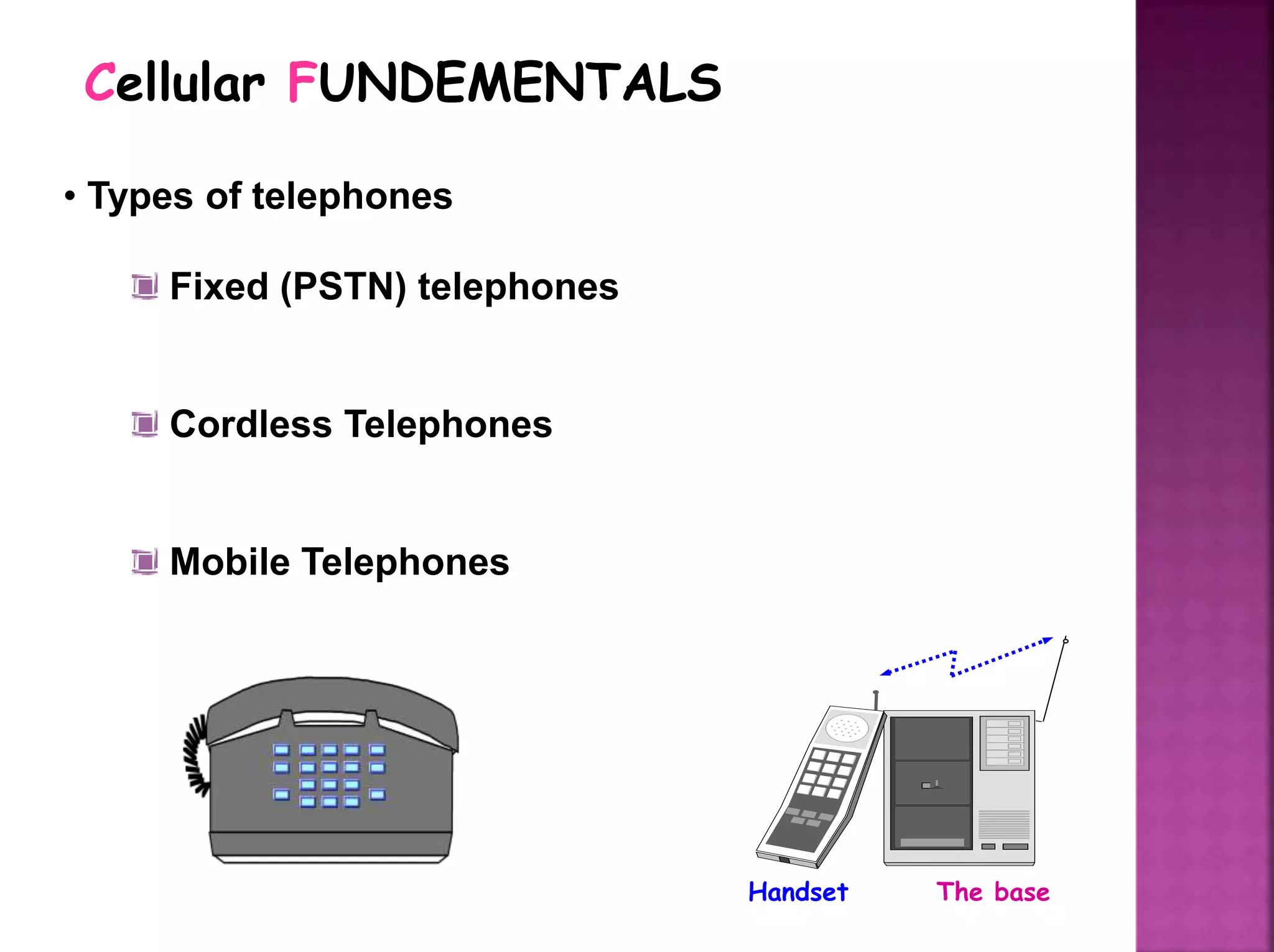
• Types of telephones
Fixed (PSTN) telephones
Cordless Telephones
Mobile Telephones
Handset The base
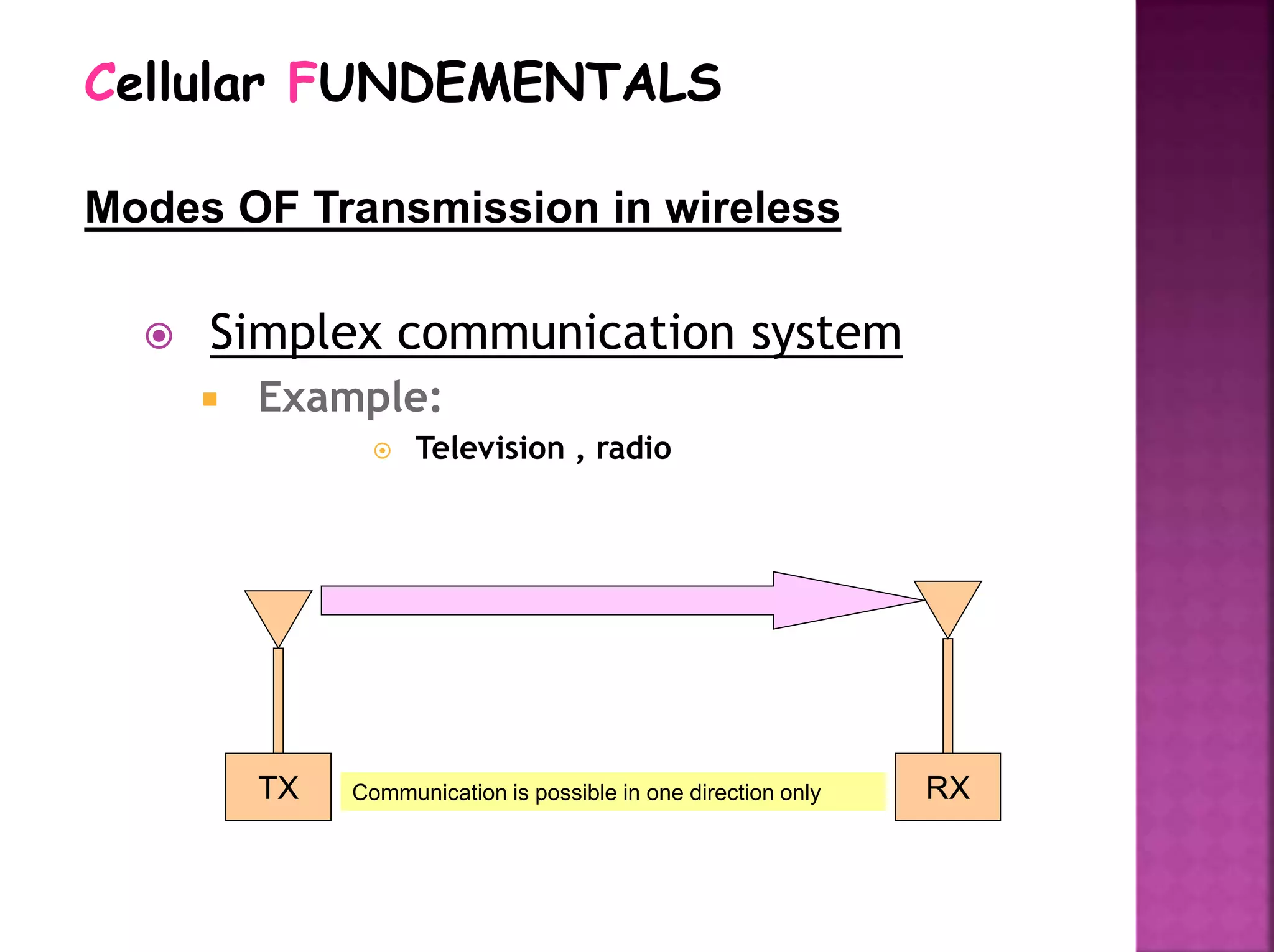
Modes OF Transmission in wireless
 Simplex communication system
 Example:
 Television , radio
TX RXCommunication is possible in one direction only
Cellular FUNDEMENTALS
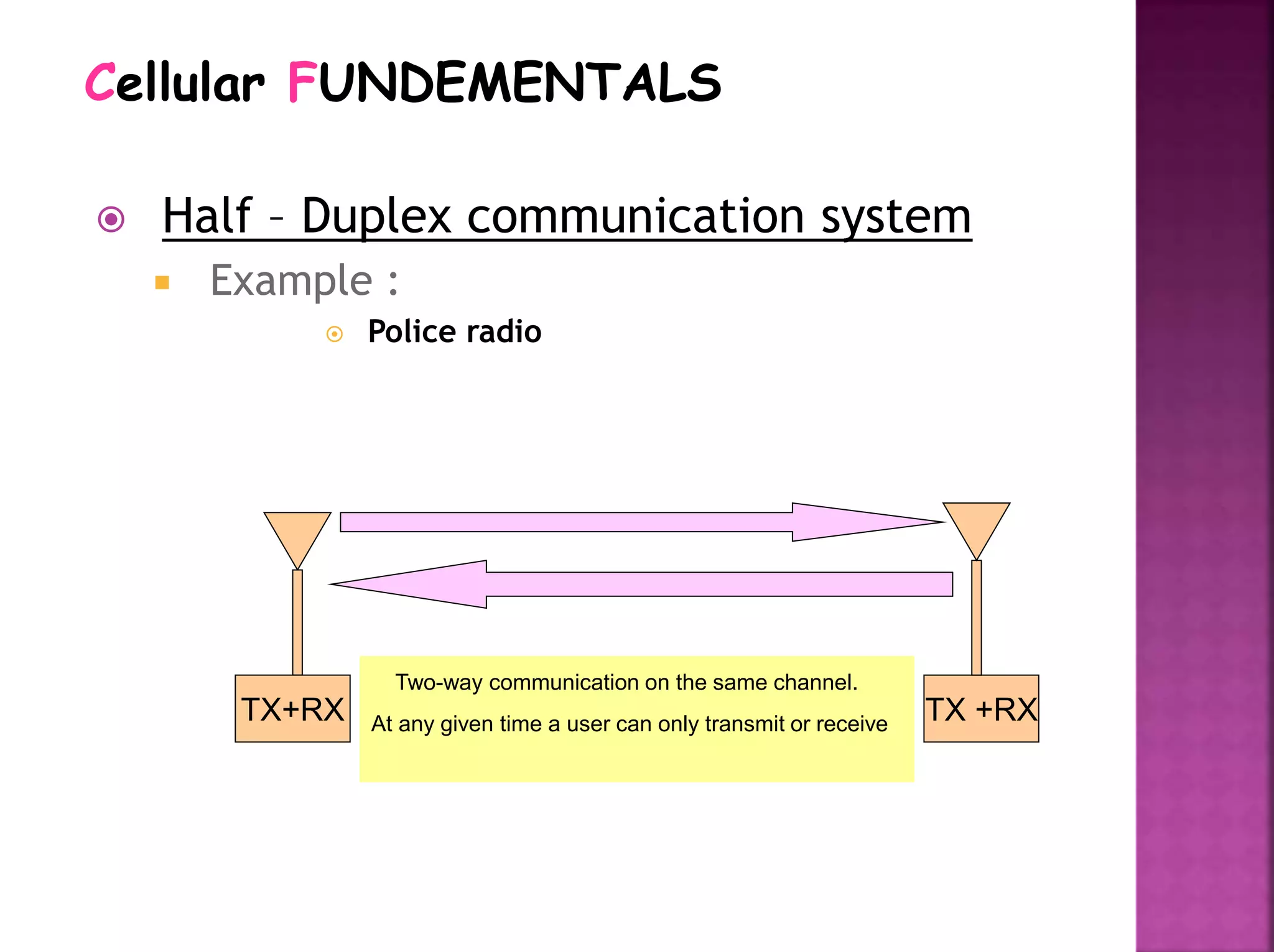
 Half – Duplex communication system
 Example :
 Police radio
TX+RX TX +RX
Two-way communication on the same channel.
At any given time a user can only transmit or receive
Cellular FUNDEMENTALS
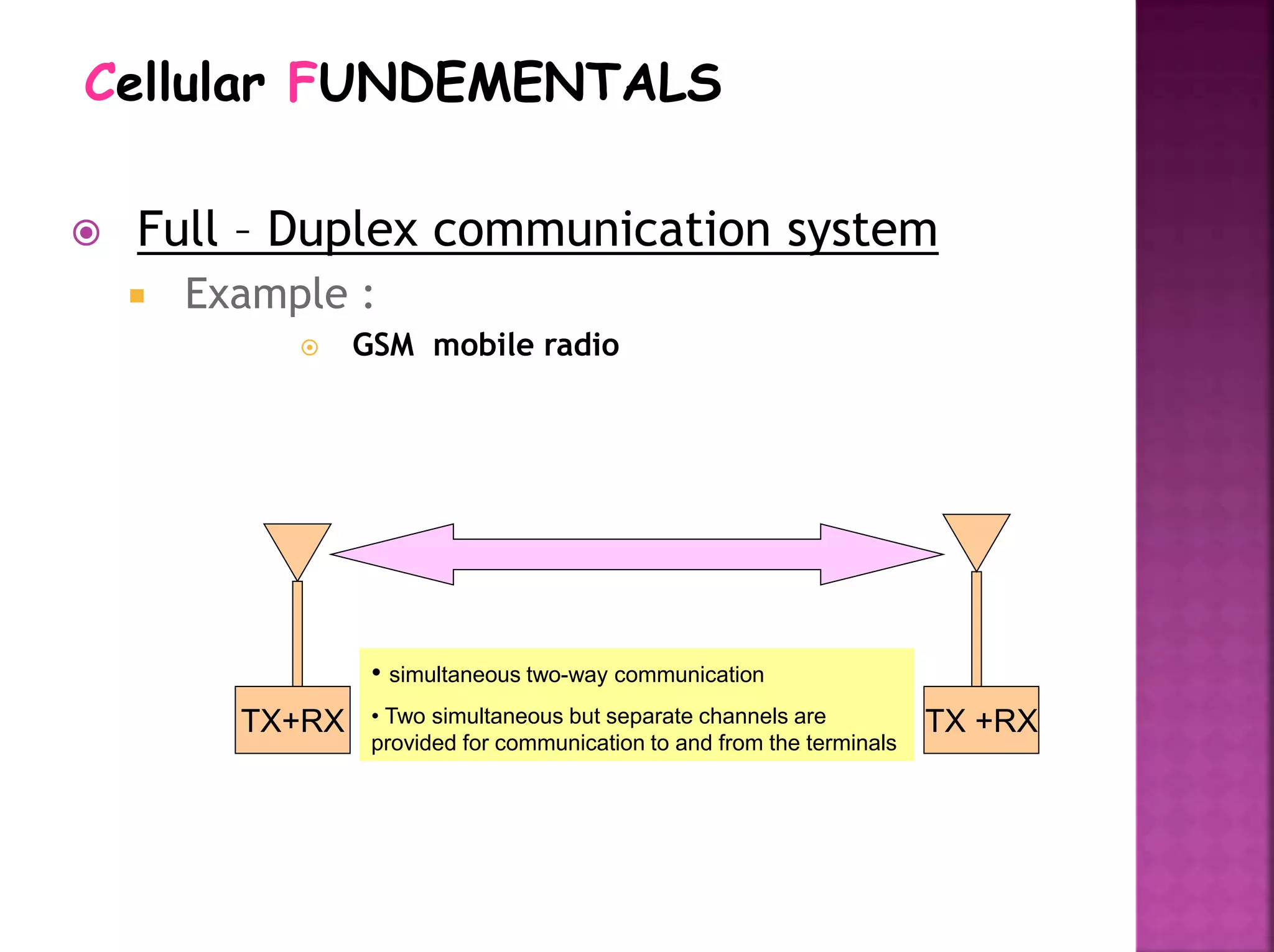
 Full – Duplex communication system
 Example :
 GSM mobile radio
TX+RX TX +RX
• simultaneous two-way communication
• Two simultaneous but separate channels are
provided for communication to and from the terminals
Cellular FUNDEMENTALS
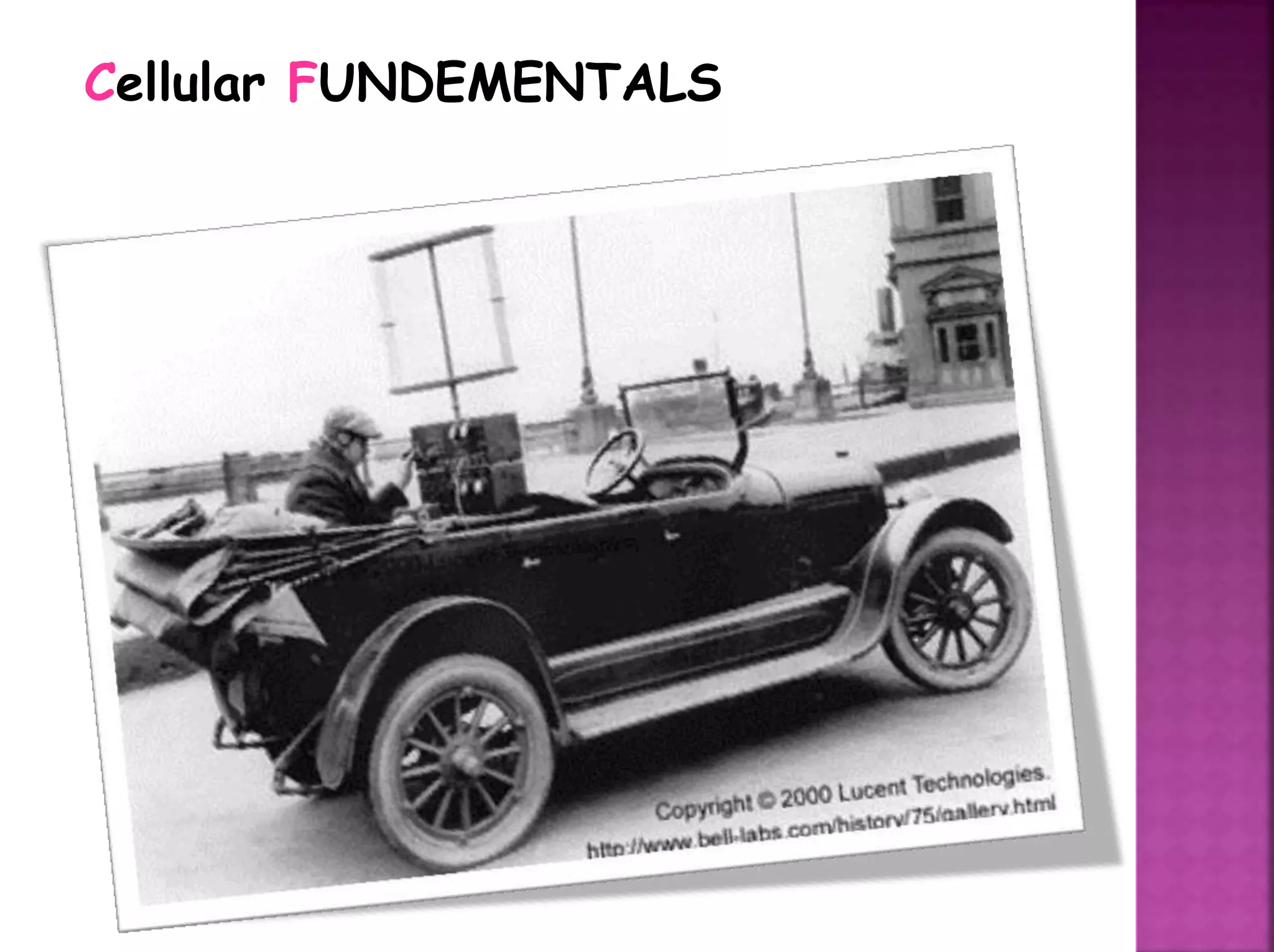
Simple growth was the single transmitting/receiving station
- heavy, bulky and expensive
- no switching between regions
- low quality
- limited capacity
- rapid market saturation
- power hungry transceiver
- power level was not safe
MS
High
transmitted
power
Up link
Down
link
Cellular FUNDEMENTALS
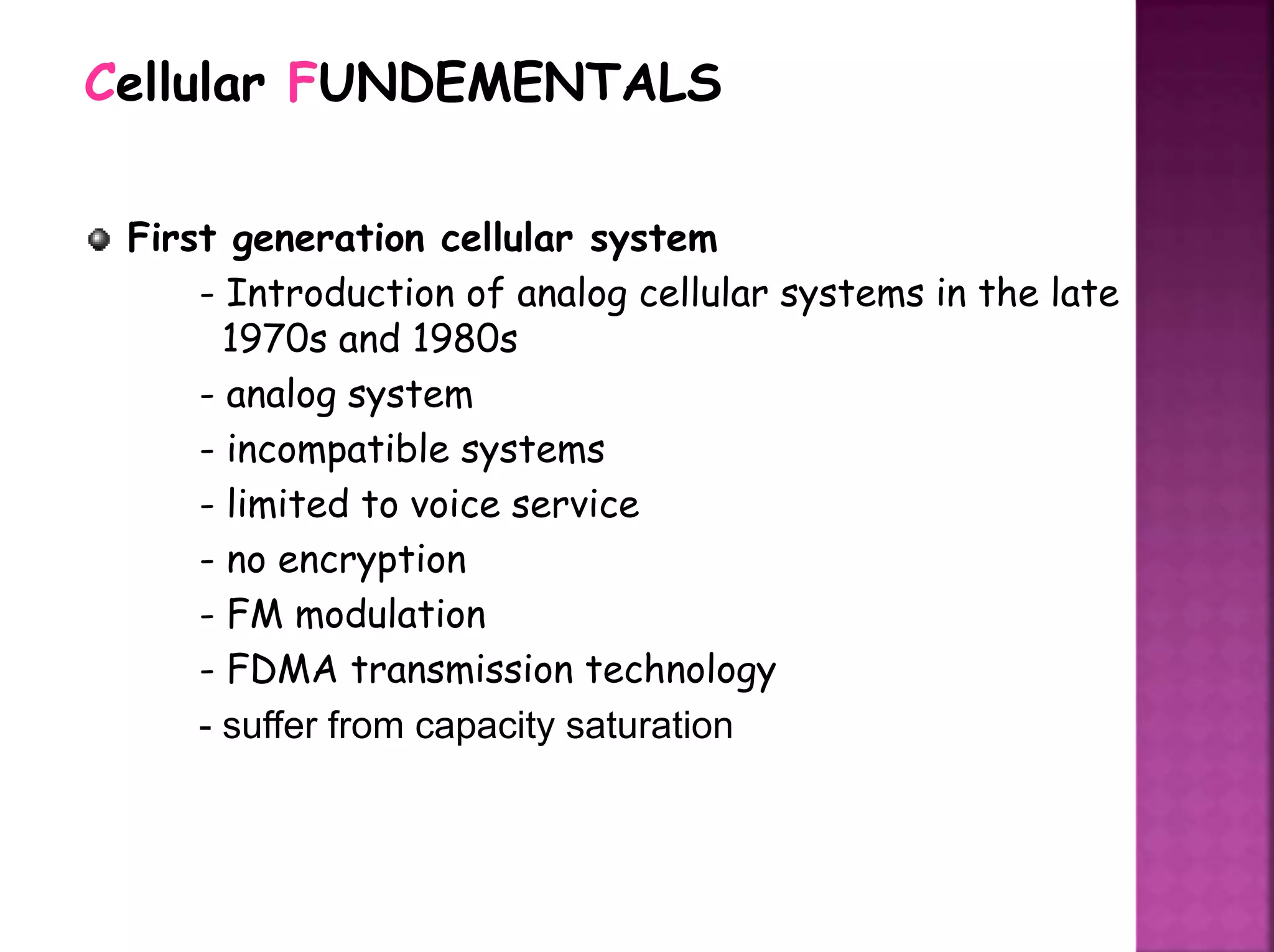
First generation cellular system
- Introduction of analog cellular systems in the late
1970s and 1980s
- analog system
- incompatible systems
- limited to voice service
- no encryption
- FM modulation
- FDMA transmission technology
- suffer from capacity saturation
Cellular FUNDEMENTALS
Second Generation cellular system
- Introduction of digital cellular systems (90’s)
- development of unified international standard for
mobile communications
- pan-national roaming
- digital encryption
- enhanced range of services (data + voice)
- low power consumption
- light weight, compact and pocket size terminals
- TDMA transmission technology
- huge capacity
Cellular FUNDEMENTALS
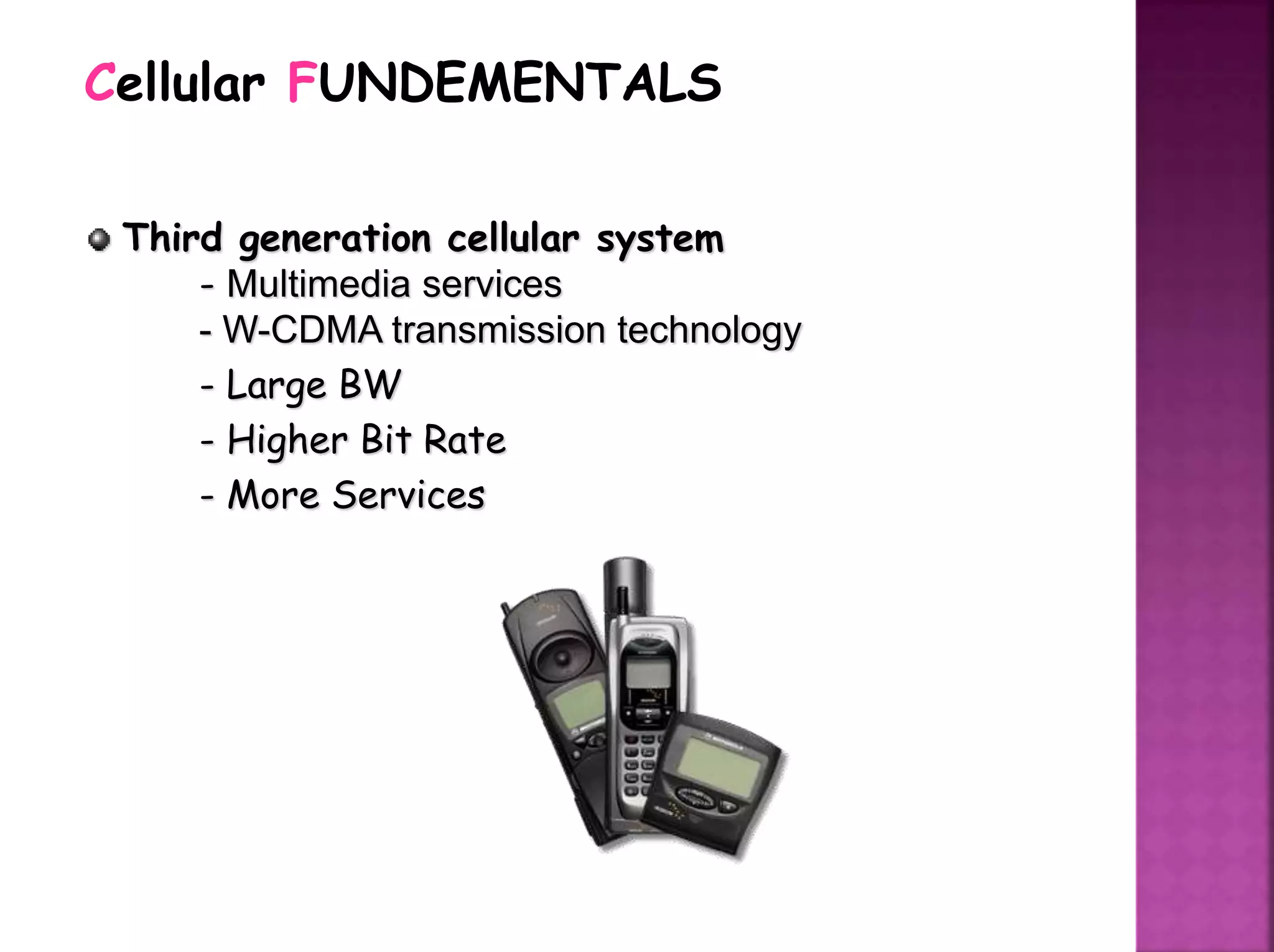
Third generation cellular system
- Multimedia services
- W-CDMA transmission technology
- Large BW
- Higher Bit Rate
- More Services
Cellular FUNDEMENTALS
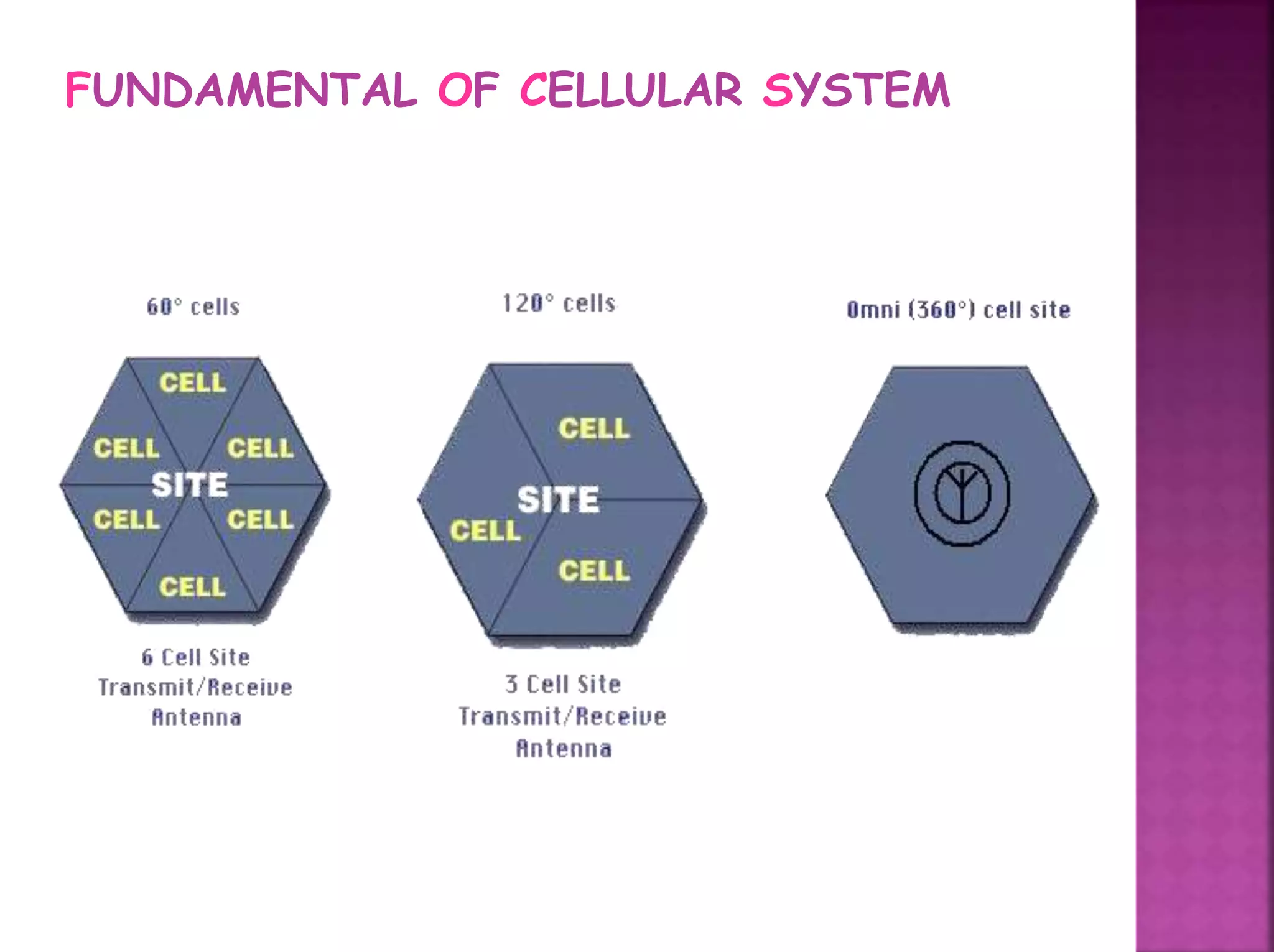
FUNDAMENTAL OF CELLULAR SYSTEM
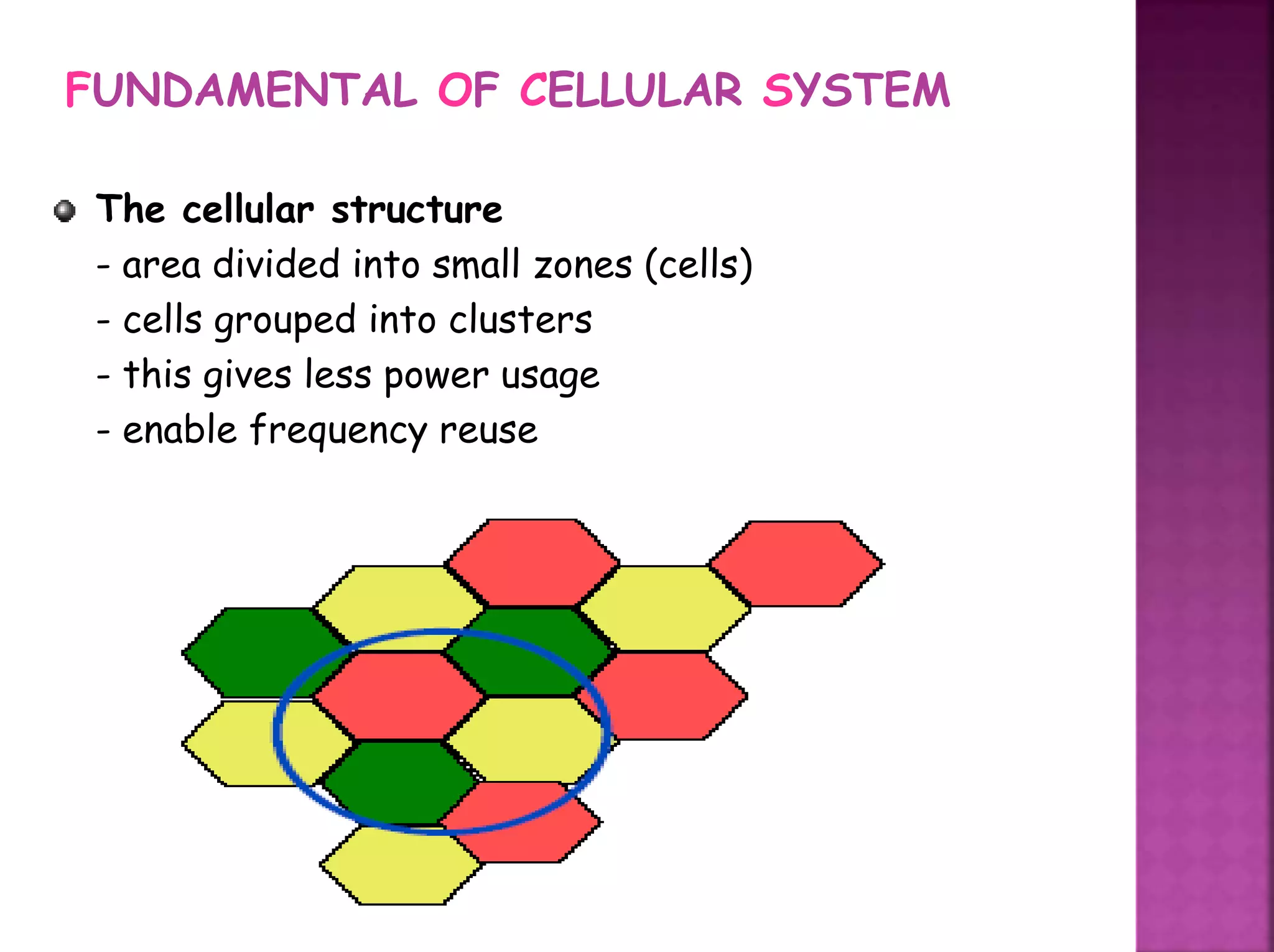
The cellular structure
- area divided into small zones (cells)
- cells grouped into clusters
- this gives less power usage
- enable frequency reuse
FUNDAMENTAL OF CELLULAR SYSTEM
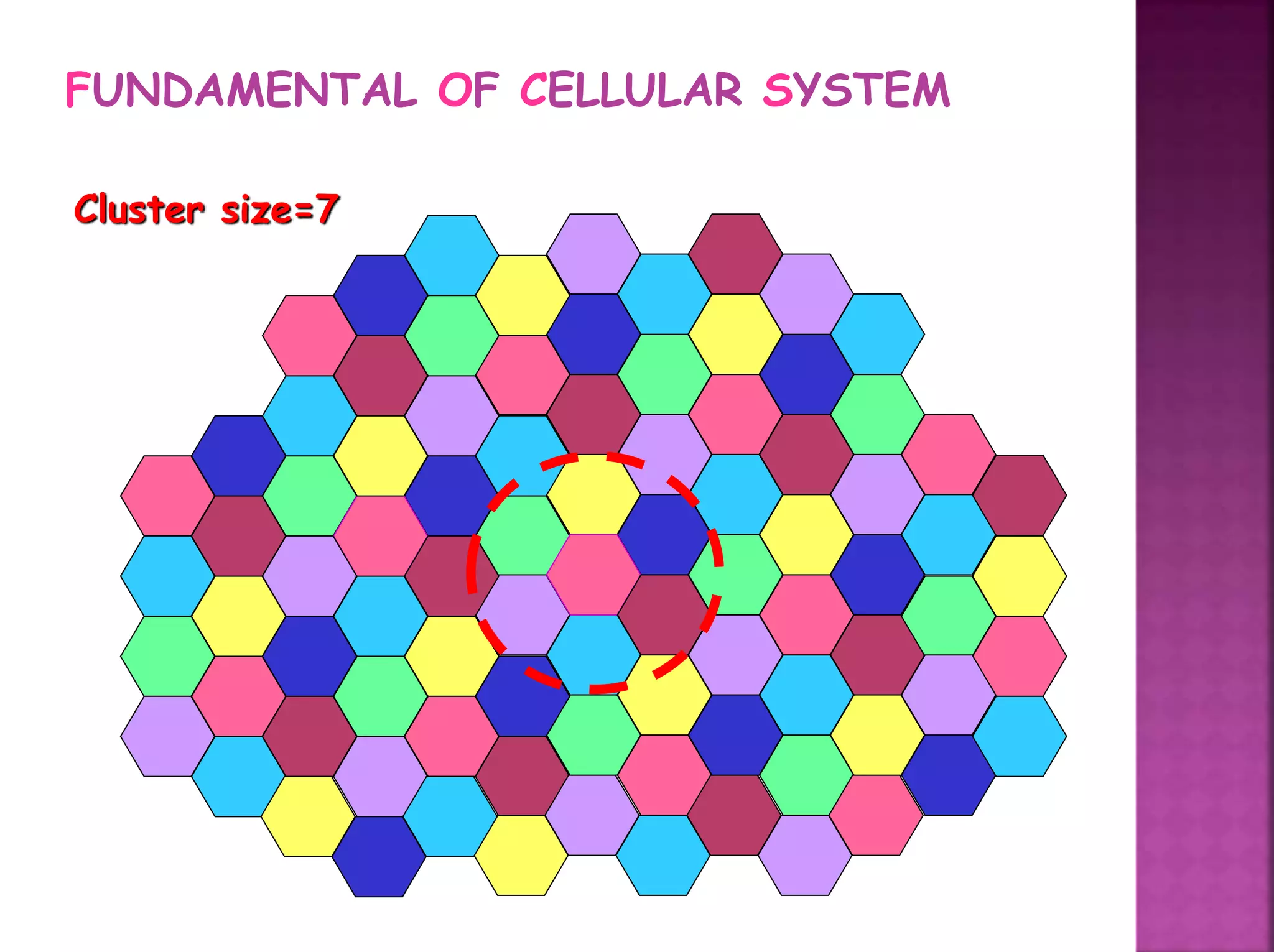
Cluster size=7
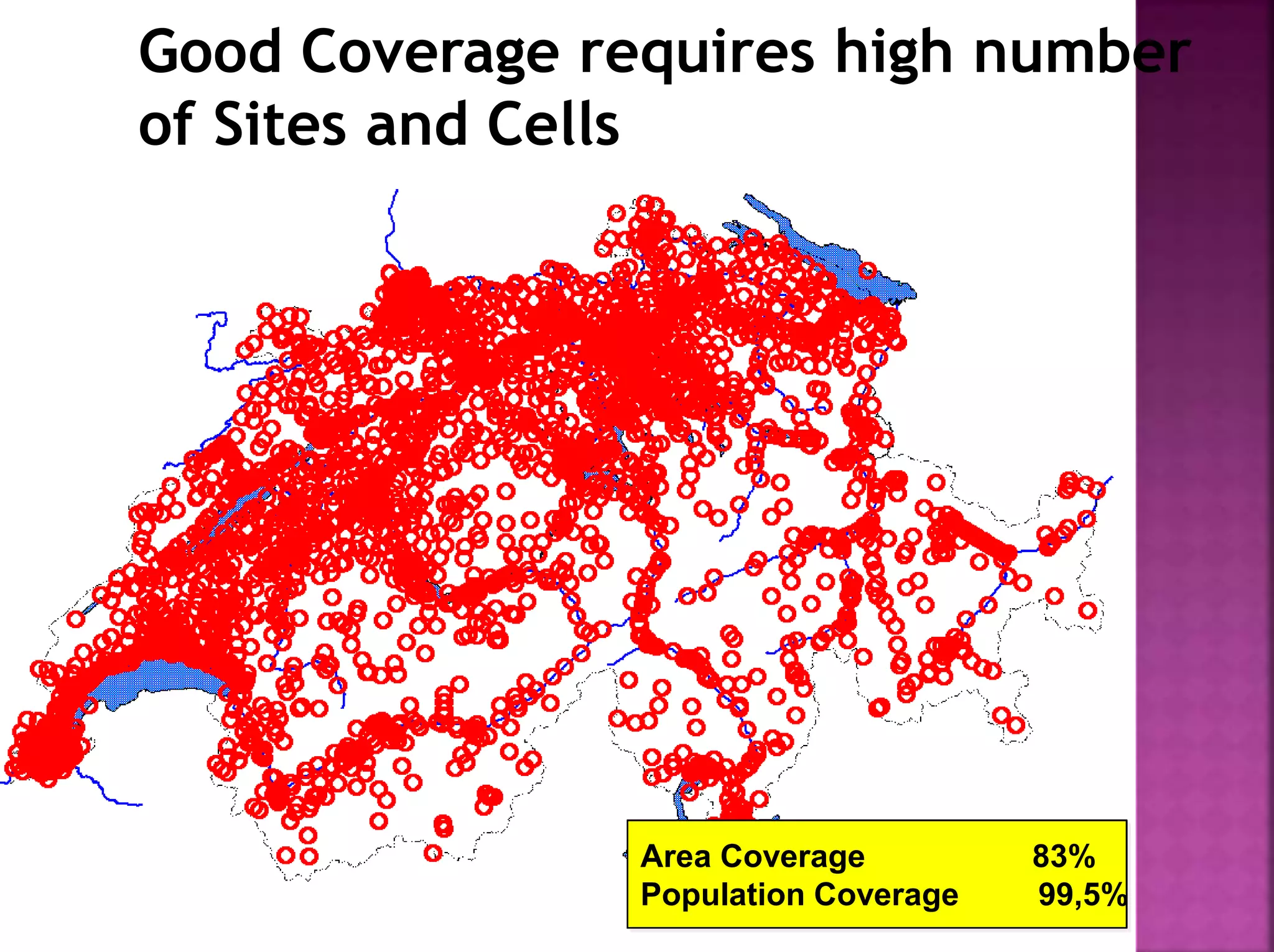
Good Coverage requires high number
of Sites and Cells
Area Coverage 83%
Population Coverage 99,5%
FUNDAMENTAL OF CELLULAR SYSTEM
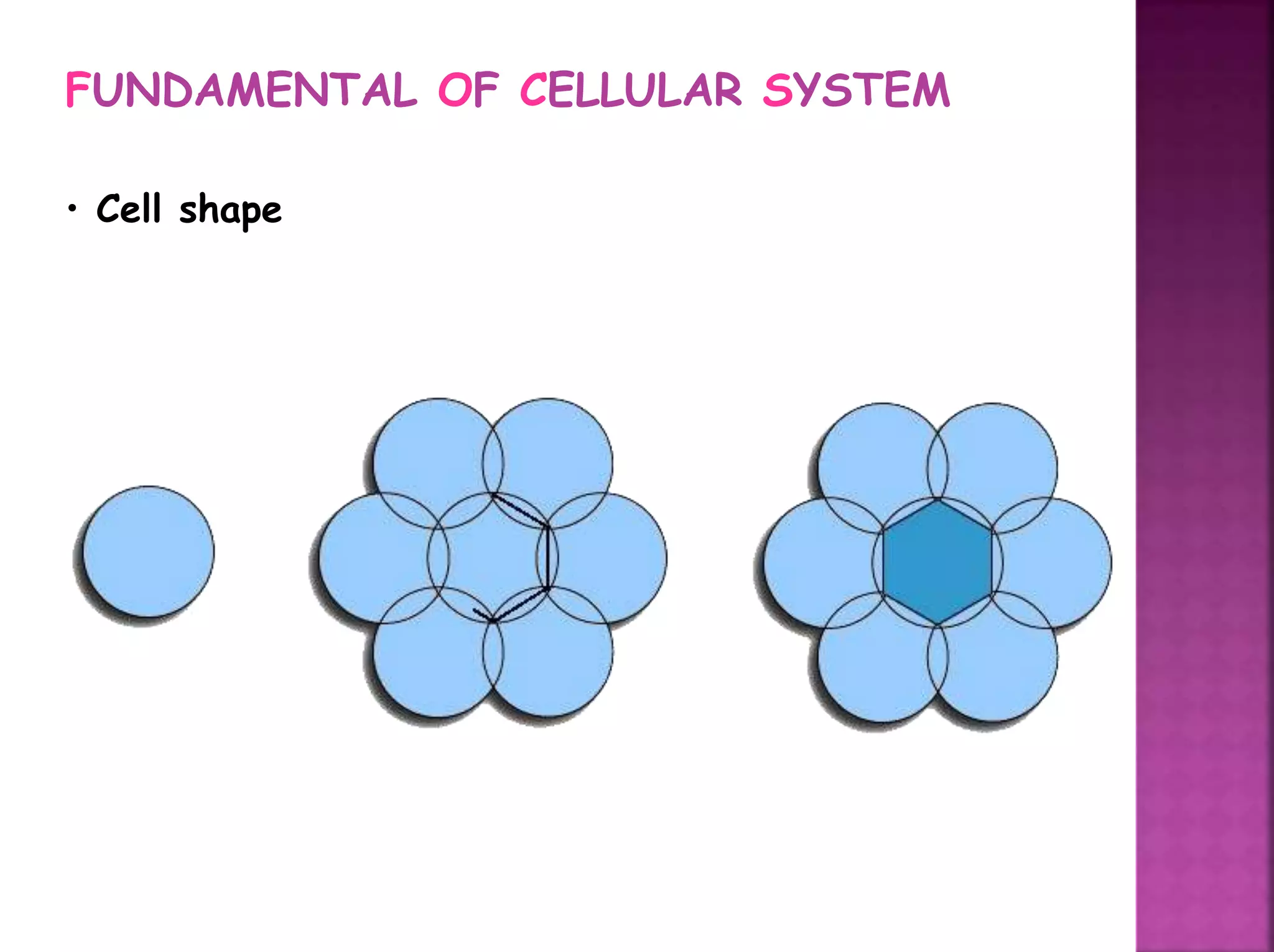
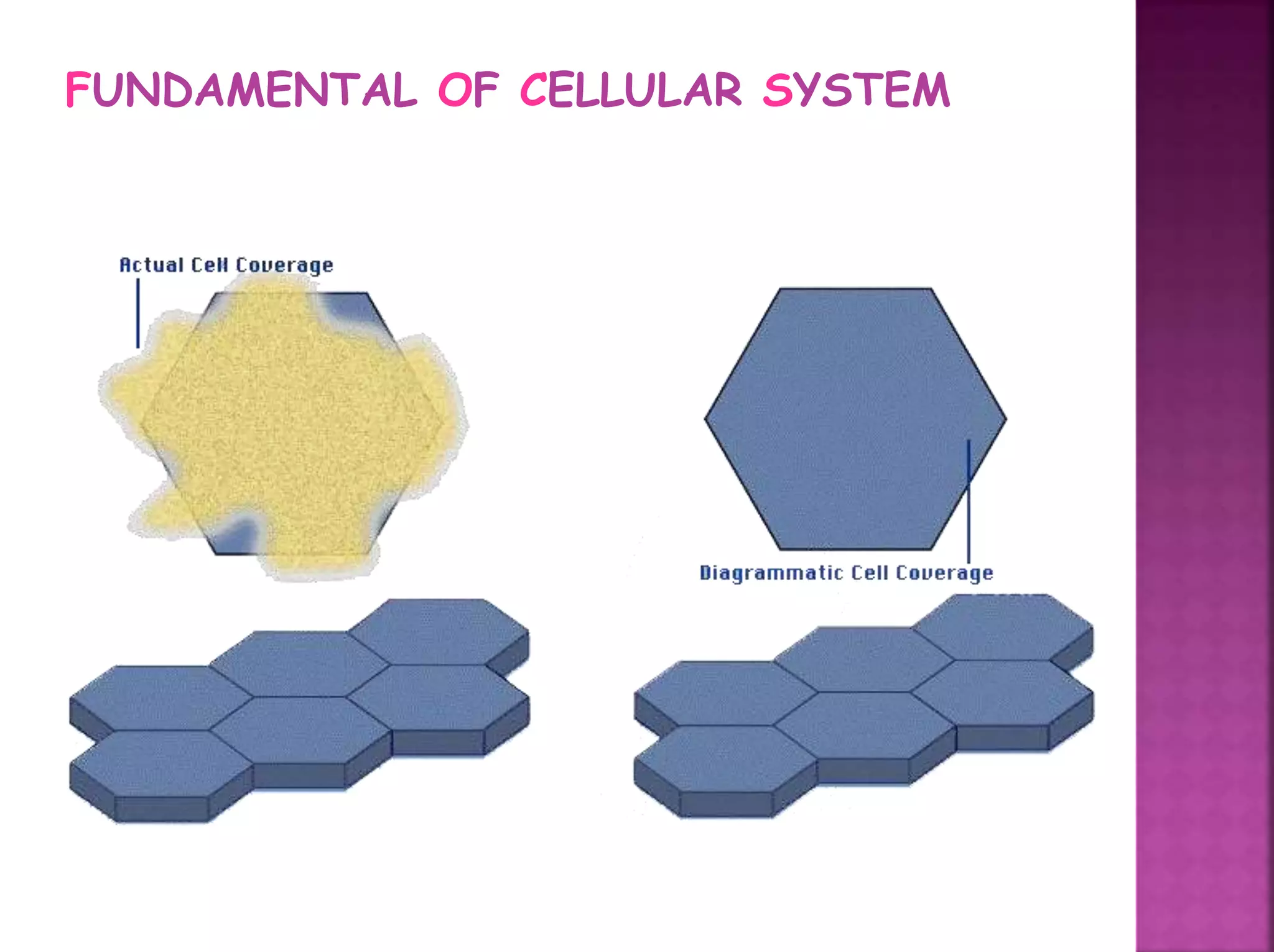
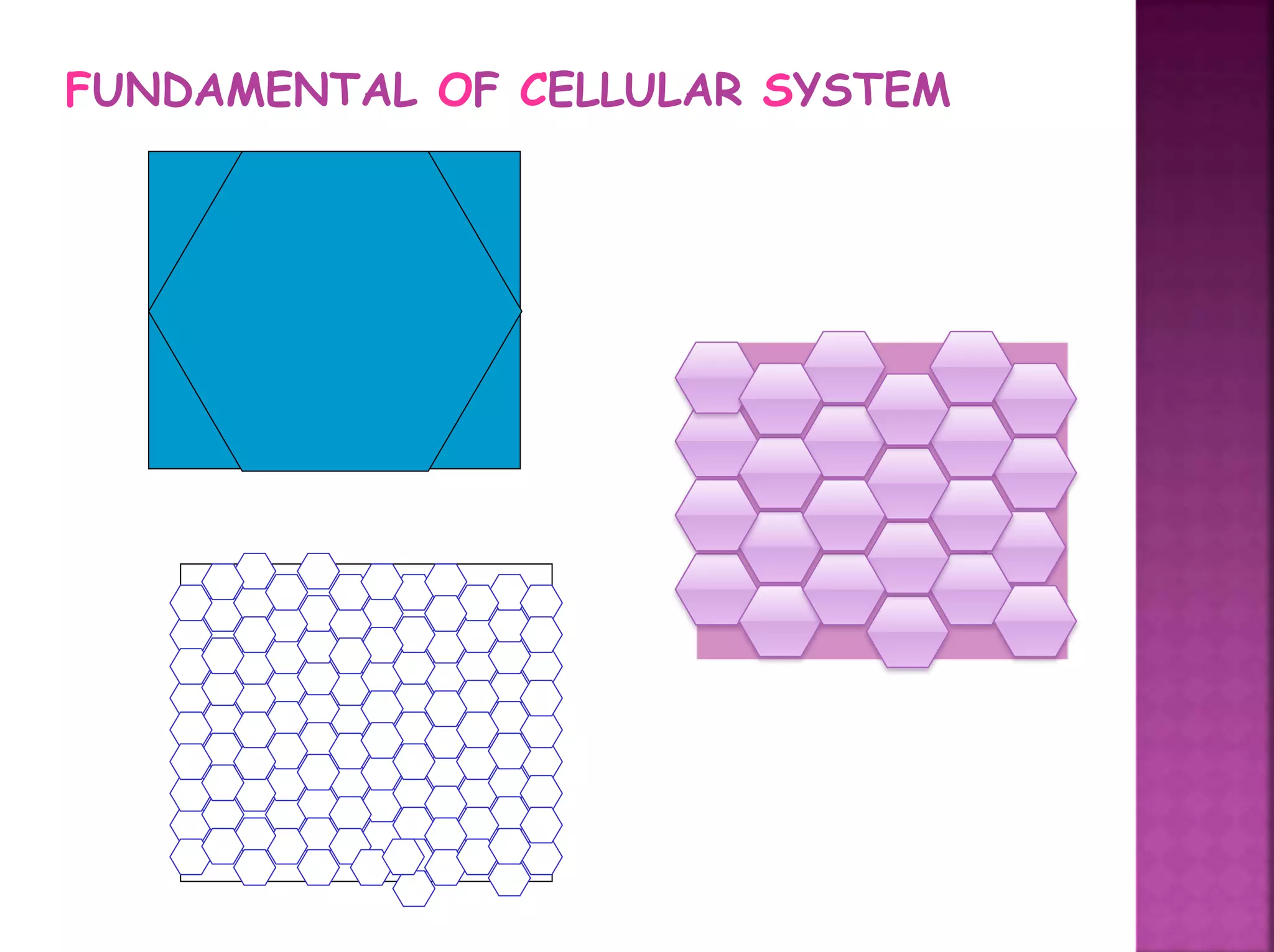
• Cell shape
FUNDAMENTAL OF CELLULAR SYSTEM
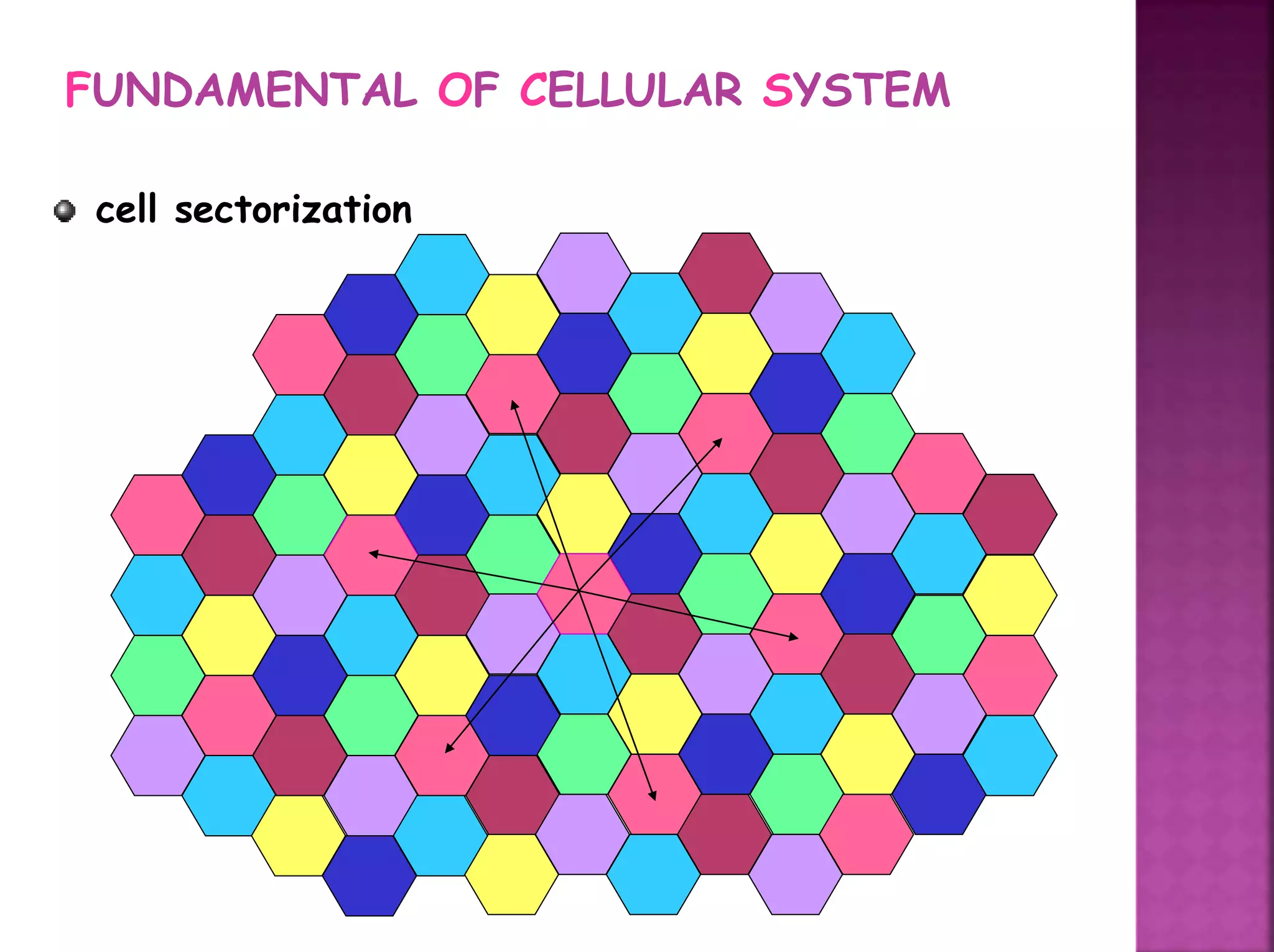
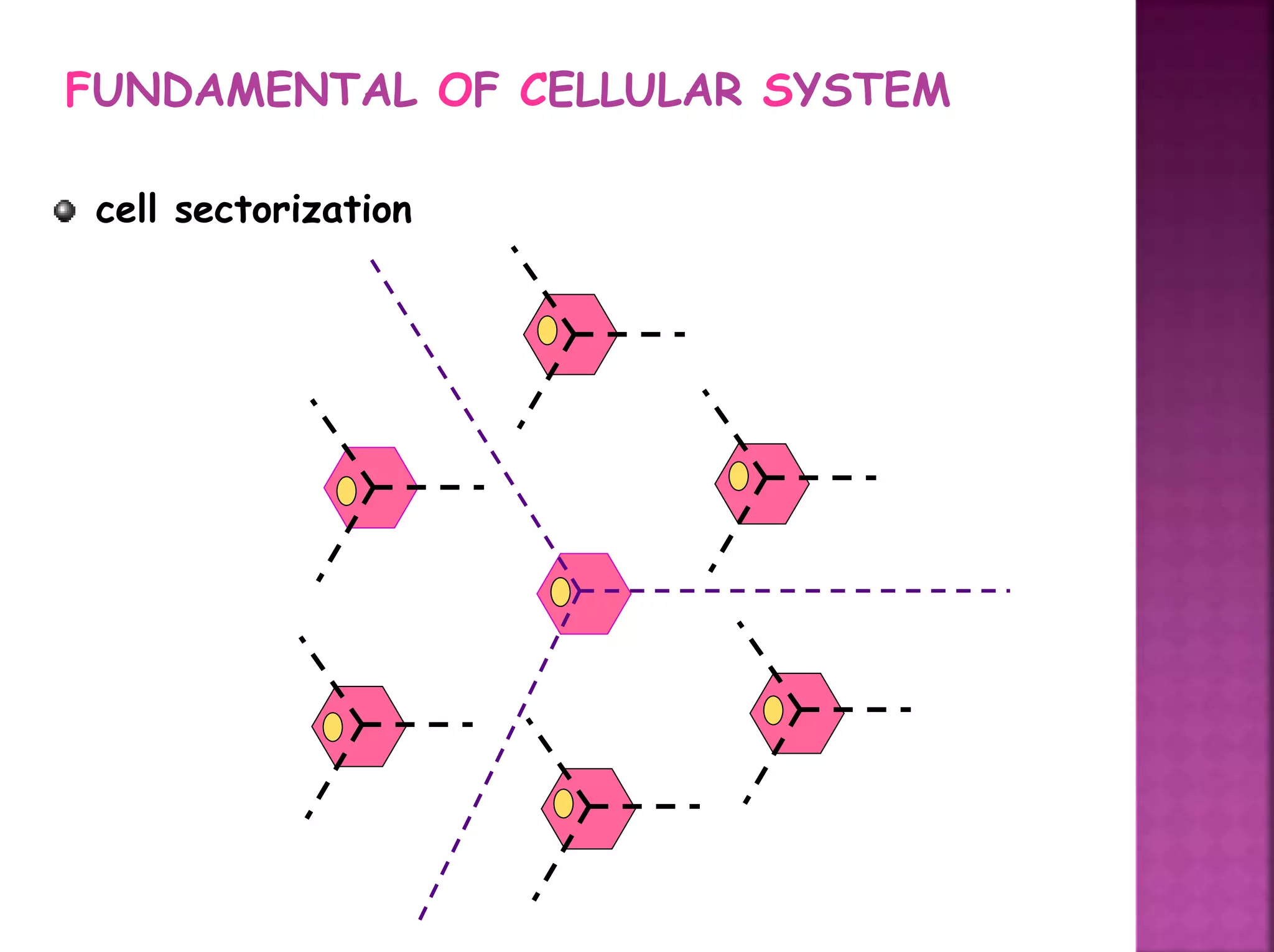
cell sectorization
FUNDAMENTAL OF CELLULAR SYSTEM
cell sectorization
FUNDAMENTAL OF CELLULAR SYSTEM
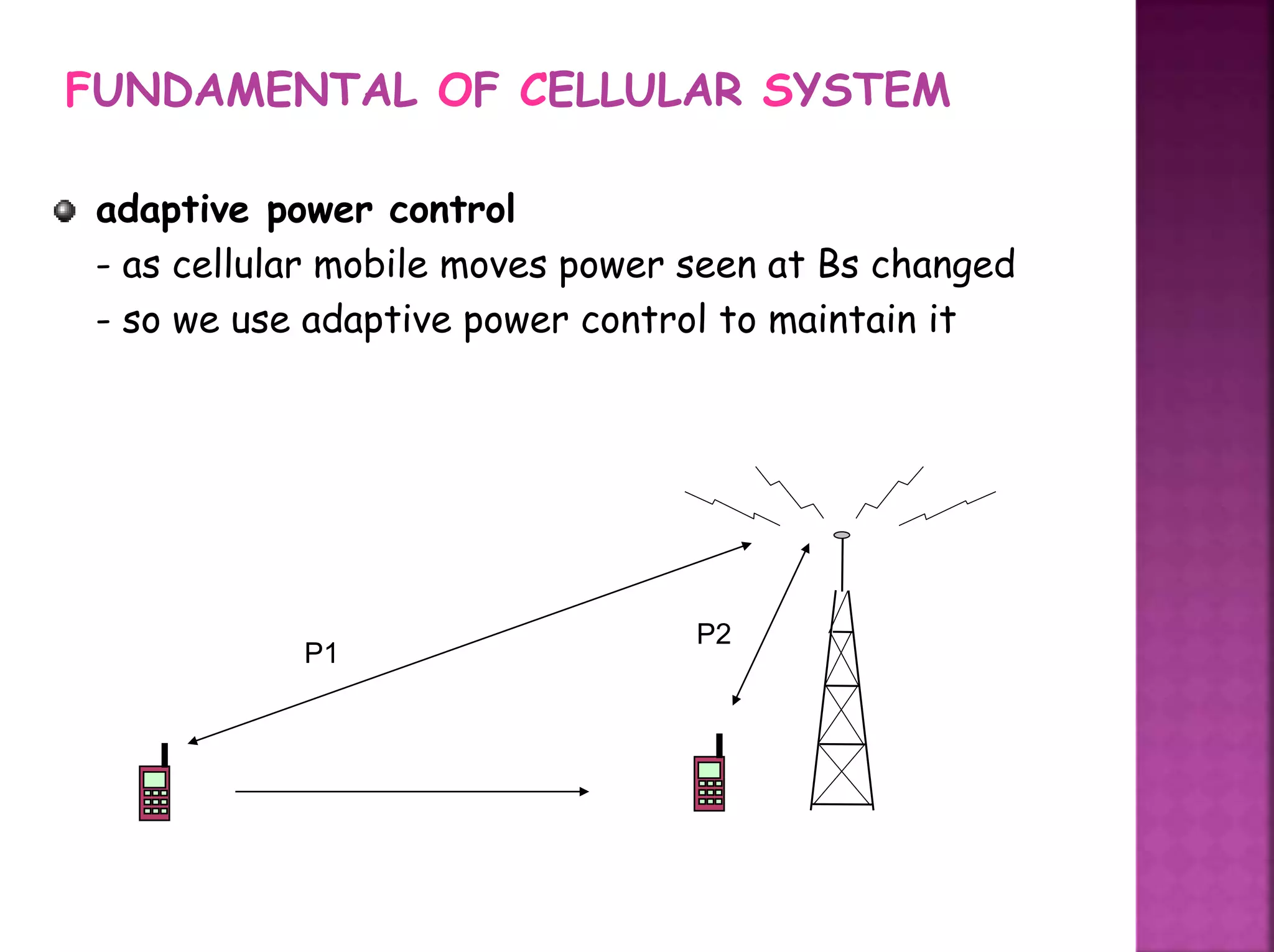
adaptive power control
- as cellular mobile moves power seen at Bs changed
- so we use adaptive power control to maintain it
P1
P2
FUNDAMENTAL OF CELLULAR SYSTEM
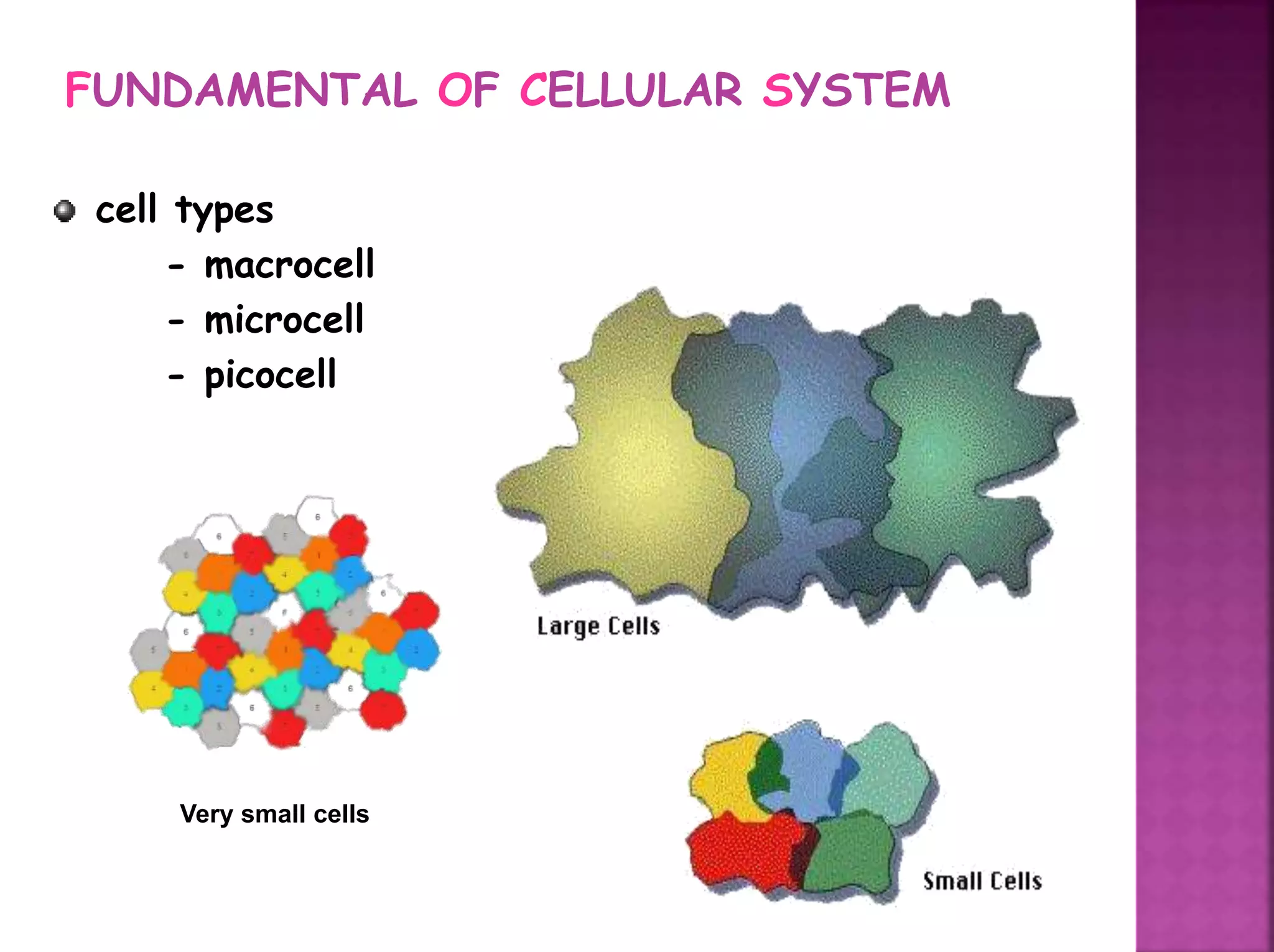
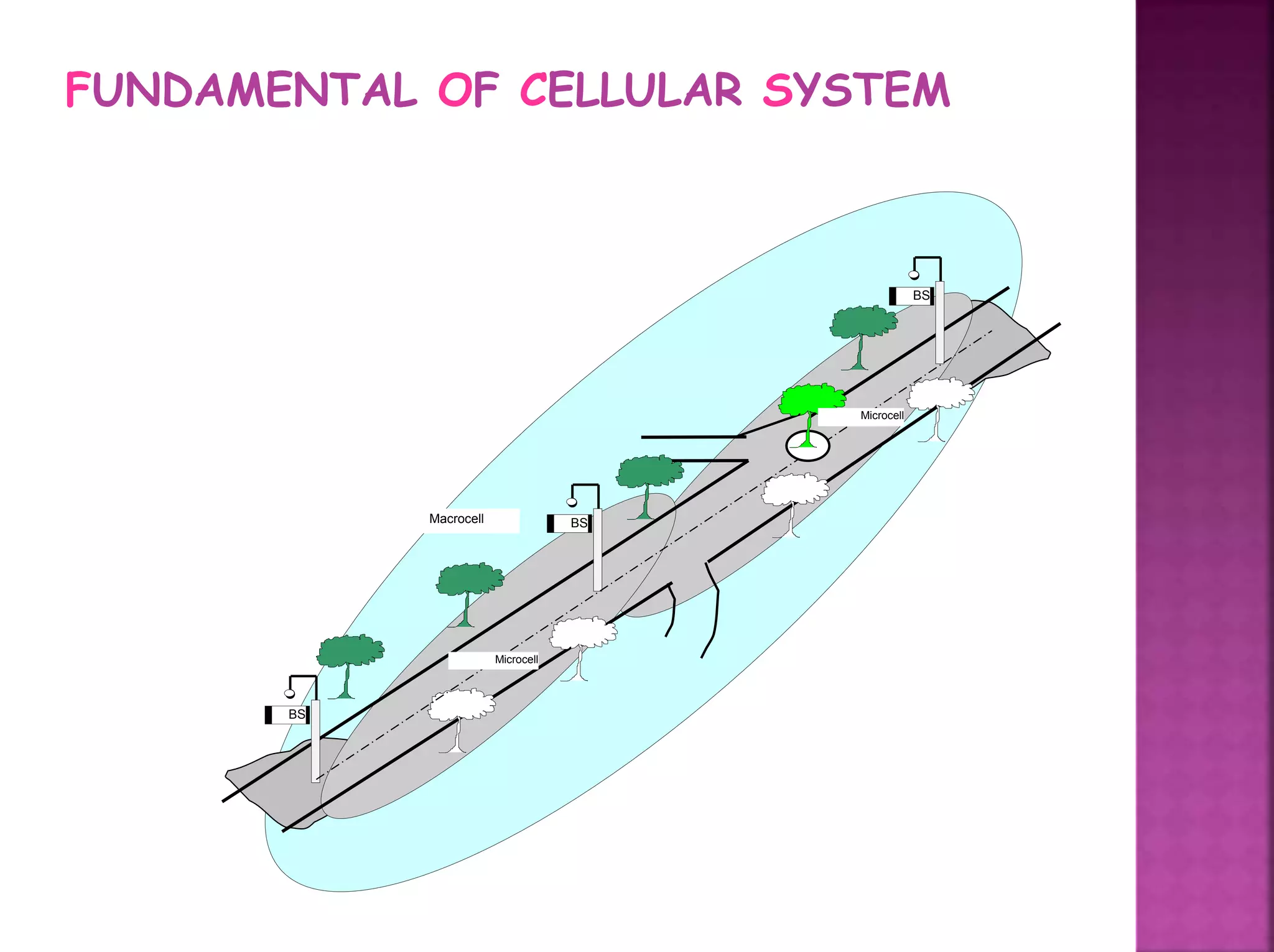
cell types
- macrocell
- microcell
- picocell
Very small cells
Macrocell BS
BS
BS
Microcell
Microcell
FUNDAMENTAL OF CELLULAR SYSTEM
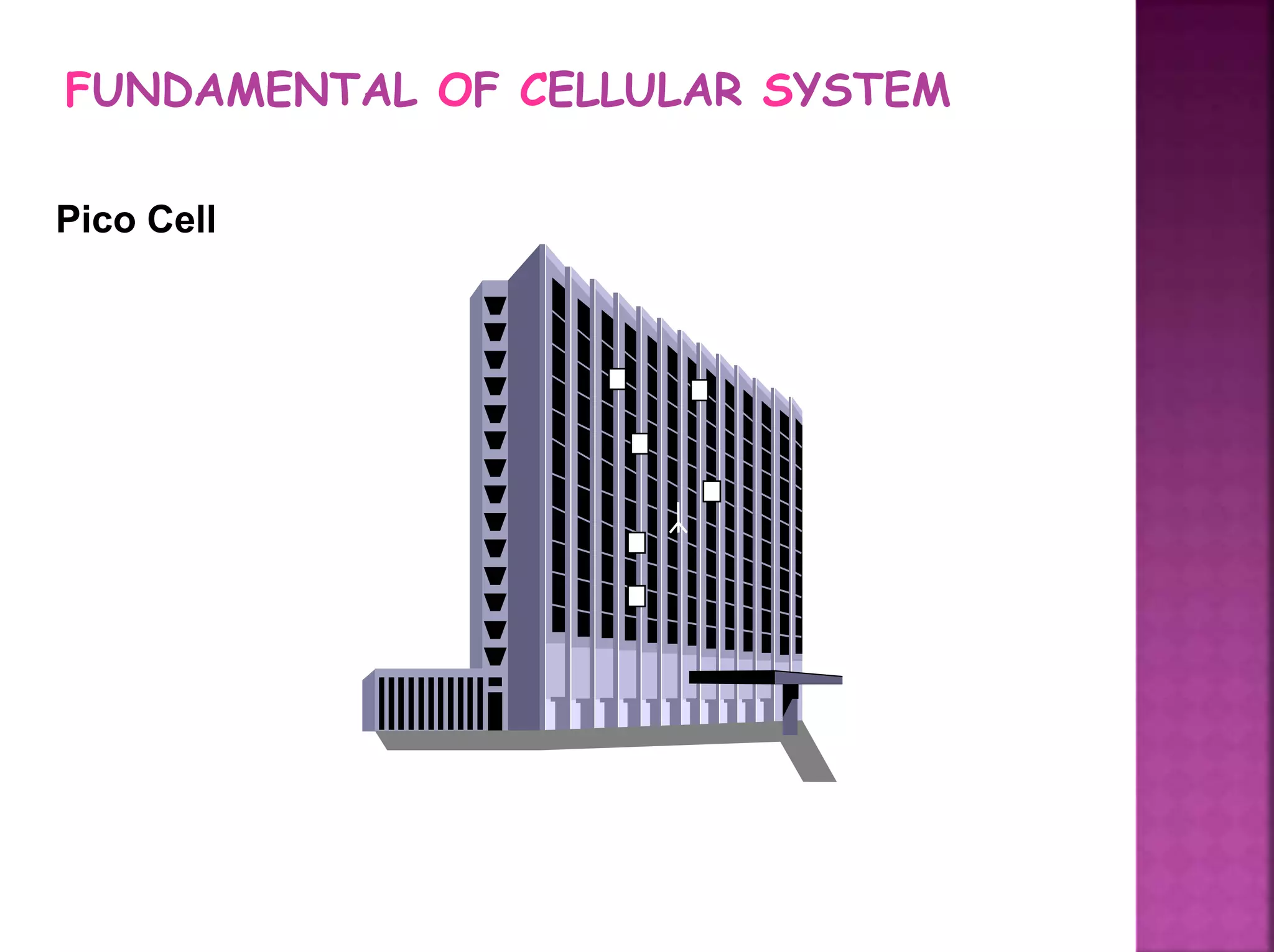
Pico Cell
FUNDAMENTAL OF CELLULAR SYSTEM
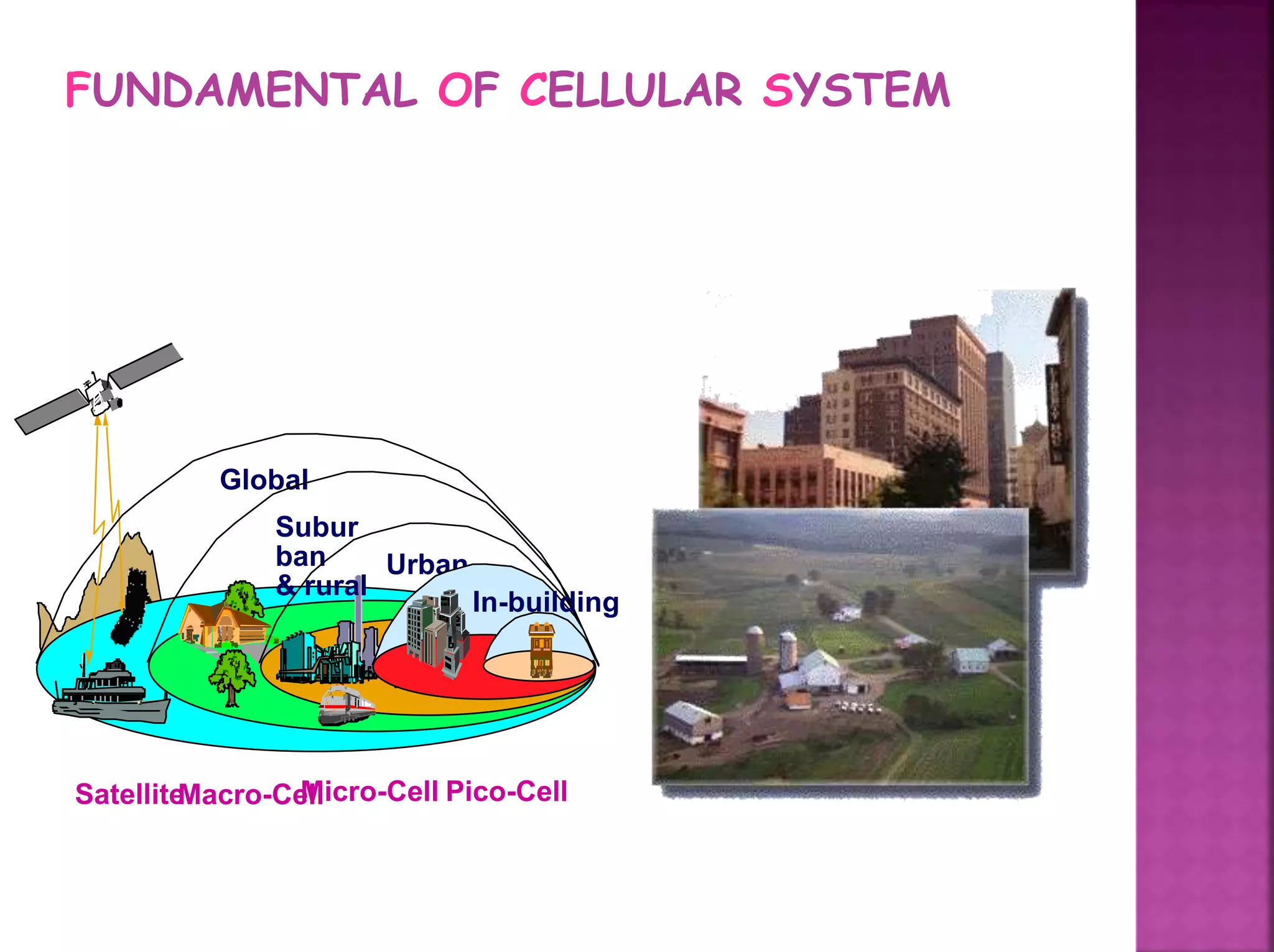
Satellite
Global
Subur
ban
& rural
Urban
Pico-Cell
Micro-CellMacro-Cell
In-building
Pico-Cell
FUNDAMENTAL OF CELLULAR SYSTEM
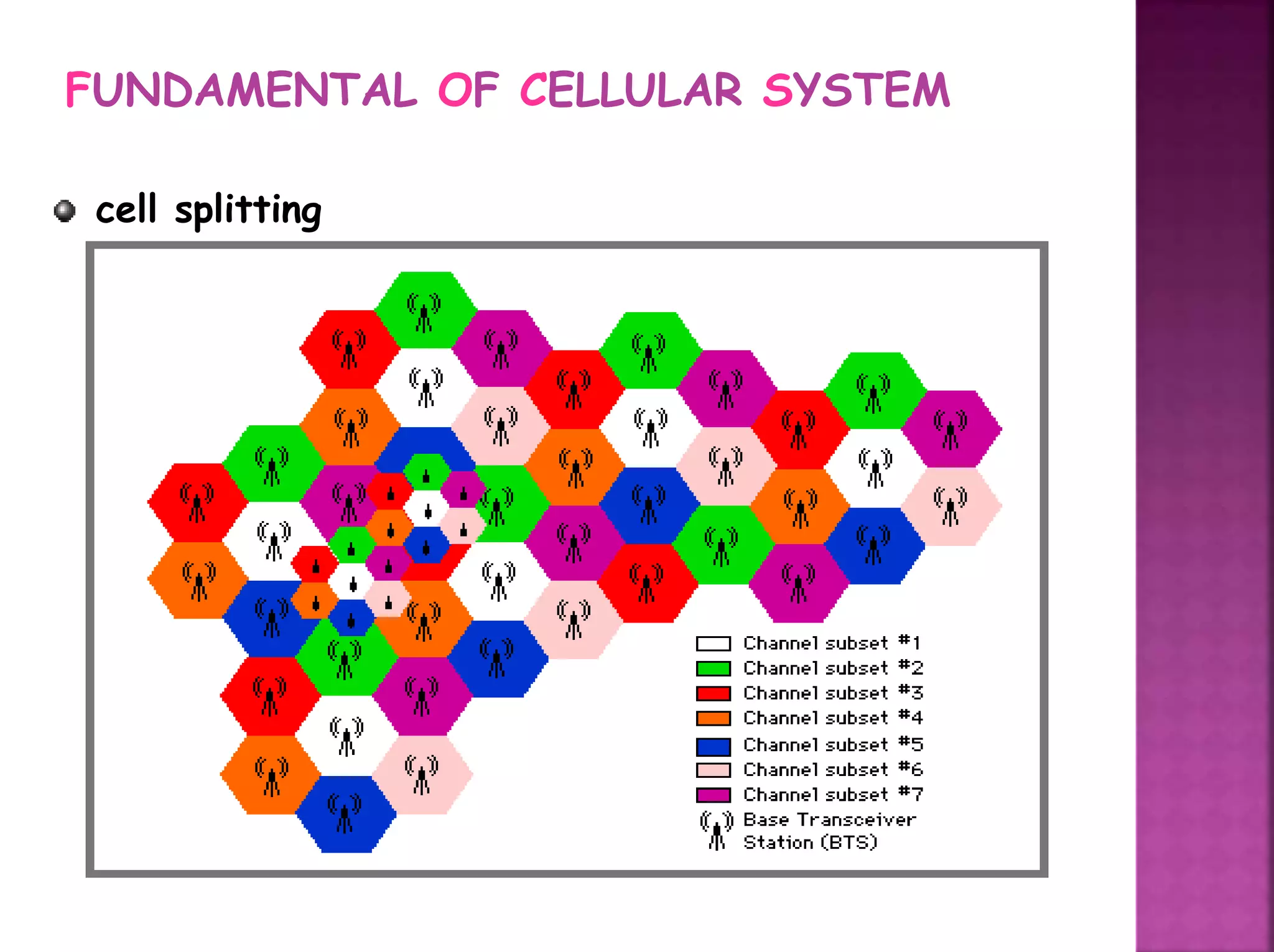
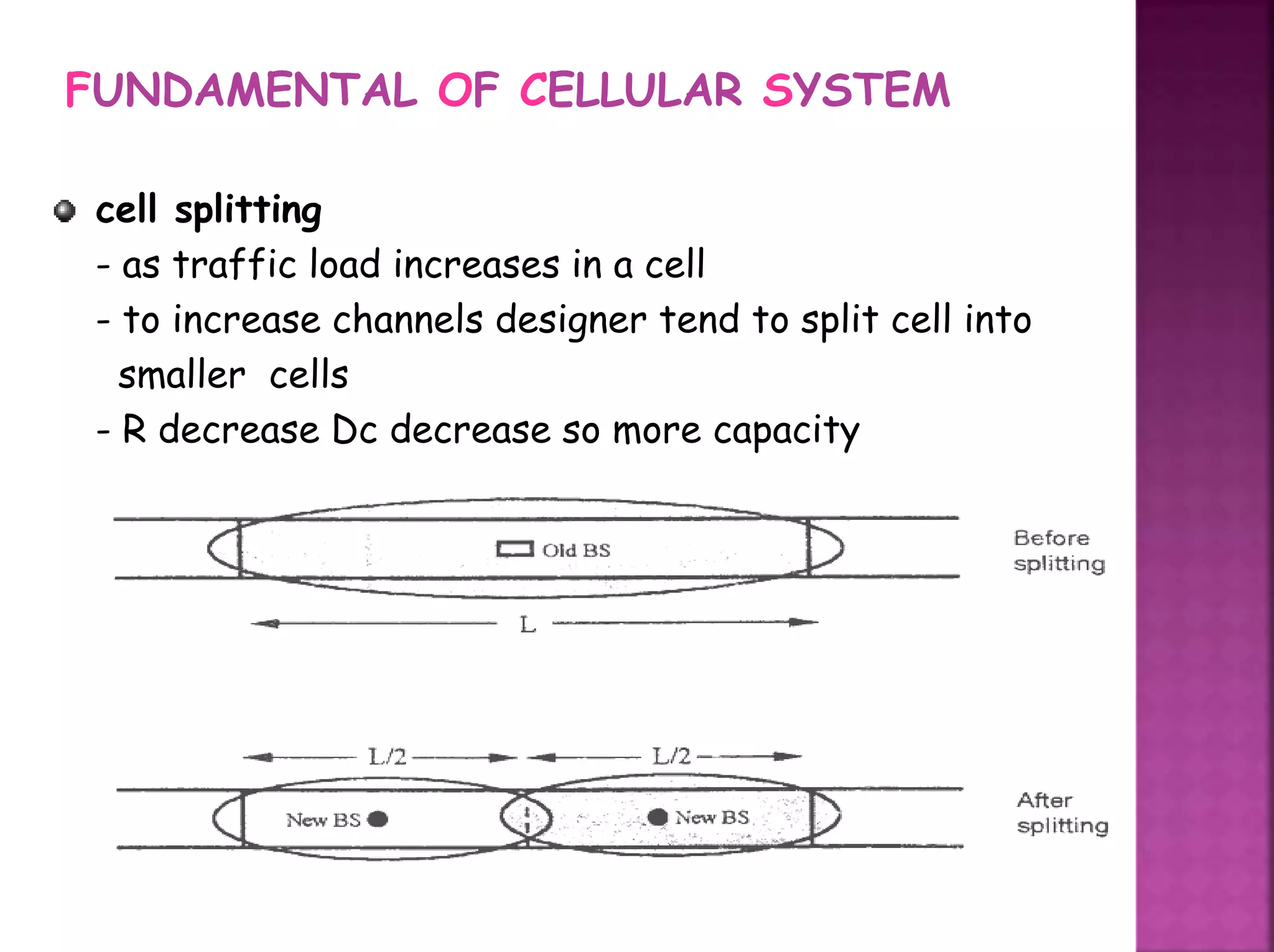
cell splitting
- as traffic load increases in a cell
- to increase channels designer tend to split cell into
smaller cells
- R decrease Dc decrease so more capacity
FUNDAMENTAL OF CELLULAR SYSTEM
cell splitting
FUNDAMENTAL OF CELLULAR SYSTEM
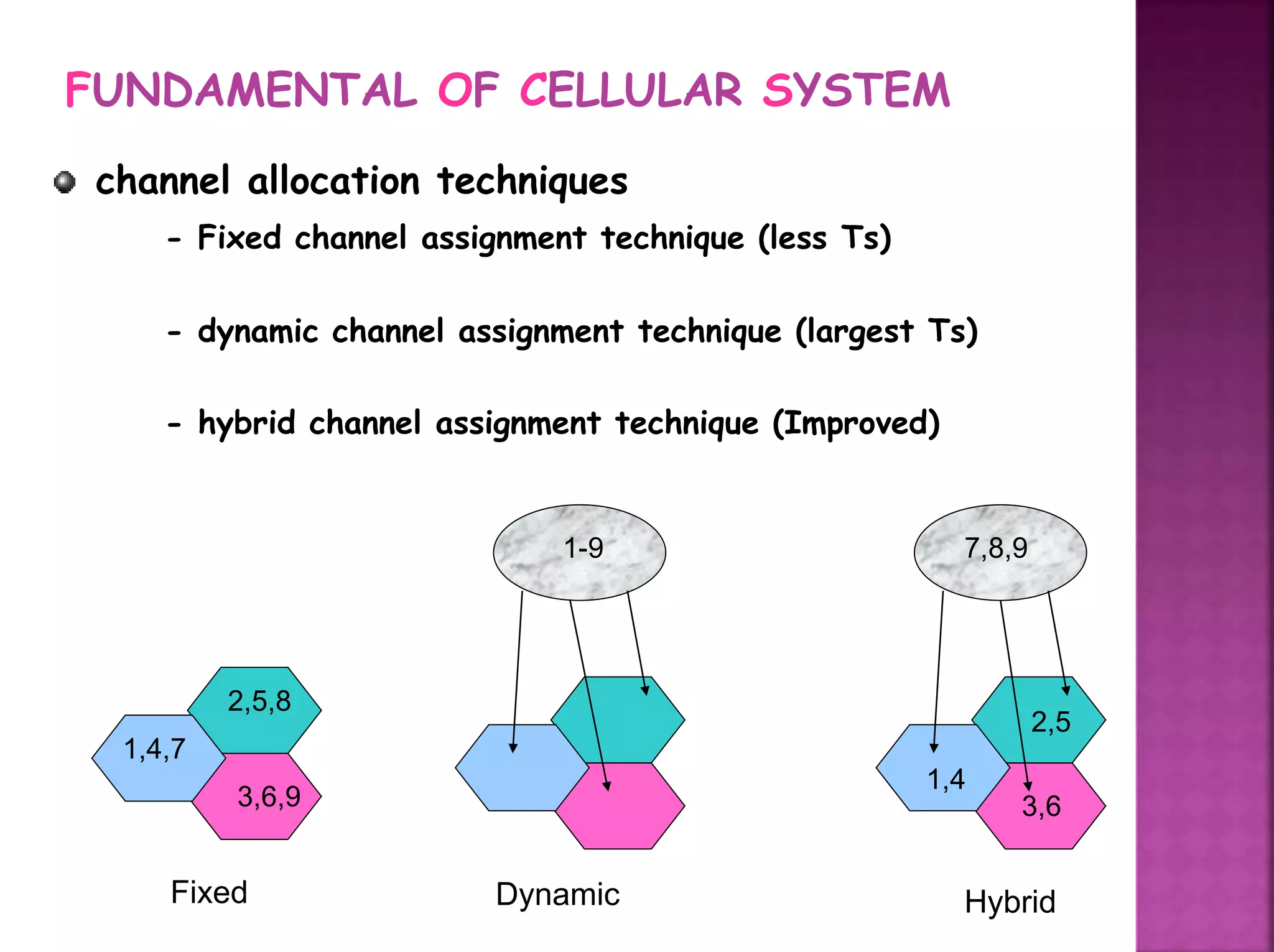
channel allocation techniques
- Fixed channel assignment technique (less Ts)
- dynamic channel assignment technique (largest Ts)
- hybrid channel assignment technique (Improved)
1,4,7
2,5,8
3,6,9
1-9 7,8,9
1,4
2,5
3,6
Fixed Dynamic Hybrid
FUNDAMENTAL OF CELLULAR SYSTEM
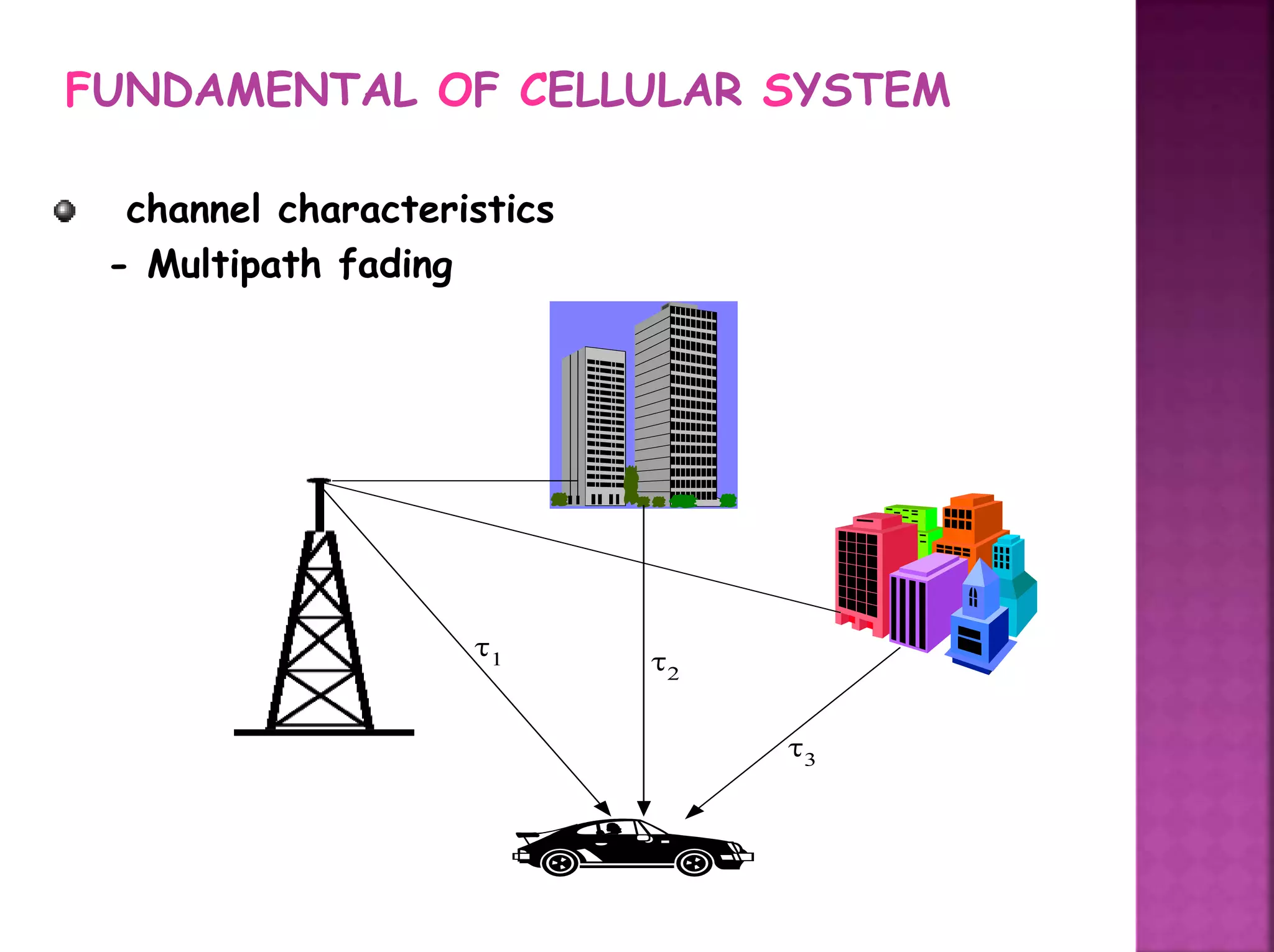
channel characteristics
- Multipath fading
t1 t2
t3
FUNDAMENTAL OF CELLULAR SYSTEM
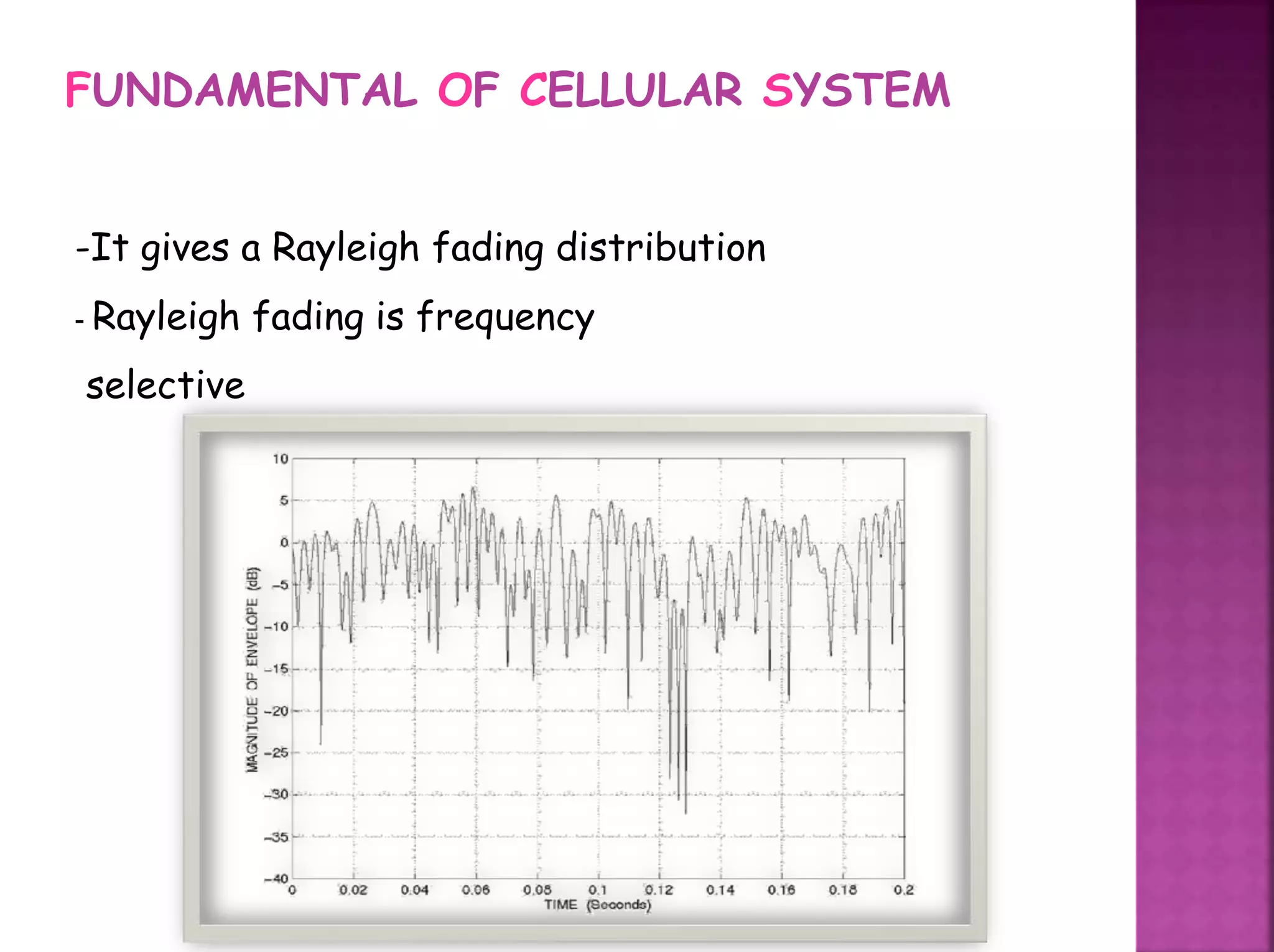
-It gives a Rayleigh fading distribution
- Rayleigh fading is frequency
selective
FUNDAMENTAL OF CELLULAR SYSTEM
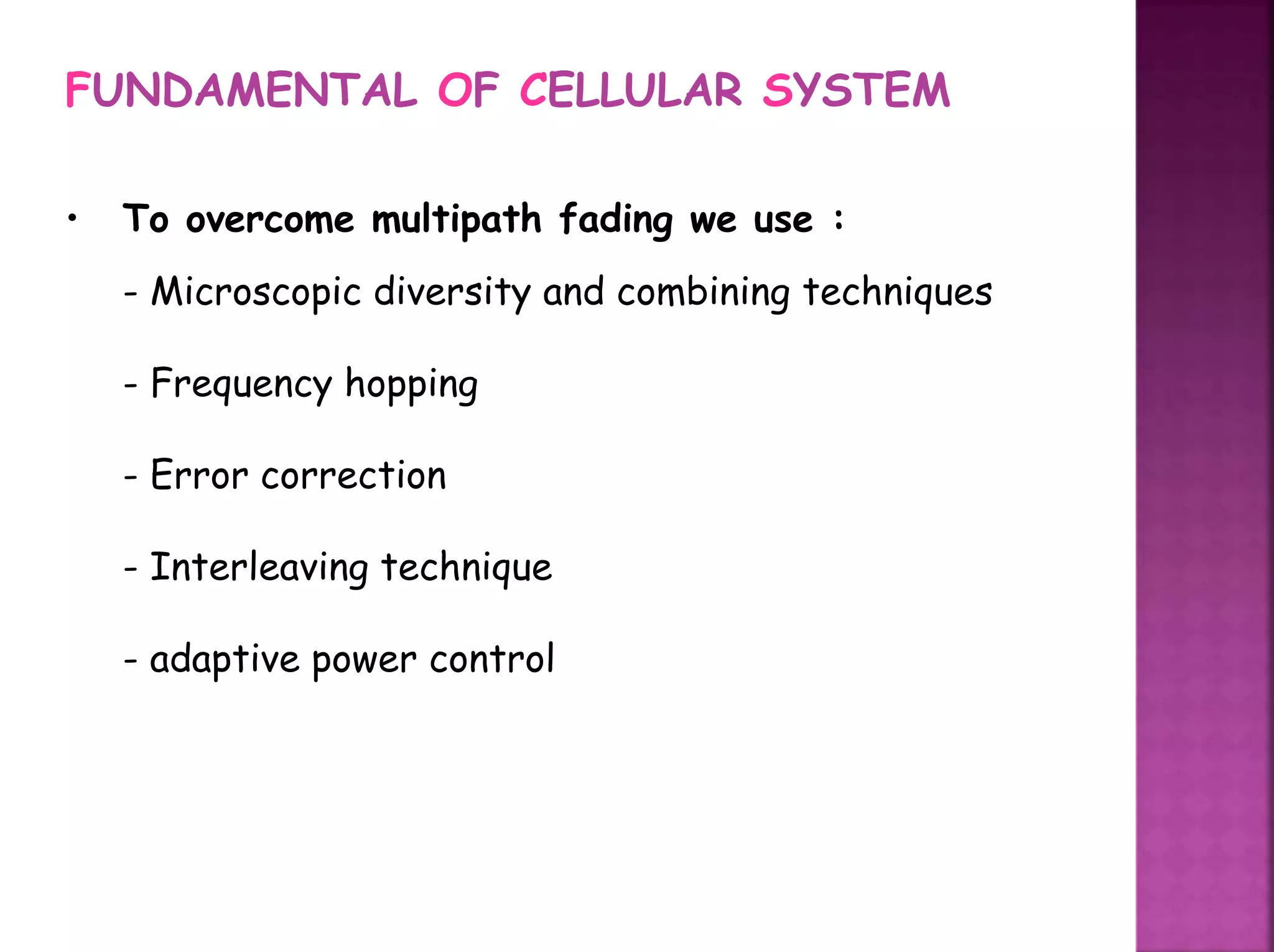
• To overcome multipath fading we use :
- Microscopic diversity and combining techniques
- Frequency hopping
- Error correction
- Interleaving technique
- adaptive power control
FUNDAMENTAL OF CELLULAR SYSTEM
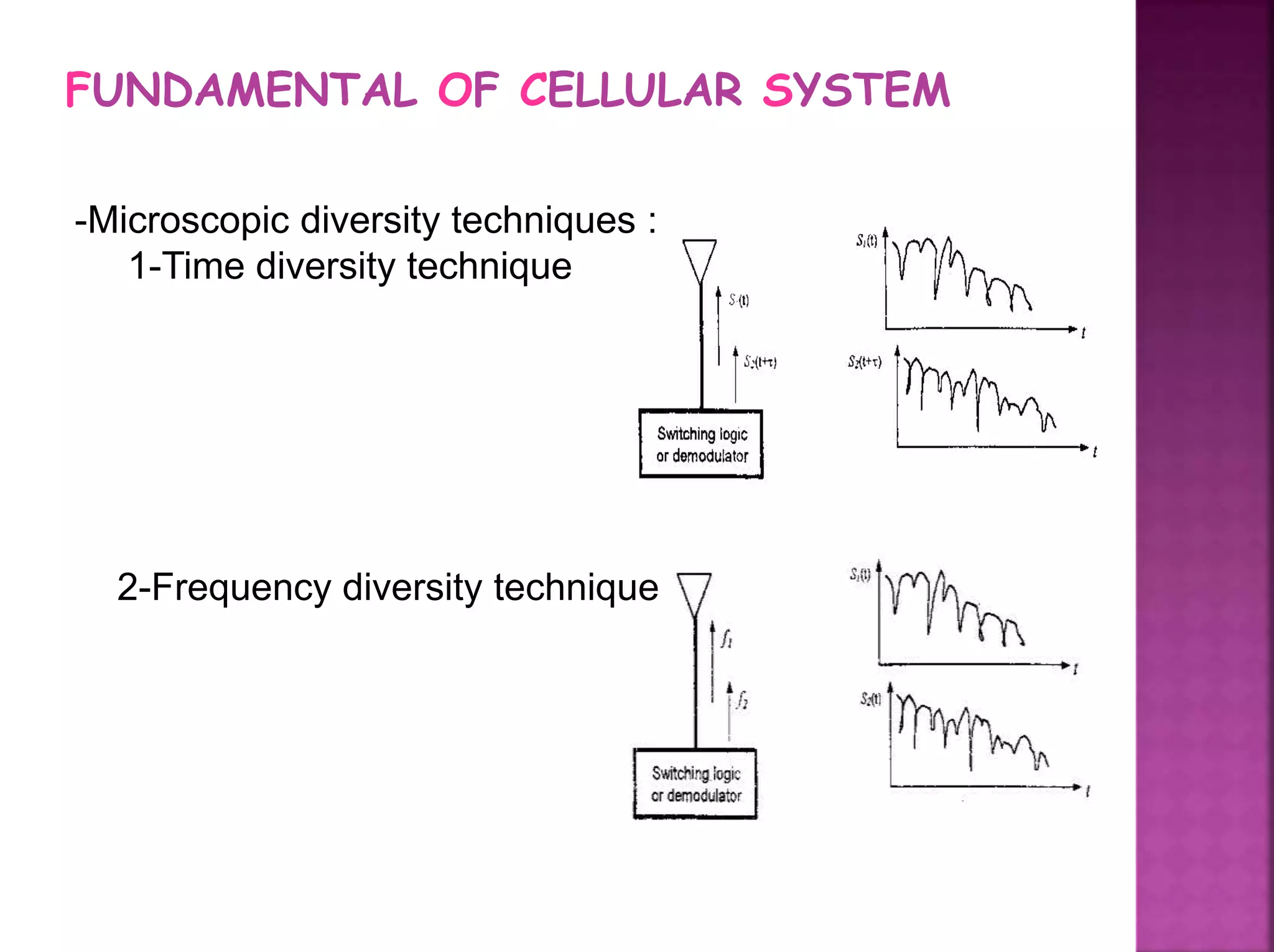
-Microscopic diversity techniques :
1-Time diversity technique
2-Frequency diversity technique
FUNDAMENTAL OF CELLULAR SYSTEM
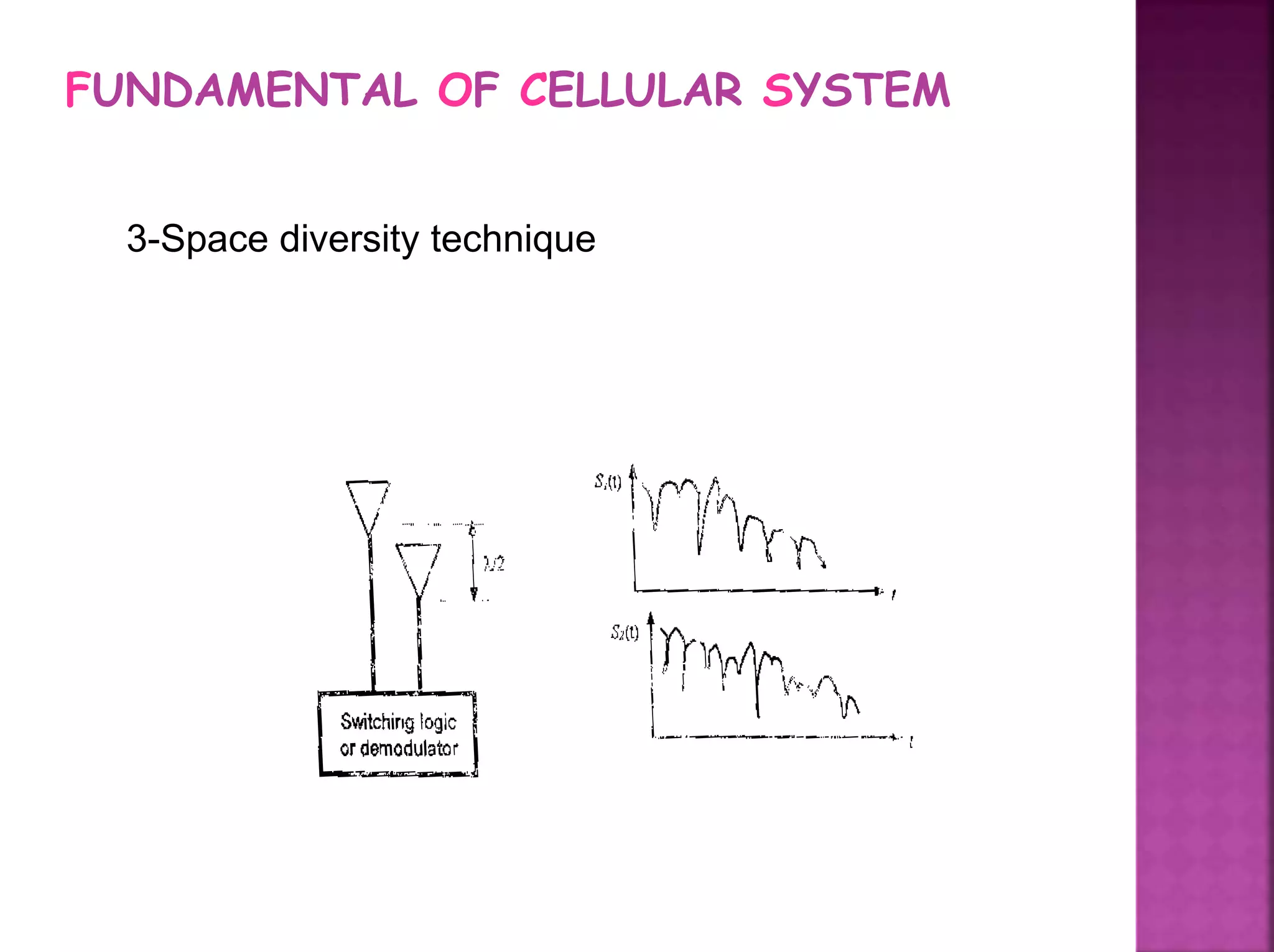
3-Space diversity technique
FUNDAMENTAL OF CELLULAR SYSTEM
-Space diversity technique
FUNDAMENTAL OF CELLULAR SYSTEM
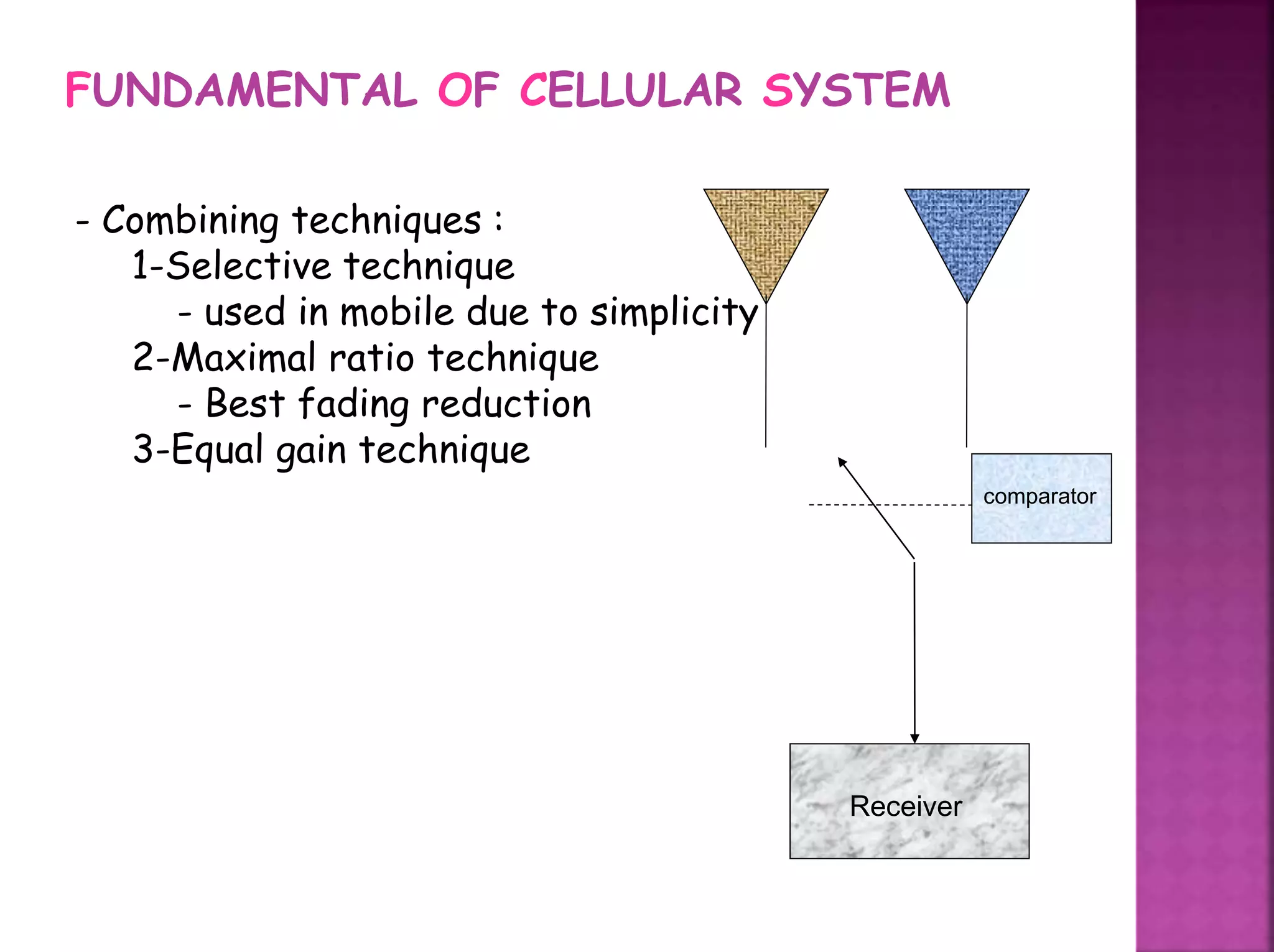
- Combining techniques :
1-Selective technique
- used in mobile due to simplicity
2-Maximal ratio technique
- Best fading reduction
3-Equal gain technique
Receiver
comparator
FUNDAMENTAL OF CELLULAR SYSTEM
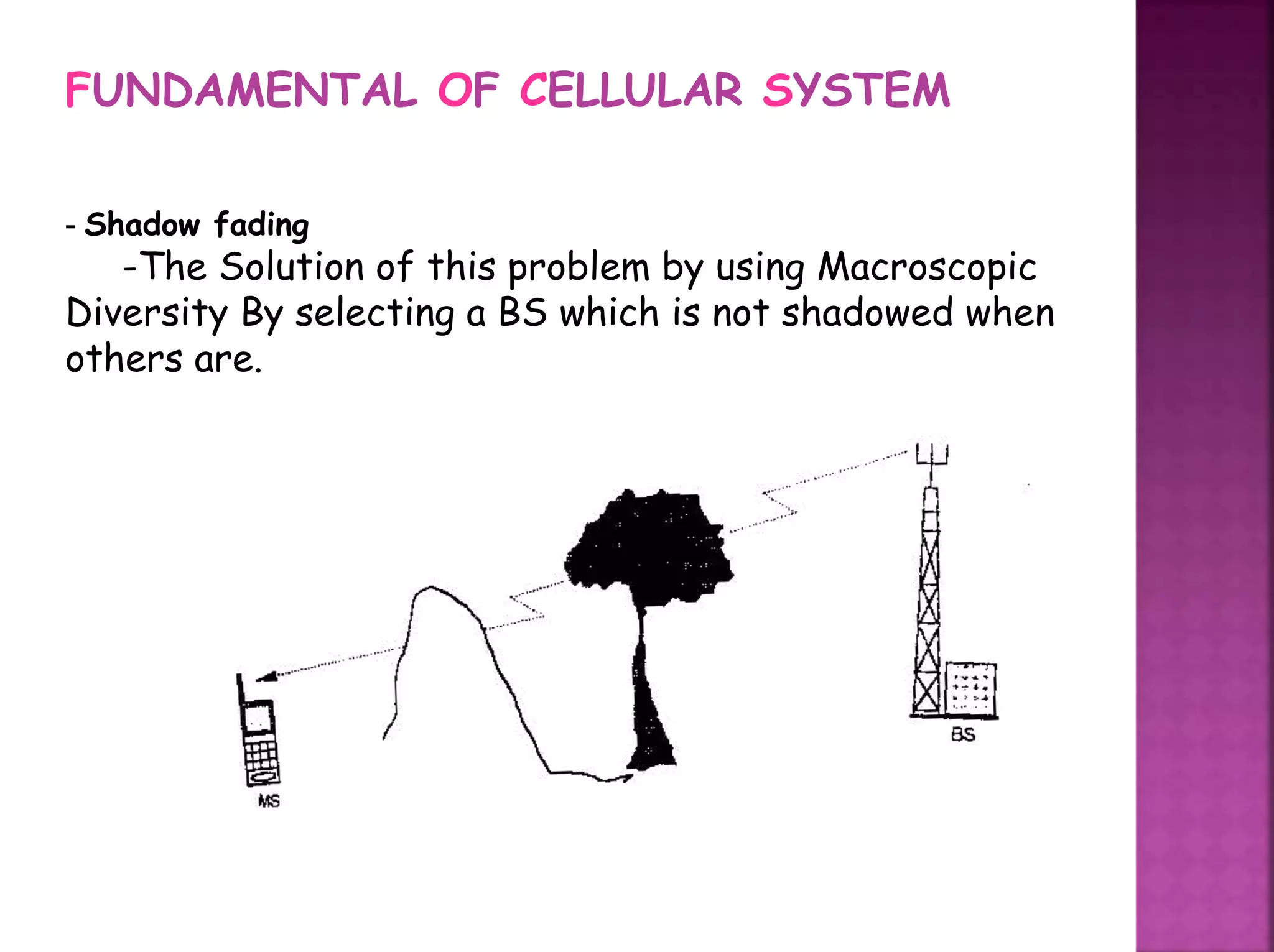
- Shadow fading
-The Solution of this problem by using Macroscopic
Diversity By selecting a BS which is not shadowed when
others are.
FUNDAMENTAL OF CELLULAR SYSTEM
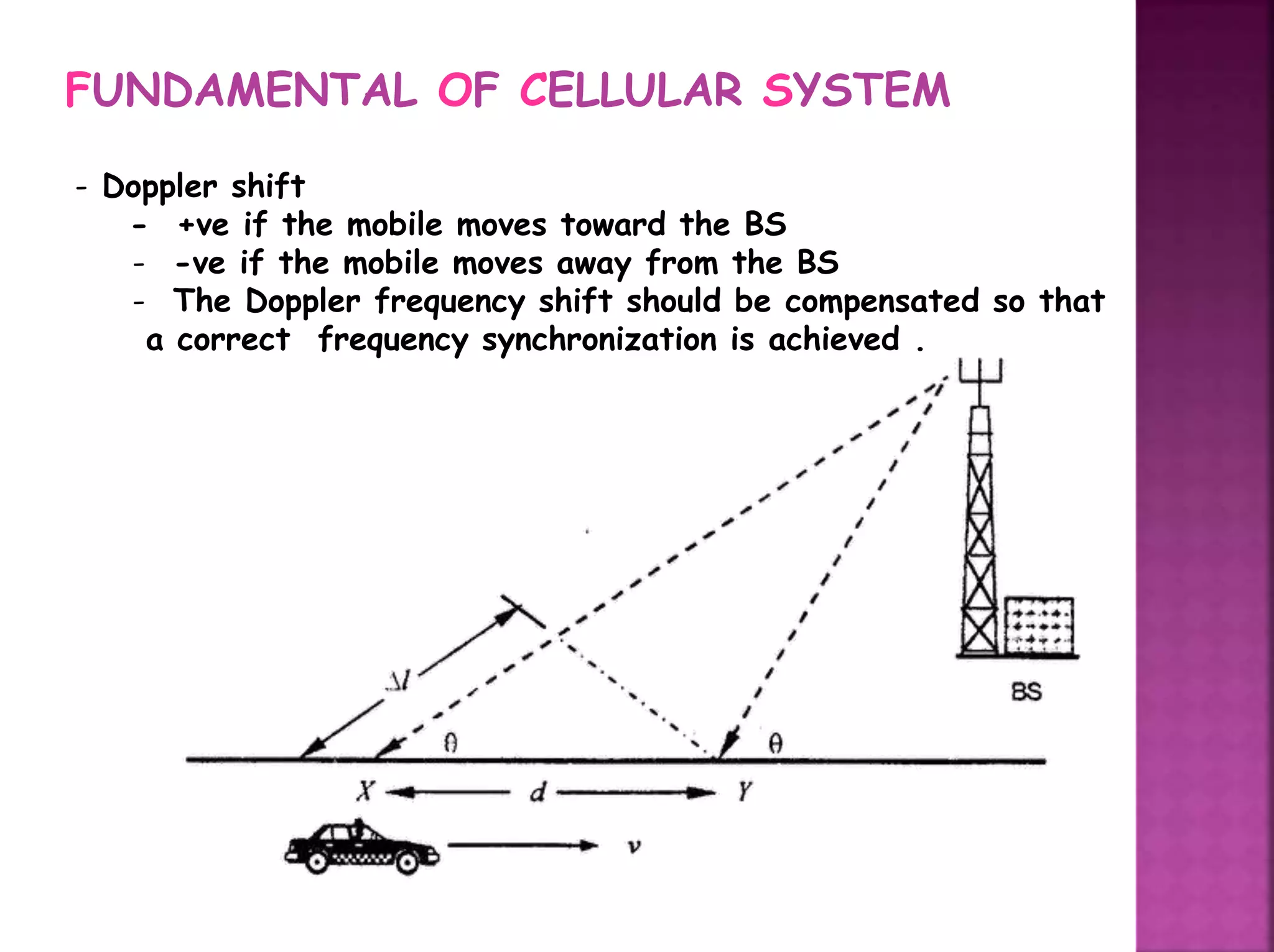
- Doppler shift
- +ve if the mobile moves toward the BS
- -ve if the mobile moves away from the BS
- The Doppler frequency shift should be compensated so that
a correct frequency synchronization is achieved .
FUNDAMENTAL OF CELLULAR SYSTEM
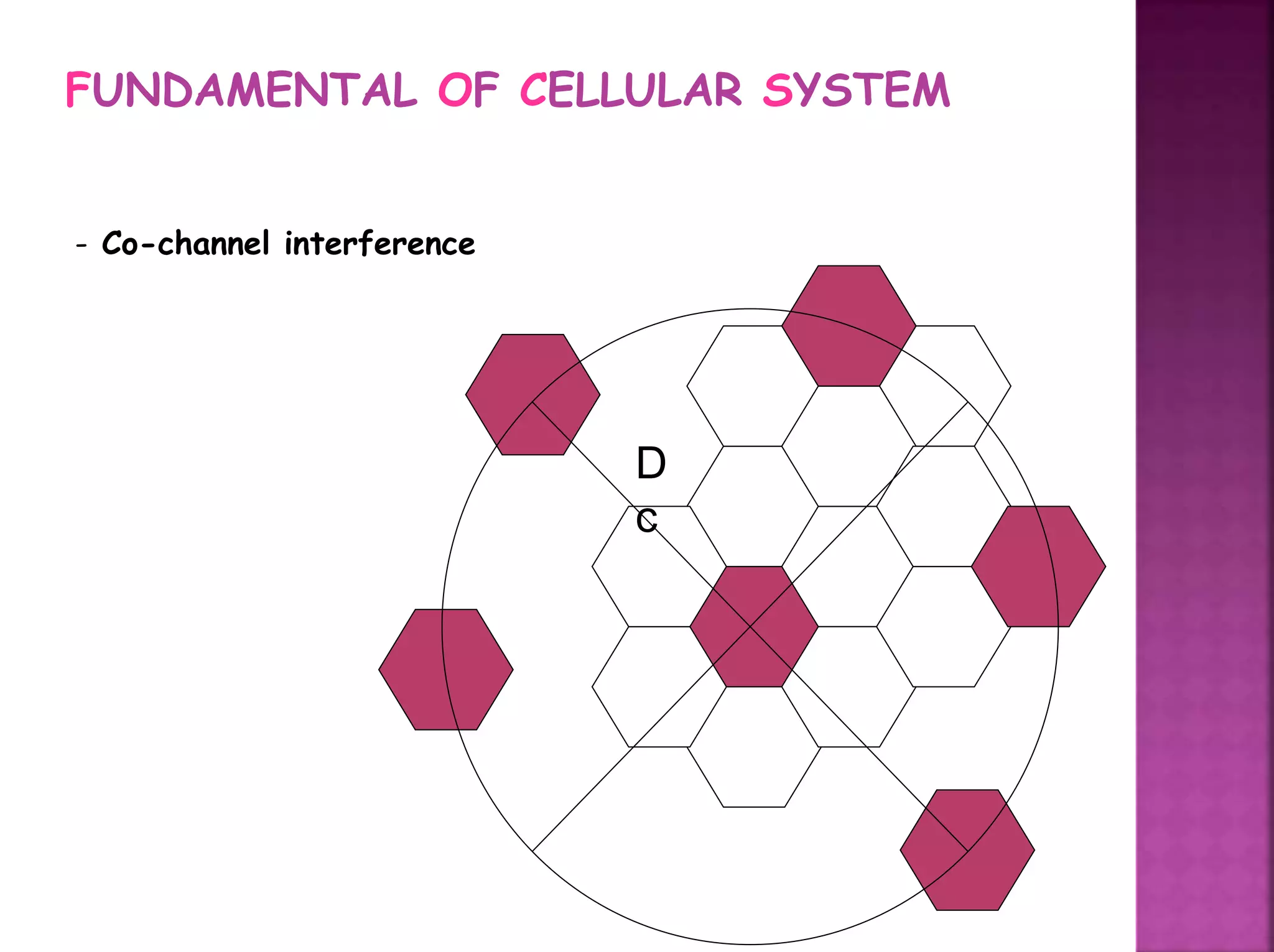
- Co-channel interference
D
c
FUNDAMENTAL OF CELLULAR SYSTEM
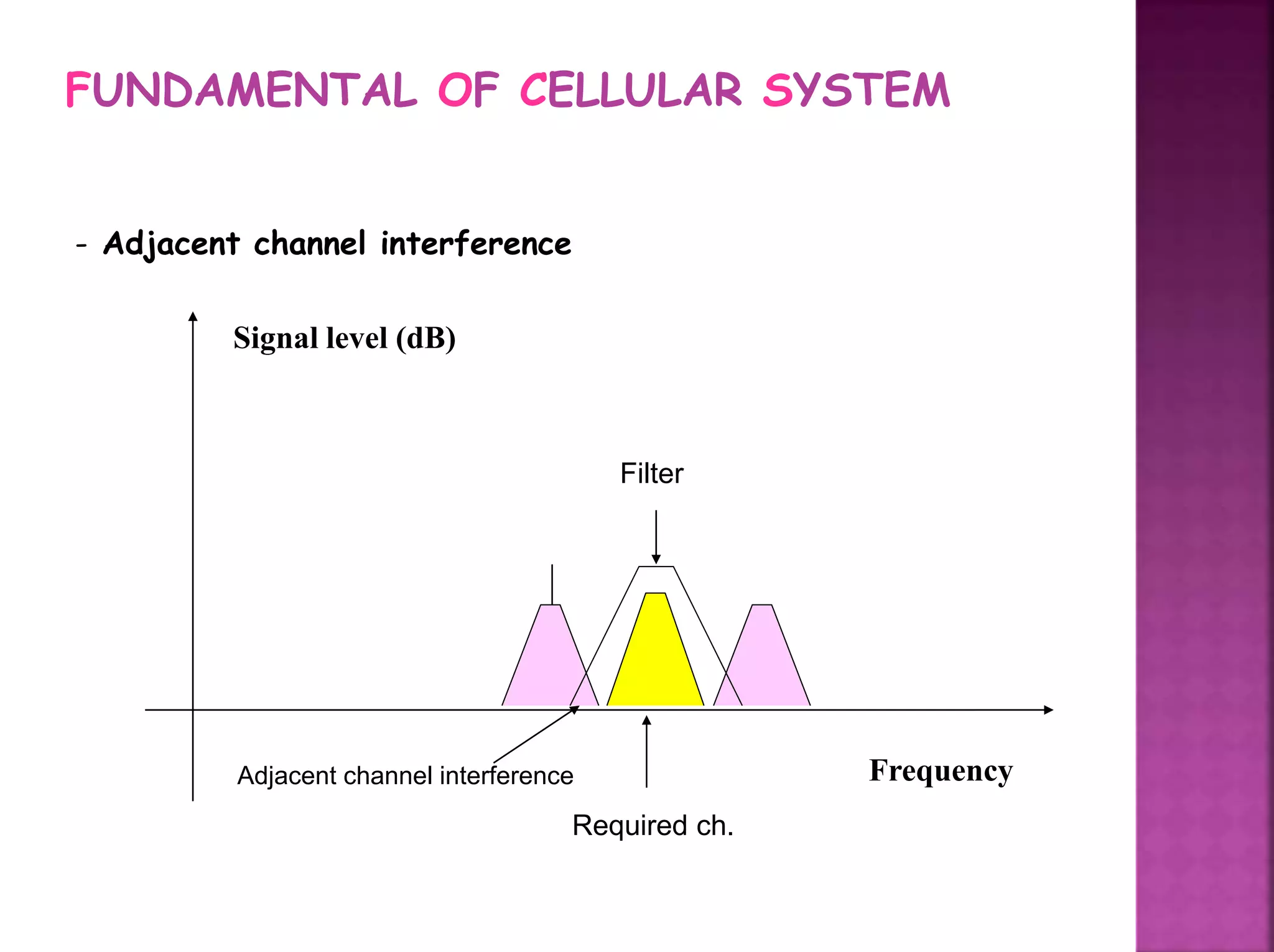
- Adjacent channel interference
Frequency
Signal level (dB)
Filter
Required ch.
Adjacent channel interference
FUNDAMENTAL OF CELLULAR SYSTEM
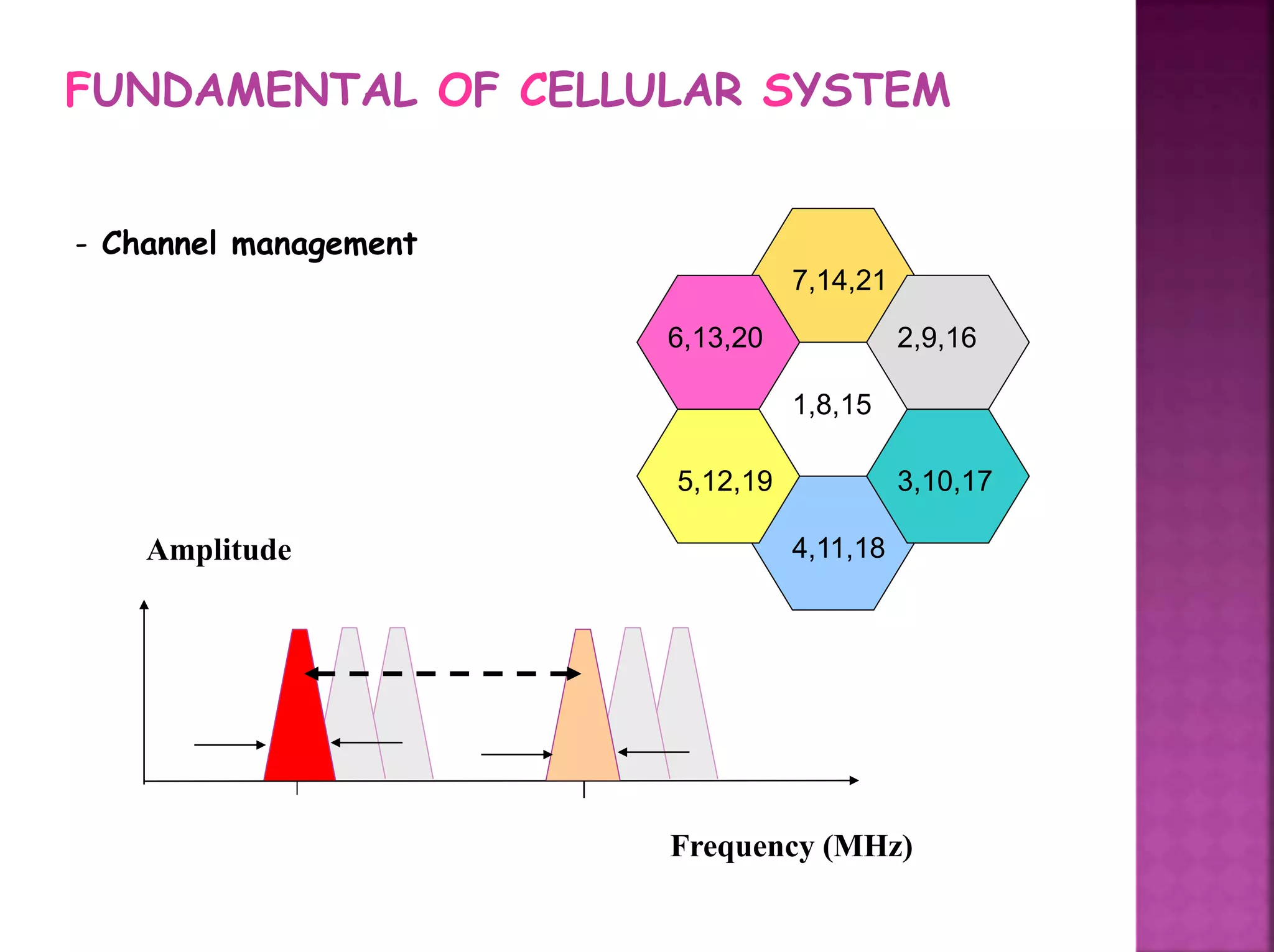
- Channel management
1,8,15
2,9,16
5,12,19
6,13,20
7,14,21
4,11,18
3,10,17
Frequency (MHz)
Amplitude
FUNDAMENTAL OF CELLULAR SYSTEM
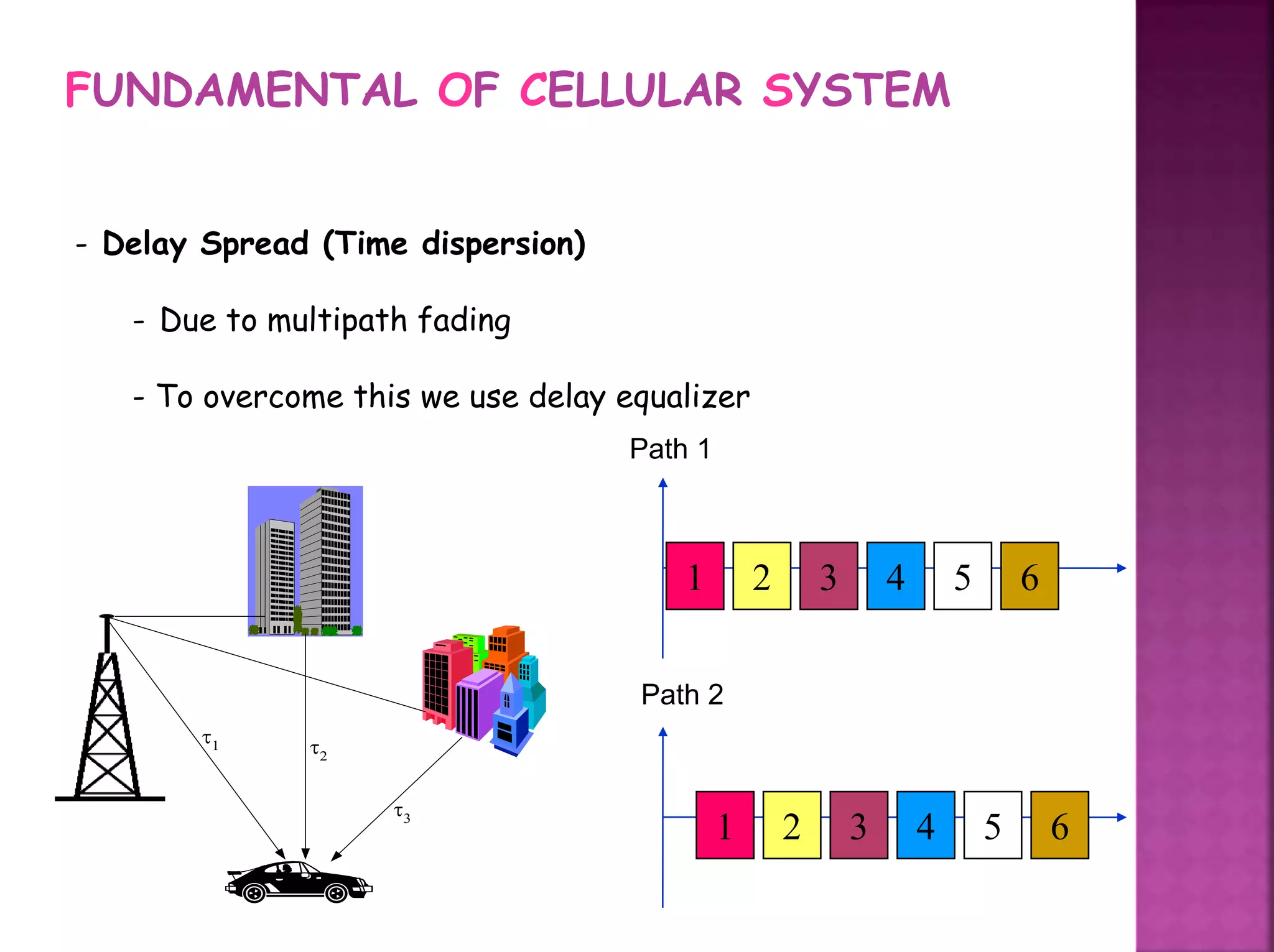
- Delay Spread (Time dispersion)
- Due to multipath fading
- To overcome this we use delay equalizer
1 2 3 4 65
1 2 3 4 65
Path 1
Path 2
t1 t2
t3
FUNDAMENTAL OF CELLULAR SYSTEM
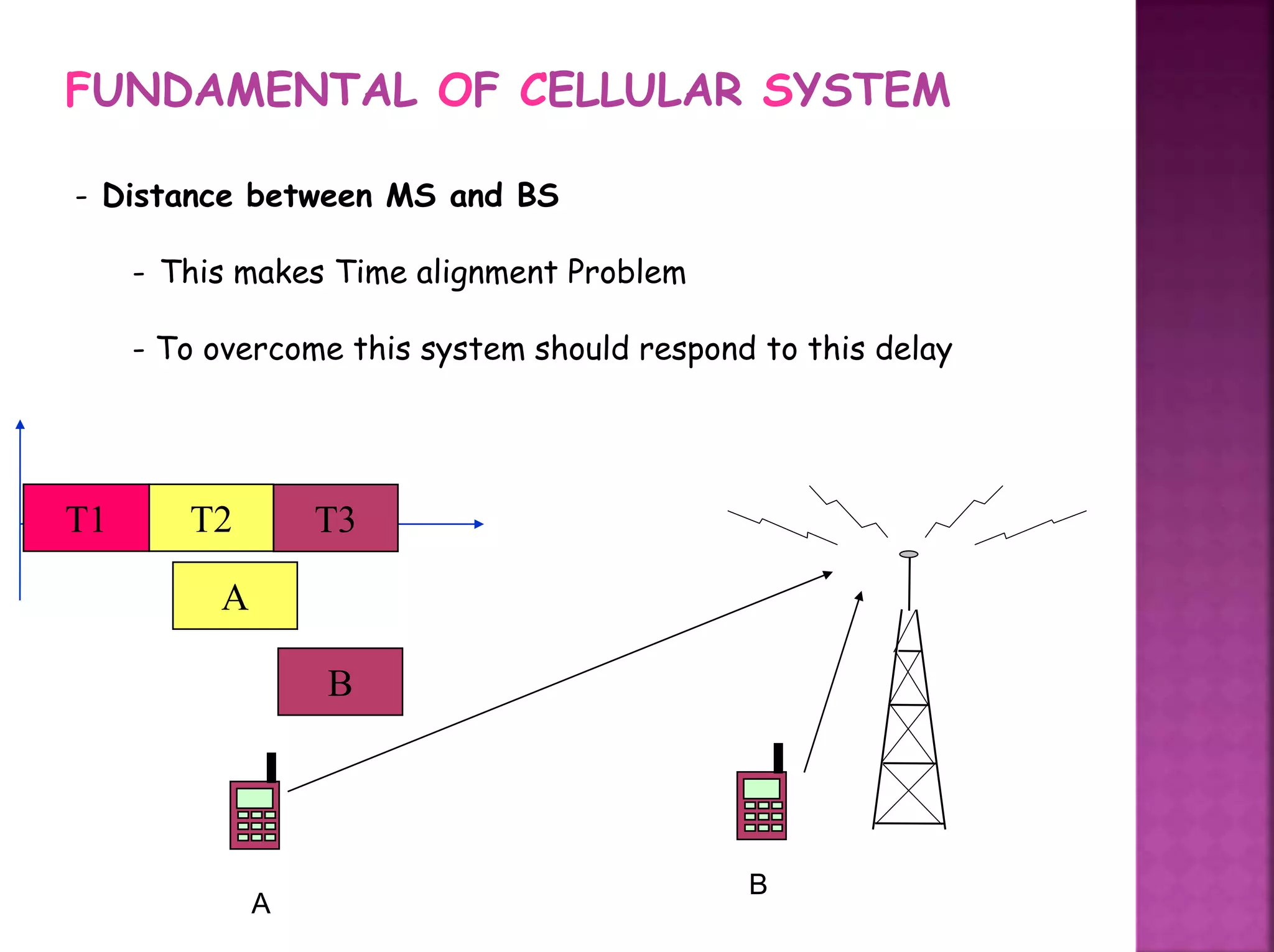
- Distance between MS and BS
- This makes Time alignment Problem
- To overcome this system should respond to this delay
T1 T2 T3
A
B
A
B
FUNDAMENTAL OF CELLULAR SYSTEM
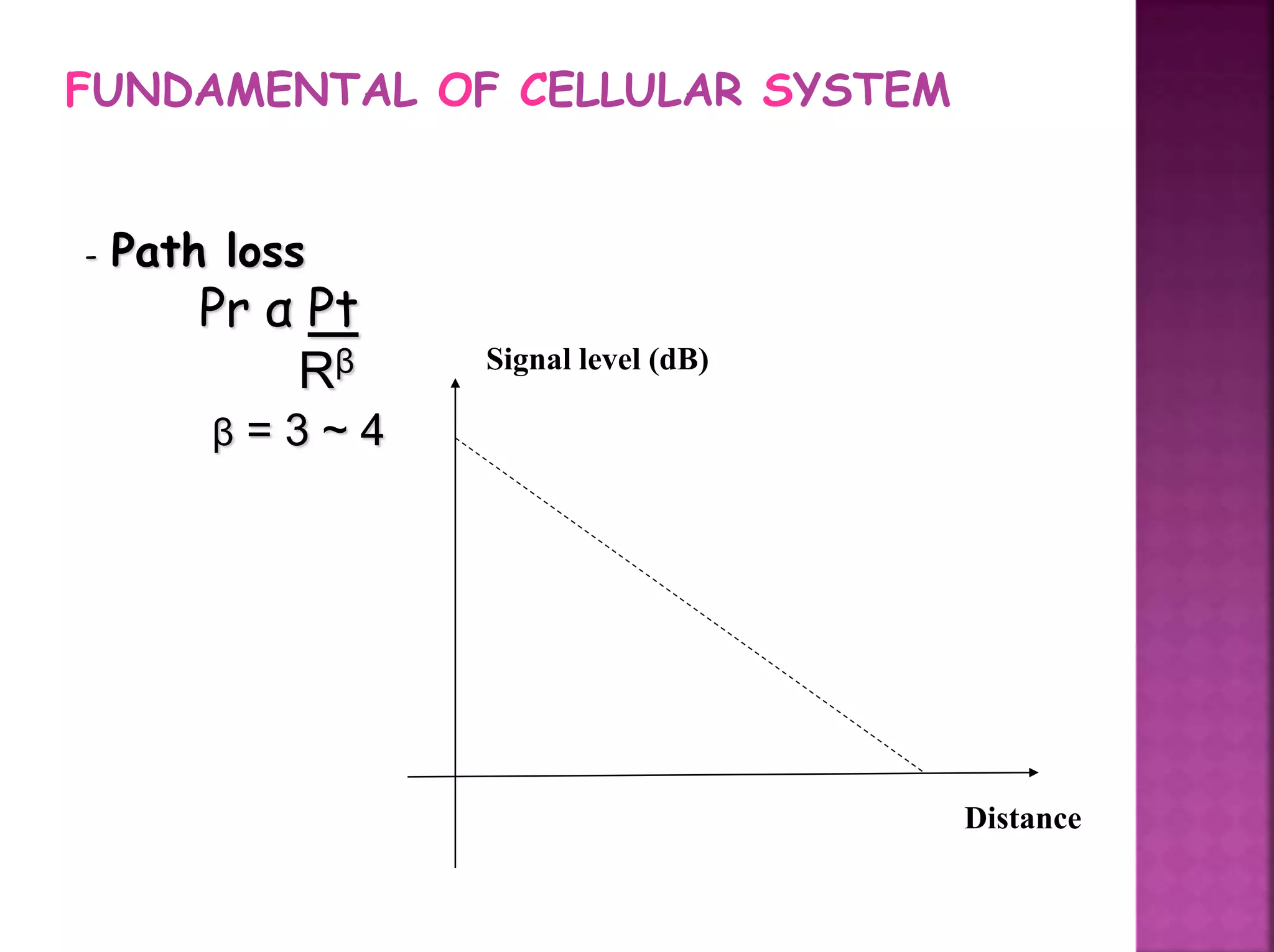
- Path loss
Pr α Pt
Rβ
β = 3 ~ 4
Signal level (dB)
Distance
FUNDAMENTAL OF CELLULAR SYSTEM
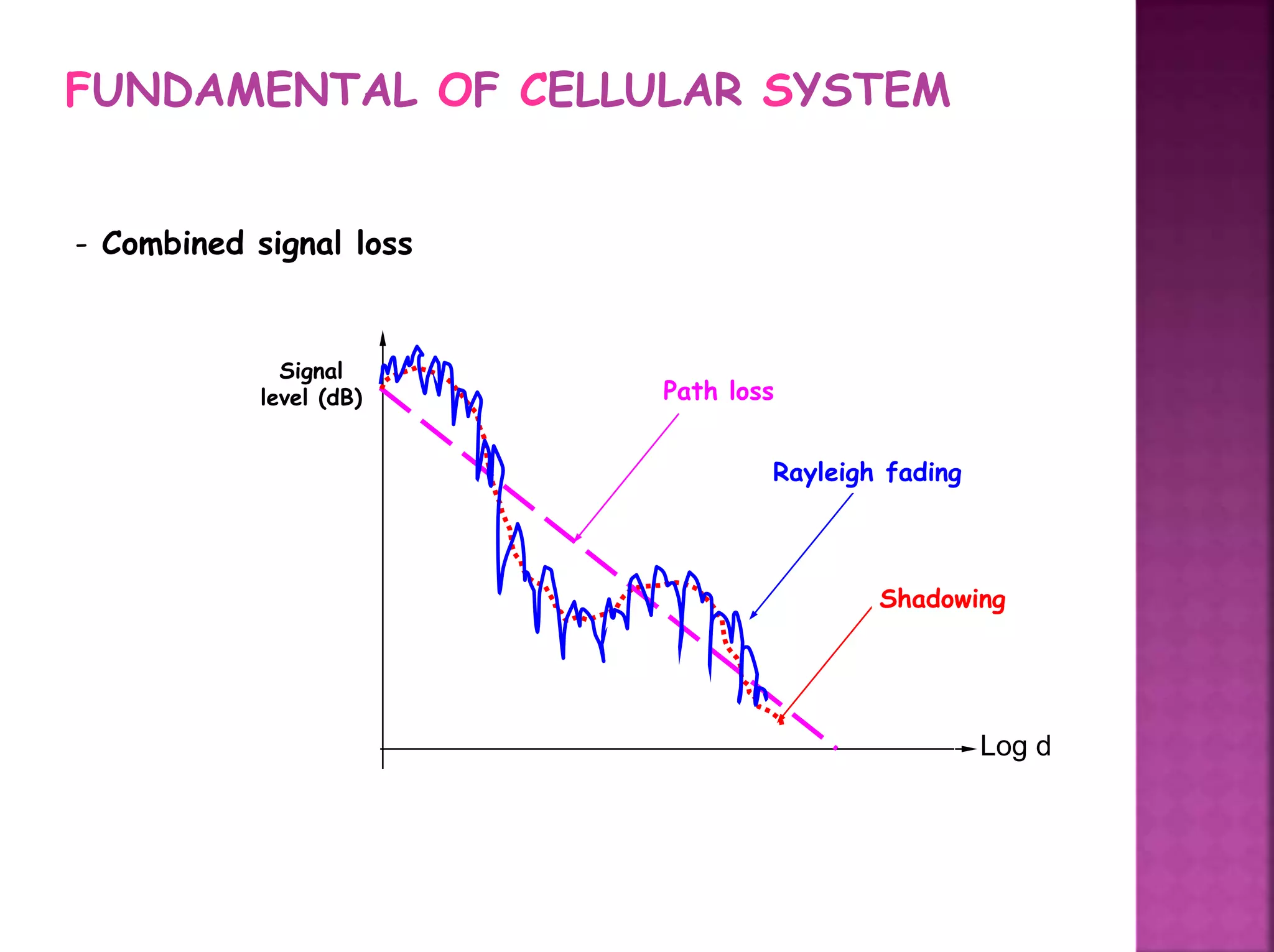
- Combined signal loss
Path loss
Rayleigh fading
Shadowing
Signal
level (dB)
Log d

Ch1 gsm “ global system for mobile communication

  • 2.
    HISTORY OF COMMUNICATION -CONTENT -communication systems overview - Introduction to Cellular Fundamentals - Network Architecture - GSM Air Interface - Digital Mobile Elements - GSM Network Protocols
  • 3.
    HISTORY OF COMMUNICATION •Communication systems
  • 4.
  • 5.
    HISTORY OF COMMUNICATION BasicCommunications System Elements ● Source ● Destination ● Transmission Medium Source Destination Transmission Medium
  • 6.
    HISTORY OF COMMUNICATION TransmissionMedium Wired Wireless • Transmission Medium
  • 7.
    HISTORY OF COMMUNICATION TelephoneNetworks Early Switching Devices Switches are devices that cause a connection between two transmitting/receiving devices. Modern Switching Devices Today many different types of automated switches are used which make it possible for fast placement of calls.
  • 8.
    HISTORY OF COMMUNICATION WiredVS Wireless • Losses • Mobility • Security • Bandwidth • Cost
  • 9.
    FUNDAMENTAL OF CELLULARSYSTEM Transition from analog to digital • Capacity Compression in digital gives more channels • compatibility with other systems As ISDN (Integrated service Digital Network) • Cost • Quality • Security
  • 10.
     Some techniquesused in wireless communication:  FDM  TDM  FDMA  TDMA Cellular FUNDEMENTALS
  • 11.
  • 12.
  • 13.
    FrequencyFDMA  FDMA isthe division of each bandwidth (RX,TX) into many frequency bands (channels) Cellular FUNDEMENTALS
  • 14.
    TDMA  It allowsseveral users to share the same radio frequency (RF) by dividing it into different timeslots Time Frequency Cellular FUNDEMENTALS
  • 15.
  • 16.
    Cellular FUNDEMENTALS • Typesof telephones Fixed (PSTN) telephones Cordless Telephones Mobile Telephones Handset The base
  • 17.
    Modes OF Transmissionin wireless  Simplex communication system  Example:  Television , radio TX RXCommunication is possible in one direction only Cellular FUNDEMENTALS
  • 18.
     Half –Duplex communication system  Example :  Police radio TX+RX TX +RX Two-way communication on the same channel. At any given time a user can only transmit or receive Cellular FUNDEMENTALS
  • 19.
     Full –Duplex communication system  Example :  GSM mobile radio TX+RX TX +RX • simultaneous two-way communication • Two simultaneous but separate channels are provided for communication to and from the terminals Cellular FUNDEMENTALS
  • 20.
    Simple growth wasthe single transmitting/receiving station - heavy, bulky and expensive - no switching between regions - low quality - limited capacity - rapid market saturation - power hungry transceiver - power level was not safe MS High transmitted power Up link Down link Cellular FUNDEMENTALS
  • 21.
  • 22.
    First generation cellularsystem - Introduction of analog cellular systems in the late 1970s and 1980s - analog system - incompatible systems - limited to voice service - no encryption - FM modulation - FDMA transmission technology - suffer from capacity saturation Cellular FUNDEMENTALS
  • 23.
    Second Generation cellularsystem - Introduction of digital cellular systems (90’s) - development of unified international standard for mobile communications - pan-national roaming - digital encryption - enhanced range of services (data + voice) - low power consumption - light weight, compact and pocket size terminals - TDMA transmission technology - huge capacity Cellular FUNDEMENTALS
  • 24.
    Third generation cellularsystem - Multimedia services - W-CDMA transmission technology - Large BW - Higher Bit Rate - More Services Cellular FUNDEMENTALS
  • 25.
    FUNDAMENTAL OF CELLULARSYSTEM The cellular structure - area divided into small zones (cells) - cells grouped into clusters - this gives less power usage - enable frequency reuse
  • 26.
    FUNDAMENTAL OF CELLULARSYSTEM Cluster size=7
  • 27.
    Good Coverage requireshigh number of Sites and Cells Area Coverage 83% Population Coverage 99,5%
  • 28.
    FUNDAMENTAL OF CELLULARSYSTEM • Cell shape
  • 29.
  • 30.
    FUNDAMENTAL OF CELLULARSYSTEM cell sectorization
  • 31.
  • 32.
    FUNDAMENTAL OF CELLULARSYSTEM cell sectorization
  • 33.
    FUNDAMENTAL OF CELLULARSYSTEM adaptive power control - as cellular mobile moves power seen at Bs changed - so we use adaptive power control to maintain it P1 P2
  • 34.
  • 35.
    FUNDAMENTAL OF CELLULARSYSTEM cell types - macrocell - microcell - picocell Very small cells
  • 36.
  • 37.
    FUNDAMENTAL OF CELLULARSYSTEM Pico Cell
  • 38.
    FUNDAMENTAL OF CELLULARSYSTEM Satellite Global Subur ban & rural Urban Pico-Cell Micro-CellMacro-Cell In-building Pico-Cell
  • 39.
    FUNDAMENTAL OF CELLULARSYSTEM cell splitting - as traffic load increases in a cell - to increase channels designer tend to split cell into smaller cells - R decrease Dc decrease so more capacity
  • 40.
    FUNDAMENTAL OF CELLULARSYSTEM cell splitting
  • 41.
    FUNDAMENTAL OF CELLULARSYSTEM channel allocation techniques - Fixed channel assignment technique (less Ts) - dynamic channel assignment technique (largest Ts) - hybrid channel assignment technique (Improved) 1,4,7 2,5,8 3,6,9 1-9 7,8,9 1,4 2,5 3,6 Fixed Dynamic Hybrid
  • 42.
    FUNDAMENTAL OF CELLULARSYSTEM channel characteristics - Multipath fading t1 t2 t3
  • 43.
    FUNDAMENTAL OF CELLULARSYSTEM -It gives a Rayleigh fading distribution - Rayleigh fading is frequency selective
  • 44.
    FUNDAMENTAL OF CELLULARSYSTEM • To overcome multipath fading we use : - Microscopic diversity and combining techniques - Frequency hopping - Error correction - Interleaving technique - adaptive power control
  • 45.
    FUNDAMENTAL OF CELLULARSYSTEM -Microscopic diversity techniques : 1-Time diversity technique 2-Frequency diversity technique
  • 46.
    FUNDAMENTAL OF CELLULARSYSTEM 3-Space diversity technique
  • 47.
    FUNDAMENTAL OF CELLULARSYSTEM -Space diversity technique
  • 48.
    FUNDAMENTAL OF CELLULARSYSTEM - Combining techniques : 1-Selective technique - used in mobile due to simplicity 2-Maximal ratio technique - Best fading reduction 3-Equal gain technique Receiver comparator
  • 49.
    FUNDAMENTAL OF CELLULARSYSTEM - Shadow fading -The Solution of this problem by using Macroscopic Diversity By selecting a BS which is not shadowed when others are.
  • 50.
    FUNDAMENTAL OF CELLULARSYSTEM - Doppler shift - +ve if the mobile moves toward the BS - -ve if the mobile moves away from the BS - The Doppler frequency shift should be compensated so that a correct frequency synchronization is achieved .
  • 51.
    FUNDAMENTAL OF CELLULARSYSTEM - Co-channel interference D c
  • 52.
    FUNDAMENTAL OF CELLULARSYSTEM - Adjacent channel interference Frequency Signal level (dB) Filter Required ch. Adjacent channel interference
  • 53.
    FUNDAMENTAL OF CELLULARSYSTEM - Channel management 1,8,15 2,9,16 5,12,19 6,13,20 7,14,21 4,11,18 3,10,17 Frequency (MHz) Amplitude
  • 54.
    FUNDAMENTAL OF CELLULARSYSTEM - Delay Spread (Time dispersion) - Due to multipath fading - To overcome this we use delay equalizer 1 2 3 4 65 1 2 3 4 65 Path 1 Path 2 t1 t2 t3
  • 55.
    FUNDAMENTAL OF CELLULARSYSTEM - Distance between MS and BS - This makes Time alignment Problem - To overcome this system should respond to this delay T1 T2 T3 A B A B
  • 56.
    FUNDAMENTAL OF CELLULARSYSTEM - Path loss Pr α Pt Rβ β = 3 ~ 4 Signal level (dB) Distance
  • 57.
    FUNDAMENTAL OF CELLULARSYSTEM - Combined signal loss Path loss Rayleigh fading Shadowing Signal level (dB) Log d