Unit No. 03
Disaster Preparedness
By Dr. Dhobale J V
Assistant Professor
IBS, IFHE, Hyderabad.
IBS Hyderabad 1
Objectives
 Introduction to Disaster Preparedness.
 The Three A’s of Disaster Preparedness.
 Principles of Disaster Preparedness.
 Steps of Disaster Preparedness.
 Organizational Structure for Disaster Preparedness.
 Essential services Preparedness and Logistical Readiness.
 Contingency planning.
 Importance of Building Team and Community Relations for
Environmental and Emergency Managers.
 Training Needs Analysis and Human Resource Development
plan.
 Emergency Operational Plan: Contents.
2IBS Hyderabad
Introduction – Disaster Preparedness
 There has been phenomenal increase in the
number of disasters in the last decade.
 The disasters that we have faced have left
behind sorrows and woes.
 They have also left behind important lessons
to be learnt for future management of
disasters.
 The more the magnitude of a disaster, the
greater is the opportunity for reflection and
corrective action.
3IBS Hyderabad
Introduction – Disaster Preparedness
 These disasters serve as an important wakeup
call and provide important clues to the
mistakes of the past and help ensure that the
same are not repeated in the future.
 It is observed that there are many occurrences
that have the potential to cause damage to life
and property.
 These are not disasters; these are hazards.
4IBS Hyderabad
Introduction – Disaster Preparedness
 These hazards become disasters when they
cause serious disruption to the day-to-day
functioning of society and, at the same time,
lead to a great loss of life and property.
 A hazard does not become a disaster on its
own.
 The impending damage arising out of a hazard
or threat can be certainly reduced and
contained to great extent.
5IBS Hyderabad
Introduction – Disaster Preparedness
 Experience has it that with preparation, any
event that is a probable threat can be
controlled to great extent from turning into
disaster.
 The key to effective management of disasters
lies in preparation.
 Preparedness, which is an important stage of
the disaster management cycle, plays a very
significant role in recognizing, evaluating and
controlling hazards.
6IBS Hyderabad
Introduction – Disaster Preparedness
 Disaster preparedness consists of action that
facilitate individuals, societies and
governmental agencies to respond efficiently
in the event of disaster-like situation.
 It refers to the process of preparing for a
disastrous event to reduce and contain its ill-
effects.
 The aim of the preparedness is the reduction
of the impact of the disaster on susceptible
populations by responding effectively and
efficiently.
7IBS Hyderabad
Introduction – Disaster Preparedness
 Disaster Mitigation and Disaster Preparedness
are two distinct but overlapping stages of the
disaster management cycle.
 The aim of the mitigation policies and
measures are to reduce the vulnerability or
increase the resilience to the effects of
inevitable disasters.
 The aim of the preparedness is the reduction
of the impact of the disaster on susceptible
populations by responding effectively and
efficiently.
8IBS Hyderabad
Introduction – Disaster Preparedness
 Preparedness aims at minimizing loss by an
impending disaster by the ‘response and
recovery activity’.
 Disaster preparedness is an ongoing and
integrated course of action taken with the aim
to reduce the pre and post impact of disaster.
9IBS Hyderabad
The Three A’s of Disaster Preparedness
 Aim, Action and Accountability.
 Effective management of disaster is achieved
through attainment of these three A’s.
1. Aim – is a target that one choose before
taking any action.
 Preparedness for disasters, the aim has to be
categorically stated.
 Aim also provides a broad guideline to the
respondents to react and know how to use
resources at hand for the impending disaster.
10IBS Hyderabad
The Three A’s of Disaster Preparedness
 Aim provides a direction to other important
activities that are commonly associated with
disaster preparedness such as –
1. Developing Planning process to ensure
readiness.
2. Formulating disaster plans.
3. Stockpiling resources necessary for effective
response.
4. Developing skills and competencies to
ensure an effective performance of related
task in disaster preparedness.
11IBS Hyderabad
The Three A’s of Disaster Preparedness
 Ensuring safety is the primary aim of
preparedness.
 It encompasses the action that are meant to
enhance the ability to respond in emergency
situations that pose a threat to life and
property.
 This broad aim can be further split into –
1. Constitution of emergency response policies
and standards.
2. Creation of plans to be followed before and
after a disaster.
12IBS Hyderabad
The Three A’s of Disaster Preparedness
3. Improvement in the efficiency and
effectiveness of disaster response
mechanisms.
4. Education and training of emergency
response team and the population at risk.
5. Development of an operational strategy for
undertaking activities that are essential in
responding to disastrous situations.
6. Provision of rapid and equitable recovery and
response.
7. Development of a culture of preparedness.
13IBS Hyderabad
The Three A’s of Disaster Preparedness
2. Action:- The aim of the preparedness phase
of disaster management is to improve
response activities to enhance the coping
capability of the affected population.
 It deals with both short-term and long term
recovery aspects.
 It consists of actions permitted to enhance the
ability to carry out emergency actions in order
to protect property and control disaster
damage and disruption as well as the ability to
engage in post-disaster restoration and early
recovery activities. 14IBS Hyderabad
The Three A’s of Disaster Preparedness
2. Action:- The aim of disaster preparedness is
achieved partially through readiness
measures that accelerate emergency
response and recovery systems and through
activities that are aimed at capacity building
of the people.
 Disaster Preparedness is everyone’s business
as there are many stakeholders and it requires
the assistance from many different areas.
 It is imperative that all the stakeholders act in
tandem to achieve the aims and objectives of
preparedness. 15IBS Hyderabad
The Three A’s of Disaster Preparedness
2. Action:- Any failure to act by a stakeholder
can result in total breakdown of the system.
 Disaster preparedness is a continuous and
integrated process concerning an extensive
range of activities that are to be undertaken by
many people.
 Without action, no aim can ever be
accomplished.
 Without proper action, no measure can be
implemented.
16IBS Hyderabad
The Three A’s of Disaster Preparedness
3. Accountability:- It is very important to facilitate
ascertaining the responsibility of action.
 Everyone knows a lot can be done for disaster
preparedness, but the question that comes to
mind is what, how and who?
 Aim answers the question of what is to be
done, action talks about how it is to be
achieved and accountability focuses on who
will achieve it.
 Accountability, in simple terms, means
accounting for one’s actions.
17IBS Hyderabad
The Three A’s of Disaster Preparedness
3. Accountability:- without accountability, every
effort towards disaster preparedness will fall
apart, and preparedness measures will turn
out to be inefficient and ineffective.
 Accountability provides a clear focus on the
result to be achieved and helps in accelerating
progress and becoming successful.
 Each and every stakeholder knows what to do
and how much is within his/her purview.
18IBS Hyderabad
Principles of Disaster Preparedness
 There are certain principles of Disaster
preparedness:
1. Principle of Realistic Planning.
2. Principle of Continuous Improvement.
3. Principle of collaboration and coordination.
4. Principle of Motivation.
5. Principle of Time-bound implementation.
6. Principle of All-Disaster Inclusiveness.
19IBS Hyderabad
Steps of Disaster Preparedness
 Preparedness is a systematic task having a
series of interrelated steps –
1. Hazard, Risk and Vulnerability Evaluation.
2. Assessment of Current Capability and
Response Mechanism.
3. Developing Preparedness Plans.
4. Implementation of Preparedness Plans.
5. Public Education, Training and Rehearsal.
20IBS Hyderabad
Organizational Structure for Disaster
Preparedness
 Organizing is a process by which roles and
responsibilities are arranged and coordinated
for the successful implementation of plans.
 The preparedness division’s role is to prepare
national, state and local agencies in
responding to disasters effectively.
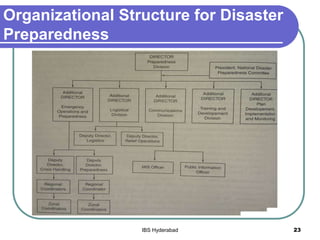
 The organizational structure for a disaster
preparedness division should consists of five
units -
21IBS Hyderabad
Organizational Structure for Disaster
Preparedness
1. Emergency operations and preparedness
unit.
2. Logistical Unit.
3. Communication unit.
4. Training and development Unit.
5. Plan development, implementation and
monitoring unit.
22IBS Hyderabad
Organizational Structure for Disaster
Preparedness
23IBS Hyderabad
Organizational Structure for Disaster
Preparedness – Logistical Readiness
 The vision of the Logistics Division is to
provide exceptional logistics and resource
management support to enable it to be
disaster-ready at all times.
 Emergency services – Medical and healthcare.
 Communication facilities readiness.
24IBS Hyderabad
Contingency Planning
 Strict compliance with the plans may prove to
be disastrous in itself.
 A fresh exploration of alternatives according to
the turn of events may be needed.
 In such situations, planning is essential for
onward movement.
 This plan is called contingency planning, which
helps in responding effectively to disasters.
 Contingency planning entails making plan B
deal with situation changes.
25IBS Hyderabad
Contingency Planning
 Many Challenges to prepare contingency
plans.
 People thing no need of contingency because
of well planned preparedness.
 The aim of the contingency plan should ensure
a minimum level of functionality of all
resources & focus should be on providing
prompt service in the event of disaster.
 It should be made clear as to when this
contingency plan has to be made functional.
26IBS Hyderabad
Contingency Planning
 The incident have to be clearly stated.
 The plan should provide the role and
responsibility of each agency at every stage.
 It should be simple and understandable to the
people.
 The method of updating people about the
changes in the plan should be clearly
mentioned.
 A method of identifying problems in the
implementation of the plan has to be in place
to ensure performance improvement.
27IBS Hyderabad
Importance of building teams
 Preparedness is the best guard against a
disaster and team building is one of the
strategic steps of preparedness that enables
an effective response in crisis situations.
 The team-building process is a tedious
process involving four stages-
1. Forming
2. Storming
3. Norming
4. Performing
28IBS Hyderabad
Training Needs Analysis and human
Resource Development Plan
 Training needs analysis is a process by which
the training and development needs of the
personnel involved in disaster preparedness is
identified.
 The needs assessment exercise is carried out
at two levels: group and individual.
29IBS Hyderabad
Emergency Operational Plan (EOP):
Contents
 EOP is essential aspect of preparedness.
 The plan is divided into 6 sections –
1. General statement of purpose indicating
mission and what the plan is well structured
aims to achieve.
2. This section clarifies the various situations in
which the plan will work.
3. This section explains organizational issues
and discusses the roles and responsibilities
of local preparedness team members.
30IBS Hyderabad
Emergency Operational Plan (EOP):
Contents
 EOP is essential aspect of preparedness.
 The plan is divided into 6 sections –
4. This section deals with details about
operational and logistics.
5. The development of plan and its
implementation is discussed – The various
important details about changes that are
suggested on the basis of review situations,
time and again.
31IBS Hyderabad
Emergency Operational Plan (EOP):
Contents
 EOP is essential aspect of preparedness.
 The plan is divided into 6 sections –
6. This last section deals with the details of
statutes, executive orders and formal
agreements issued time and again by
disaster management authorities and
government agencies relating to disaster
preparedness.
 EOP is a well narrated descriptive on
operating procedures about the activities of
preparedness team.
32IBS Hyderabad
Case let – Orissa Cyclone Hit in 1999 &
2013
 Case let discussion – Orissa Cyclone Hit in
1999 & 2013
33IBS Hyderabad
Review
 Introduction to Disaster Preparedness.
 The Three A’s of Disaster Preparedness.
 Principles of Disaster Preparedness.
 Steps of Disaster Preparedness.
 Organizational Structure for Disaster Preparedness.
 Essential services Preparedness and Logistical Readiness.
 Contingency planning.
 Importance of Building Team and Community Relations for
Environmental and Emergency Managers.
 Training Needs Analysis and Human Resource Development
plan.
 Emergency Operational Plan: Contents.
34IBS Hyderabad
Thank You!
35IBS Hyderabad

Unit no 03 disaster preparedness

  • 1.
    Unit No. 03 DisasterPreparedness By Dr. Dhobale J V Assistant Professor IBS, IFHE, Hyderabad. IBS Hyderabad 1
  • 2.
    Objectives  Introduction toDisaster Preparedness.  The Three A’s of Disaster Preparedness.  Principles of Disaster Preparedness.  Steps of Disaster Preparedness.  Organizational Structure for Disaster Preparedness.  Essential services Preparedness and Logistical Readiness.  Contingency planning.  Importance of Building Team and Community Relations for Environmental and Emergency Managers.  Training Needs Analysis and Human Resource Development plan.  Emergency Operational Plan: Contents. 2IBS Hyderabad
  • 3.
    Introduction – DisasterPreparedness  There has been phenomenal increase in the number of disasters in the last decade.  The disasters that we have faced have left behind sorrows and woes.  They have also left behind important lessons to be learnt for future management of disasters.  The more the magnitude of a disaster, the greater is the opportunity for reflection and corrective action. 3IBS Hyderabad
  • 4.
    Introduction – DisasterPreparedness  These disasters serve as an important wakeup call and provide important clues to the mistakes of the past and help ensure that the same are not repeated in the future.  It is observed that there are many occurrences that have the potential to cause damage to life and property.  These are not disasters; these are hazards. 4IBS Hyderabad
  • 5.
    Introduction – DisasterPreparedness  These hazards become disasters when they cause serious disruption to the day-to-day functioning of society and, at the same time, lead to a great loss of life and property.  A hazard does not become a disaster on its own.  The impending damage arising out of a hazard or threat can be certainly reduced and contained to great extent. 5IBS Hyderabad
  • 6.
    Introduction – DisasterPreparedness  Experience has it that with preparation, any event that is a probable threat can be controlled to great extent from turning into disaster.  The key to effective management of disasters lies in preparation.  Preparedness, which is an important stage of the disaster management cycle, plays a very significant role in recognizing, evaluating and controlling hazards. 6IBS Hyderabad
  • 7.
    Introduction – DisasterPreparedness  Disaster preparedness consists of action that facilitate individuals, societies and governmental agencies to respond efficiently in the event of disaster-like situation.  It refers to the process of preparing for a disastrous event to reduce and contain its ill- effects.  The aim of the preparedness is the reduction of the impact of the disaster on susceptible populations by responding effectively and efficiently. 7IBS Hyderabad
  • 8.
    Introduction – DisasterPreparedness  Disaster Mitigation and Disaster Preparedness are two distinct but overlapping stages of the disaster management cycle.  The aim of the mitigation policies and measures are to reduce the vulnerability or increase the resilience to the effects of inevitable disasters.  The aim of the preparedness is the reduction of the impact of the disaster on susceptible populations by responding effectively and efficiently. 8IBS Hyderabad
  • 9.
    Introduction – DisasterPreparedness  Preparedness aims at minimizing loss by an impending disaster by the ‘response and recovery activity’.  Disaster preparedness is an ongoing and integrated course of action taken with the aim to reduce the pre and post impact of disaster. 9IBS Hyderabad
  • 10.
    The Three A’sof Disaster Preparedness  Aim, Action and Accountability.  Effective management of disaster is achieved through attainment of these three A’s. 1. Aim – is a target that one choose before taking any action.  Preparedness for disasters, the aim has to be categorically stated.  Aim also provides a broad guideline to the respondents to react and know how to use resources at hand for the impending disaster. 10IBS Hyderabad
  • 11.
    The Three A’sof Disaster Preparedness  Aim provides a direction to other important activities that are commonly associated with disaster preparedness such as – 1. Developing Planning process to ensure readiness. 2. Formulating disaster plans. 3. Stockpiling resources necessary for effective response. 4. Developing skills and competencies to ensure an effective performance of related task in disaster preparedness. 11IBS Hyderabad
  • 12.
    The Three A’sof Disaster Preparedness  Ensuring safety is the primary aim of preparedness.  It encompasses the action that are meant to enhance the ability to respond in emergency situations that pose a threat to life and property.  This broad aim can be further split into – 1. Constitution of emergency response policies and standards. 2. Creation of plans to be followed before and after a disaster. 12IBS Hyderabad
  • 13.
    The Three A’sof Disaster Preparedness 3. Improvement in the efficiency and effectiveness of disaster response mechanisms. 4. Education and training of emergency response team and the population at risk. 5. Development of an operational strategy for undertaking activities that are essential in responding to disastrous situations. 6. Provision of rapid and equitable recovery and response. 7. Development of a culture of preparedness. 13IBS Hyderabad
  • 14.
    The Three A’sof Disaster Preparedness 2. Action:- The aim of the preparedness phase of disaster management is to improve response activities to enhance the coping capability of the affected population.  It deals with both short-term and long term recovery aspects.  It consists of actions permitted to enhance the ability to carry out emergency actions in order to protect property and control disaster damage and disruption as well as the ability to engage in post-disaster restoration and early recovery activities. 14IBS Hyderabad
  • 15.
    The Three A’sof Disaster Preparedness 2. Action:- The aim of disaster preparedness is achieved partially through readiness measures that accelerate emergency response and recovery systems and through activities that are aimed at capacity building of the people.  Disaster Preparedness is everyone’s business as there are many stakeholders and it requires the assistance from many different areas.  It is imperative that all the stakeholders act in tandem to achieve the aims and objectives of preparedness. 15IBS Hyderabad
  • 16.
    The Three A’sof Disaster Preparedness 2. Action:- Any failure to act by a stakeholder can result in total breakdown of the system.  Disaster preparedness is a continuous and integrated process concerning an extensive range of activities that are to be undertaken by many people.  Without action, no aim can ever be accomplished.  Without proper action, no measure can be implemented. 16IBS Hyderabad
  • 17.
    The Three A’sof Disaster Preparedness 3. Accountability:- It is very important to facilitate ascertaining the responsibility of action.  Everyone knows a lot can be done for disaster preparedness, but the question that comes to mind is what, how and who?  Aim answers the question of what is to be done, action talks about how it is to be achieved and accountability focuses on who will achieve it.  Accountability, in simple terms, means accounting for one’s actions. 17IBS Hyderabad
  • 18.
    The Three A’sof Disaster Preparedness 3. Accountability:- without accountability, every effort towards disaster preparedness will fall apart, and preparedness measures will turn out to be inefficient and ineffective.  Accountability provides a clear focus on the result to be achieved and helps in accelerating progress and becoming successful.  Each and every stakeholder knows what to do and how much is within his/her purview. 18IBS Hyderabad
  • 19.
    Principles of DisasterPreparedness  There are certain principles of Disaster preparedness: 1. Principle of Realistic Planning. 2. Principle of Continuous Improvement. 3. Principle of collaboration and coordination. 4. Principle of Motivation. 5. Principle of Time-bound implementation. 6. Principle of All-Disaster Inclusiveness. 19IBS Hyderabad
  • 20.
    Steps of DisasterPreparedness  Preparedness is a systematic task having a series of interrelated steps – 1. Hazard, Risk and Vulnerability Evaluation. 2. Assessment of Current Capability and Response Mechanism. 3. Developing Preparedness Plans. 4. Implementation of Preparedness Plans. 5. Public Education, Training and Rehearsal. 20IBS Hyderabad
  • 21.
    Organizational Structure forDisaster Preparedness  Organizing is a process by which roles and responsibilities are arranged and coordinated for the successful implementation of plans.  The preparedness division’s role is to prepare national, state and local agencies in responding to disasters effectively.  The organizational structure for a disaster preparedness division should consists of five units - 21IBS Hyderabad
  • 22.
    Organizational Structure forDisaster Preparedness 1. Emergency operations and preparedness unit. 2. Logistical Unit. 3. Communication unit. 4. Training and development Unit. 5. Plan development, implementation and monitoring unit. 22IBS Hyderabad
  • 23.
    Organizational Structure forDisaster Preparedness 23IBS Hyderabad
  • 24.
    Organizational Structure forDisaster Preparedness – Logistical Readiness  The vision of the Logistics Division is to provide exceptional logistics and resource management support to enable it to be disaster-ready at all times.  Emergency services – Medical and healthcare.  Communication facilities readiness. 24IBS Hyderabad
  • 25.
    Contingency Planning  Strictcompliance with the plans may prove to be disastrous in itself.  A fresh exploration of alternatives according to the turn of events may be needed.  In such situations, planning is essential for onward movement.  This plan is called contingency planning, which helps in responding effectively to disasters.  Contingency planning entails making plan B deal with situation changes. 25IBS Hyderabad
  • 26.
    Contingency Planning  ManyChallenges to prepare contingency plans.  People thing no need of contingency because of well planned preparedness.  The aim of the contingency plan should ensure a minimum level of functionality of all resources & focus should be on providing prompt service in the event of disaster.  It should be made clear as to when this contingency plan has to be made functional. 26IBS Hyderabad
  • 27.
    Contingency Planning  Theincident have to be clearly stated.  The plan should provide the role and responsibility of each agency at every stage.  It should be simple and understandable to the people.  The method of updating people about the changes in the plan should be clearly mentioned.  A method of identifying problems in the implementation of the plan has to be in place to ensure performance improvement. 27IBS Hyderabad
  • 28.
    Importance of buildingteams  Preparedness is the best guard against a disaster and team building is one of the strategic steps of preparedness that enables an effective response in crisis situations.  The team-building process is a tedious process involving four stages- 1. Forming 2. Storming 3. Norming 4. Performing 28IBS Hyderabad
  • 29.
    Training Needs Analysisand human Resource Development Plan  Training needs analysis is a process by which the training and development needs of the personnel involved in disaster preparedness is identified.  The needs assessment exercise is carried out at two levels: group and individual. 29IBS Hyderabad
  • 30.
    Emergency Operational Plan(EOP): Contents  EOP is essential aspect of preparedness.  The plan is divided into 6 sections – 1. General statement of purpose indicating mission and what the plan is well structured aims to achieve. 2. This section clarifies the various situations in which the plan will work. 3. This section explains organizational issues and discusses the roles and responsibilities of local preparedness team members. 30IBS Hyderabad
  • 31.
    Emergency Operational Plan(EOP): Contents  EOP is essential aspect of preparedness.  The plan is divided into 6 sections – 4. This section deals with details about operational and logistics. 5. The development of plan and its implementation is discussed – The various important details about changes that are suggested on the basis of review situations, time and again. 31IBS Hyderabad
  • 32.
    Emergency Operational Plan(EOP): Contents  EOP is essential aspect of preparedness.  The plan is divided into 6 sections – 6. This last section deals with the details of statutes, executive orders and formal agreements issued time and again by disaster management authorities and government agencies relating to disaster preparedness.  EOP is a well narrated descriptive on operating procedures about the activities of preparedness team. 32IBS Hyderabad
  • 33.
    Case let –Orissa Cyclone Hit in 1999 & 2013  Case let discussion – Orissa Cyclone Hit in 1999 & 2013 33IBS Hyderabad
  • 34.
    Review  Introduction toDisaster Preparedness.  The Three A’s of Disaster Preparedness.  Principles of Disaster Preparedness.  Steps of Disaster Preparedness.  Organizational Structure for Disaster Preparedness.  Essential services Preparedness and Logistical Readiness.  Contingency planning.  Importance of Building Team and Community Relations for Environmental and Emergency Managers.  Training Needs Analysis and Human Resource Development plan.  Emergency Operational Plan: Contents. 34IBS Hyderabad
  • 35.