SERIAL VS PARALLEL COMMUNICATION
&
SYNCHRONOUS & ASYNCHRONOUS DATA
TRANSMISSION
RAUSHAN PANJIYAR – 21430
ROHAN MISTRY - 21432
PRANJAL YADAV - 21425
NAAZNEEN SAYED - 21470
OVERVIEW OF THE PRESENTATION
• Serial Communication
• Advantages & Disadvantage
• Parallel Communication
• Advantages & Disadvantage
• Difference Between Serial & Parallel
• Synchronous Data Transmission
• Advantages & Disadvantage
• Asynchronous Data Transmission
• Advantages & Disadvantage
SERIAL TRANSMISSION
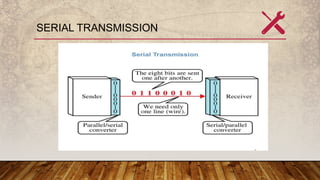
• In Serial Transmission, the bits of a byte are serially transmitted one after other.
• The shift register is used for serial transmission
• The byte to be transmitted is the first stored in a shift register.
• Then these bits are shifted from MSB to LSB bit by bit in synchronization with the
clock. Bits are shifted right by one by one position per clock cycle.
• As an advantage only one wire is used in serial transmission between the
transmitter and the receiver.
SERIAL TRANSMISSION
MODES OF SERIAL COMMUNICATION
.
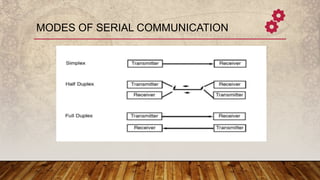
• In simple transmissions, the computer can only send data. There is only one
wire.
• If the data can be transmission and received, then it is a duplex transmission
• Duplex transmission can be half or full duplex depending on whether or not the
data transfer can be simultaneous
• If the communication is only one way at a time, it is half duplex
• If both sides can communicate at the same time, it is full duplex
• Full duplex requires two wire conductors for the data lines
MODES OF SERIAL COMMUNICATION
• Only one wire is required
• Reduction is cost due to less number of conductor wire
• It is the most used method for long distance data transfers
ADVANTAGES OF SERIAL TRANSMISSION
• Since there is only one line of transmission therefore the speed of transmission is
quite slow
• If we have to increase the speed of data transfer then it is necessary to increase
the clock frequency. But there ia a limit of clock frequency.
DISADVANTAGES OF SERIAL TRANSMISSION
Serial transmission has two categories:
1. Synchronous data transmission
2. Asynchronous data transmission
TYPES OF SERIAL TRANSMISSION
• Synchronous events means events which happen at the same clock rate.
• Synchronous transmission is carried out under the control of a common master clock.
• Here the bits which are being transmitted as Synchronous to the same reference clock.
• The stream of bits is combined into bigger frames which may comprise more than one
byte.
• Each byte is transmitted without gap between the next byte.
• No start and stop bits are used instead the bytes are transmitted as a block in a continuous
stream of bits.
SYNCHRONOUS TRANSMISSION
• The receivers operates at the same clock frequency as that of transmitted.
• The data is send in blocks ( we can call these blocks as frames or packets)
spaced by fixed time intervals.
• It is the duty of receiver to separate the bits send in group
• There is an inter block idle time which also is filled with idle characters.
• Ways to find the solution to the problem of error in transmission because of loss
in synchronization is to include re-Synchronization of the clock and use of check
digit to ensure the byte in correctly interpreted and received
SYNCHRONOUS TRANSMISSION
• The main advantage is speed. The speed of transmission is much higher than
that asynchronous transmission.
• This is due to the absence of gaps between the data units and absence of start
stop bits.
• Timing errors are reduced due to synchronization.
ADVANTAGES OF SYNCHRONOUS
TRANSMISSION
• The timing is very important. The accuracy of the received data is dependent
entirely on the ability of the receiver to count the received bits accurately.
• The transmitter and receiver have to operate at the same clock frequency. This
requires proper synchronization which makes the system complicated.
DISADVANTAGES OF SYNCHRONOUS
TRANSMISSION
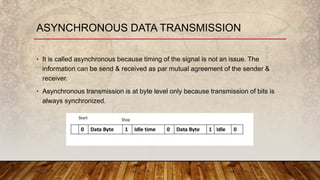
• It is called asynchronous because timing of the signal is not an issue. The
information can be send & received as par mutual agreement of the sender &
receiver.
• Asynchronous transmission is at byte level only because transmission of bits is
always synchronized.
ASYNCHRONOUS DATA TRANSMISSION
• Asynchronous transmission is eased by two bits, namely start bit as ‘0’ & stop bit
as ‘1’.
• We send ‘0’ bit to start the communication & ‘1’ bit to stop the transmission.
• There can be a time delay between communication of two bytes.
• Only one byte is send at a time. After a gap of time next byte is transmitted.
• The transmitter and receiver may function at different clock frequencies.
• Asynchronous transmission is mostly used by asynchronous modems.
ASYNCHRONOUS TRANSMISSION
• It is a flexible data transmission method.
• Synchronization between the transmitter and receiver is not necessary.
• It is possible to transmit signals from the sources having different bit rates.
• The transmission can commence as soon as the data byte to be transmitted
becomes available.
• This mode of transmission is easy to implement.
• It is an effective scheme.
ADVANTAGES OF ASYNCHRONOUS TRANSMISSION
• Additional bits called start and stop bits are required to be used.
• The timing error may take place because it is difficult to determine synchronicity.
• It has slower transmission rate.
DISADVANTAGES OF ASYNCHRONOUS
TRANSMISSION
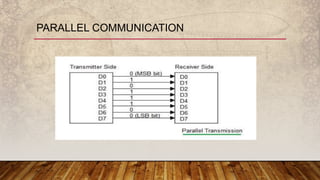
• In data transmission, parallel communication is a method of conveying multiple
binary digits (bits) simultaneously. It contrasts with serial communication,
which conveys only a single bit at a time; this distinction is one way of
characterizing a communications link.
PARALLEL COMMUNICATION
• It offers fast data communication between devices compare to serial interface.
ADVANTAGES OF PARALLEL TRANSMISSION
• It supports short distance communication between devices. This is due to
crosstalk between the parallel lines.
• It uses more wires compare to serial interface and hence it is costly and a bit
complex to implement.
DISADVANTAGES OF PARALLEL TRANSMISSION
"Thank You"

Serial vs Parallel communication & Synchronous and Asynchronous transmission

  • 1.
    SERIAL VS PARALLELCOMMUNICATION & SYNCHRONOUS & ASYNCHRONOUS DATA TRANSMISSION RAUSHAN PANJIYAR – 21430 ROHAN MISTRY - 21432 PRANJAL YADAV - 21425 NAAZNEEN SAYED - 21470
  • 2.
    OVERVIEW OF THEPRESENTATION • Serial Communication • Advantages & Disadvantage • Parallel Communication • Advantages & Disadvantage • Difference Between Serial & Parallel • Synchronous Data Transmission • Advantages & Disadvantage • Asynchronous Data Transmission • Advantages & Disadvantage
  • 3.
    SERIAL TRANSMISSION • InSerial Transmission, the bits of a byte are serially transmitted one after other. • The shift register is used for serial transmission • The byte to be transmitted is the first stored in a shift register. • Then these bits are shifted from MSB to LSB bit by bit in synchronization with the clock. Bits are shifted right by one by one position per clock cycle. • As an advantage only one wire is used in serial transmission between the transmitter and the receiver.
  • 4.
  • 5.
    MODES OF SERIALCOMMUNICATION .
  • 6.
    • In simpletransmissions, the computer can only send data. There is only one wire. • If the data can be transmission and received, then it is a duplex transmission • Duplex transmission can be half or full duplex depending on whether or not the data transfer can be simultaneous • If the communication is only one way at a time, it is half duplex • If both sides can communicate at the same time, it is full duplex • Full duplex requires two wire conductors for the data lines MODES OF SERIAL COMMUNICATION
  • 7.
    • Only onewire is required • Reduction is cost due to less number of conductor wire • It is the most used method for long distance data transfers ADVANTAGES OF SERIAL TRANSMISSION
  • 8.
    • Since thereis only one line of transmission therefore the speed of transmission is quite slow • If we have to increase the speed of data transfer then it is necessary to increase the clock frequency. But there ia a limit of clock frequency. DISADVANTAGES OF SERIAL TRANSMISSION
  • 9.
    Serial transmission hastwo categories: 1. Synchronous data transmission 2. Asynchronous data transmission TYPES OF SERIAL TRANSMISSION
  • 10.
    • Synchronous eventsmeans events which happen at the same clock rate. • Synchronous transmission is carried out under the control of a common master clock. • Here the bits which are being transmitted as Synchronous to the same reference clock. • The stream of bits is combined into bigger frames which may comprise more than one byte. • Each byte is transmitted without gap between the next byte. • No start and stop bits are used instead the bytes are transmitted as a block in a continuous stream of bits. SYNCHRONOUS TRANSMISSION
  • 11.
    • The receiversoperates at the same clock frequency as that of transmitted. • The data is send in blocks ( we can call these blocks as frames or packets) spaced by fixed time intervals. • It is the duty of receiver to separate the bits send in group • There is an inter block idle time which also is filled with idle characters. • Ways to find the solution to the problem of error in transmission because of loss in synchronization is to include re-Synchronization of the clock and use of check digit to ensure the byte in correctly interpreted and received SYNCHRONOUS TRANSMISSION
  • 12.
    • The mainadvantage is speed. The speed of transmission is much higher than that asynchronous transmission. • This is due to the absence of gaps between the data units and absence of start stop bits. • Timing errors are reduced due to synchronization. ADVANTAGES OF SYNCHRONOUS TRANSMISSION
  • 13.
    • The timingis very important. The accuracy of the received data is dependent entirely on the ability of the receiver to count the received bits accurately. • The transmitter and receiver have to operate at the same clock frequency. This requires proper synchronization which makes the system complicated. DISADVANTAGES OF SYNCHRONOUS TRANSMISSION
  • 14.
    • It iscalled asynchronous because timing of the signal is not an issue. The information can be send & received as par mutual agreement of the sender & receiver. • Asynchronous transmission is at byte level only because transmission of bits is always synchronized. ASYNCHRONOUS DATA TRANSMISSION
  • 15.
    • Asynchronous transmissionis eased by two bits, namely start bit as ‘0’ & stop bit as ‘1’. • We send ‘0’ bit to start the communication & ‘1’ bit to stop the transmission. • There can be a time delay between communication of two bytes. • Only one byte is send at a time. After a gap of time next byte is transmitted. • The transmitter and receiver may function at different clock frequencies. • Asynchronous transmission is mostly used by asynchronous modems. ASYNCHRONOUS TRANSMISSION
  • 16.
    • It isa flexible data transmission method. • Synchronization between the transmitter and receiver is not necessary. • It is possible to transmit signals from the sources having different bit rates. • The transmission can commence as soon as the data byte to be transmitted becomes available. • This mode of transmission is easy to implement. • It is an effective scheme. ADVANTAGES OF ASYNCHRONOUS TRANSMISSION
  • 17.
    • Additional bitscalled start and stop bits are required to be used. • The timing error may take place because it is difficult to determine synchronicity. • It has slower transmission rate. DISADVANTAGES OF ASYNCHRONOUS TRANSMISSION
  • 18.
    • In datatransmission, parallel communication is a method of conveying multiple binary digits (bits) simultaneously. It contrasts with serial communication, which conveys only a single bit at a time; this distinction is one way of characterizing a communications link. PARALLEL COMMUNICATION
  • 19.
  • 20.
    • It offersfast data communication between devices compare to serial interface. ADVANTAGES OF PARALLEL TRANSMISSION
  • 21.
    • It supportsshort distance communication between devices. This is due to crosstalk between the parallel lines. • It uses more wires compare to serial interface and hence it is costly and a bit complex to implement. DISADVANTAGES OF PARALLEL TRANSMISSION
  • 22.