Convolution Codes
                       ADVANCED COMMUNICATION SYSTEMS


                             PRATISHTHA SHIRA RAM
                                  SEMESTER 8
                                  DEPT. OF ECE


Pratishtha Shira Ram
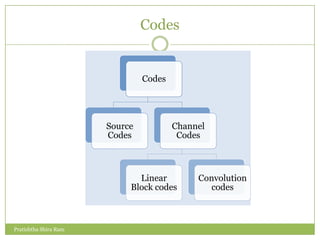
Codes


                                Codes


                       Source           Channel
                       Codes             Codes


                              Linear         Convolution
                            Block codes         codes


Pratishtha Shira Ram
Codes (contd.)


                 1         Source Codes
                  • The aim of source coding is to take the
                    source data and make it smaller.


                 2       Channel Codes
                  • The aim of channel coding theory is to
                    find codes which transmit
                    quickly, contain many valid code words
                    and can correct or at least detect many
                    errors.


Pratishtha Shira Ram
Channel Codes
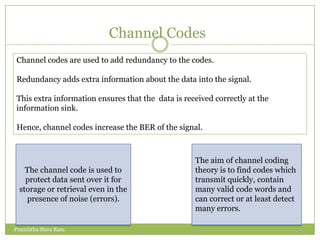
 Channel codes are used to add redundancy to the codes.

 Redundancy adds extra information about the data into the signal.

 This extra information ensures that the data is received correctly at the
 information sink.

 Hence, channel codes increase the BER of the signal.


                                                    The aim of channel coding
    The channel code is used to                     theory is to find codes which
    protect data sent over it for                   transmit quickly, contain
  storage or retrieval even in the                  many valid code words and
    presence of noise (errors).                     can correct or at least detect
                                                    many errors.

Pratishtha Shira Ram
Convolution Codes
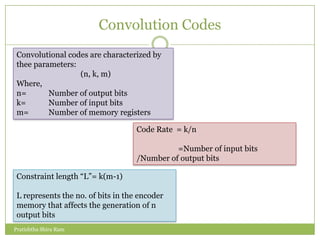
 Convolutional codes are characterized by
 thee parameters:
                  (n, k, m)
 Where,
 n=       Number of output bits
 k=       Number of input bits
 m=       Number of memory registers

                                    Code Rate = k/n

                                              =Number of input bits
                                    /Number of output bits

 Constraint length “L”= k(m-1)

 L represents the no. of bits in the encoder
 memory that affects the generation of n
 output bits
Pratishtha Shira Ram
An example: (2,1,4) Coder

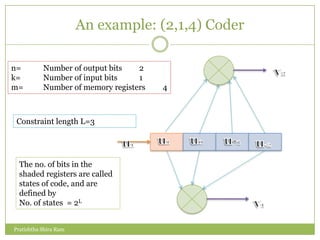
n=         Number of output bits   2
k=         Number of input bits    1
m=         Number of memory registers   4


 Constraint length L=3


  The no. of bits in the
  shaded registers are called
  states of code, and are
  defined by
  No. of states = 2L


Pratishtha Shira Ram
(2,1,4) Coder


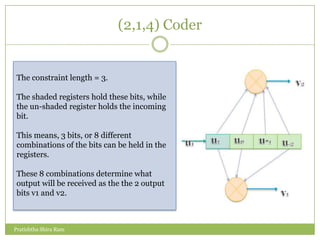
 The constraint length = 3.

 The shaded registers hold these bits, while
 the un-shaded register holds the incoming
 bit.

 This means, 3 bits, or 8 different
 combinations of the bits can be held in the
 registers.

 These 8 combinations determine what
 output will be received as the the 2 output
 bits v1 and v2.


Pratishtha Shira Ram
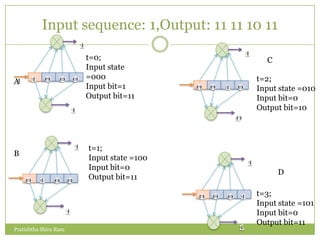
Input sequence: 1,Output: 11 11 10 11

                       t=0;                   C
                       Input state
                       =000                 t=2;
A
                       Input bit=1          Input state =010
                       Output bit=11        Input bit=0
                                            Output bit=10


                       t=1;
B
                       Input state =100
                       Input bit=0
                                                   D
                       Output bit=11

                                            t=3;
                                            Input state =101
                                            Input bit=0
                                            Output bit=11
Pratishtha Shira Ram
The convolution

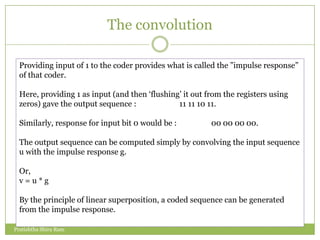
  Providing input of 1 to the coder provides what is called the ”impulse response”
  of that coder.

  Here, providing 1 as input (and then „flushing‟ it out from the registers using
  zeros) gave the output sequence :             11 11 10 11.

  Similarly, response for input bit 0 would be :          00 00 00 00.

  The output sequence can be computed simply by convolving the input sequence
  u with the impulse response g.

  Or,
  v=u*g

  By the principle of linear superposition, a coded sequence can be generated
  from the impulse response.

Pratishtha Shira Ram
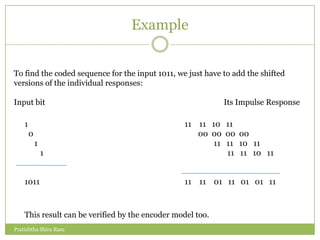
Example


To find the coded sequence for the input 1011, we just have to add the shifted
versions of the individual responses:

Input bit                                                   Its Impulse Response

    1                                            11 11 10 11
        0                                           00 00 00 00
            1                                           11 11 10 11
                1                                          11 11 10 11


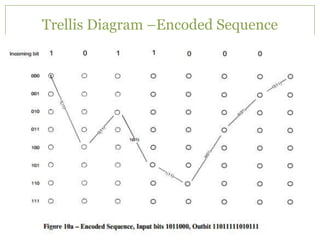
    1011                                         11 11 01 11 01 01 11


    This result can be verified by the encoder model too.
Pratishtha Shira Ram
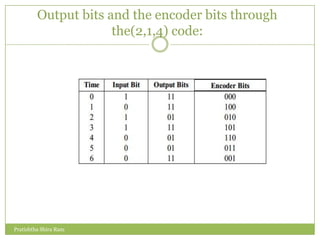
Output bits and the encoder bits through
                      the(2,1,4) code:


Pratishtha Shira Ram
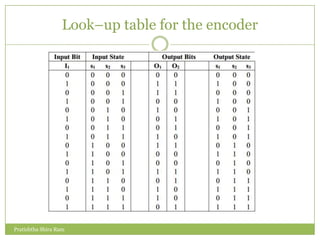
Look–up table for the encoder


Pratishtha Shira Ram
Understanding the encoder design

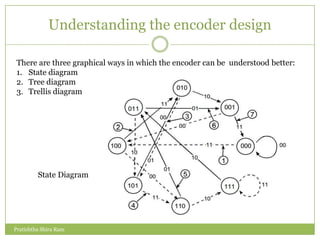
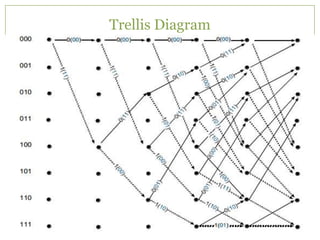
 There are three graphical ways in which the encoder can be understood better:
 1. State diagram
 2. Tree diagram
 3. Trellis diagram


         State Diagram


Pratishtha Shira Ram
Tree Diagram


Pratishtha Shira Ram
Trellis Diagram


Pratishtha Shira Ram
Trellis Diagram –Encoded Sequence


Pratishtha Shira Ram
Deconvolution of codes

There are 2 basic methods of deconvolution

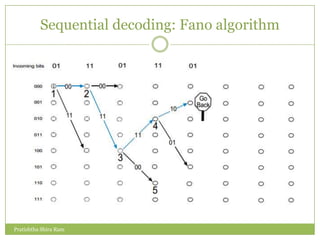
1. Sequential decoding: Fano algorithm
     - It allows both forward and backward movement through the Trellis diagram
   flow.
     -If instead of 11 11 01 11 01 01 11, the code 01 11 01 11 01 01 11 is
   received, the algorithm will take a start and tally with the outputs it finds on the
   way. If an output does not tally, it retraces its position back to the previous
   ambiguous decision.

2. Maximum –Likelihood decoding:               Viterbi algorithm
    -The viterbi decoder examines the entire received sequence of a given length.
    -The decoder then computes a metric for the path and then makes a decision
   based on it.
     -The path with the higher metric is kept, and the one with the lower one is
   discarded.
   - Generally the Hamming distance is used as the metric here.
Pratishtha Shira Ram
Sequential decoding: Fano algorithm


Pratishtha Shira Ram
Maximum –Likelihood decoding:
            Viterbi algorithm           [Step 1]


Pratishtha Shira Ram
Maximum –Likelihood decoding:
                Viterbi algorithm     [Step 2]


Pratishtha Shira Ram
Maximum –Likelihood decoding:
                 Viterbi algorithm     [Step 3]


Pratishtha Shira Ram
Maximum –Likelihood decoding:
                 Viterbi algorithm     [Step 4]


Pratishtha Shira Ram
Thank you!


Pratishtha Shira Ram

Convolution Codes

  • 1.
    Convolution Codes ADVANCED COMMUNICATION SYSTEMS PRATISHTHA SHIRA RAM SEMESTER 8 DEPT. OF ECE Pratishtha Shira Ram
  • 2.
    Codes Codes Source Channel Codes Codes Linear Convolution Block codes codes Pratishtha Shira Ram
  • 3.
    Codes (contd.) 1 Source Codes • The aim of source coding is to take the source data and make it smaller. 2 Channel Codes • The aim of channel coding theory is to find codes which transmit quickly, contain many valid code words and can correct or at least detect many errors. Pratishtha Shira Ram
  • 4.
    Channel Codes Channelcodes are used to add redundancy to the codes. Redundancy adds extra information about the data into the signal. This extra information ensures that the data is received correctly at the information sink. Hence, channel codes increase the BER of the signal. The aim of channel coding The channel code is used to theory is to find codes which protect data sent over it for transmit quickly, contain storage or retrieval even in the many valid code words and presence of noise (errors). can correct or at least detect many errors. Pratishtha Shira Ram
  • 5.
    Convolution Codes Convolutionalcodes are characterized by thee parameters: (n, k, m) Where, n= Number of output bits k= Number of input bits m= Number of memory registers Code Rate = k/n =Number of input bits /Number of output bits Constraint length “L”= k(m-1) L represents the no. of bits in the encoder memory that affects the generation of n output bits Pratishtha Shira Ram
  • 6.
    An example: (2,1,4)Coder n= Number of output bits 2 k= Number of input bits 1 m= Number of memory registers 4 Constraint length L=3 The no. of bits in the shaded registers are called states of code, and are defined by No. of states = 2L Pratishtha Shira Ram
  • 7.
    (2,1,4) Coder Theconstraint length = 3. The shaded registers hold these bits, while the un-shaded register holds the incoming bit. This means, 3 bits, or 8 different combinations of the bits can be held in the registers. These 8 combinations determine what output will be received as the the 2 output bits v1 and v2. Pratishtha Shira Ram
  • 8.
    Input sequence: 1,Output:11 11 10 11 t=0; C Input state =000 t=2; A Input bit=1 Input state =010 Output bit=11 Input bit=0 Output bit=10 t=1; B Input state =100 Input bit=0 D Output bit=11 t=3; Input state =101 Input bit=0 Output bit=11 Pratishtha Shira Ram
  • 9.
    The convolution Providing input of 1 to the coder provides what is called the ”impulse response” of that coder. Here, providing 1 as input (and then „flushing‟ it out from the registers using zeros) gave the output sequence : 11 11 10 11. Similarly, response for input bit 0 would be : 00 00 00 00. The output sequence can be computed simply by convolving the input sequence u with the impulse response g. Or, v=u*g By the principle of linear superposition, a coded sequence can be generated from the impulse response. Pratishtha Shira Ram
  • 10.
    Example To find thecoded sequence for the input 1011, we just have to add the shifted versions of the individual responses: Input bit Its Impulse Response 1 11 11 10 11 0 00 00 00 00 1 11 11 10 11 1 11 11 10 11 1011 11 11 01 11 01 01 11 This result can be verified by the encoder model too. Pratishtha Shira Ram
  • 11.
    Output bits andthe encoder bits through the(2,1,4) code: Pratishtha Shira Ram
  • 12.
    Look–up table forthe encoder Pratishtha Shira Ram
  • 13.
    Understanding the encoderdesign There are three graphical ways in which the encoder can be understood better: 1. State diagram 2. Tree diagram 3. Trellis diagram State Diagram Pratishtha Shira Ram
  • 14.
  • 15.
  • 16.
    Trellis Diagram –EncodedSequence Pratishtha Shira Ram
  • 17.
    Deconvolution of codes Thereare 2 basic methods of deconvolution 1. Sequential decoding: Fano algorithm - It allows both forward and backward movement through the Trellis diagram flow. -If instead of 11 11 01 11 01 01 11, the code 01 11 01 11 01 01 11 is received, the algorithm will take a start and tally with the outputs it finds on the way. If an output does not tally, it retraces its position back to the previous ambiguous decision. 2. Maximum –Likelihood decoding: Viterbi algorithm -The viterbi decoder examines the entire received sequence of a given length. -The decoder then computes a metric for the path and then makes a decision based on it. -The path with the higher metric is kept, and the one with the lower one is discarded. - Generally the Hamming distance is used as the metric here. Pratishtha Shira Ram
  • 18.
    Sequential decoding: Fanoalgorithm Pratishtha Shira Ram
  • 19.
    Maximum –Likelihood decoding: Viterbi algorithm [Step 1] Pratishtha Shira Ram
  • 20.
    Maximum –Likelihood decoding: Viterbi algorithm [Step 2] Pratishtha Shira Ram
  • 21.
    Maximum –Likelihood decoding: Viterbi algorithm [Step 3] Pratishtha Shira Ram
  • 22.
    Maximum –Likelihood decoding: Viterbi algorithm [Step 4] Pratishtha Shira Ram
  • 23.