The (Almost) PerfectTriageTool
Brent Muir – 2014 Version 1.0
 Benefits ofWinFE
 History ofWinFE
 BuildingWinFE
 “Live”Vs. Booting
 UsingWinFE:
 EncryptionTesting
 Imaging
▪ RAM
▪ HDs
 Triage
2
 Ability to boot on all x86 devices regardless of OS
 Windows
 Linux
 OSX (requires optical drive)
 RunsWindows compatible tools
 The price is right
 Cost ofWindows OS licence
 Highly customisable
3
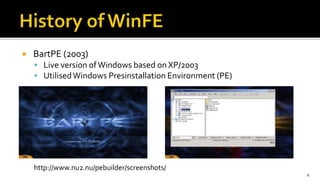
 BartPE (2003)
 Live version ofWindows based on XP/2003
 UtilisedWindows Presinstallation Environment (PE)
http://www.nu2.nu/pebuilder/screenshots/
4
 Microsoft (SysInternals) created first “official”
WinFE guide (2008)
 Highly modified OS
▪ No GUI interface, CMD based only
▪ Registry keys modified to not mount devices by default
▪ Basic functionality, required batch scripts or plenty of
DOS commands
▪ Based onVista, compatible with Windows 7
5
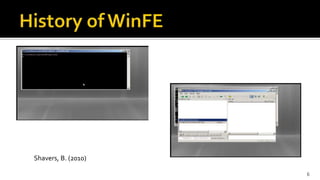
Shavers, B. (2010)
6
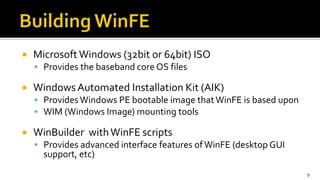
 WinBuilder -Windows PE building utility
 WinFE script created by Brett Shavers that
modified the same registry keys as SysInternals
instructions (2010)
 Retained GUI interface
 Write ProtectTool Management Console
(replacement Disk Manager)
7
http://winbuilder.net/screenshots
8
 Microsoft Windows (32bit or 64bit) ISO
 Provides the baseband core OS files
 Windows Automated Installation Kit (AIK)
 Provides Windows PE bootable image thatWinFE is based upon
 WIM (Windows Image) mounting tools
 WinBuilder withWinFE scripts
 Provides advanced interface features ofWinFE (desktop GUI
support, etc)
9
 Two modes for third-party applications:
 Run from RAM
▪ Stops end-users modifying installed programs
▪ Takes up more RAM when booting (if working with low-
specced PCs)
 Run from Disk
▪ Easier to update (no more recompiling the fullWIM)
10
11
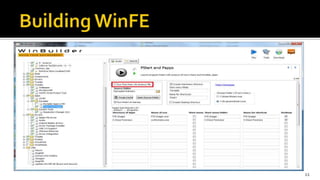
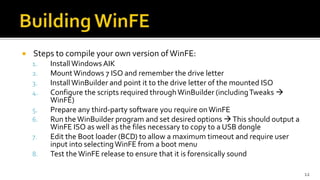
 Steps to compile your own version ofWinFE:
1. InstallWindows AIK
2. Mount Windows 7 ISO and remember the drive letter
3. InstallWinBuilder and point it to the drive letter of the mounted ISO
4. Configure the scripts required throughWinBuilder (includingTweaks 
WinFE)
5. Prepare any third-party software you require on WinFE
6. Run the WinBuilder program and set desired options This should output a
WinFE ISO as well as the files necessary to copy to a USB dongle
7. Edit the Boot loader (BCD) to allow a maximum timeout and require user
input into selectingWinFE from a boot menu
8. Test the WinFE release to ensure that it is forensically sound
12
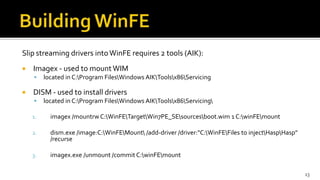
Slip streaming drivers intoWinFE requires 2 tools (AIK):
 Imagex - used to mount WIM
 located in C:Program FilesWindows AIKToolsx86Servicing
 DISM - used to install drivers
 located in C:Program FilesWindows AIKToolsx86Servicing
1. imagex /mountrw C:WinFETargetWin7PE_SEsourcesboot.wim 1 C:winFEmount
2. dism.exe /image:C:WinFEMount /add-driver /driver:"C:WinFEFiles to injectHaspHasp"
/recurse
3. imagex.exe /unmount /commit C:winFEmount
13
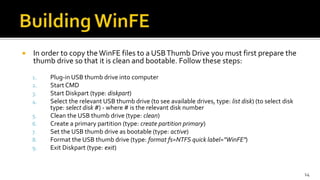
 In order to copy the WinFE files to a USBThumb Drive you must first prepare the
thumb drive so that it is clean and bootable. Follow these steps:
1. Plug-in USB thumb drive into computer
2. Start CMD
3. Start Diskpart (type: diskpart)
4. Select the relevant USB thumb drive (to see available drives, type: list disk) (to select disk
type: select disk #) - where # is the relevant disk number
5. Clean the USB thumb drive (type: clean)
6. Create a primary partition (type: create partition primary)
7. Set the USB thumb drive as bootable (type: active)
8. Format the USB thumb drive (type: format fs=NTFS quick label="WinFE")
9. Exit Diskpart (type: exit)
14
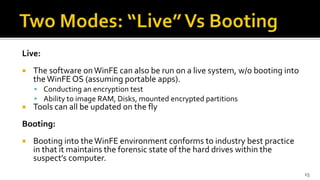
Live:
 The software onWinFE can also be run on a live system, w/o booting into
theWinFEOS (assuming portable apps).
 Conducting an encryption test
 Ability to image RAM, Disks, mounted encrypted partitions
 Tools can all be updated on the fly
Booting:
 Booting into theWinFE environment conforms to industry best practice
in that it maintains the forensic state of the hard drives within the
suspect’s computer.
15
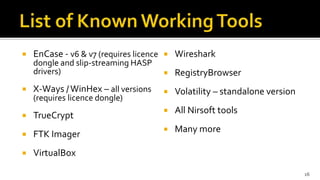
 EnCase - v6 & v7 (requires licence
dongle and slip-streaming HASP
drivers)
 X-Ways /WinHex – all versions
(requires licence dongle)
 TrueCrypt
 FTK Imager
 VirtualBox
 Wireshark
 RegistryBrowser
 Volatility – standalone version
 All Nirsoft tools
 Many more
16
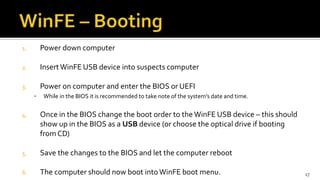
1. Power down computer
2. InsertWinFE USB device into suspects computer
3. Power on computer and enter the BIOS or UEFI
 While in the BIOS it is recommended to take note of the system’s date and time.
4. Once in the BIOS change the boot order to the WinFE USB device – this should
show up in the BIOS as a USB device (or choose the optical drive if booting
from CD)
5. Save the changes to the BIOS and let the computer reboot
6. The computer should now boot intoWinFE boot menu. 17
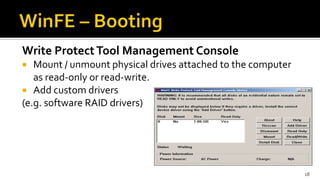
Write ProtectTool Management Console
 Mount / unmount physical drives attached to the computer
as read-only or read-write.
 Add custom drivers
(e.g. software RAID drivers)
18
19
 EncryptionTest
 HD / RAM Imaging
 Triage
20
 Windows
 Linux
 OSX
21
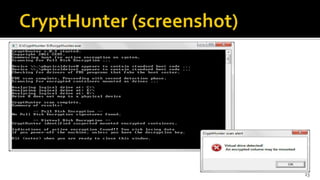
WINDOWS OS – CryptHunter (LE only)
1. Plug in the WinFE USB thumb drive into the suspect's computer
2. The WinFE USB drive should now be visible in Explorer (My
Computer). Browse to the directory titled "CryptHunter" and
double-click on the file called "crypthunter". This will begin the
encryption test.
3. If anything of note is discovered a pop-up box will appear
warning that encryption may be present.
22
23
LINUX OSes – quick and dirty
 Method 1 –Terminal
1. Open the terminal (console / konsole) and type
mount and hit enter (return)
2. This command will list all currently mounted drives
on the computer, look for the word "crypt“
24
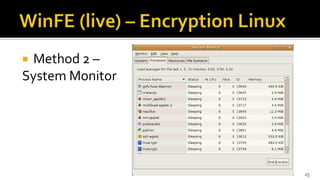
 Method 2 –
System Monitor
25
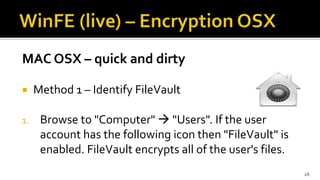
MAC OSX – quick and dirty
 Method 1 – Identify FileVault
1. Browse to "Computer"  "Users". If the user
account has the following icon then "FileVault" is
enabled. FileVault encrypts all of the user's files.
26
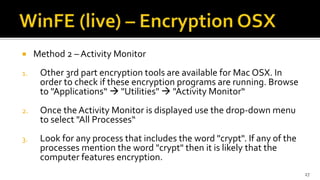
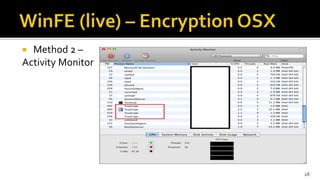
 Method 2 – Activity Monitor
1. Other 3rd part encryption tools are available for Mac OSX. In
order to check if these encryption programs are running. Browse
to "Applications“  "Utilities"  "Activity Monitor“
2. Once the Activity Monitor is displayed use the drop-down menu
to select "All Processes“
3. Look for any process that includes the word "crypt". If any of the
processes mention the word "crypt" then it is likely that the
computer features encryption.
27
 Method 2 –
Activity Monitor
28
RAM:
 DumpIt
 Simple executable, puts output in same directory as EXE
 Has some issues with RAM larger than 8GB
 WinPMEM
 CMD based
 Supports RAM larger than 8GB
 Supports RAW & Crashdump formats
 FTK Imager
 GUI version only
 Supports RAW acquisition as well as Pagefile.sys & Hiberfil.sys
 Larger footprint than DumpIt & WinPMEM
HD:
 FTK Imager
29
RAM:
 FMEM
 Creates kernel mirror driver
 Then use dd commands to capture
HD:
 DD
 Built-in
 FTK Imager CLI
 Debian
 Ubuntu (x32 & x64)
 Fedora (x32 & x64)
30
RAM:
 OSXPMEM
 Supports up to and including 10.9.x
 Creates kernel mirror driver (must be extracted onto local
machine to run or from HFS+/exFAT partition)
 Supports Raw, Mach-O, and ELF formats
1. copy OSXPMem.tar.gz to local directory
2. tar xvf OSXPMem.tar.gz
3. ./osxpmem -h to give help
4. ./osxpmem memory.dump
31
HD:
 FTK Imager for Mac
 CLI only, no GUI
 Needs to be copied to local machine to run (or on
HFS+/exFAT partition)
 Mac OSX Forensic Imager
 Needs to be copied to local machine to run (or on
HFS+/exFAT partition)
32
1. Connect an external hard drive (via USB) to the
suspect's computer
2. Open "WinFEWrite ProtectTool Management
Console " and mount this new drive as read/write
 NOTE – if this is the first drive you are mounting in WinFE it will
be given the drive letter “C”
 This drive will now be visible inWindows Explorer
3. Open FTK Imager and image normally
33
 Even w/o X-Ways or EnCase dongles there
are a number of tools to facilitate triage of
devices
 Apple Bootcamp script allows HFS+
partitions to be seen throughWinFE w/o third
party tools
34
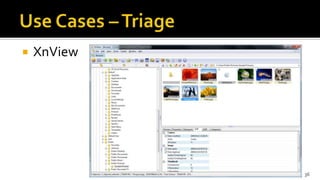
 XnView:
 Graphic files
 Recursively look at directories
 Tag files  create reports
35
 XnView
36
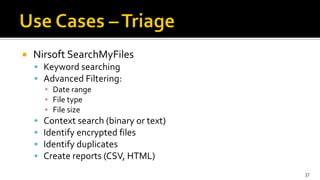
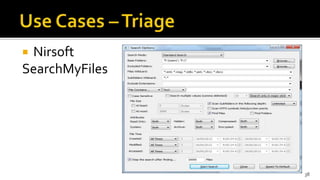
 Nirsoft SearchMyFiles
 Keyword searching
 Advanced Filtering:
▪ Date range
▪ File type
▪ File size
 Context search (binary or text)
 Identify encrypted files
 Identify duplicates
 Create reports (CSV, HTML)
37
 Nirsoft
SearchMyFiles
38
 Email viewing programs:
 MiTec MailView
▪ DBX, MBX, EML,Thunderbird DB
 Kernel Exchange EDBViewer
▪ EDB, STM
 Kernel OSTViewer
▪ OST
 Kernel Outlook PSTViewer
▪ PST
 Windows MBOXViewer
▪ MBOX
39
 SQLite
 SQLite DB Browser
 SQLiteQ
 Microsoft ESE/EDB/JET Blue DB files
 Nirsoft ESEDatabaseView
40
 Web browser history
 Nirsoft BrowsingHistoryView
▪ IE (including 10/11), Firefox, Chrome, Safari
 Windows Registry
 LockAnd Code RegistryBrowser
▪ Mount the suspect's drive as read-only usingWrite Protect
Tool first
41
42
 Larson,T. (2008) “HowTo BuildWindows FEWithThe
Windows Preinstallation Environment 2.1”, SysInternals,
Microsoft Law Enforcement Portal
 Shavers, B. (2010) “The (Nearly) Perfect Forensic Boot CD”,
URL: http://www.forensicfocus.com/downloads/WinFE.pdf
43
 CryptHunter (LE only) - http://www.cert.org/digital-intelligence/tools/crypthunter.cfm?
 Kernel Data Recovery Tools - http://www.nucleustechnologies.com/
 MiTeC (MailView, SQLiteQ) - http://www.mitec.cz
 Nirsoft Suite - http://nirsoft.net/
 RegistryBrowser - https://lockandcode.com/software/registry_browser
 SQLite Database Browser - http://sourceforge.net/projects/sqlitebrowser/
 WinBuilder - http://reboot.pro/files/file/4-winbuilder/
 Windows Assessment and Deployment Kit (Windows ADK) - http://www.microsoft.com/en-us/download/details.aspx?id=39982&751be11f-
ede8-5a0c-058c-2ee190a24fa6=True
 Windows Automated Installation Kit (Windows AIK) - http://www.microsoft.com/en-au/download/details.aspx?id=5753
 Windows MBOX Viewer - http://sourceforge.net/projects/mbox-viewer/
 WinFE Blog (Brett Shavers) - http://winfe.wordpress.com/
 XnView - http://www.xnview.com/en/ 44

WinFE: The (Almost) Perfect Triage Tool

  • 1.
    The (Almost) PerfectTriageTool BrentMuir – 2014 Version 1.0
  • 2.
     Benefits ofWinFE History ofWinFE  BuildingWinFE  “Live”Vs. Booting  UsingWinFE:  EncryptionTesting  Imaging ▪ RAM ▪ HDs  Triage 2
  • 3.
     Ability toboot on all x86 devices regardless of OS  Windows  Linux  OSX (requires optical drive)  RunsWindows compatible tools  The price is right  Cost ofWindows OS licence  Highly customisable 3
  • 4.
     BartPE (2003) Live version ofWindows based on XP/2003  UtilisedWindows Presinstallation Environment (PE) http://www.nu2.nu/pebuilder/screenshots/ 4
  • 5.
     Microsoft (SysInternals)created first “official” WinFE guide (2008)  Highly modified OS ▪ No GUI interface, CMD based only ▪ Registry keys modified to not mount devices by default ▪ Basic functionality, required batch scripts or plenty of DOS commands ▪ Based onVista, compatible with Windows 7 5
  • 6.
  • 7.
     WinBuilder -WindowsPE building utility  WinFE script created by Brett Shavers that modified the same registry keys as SysInternals instructions (2010)  Retained GUI interface  Write ProtectTool Management Console (replacement Disk Manager) 7
  • 8.
  • 9.
     Microsoft Windows(32bit or 64bit) ISO  Provides the baseband core OS files  Windows Automated Installation Kit (AIK)  Provides Windows PE bootable image thatWinFE is based upon  WIM (Windows Image) mounting tools  WinBuilder withWinFE scripts  Provides advanced interface features ofWinFE (desktop GUI support, etc) 9
  • 10.
     Two modesfor third-party applications:  Run from RAM ▪ Stops end-users modifying installed programs ▪ Takes up more RAM when booting (if working with low- specced PCs)  Run from Disk ▪ Easier to update (no more recompiling the fullWIM) 10
  • 11.
  • 12.
     Steps tocompile your own version ofWinFE: 1. InstallWindows AIK 2. Mount Windows 7 ISO and remember the drive letter 3. InstallWinBuilder and point it to the drive letter of the mounted ISO 4. Configure the scripts required throughWinBuilder (includingTweaks  WinFE) 5. Prepare any third-party software you require on WinFE 6. Run the WinBuilder program and set desired options This should output a WinFE ISO as well as the files necessary to copy to a USB dongle 7. Edit the Boot loader (BCD) to allow a maximum timeout and require user input into selectingWinFE from a boot menu 8. Test the WinFE release to ensure that it is forensically sound 12
  • 13.
    Slip streaming driversintoWinFE requires 2 tools (AIK):  Imagex - used to mount WIM  located in C:Program FilesWindows AIKToolsx86Servicing  DISM - used to install drivers  located in C:Program FilesWindows AIKToolsx86Servicing 1. imagex /mountrw C:WinFETargetWin7PE_SEsourcesboot.wim 1 C:winFEmount 2. dism.exe /image:C:WinFEMount /add-driver /driver:"C:WinFEFiles to injectHaspHasp" /recurse 3. imagex.exe /unmount /commit C:winFEmount 13
  • 14.
     In orderto copy the WinFE files to a USBThumb Drive you must first prepare the thumb drive so that it is clean and bootable. Follow these steps: 1. Plug-in USB thumb drive into computer 2. Start CMD 3. Start Diskpart (type: diskpart) 4. Select the relevant USB thumb drive (to see available drives, type: list disk) (to select disk type: select disk #) - where # is the relevant disk number 5. Clean the USB thumb drive (type: clean) 6. Create a primary partition (type: create partition primary) 7. Set the USB thumb drive as bootable (type: active) 8. Format the USB thumb drive (type: format fs=NTFS quick label="WinFE") 9. Exit Diskpart (type: exit) 14
  • 15.
    Live:  The softwareonWinFE can also be run on a live system, w/o booting into theWinFEOS (assuming portable apps).  Conducting an encryption test  Ability to image RAM, Disks, mounted encrypted partitions  Tools can all be updated on the fly Booting:  Booting into theWinFE environment conforms to industry best practice in that it maintains the forensic state of the hard drives within the suspect’s computer. 15
  • 16.
     EnCase -v6 & v7 (requires licence dongle and slip-streaming HASP drivers)  X-Ways /WinHex – all versions (requires licence dongle)  TrueCrypt  FTK Imager  VirtualBox  Wireshark  RegistryBrowser  Volatility – standalone version  All Nirsoft tools  Many more 16
  • 17.
    1. Power downcomputer 2. InsertWinFE USB device into suspects computer 3. Power on computer and enter the BIOS or UEFI  While in the BIOS it is recommended to take note of the system’s date and time. 4. Once in the BIOS change the boot order to the WinFE USB device – this should show up in the BIOS as a USB device (or choose the optical drive if booting from CD) 5. Save the changes to the BIOS and let the computer reboot 6. The computer should now boot intoWinFE boot menu. 17
  • 18.
    Write ProtectTool ManagementConsole  Mount / unmount physical drives attached to the computer as read-only or read-write.  Add custom drivers (e.g. software RAID drivers) 18
  • 19.
  • 20.
     EncryptionTest  HD/ RAM Imaging  Triage 20
  • 21.
  • 22.
    WINDOWS OS –CryptHunter (LE only) 1. Plug in the WinFE USB thumb drive into the suspect's computer 2. The WinFE USB drive should now be visible in Explorer (My Computer). Browse to the directory titled "CryptHunter" and double-click on the file called "crypthunter". This will begin the encryption test. 3. If anything of note is discovered a pop-up box will appear warning that encryption may be present. 22
  • 23.
  • 24.
    LINUX OSes –quick and dirty  Method 1 –Terminal 1. Open the terminal (console / konsole) and type mount and hit enter (return) 2. This command will list all currently mounted drives on the computer, look for the word "crypt“ 24
  • 25.
     Method 2– System Monitor 25
  • 26.
    MAC OSX –quick and dirty  Method 1 – Identify FileVault 1. Browse to "Computer"  "Users". If the user account has the following icon then "FileVault" is enabled. FileVault encrypts all of the user's files. 26
  • 27.
     Method 2– Activity Monitor 1. Other 3rd part encryption tools are available for Mac OSX. In order to check if these encryption programs are running. Browse to "Applications“  "Utilities"  "Activity Monitor“ 2. Once the Activity Monitor is displayed use the drop-down menu to select "All Processes“ 3. Look for any process that includes the word "crypt". If any of the processes mention the word "crypt" then it is likely that the computer features encryption. 27
  • 28.
     Method 2– Activity Monitor 28
  • 29.
    RAM:  DumpIt  Simpleexecutable, puts output in same directory as EXE  Has some issues with RAM larger than 8GB  WinPMEM  CMD based  Supports RAM larger than 8GB  Supports RAW & Crashdump formats  FTK Imager  GUI version only  Supports RAW acquisition as well as Pagefile.sys & Hiberfil.sys  Larger footprint than DumpIt & WinPMEM HD:  FTK Imager 29
  • 30.
    RAM:  FMEM  Createskernel mirror driver  Then use dd commands to capture HD:  DD  Built-in  FTK Imager CLI  Debian  Ubuntu (x32 & x64)  Fedora (x32 & x64) 30
  • 31.
    RAM:  OSXPMEM  Supportsup to and including 10.9.x  Creates kernel mirror driver (must be extracted onto local machine to run or from HFS+/exFAT partition)  Supports Raw, Mach-O, and ELF formats 1. copy OSXPMem.tar.gz to local directory 2. tar xvf OSXPMem.tar.gz 3. ./osxpmem -h to give help 4. ./osxpmem memory.dump 31
  • 32.
    HD:  FTK Imagerfor Mac  CLI only, no GUI  Needs to be copied to local machine to run (or on HFS+/exFAT partition)  Mac OSX Forensic Imager  Needs to be copied to local machine to run (or on HFS+/exFAT partition) 32
  • 33.
    1. Connect anexternal hard drive (via USB) to the suspect's computer 2. Open "WinFEWrite ProtectTool Management Console " and mount this new drive as read/write  NOTE – if this is the first drive you are mounting in WinFE it will be given the drive letter “C”  This drive will now be visible inWindows Explorer 3. Open FTK Imager and image normally 33
  • 34.
     Even w/oX-Ways or EnCase dongles there are a number of tools to facilitate triage of devices  Apple Bootcamp script allows HFS+ partitions to be seen throughWinFE w/o third party tools 34
  • 35.
     XnView:  Graphicfiles  Recursively look at directories  Tag files  create reports 35
  • 36.
  • 37.
     Nirsoft SearchMyFiles Keyword searching  Advanced Filtering: ▪ Date range ▪ File type ▪ File size  Context search (binary or text)  Identify encrypted files  Identify duplicates  Create reports (CSV, HTML) 37
  • 38.
  • 39.
     Email viewingprograms:  MiTec MailView ▪ DBX, MBX, EML,Thunderbird DB  Kernel Exchange EDBViewer ▪ EDB, STM  Kernel OSTViewer ▪ OST  Kernel Outlook PSTViewer ▪ PST  Windows MBOXViewer ▪ MBOX 39
  • 40.
     SQLite  SQLiteDB Browser  SQLiteQ  Microsoft ESE/EDB/JET Blue DB files  Nirsoft ESEDatabaseView 40
  • 41.
     Web browserhistory  Nirsoft BrowsingHistoryView ▪ IE (including 10/11), Firefox, Chrome, Safari  Windows Registry  LockAnd Code RegistryBrowser ▪ Mount the suspect's drive as read-only usingWrite Protect Tool first 41
  • 42.
  • 43.
     Larson,T. (2008)“HowTo BuildWindows FEWithThe Windows Preinstallation Environment 2.1”, SysInternals, Microsoft Law Enforcement Portal  Shavers, B. (2010) “The (Nearly) Perfect Forensic Boot CD”, URL: http://www.forensicfocus.com/downloads/WinFE.pdf 43
  • 44.
     CryptHunter (LEonly) - http://www.cert.org/digital-intelligence/tools/crypthunter.cfm?  Kernel Data Recovery Tools - http://www.nucleustechnologies.com/  MiTeC (MailView, SQLiteQ) - http://www.mitec.cz  Nirsoft Suite - http://nirsoft.net/  RegistryBrowser - https://lockandcode.com/software/registry_browser  SQLite Database Browser - http://sourceforge.net/projects/sqlitebrowser/  WinBuilder - http://reboot.pro/files/file/4-winbuilder/  Windows Assessment and Deployment Kit (Windows ADK) - http://www.microsoft.com/en-us/download/details.aspx?id=39982&751be11f- ede8-5a0c-058c-2ee190a24fa6=True  Windows Automated Installation Kit (Windows AIK) - http://www.microsoft.com/en-au/download/details.aspx?id=5753  Windows MBOX Viewer - http://sourceforge.net/projects/mbox-viewer/  WinFE Blog (Brett Shavers) - http://winfe.wordpress.com/  XnView - http://www.xnview.com/en/ 44

Editor's Notes

  • #5 Very basic: No write-protection of devices No Windows Explorer - all tools were 3rd party
  • #6 No GUI but could run GUI software (for example FTK Imager or XWF)
  • #10 Windows 8/8.1 WinFE require Windows Assessment and Deployment Kit (Windows ADK) http://www.microsoft.com/en-us/download/details.aspx?id=39982&751be11f-ede8-5a0c-058c-2ee190a24fa6=True
  • #14 Example of slip-streaming the HASP dongle drivers (for EnCase)
  • #17 Dependant on host PC resources, there is the ability to boot the suspect’s PC as a forensically sound VM with VirtualBox (requires 64bit WinFE, lots of RAM and MIP to mount physical disk) mount image write-cached function)
  • #18 If this menu is not displayed then the computer is trying to boot into another OS  pull the power cord!
  • #23 If you are LE I recommend that you get access to the US CERT program CryptHunter (free): Small footprint, able to detect many encryption programs as well as boot sector abnormalities Supports: BestCrypt, DriveCrypt, Sophos SafeGaurd, Paragon Encrypted Disk, PGPDisk, TrueCrypt, BitLocker
  • #24 If non-LE (or CryptHunter is not available) it is useful to check Task Manager for running processes
  • #26 Can also look at running processes to determine if any encryption programs are running
  • #27 Latest version of FileVault allows for full disk encryption and therefore the symbol may not be present on the user directory
  • #30 Windows imaging HDs live, there is FTK Imager (including CLI), Cygwin DD, also EnCase acquisition / imager, XWF if dongle present
  • #42 As well as Nirsoft Opera History View, cache view, etc
  • #43 Additional tools: Cygwin (dd, NetCat) Nirsoft live password recovery tools Wireshark