Memory
Forensics
THE THEORY
Forensics
Forensic science is the scientific method of
gathering and examining information about the
past.
Computer Forensics
 Is to examine digital media in a forensically sound manner
with the aim of
Identifying
Preserving
Recovering
Analyzing
And presenting
Facts
and Opinions
about the digital information
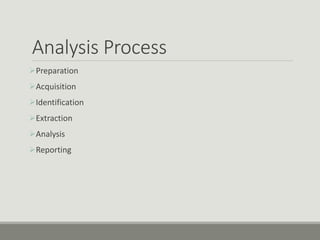
Analysis Process
Preparation
Acquisition
Identification
Extraction
Analysis
Reporting
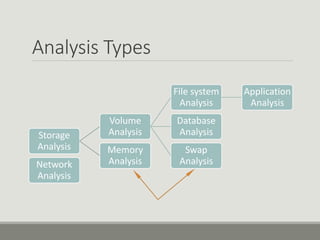
Analysis Types
Storage
Analysis
Volume
Analysis
File system
Analysis
Application
Analysis
Database
Analysis
Swap
Analysis
Memory
AnalysisNetwork
Analysis
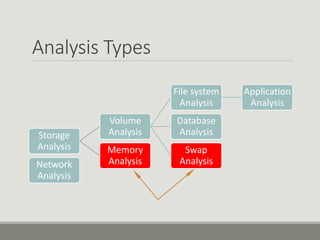
Analysis Types
Storage
Analysis
Volume
Analysis
File system
Analysis
Application
Analysis
Database
Analysis
Swap
Analysis
Memory
AnalysisNetwork
Analysis
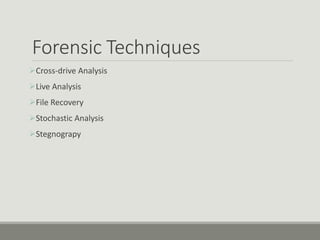
Forensic Techniques
Cross-drive Analysis
Live Analysis
File Recovery
Stochastic Analysis
Stegnograpy
Sources
Physical Disks
Packet Capture
Swap/Pagefile
Hibernation File
Firmware
Volatile Memory
Sources
Physical Disks
Packet Capture
Swap/Pagefile
Hibernation File
Firmware
Volatile Memory
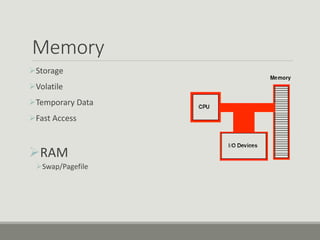
Memory
Storage
Volatile
Temporary Data
Fast Access
RAM
Swap/Pagefile
Memory Acquisition
Acquisition of Volatile Memory Contents (RAM) bit-by-bit to a Non-
Volatile Storage (Image File).
Hardware Based Tools
WindowsSCOPE CaptureGUARD PCIe
Goldfish (Firewire/ Mac)
Software Based Tools
Memoryze
KntDD
FTKImager
LiME
OSXPMem
…
 Requires Kernel Mode/Physical Access
Real(Physical) Memory
Actual RAM Hardware
Shared
◦ Devices
◦ Kernel
◦ Drivers
◦ Processes
System wide address space
◦ Defined by H/W capability
Managed by OS Memory Manager
Virtual Memory
 An abstraction of Real Memory
 Per-process Isolation
 Shared if required
 Shared by process
Code
Data
 Per-process address space
User Mode
Kernel Mode
Managed by Process
Virtual  Real Mapping
Conversion of Virtual Address to Read Address
◦ RAM
◦ Swap/Pagefile
Page : Fixed size allocation unit
◦ Virtual Memory
◦ Real Memory
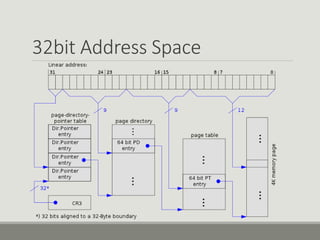
Page Table
◦ A table to convert virtual page to real page
Page Directory
◦ A list of page tables
◦ Level2 Pages
32bit Address Space
Forensic Tools
0th Generation
◦ Before 2004
◦ ‘strings’
◦ ‘grep’
1st Generation
◦ 2004-2005
◦ Tools for structured analysis
◦ Parsing OS structures
◦ Crash dump analysis
Forensic Tools
2nd Generation
◦ 2005-2010
◦ Generic, automated tools
◦ Multiple OS support
◦ Volatality
◦ Rekall
3rd Generation
◦ 2010 & Later
◦ Emphasis on Visualization
◦ Cloud/VM based
◦ MoonSols LiveCloudKd
◦ Microsoft LiveKd
Volatility
A advanced memory forensics framework.
Written in python.
Follows modular plug-in architecture.
Supports many systems and architectures.
Open source.
Current release 2.4.1
Community plugins to automate volatility.
Dump formats
Also known as AddressSpaces in volatility
Define organization of memory content from H/W perspective
◦ Virtual  Real Mapping
◦ Location of PDE
Supported
◦ intel (x86)
◦ amd64(x64)
◦ Crashbmp (Window Kernel Crash Dump)
◦ elfcoredump(Linux Core Dump)
◦ MachO (Mac OSX)
◦ vmem (VMWare/Vbox)
Profiles
Organization/Location of memory content from Operating System
perspective.
Locations of important Objects
◦ KDBG
◦ _KPROCESS
◦ _EPROCESS
◦ PTE
◦ SSDT
◦ IDT
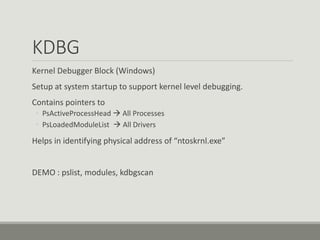
KDBG
Kernel Debugger Block (Windows)
Setup at system startup to support kernel level debugging.
Contains pointers to
◦ PsActiveProcessHead  All Processes
◦ PsLoadedModuleList  All Drivers
Helps in identifying physical address of “ntoskrnl.exe”
DEMO : pslist, modules, kdbgscan
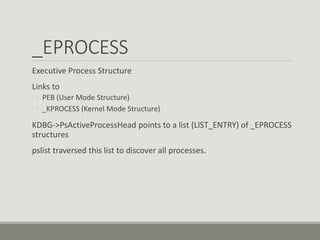
_EPROCESS
Executive Process Structure
Links to
◦ PEB (User Mode Structure)
◦ _KPROCESS (Kernel Mode Structure)
KDBG->PsActiveProcessHead points to a list (LIST_ENTRY) of _EPROCESS
structures
pslist traversed this list to discover all processes.
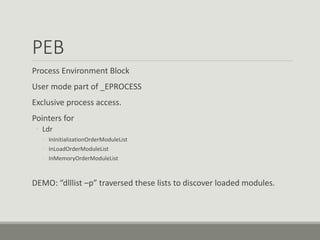
PEB
Process Environment Block
User mode part of _EPROCESS
Exclusive process access.
Pointers for
◦ Ldr
◦ InInitializationOrderModuleList
◦ InLoadOrderModuleList
◦ InMemoryOrderModuleList
DEMO: “dlllist –p” traversed these lists to discover loaded modules.
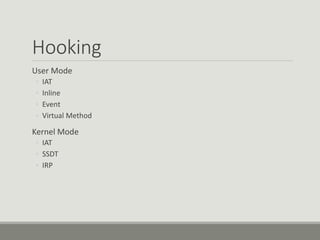
Hooking
User Mode
◦ IAT
◦ Inline
◦ Event
◦ Virtual Method
Kernel Mode
◦ IAT
◦ SSDT
◦ IRP
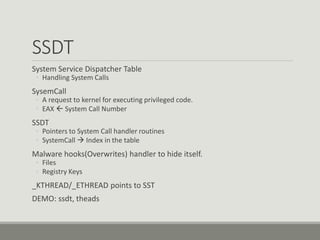
SSDT
System Service Dispatcher Table
◦ Handling System Calls
SysemCall
◦ A request to kernel for executing privileged code.
◦ EAX  System Call Number
SSDT
◦ Pointers to System Call handler routines
◦ SystemCall  Index in the table
Malware hooks(Overwrites) handler to hide itself.
◦ Files
◦ Registry Keys
_KTHREAD/_ETHREAD points to SST
DEMO: ssdt, theads
IDT
Interrupt Descriptor Table
◦ List of interrupt handlers
◦ Interrupt number  index
User Callable interrupts
◦ Int3
◦ Int4
◦ …
Malwares hook(overwrite) to handle interrupts themselves
◦ Intercept debugger breakpoints
DEMO: idt
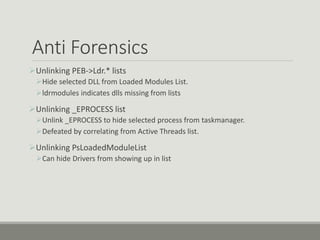
Anti Forensics
Unlinking PEB->Ldr.* lists
Hide selected DLL from Loaded Modules List.
ldrmodules indicates dlls missing from lists
Unlinking _EPROCESS list
Unlink _EPROCESS to hide selected process from taskmanager.
Defeated by correlating from Active Threads list.
Unlinking PsLoadedModuleList
Can hide Drivers from showing up in list
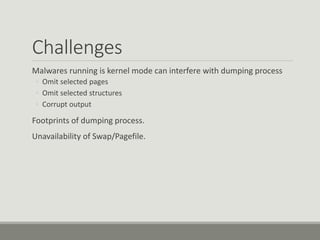
Challenges
Malwares running is kernel mode can interfere with dumping process
◦ Omit selected pages
◦ Omit selected structures
◦ Corrupt output
Footprints of dumping process.
Unavailability of Swap/Pagefile.
THATSITFORNOW

Memory forensics

Editor's Notes

  • #7 Relevent
  • #10 Interested in
  • #23 DEMO: pslist
  • #26 KeServiceDescriptorTable KeServiceDescriptorTableShadow
  • #28 DEMO: ldrmodules, psxview