BIOS - UEFI/Legacy
Faizan Mushtaq , Gurleen Kaur
B.Tech Computer Science
CT Group of Institutions,
Jalandhar
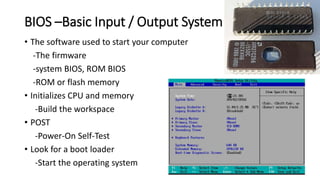
BIOS –Basic Input / Output System
• The software used to start your computer
-The firmware
-system BIOS, ROM BIOS
-ROM or flash memory
• Initializes CPU and memory
-Build the workspace
• POST
-Power-On Self-Test
• Look for a boot loader
-Start the operating system
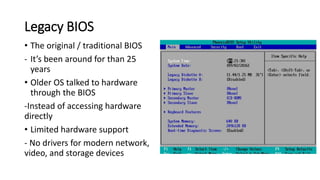
Legacy BIOS
• The original / traditional BIOS
- It’s been around for than 25
years
• Older OS talked to hardware
through the BIOS
-Instead of accessing hardware
directly
• Limited hardware support
- No drivers for modern network,
video, and storage devices
Why do we need something new?
• BIOS is already more than 25 years old
• BIOS has not advances with the latest PC Technology in market
• BIOS has Limitations:
-Can only boot from HDD of 2.1TB or less
-MBR Partition used
UEFI-Unified Extensible Firmware Interface
• Started late 90’s by INTEL
• Released October 2002 by INTEL for Itanium x64 Systems
• 2005 UEFI Forum is born and take care about UEFI
• UEFI is a Firmware Specification, NOT a Firmware Implementation!
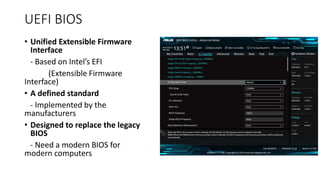
UEFI BIOS
• Unified Extensible Firmware
Interface
- Based on Intel’s EFI
(Extensible Firmware
Interface)
• A defined standard
- Implemented by the
manufacturers
• Designed to replace the legacy
BIOS
- Need a modern BIOS for
modern computers
UEEFI advantages
• Boot from large (>2.2 TB)
GUID partition table (GPT) disks
-Also supports FAT and removable media
• Includes a pre-boot environment
-This isn’t an Operating System
-Has its own shell, drivers, and applications
-Browse the Internet, backup a storage drive
-Remote diagnostics, even without an OS
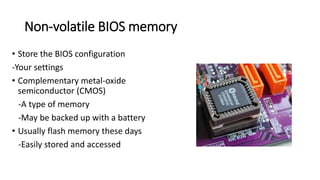
Non-volatile BIOS memory
• Store the BIOS configuration
-Your settings
• Complementary metal-oxide
semiconductor (CMOS)
-A type of memory
-May be backed up with a battery
• Usually flash memory these days
-Easily stored and accessed
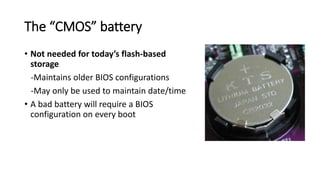
The “CMOS” battery
• Not needed for today’s flash-based
storage
-Maintains older BIOS configurations
-May only be used to maintain date/time
• A bad battery will require a BIOS
configuration on every boot
How to get into BIOS setting?
(Legacy / UEFI)
• Launching the system Setup
Secret Button(s)
Esc, F1 ,F2, del e.t.c
• Microsoft Virtual PC (Win 7 ), Hyper-v ( Win 8 )
-https://www.Microsoft.com/hyper-v
-https://support.Microsoft.com/en-us/kb/958559
• Vmware Workstation Player
-http://www.vmware.com/products/player
• But not Virtual Box
-http://www.virtualbox.org
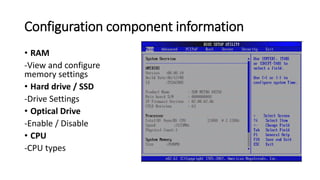
Configuration component information
• RAM
-View and configure
memory settings
• Hard drive / SSD
-Drive Settings
• Optical Drive
-Enable / Disable
• CPU
-CPU types
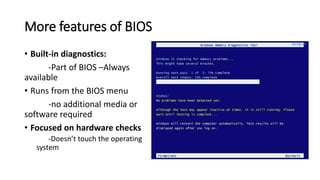
More features of BIOS
• Built-in diagnostics:
-Part of BIOS –Always
available
• Runs from the BIOS menu
-no additional media or
software required
• Focused on hardware checks
-Doesn’t touch the operating
system
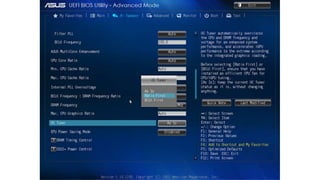
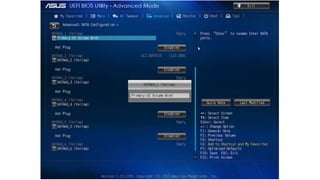
UEFI BIOS
BIOS Security
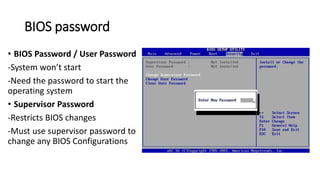
BIOS password
• BIOS Password / User Password
-System won’t start
-Need the password to start the
operating system
• Supervisor Password
-Restricts BIOS changes
-Must use supervisor password to
change any BIOS Configurations
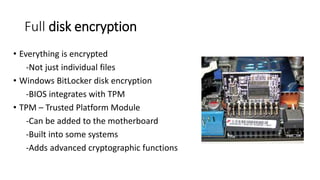
Full disk encryption
• Everything is encrypted
-Not just individual files
• Windows BitLocker disk encryption
-BIOS integrates with TPM
• TPM – Trusted Platform Module
-Can be added to the motherboard
-Built into some systems
-Adds advanced cryptographic functions
LoJack for Laptops
• Originally Called CompuTrace
• Built into the BIOS
-Software installed into the OS
-Reinstalls itself if removed or
new storage drive installed
• “Phone home” function
- Provides location information
• Theft mode
-Remotely lock the laptop
and/or delete files
-Forces a start-up password
Secure Boot
• Malicious software can “own” your system
-Malicious drivers or OS software's
• Secure Boot
-Part of the UEFI specification
• Digitally sign known-good software
-cryptographically secure
-Software won’t run without the proper signature
• Supports in many different Operating Systems
-Windows 8,8.1,10, Windows Server 2012 and 2012 R2
-Linux Fedora, Open SUSE, Ubuntu
Advantages of UEFI over BIOS
• Support for HDD partitions larger than 2TB
• Supports more than 4 partitions on a drive
• Fast Booting
• Efficient Power and System Management
• Robust Reliability and fault management
• Backward compatibility
• Mimics BIOS – Legacy Mode
How to update your BIOS?
• Step 1: Identify your motherboard.
• Step 2: Visit your motherboard's website.
• Step 3: Download the latest BIOS (uefi)
• Step 4: Use your USB stick.
• Step 5: Reboot and enter your BIOS (UEFI)
• Step 6: Execute the BIOS update.

Bios vs uefi

  • 1.
    BIOS - UEFI/Legacy FaizanMushtaq , Gurleen Kaur B.Tech Computer Science CT Group of Institutions, Jalandhar
  • 2.
    BIOS –Basic Input/ Output System • The software used to start your computer -The firmware -system BIOS, ROM BIOS -ROM or flash memory • Initializes CPU and memory -Build the workspace • POST -Power-On Self-Test • Look for a boot loader -Start the operating system
  • 3.
    Legacy BIOS • Theoriginal / traditional BIOS - It’s been around for than 25 years • Older OS talked to hardware through the BIOS -Instead of accessing hardware directly • Limited hardware support - No drivers for modern network, video, and storage devices
  • 4.
    Why do weneed something new? • BIOS is already more than 25 years old • BIOS has not advances with the latest PC Technology in market • BIOS has Limitations: -Can only boot from HDD of 2.1TB or less -MBR Partition used
  • 5.
    UEFI-Unified Extensible FirmwareInterface • Started late 90’s by INTEL • Released October 2002 by INTEL for Itanium x64 Systems • 2005 UEFI Forum is born and take care about UEFI • UEFI is a Firmware Specification, NOT a Firmware Implementation!
  • 6.
    UEFI BIOS • UnifiedExtensible Firmware Interface - Based on Intel’s EFI (Extensible Firmware Interface) • A defined standard - Implemented by the manufacturers • Designed to replace the legacy BIOS - Need a modern BIOS for modern computers
  • 7.
    UEEFI advantages • Bootfrom large (>2.2 TB) GUID partition table (GPT) disks -Also supports FAT and removable media • Includes a pre-boot environment -This isn’t an Operating System -Has its own shell, drivers, and applications -Browse the Internet, backup a storage drive -Remote diagnostics, even without an OS
  • 8.
    Non-volatile BIOS memory •Store the BIOS configuration -Your settings • Complementary metal-oxide semiconductor (CMOS) -A type of memory -May be backed up with a battery • Usually flash memory these days -Easily stored and accessed
  • 9.
    The “CMOS” battery •Not needed for today’s flash-based storage -Maintains older BIOS configurations -May only be used to maintain date/time • A bad battery will require a BIOS configuration on every boot
  • 10.
    How to getinto BIOS setting? (Legacy / UEFI)
  • 11.
    • Launching thesystem Setup Secret Button(s) Esc, F1 ,F2, del e.t.c • Microsoft Virtual PC (Win 7 ), Hyper-v ( Win 8 ) -https://www.Microsoft.com/hyper-v -https://support.Microsoft.com/en-us/kb/958559 • Vmware Workstation Player -http://www.vmware.com/products/player • But not Virtual Box -http://www.virtualbox.org
  • 12.
    Configuration component information •RAM -View and configure memory settings • Hard drive / SSD -Drive Settings • Optical Drive -Enable / Disable • CPU -CPU types
  • 13.
    More features ofBIOS • Built-in diagnostics: -Part of BIOS –Always available • Runs from the BIOS menu -no additional media or software required • Focused on hardware checks -Doesn’t touch the operating system
  • 14.
  • 18.
  • 19.
    BIOS password • BIOSPassword / User Password -System won’t start -Need the password to start the operating system • Supervisor Password -Restricts BIOS changes -Must use supervisor password to change any BIOS Configurations
  • 20.
    Full disk encryption •Everything is encrypted -Not just individual files • Windows BitLocker disk encryption -BIOS integrates with TPM • TPM – Trusted Platform Module -Can be added to the motherboard -Built into some systems -Adds advanced cryptographic functions
  • 21.
    LoJack for Laptops •Originally Called CompuTrace • Built into the BIOS -Software installed into the OS -Reinstalls itself if removed or new storage drive installed • “Phone home” function - Provides location information • Theft mode -Remotely lock the laptop and/or delete files -Forces a start-up password
  • 22.
    Secure Boot • Malicioussoftware can “own” your system -Malicious drivers or OS software's • Secure Boot -Part of the UEFI specification • Digitally sign known-good software -cryptographically secure -Software won’t run without the proper signature • Supports in many different Operating Systems -Windows 8,8.1,10, Windows Server 2012 and 2012 R2 -Linux Fedora, Open SUSE, Ubuntu
  • 23.
    Advantages of UEFIover BIOS • Support for HDD partitions larger than 2TB • Supports more than 4 partitions on a drive • Fast Booting • Efficient Power and System Management • Robust Reliability and fault management • Backward compatibility • Mimics BIOS – Legacy Mode
  • 24.
    How to updateyour BIOS? • Step 1: Identify your motherboard. • Step 2: Visit your motherboard's website. • Step 3: Download the latest BIOS (uefi) • Step 4: Use your USB stick. • Step 5: Reboot and enter your BIOS (UEFI) • Step 6: Execute the BIOS update.