Lets do some Autopsy!!
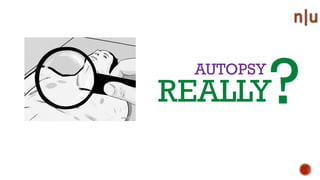
AUTOPSY
REALLY?
BUT CLOSE…
BUT CLOSE…
What is forensics
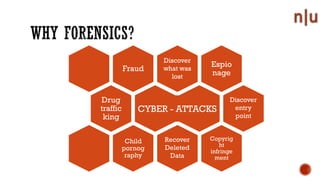
Why to forensics
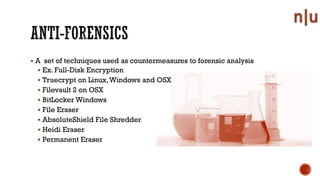
Anti-Forensics
How To Become Forensics Expert
Some terms
Computer Forensics
Memory analysis
Volatile/non-volatile
Encryption/stegnography
N/w Analysis
Hands on Challenges
Vikas Jain
Er.vikey@gmail.com Follow me at @ervikey
Forensic is Related to Court and Trials or To Answer
Questions Related to Legal System
Computer Forensics Helps answering If a Digital
Device is part of cyber crime or victim of cybercrime
purpose Is to find evidence which can prove things
done on the system in court of case
Five Aspects:
IF WHO WHAT WHEN WHY
Fraud
Drug
traffic
king
Child
pornog
raphy
Espio
nage
Copyrig
ht
infringe
ment
Discover
what was
lost
Recover
Deleted
Data
Discover
entry
point
CYBER - ATTACKS
A set of techniques used as countermeasures to forensic analysis
Ex. Full-Disk Encryption
Truecrypt on Linux,Windows and OSX
Filevault 2 on OSX
BitLocker Windows
File Eraser
AbsoluteShield File Shredder
Heidi Eraser
Permanent Eraser
TOO DAMN EASY!!
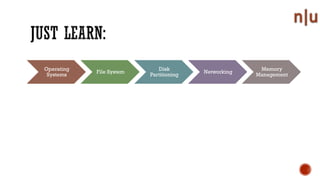
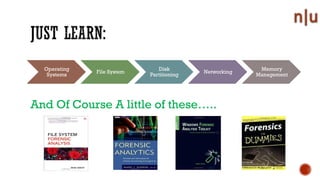
Operating
Systems
File System
Disk
Partitioning
Networking
Memory
Management
Operating
Systems
File System
Disk
Partitioning
Networking
Memory
Management
And Of Course A little of these…..
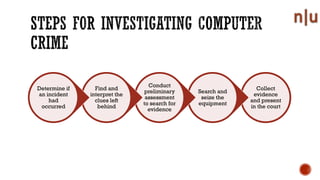
Collect
evidence
and present
in the court
Search and
seize the
equipment
Conduct
preliminary
assessment
to search for
evidence
Find and
interpret the
clues left
behind
Determine if
an incident
had
occurred
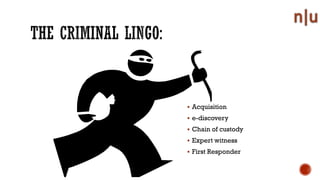
Acquisition
e-discovery
Chain of custody
Expert witness
First Responder
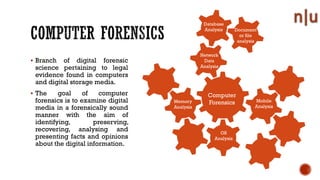
Branch of digital forensic
science pertaining to legal
evidence found in computers
and digital storage media.
The goal of computer
forensics is to examine digital
media in a forensically sound
manner with the aim of
identifying, preserving,
recovering, analysing and
presenting facts and opinions
about the digital information.
Computer
ForensicsMemory
Analysis
Network
Data
Analysis
Document
or file
analysis
OS
Analysis
Mobile
Analysis
Database
Analysis
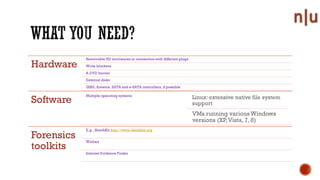
Hardware
Removable HD enclosures or connectors with different plugs
Write blockers
A DVD burner
External disks
USB2, firewire, SATA and e-SATA controllers, if possible
Software
Multiple operating systems
Linux: extensive native file system
support
VMs running various Windows
versions (XP,Vista, 7, 8)
Forensics
toolkits
E.g., SleuthKit http://www.sleuthkit.org
Winhex
Internet Evidence Finder
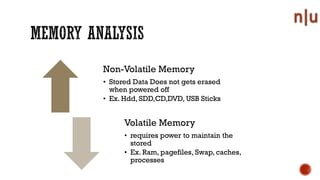
Non-Volatile Memory
• Stored Data Does not gets erased
when powered off
• Ex. Hdd, SDD,CD,DVD, USB Sticks
Volatile Memory
• requires power to maintain the
stored
• Ex. Ram, pagefiles, Swap, caches,
processes
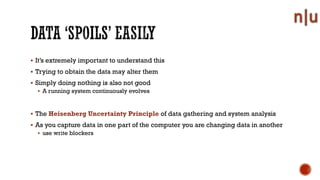
It’s extremely important to understand this
Trying to obtain the data may alter them
Simply doing nothing is also not good
A running system continuously evolves
The Heisenberg Uncertainty Principle of data gathering and system analysis
As you capture data in one part of the computer you are changing data in another
use write blockers
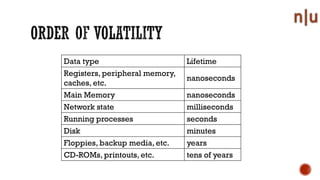
Data type Lifetime
Registers, peripheral memory,
caches, etc.
nanoseconds
Main Memory nanoseconds
Network state milliseconds
Running processes seconds
Disk minutes
Floppies, backup media, etc. years
CD-ROMs, printouts, etc. tens of years
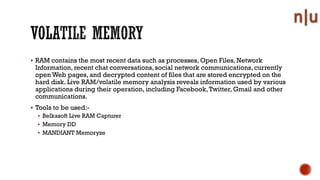
RAM contains the most recent data such as processes, Open Files, Network
Information, recent chat conversations,social network communications, currently
open Web pages, and decrypted content of files that are stored encrypted on the
hard disk. Live RAM/volatile memory analysis reveals information used by various
applications during their operation, including Facebook,Twitter, Gmail and other
communications.
Tools to be used:-
Belkasoft Live RAM Capturer
Memory DD
MANDIANT Memoryze
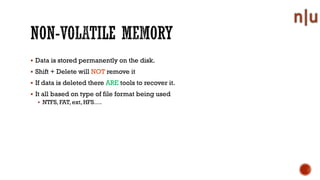
Data is stored permanently on the disk.
Shift + Delete will NOT remove it
If data is deleted there ARE tools to recover it.
It all based on type of file format being used
NTFS, FAT, ext, HFS….
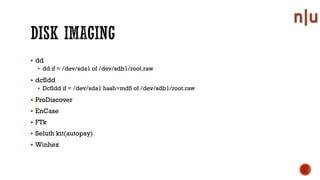
dd
dd if = /dev/sda1 of /dev/sdb1/root.raw
dcfldd
Dcfldd if = /dev/sda1 hash=md5 of /dev/sdb1/root.raw
ProDiscover
EnCase
FTk
Seluth kit(autopsy)
Winhex
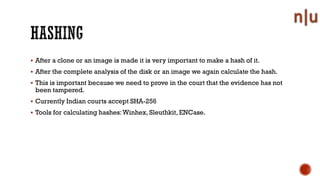
After a clone or an image is made it is very important to make a hash of it.
After the complete analysis of the disk or an image we again calculate the hash.
This is important because we need to prove in the court that the evidence has not
been tampered.
Currently Indian courts accept SHA-256
Tools for calculating hashes:Winhex, Sleuthkit, ENCase.
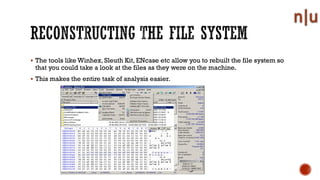
The tools like Winhex, Sleuth Kit, ENcase etc allow you to rebuilt the file system so
that you could take a look at the files as they were on the machine.
This makes the entire task of analysis easier.
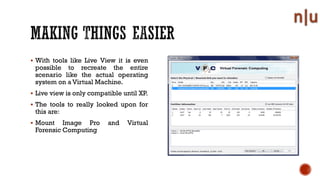
With tools like Live View it is even
possible to recreate the entire
scenario like the actual operating
system on a Virtual Machine.
Live view is only compatible until XP.
The tools to really looked upon for
this are:
Mount Image Pro and Virtual
Forensic Computing
Slack Space
ADS streams
Stenography
Hidden Partitions
Unallocated space
Modified file extensions
META DATA
While Imaging or cloning a disk
the exact copy is made and hence
the hidden data remains as it is.
There is no specific tool for the
extraction of the hidden data and
hence we need to perform manual
analysis on the image or the disk
using hex editors
Eg:Winhex
While performing analysis on disks and images there are very good chances that
we come across encrypted data.
This creates a problem for an forensic analyst.
Even though there are tools and techniques to break encryptions we sometimes fail
to do so.
A series of attacks are carried out to break encryptions:
Brute Force Attack
Dictionary Attack
Known Plain Text Attack
Rainbow Table Attack
Tools: A variety of stand-alone as well as online tools are
available which helps us cracking the encrypted files.
AZPR
AOPR
Decryptum(Online)
Passware kit
If we come across any type of encryption files or data
that have been encrypted with tools like PGP, True
Crypt etc., It becomes really difficult from the
forensics point of view to get through.
In such cases the farthest we can do is look for the
keys on the machine.
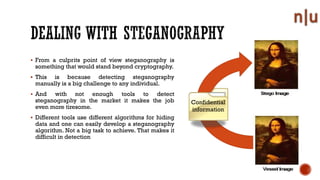
From a culprits point of view steganography is
something that would stand beyond cryptography.
This is because detecting steganography
manually is a big challenge to any individual.
And with not enough tools to detect
steganography in the market it makes the job
even more tiresome.
Different tools use different algorithms for hiding
data and one can easily develop a steganography
algorithm. Not a big task to achieve. That makes it
difficult in detection
Confidential
information
Speaking of the tools used for steganalysis, these tools may
sometimes give you false positives as well.
StegDetect
StegSecret
Network forensics is a sub-branch of digital forensics relating to the monitoring
and analysis of computer network traffic for the purposes of information gathering,
legal evidence, or intrusion detection.
Unlike other areas of digital forensics, network investigations deal with volatile and
dynamic information.
Why Network Forensics plays an important role?
Network Forensics can reveal if the network or a machine from which the crime has
occurred was compromised or not. Which can turn out to be really handy in some
cases.
Tcp Dump
Wireshark
Network minner
Snortc
Activity:
Find as much information as you can…
Happy Hacking!!!

Digital Forensics

  • 1.
    Lets do someAutopsy!!
  • 2.
  • 4.
  • 5.
  • 6.
    What is forensics Whyto forensics Anti-Forensics How To Become Forensics Expert Some terms Computer Forensics Memory analysis Volatile/non-volatile Encryption/stegnography N/w Analysis Hands on Challenges
  • 7.
  • 8.
    Forensic is Relatedto Court and Trials or To Answer Questions Related to Legal System Computer Forensics Helps answering If a Digital Device is part of cyber crime or victim of cybercrime purpose Is to find evidence which can prove things done on the system in court of case Five Aspects: IF WHO WHAT WHEN WHY
  • 9.
  • 10.
    A set oftechniques used as countermeasures to forensic analysis Ex. Full-Disk Encryption Truecrypt on Linux,Windows and OSX Filevault 2 on OSX BitLocker Windows File Eraser AbsoluteShield File Shredder Heidi Eraser Permanent Eraser
  • 12.
  • 13.
  • 14.
  • 15.
    Collect evidence and present in thecourt Search and seize the equipment Conduct preliminary assessment to search for evidence Find and interpret the clues left behind Determine if an incident had occurred
  • 16.
  • 17.
    Branch of digitalforensic science pertaining to legal evidence found in computers and digital storage media. The goal of computer forensics is to examine digital media in a forensically sound manner with the aim of identifying, preserving, recovering, analysing and presenting facts and opinions about the digital information. Computer ForensicsMemory Analysis Network Data Analysis Document or file analysis OS Analysis Mobile Analysis Database Analysis
  • 18.
    Hardware Removable HD enclosuresor connectors with different plugs Write blockers A DVD burner External disks USB2, firewire, SATA and e-SATA controllers, if possible Software Multiple operating systems Linux: extensive native file system support VMs running various Windows versions (XP,Vista, 7, 8) Forensics toolkits E.g., SleuthKit http://www.sleuthkit.org Winhex Internet Evidence Finder
  • 19.
    Non-Volatile Memory • StoredData Does not gets erased when powered off • Ex. Hdd, SDD,CD,DVD, USB Sticks Volatile Memory • requires power to maintain the stored • Ex. Ram, pagefiles, Swap, caches, processes
  • 20.
    It’s extremely importantto understand this Trying to obtain the data may alter them Simply doing nothing is also not good A running system continuously evolves The Heisenberg Uncertainty Principle of data gathering and system analysis As you capture data in one part of the computer you are changing data in another use write blockers
  • 21.
    Data type Lifetime Registers,peripheral memory, caches, etc. nanoseconds Main Memory nanoseconds Network state milliseconds Running processes seconds Disk minutes Floppies, backup media, etc. years CD-ROMs, printouts, etc. tens of years
  • 22.
    RAM contains themost recent data such as processes, Open Files, Network Information, recent chat conversations,social network communications, currently open Web pages, and decrypted content of files that are stored encrypted on the hard disk. Live RAM/volatile memory analysis reveals information used by various applications during their operation, including Facebook,Twitter, Gmail and other communications. Tools to be used:- Belkasoft Live RAM Capturer Memory DD MANDIANT Memoryze
  • 23.
    Data is storedpermanently on the disk. Shift + Delete will NOT remove it If data is deleted there ARE tools to recover it. It all based on type of file format being used NTFS, FAT, ext, HFS….
  • 24.
    dd dd if =/dev/sda1 of /dev/sdb1/root.raw dcfldd Dcfldd if = /dev/sda1 hash=md5 of /dev/sdb1/root.raw ProDiscover EnCase FTk Seluth kit(autopsy) Winhex
  • 25.
    After a cloneor an image is made it is very important to make a hash of it. After the complete analysis of the disk or an image we again calculate the hash. This is important because we need to prove in the court that the evidence has not been tampered. Currently Indian courts accept SHA-256 Tools for calculating hashes:Winhex, Sleuthkit, ENCase.
  • 26.
    The tools likeWinhex, Sleuth Kit, ENcase etc allow you to rebuilt the file system so that you could take a look at the files as they were on the machine. This makes the entire task of analysis easier.
  • 27.
    With tools likeLive View it is even possible to recreate the entire scenario like the actual operating system on a Virtual Machine. Live view is only compatible until XP. The tools to really looked upon for this are: Mount Image Pro and Virtual Forensic Computing
  • 28.
    Slack Space ADS streams Stenography HiddenPartitions Unallocated space Modified file extensions META DATA
  • 30.
    While Imaging orcloning a disk the exact copy is made and hence the hidden data remains as it is. There is no specific tool for the extraction of the hidden data and hence we need to perform manual analysis on the image or the disk using hex editors Eg:Winhex
  • 31.
    While performing analysison disks and images there are very good chances that we come across encrypted data. This creates a problem for an forensic analyst. Even though there are tools and techniques to break encryptions we sometimes fail to do so.
  • 32.
    A series ofattacks are carried out to break encryptions: Brute Force Attack Dictionary Attack Known Plain Text Attack Rainbow Table Attack Tools: A variety of stand-alone as well as online tools are available which helps us cracking the encrypted files. AZPR AOPR Decryptum(Online) Passware kit
  • 33.
    If we comeacross any type of encryption files or data that have been encrypted with tools like PGP, True Crypt etc., It becomes really difficult from the forensics point of view to get through. In such cases the farthest we can do is look for the keys on the machine.
  • 34.
    From a culpritspoint of view steganography is something that would stand beyond cryptography. This is because detecting steganography manually is a big challenge to any individual. And with not enough tools to detect steganography in the market it makes the job even more tiresome. Different tools use different algorithms for hiding data and one can easily develop a steganography algorithm. Not a big task to achieve. That makes it difficult in detection Confidential information
  • 35.
    Speaking of thetools used for steganalysis, these tools may sometimes give you false positives as well. StegDetect StegSecret
  • 36.
    Network forensics isa sub-branch of digital forensics relating to the monitoring and analysis of computer network traffic for the purposes of information gathering, legal evidence, or intrusion detection. Unlike other areas of digital forensics, network investigations deal with volatile and dynamic information. Why Network Forensics plays an important role? Network Forensics can reveal if the network or a machine from which the crime has occurred was compromised or not. Which can turn out to be really handy in some cases.
  • 37.
  • 38.
    Activity: Find as muchinformation as you can…
  • 39.