Wind Energy
•Submitted to:
Dr/Khaled ramzi
•Submitted to:
Dr/Khaled ramzi
Team:
• Asmahan Abdullah Khalaf allah
• Eman Mohammed Essa
• Haneen Salah Mahmoud
• Mariam Ramdan Ahmed
List of
contents
• Introduction
• Wind Basics & Classification
• Wind Obstacles & Effects
• Wind Turbine Types & Conversion
• Power, Torque &
Performance
• VAWT vs. HAWT
• Design & Components
• Conclusion
• small , medium, larg wind turbine
• Horizontal and vertical wind turbine
• classification of HAWT
• classification of VAWT
• advantage and Disadvantages of VAWT
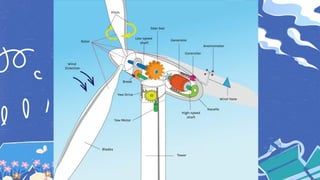
• wind turbine components
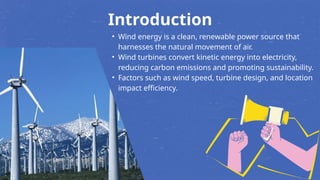
• Wind energy is a clean, renewable power source that
harnesses the natural movement of air.
• Wind turbines convert kinetic energy into electricity,
reducing carbon emissions and promoting sustainability.
• Factors such as wind speed, turbine design, and location
impact efficiency.
Introduction
Wind Energy
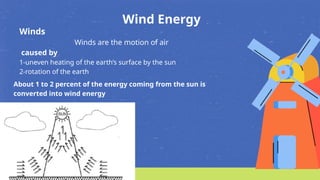
Winds
Winds are the motion of air
caused by
1-uneven heating of the earth’s surface by the sun
2-rotation of the earth
About 1 to 2 percent of the energy coming from the sun is
converted into wind energy
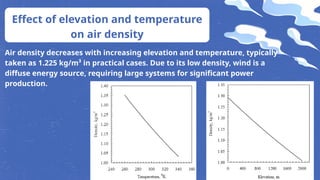
Effect of elevation and temperature
on air density
Air density decreases with increasing elevation and temperature, typically
taken as 1.225 kg/m³ in practical cases. Due to its low density, wind is a
diffuse energy source, requiring large systems for significant power
production.
1- Planetary winds
2-Local Winds
Winds are classified as:
•The large atmospheric winds that circle the
earth are created because land near the
equator is heated more by the sun than land
near the North and South Poles.
Planetary winds
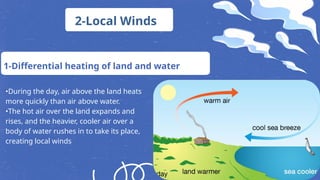
•During the day, air above the land heats
more quickly than air above water.
•The hot air over the land expands and
rises, and the heavier, cooler air over a
body of water rushes in to take its place,
creating local winds
1-Differential heating of land and water
2-Local Winds
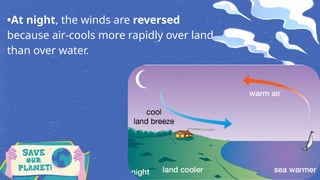
•At night, the winds are reversed
because air-cools more rapidly over land
than over water.
•The air above the slopes heat up during the day and
cools down at night , more rapidly than the air above
low land.
•This caused heated air during the day to rise along
the slopes and relatively cool heavy air to flow down at
night.
2-Hills and
Mountains
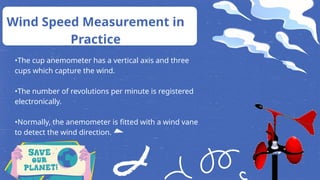
•The cup anemometer has a vertical axis and three
cups which capture the wind.
•The number of revolutions per minute is registered
electronically.
•Normally, the anemometer is fitted with a wind vane
to detect the wind direction.
Wind Speed Measurement in
Practice
Wind turbines are often placed near the
top of hill and ridges ,away from building
and other structures, coastal areas and
open plains
Wind Obstacles
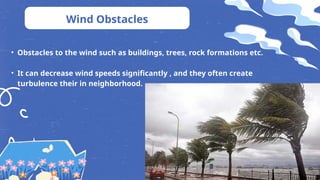
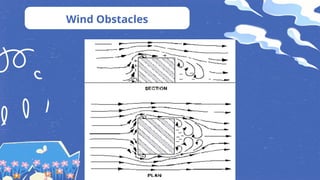
• Obstacles to the wind such as buildings, trees, rock formations etc.
• It can decrease wind speeds significantly , and they often create
turbulence their in neighborhood.
Wind Obstacles
Wake Effect
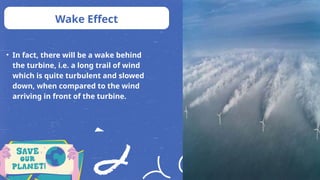
• In fact, there will be a wake behind
the turbine, i.e. a long trail of wind
which is quite turbulent and slowed
down, when compared to the wind
arriving in front of the turbine.
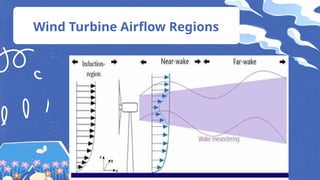
Wind Turbine Airflow Regions
Park Effect
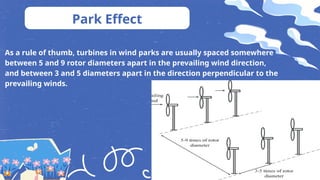
As a rule of thumb, turbines in wind parks are usually spaced somewhere
between 5 and 9 rotor diameters apart in the prevailing wind direction,
and between 3 and 5 diameters apart in the direction perpendicular to the
prevailing winds.
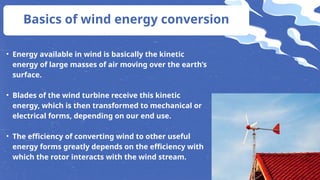
• Energy available in wind is basically the kinetic
energy of large masses of air moving over the earth’s
surface.
• Blades of the wind turbine receive this kinetic
energy, which is then transformed to mechanical or
electrical forms, depending on our end use.
• The efficiency of converting wind to other useful
energy forms greatly depends on the efficiency with
which the rotor interacts with the wind stream.
Basics of wind energy conversion
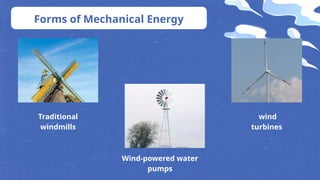
Forms of Mechanical Energy
Traditional
windmills
Wind-powered water
pumps
wind
turbines
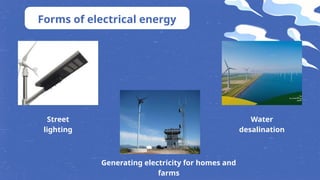
Forms of electrical energy
Street
lighting
Generating electricity for homes and
farms
Water
desalination
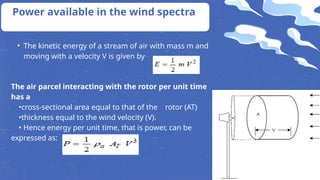
Power available in the wind spectra
• The kinetic energy of a stream of air with mass m and
moving with a velocity V is given by
The air parcel interacting with the rotor per unit time
has a
•cross-sectional area equal to that of the rotor (AT)
•thickness equal to the wind velocity (V).
• Hence energy per unit time, that is power, can be
expressed as:
The factors influencing the power available in
the wind stream are :
•the air density,
•area of the wind rotor
• the wind velocity
Factors like temperature, atmospheric pressure,
elevation and air constituents affect the density
of air.
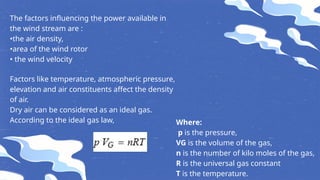
Dry air can be considered as an ideal gas.
According to the ideal gas law, Where:
p is the pressure,
VG is the volume of the gas,
n is the number of kilo moles of the gas,
R is the universal gas constant
T is the temperature.
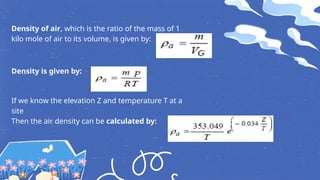
Density of air, which is the ratio of the mass of 1
kilo mole of air to its volume, is given by:
Density is given by:
If we know the elevation Z and temperature T at a
site
Then the air density can be calculated by:
• When the wind stream passes the turbine, a part of its
kinetic energy is transferred to the rotor and the air
leaving the turbine carries the rest away.
• Actual power produced by a rotor would thus be
decided by : The efficiency with which this energy
transfer from wind to the rotor takes place.
• This efficiency is usually termed as the power
coefficient (Cp ).
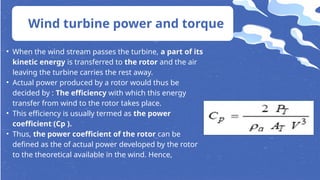
• Thus, the power coefficient of the rotor can be
defined as the of actual power developed by the rotor
to the theoretical available in the wind. Hence,
Wind turbine power and torque
• The power coefficient of a turbine depends on many
factors such as:
1.The profile of the rotor blades,
2.Blade arrangement and
3.Setting etc.
• A designer would try to fix these parameters at its
optimum level so as to attain maximum Cp at a wide
range of wind velocities.
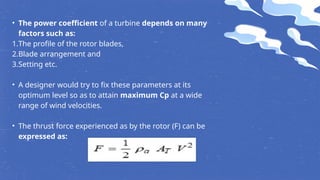
• The thrust force experienced as by the rotor (F) can be
expressed as:
Where:
R is the radius of the rotor.
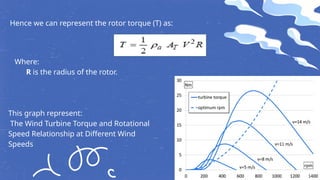
Hence we can represent the rotor torque (T) as:
This graph represent:
The Wind Turbine Torque and Rotational
Speed Relationship at Different Wind
Speeds
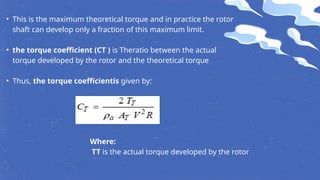
• This is the maximum theoretical torque and in practice the rotor
shaft can develop only a fraction of this maximum limit.
• the torque coefficient (CT ) is Theratio between the actual
torque developed by the rotor and the theoretical torque
• Thus, the torque coefficientis given by:
Where:
TT is the actual torque developed by the rotor
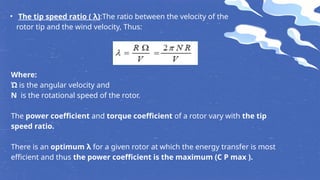
• The tip speed ratio ( λ):The ratio between the velocity of the
rotor tip and the wind velocity, Thus:
Where:
Ώ is the angular velocity and
N is the rotational speed of the rotor.
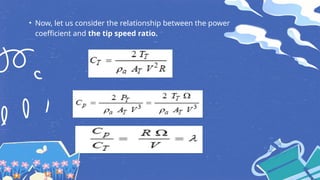
The power coefficient and torque coefficient of a rotor vary with the tip
speed ratio.
There is an optimum λ for a given rotor at which the energy transfer is most
efficient and thus the power coefficient is the maximum (C P max ).
• Now, let us consider the relationship between the power
coefficient and the tip speed ratio.
Example 1
Consider a wind turbine with 5 m diameter rotor. Speed of
the rotor at 10 m/s wind velocity is 130 r/min and its power
coefficient at this point is 0.35.
Calculate the tip speed ratio and torque coefficient of the
turbine.
What will be the torque available at the rotor shaft? Assume
the density of air to be 1.24 kg/m3.
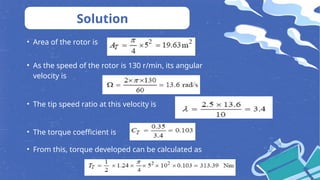
• Area of the rotor is
Solution
• As the speed of the rotor is 130 r/min, its angular
velocity is
• The tip speed ratio at this velocity is
• The torque coefficient is
• From this, torque developed can be calculated as
Example 2
Consider a wind turbine with 7 m diameter rotor. Speed of the rotor at
11 m/s wind velocity is 140 r/min and its Torque coefficient at this
point is 0.08
Calculate the tip speed ratio and power coefficient of the turbine.
What will be the torque available at the rotor shaft? Assume the
density of air to be 1.25kg/m3.
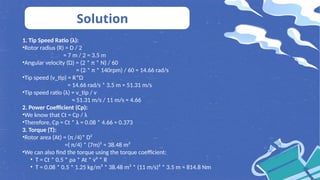
1. Tip Speed Ratio (λ):
•Rotor radius (R) = D / 2
= 7 m / 2 = 3.5 m
•Angular velocity (Ώ) = (2 * π * N) / 60
= (2 * π * 140rpm) / 60 ≈ 14.66 rad/s
•Tip speed (v_tip) = R*Ώ
= 14.66 rad/s * 3.5 m ≈ 51.31 m/s
•Tip speed ratio (λ) = v_tip / v
= 51.31 m/s / 11 m/s ≈ 4.66
2. Power Coefficient (Cp):
•We know that Ct = Cp / λ
•Therefore, Cp = Ct * λ = 0.08 * 4.66 ≈ 0.373
3. Torque (T):
•Rotor area (At) = (π /4)* D²
=( π/4) * (7m)² ≈ 38.48 m²
•We can also find the torque using the torque coefficient:
• T = Ct * 0.5 * ρa * At * v² * R
• T = 0.08 * 0.5 * 1.25 kg/m³ * 38.48 m² * (11 m/s)² * 3.5 m ≈ 814.8 Nm
Solution
Example 3
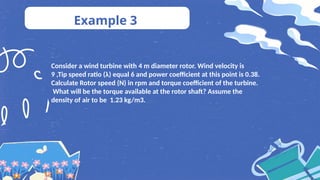
Consider a wind turbine with 4 m diameter rotor. Wind velocity is
9 ,Tip speed ratio (λ) equal 6 and power coefficient at this point is 0.38.
Calculate Rotor speed (N) in rpm and torque coefficient of the turbine.
What will be the torque available at the rotor shaft? Assume the
density of air to be 1.23 kg/m3.
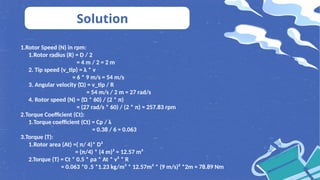
1.Rotor Speed (N) in rpm:
1.Rotor radius (R) = D / 2
= 4 m / 2 = 2 m
2. Tip speed (v_tip) = λ * v
= 6 * 9 m/s = 54 m/s
3. Angular velocity (Ώ) = v_tip / R
= 54 m/s / 2 m = 27 rad/s
4. Rotor speed (N) = (Ώ * 60) / (2 * π)
= (27 rad/s * 60) / (2 * π) ≈ 257.83 rpm
2.Torque Coefficient (Ct):
1.Torque coefficient (Ct) = Cp / λ
= 0.38 / 6 ≈ 0.063
3.Torque (T):
1.Rotor area (At) =( π/ 4)* D²
= (π/4) * (4 m)² ≈ 12.57 m²
2.Torque (T) = Ct * 0.5 * ρa * At * v² * R
= 0.063 *0 .5 *1.23 kg/m³ * 12.57m² * (9 m/s)² *2m ≈ 78.89 Nm
Solution
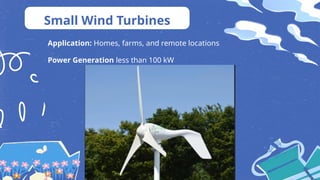
Small Wind Turbines
Application: Homes, farms, and remote locations
Power Generation less than 100 kW
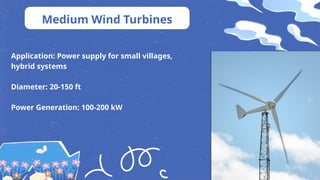
Application: Power supply for small villages,
hybrid systems
Diameter: 20-150 ft
Power Generation: 100-200 kW
Medium Wind Turbines
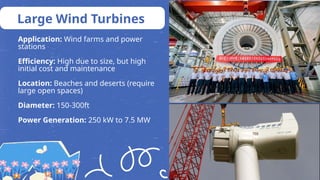
Large Wind Turbines
Application: Wind farms and power
stations
Efficiency: High due to size, but high
initial cost and maintenance
Location: Beaches and deserts (require
large open spaces)
Diameter: 150-300ft
Power Generation: 250 kW to 7.5 MW
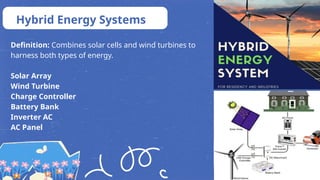
Definition: Combines solar cells and wind turbines to
harness both types of energy.
Solar Array
Wind Turbine
Charge Controller
Battery Bank
Inverter AC
AC Panel
Hybrid Energy Systems
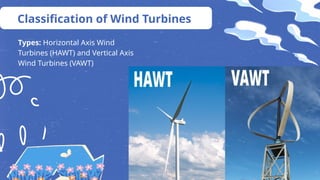
Classification of Wind Turbines
Types: Horizontal Axis Wind
Turbines (HAWT) and Vertical Axis
Wind Turbines (VAWT)
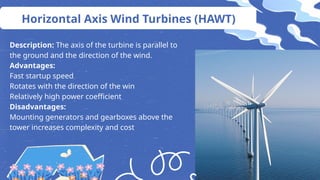
Horizontal Axis Wind Turbines (HAWT)
Description: The axis of the turbine is parallel to
the ground and the direction of the wind.
Advantages:
Fast startup speed
Rotates with the direction of the win
Relatively high power coefficient
Disadvantages:
Mounting generators and gearboxes above the
tower increases complexity and cost
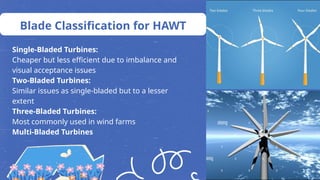
Blade Classification for HAWT
Single-Bladed Turbines:
Cheaper but less efficient due to imbalance and
visual acceptance issues
Two-Bladed Turbines:
Similar issues as single-bladed but to a lesser
extent
Three-Bladed Turbines:
Most commonly used in wind farms
Multi-Bladed Turbines
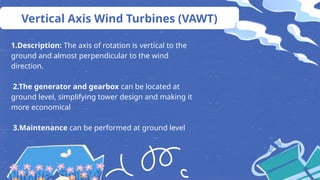
Vertical Axis Wind Turbines (VAWT)
1.Description: The axis of rotation is vertical to the
ground and almost perpendicular to the wind
direction.
2.The generator and gearbox can be located at
ground level, simplifying tower design and making it
more economical
3.Maintenance can be performed at ground level
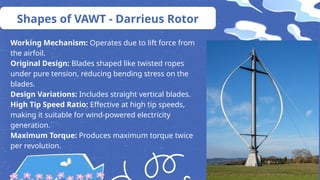
Working Mechanism: Operates due to lift force from
the airfoil.
Original Design: Blades shaped like twisted ropes
under pure tension, reducing bending stress on the
blades.
Design Variations: Includes straight vertical blades.
High Tip Speed Ratio: Effective at high tip speeds,
making it suitable for wind-powered electricity
generation.
Maximum Torque: Produces maximum torque twice
per revolution.
Shapes of VAWT - Darrieus Rotor
Shapes of VAWT - Savonius Rotor
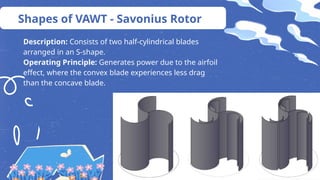
Description: Consists of two half-cylindrical blades
arranged in an S-shape.
Operating Principle: Generates power due to the airfoil
effect, where the convex blade experiences less drag
than the concave blade.
Shapes of VAWT - Musgrove Rotor
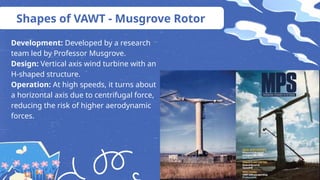
Development: Developed by a research
team led by Professor Musgrove.
Design: Vertical axis wind turbine with an
H-shaped structure.
Operation: At high speeds, it turns about
a horizontal axis due to centrifugal force,
reducing the risk of higher aerodynamic
forces.
Advantages and Disadvantages of VAWT
Advantages:
Accept wind from any angle
Components can be located at ground level
Theoretical potential to use less material
Disadvantages:
Rotor located at ground level where wind speeds are typically lower, reducing
efficiency
Poor self-starting capabilities, requires additional mechanisms to start if they stop
Requires support at the top of the turbine rotor
Guy Wires: The wires used to support the structure can pose difficulties in installation
due to the need for them to bend to fit the tower’s curvature.
Blade Speed: Blades may run at dangerous speeds, posing a risk of failure.
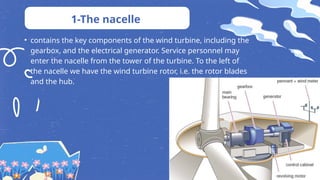
• contains the key components of the wind turbine, including the
gearbox, and the electrical generator. Service personnel may
enter the nacelle from the tower of the turbine. To the left of
the nacelle we have the wind turbine rotor, i.e. the rotor blades
and the hub.
1-The nacelle
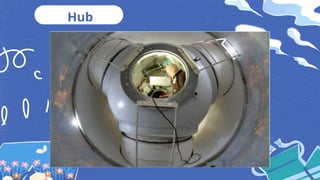
Hub
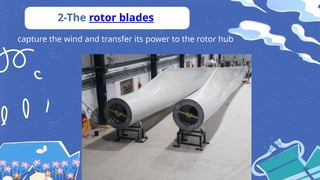
capture the wind and transfer its power to the rotor hub
2-The rotor blades
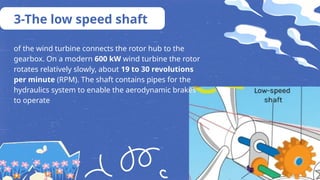
of the wind turbine connects the rotor hub to the
gearbox. On a modern 600 kW wind turbine the rotor
rotates relatively slowly, about 19 to 30 revolutions
per minute (RPM). The shaft contains pipes for the
hydraulics system to enable the aerodynamic brakes
to operate
3-The low speed shaft
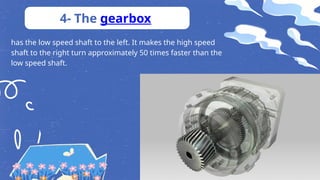
4- The gearbox
has the low speed shaft to the left. It makes the high speed
shaft to the right turn approximately 50 times faster than the
low speed shaft.
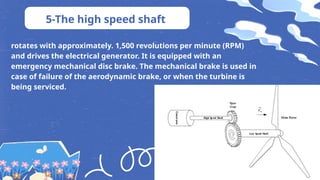
5-The high speed shaft
rotates with approximately. 1,500 revolutions per minute (RPM)
and drives the electrical generator. It is equipped with an
emergency mechanical disc brake. The mechanical brake is used in
case of failure of the aerodynamic brake, or when the turbine is
being serviced.
6-The electrical generator
On a modern wind turbine the maximum
electric power is usually between 500 and
1,500 kilowatts (kW).
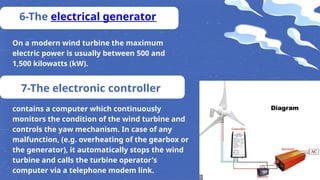
7-The electronic controller
contains a computer which continuously
monitors the condition of the wind turbine and
controls the yaw mechanism. In case of any
malfunction, (e.g. overheating of the gearbox or
the generator), it automatically stops the wind
turbine and calls the turbine operator's
computer via a telephone modem link.
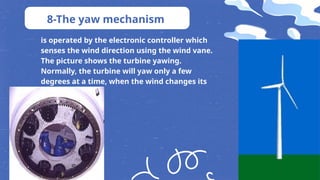
8-The yaw mechanism
is operated by the electronic controller which
senses the wind direction using the wind vane.
The picture shows the turbine yawing.
Normally, the turbine will yaw only a few
degrees at a time, when the wind changes its
direction.
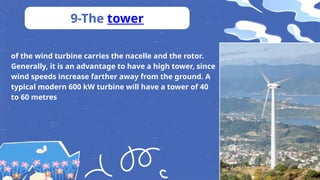
9-The tower
of the wind turbine carries the nacelle and the rotor.
Generally, it is an advantage to have a high tower, since
wind speeds increase farther away from the ground. A
typical modern 600 kW turbine will have a tower of 40
to 60 metres
are used to measure the speed and the direction of the wind.
10-The anemometer and the wind vane
The computers stops the wind turbine automatically
if the wind speed exceeds 25 meters per second (50 knots)
in order to protect the turbine and its surroundings.
The electronic signals from the anemometer are used
by the wind turbine's electronic controller to
start the wind turbine when the wind speed reaches
approximately 5 meters per second
The wind vane signals are used by the wind turbine's
electronic controller to turn the wind turbine against the
wind, using the yaw mechanism.
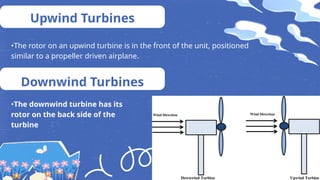
Upwind Turbines
•The rotor on an upwind turbine is in the front of the unit, positioned
similar to a propeller driven airplane.
Downwind Turbines
•The downwind turbine has its
rotor on the back side of the
turbine
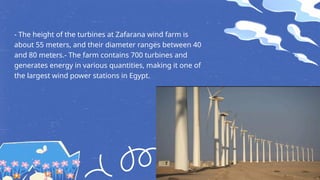
- The height of the turbines at Zafarana wind farm is
about 55 meters, and their diameter ranges between 40
and 80 meters.- The farm contains 700 turbines and
generates energy in various quantities, making it one of
the largest wind power stations in Egypt.
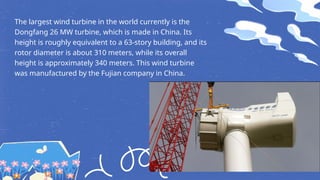
The largest wind turbine in the world currently is the
Dongfang 26 MW turbine, which is made in China. Its
height is roughly equivalent to a 63-story building, and its
rotor diameter is about 310 meters, while its overall
height is approximately 340 meters. This wind turbine
was manufactured by the Fujian company in China.
Conclusion
Thank You

Wind Energy.pptxccccfffffffffffffffffffffffffffffffff

  • 1.
  • 2.
    •Submitted to: Dr/Khaled ramzi Team: •Asmahan Abdullah Khalaf allah • Eman Mohammed Essa • Haneen Salah Mahmoud • Mariam Ramdan Ahmed
  • 3.
    List of contents • Introduction •Wind Basics & Classification • Wind Obstacles & Effects • Wind Turbine Types & Conversion • Power, Torque & Performance • VAWT vs. HAWT • Design & Components • Conclusion
  • 4.
    • small ,medium, larg wind turbine • Horizontal and vertical wind turbine • classification of HAWT • classification of VAWT • advantage and Disadvantages of VAWT • wind turbine components
  • 5.
    • Wind energyis a clean, renewable power source that harnesses the natural movement of air. • Wind turbines convert kinetic energy into electricity, reducing carbon emissions and promoting sustainability. • Factors such as wind speed, turbine design, and location impact efficiency. Introduction
  • 6.
    Wind Energy Winds Winds arethe motion of air caused by 1-uneven heating of the earth’s surface by the sun 2-rotation of the earth About 1 to 2 percent of the energy coming from the sun is converted into wind energy
  • 8.
    Effect of elevationand temperature on air density Air density decreases with increasing elevation and temperature, typically taken as 1.225 kg/m³ in practical cases. Due to its low density, wind is a diffuse energy source, requiring large systems for significant power production.
  • 9.
    1- Planetary winds 2-LocalWinds Winds are classified as:
  • 10.
    •The large atmosphericwinds that circle the earth are created because land near the equator is heated more by the sun than land near the North and South Poles. Planetary winds
  • 11.
    •During the day,air above the land heats more quickly than air above water. •The hot air over the land expands and rises, and the heavier, cooler air over a body of water rushes in to take its place, creating local winds 1-Differential heating of land and water 2-Local Winds
  • 12.
    •At night, thewinds are reversed because air-cools more rapidly over land than over water.
  • 13.
    •The air abovethe slopes heat up during the day and cools down at night , more rapidly than the air above low land. •This caused heated air during the day to rise along the slopes and relatively cool heavy air to flow down at night. 2-Hills and Mountains
  • 14.
    •The cup anemometerhas a vertical axis and three cups which capture the wind. •The number of revolutions per minute is registered electronically. •Normally, the anemometer is fitted with a wind vane to detect the wind direction. Wind Speed Measurement in Practice
  • 15.
    Wind turbines areoften placed near the top of hill and ridges ,away from building and other structures, coastal areas and open plains
  • 20.
    Wind Obstacles • Obstaclesto the wind such as buildings, trees, rock formations etc. • It can decrease wind speeds significantly , and they often create turbulence their in neighborhood.
  • 21.
  • 22.
    Wake Effect • Infact, there will be a wake behind the turbine, i.e. a long trail of wind which is quite turbulent and slowed down, when compared to the wind arriving in front of the turbine.
  • 23.
  • 24.
    Park Effect As arule of thumb, turbines in wind parks are usually spaced somewhere between 5 and 9 rotor diameters apart in the prevailing wind direction, and between 3 and 5 diameters apart in the direction perpendicular to the prevailing winds.
  • 25.
    • Energy availablein wind is basically the kinetic energy of large masses of air moving over the earth’s surface. • Blades of the wind turbine receive this kinetic energy, which is then transformed to mechanical or electrical forms, depending on our end use. • The efficiency of converting wind to other useful energy forms greatly depends on the efficiency with which the rotor interacts with the wind stream. Basics of wind energy conversion
  • 26.
    Forms of MechanicalEnergy Traditional windmills Wind-powered water pumps wind turbines
  • 27.
    Forms of electricalenergy Street lighting Generating electricity for homes and farms Water desalination
  • 28.
    Power available inthe wind spectra • The kinetic energy of a stream of air with mass m and moving with a velocity V is given by The air parcel interacting with the rotor per unit time has a •cross-sectional area equal to that of the rotor (AT) •thickness equal to the wind velocity (V). • Hence energy per unit time, that is power, can be expressed as:
  • 29.
    The factors influencingthe power available in the wind stream are : •the air density, •area of the wind rotor • the wind velocity Factors like temperature, atmospheric pressure, elevation and air constituents affect the density of air. Dry air can be considered as an ideal gas. According to the ideal gas law, Where: p is the pressure, VG is the volume of the gas, n is the number of kilo moles of the gas, R is the universal gas constant T is the temperature.
  • 30.
    Density of air,which is the ratio of the mass of 1 kilo mole of air to its volume, is given by: Density is given by: If we know the elevation Z and temperature T at a site Then the air density can be calculated by:
  • 31.
    • When thewind stream passes the turbine, a part of its kinetic energy is transferred to the rotor and the air leaving the turbine carries the rest away. • Actual power produced by a rotor would thus be decided by : The efficiency with which this energy transfer from wind to the rotor takes place. • This efficiency is usually termed as the power coefficient (Cp ). • Thus, the power coefficient of the rotor can be defined as the of actual power developed by the rotor to the theoretical available in the wind. Hence, Wind turbine power and torque
  • 32.
    • The powercoefficient of a turbine depends on many factors such as: 1.The profile of the rotor blades, 2.Blade arrangement and 3.Setting etc. • A designer would try to fix these parameters at its optimum level so as to attain maximum Cp at a wide range of wind velocities. • The thrust force experienced as by the rotor (F) can be expressed as:
  • 33.
    Where: R is theradius of the rotor. Hence we can represent the rotor torque (T) as: This graph represent: The Wind Turbine Torque and Rotational Speed Relationship at Different Wind Speeds
  • 34.
    • This isthe maximum theoretical torque and in practice the rotor shaft can develop only a fraction of this maximum limit. • the torque coefficient (CT ) is Theratio between the actual torque developed by the rotor and the theoretical torque • Thus, the torque coefficientis given by: Where: TT is the actual torque developed by the rotor
  • 35.
    • The tipspeed ratio ( λ):The ratio between the velocity of the rotor tip and the wind velocity, Thus: Where: Ώ is the angular velocity and N is the rotational speed of the rotor. The power coefficient and torque coefficient of a rotor vary with the tip speed ratio. There is an optimum λ for a given rotor at which the energy transfer is most efficient and thus the power coefficient is the maximum (C P max ).
  • 36.
    • Now, letus consider the relationship between the power coefficient and the tip speed ratio.
  • 37.
    Example 1 Consider awind turbine with 5 m diameter rotor. Speed of the rotor at 10 m/s wind velocity is 130 r/min and its power coefficient at this point is 0.35. Calculate the tip speed ratio and torque coefficient of the turbine. What will be the torque available at the rotor shaft? Assume the density of air to be 1.24 kg/m3.
  • 38.
    • Area ofthe rotor is Solution • As the speed of the rotor is 130 r/min, its angular velocity is • The tip speed ratio at this velocity is • The torque coefficient is • From this, torque developed can be calculated as
  • 39.
    Example 2 Consider awind turbine with 7 m diameter rotor. Speed of the rotor at 11 m/s wind velocity is 140 r/min and its Torque coefficient at this point is 0.08 Calculate the tip speed ratio and power coefficient of the turbine. What will be the torque available at the rotor shaft? Assume the density of air to be 1.25kg/m3.
  • 40.
    1. Tip SpeedRatio (λ): •Rotor radius (R) = D / 2 = 7 m / 2 = 3.5 m •Angular velocity (Ώ) = (2 * π * N) / 60 = (2 * π * 140rpm) / 60 ≈ 14.66 rad/s •Tip speed (v_tip) = R*Ώ = 14.66 rad/s * 3.5 m ≈ 51.31 m/s •Tip speed ratio (λ) = v_tip / v = 51.31 m/s / 11 m/s ≈ 4.66 2. Power Coefficient (Cp): •We know that Ct = Cp / λ •Therefore, Cp = Ct * λ = 0.08 * 4.66 ≈ 0.373 3. Torque (T): •Rotor area (At) = (π /4)* D² =( π/4) * (7m)² ≈ 38.48 m² •We can also find the torque using the torque coefficient: • T = Ct * 0.5 * ρa * At * v² * R • T = 0.08 * 0.5 * 1.25 kg/m³ * 38.48 m² * (11 m/s)² * 3.5 m ≈ 814.8 Nm Solution
  • 41.
    Example 3 Consider awind turbine with 4 m diameter rotor. Wind velocity is 9 ,Tip speed ratio (λ) equal 6 and power coefficient at this point is 0.38. Calculate Rotor speed (N) in rpm and torque coefficient of the turbine. What will be the torque available at the rotor shaft? Assume the density of air to be 1.23 kg/m3.
  • 42.
    1.Rotor Speed (N)in rpm: 1.Rotor radius (R) = D / 2 = 4 m / 2 = 2 m 2. Tip speed (v_tip) = λ * v = 6 * 9 m/s = 54 m/s 3. Angular velocity (Ώ) = v_tip / R = 54 m/s / 2 m = 27 rad/s 4. Rotor speed (N) = (Ώ * 60) / (2 * π) = (27 rad/s * 60) / (2 * π) ≈ 257.83 rpm 2.Torque Coefficient (Ct): 1.Torque coefficient (Ct) = Cp / λ = 0.38 / 6 ≈ 0.063 3.Torque (T): 1.Rotor area (At) =( π/ 4)* D² = (π/4) * (4 m)² ≈ 12.57 m² 2.Torque (T) = Ct * 0.5 * ρa * At * v² * R = 0.063 *0 .5 *1.23 kg/m³ * 12.57m² * (9 m/s)² *2m ≈ 78.89 Nm Solution
  • 43.
    Small Wind Turbines Application:Homes, farms, and remote locations Power Generation less than 100 kW
  • 44.
    Application: Power supplyfor small villages, hybrid systems Diameter: 20-150 ft Power Generation: 100-200 kW Medium Wind Turbines
  • 45.
    Large Wind Turbines Application:Wind farms and power stations Efficiency: High due to size, but high initial cost and maintenance Location: Beaches and deserts (require large open spaces) Diameter: 150-300ft Power Generation: 250 kW to 7.5 MW
  • 46.
    Definition: Combines solarcells and wind turbines to harness both types of energy. Solar Array Wind Turbine Charge Controller Battery Bank Inverter AC AC Panel Hybrid Energy Systems
  • 47.
    Classification of WindTurbines Types: Horizontal Axis Wind Turbines (HAWT) and Vertical Axis Wind Turbines (VAWT)
  • 48.
    Horizontal Axis WindTurbines (HAWT) Description: The axis of the turbine is parallel to the ground and the direction of the wind. Advantages: Fast startup speed Rotates with the direction of the win Relatively high power coefficient Disadvantages: Mounting generators and gearboxes above the tower increases complexity and cost
  • 49.
    Blade Classification forHAWT Single-Bladed Turbines: Cheaper but less efficient due to imbalance and visual acceptance issues Two-Bladed Turbines: Similar issues as single-bladed but to a lesser extent Three-Bladed Turbines: Most commonly used in wind farms Multi-Bladed Turbines
  • 50.
    Vertical Axis WindTurbines (VAWT) 1.Description: The axis of rotation is vertical to the ground and almost perpendicular to the wind direction. 2.The generator and gearbox can be located at ground level, simplifying tower design and making it more economical 3.Maintenance can be performed at ground level
  • 51.
    Working Mechanism: Operatesdue to lift force from the airfoil. Original Design: Blades shaped like twisted ropes under pure tension, reducing bending stress on the blades. Design Variations: Includes straight vertical blades. High Tip Speed Ratio: Effective at high tip speeds, making it suitable for wind-powered electricity generation. Maximum Torque: Produces maximum torque twice per revolution. Shapes of VAWT - Darrieus Rotor
  • 52.
    Shapes of VAWT- Savonius Rotor Description: Consists of two half-cylindrical blades arranged in an S-shape. Operating Principle: Generates power due to the airfoil effect, where the convex blade experiences less drag than the concave blade.
  • 53.
    Shapes of VAWT- Musgrove Rotor Development: Developed by a research team led by Professor Musgrove. Design: Vertical axis wind turbine with an H-shaped structure. Operation: At high speeds, it turns about a horizontal axis due to centrifugal force, reducing the risk of higher aerodynamic forces.
  • 54.
    Advantages and Disadvantagesof VAWT Advantages: Accept wind from any angle Components can be located at ground level Theoretical potential to use less material Disadvantages: Rotor located at ground level where wind speeds are typically lower, reducing efficiency Poor self-starting capabilities, requires additional mechanisms to start if they stop Requires support at the top of the turbine rotor Guy Wires: The wires used to support the structure can pose difficulties in installation due to the need for them to bend to fit the tower’s curvature. Blade Speed: Blades may run at dangerous speeds, posing a risk of failure.
  • 56.
    • contains thekey components of the wind turbine, including the gearbox, and the electrical generator. Service personnel may enter the nacelle from the tower of the turbine. To the left of the nacelle we have the wind turbine rotor, i.e. the rotor blades and the hub. 1-The nacelle
  • 57.
  • 58.
    capture the windand transfer its power to the rotor hub 2-The rotor blades
  • 59.
    of the windturbine connects the rotor hub to the gearbox. On a modern 600 kW wind turbine the rotor rotates relatively slowly, about 19 to 30 revolutions per minute (RPM). The shaft contains pipes for the hydraulics system to enable the aerodynamic brakes to operate 3-The low speed shaft
  • 60.
    4- The gearbox hasthe low speed shaft to the left. It makes the high speed shaft to the right turn approximately 50 times faster than the low speed shaft.
  • 61.
    5-The high speedshaft rotates with approximately. 1,500 revolutions per minute (RPM) and drives the electrical generator. It is equipped with an emergency mechanical disc brake. The mechanical brake is used in case of failure of the aerodynamic brake, or when the turbine is being serviced.
  • 62.
    6-The electrical generator Ona modern wind turbine the maximum electric power is usually between 500 and 1,500 kilowatts (kW). 7-The electronic controller contains a computer which continuously monitors the condition of the wind turbine and controls the yaw mechanism. In case of any malfunction, (e.g. overheating of the gearbox or the generator), it automatically stops the wind turbine and calls the turbine operator's computer via a telephone modem link.
  • 63.
    8-The yaw mechanism isoperated by the electronic controller which senses the wind direction using the wind vane. The picture shows the turbine yawing. Normally, the turbine will yaw only a few degrees at a time, when the wind changes its direction.
  • 64.
    9-The tower of thewind turbine carries the nacelle and the rotor. Generally, it is an advantage to have a high tower, since wind speeds increase farther away from the ground. A typical modern 600 kW turbine will have a tower of 40 to 60 metres
  • 65.
    are used tomeasure the speed and the direction of the wind. 10-The anemometer and the wind vane The computers stops the wind turbine automatically if the wind speed exceeds 25 meters per second (50 knots) in order to protect the turbine and its surroundings. The electronic signals from the anemometer are used by the wind turbine's electronic controller to start the wind turbine when the wind speed reaches approximately 5 meters per second The wind vane signals are used by the wind turbine's electronic controller to turn the wind turbine against the wind, using the yaw mechanism.
  • 66.
    Upwind Turbines •The rotoron an upwind turbine is in the front of the unit, positioned similar to a propeller driven airplane. Downwind Turbines •The downwind turbine has its rotor on the back side of the turbine
  • 67.
    - The heightof the turbines at Zafarana wind farm is about 55 meters, and their diameter ranges between 40 and 80 meters.- The farm contains 700 turbines and generates energy in various quantities, making it one of the largest wind power stations in Egypt.
  • 68.
    The largest windturbine in the world currently is the Dongfang 26 MW turbine, which is made in China. Its height is roughly equivalent to a 63-story building, and its rotor diameter is about 310 meters, while its overall height is approximately 340 meters. This wind turbine was manufactured by the Fujian company in China.
  • 69.
  • 70.