Why Driving-Pressure Matters
Marcelo B. P. Amato
University of São Paulo, Brazil
DasSMACC, Berlin, June 2017
Special Article
Driving Pressure and Survival in the Acute
Respiratory Distress Syndrome
Marcelo B.P. Amato, M.D., Maureen O. Meade, M.D., Arthur S. Slutsky, M.D.,
Laurent Brochard, M.D., Eduardo L.V. Costa, M.D., David A.
Schoenfeld, Ph.D., Thomas E. Stewart, M.D., Matthias Briel, M.D., Daniel
Talmor, M.D., M.P.H., Alain Mercat, M.D., Jean-Christophe M. Richard, M.D.,
Carlos R.R. Carvalho, M.D., and Roy G. Brower, M.D.
N Engl J Med
Volume 372(8):747-755
February 19, 2015
São Paulo, Brazil
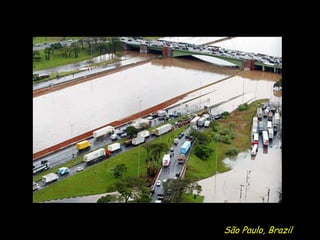
São Paulo, Brazil
São Paulo, Brazil
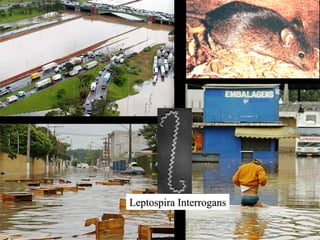
Leptospira Interrogans
Bleeding....
?
?
?
?
?
??
?
?? ?
?
???
?
? ?
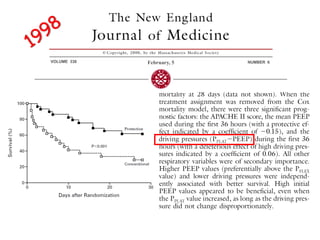
VOLUME 338 February, 5 NUMBER 6
1998
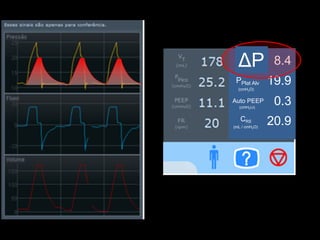
(cmH2O)
PDriving
(cmH2O)
PPlat Alv
(cmH2O)
Auto PEEP
CRS
(mL / cmH2O)
8.4
19.9
0.3
20.9
ΔP
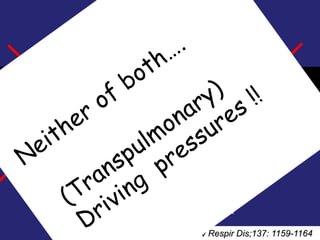
Dreyfuss et al (1988) Am Rev Respir Dis;137: 1159-1164
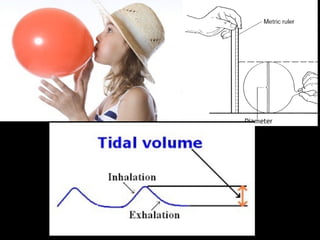
Volutrauma or Barotrauma ?
Neither of both….
(Transpulmonary)
Driving
pressures !!
LIM 09 - HCFMUSP
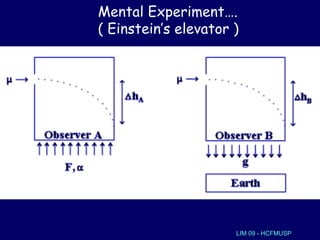
Mental Experiment….
( Einstein’s elevator )
35 cmH O2
P =p l
15
spulmonary:
20 cmH O2
P =p l
-5
35 cmH O2
Transpulmonary:
40 cmH O2
VT
CRS
DV
DV
DP
DP
VT = 400 mL VT = 400 mL
PTP = 4 PTP = 36
VT is
important?
Crs = 10Crs = 50 (CCW = 100)
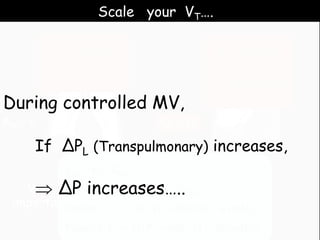
Scale your VT….
VT = 400 mL
∆P = 8 cmH2O
VT = 400 mL
∆P = 40 cmH2O
Lung-size
ERS = EL+ ECW
( 1 / CRS) = (1 / CL) + (1 / CCW)
Patient 1: CL = 100; PL = 400/100 = 4 cmH2O
Patient 2: CL = 11; PL = 400 / 11 = 36 cmH2O
During controlled MV,
If ∆PL (Transpulmonary) increases,
Þ ∆P increases…..
LIM 09 - HCFMUSP
Anesthesia
Left-Lung
Ventilation
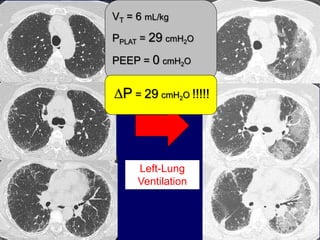
VT = 6 mL/kg
PPLAT = 29 cmH2O
PEEP = 0 cmH2O
DP = 29 cmH2O !!!!!
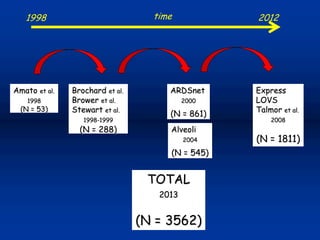
Amato et al.
1998
(N = 53)
Brochard et al.
Brower et al.
Stewart et al.
1998-1999
(N = 288)
ARDSnet
2000
(N = 861)
Alveoli
2004
(N = 545)
Express
LOVS
Talmor et al.
2008
(N = 1811)
TOTAL
2013
(N = 3562)
time1998 2012
Because of terrible offenses to God ,
Sisyphus was condemned to repeat forever
the same meaningless task of pushing an
enormous rock up a mountain, only to see it
roll down again…
0 1 2 3 4 5
0
10
20
30
40
0 1 2 3 4 5
0
10
20
30
40
30
20
40
10
0
1.4
1
0.7
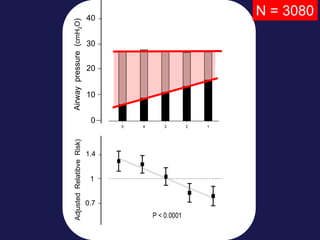
Airwaypressure(cmH2O)AdjustedRelatibveRisk)
N = 3080
MultivariateRisk
123456
0
10
20
30
40
123456
0
10
20
30
40
30
20
40
10
0
1.4
1
0.7
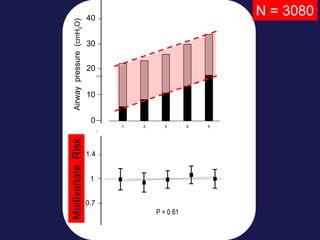
Airwaypressure(cmH2O)AdjustedRelatibveRisk)
N = 3080
?
0 1 2 3 4 5
0
10
20
30
40
0 1 2 3 4 5
0
10
20
30
40
?
30
20
40
10
0
1.4
1
0.7
Airwaypressure(cmH2O)AdjustedRelatibveRisk)
N = 3080
MultivariateRisk
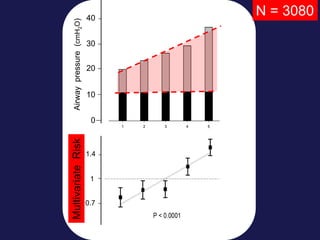
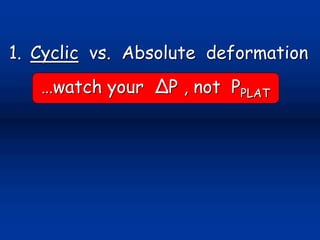
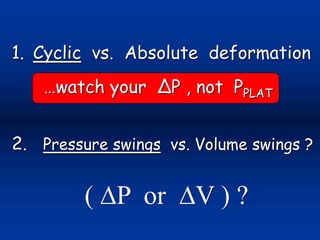
1. Cyclic vs. Absolute deformation
…watch your ∆P , not PPLAT
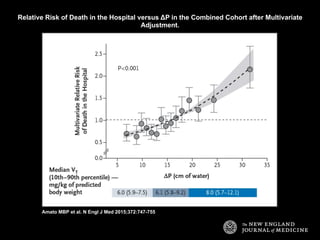
Relative Risk of Death in the Hospital versus ΔP in the Combined Cohort after Multivariate
Adjustment.
Amato MBP et al. N Engl J Med 2015;372:747-755
1. Cyclic vs. Absolute deformation
…watch your ∆P , not PPLAT
2. Pressure swings vs. Volume swings ?
( ∆P or ∆V ) ?
LIM 09 - HCFMUSP
Grafico driving pressure
LIM 09 - HCFMUSP
Grafico driving pressure
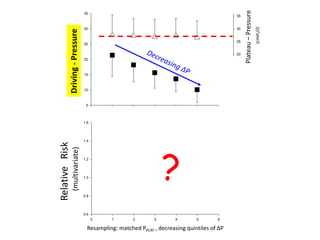
DRIVING-PRESSURE
5
10
15
20
25
30
35
PLATEAU-PRESSURE
0
5
10
15
20
25
30
35
RESAMPLING : MATCHED PPLAT , QUINTILES OF DP
0 1 2 3 4 5 6
RELATIVE-RISK(adjusted)
0.6
0.8
1.0
1.2
1.4
1.6
Plateau–Pressure
(cmH2O)
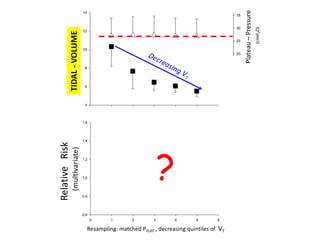
Resampling: matched PPLAT , decreasing quintiles of ∆P
Decreasing ∆P
P < 0.0001
?
Driving-Pressure
RelativeRisk
(multivariate)
TIDAL-VOLUME
4
6
8
10
12
14
PLATEAU-PRESSURE
0
5
10
15
20
25
30
35
RESAMPLING : MATCHED PPLAT , QUINTILES OF VT
0 1 2 3 4 5 6
RELATIVE-RISK(adjusted)
0.6
0.8
1.0
1.2
1.4
1.6
Resampling: matched PPLAT , decreasing quintiles of VT
Decreasing VT
P = 0.92
?
TIDAL-VOLUME
Plateau–Pressure
(cmH2O)
RelativeRisk
(multivariate)
P < 0.0001
Odds-ratioforBarotrauma
(adjusted*)
*: pre-adjusted for age, APACHE/SAPS risk, arterial-pH, P/F ratio and study-trial
(multivariate logistic regression where both ∆P and VT co-participate in Model-1)
Odds for Barotrauma across quintiles of ∆P or VT:
- Combined population of ARDS ( N = 3080 )
Figure 2d:
4 8 12 16 20 24 28
0.6
1.0
1.4
1.8
2.2
P < 0.0001
Driving-pressure (∆P, cmH2O)
Odds-ratioforBarotrauma
(adjusted*)
*: pre-adjusted for age, APACHE/SAPS risk, arterial-pH, P/F ratio and study-trial
(VT and ∆P co-participating in model-1 )
4 6 8 10 12
0.6
1.0
1.4
1.8
2.2
P = 0.87
Tidal-Volume (VT , mL/kg.PBW)
Odds-ratioforBarotrauma
(adjusted*)
*: pre-adjusted for age, APACHE/SAPS risk, arterial-pH, P/F ratio and study-trial
(VT and ∆P co-participating in model-1)
Driving-pressure (∆P, cmH2O)
4 8 12 16 20 24 28
Tidal-Volume (VT , mL/kg[PBW] )
4 6 12108
P < 0.0001 P = 0.87
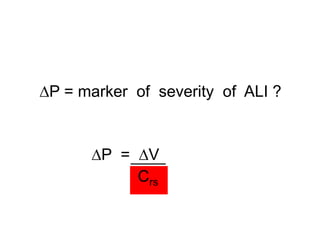
DP = marker of severity of ALI ?
DP = DV
Crs
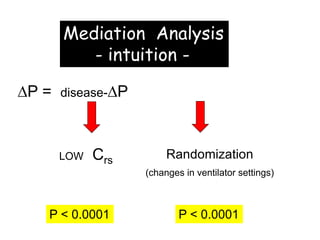
DP = disease-∆P + superimposed-∆P
LOW Crs Randomization
(changes in ventilator settings)
P < 0.0001 P < 0.0001
Mediation Analysis
- intuition -
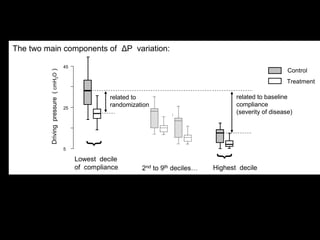
related to
randomization
related to baseline
compliance
(severity of disease)
{
Highest decile
of compliance
{
Lowest decile2nd to 9th deciles…
25
45
5
Drivingpressure(cmH2O)
Control arm
Treatment
Average exposure to ΔP Observed Risk ( across decile
B. Variations in ΔP driven by differences in baseline lung compliance
A. The two main components of ΔP variation:
pliance
9
10
Treatment arm
Control arm
Lowest decile
of compliance 2nd to 9th deciles… Highest decile
P < 0.0001
related to
randomization
related to baseline
compliance
(severity of disease)
{
Highest decile
of compliance
{
Lowest decile2nd to 9th deciles…
25
45
5
Drivingpressure(cmH2O)
Control arm
Treatment
Average exposure to ΔP Observed Risk ( acros
B. Variations in ΔP driven by differences in baseline lung compliance
A. The two main components of ΔP variation:
pliance
9
10
Treatment a
Control arm
Lowest decile
of compliance 2nd to 9th deciles… Highest decile
P < 0.0
related to
randomization
related to baseline
compliance
(severity of disease){
Highest decile
of compliance
{
Lowest decile2nd to 9th deciles…
25
45
5
Drivingpressure(cmH2O) Control arm
Treatment
Average exposure to ΔP Observed Risk ( acros
B. Variations in ΔP driven by differences in baseline lung compliance
A. The two main components of ΔP variation:
nce
10
Treatment a
Control arm
Lowest decile
of compliance 2nd to 9th deciles… Highest decile
related to
randomization
related to baseline
compliance
(severity of disease){
Highest decile
of compliance
{
Lowest decile2nd to 9th deciles…
25
45
5
Drivingpressure(cmH2O) Control arm
Treatment
Average exposure to ΔP Observed Risk ( across d
B. Variations in ΔP driven by differences in baseline lung compliance
A. The two main components of ΔP variation:
liance
9
10
Treatment arm
Control arm
Lowest decile
of compliance 2nd to 9th deciles… Highest decile
Disciplina de Pneumologia - InCor HC FMUSP
Causality and Mediation
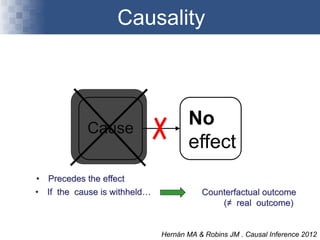
Causality
Cause Effect
• If the cause is withheld… Counterfactual outcome
(≠ real outcome)
No
effect
• Precedes the effect
Hernán MA & Robins JM . Causal Inference 2012
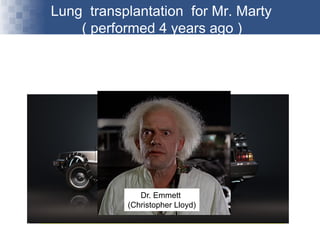
Lung transplantation for Mr. Marty
( performed 4 years ago )
Michael J. Fox
But what if he had not received the lung ??
He is alive today!!Dr. Emmett
(Christopher Lloyd)
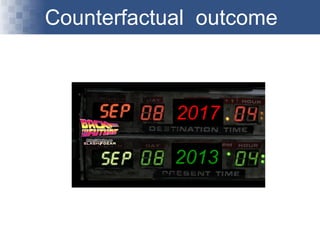
Counterfactual outcome
2017
2013
Causality
Cause Effect
• Precedes the effect
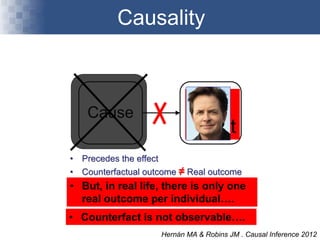
• Counterfactual outcome ≠ Real outcome
Hernán MA & Robins JM . Causal Inference 2012
• But, in real life, there is only one
real outcome per individual….
No
effect
• Counterfact is not observable….
Average causal effect
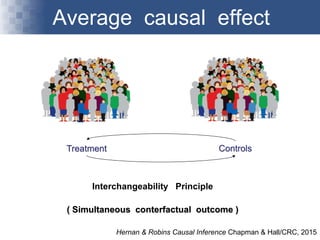
Interchangeability Principle
( Simultaneous conterfactual outcome )
Hernan & Robins Causal Inference Chapman & Hall/CRC, 2015
Treatment Controls
Mediation
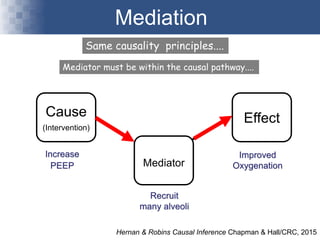
Hernan & Robins Causal Inference Chapman & Hall/CRC, 2015
Increase
PEEP
Improved
Oxygenation
Recruit
many alveoli
Mediator must be within the causal pathway....
Cause
(Intervention)
Mediator
Effect
Same causality principles....
Mediation
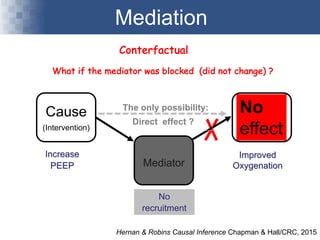
Hernan & Robins Causal Inference Chapman & Hall/CRC, 2015
Increase
PEEP
Improved
Oxygenation
Recruit
many alveoli
Cause
(Intervention)
Effect
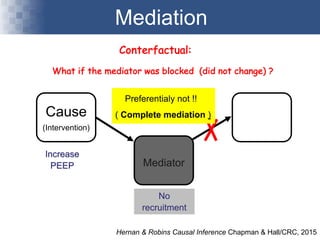
Conterfactual:
No
effect
Mediator
What if the mediator was blocked (did not change) ?
No
recruitment
The only possibility:
Direct effect ?
Mediation
Hernan & Robins Causal Inference Chapman & Hall/CRC, 2015
Increase
PEEP
Recruit
many alveoli
Cause
(Intervention)
Effect
Conterfactual:
Mediator
What if the mediator was blocked (did not change) ?
No
recruitment
Preferentialy not !!
( Complete mediation )
Mediation
Hernan & Robins Causal Inference Chapman & Hall/CRC, 2015
Cause
(Intervention)
Effect
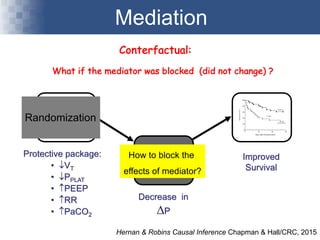
Conterfactual:
Mediator
What if the mediator was blocked (did not change) ?
Protective package:
• ¯VT
• ¯PPLAT
• ­PEEP
• ­RR
• ­PaCO2
Improved
Survival
Decrease in
∆P
How to block the
effects of mediator?
Randomization
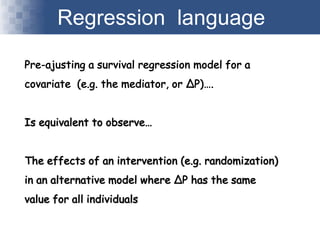
Regression language
Pre-ajusting a survival regression model for a
covariate (e.g. the mediator, or ∆P)….
Is equivalent to observe…
The effects of an intervention (e.g. randomization)
in an alternative model where ∆P has the same
value for all individuals
Mediation
Cause
(Intervention)
Effect
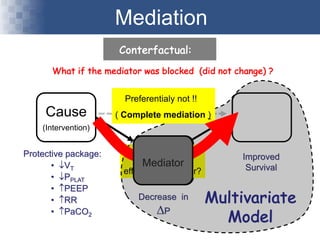
Conterfactual:
Mediator
What if the mediator was blocked (did not change) ?
Direct effect ?
Protective package:
• ¯VT
• ¯PPLAT
• ­PEEP
• ­RR
• ­PaCO2
Improved
Survival
Decrease in
∆P
How to block the
effects of mediator?
Multivariate
Model
Preferentialy not !!
( Complete mediation )
Mediator
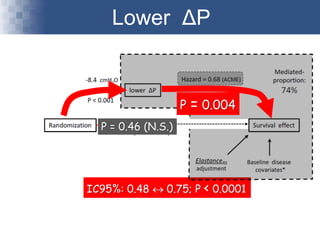
Lower ΔP
IC95%: 0.48 « 0.75; P < 0.0001
P = 0.004
P = 0.46 (N.S.)
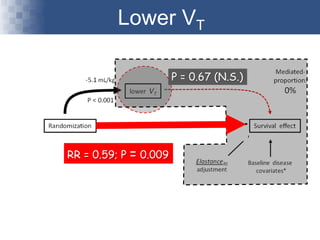
Lower VT
RR = 0.59; P = 0.009
P = 0.67 (N.S.)
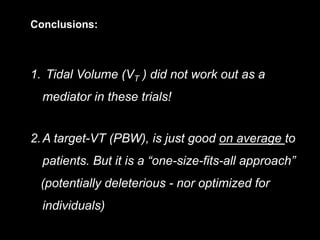
Conclusions:
1. Tidal Volume (VT ) did not work out as a
mediator in these trials!
2.A target-VT (PBW), is just good on average to
patients. But it is a “one-size-fits-all approach”
(potentially deleterious - nor optimized for
individuals)
35 cmH O2
P =p l
15
spulmonary:
20 cmH O2
P =p l
-5
35 cmH O2
Transpulmonary:
40 cmH O2
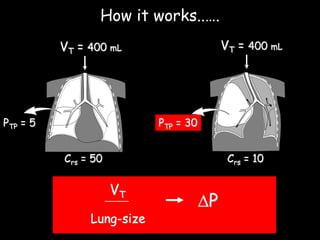
VT
DP
VT = 400 mL VT = 400 mL
PTP = 5 PTP = 30
Crs = 10Crs = 50
How it works..….
Lung-size
Thank you !

Mechanical Ventilation in Critical Care: Why driving pressure matters

  • 1.
    Why Driving-Pressure Matters MarceloB. P. Amato University of São Paulo, Brazil DasSMACC, Berlin, June 2017
  • 2.
    Special Article Driving Pressureand Survival in the Acute Respiratory Distress Syndrome Marcelo B.P. Amato, M.D., Maureen O. Meade, M.D., Arthur S. Slutsky, M.D., Laurent Brochard, M.D., Eduardo L.V. Costa, M.D., David A. Schoenfeld, Ph.D., Thomas E. Stewart, M.D., Matthias Briel, M.D., Daniel Talmor, M.D., M.P.H., Alain Mercat, M.D., Jean-Christophe M. Richard, M.D., Carlos R.R. Carvalho, M.D., and Roy G. Brower, M.D. N Engl J Med Volume 372(8):747-755 February 19, 2015
  • 3.
  • 4.
  • 5.
  • 6.
  • 7.
  • 9.
    VOLUME 338 February,5 NUMBER 6 1998
  • 10.
  • 12.
    Dreyfuss et al(1988) Am Rev Respir Dis;137: 1159-1164 Volutrauma or Barotrauma ? Neither of both…. (Transpulmonary) Driving pressures !!
  • 13.
    LIM 09 -HCFMUSP Mental Experiment…. ( Einstein’s elevator )
  • 14.
    35 cmH O2 P=p l 15 spulmonary: 20 cmH O2 P =p l -5 35 cmH O2 Transpulmonary: 40 cmH O2 VT CRS DV DV DP DP VT = 400 mL VT = 400 mL PTP = 4 PTP = 36 VT is important? Crs = 10Crs = 50 (CCW = 100) Scale your VT…. VT = 400 mL ∆P = 8 cmH2O VT = 400 mL ∆P = 40 cmH2O Lung-size ERS = EL+ ECW ( 1 / CRS) = (1 / CL) + (1 / CCW) Patient 1: CL = 100; PL = 400/100 = 4 cmH2O Patient 2: CL = 11; PL = 400 / 11 = 36 cmH2O During controlled MV, If ∆PL (Transpulmonary) increases, Þ ∆P increases…..
  • 15.
    LIM 09 -HCFMUSP Anesthesia Left-Lung Ventilation VT = 6 mL/kg PPLAT = 29 cmH2O PEEP = 0 cmH2O DP = 29 cmH2O !!!!!
  • 16.
    Amato et al. 1998 (N= 53) Brochard et al. Brower et al. Stewart et al. 1998-1999 (N = 288) ARDSnet 2000 (N = 861) Alveoli 2004 (N = 545) Express LOVS Talmor et al. 2008 (N = 1811) TOTAL 2013 (N = 3562) time1998 2012
  • 17.
    Because of terribleoffenses to God , Sisyphus was condemned to repeat forever the same meaningless task of pushing an enormous rock up a mountain, only to see it roll down again…
  • 18.
    0 1 23 4 5 0 10 20 30 40 0 1 2 3 4 5 0 10 20 30 40 30 20 40 10 0 1.4 1 0.7 Airwaypressure(cmH2O)AdjustedRelatibveRisk) N = 3080 MultivariateRisk
  • 19.
  • 20.
    0 1 23 4 5 0 10 20 30 40 0 1 2 3 4 5 0 10 20 30 40 ? 30 20 40 10 0 1.4 1 0.7 Airwaypressure(cmH2O)AdjustedRelatibveRisk) N = 3080 MultivariateRisk
  • 21.
    1. Cyclic vs.Absolute deformation …watch your ∆P , not PPLAT
  • 22.
    Relative Risk ofDeath in the Hospital versus ΔP in the Combined Cohort after Multivariate Adjustment. Amato MBP et al. N Engl J Med 2015;372:747-755
  • 23.
    1. Cyclic vs.Absolute deformation …watch your ∆P , not PPLAT 2. Pressure swings vs. Volume swings ? ( ∆P or ∆V ) ?
  • 24.
    LIM 09 -HCFMUSP Grafico driving pressure
  • 25.
    LIM 09 -HCFMUSP Grafico driving pressure
  • 26.
    DRIVING-PRESSURE 5 10 15 20 25 30 35 PLATEAU-PRESSURE 0 5 10 15 20 25 30 35 RESAMPLING : MATCHEDPPLAT , QUINTILES OF DP 0 1 2 3 4 5 6 RELATIVE-RISK(adjusted) 0.6 0.8 1.0 1.2 1.4 1.6 Plateau–Pressure (cmH2O) Resampling: matched PPLAT , decreasing quintiles of ∆P Decreasing ∆P P < 0.0001 ? Driving-Pressure RelativeRisk (multivariate)
  • 27.
    TIDAL-VOLUME 4 6 8 10 12 14 PLATEAU-PRESSURE 0 5 10 15 20 25 30 35 RESAMPLING : MATCHEDPPLAT , QUINTILES OF VT 0 1 2 3 4 5 6 RELATIVE-RISK(adjusted) 0.6 0.8 1.0 1.2 1.4 1.6 Resampling: matched PPLAT , decreasing quintiles of VT Decreasing VT P = 0.92 ? TIDAL-VOLUME Plateau–Pressure (cmH2O) RelativeRisk (multivariate)
  • 28.
    P < 0.0001 Odds-ratioforBarotrauma (adjusted*) *:pre-adjusted for age, APACHE/SAPS risk, arterial-pH, P/F ratio and study-trial (multivariate logistic regression where both ∆P and VT co-participate in Model-1) Odds for Barotrauma across quintiles of ∆P or VT: - Combined population of ARDS ( N = 3080 ) Figure 2d: 4 8 12 16 20 24 28 0.6 1.0 1.4 1.8 2.2 P < 0.0001 Driving-pressure (∆P, cmH2O) Odds-ratioforBarotrauma (adjusted*) *: pre-adjusted for age, APACHE/SAPS risk, arterial-pH, P/F ratio and study-trial (VT and ∆P co-participating in model-1 ) 4 6 8 10 12 0.6 1.0 1.4 1.8 2.2 P = 0.87 Tidal-Volume (VT , mL/kg.PBW) Odds-ratioforBarotrauma (adjusted*) *: pre-adjusted for age, APACHE/SAPS risk, arterial-pH, P/F ratio and study-trial (VT and ∆P co-participating in model-1) Driving-pressure (∆P, cmH2O) 4 8 12 16 20 24 28 Tidal-Volume (VT , mL/kg[PBW] ) 4 6 12108 P < 0.0001 P = 0.87
  • 29.
    DP = markerof severity of ALI ? DP = DV Crs
  • 30.
    DP = disease-∆P+ superimposed-∆P LOW Crs Randomization (changes in ventilator settings) P < 0.0001 P < 0.0001 Mediation Analysis - intuition -
  • 31.
    related to randomization related tobaseline compliance (severity of disease) { Highest decile of compliance { Lowest decile2nd to 9th deciles… 25 45 5 Drivingpressure(cmH2O) Control arm Treatment Average exposure to ΔP Observed Risk ( across decile B. Variations in ΔP driven by differences in baseline lung compliance A. The two main components of ΔP variation: pliance 9 10 Treatment arm Control arm Lowest decile of compliance 2nd to 9th deciles… Highest decile P < 0.0001 related to randomization related to baseline compliance (severity of disease) { Highest decile of compliance { Lowest decile2nd to 9th deciles… 25 45 5 Drivingpressure(cmH2O) Control arm Treatment Average exposure to ΔP Observed Risk ( acros B. Variations in ΔP driven by differences in baseline lung compliance A. The two main components of ΔP variation: pliance 9 10 Treatment a Control arm Lowest decile of compliance 2nd to 9th deciles… Highest decile P < 0.0 related to randomization related to baseline compliance (severity of disease){ Highest decile of compliance { Lowest decile2nd to 9th deciles… 25 45 5 Drivingpressure(cmH2O) Control arm Treatment Average exposure to ΔP Observed Risk ( acros B. Variations in ΔP driven by differences in baseline lung compliance A. The two main components of ΔP variation: nce 10 Treatment a Control arm Lowest decile of compliance 2nd to 9th deciles… Highest decile related to randomization related to baseline compliance (severity of disease){ Highest decile of compliance { Lowest decile2nd to 9th deciles… 25 45 5 Drivingpressure(cmH2O) Control arm Treatment Average exposure to ΔP Observed Risk ( across d B. Variations in ΔP driven by differences in baseline lung compliance A. The two main components of ΔP variation: liance 9 10 Treatment arm Control arm Lowest decile of compliance 2nd to 9th deciles… Highest decile
  • 32.
    Disciplina de Pneumologia- InCor HC FMUSP Causality and Mediation
  • 33.
    Causality Cause Effect • Ifthe cause is withheld… Counterfactual outcome (≠ real outcome) No effect • Precedes the effect Hernán MA & Robins JM . Causal Inference 2012
  • 34.
    Lung transplantation forMr. Marty ( performed 4 years ago ) Michael J. Fox But what if he had not received the lung ?? He is alive today!!Dr. Emmett (Christopher Lloyd)
  • 35.
  • 36.
    Causality Cause Effect • Precedesthe effect • Counterfactual outcome ≠ Real outcome Hernán MA & Robins JM . Causal Inference 2012 • But, in real life, there is only one real outcome per individual…. No effect • Counterfact is not observable….
  • 37.
    Average causal effect InterchangeabilityPrinciple ( Simultaneous conterfactual outcome ) Hernan & Robins Causal Inference Chapman & Hall/CRC, 2015 Treatment Controls
  • 38.
    Mediation Hernan & RobinsCausal Inference Chapman & Hall/CRC, 2015 Increase PEEP Improved Oxygenation Recruit many alveoli Mediator must be within the causal pathway.... Cause (Intervention) Mediator Effect Same causality principles....
  • 39.
    Mediation Hernan & RobinsCausal Inference Chapman & Hall/CRC, 2015 Increase PEEP Improved Oxygenation Recruit many alveoli Cause (Intervention) Effect Conterfactual: No effect Mediator What if the mediator was blocked (did not change) ? No recruitment The only possibility: Direct effect ?
  • 40.
    Mediation Hernan & RobinsCausal Inference Chapman & Hall/CRC, 2015 Increase PEEP Recruit many alveoli Cause (Intervention) Effect Conterfactual: Mediator What if the mediator was blocked (did not change) ? No recruitment Preferentialy not !! ( Complete mediation )
  • 41.
    Mediation Hernan & RobinsCausal Inference Chapman & Hall/CRC, 2015 Cause (Intervention) Effect Conterfactual: Mediator What if the mediator was blocked (did not change) ? Protective package: • ¯VT • ¯PPLAT • ­PEEP • ­RR • ­PaCO2 Improved Survival Decrease in ∆P How to block the effects of mediator? Randomization
  • 42.
    Regression language Pre-ajusting asurvival regression model for a covariate (e.g. the mediator, or ∆P)…. Is equivalent to observe… The effects of an intervention (e.g. randomization) in an alternative model where ∆P has the same value for all individuals
  • 43.
    Mediation Cause (Intervention) Effect Conterfactual: Mediator What if themediator was blocked (did not change) ? Direct effect ? Protective package: • ¯VT • ¯PPLAT • ­PEEP • ­RR • ­PaCO2 Improved Survival Decrease in ∆P How to block the effects of mediator? Multivariate Model Preferentialy not !! ( Complete mediation ) Mediator
  • 44.
    Lower ΔP IC95%: 0.48« 0.75; P < 0.0001 P = 0.004 P = 0.46 (N.S.)
  • 45.
    Lower VT RR =0.59; P = 0.009 P = 0.67 (N.S.)
  • 46.
    Conclusions: 1. Tidal Volume(VT ) did not work out as a mediator in these trials! 2.A target-VT (PBW), is just good on average to patients. But it is a “one-size-fits-all approach” (potentially deleterious - nor optimized for individuals)
  • 47.
    35 cmH O2 P=p l 15 spulmonary: 20 cmH O2 P =p l -5 35 cmH O2 Transpulmonary: 40 cmH O2 VT DP VT = 400 mL VT = 400 mL PTP = 5 PTP = 30 Crs = 10Crs = 50 How it works..…. Lung-size
  • 48.