


JOURNAL CLUB
PRESENTATION BY:DR.ABHINAV KUMAR
MODERATOR:DR.SANJAY KULKARNI
TITLE
• Noninvasive ventilation as a weaning strategy
for mechanical ventilation in adults with
respiratory failure: a Cochrane systematic review
• Karen E.A. Burns MD MSc, Maureen O. Meade MD MSc, Azra Premji MSc
RRT, Neill K.J. Adhikari MDCM MSc
• CANADIAN MEDICAL ASSOCIATION JOURNAL, February 18,
2014
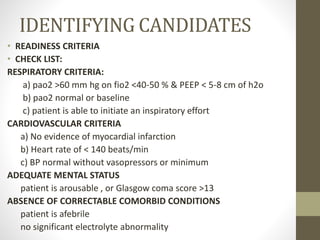
IDENTIFYING CANDIDATES
• READINESS CRITERIA
• CHECK LIST:
RESPIRATORY CRITERIA:
a) pao2 >60 mm hg on fio2 <40-50 % & PEEP < 5-8 cm of h2o
b) pao2 normal or baseline
c) patient is able to initiate an inspiratory effort
CARDIOVASCULAR CRITERIA
a) No evidence of myocardial infarction
b) Heart rate of < 140 beats/min
c) BP normal without vasopressors or minimum
ADEQUATE MENTAL STATUS
patient is arousable , or Glasgow coma score >13
ABSENCE OF CORRECTABLE COMORBID CONDITIONS
patient is afebrile
no significant electrolyte abnormality
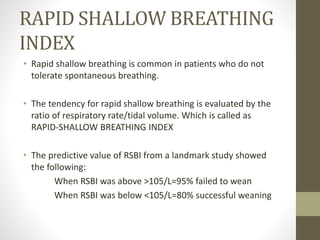
RAPID SHALLOW BREATHING
INDEX
• Rapid shallow breathing is common in patients who do not
tolerate spontaneous breathing.
• The tendency for rapid shallow breathing is evaluated by the
ratio of respiratory rate/tidal volume. Which is called as
RAPID-SHALLOW BREATHING INDEX
• The predictive value of RSBI from a landmark study showed
the following:
When RSBI was above >105/L=95% failed to wean
When RSBI was below <105/L=80% successful weaning
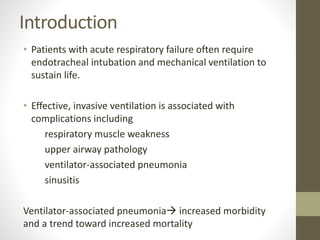
Introduction
• Patients with acute respiratory failure often require
endotracheal intubation and mechanical ventilation to
sustain life.
• Effective, invasive ventilation is associated with
complications including
respiratory muscle weakness
upper airway pathology
ventilator-associated pneumonia
sinusitis
Ventilator-associated pneumonia increased morbidity
and a trend toward increased mortality
• Noninvasive ventilation may provide a means of reducing the
duration of invasive mechanical support for patients with
acute respiratory failure.
• Noninvasive ventilation is delivered with an oro-nasal, nasal or
total face mask, or a helmet, connected to a ventilator, and
does not require an artificial airway.
• Augment inhaled volume and apply extrinsic positive end-
expiratory pressure to counteract intrinsic positive end-
expiratory pressure, similar to invasive ventilation.
• Noninvasive ventilation  augment tidal volume, reduce breathing
frequency, rest the muscles of respiration and improve gas exchange.
• Randomized controlled trials (RCTs) and meta- analyses  decreases
mortality and intubation rates compared with standard medical
treatment alone in the treatment of acute exacerbations of chronic
obstructive pulmonary disease (COPD)
• Many patients undergo intubation when non- invasive ventilation has
failed or is contraindicated.
• Role of noninvasive ventilation in weaning, replacing invasive support
with Noninvasive support in patients who are ready to be weaned
but not yet ready for mechanical ventilation to be removed.
no artificial air- way is used
the cough reflex is preserved
risk for ventilator- associated pneumonia is reduced
• Noninvasive weaning may reduce the
Requirement for sedation
decrease psychological distress
permit speech and oral intake
• With noninvasive weaning,
anticipate drying of secretions
only partial ventilatory support can be provided
forfeit a protected airway
• A recent guideline suggested that noninvasive ventilation
could be used to facilitate early liberation from mechanical
ventilation in patients who have COPD at centers with
expertise in its use
Objective
• Critically appraise, summarize and update a systematic review
and meta-analysis of the effect of noninvasive weaning
compared with invasive weaning on important outcomes in
light of new evidence.
Materials and Methods
Data sources and search criteria:
• MEDLINE (January 1966 to May 2013)
• Embase (January 1980 to May 2013) via OvidSP, the Cochrane
Central Register of Controlled Trials (CENTRAL)
Study selection
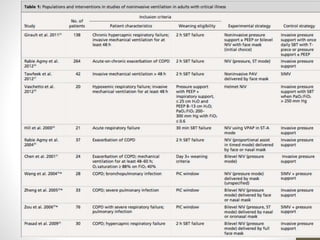
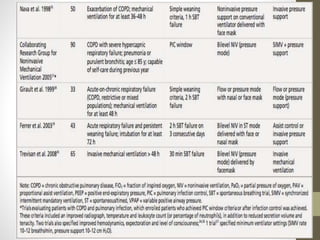
• Randomized and quasirandomized trials that enrolled adults with
respiratory failure who required invasive mechanical ventilation
for at least 24 hours, compared extubation with immediate
application of noninvasive ventilation with continued invasive
weaning and reported at least one of the following outcomes:
mortality (primary out- come)
ventilator-associated pneumonia
weaning failure
length of stay in the intensive care unit (ICU) or hospital
total duration of ventilation
duration of ventilation related to weaning
Duration of invasive ventilation
adverse events or quality of life
EXCLUSION CRITERIA
• compared noninvasive weaning with invasive weaning in the
immediate postoperative setting
• compared noninvasive ventilation with unassisted oxygen
supplementation or
• investigated noninvasive ventilation after unplanned extubation.
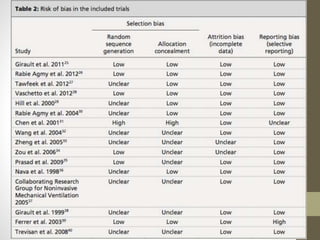
Data extraction and quality assessment
• Two authors (KB, NA), unblinded to the source of the reports,
abstracted data regarding study methods (randomization, allocation
concealment, completeness of follow-up, selective out- comes
reporting) using a standardized form.
Data synthesis and statistical
analysis:
• Pooled data across studies using random effects models.
• Derived summary estimates of risk ratio (RR) and mean
difference (MD) with 95% confidence intervals (CIs) for binary
and continuous outcomes, respectively, using Review Manager
5.1.6.If an outcome was reported at 2 different times,
included the more protracted measure in pooled analyses
• Planned subgroup analyses to compare the effects of
noninvasive weaning on mortality and weaning failure in
studies including only patients with COPD with the effects
seen in studies involving patients without COPD or mixed
populations.
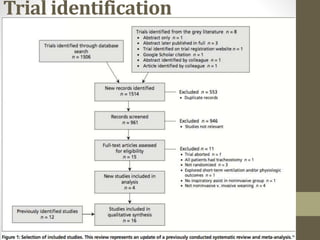
Trial identification
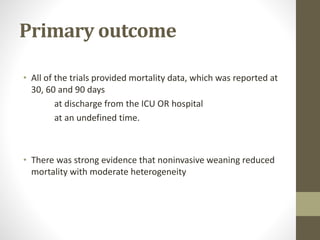
Primary outcome
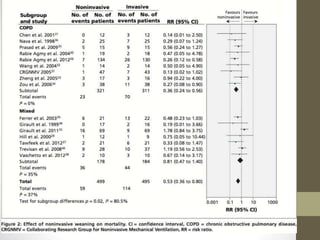
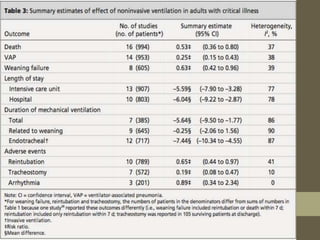
• All of the trials provided mortality data, which was reported at
30, 60 and 90 days
at discharge from the ICU OR hospital
at an undefined time.
• There was strong evidence that noninvasive weaning reduced
mortality with moderate heterogeneity
Secondary outcomes
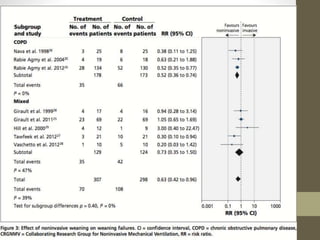
• Eight trials involving 605 patients, using variable definitions,
reported the proportion of patients successfully weaned.
• The pooled data showed a significant reduction in the
proportion of weaning failures using noninvasive weaning with
moderate heterogeneity
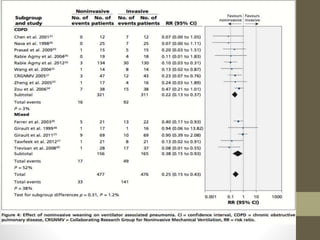
• Pooled data from 14 trials (involving 953 patients) that
reported ventilator-associated pneumonia showed that
noninvasive weaning was associated with decreased
ventilator-associated pneumonia with moderate
heterogeneity.
• Noninvasive weaning significantly reduced the length of stay in
both the ICU and the hospital
• the total duration of mechanical ventilation
• duration of invasive ventilation
• Non- invasive weaning had no effect on the duration of
mechanical ventilation related to weaning.
• None of the included studies reported on quality of life
Adverse events
The pooled result showed
no difference in arrhythmias but
significantly lower rates of re-intubation & tracheostomy
Interpretation
• Compared with invasive weaning, noninvasive weaning significantly
decreased
mortality,
rates of weaning failures and
ventilator-associated pneumonia,
length of stay in the ICU or hospital,
total duration of mechanical ventilation
duration of invasive ventilation.
• Noninvasive weaning had no effect on the duration of mechanical
ventilation related to weaning, it significantly reduced tracheostomy
and reintubation rates.
• Subgroup analyses suggested that the benefits of noninvasive
weaning to mortality were significantly greater in trials exclusively
enrolling patients with COPD than in trials enrolling mixed
populations.
• Patients with chronic airflow limitation may be ideally suited
to noninvasive ventilation given its ability to
offset respiratory muscle fatigue and tachypnea,
augment tidal volume
reduce intrinsic positive end-expiratory pressure.
• Subgroup analyses for mortality suggested non-invasive
weaning conferred significantly greater benefits in patients
with COPD.
TAKE HOME MESSAGE
• Non-invasive weaning
reduces mortality
pneumonia without increasing the risk of weaning failure
Reintubation.
• Sub- group analysis, noninvasive weaning significantly reduced
mortality in studies involving patients with COPD compared
with studies involving mixed populations.
REFRENCES
• THE ICU BOOK--PAUL.L MARINO
• Pingleton SK. Complications of acute respiratory failure. Am Rev
Respir Dis 1988;137:1463-93.
• Niederman MS, Ferranti RD, Ziegler A, et al. Respiratory infec- tion
complicating long-term tracheostomy: the implication of persistent
gram-negative tracheobronchial colonization. Chest 1984;85:39-44.
• Heyland DK, Cook DJ, Griffith L, et al. The attributable morbid- ity
and mortality of ventilator associated pneumonia in the criti- cally ill
patient. The Canadian Critical Care Trials Group. Am J Respir Crit
Care Med 1999;159:1249-56.
• MacIntyre NR, Cook DJ, Ely EW, et al. Evidence-based guide- lines for
weaning and discontinuing ventilatory support. A col- lective task
force facilitated by the American College of Chest Physicians; the
American Association for Respiratory Care; and the American
College of Critical Care Medicine. Chest 2001; 120(Suppl 6):375S-
95S.
NON INVASIVE VENTILATION

NON INVASIVE VENTILATION

  • 1.
    JOURNAL CLUB PRESENTATION BY:DR.ABHINAVKUMAR MODERATOR:DR.SANJAY KULKARNI
  • 2.
    TITLE • Noninvasive ventilationas a weaning strategy for mechanical ventilation in adults with respiratory failure: a Cochrane systematic review • Karen E.A. Burns MD MSc, Maureen O. Meade MD MSc, Azra Premji MSc RRT, Neill K.J. Adhikari MDCM MSc • CANADIAN MEDICAL ASSOCIATION JOURNAL, February 18, 2014
  • 3.
    IDENTIFYING CANDIDATES • READINESSCRITERIA • CHECK LIST: RESPIRATORY CRITERIA: a) pao2 >60 mm hg on fio2 <40-50 % & PEEP < 5-8 cm of h2o b) pao2 normal or baseline c) patient is able to initiate an inspiratory effort CARDIOVASCULAR CRITERIA a) No evidence of myocardial infarction b) Heart rate of < 140 beats/min c) BP normal without vasopressors or minimum ADEQUATE MENTAL STATUS patient is arousable , or Glasgow coma score >13 ABSENCE OF CORRECTABLE COMORBID CONDITIONS patient is afebrile no significant electrolyte abnormality
  • 4.
    RAPID SHALLOW BREATHING INDEX •Rapid shallow breathing is common in patients who do not tolerate spontaneous breathing. • The tendency for rapid shallow breathing is evaluated by the ratio of respiratory rate/tidal volume. Which is called as RAPID-SHALLOW BREATHING INDEX • The predictive value of RSBI from a landmark study showed the following: When RSBI was above >105/L=95% failed to wean When RSBI was below <105/L=80% successful weaning
  • 5.
    Introduction • Patients withacute respiratory failure often require endotracheal intubation and mechanical ventilation to sustain life. • Effective, invasive ventilation is associated with complications including respiratory muscle weakness upper airway pathology ventilator-associated pneumonia sinusitis Ventilator-associated pneumonia increased morbidity and a trend toward increased mortality
  • 6.
    • Noninvasive ventilationmay provide a means of reducing the duration of invasive mechanical support for patients with acute respiratory failure. • Noninvasive ventilation is delivered with an oro-nasal, nasal or total face mask, or a helmet, connected to a ventilator, and does not require an artificial airway. • Augment inhaled volume and apply extrinsic positive end- expiratory pressure to counteract intrinsic positive end- expiratory pressure, similar to invasive ventilation.
  • 7.
    • Noninvasive ventilation augment tidal volume, reduce breathing frequency, rest the muscles of respiration and improve gas exchange. • Randomized controlled trials (RCTs) and meta- analyses  decreases mortality and intubation rates compared with standard medical treatment alone in the treatment of acute exacerbations of chronic obstructive pulmonary disease (COPD) • Many patients undergo intubation when non- invasive ventilation has failed or is contraindicated. • Role of noninvasive ventilation in weaning, replacing invasive support with Noninvasive support in patients who are ready to be weaned but not yet ready for mechanical ventilation to be removed. no artificial air- way is used the cough reflex is preserved risk for ventilator- associated pneumonia is reduced
  • 8.
    • Noninvasive weaningmay reduce the Requirement for sedation decrease psychological distress permit speech and oral intake • With noninvasive weaning, anticipate drying of secretions only partial ventilatory support can be provided forfeit a protected airway • A recent guideline suggested that noninvasive ventilation could be used to facilitate early liberation from mechanical ventilation in patients who have COPD at centers with expertise in its use
  • 9.
    Objective • Critically appraise,summarize and update a systematic review and meta-analysis of the effect of noninvasive weaning compared with invasive weaning on important outcomes in light of new evidence.
  • 10.
    Materials and Methods Datasources and search criteria: • MEDLINE (January 1966 to May 2013) • Embase (January 1980 to May 2013) via OvidSP, the Cochrane Central Register of Controlled Trials (CENTRAL)
  • 11.
    Study selection • Randomizedand quasirandomized trials that enrolled adults with respiratory failure who required invasive mechanical ventilation for at least 24 hours, compared extubation with immediate application of noninvasive ventilation with continued invasive weaning and reported at least one of the following outcomes: mortality (primary out- come) ventilator-associated pneumonia weaning failure length of stay in the intensive care unit (ICU) or hospital total duration of ventilation duration of ventilation related to weaning Duration of invasive ventilation adverse events or quality of life
  • 12.
    EXCLUSION CRITERIA • comparednoninvasive weaning with invasive weaning in the immediate postoperative setting • compared noninvasive ventilation with unassisted oxygen supplementation or • investigated noninvasive ventilation after unplanned extubation. Data extraction and quality assessment • Two authors (KB, NA), unblinded to the source of the reports, abstracted data regarding study methods (randomization, allocation concealment, completeness of follow-up, selective out- comes reporting) using a standardized form.
  • 13.
    Data synthesis andstatistical analysis: • Pooled data across studies using random effects models. • Derived summary estimates of risk ratio (RR) and mean difference (MD) with 95% confidence intervals (CIs) for binary and continuous outcomes, respectively, using Review Manager 5.1.6.If an outcome was reported at 2 different times, included the more protracted measure in pooled analyses • Planned subgroup analyses to compare the effects of noninvasive weaning on mortality and weaning failure in studies including only patients with COPD with the effects seen in studies involving patients without COPD or mixed populations.
  • 14.
  • 18.
    Primary outcome • Allof the trials provided mortality data, which was reported at 30, 60 and 90 days at discharge from the ICU OR hospital at an undefined time. • There was strong evidence that noninvasive weaning reduced mortality with moderate heterogeneity
  • 20.
    Secondary outcomes • Eighttrials involving 605 patients, using variable definitions, reported the proportion of patients successfully weaned. • The pooled data showed a significant reduction in the proportion of weaning failures using noninvasive weaning with moderate heterogeneity • Pooled data from 14 trials (involving 953 patients) that reported ventilator-associated pneumonia showed that noninvasive weaning was associated with decreased ventilator-associated pneumonia with moderate heterogeneity.
  • 23.
    • Noninvasive weaningsignificantly reduced the length of stay in both the ICU and the hospital • the total duration of mechanical ventilation • duration of invasive ventilation • Non- invasive weaning had no effect on the duration of mechanical ventilation related to weaning. • None of the included studies reported on quality of life Adverse events The pooled result showed no difference in arrhythmias but significantly lower rates of re-intubation & tracheostomy
  • 25.
    Interpretation • Compared withinvasive weaning, noninvasive weaning significantly decreased mortality, rates of weaning failures and ventilator-associated pneumonia, length of stay in the ICU or hospital, total duration of mechanical ventilation duration of invasive ventilation. • Noninvasive weaning had no effect on the duration of mechanical ventilation related to weaning, it significantly reduced tracheostomy and reintubation rates. • Subgroup analyses suggested that the benefits of noninvasive weaning to mortality were significantly greater in trials exclusively enrolling patients with COPD than in trials enrolling mixed populations.
  • 26.
    • Patients withchronic airflow limitation may be ideally suited to noninvasive ventilation given its ability to offset respiratory muscle fatigue and tachypnea, augment tidal volume reduce intrinsic positive end-expiratory pressure. • Subgroup analyses for mortality suggested non-invasive weaning conferred significantly greater benefits in patients with COPD.
  • 27.
    TAKE HOME MESSAGE •Non-invasive weaning reduces mortality pneumonia without increasing the risk of weaning failure Reintubation. • Sub- group analysis, noninvasive weaning significantly reduced mortality in studies involving patients with COPD compared with studies involving mixed populations.
  • 28.
    REFRENCES • THE ICUBOOK--PAUL.L MARINO • Pingleton SK. Complications of acute respiratory failure. Am Rev Respir Dis 1988;137:1463-93. • Niederman MS, Ferranti RD, Ziegler A, et al. Respiratory infec- tion complicating long-term tracheostomy: the implication of persistent gram-negative tracheobronchial colonization. Chest 1984;85:39-44. • Heyland DK, Cook DJ, Griffith L, et al. The attributable morbid- ity and mortality of ventilator associated pneumonia in the criti- cally ill patient. The Canadian Critical Care Trials Group. Am J Respir Crit Care Med 1999;159:1249-56. • MacIntyre NR, Cook DJ, Ely EW, et al. Evidence-based guide- lines for weaning and discontinuing ventilatory support. A col- lective task force facilitated by the American College of Chest Physicians; the American Association for Respiratory Care; and the American College of Critical Care Medicine. Chest 2001; 120(Suppl 6):375S- 95S.