
DILATING THE
DOGMA OF
VASOSPASM
R. LOCH MACDONALD, M.D., Ph.D.
COMMUNITY NEUROSCIENCES INSTITUTE
FRESNO, CALIFORNIA, USA
Fresno, CA
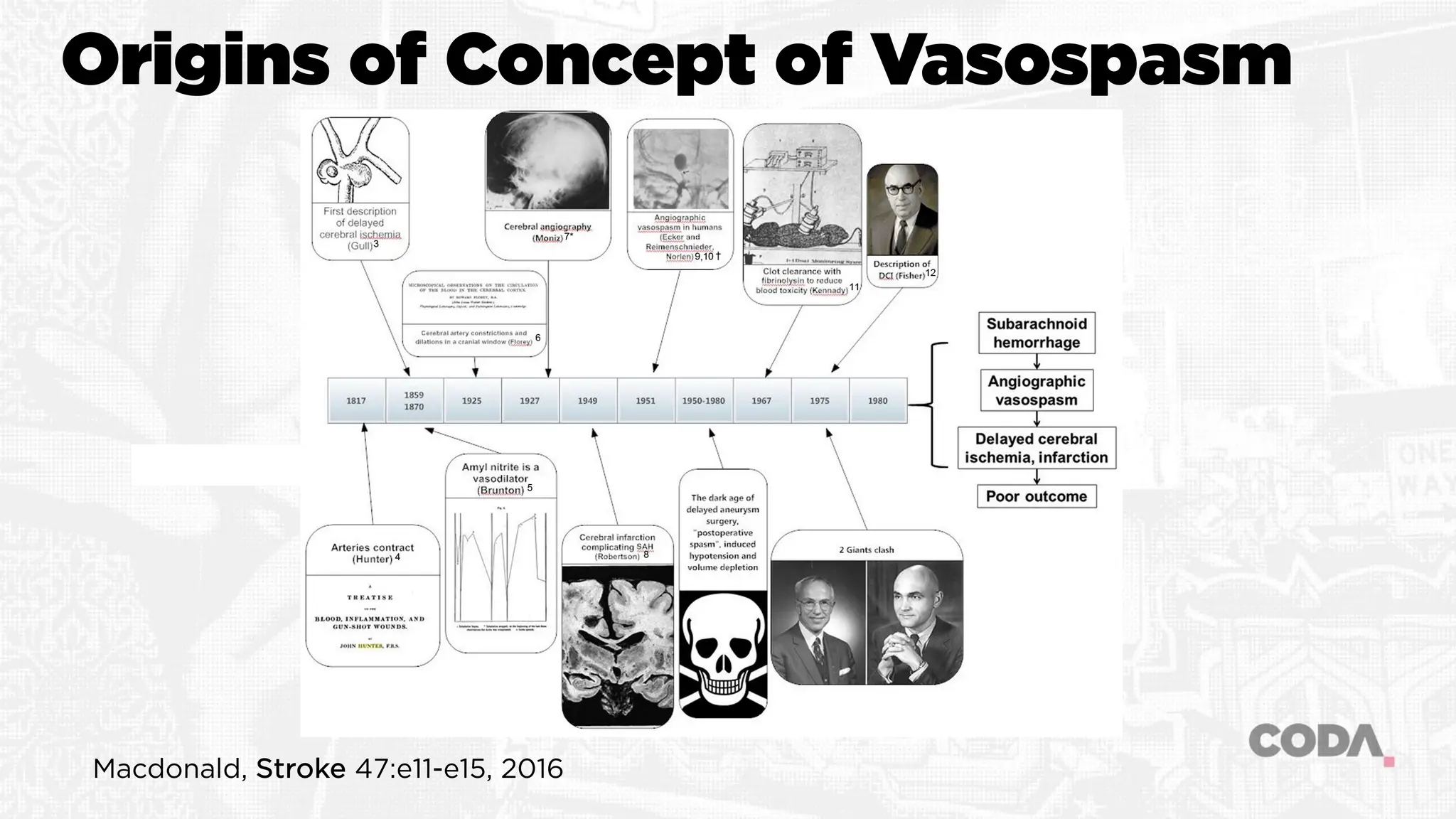
Origins of Concept of Vasospasm
Macdonald, Stroke 47:e11-e15, 2016
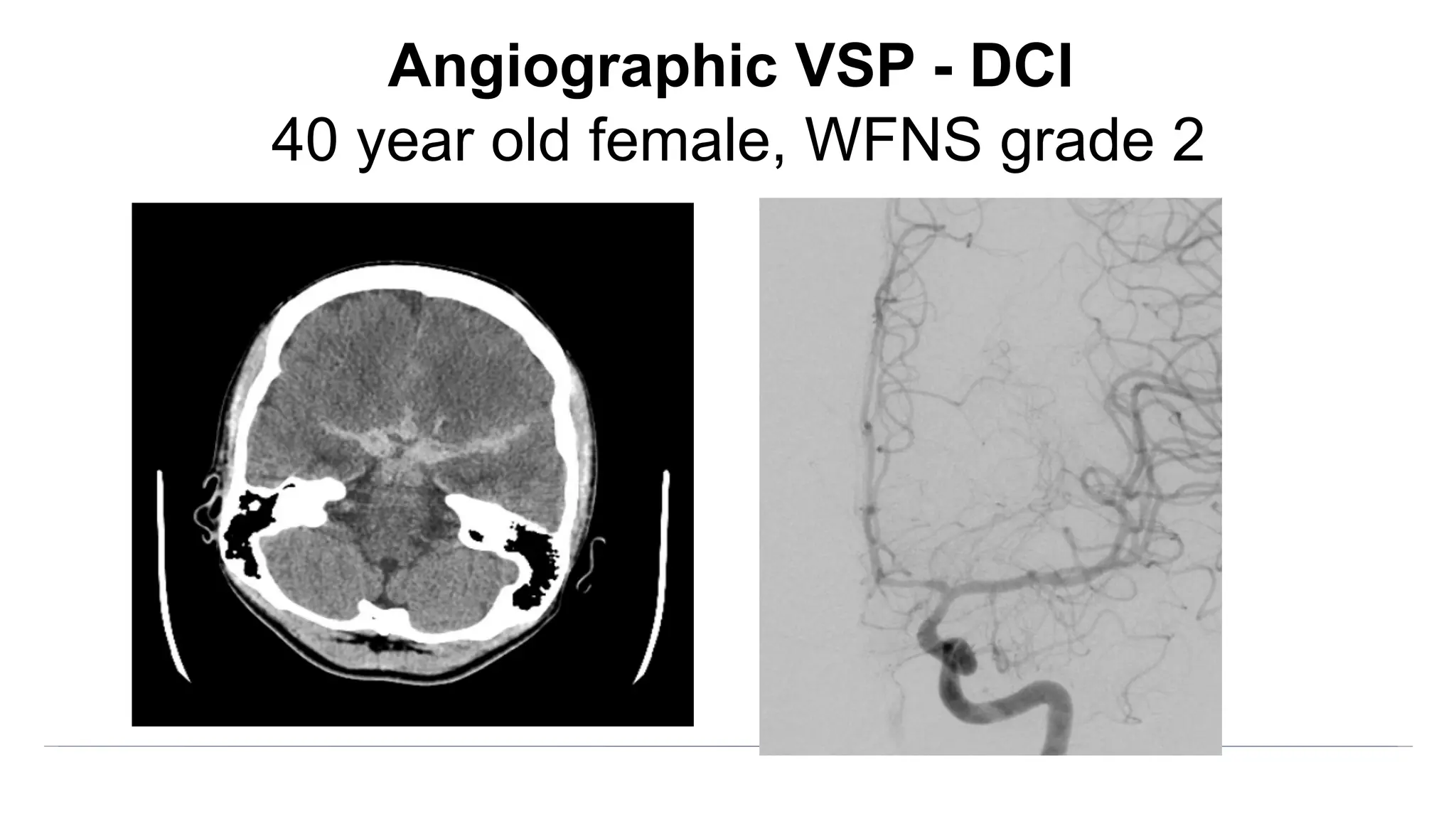
Angiographic VSP - DCI
40 year old female, WFNS grade 2
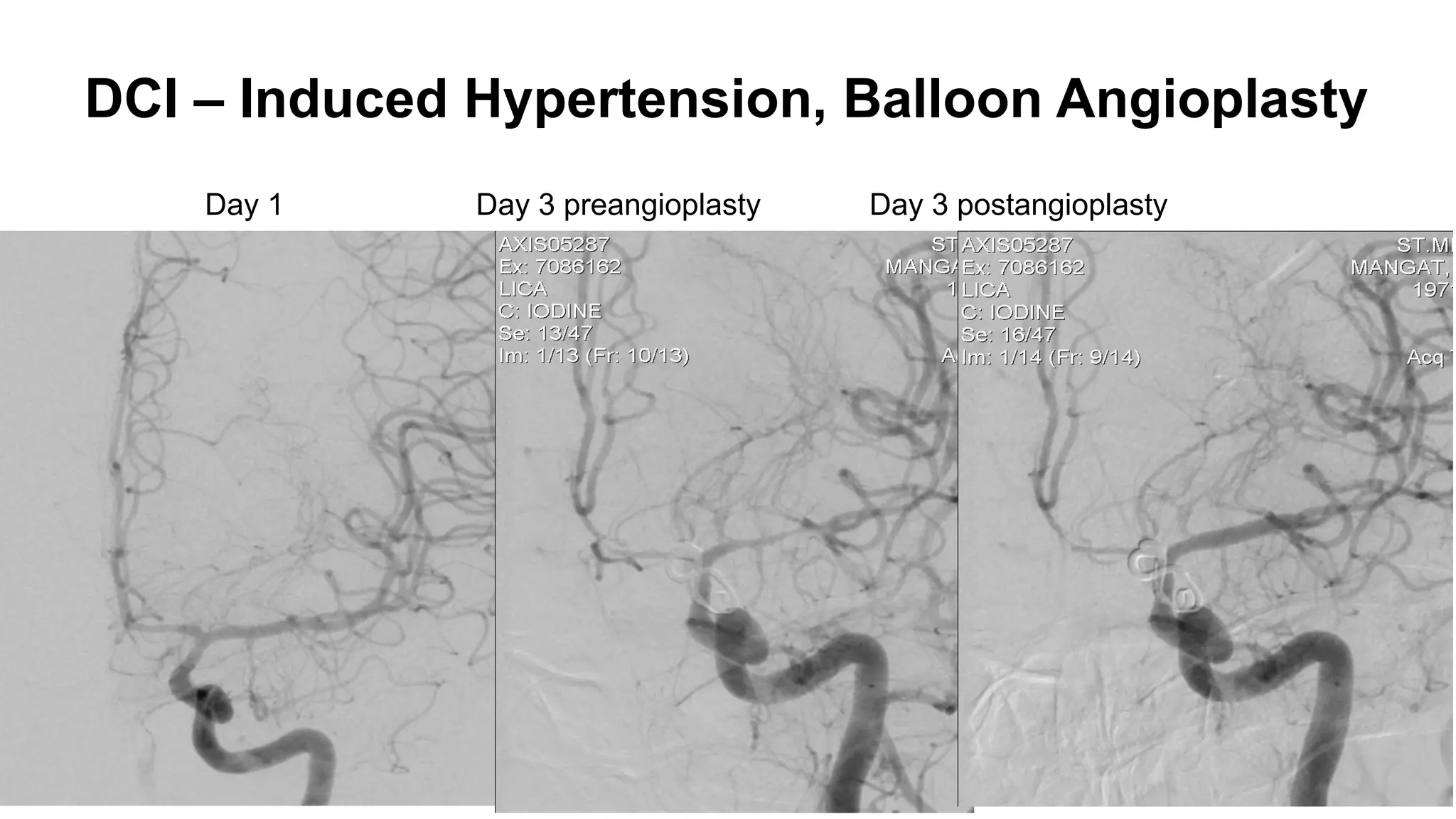
DCI – Induced Hypertension, Balloon Angioplasty
Day 1 Day 3 preangioplasty Day 3 postangioplasty
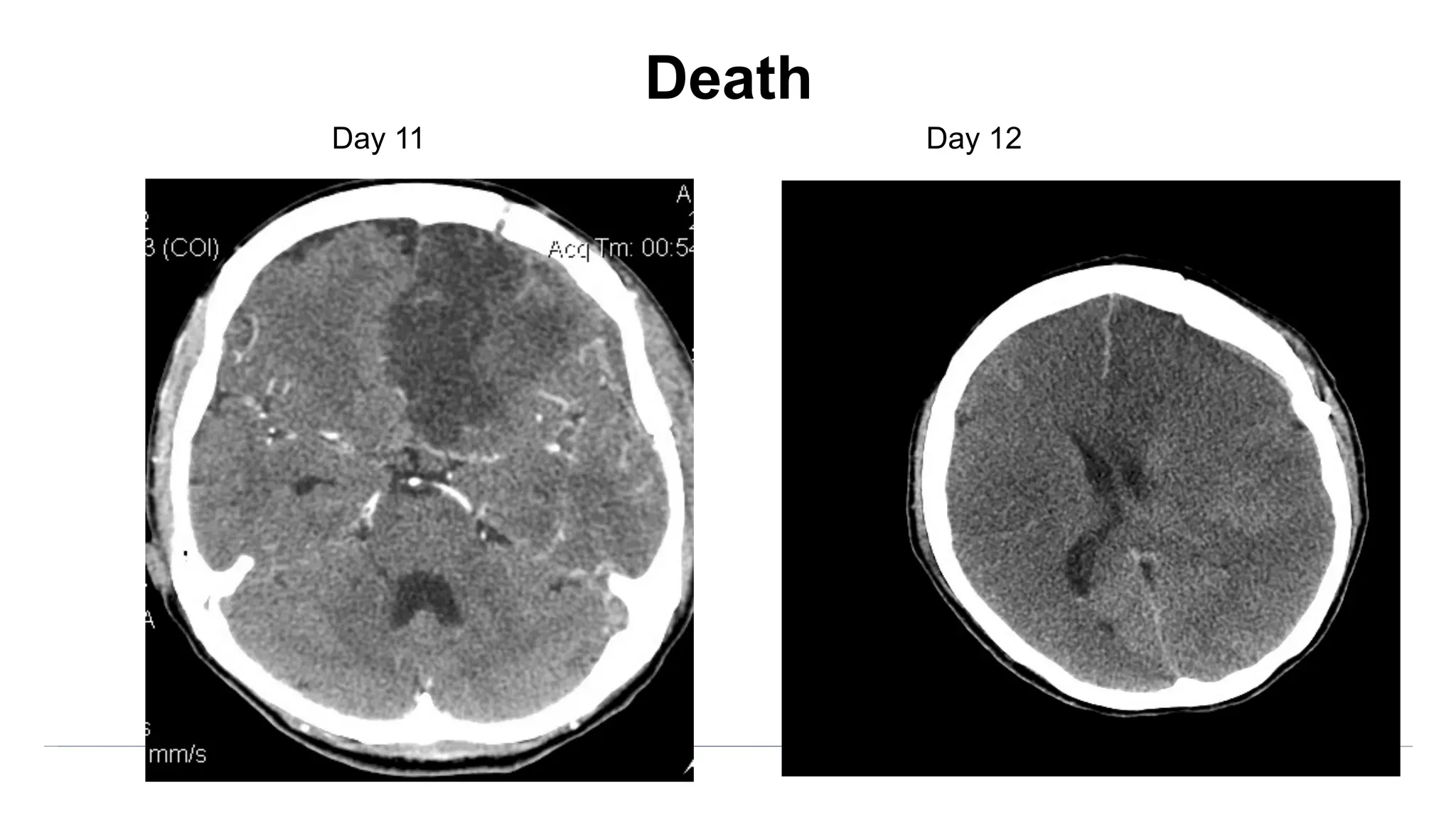
Death
Day 11 Day 12
Angiographic VSP
Blood clot leads to angiographic VSP leads to infarction and
poor outcome
Vasoconstriction of large cerebral arteries due to hemoglobin
component of subarachnoid blood
“Pharmacologic” dose response related to the location,
duration of presence and concentration of the
hemoglobin/blood clot
Subarachnoid blood leads to angiographic vasospasm (?leads
to cerebral infarction [DCI] leading to poor outcome)
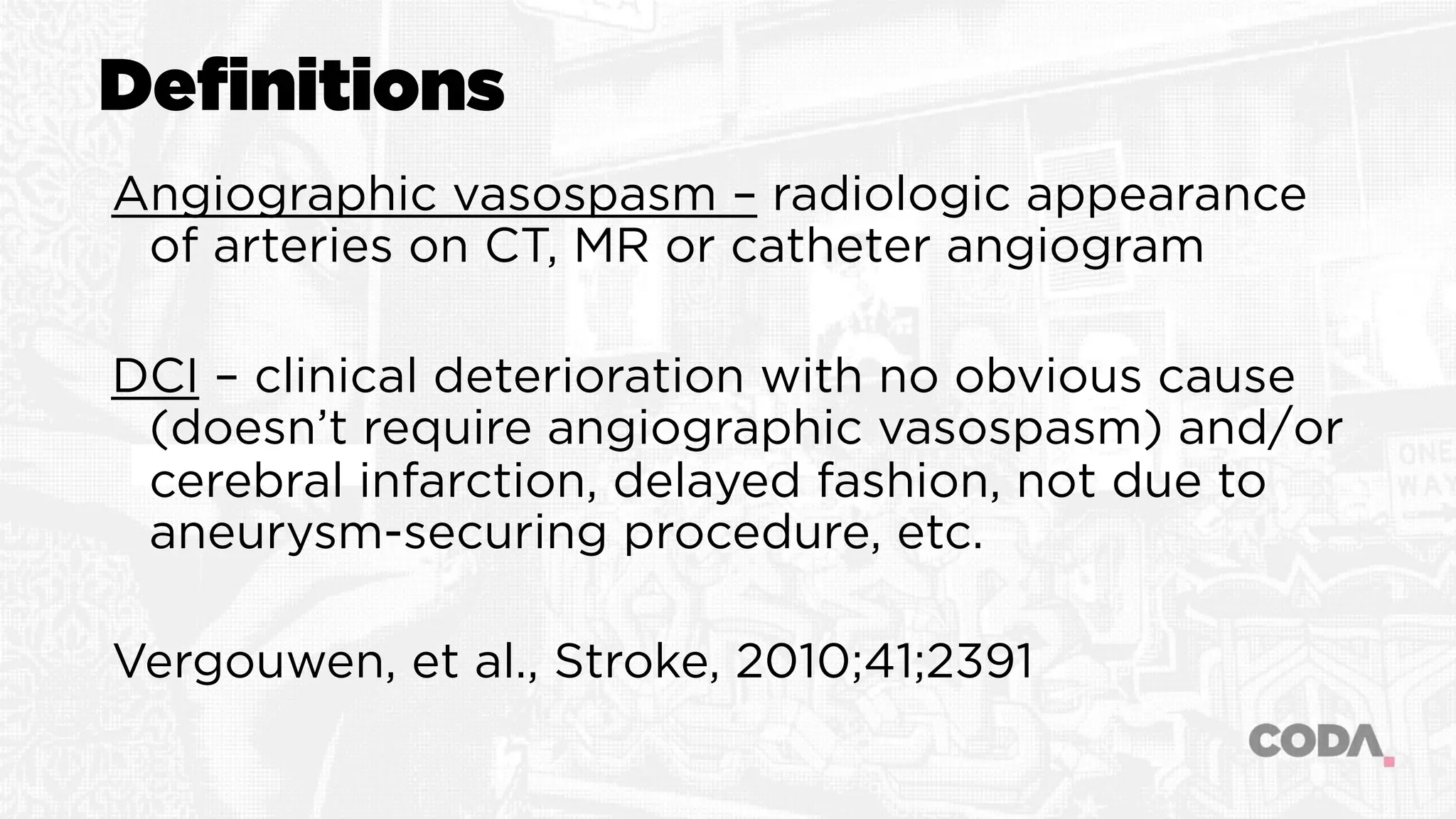
Definitions
Angiographic vasospasm – radiologic appearance
of arteries on CT, MR or catheter angiogram
DCI – clinical deterioration with no obvious cause
(doesn’t require angiographic vasospasm) and/or
cerebral infarction, delayed fashion, not due to
aneurysm-securing procedure, etc.
Vergouwen, et al., Stroke, 2010;41;2391
9
0
10
20
30
40
50
60
70
80
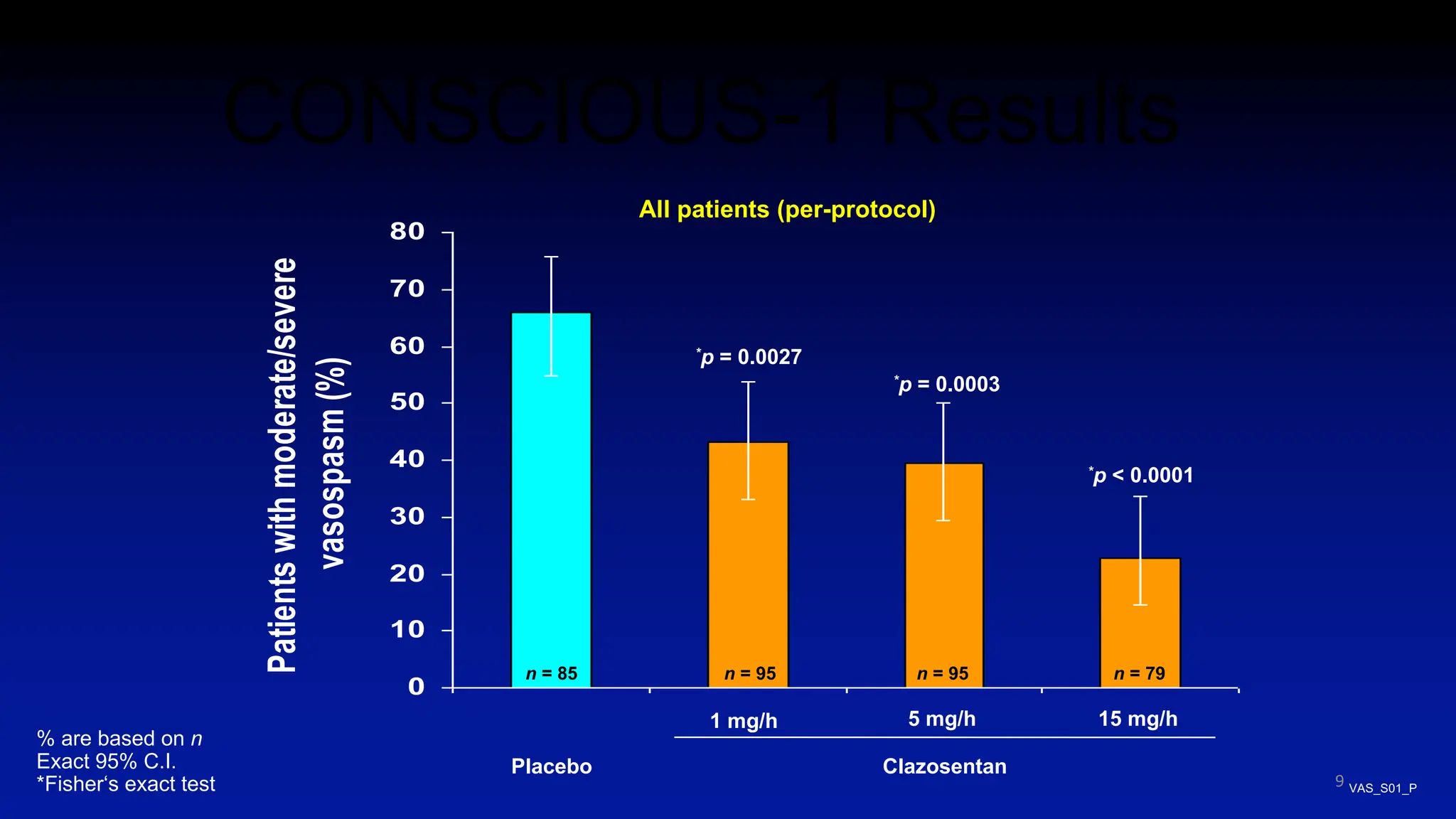
Patients
with
moderate/severe
vasospasm
(%)
% are based on n
Exact 95% C.I.
*Fisher‘s exact test VAS_S01_P
n = 85 n = 95 n = 95 n = 79
All patients (per-protocol)
*p = 0.0027
*p = 0.0003
*p < 0.0001
Clazosentan
1 mg/h 5 mg/h 15 mg/h
Placebo
CONSCIOUS-1 Results
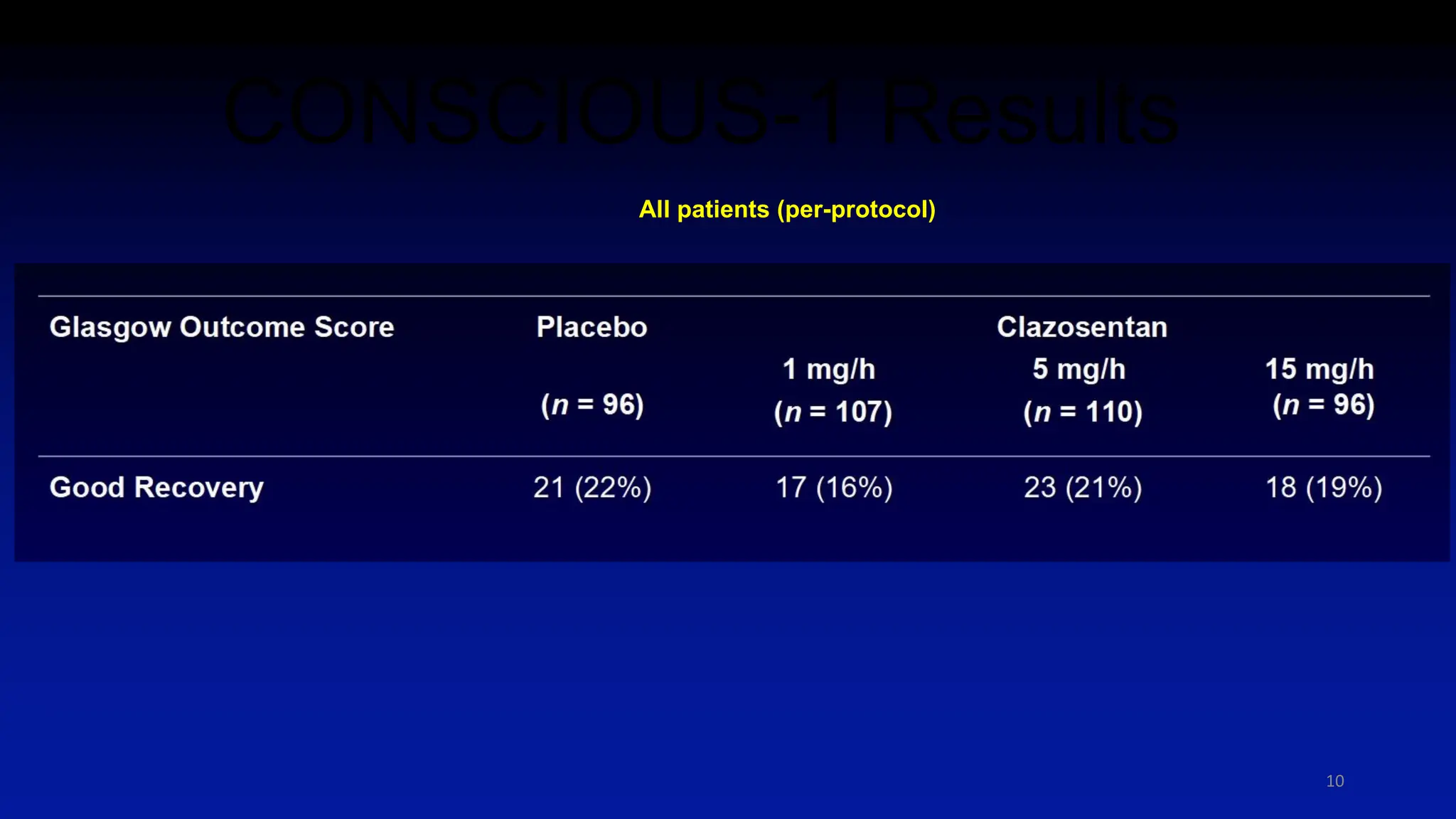
10
All patients (per-protocol)
*p = 0.0027
*p = 0.0003
*p < 0.0001
CONSCIOUS-1 Results
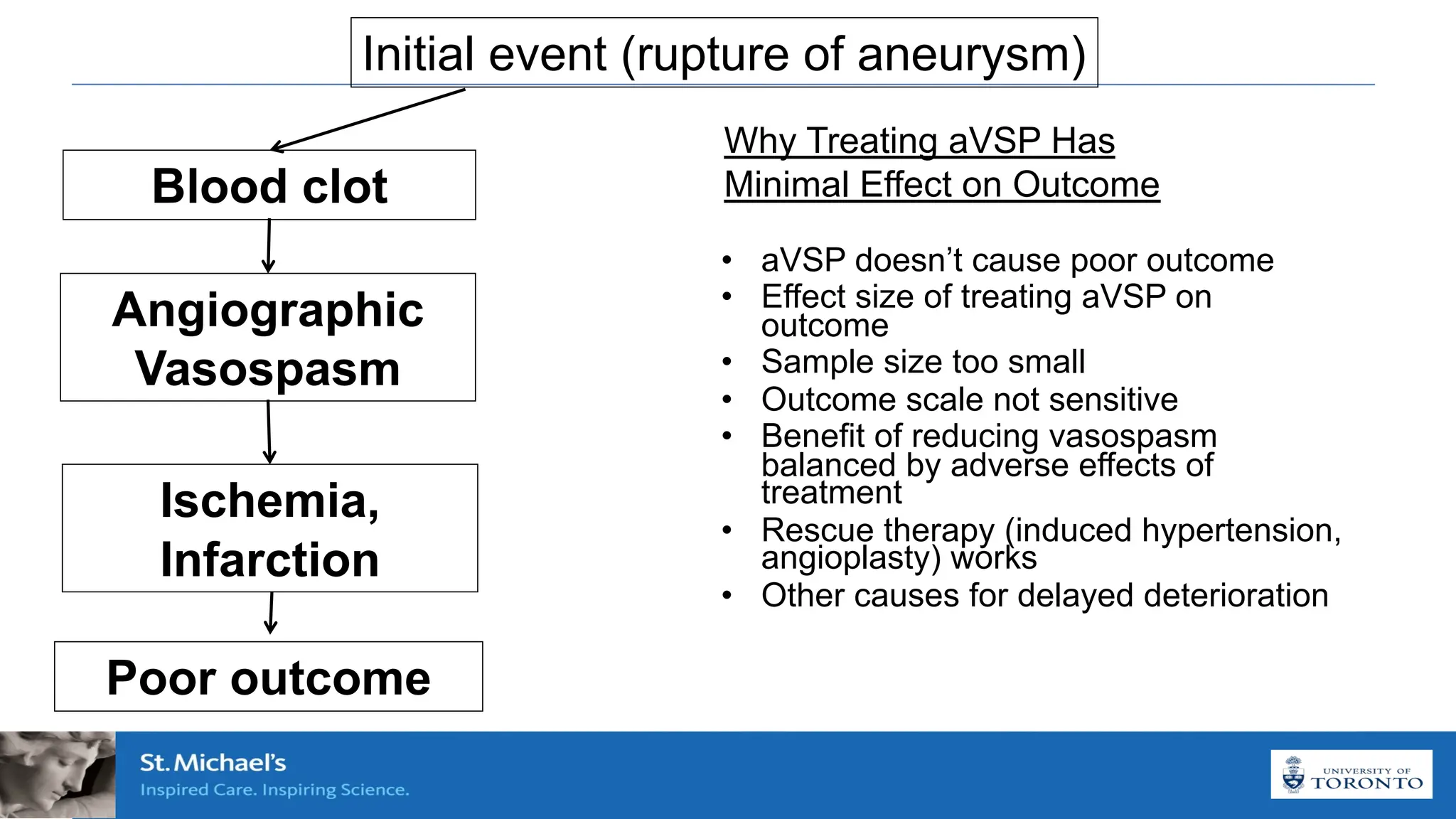
Initial event (rupture of aneurysm)
Blood clot
Angiographic
Vasospasm
Ischemia,
Infarction
Poor outcome
• aVSP doesn’t cause poor outcome
• Effect size of treating aVSP on
outcome
• Sample size too small
• Outcome scale not sensitive
• Benefit of reducing vasospasm
balanced by adverse effects of
treatment
• Rescue therapy (induced hypertension,
angioplasty) works
• Other causes for delayed deterioration
Why Treating aVSP Has
Minimal Effect on Outcome
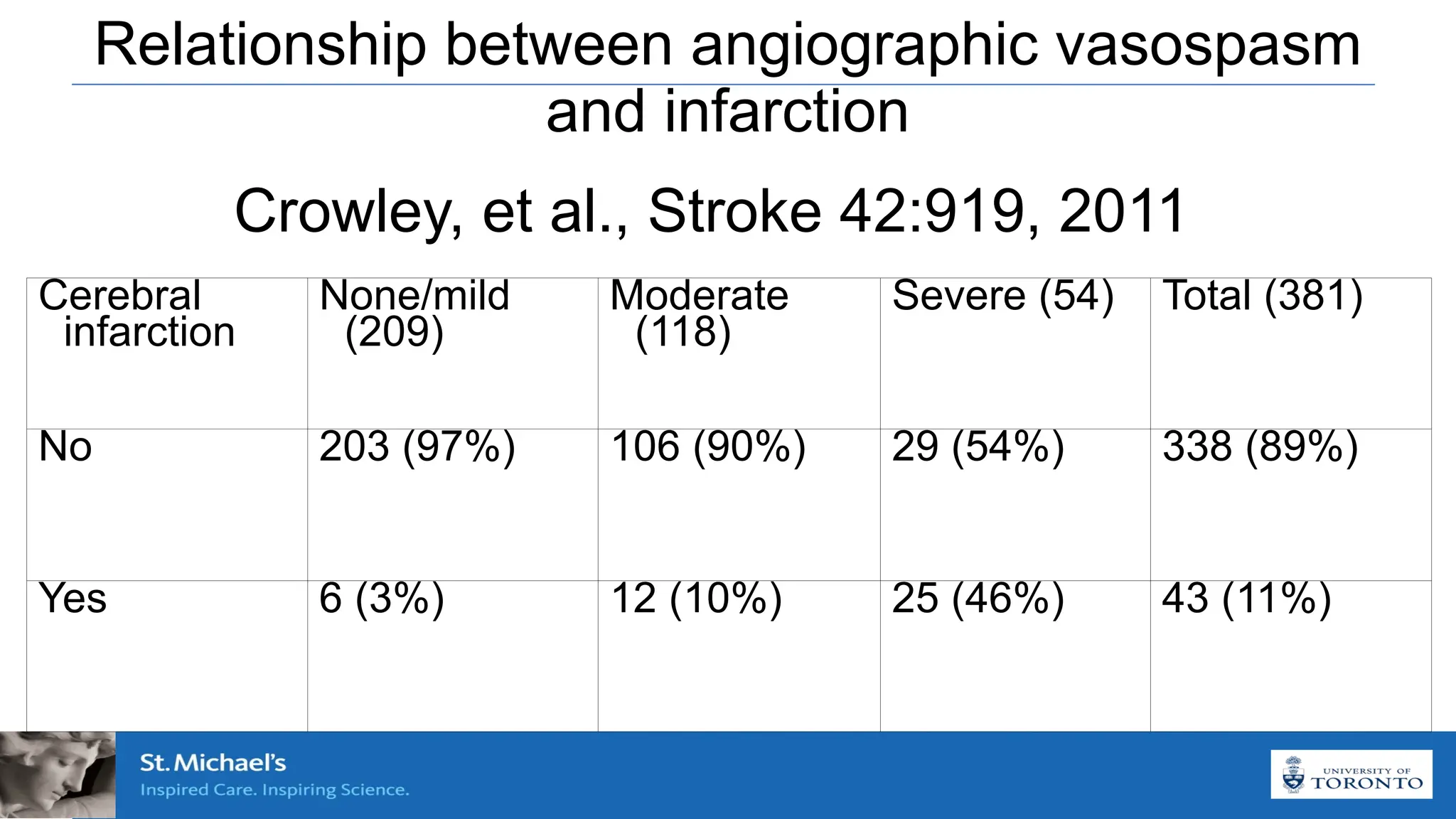
Relationship between angiographic vasospasm
and infarction
Cerebral
infarction
None/mild
(209)
Moderate
(118)
Severe (54) Total (381)
No 203 (97%) 106 (90%) 29 (54%) 338 (89%)
Yes 6 (3%) 12 (10%) 25 (46%) 43 (11%)
Crowley, et al., Stroke 42:919, 2011
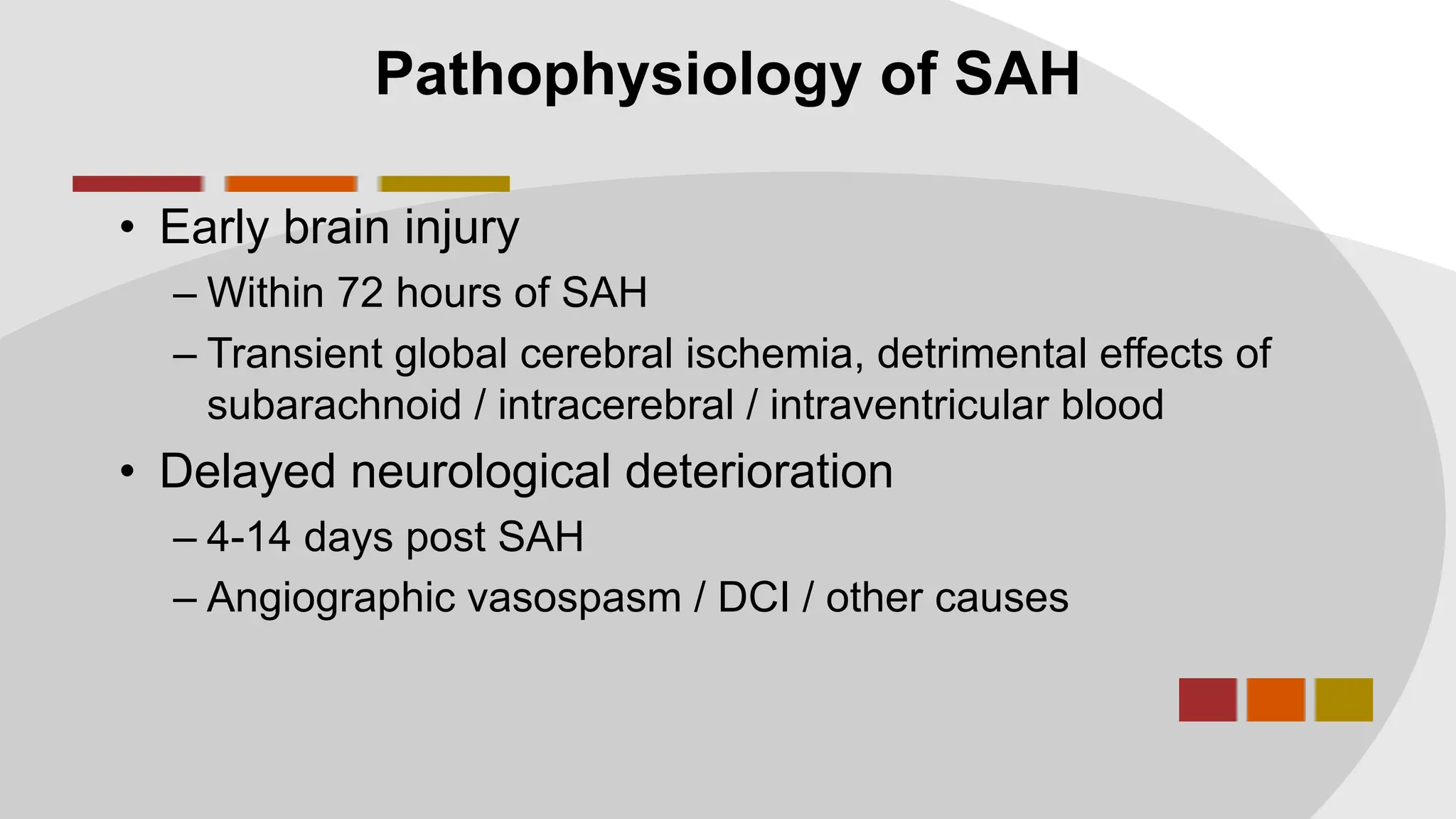
Pathophysiology of SAH
• Early brain injury
– Within 72 hours of SAH
– Transient global cerebral ischemia, detrimental effects of
subarachnoid / intracerebral / intraventricular blood
• Delayed neurological deterioration
– 4-14 days post SAH
– Angiographic vasospasm / DCI / other causes
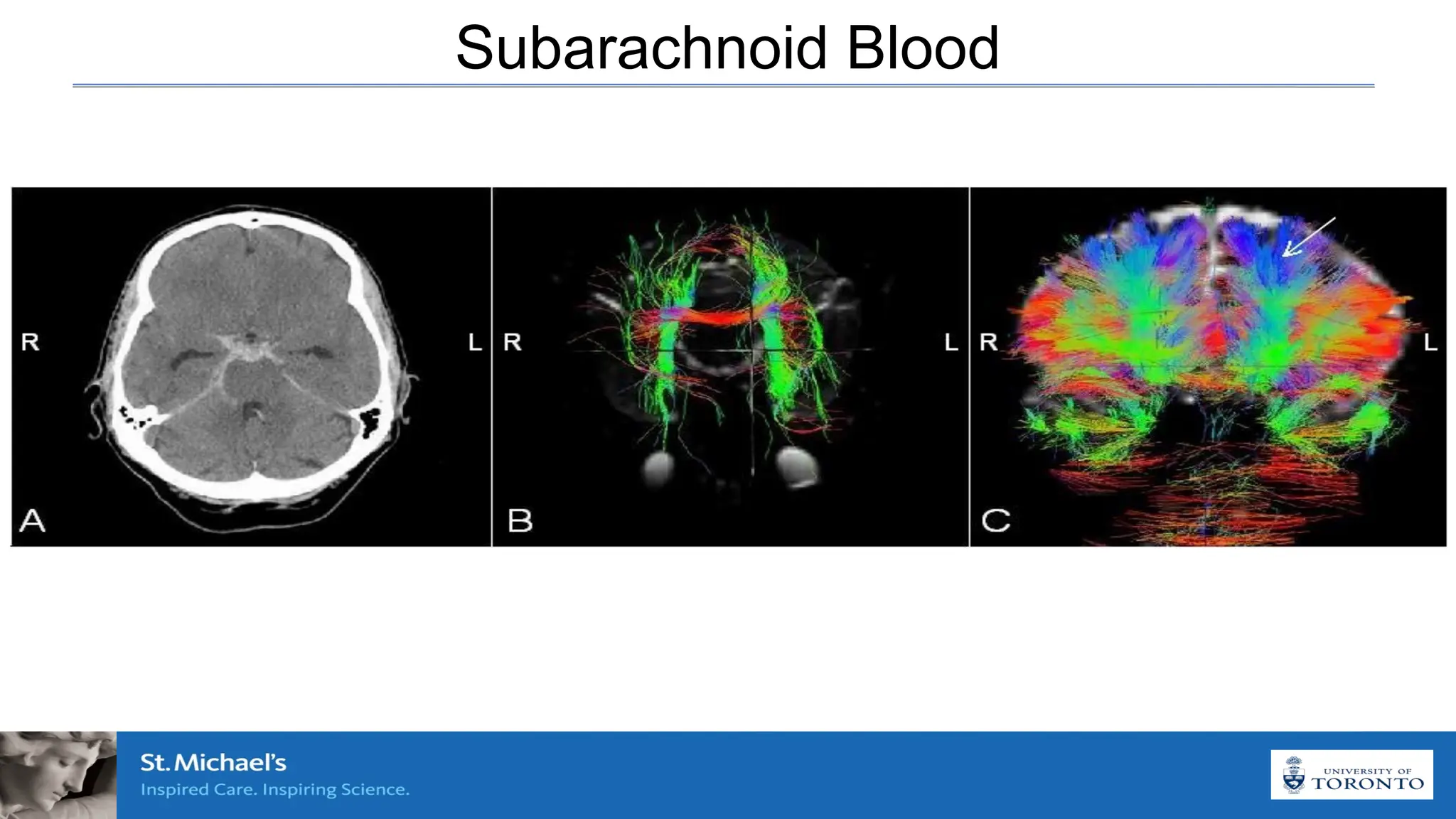
Subarachnoid Blood
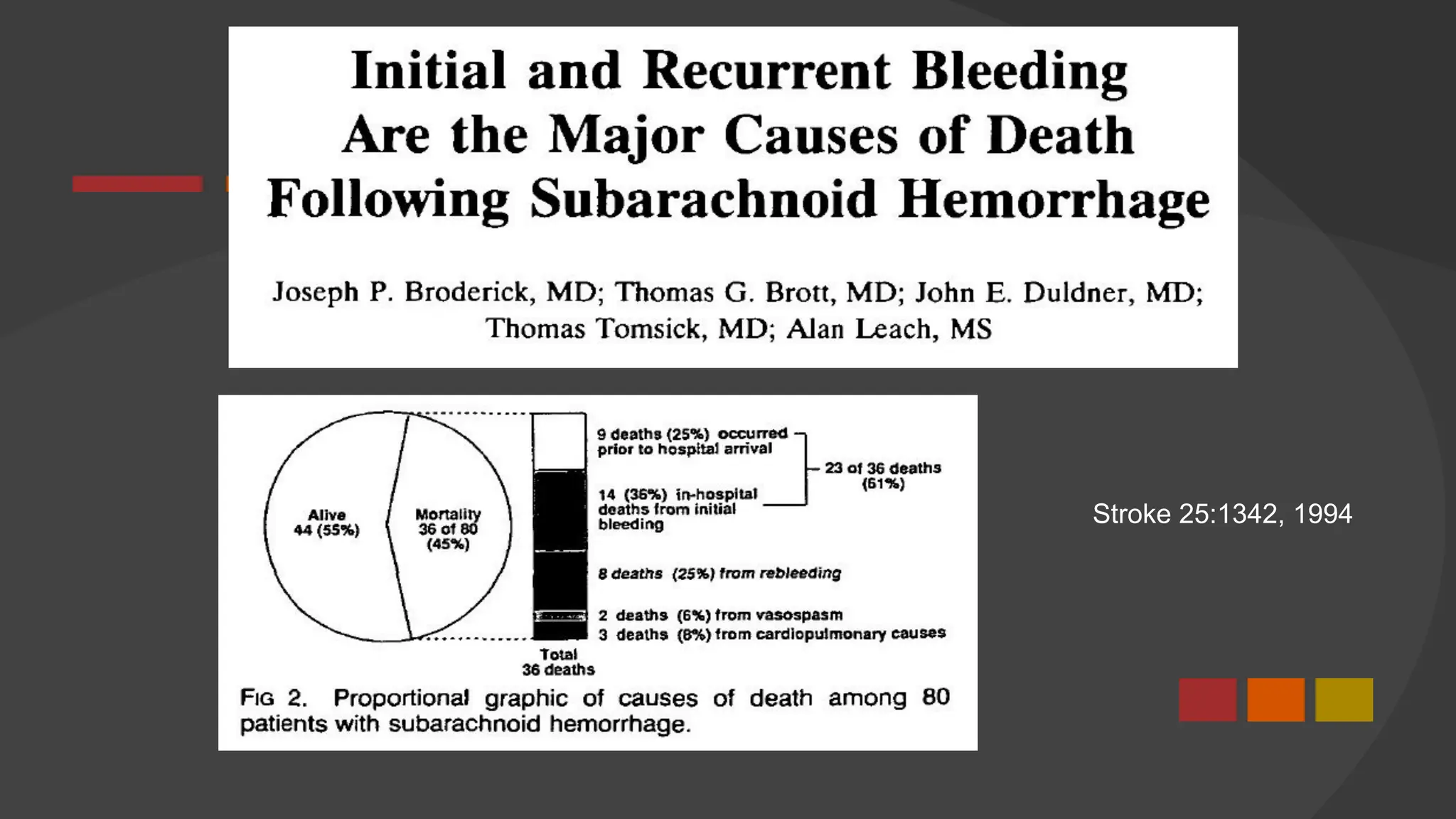
Stroke 25:1342, 1994
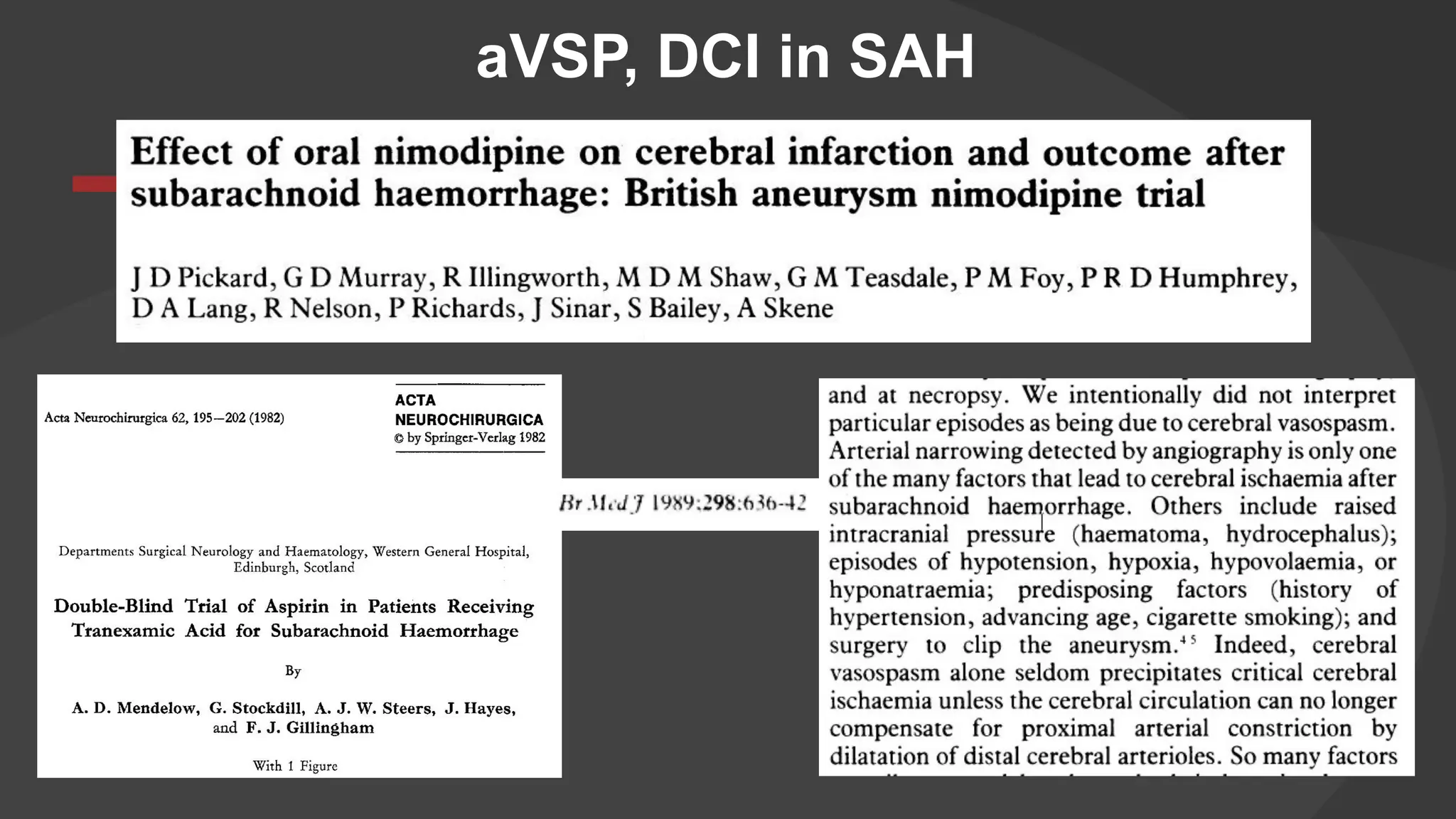
aVSP, DCI in SAH
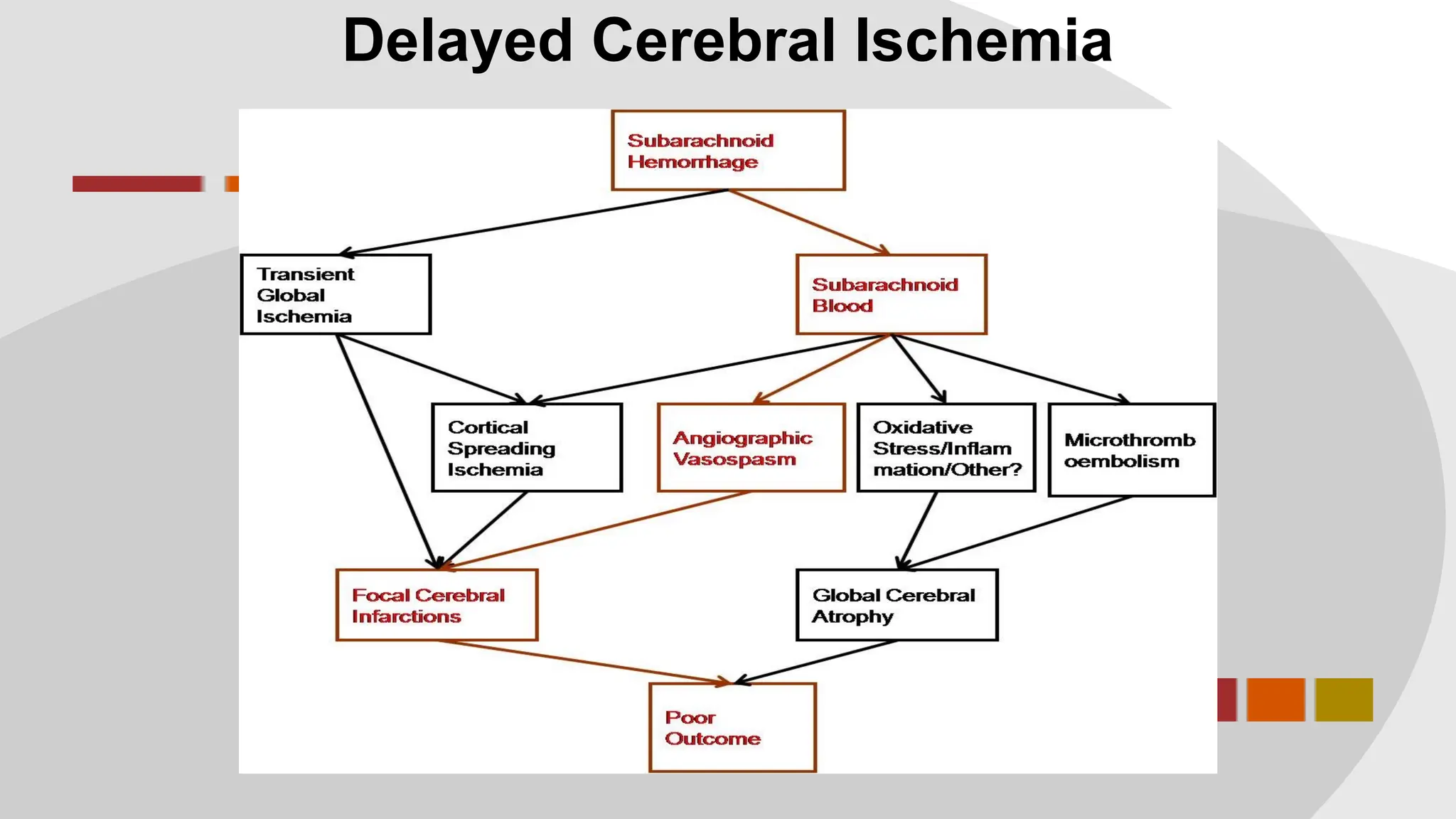
Delayed Cerebral Ischemia
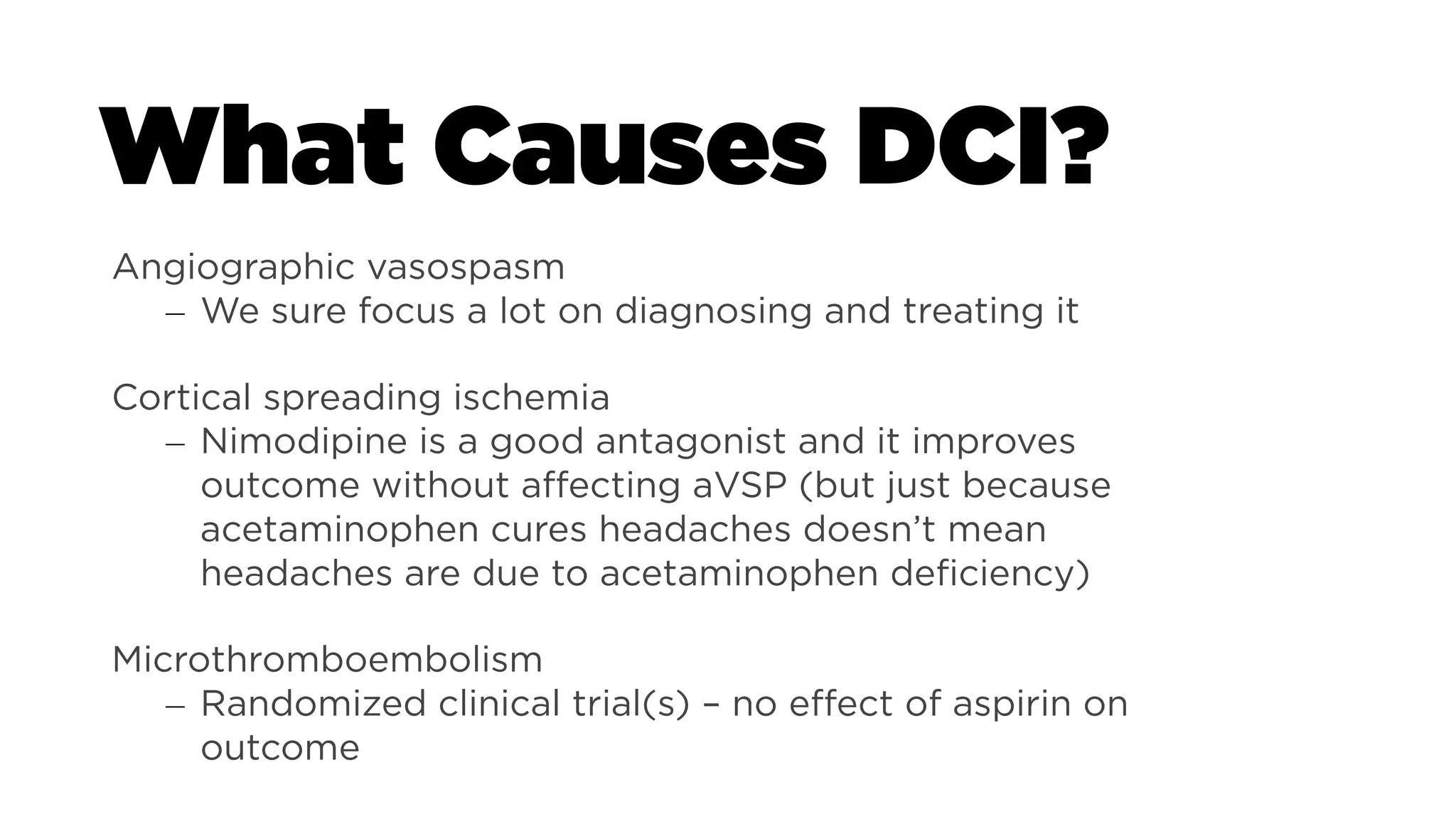
What Causes DCI?
THERE IS INSUFFICIENT EVIDENCE TO
PROVIDE A RECOMMENDATION...
Angiographic vasospasm
– We sure focus a lot on diagnosing and treating it
Cortical spreading ischemia
– Nimodipine is a good antagonist and it improves
outcome without affecting aVSP (but just because
acetaminophen cures headaches doesn’t mean
headaches are due to acetaminophen deficiency)
Microthromboembolism
– Randomized clinical trial(s) – no effect of aspirin on
outcome
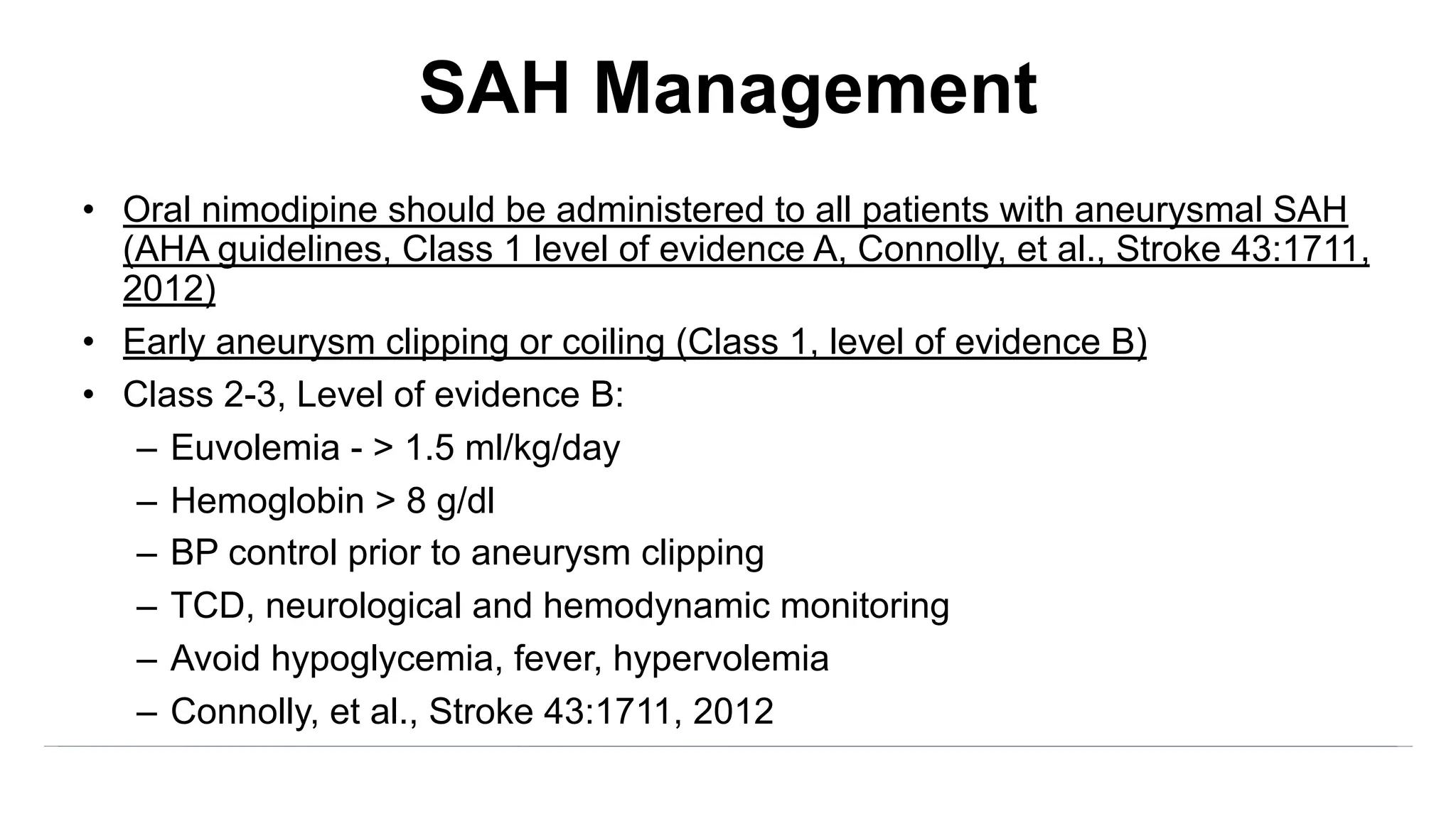
SAH Management
• Oral nimodipine should be administered to all patients with aneurysmal SAH
(AHA guidelines, Class 1 level of evidence A, Connolly, et al., Stroke 43:1711,
2012)
• Early aneurysm clipping or coiling (Class 1, level of evidence B)
• Class 2-3, Level of evidence B:
– Euvolemia - > 1.5 ml/kg/day
– Hemoglobin > 8 g/dl
– BP control prior to aneurysm clipping
– TCD, neurological and hemodynamic monitoring
– Avoid hypoglycemia, fever, hypervolemia
– Connolly, et al., Stroke 43:1711, 2012
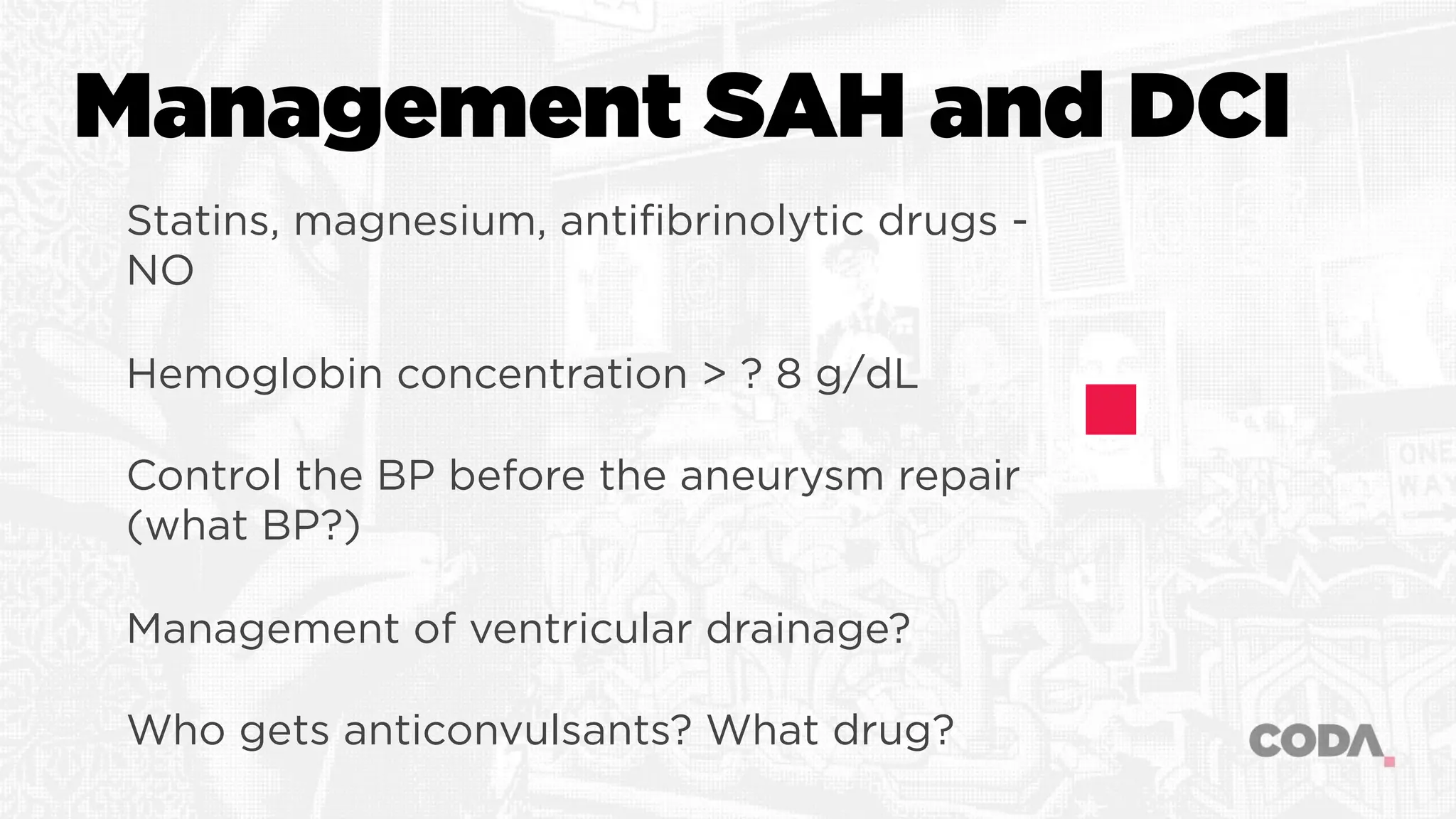
Management SAH and DCI
Statins, magnesium, antifibrinolytic drugs -
NO
Hemoglobin concentration > ? 8 g/dL
Control the BP before the aneurysm repair
(what BP?)
Management of ventricular drainage?
Who gets anticonvulsants? What drug?
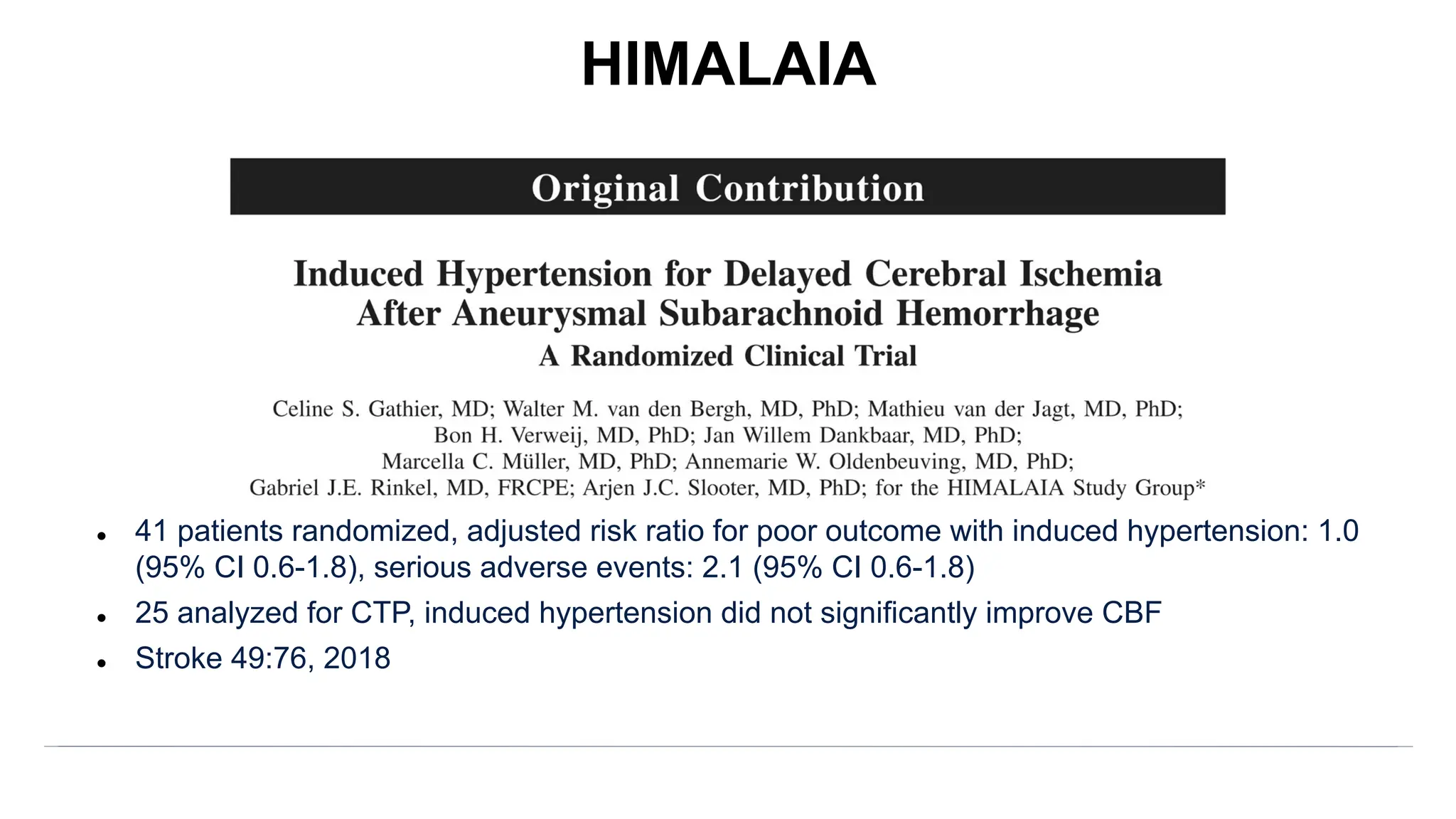
l 41 patients randomized, adjusted risk ratio for poor outcome with induced hypertension: 1.0
(95% CI 0.6-1.8), serious adverse events: 2.1 (95% CI 0.6-1.8)
l 25 analyzed for CTP, induced hypertension did not significantly improve CBF
l Stroke 49:76, 2018
HIMALAIA
Results: Rescue Therapy for DCI
R
R
RESEARCH
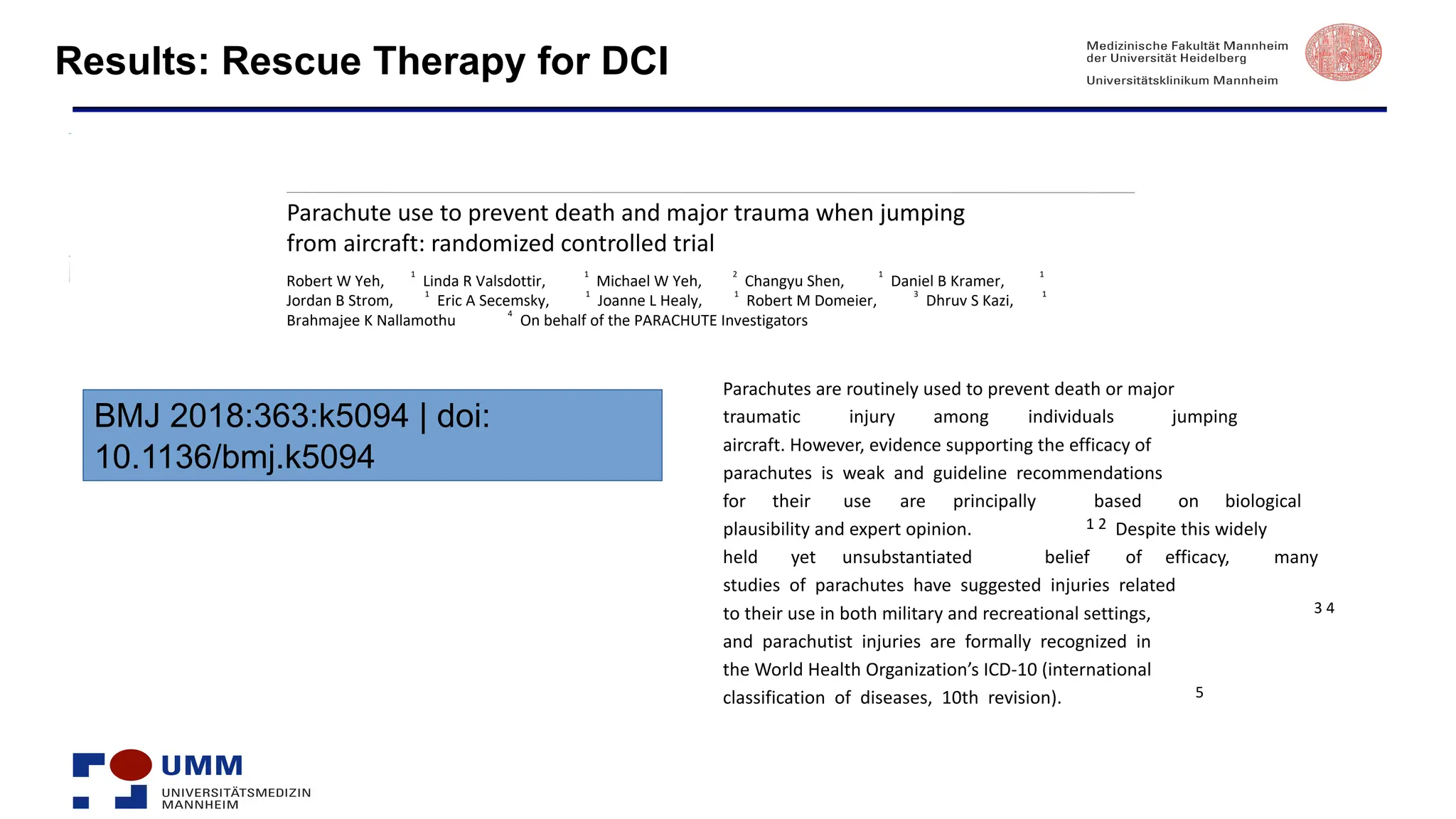
Parachute use to prevent death and major trauma when jumping
from aircraft: randomized controlled trial
Robert W Yeh,
1
Linda R Valsdottir,
1
Michael W Yeh,
2
Changyu Shen,
1
Daniel B Kramer,
1
Jordan B Strom,
1
Eric A Secemsky,
1
Joanne L Healy,
1
Robert M Domeier,
3
Dhruv S Kazi,
1
Brahmajee K Nallamothu
4
On behalf of the PARACHUTE Investigators
BMJ 2018:363:k5094 | doi:
10.1136/bmj.k5094
Parachutes are routinely used to prevent death or major
traumatic injury among individuals jumping
aircraft. However, evidence supporting the efficacy of
parachutes is weak and guideline recommendations
for their use are principally based on biological
plausibility and expert opinion. 1 2 Despite this widely
held yet unsubstantiated belief of efficacy, many
studies of parachutes have suggested injuries related
to their use in both military and recreational settings, 3 4
and parachutist injuries are formally recognized in
the World Health Organization’s ICD-10 (international
classification of diseases, 10th revision). 5
Results: Rescue Therapy for DCI
R
R
RESEARCH
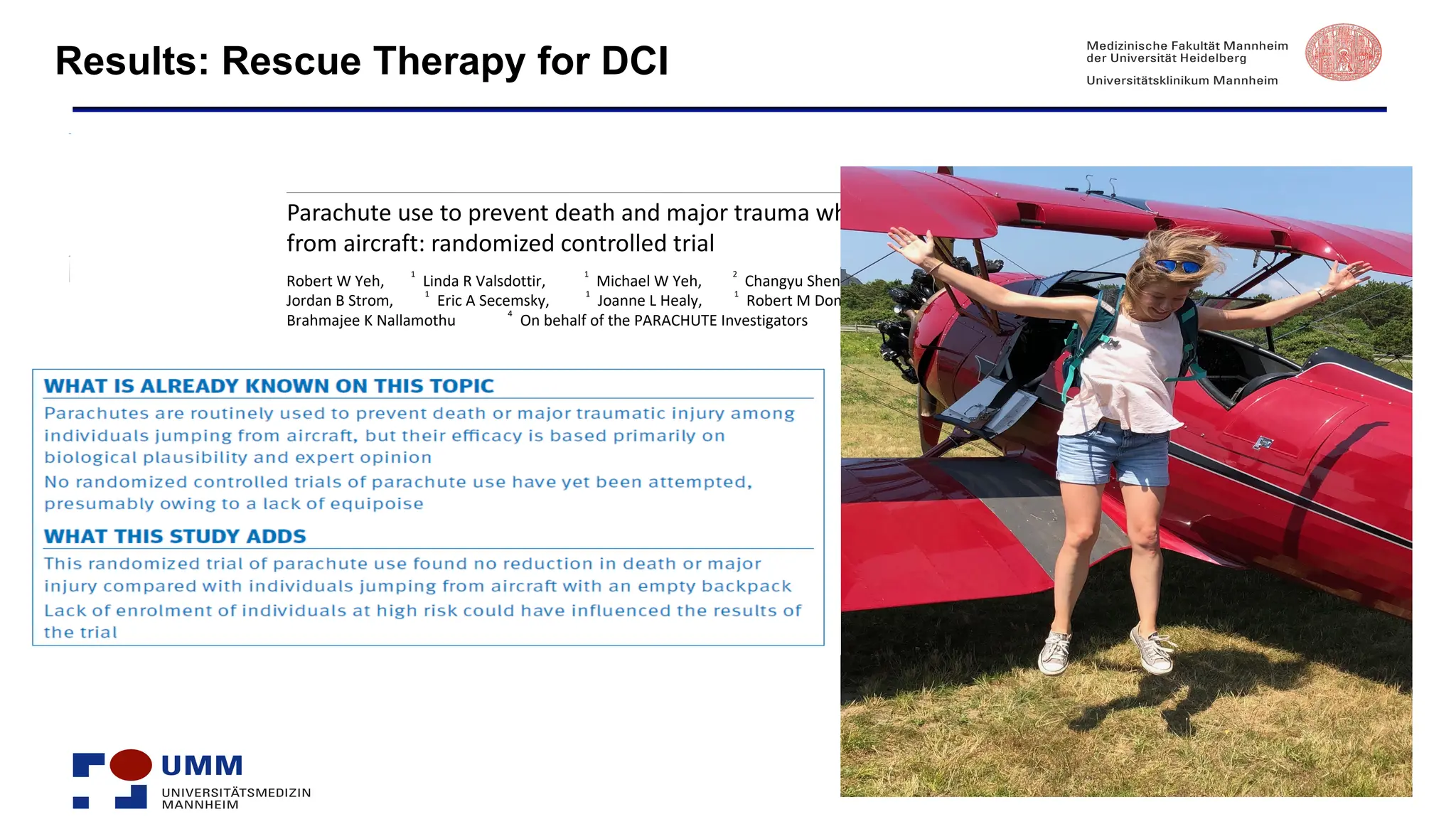
Parachute use to prevent death and major trauma when jumping
from aircraft: randomized controlled trial
Robert W Yeh,
1
Linda R Valsdottir,
1
Michael W Yeh,
2
Changyu Shen,
1
Daniel B Kramer,
1
Jordan B Strom,
1
Eric A Secemsky,
1
Joanne L Healy,
1
Robert M Domeier,
3
Dhruv S Kazi,
1
Brahmajee K Nallamothu
4
On behalf of the PARACHUTE Investigators
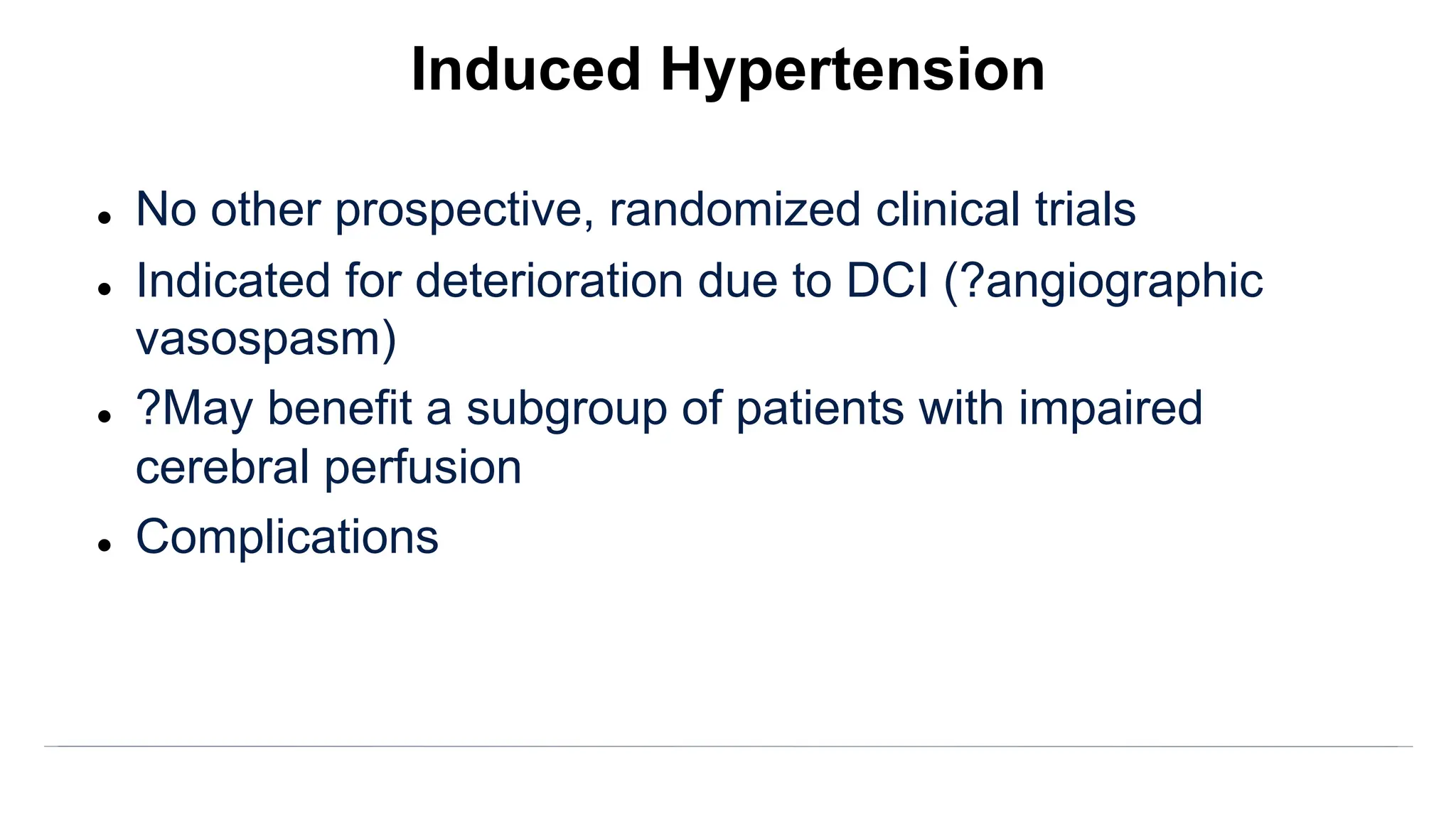
l No other prospective, randomized clinical trials
l Indicated for deterioration due to DCI (?angiographic
vasospasm)
l ?May benefit a subgroup of patients with impaired
cerebral perfusion
l Complications
Induced Hypertension
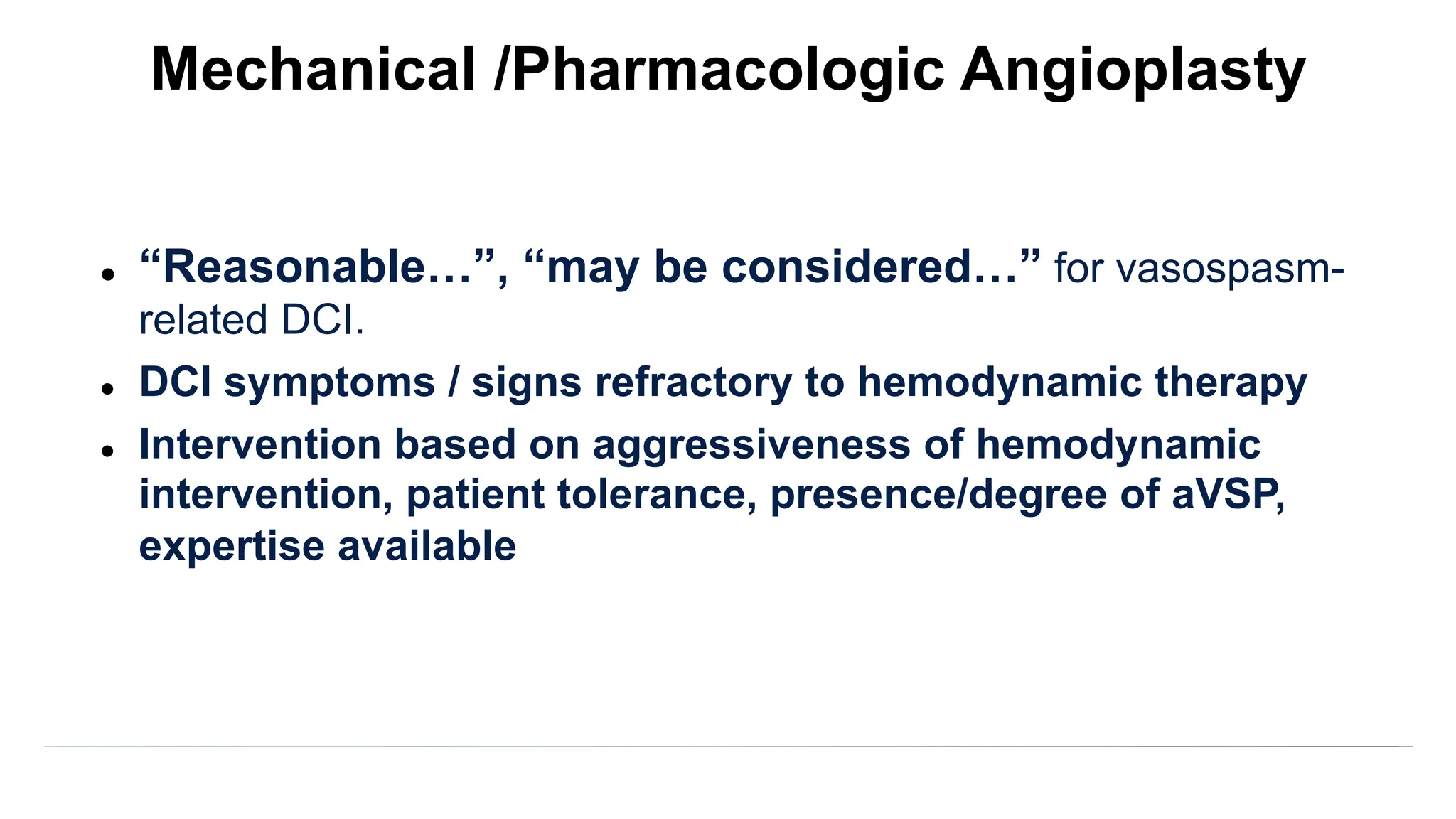
l “Reasonable…”, “may be considered…” for vasospasm-
related DCI.
l DCI symptoms / signs refractory to hemodynamic therapy
l Intervention based on aggressiveness of hemodynamic
intervention, patient tolerance, presence/degree of aVSP,
expertise available
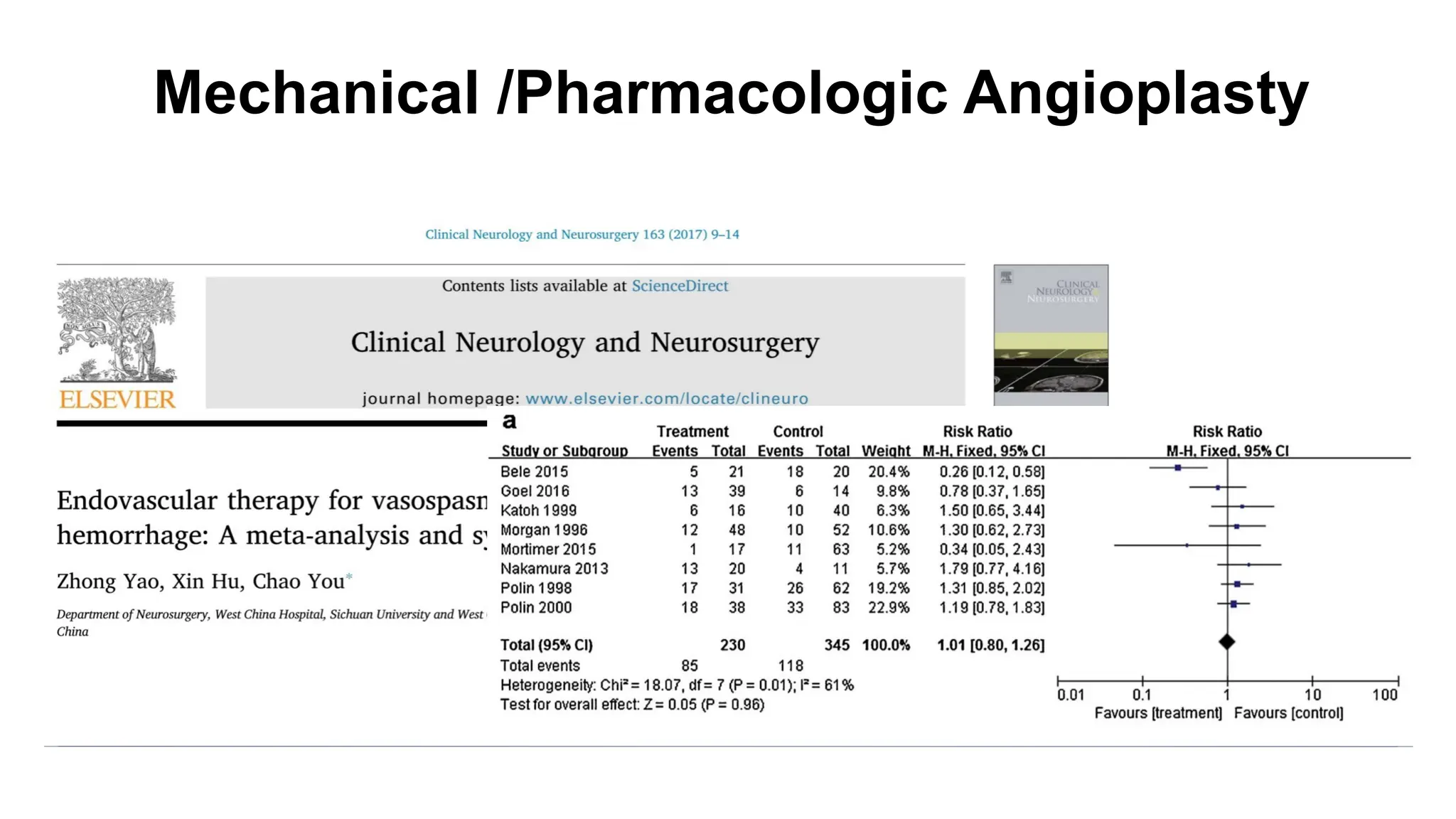
Mechanical /Pharmacologic Angioplasty
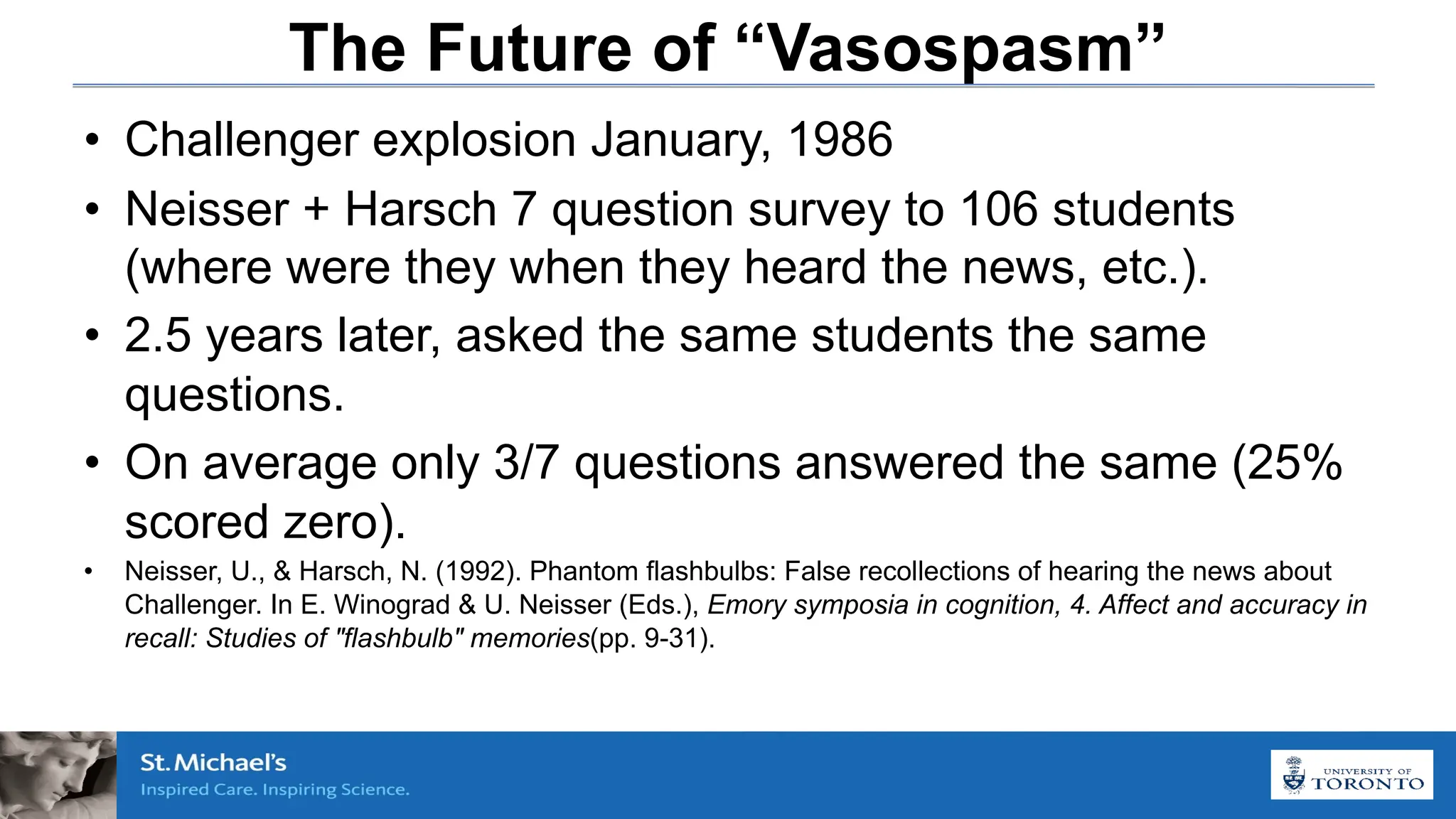
The Future of “Vasospasm”
• Challenger explosion January, 1986
• Neisser + Harsch 7 question survey to 106 students
(where were they when they heard the news, etc.).
• 2.5 years later, asked the same students the same
questions.
• On average only 3/7 questions answered the same (25%
scored zero).
• Neisser, U., & Harsch, N. (1992). Phantom flashbulbs: False recollections of hearing the news about
Challenger. In E. Winograd & U. Neisser (Eds.), Emory symposia in cognition, 4. Affect and accuracy in
recall: Studies of "flashbulb" memories(pp. 9-31).
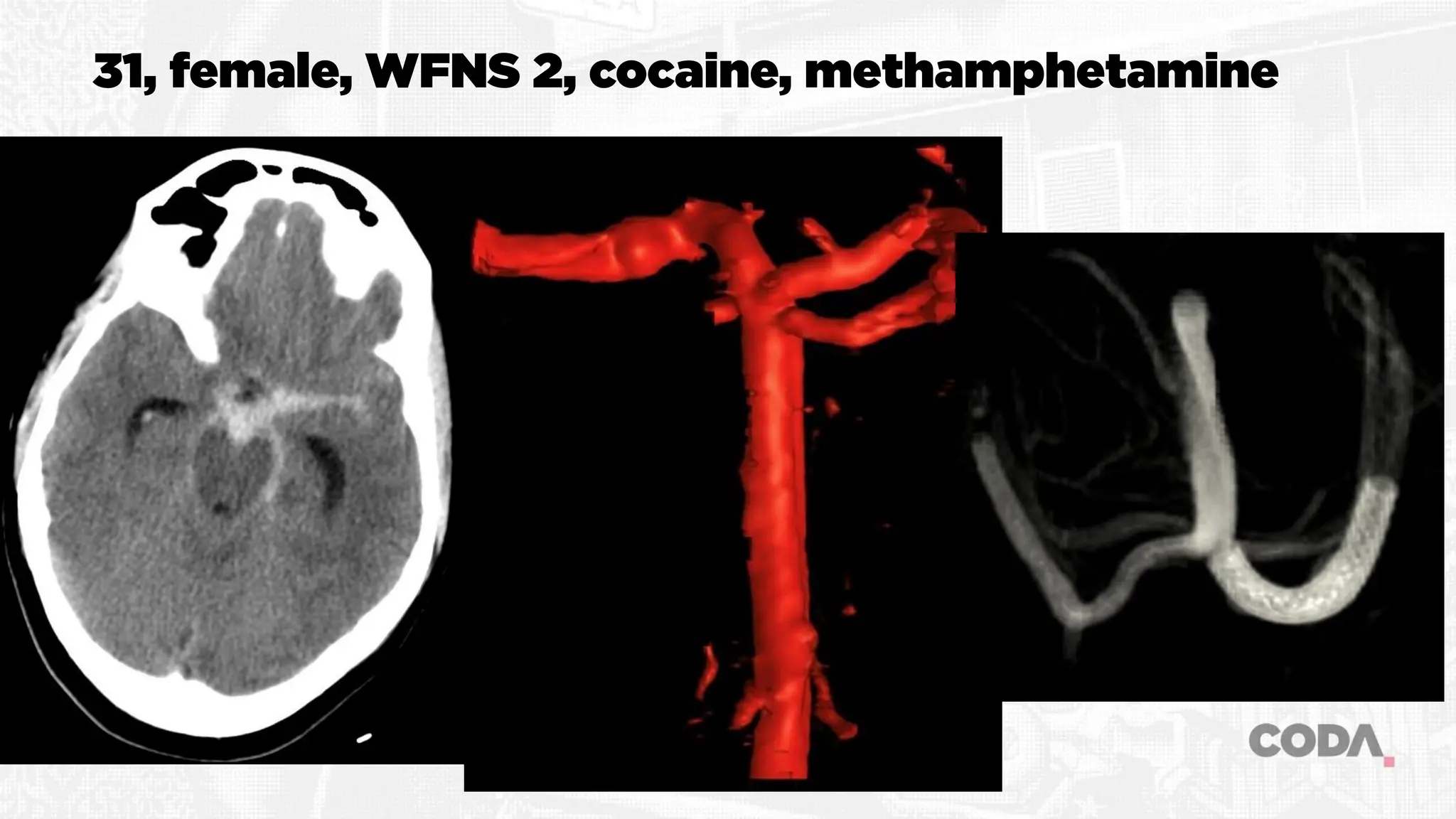
31, female, WFNS 2, cocaine, methamphetamine
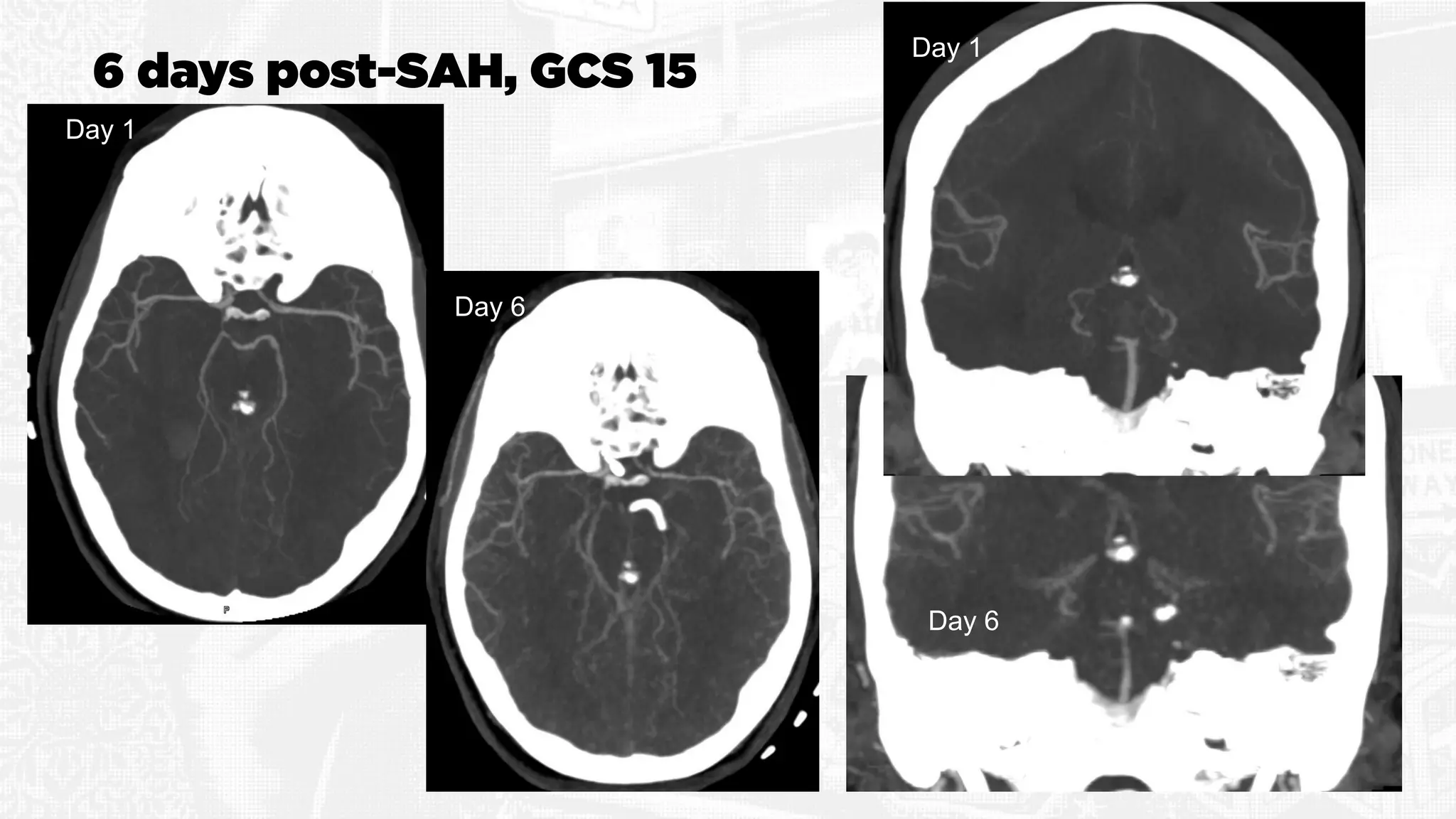
6 days post-SAH, GCS 15
Day 1
Day 6
Day 6
Day 1
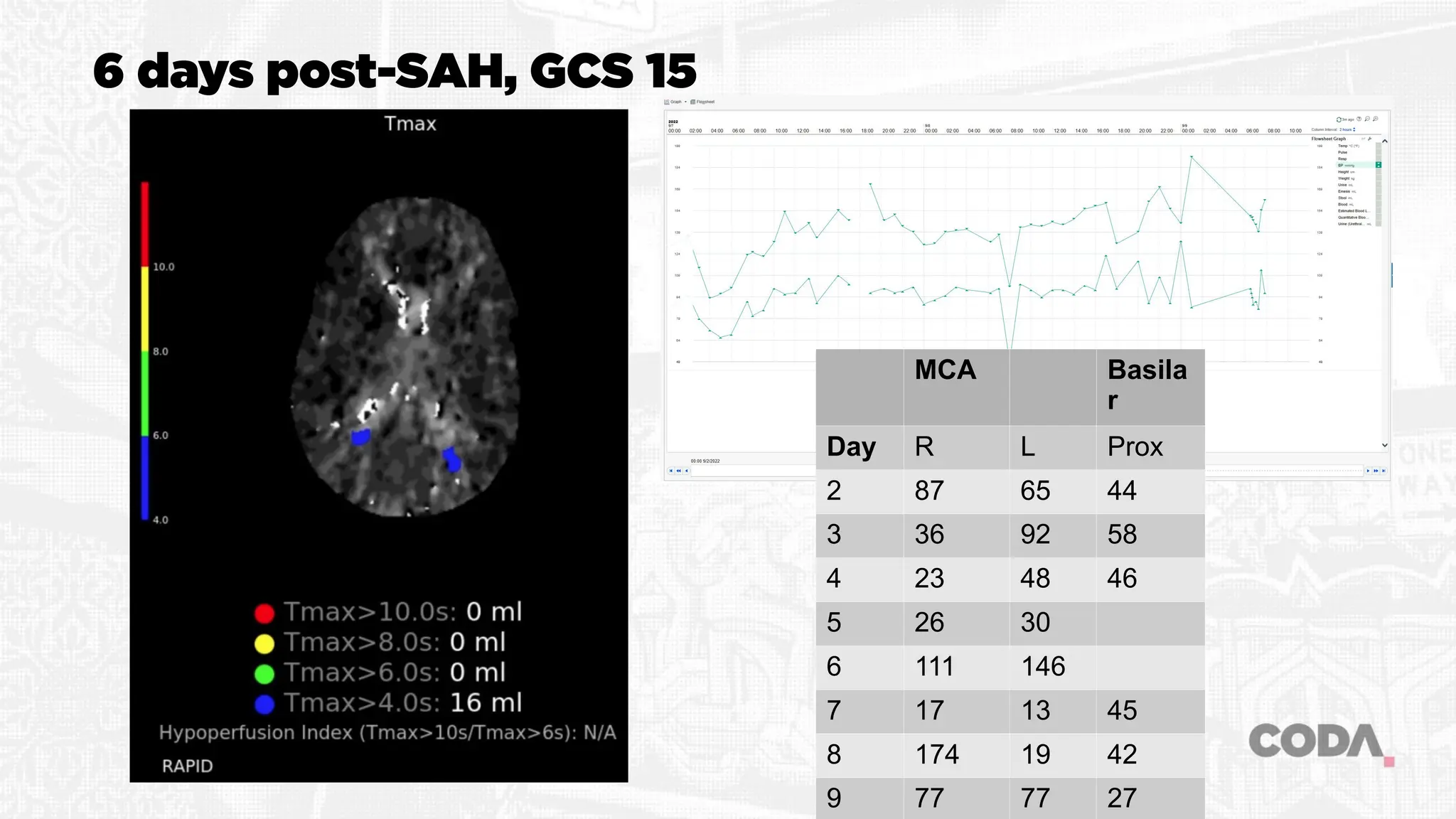
6 days post-SAH, GCS 15
MCA Basila
r
Day R L Prox
2 87 65 44
3 36 92 58
4 23 48 46
5 26 30
6 111 146
7 17 13 45
8 174 19 42
9 77 77 27
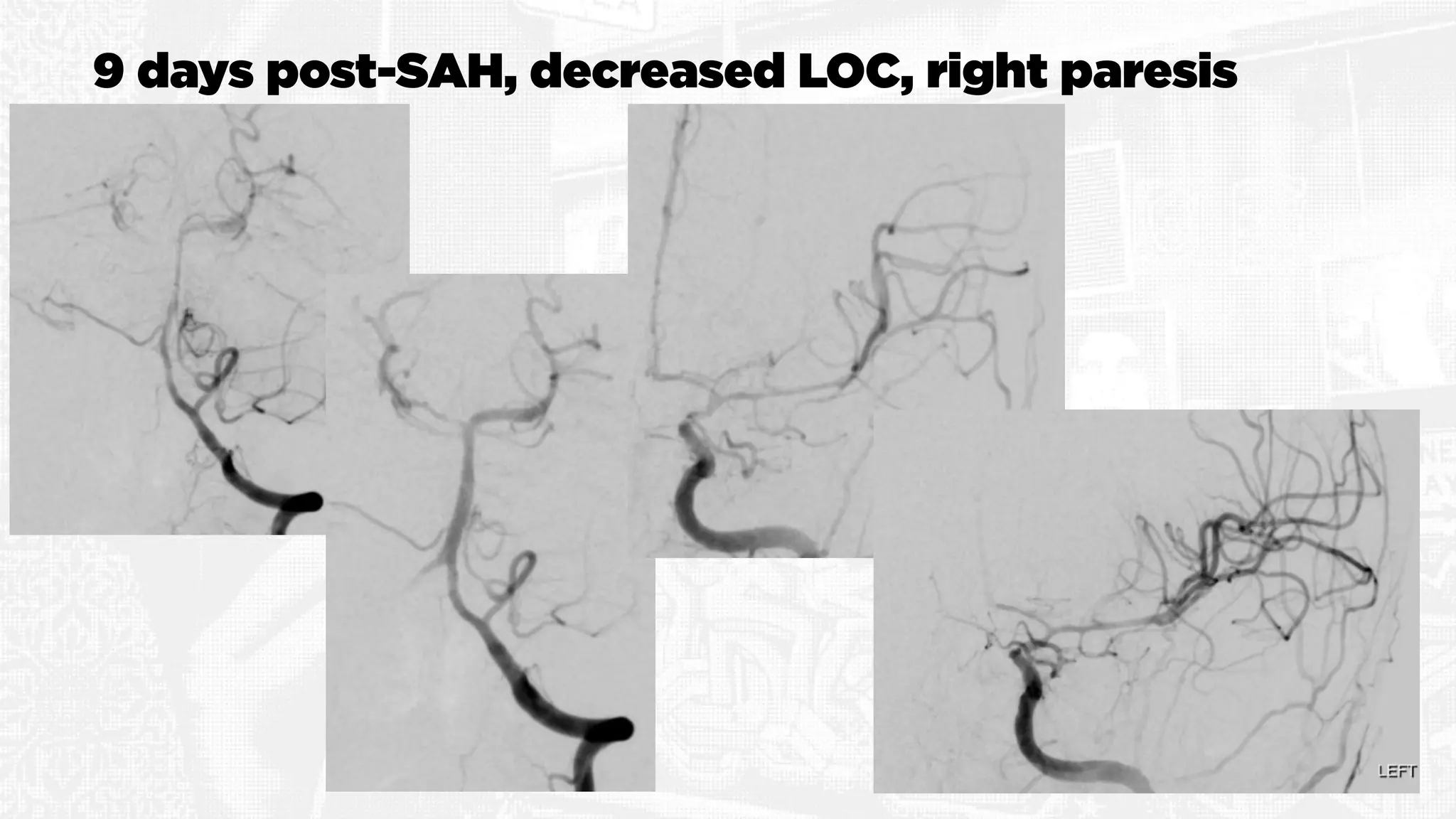
9 days post-SAH, decreased LOC, right paresis
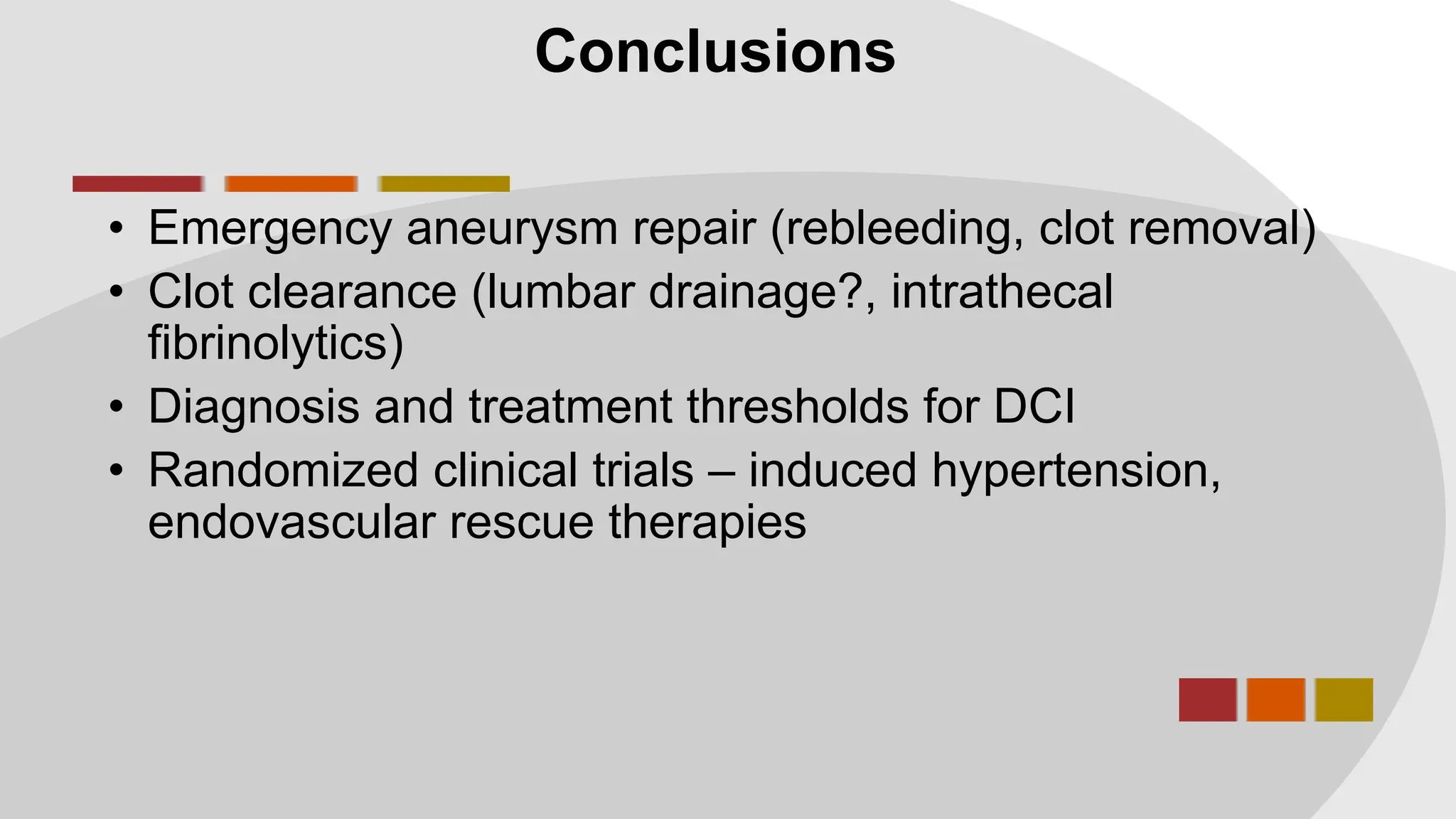
Conclusions
• Emergency aneurysm repair (rebleeding, clot removal)
• Clot clearance (lumbar drainage?, intrathecal
fibrinolytics)
• Diagnosis and treatment thresholds for DCI
• Randomized clinical trials – induced hypertension,
endovascular rescue therapies
0

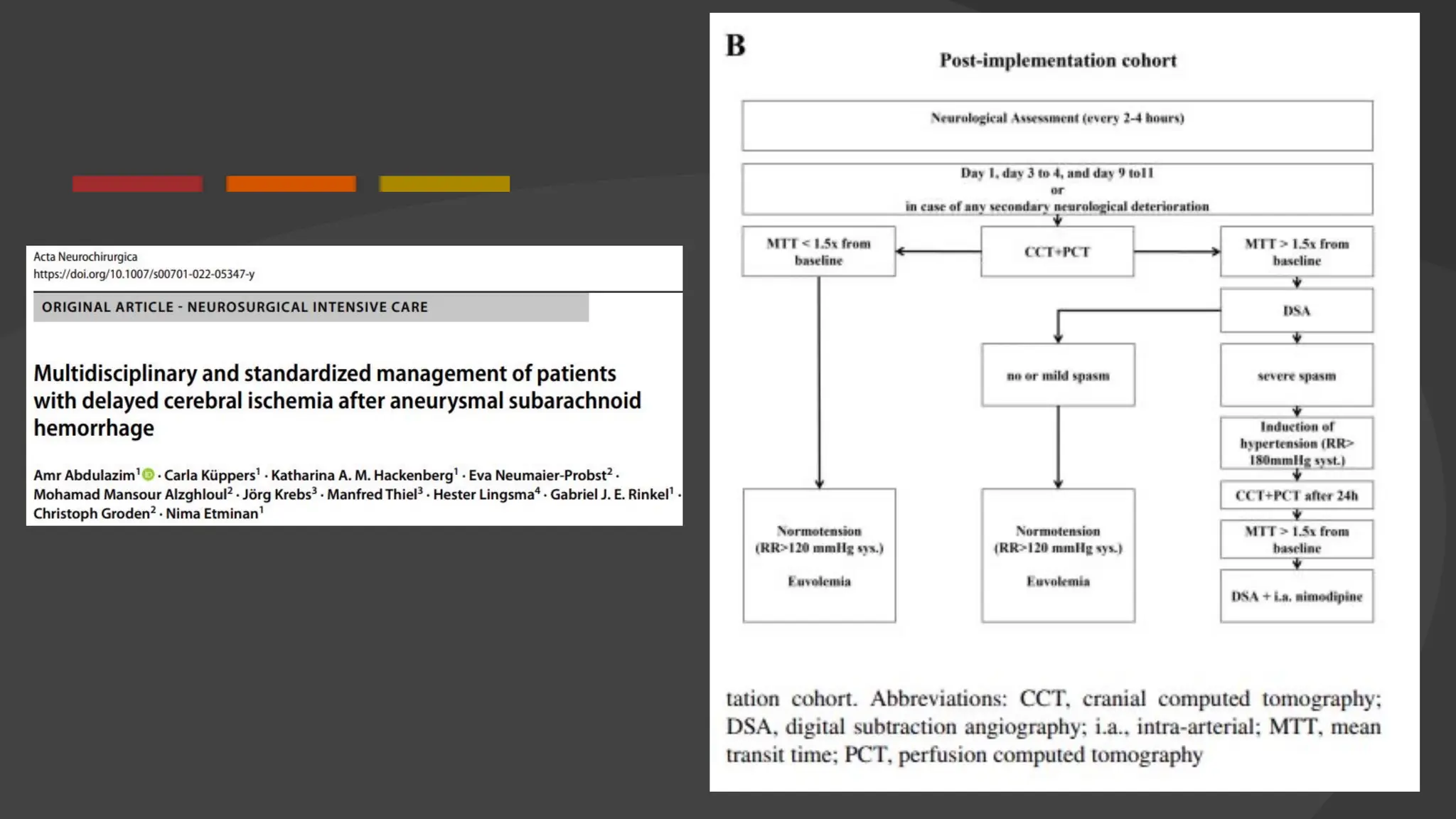
Dilating the Dogma of Vasospasm

  • 1.
    DILATING THE DOGMA OF VASOSPASM R.LOCH MACDONALD, M.D., Ph.D. COMMUNITY NEUROSCIENCES INSTITUTE FRESNO, CALIFORNIA, USA
  • 2.
  • 3.
    Origins of Conceptof Vasospasm Macdonald, Stroke 47:e11-e15, 2016
  • 4.
    Angiographic VSP -DCI 40 year old female, WFNS grade 2
  • 5.
    DCI – InducedHypertension, Balloon Angioplasty Day 1 Day 3 preangioplasty Day 3 postangioplasty
  • 6.
  • 7.
    Angiographic VSP Blood clotleads to angiographic VSP leads to infarction and poor outcome Vasoconstriction of large cerebral arteries due to hemoglobin component of subarachnoid blood “Pharmacologic” dose response related to the location, duration of presence and concentration of the hemoglobin/blood clot Subarachnoid blood leads to angiographic vasospasm (?leads to cerebral infarction [DCI] leading to poor outcome)
  • 8.
    Definitions Angiographic vasospasm –radiologic appearance of arteries on CT, MR or catheter angiogram DCI – clinical deterioration with no obvious cause (doesn’t require angiographic vasospasm) and/or cerebral infarction, delayed fashion, not due to aneurysm-securing procedure, etc. Vergouwen, et al., Stroke, 2010;41;2391
  • 9.
    9 0 10 20 30 40 50 60 70 80 Patients with moderate/severe vasospasm (%) % are basedon n Exact 95% C.I. *Fisher‘s exact test VAS_S01_P n = 85 n = 95 n = 95 n = 79 All patients (per-protocol) *p = 0.0027 *p = 0.0003 *p < 0.0001 Clazosentan 1 mg/h 5 mg/h 15 mg/h Placebo CONSCIOUS-1 Results
  • 10.
    10 All patients (per-protocol) *p= 0.0027 *p = 0.0003 *p < 0.0001 CONSCIOUS-1 Results
  • 11.
    Initial event (ruptureof aneurysm) Blood clot Angiographic Vasospasm Ischemia, Infarction Poor outcome • aVSP doesn’t cause poor outcome • Effect size of treating aVSP on outcome • Sample size too small • Outcome scale not sensitive • Benefit of reducing vasospasm balanced by adverse effects of treatment • Rescue therapy (induced hypertension, angioplasty) works • Other causes for delayed deterioration Why Treating aVSP Has Minimal Effect on Outcome
  • 12.
    Relationship between angiographicvasospasm and infarction Cerebral infarction None/mild (209) Moderate (118) Severe (54) Total (381) No 203 (97%) 106 (90%) 29 (54%) 338 (89%) Yes 6 (3%) 12 (10%) 25 (46%) 43 (11%) Crowley, et al., Stroke 42:919, 2011
  • 13.
    Pathophysiology of SAH •Early brain injury – Within 72 hours of SAH – Transient global cerebral ischemia, detrimental effects of subarachnoid / intracerebral / intraventricular blood • Delayed neurological deterioration – 4-14 days post SAH – Angiographic vasospasm / DCI / other causes
  • 14.
  • 15.
  • 16.
  • 17.
  • 18.
    What Causes DCI? THEREIS INSUFFICIENT EVIDENCE TO PROVIDE A RECOMMENDATION... Angiographic vasospasm – We sure focus a lot on diagnosing and treating it Cortical spreading ischemia – Nimodipine is a good antagonist and it improves outcome without affecting aVSP (but just because acetaminophen cures headaches doesn’t mean headaches are due to acetaminophen deficiency) Microthromboembolism – Randomized clinical trial(s) – no effect of aspirin on outcome
  • 19.
    SAH Management • Oralnimodipine should be administered to all patients with aneurysmal SAH (AHA guidelines, Class 1 level of evidence A, Connolly, et al., Stroke 43:1711, 2012) • Early aneurysm clipping or coiling (Class 1, level of evidence B) • Class 2-3, Level of evidence B: – Euvolemia - > 1.5 ml/kg/day – Hemoglobin > 8 g/dl – BP control prior to aneurysm clipping – TCD, neurological and hemodynamic monitoring – Avoid hypoglycemia, fever, hypervolemia – Connolly, et al., Stroke 43:1711, 2012
  • 20.
    Management SAH andDCI Statins, magnesium, antifibrinolytic drugs - NO Hemoglobin concentration > ? 8 g/dL Control the BP before the aneurysm repair (what BP?) Management of ventricular drainage? Who gets anticonvulsants? What drug?
  • 21.
    l 41 patientsrandomized, adjusted risk ratio for poor outcome with induced hypertension: 1.0 (95% CI 0.6-1.8), serious adverse events: 2.1 (95% CI 0.6-1.8) l 25 analyzed for CTP, induced hypertension did not significantly improve CBF l Stroke 49:76, 2018 HIMALAIA
  • 22.
    Results: Rescue Therapyfor DCI R R RESEARCH Parachute use to prevent death and major trauma when jumping from aircraft: randomized controlled trial Robert W Yeh, 1 Linda R Valsdottir, 1 Michael W Yeh, 2 Changyu Shen, 1 Daniel B Kramer, 1 Jordan B Strom, 1 Eric A Secemsky, 1 Joanne L Healy, 1 Robert M Domeier, 3 Dhruv S Kazi, 1 Brahmajee K Nallamothu 4 On behalf of the PARACHUTE Investigators BMJ 2018:363:k5094 | doi: 10.1136/bmj.k5094 Parachutes are routinely used to prevent death or major traumatic injury among individuals jumping aircraft. However, evidence supporting the efficacy of parachutes is weak and guideline recommendations for their use are principally based on biological plausibility and expert opinion. 1 2 Despite this widely held yet unsubstantiated belief of efficacy, many studies of parachutes have suggested injuries related to their use in both military and recreational settings, 3 4 and parachutist injuries are formally recognized in the World Health Organization’s ICD-10 (international classification of diseases, 10th revision). 5
  • 23.
    Results: Rescue Therapyfor DCI R R RESEARCH Parachute use to prevent death and major trauma when jumping from aircraft: randomized controlled trial Robert W Yeh, 1 Linda R Valsdottir, 1 Michael W Yeh, 2 Changyu Shen, 1 Daniel B Kramer, 1 Jordan B Strom, 1 Eric A Secemsky, 1 Joanne L Healy, 1 Robert M Domeier, 3 Dhruv S Kazi, 1 Brahmajee K Nallamothu 4 On behalf of the PARACHUTE Investigators
  • 24.
    l No otherprospective, randomized clinical trials l Indicated for deterioration due to DCI (?angiographic vasospasm) l ?May benefit a subgroup of patients with impaired cerebral perfusion l Complications Induced Hypertension
  • 25.
    l “Reasonable…”, “maybe considered…” for vasospasm- related DCI. l DCI symptoms / signs refractory to hemodynamic therapy l Intervention based on aggressiveness of hemodynamic intervention, patient tolerance, presence/degree of aVSP, expertise available Mechanical /Pharmacologic Angioplasty
  • 26.
  • 27.
    The Future of“Vasospasm” • Challenger explosion January, 1986 • Neisser + Harsch 7 question survey to 106 students (where were they when they heard the news, etc.). • 2.5 years later, asked the same students the same questions. • On average only 3/7 questions answered the same (25% scored zero). • Neisser, U., & Harsch, N. (1992). Phantom flashbulbs: False recollections of hearing the news about Challenger. In E. Winograd & U. Neisser (Eds.), Emory symposia in cognition, 4. Affect and accuracy in recall: Studies of "flashbulb" memories(pp. 9-31).
  • 28.
    31, female, WFNS2, cocaine, methamphetamine
  • 29.
    6 days post-SAH,GCS 15 Day 1 Day 6 Day 6 Day 1
  • 30.
    6 days post-SAH,GCS 15 MCA Basila r Day R L Prox 2 87 65 44 3 36 92 58 4 23 48 46 5 26 30 6 111 146 7 17 13 45 8 174 19 42 9 77 77 27
  • 31.
    9 days post-SAH,decreased LOC, right paresis
  • 33.
    Conclusions • Emergency aneurysmrepair (rebleeding, clot removal) • Clot clearance (lumbar drainage?, intrathecal fibrinolytics) • Diagnosis and treatment thresholds for DCI • Randomized clinical trials – induced hypertension, endovascular rescue therapies
  • 35.