Severe disability following TBI:
what does it mean?
Dr Stuart Browne
Brain Injury Rehabilitation Service, Royal Rehab
Case Study: 50M, high-speed MVA 2017
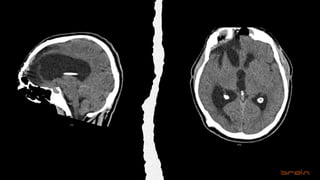
 Unrestrained driver; crashed into parked vehicle; major
brain/ skull trauma (extracranial brain herniation)
 2 months ICU; multiple complications: EVD/ shunt;
respiratory; DVTs; IVC filter; ventriculitis; PUO;
seizures; fractures; burns
 1 year in Brain Injury Rehabilitation Unit: mobility
impairments; ROM restrictions; pain; incontinence;
cognitive impairments; significant psychosocial issues
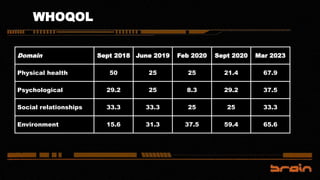
WHOQOL
Domain Sept 2018 June 2019 Feb 2020 Sept 2020 Mar 2023
Physical health 50 25 25 21.4 67.9
Psychological 29.2 25 8.3 29.2 37.5
Social relationships 33.3 33.3 25 25 33.3
Environment 15.6 31.3 37.5 59.4 65.6
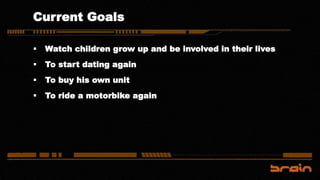
Current Goals
 Watch children grow up and be involved in their lives
 To start dating again
 To buy his own unit
 To ride a motorbike again
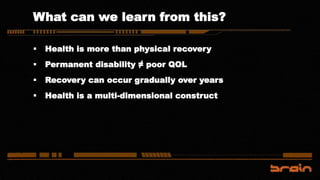
What can we learn from this?
 Health is more than physical recovery
 Permanent disability ≠ poor QOL
 Recovery can occur gradually over years
 Health is a multi-dimensional construct
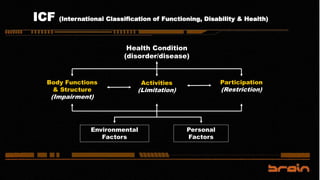
Health Condition
(disorder/disease)
Environmental
Factors
Personal
Factors
Body Functions
& Structure
(Impairment)
Activities
(Limitation)
Participation
(Restriction)
ICF (International Classification of Functioning, Disability & Health)
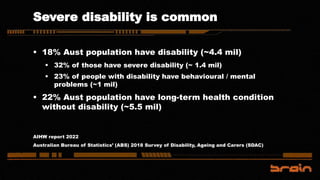
Severe disability is common
 18% Aust population have disability (~4.4 mil)
 32% of those have severe disability (~ 1.4 mil)
 23% of people with disability have behavioural / mental
problems (~1 mil)
 22% Aust population have long-term health condition
without disability (~5.5 mil)
AIHW report 2022
Australian Bureau of Statistics’ (ABS) 2018 Survey of Disability, Ageing and Carers (SDAC)
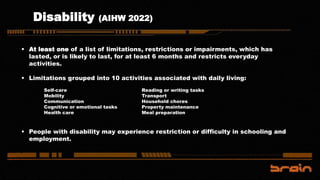
Disability (AIHW 2022)
 At least one of a list of limitations, restrictions or impairments, which has
lasted, or is likely to last, for at least 6 months and restricts everyday
activities.
 Limitations grouped into 10 activities associated with daily living:
 People with disability may experience restriction or difficulty in schooling and
employment.
Self-care
Mobility
Communication
Cognitive or emotional tasks
Health care
Reading or writing tasks
Transport
Household chores
Property maintenance
Meal preparation
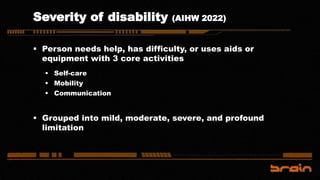
Severity of disability (AIHW 2022)
 Person needs help, has difficulty, or uses aids or
equipment with 3 core activities
 Self-care
 Mobility
 Communication
 Grouped into mild, moderate, severe, and profound
limitation
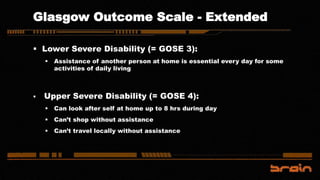
Glasgow Outcome Scale - Extended
 Lower Severe Disability (= GOSE 3):
 Assistance of another person at home is essential every day for some
activities of daily living
 Upper Severe Disability (= GOSE 4):
 Can look after self at home up to 8 hrs during day
 Can’t shop without assistance
 Can’t travel locally without assistance
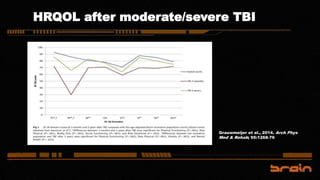
HRQOL after moderate/severe TBI
Grauwmeijer et al., 2014. Arch Phys
Med & Rehab; 95:1268-76
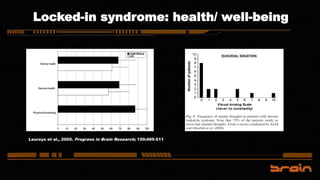
Locked-in syndrome: health/ well-being
Laureys et al., 2005. Progress in Brain Research; 150:495-511
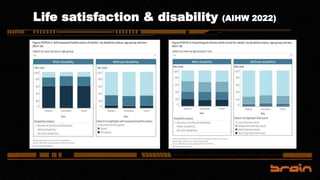
Life satisfaction & disability (AIHW 2022)
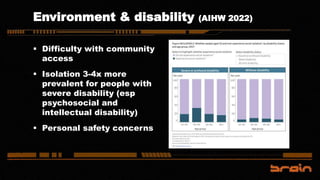
Environment & disability (AIHW 2022)
 Difficulty with community
access
 Isolation 3-4x more
prevalent for people with
severe disability (esp
psychosocial and
intellectual disability)
 Personal safety concerns
Areas of discrimination
 Education – 36.8%
 Employment & income (assoc. with work avoidance)
 Access to facilities & services (eg 43% medical facility)
 Public transport
 Using steps 34%; facing fear or anxiety 32%; getting to stops or stations 21%, finding a
seat or standing 20%
 Service provider access 28% (cf 20% without disability)
 Centrelink/Medicare/Family Assistance Office 50%; hospitals 29%; banks 28%
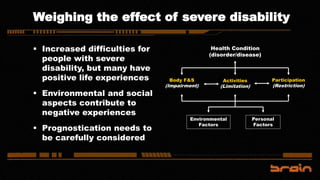
Weighing the effect of severe disability
 Increased difficulties for
people with severe
disability, but many have
positive life experiences
 Environmental and social
aspects contribute to
negative experiences
 Prognostication needs to
be carefully considered
Health Condition
(disorder/disease)
Environmental
Factors
Personal
Factors
Body F&S
(Impairment)
Activities
(Limitation)
Participation
(Restriction)

Browne Neuro symposium.pptx

  • 2.
    Severe disability followingTBI: what does it mean? Dr Stuart Browne Brain Injury Rehabilitation Service, Royal Rehab
  • 3.
    Case Study: 50M,high-speed MVA 2017  Unrestrained driver; crashed into parked vehicle; major brain/ skull trauma (extracranial brain herniation)  2 months ICU; multiple complications: EVD/ shunt; respiratory; DVTs; IVC filter; ventriculitis; PUO; seizures; fractures; burns  1 year in Brain Injury Rehabilitation Unit: mobility impairments; ROM restrictions; pain; incontinence; cognitive impairments; significant psychosocial issues
  • 5.
    WHOQOL Domain Sept 2018June 2019 Feb 2020 Sept 2020 Mar 2023 Physical health 50 25 25 21.4 67.9 Psychological 29.2 25 8.3 29.2 37.5 Social relationships 33.3 33.3 25 25 33.3 Environment 15.6 31.3 37.5 59.4 65.6
  • 6.
    Current Goals  Watchchildren grow up and be involved in their lives  To start dating again  To buy his own unit  To ride a motorbike again
  • 7.
    What can welearn from this?  Health is more than physical recovery  Permanent disability ≠ poor QOL  Recovery can occur gradually over years  Health is a multi-dimensional construct
  • 8.
    Health Condition (disorder/disease) Environmental Factors Personal Factors Body Functions &Structure (Impairment) Activities (Limitation) Participation (Restriction) ICF (International Classification of Functioning, Disability & Health)
  • 9.
    Severe disability iscommon  18% Aust population have disability (~4.4 mil)  32% of those have severe disability (~ 1.4 mil)  23% of people with disability have behavioural / mental problems (~1 mil)  22% Aust population have long-term health condition without disability (~5.5 mil) AIHW report 2022 Australian Bureau of Statistics’ (ABS) 2018 Survey of Disability, Ageing and Carers (SDAC)
  • 10.
    Disability (AIHW 2022) At least one of a list of limitations, restrictions or impairments, which has lasted, or is likely to last, for at least 6 months and restricts everyday activities.  Limitations grouped into 10 activities associated with daily living:  People with disability may experience restriction or difficulty in schooling and employment. Self-care Mobility Communication Cognitive or emotional tasks Health care Reading or writing tasks Transport Household chores Property maintenance Meal preparation
  • 11.
    Severity of disability(AIHW 2022)  Person needs help, has difficulty, or uses aids or equipment with 3 core activities  Self-care  Mobility  Communication  Grouped into mild, moderate, severe, and profound limitation
  • 12.
    Glasgow Outcome Scale- Extended  Lower Severe Disability (= GOSE 3):  Assistance of another person at home is essential every day for some activities of daily living  Upper Severe Disability (= GOSE 4):  Can look after self at home up to 8 hrs during day  Can’t shop without assistance  Can’t travel locally without assistance
  • 13.
    HRQOL after moderate/severeTBI Grauwmeijer et al., 2014. Arch Phys Med & Rehab; 95:1268-76
  • 14.
    Locked-in syndrome: health/well-being Laureys et al., 2005. Progress in Brain Research; 150:495-511
  • 15.
    Life satisfaction &disability (AIHW 2022)
  • 16.
    Environment & disability(AIHW 2022)  Difficulty with community access  Isolation 3-4x more prevalent for people with severe disability (esp psychosocial and intellectual disability)  Personal safety concerns
  • 17.
    Areas of discrimination Education – 36.8%  Employment & income (assoc. with work avoidance)  Access to facilities & services (eg 43% medical facility)  Public transport  Using steps 34%; facing fear or anxiety 32%; getting to stops or stations 21%, finding a seat or standing 20%  Service provider access 28% (cf 20% without disability)  Centrelink/Medicare/Family Assistance Office 50%; hospitals 29%; banks 28%
  • 18.
    Weighing the effectof severe disability  Increased difficulties for people with severe disability, but many have positive life experiences  Environmental and social aspects contribute to negative experiences  Prognostication needs to be carefully considered Health Condition (disorder/disease) Environmental Factors Personal Factors Body F&S (Impairment) Activities (Limitation) Participation (Restriction)