What is e-learningSome answers and a lot of questions
ContentsLearning is much more than trainingThe difference between information and educationLearning design stepse-learning featuresE-learning justificationE-learning benefits: costs, quality, reach, responsivenessIntegration of e-learning and classroom educationChanges in education paradigmsE-learning challengesLearning redesign modelsE-learning technologyE-learning specific technologies: authorware and LMSIntegration with other information systemsClosing knowledge management loopIntegration of e-learning and knowledge managemente-learning | Presentation2
Learning is much more than training“The illiterate of the 21st century will not be those who cannot read and write, but those who cannot learn, unlearn and relearn”Alvin Toffler
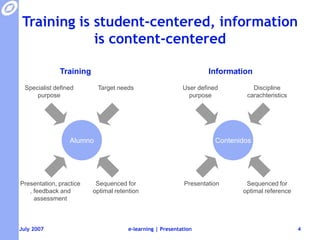
Training is student-centered, information is content-centeredTrainingInformationSpecialistdefinedpurposeTarget needsUserdefinedpurposeDiscipline carachteristicsStudentContentSequencedforoptimalretentionPresentation, practice, feedback and assessmentSequencedforoptimalreferencePresentatione-learning | Presentation4
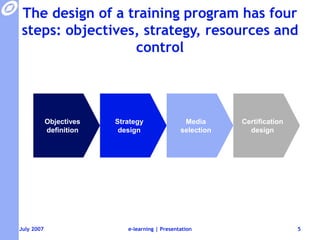
The design of a training program has four steps: objectives, strategy, resources and controlCertification designMedia selectionStrategy designObjectives definitione-learning | Presentation5
E-learning features are: inmediacy, universality and continuitye-learning leverages Internet advantages, allowing updating, storing, recovering, distributing and sharing of information and trainingCan reach a wide target as is using standard Internet technologyLearning is not over when training is finished, but performance assistance tools can be providede-learning | Presentation6
e-learning justificationNucleus Research analysts independently assessed the IBM training program “Basic Blue” and found that the company has got a return of investment (ROI) of 2284%
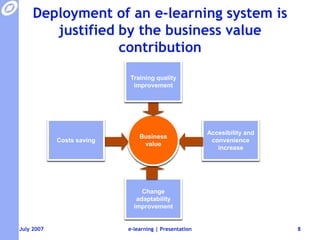
Deployment of an e-learning system is justified by the business value contributionTraining qualityimprovementBusiness valueAccesibility and convenienceincreaseCostssavingChangeadaptabilityimprovementJuly 2007e-learning | Presentation8
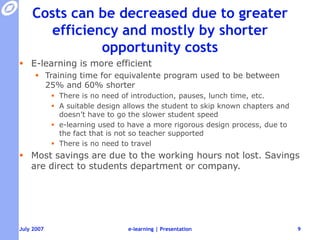
Costs can be decreased due to greater efficiency and mostly by shorter opportunity costsE-learning is more efficientTraining time for equivalente program used to be between 25% and 60% shorterThere is no need of introduction, pauses, lunch time, etc.A suitable design allows the student to skip known chapters and doesn’t have to go the slower student speede-learning used to have a more rigorous design process, due to the fact that is not so teacher supportedThere is no need to travelMost savings are due to the working hours not lost. Savings are direct to students department or company.e-learning | Presentation9
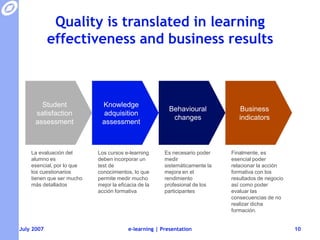
Quality is translated in learning effectiveness and business resultsBusiness indicatorsBehaviouralchangesKnowledgeadquisitionassessmentStudentsatisfactionassessmente-learning | Presentation10
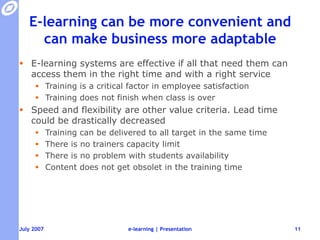
E-learning can be more convenient and can make business more adaptableE-learning systems are effective if all that need them can access them in the right time and with a right serviceTraining is a critical factor in employee satisfactionTraining does not finish when class is overSpeed and flexibility are other value criteria. Lead time could be drastically decreasedTraining can be delivered to all target in the same timeThere is no trainers capacity limitThere is no problem with students availabilityContent does not get obsolet in the training timeJuly 2007e-learning | Presentation11
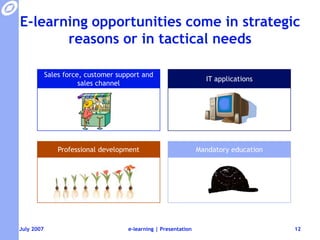
E-learning opportunities come in strategic reasons or in tactical needsIT applicationsSales force, customersupport and sales channelMandatoryeducationProfessional developmente-learning | Presentation12
Integration of e-learning and classroom training“Personally, I am always ready to learn, although I do not always like being taught”Winston Churchill
Internet is going to change classroom training paradigm...Classroom will not be default trainingClassroom training and e-learning synergies will increase progressivelyTeacher will become a facilitatorTraining manuals will become Internet o intranet guides continously updatedTraining schedules will become irrelevante-learning | Presentation14
...but there are big challenges to faceTo be part of a global learning strategy integrated in HR strategy and suitable to corporate cultureTo be suitable to student needs (pretest, skills profile, expert system, tutor)To keep student interest and attention during all training eventTo be user friendlyTo relate learning to business objectivesTo measure learning application and impact in business resultsTo provide suitable support for student difficultiese-learning | Presentation15
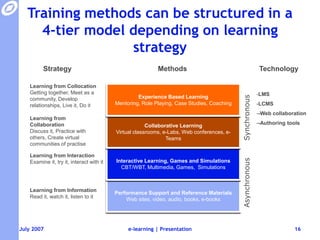
Training methods can be structured in a 4-tier model depending on learning strategyStrategyTechnologyMethodsLearning from CollocationGetting together, Meet as a community, Develop relationships, Live it, Do itExperienceBasedLearningMentoring, Role Playing, Case Studies, CoachingLMS
LCMS
-Web collaboration
-AuthoringtoolsSynchronousLearningfromCollaborationDiscussit, Practicewithothers, Create virtual communities of practiseCollaborativeLearningVirtual classrooms, e-Labs, Web conferences, e-TeamsInteractiveLearning, Games and SimulationsCBT/WBT, Multimedia, Games,  SimulationsLearning from InteractionExamine it, try it, interact with itAsynchronousPerformance Support and ReferenceMaterialsWeb sites, video, audio, books, e-booksLearning from InformationRead it, watch it, listen to ite-learning | Presentation16
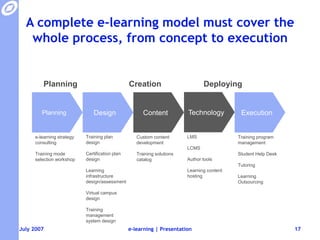
A complete e-learning model must cover the whole process, from concept to executionPlanningDeployingCreationTechnologyExecutionContentDesignPlanningLMSLCMSAuthortoolsLearningcontenthostingTraining plan designCertification plan designLearninginfrastructuredesign/assessmentVirtual campus designTraining managementsystemdesigne-learningstrategyconsultingTraining modeselectionworkshopTraining programmanagementStudentHelpDeskTutoringLearningOutsourcingCustomcontentdevelopmentTraining solutionscataloge-learning | Presentation17
e-learning technology“Internet content is the King but infrastructure is God"Tom KellyWorld Education VP, Cisco Systems
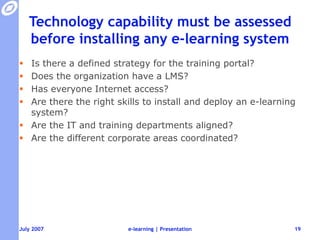
Technology capability must be assessed before installing any e-learning systemIs there a defined strategy for the training portal?Does the organization have a LMS?Has everyone Internet access?Are there the right skills to install and deploy an e-learning system?Are the IT and training departments aligned?Are the different corporate areas coordinated?e-learning | Presentation19
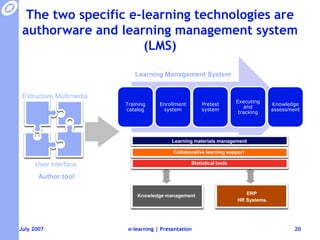
The two specific e-learning technologies areauthorware and learning management system (LMS)EstructureMultimediaLearningmaterialsmanagementCollaborativelearningsupportStatisticaltoolsUser interfaceERPKnowledgemanagementHR Systems.Learning Management SystemAuthortoole-learning | Presentation20
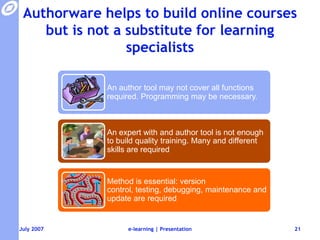
Authorware helps to build online courses but is not a substitute for learning specialistse-learning | Presentation21
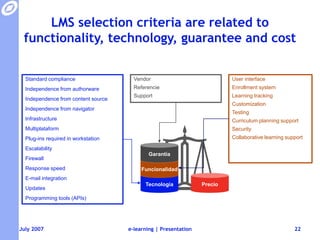
LMS selection criteria are related to functionality, technology, guarantee and costUser interfaceEnrollmentsystemLearning trackingCustomizationTestingCurriculumplanningsupportSecurityCollaborativelearningsupportVendorReferencieSupportStandard complianceIndependence fromauthorwareIndependence fromcontentsourceIndependence fromnavigatorInfrastructureMultiplataformPlug-insrequired in workstationEscalabilityFirewallResponse speedE-mail integrationUpdatesProgrammingtools(APIs)GuaranteeFuncionalityTecnologyPricee-learning | Presentation22
Closing the knowledge loopLearning 2.0

What is e-learning?

  • 1.
    What is e-learningSomeanswers and a lot of questions
  • 2.
    ContentsLearning is muchmore than trainingThe difference between information and educationLearning design stepse-learning featuresE-learning justificationE-learning benefits: costs, quality, reach, responsivenessIntegration of e-learning and classroom educationChanges in education paradigmsE-learning challengesLearning redesign modelsE-learning technologyE-learning specific technologies: authorware and LMSIntegration with other information systemsClosing knowledge management loopIntegration of e-learning and knowledge managemente-learning | Presentation2
  • 3.
    Learning is muchmore than training“The illiterate of the 21st century will not be those who cannot read and write, but those who cannot learn, unlearn and relearn”Alvin Toffler
  • 4.
    Training is student-centered,information is content-centeredTrainingInformationSpecialistdefinedpurposeTarget needsUserdefinedpurposeDiscipline carachteristicsStudentContentSequencedforoptimalretentionPresentation, practice, feedback and assessmentSequencedforoptimalreferencePresentatione-learning | Presentation4
  • 5.
    The design ofa training program has four steps: objectives, strategy, resources and controlCertification designMedia selectionStrategy designObjectives definitione-learning | Presentation5
  • 6.
    E-learning features are:inmediacy, universality and continuitye-learning leverages Internet advantages, allowing updating, storing, recovering, distributing and sharing of information and trainingCan reach a wide target as is using standard Internet technologyLearning is not over when training is finished, but performance assistance tools can be providede-learning | Presentation6
  • 7.
    e-learning justificationNucleus Researchanalysts independently assessed the IBM training program “Basic Blue” and found that the company has got a return of investment (ROI) of 2284%
  • 8.
    Deployment of ane-learning system is justified by the business value contributionTraining qualityimprovementBusiness valueAccesibility and convenienceincreaseCostssavingChangeadaptabilityimprovementJuly 2007e-learning | Presentation8
  • 9.
    Costs can bedecreased due to greater efficiency and mostly by shorter opportunity costsE-learning is more efficientTraining time for equivalente program used to be between 25% and 60% shorterThere is no need of introduction, pauses, lunch time, etc.A suitable design allows the student to skip known chapters and doesn’t have to go the slower student speede-learning used to have a more rigorous design process, due to the fact that is not so teacher supportedThere is no need to travelMost savings are due to the working hours not lost. Savings are direct to students department or company.e-learning | Presentation9
  • 10.
    Quality is translatedin learning effectiveness and business resultsBusiness indicatorsBehaviouralchangesKnowledgeadquisitionassessmentStudentsatisfactionassessmente-learning | Presentation10
  • 11.
    E-learning can bemore convenient and can make business more adaptableE-learning systems are effective if all that need them can access them in the right time and with a right serviceTraining is a critical factor in employee satisfactionTraining does not finish when class is overSpeed and flexibility are other value criteria. Lead time could be drastically decreasedTraining can be delivered to all target in the same timeThere is no trainers capacity limitThere is no problem with students availabilityContent does not get obsolet in the training timeJuly 2007e-learning | Presentation11
  • 12.
    E-learning opportunities comein strategic reasons or in tactical needsIT applicationsSales force, customersupport and sales channelMandatoryeducationProfessional developmente-learning | Presentation12
  • 13.
    Integration of e-learningand classroom training“Personally, I am always ready to learn, although I do not always like being taught”Winston Churchill
  • 14.
    Internet is goingto change classroom training paradigm...Classroom will not be default trainingClassroom training and e-learning synergies will increase progressivelyTeacher will become a facilitatorTraining manuals will become Internet o intranet guides continously updatedTraining schedules will become irrelevante-learning | Presentation14
  • 15.
    ...but there arebig challenges to faceTo be part of a global learning strategy integrated in HR strategy and suitable to corporate cultureTo be suitable to student needs (pretest, skills profile, expert system, tutor)To keep student interest and attention during all training eventTo be user friendlyTo relate learning to business objectivesTo measure learning application and impact in business resultsTo provide suitable support for student difficultiese-learning | Presentation15
  • 16.
    Training methods canbe structured in a 4-tier model depending on learning strategyStrategyTechnologyMethodsLearning from CollocationGetting together, Meet as a community, Develop relationships, Live it, Do itExperienceBasedLearningMentoring, Role Playing, Case Studies, CoachingLMS
  • 17.
  • 18.
  • 19.
    -AuthoringtoolsSynchronousLearningfromCollaborationDiscussit, Practicewithothers, Createvirtual communities of practiseCollaborativeLearningVirtual classrooms, e-Labs, Web conferences, e-TeamsInteractiveLearning, Games and SimulationsCBT/WBT, Multimedia, Games, SimulationsLearning from InteractionExamine it, try it, interact with itAsynchronousPerformance Support and ReferenceMaterialsWeb sites, video, audio, books, e-booksLearning from InformationRead it, watch it, listen to ite-learning | Presentation16
  • 20.
    A complete e-learningmodel must cover the whole process, from concept to executionPlanningDeployingCreationTechnologyExecutionContentDesignPlanningLMSLCMSAuthortoolsLearningcontenthostingTraining plan designCertification plan designLearninginfrastructuredesign/assessmentVirtual campus designTraining managementsystemdesigne-learningstrategyconsultingTraining modeselectionworkshopTraining programmanagementStudentHelpDeskTutoringLearningOutsourcingCustomcontentdevelopmentTraining solutionscataloge-learning | Presentation17
  • 21.
    e-learning technology“Internet contentis the King but infrastructure is God"Tom KellyWorld Education VP, Cisco Systems
  • 22.
    Technology capability mustbe assessed before installing any e-learning systemIs there a defined strategy for the training portal?Does the organization have a LMS?Has everyone Internet access?Are there the right skills to install and deploy an e-learning system?Are the IT and training departments aligned?Are the different corporate areas coordinated?e-learning | Presentation19
  • 23.
    The two specifice-learning technologies areauthorware and learning management system (LMS)EstructureMultimediaLearningmaterialsmanagementCollaborativelearningsupportStatisticaltoolsUser interfaceERPKnowledgemanagementHR Systems.Learning Management SystemAuthortoole-learning | Presentation20
  • 24.
    Authorware helps tobuild online courses but is not a substitute for learning specialistse-learning | Presentation21
  • 25.
    LMS selection criteriaare related to functionality, technology, guarantee and costUser interfaceEnrollmentsystemLearning trackingCustomizationTestingCurriculumplanningsupportSecurityCollaborativelearningsupportVendorReferencieSupportStandard complianceIndependence fromauthorwareIndependence fromcontentsourceIndependence fromnavigatorInfrastructureMultiplataformPlug-insrequired in workstationEscalabilityFirewallResponse speedE-mail integrationUpdatesProgrammingtools(APIs)GuaranteeFuncionalityTecnologyPricee-learning | Presentation22
  • 26.
    Closing the knowledgeloopLearning 2.0
  • 27.
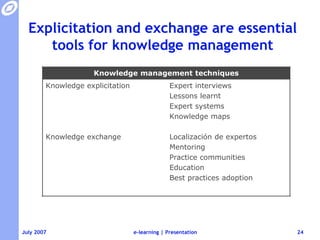
    Explicitation and exchangeare essential tools for knowledge managemente-learning | Presentation24
  • 28.
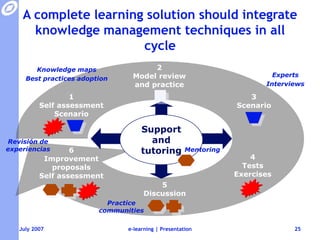
    A complete learningsolution should integrate knowledge management techniques in all cycle2Modelreviewand practiceKnowledgemapsBestpracticesadoptionExpertsInterviews1SelfassessmentScenario3ScenarioSupport and tutoringExperiencereview6ImprovementproposalsSelfassessmentMentoring4 TestsExercises5DiscussionPracticecommunitiese-learning | Presentation25
  • 29.