Government Employee Experiences in an Online Wilderness Management Course Lisa Eidson Wilderness Information Specialist,  http://www.wilderness.net   Technology Steward,  http://connect.wilderness.net Master’s Student (graduated fall 2009), University of Montana
Presentation Outline Importance of e-learning What is e-learning? Research Study details Results Systemic problems Conclusions Recommendations
Importance of E-Learning E-learning allows government to continue training employees despite: Increasingly restricted travel Shrinking natural resource budgets E-learning represents the future of wilderness training
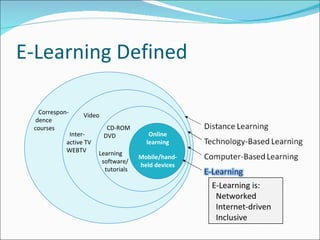
E-Learning Defined Correspon- dence  courses Video CD-ROM DVD Online learning Inter- active TV WEBTV Mobile/hand-held devices Learning software/ tutorials E-Learning is: Networked Internet-driven Inclusive
E-Learning Benefits Convenient Accessible Reliable and universal Accurate Scalable Easy to learn Risk-free Equality of participation Efficient
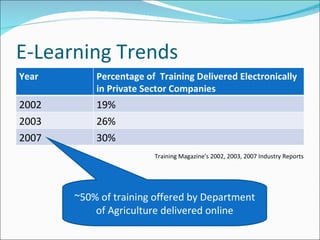
E-Learning Trends Training Magazine’s 2002, 2003, 2007 Industry Reports ~50% of training offered by Department of Agriculture delivered online Year Percentage of  Training Delivered Electronically in Private Sector Companies 2002 19% 2003 26% 2007 30%
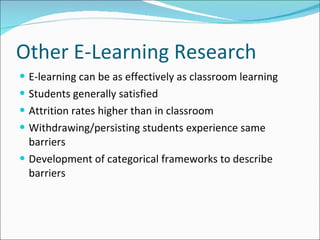
Other E-Learning Research E-learning can be as effectively as classroom learning Students generally satisfied Attrition rates higher than in classroom Withdrawing/persisting students experience same barriers Development of categorical frameworks to describe barriers
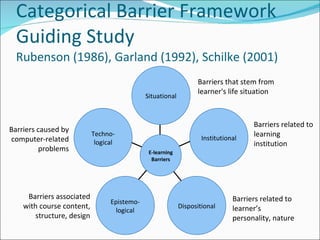
Categorical Barrier Framework Guiding Study Rubenson (1986), Garland (1992), Schilke (2001) Techno-logical Epistemo-logical Dispositional Institutional Situational E-learning Barriers Barriers that stem from learner's life situation Barriers related to learning institution Barriers related to learner’s personality, nature Barriers associated with course content, structure, design Barriers caused by computer-related problems
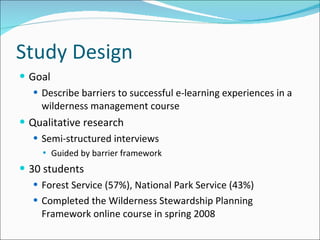
Study Design Goal Describe barriers to successful e-learning experiences in a wilderness management course Qualitative research Semi-structured interviews Guided by barrier framework 30 students Forest Service (57%), National Park Service (43%) Completed the Wilderness Stewardship Planning Framework online course in spring 2008
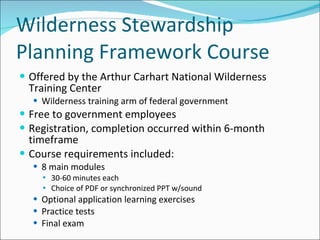
Wilderness Stewardship Planning Framework Course Offered by the Arthur Carhart National Wilderness Training Center Wilderness training arm of federal government Free to government employees Registration, completion occurred within 6-month timeframe Course requirements included: 8 main modules  30-60 minutes each Choice of PDF or synchronized PPT w/sound Optional application learning exercises Practice tests Final exam
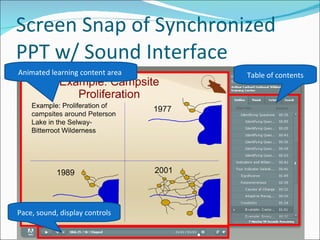
Screen Snap of Synchronized PPT w/ Sound Interface Screen snap of course Table of contents Pace, sound, display controls Animated learning content area
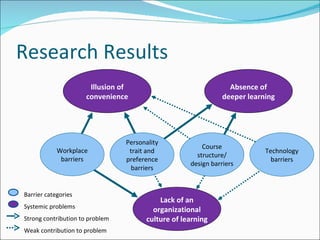
Research Results Illusion of convenience Absence of deeper learning Lack of an organizational culture of learning Workplace barriers Personality trait and preference barriers Course structure/ design barriers Technology barriers Barrier categories Systemic problems Strong contribution to problem Weak contribution to problem
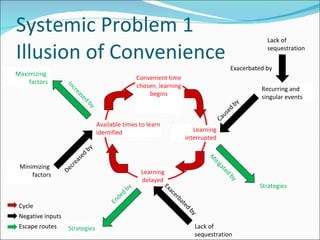
Systemic Problem 1 Illusion of Convenience Recurring and singular events Convenient time chosen, learning begins Available times to learn identified Learning delayed Learning interrupted Lack of  sequestration Strategies Maximizing  factors Minimizing  factors Strategies Caused by Decreased by Exacerbated by Exacerbated by Lack of sequestration Ended by Mitigated by Increased by Cycle Negative inputs Escape routes
Minimizing Factor: Competing Priorities Recurring and singular events Convenient time chosen, learning begins Available times to learn identified Learning delayed Learning interrupted Lack of  sequestration Strategies Maximizing  factors Minimizing  factors Strategies Caused by Decreased by Exacerbated by Exacerbated by Lack of sequestration Ended by Mitigated by Increased by “ Learning in the workplace…isn’t the main priority.” “ shoe horn [learning] in“ "work [learning] around…obligations"
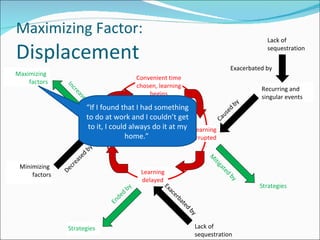
Maximizing Factor: Displacement Recurring and singular events Convenient time chosen, learning begins Available times to learn identified Learning delayed Learning interrupted Lack of  sequestration Strategies Maximizing  factors Minimizing  factors Strategies Caused by Decreased by Exacerbated by Exacerbated by Lack of sequestration Ended by Mitigated by Increased by “ If I found that I had something to do at work and I couldn’t get to it, I could always do it at my home.”
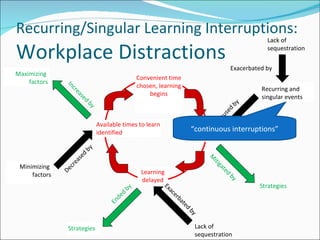
Recurring/Singular Learning Interruptions: Workplace Distractions Recurring and singular events Convenient time chosen, learning begins Available times to learn identified Learning delayed Learning interrupted Lack of  sequestration Strategies Maximizing  factors Minimizing  factors Strategies Caused by Decreased by Exacerbated by Exacerbated by Lack of sequestration Ended by Mitigated by Increased by “ continuous interruptions”
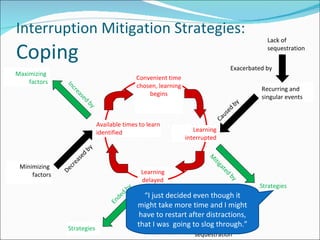
Interruption Mitigation Strategies: Coping Recurring and singular events Convenient time chosen, learning begins Available times to learn identified Learning delayed Learning interrupted Lack of  sequestration Strategies Maximizing  factors Minimizing  factors Strategies Caused by Decreased by Exacerbated by Exacerbated by Lack of sequestration Ended by Mitigated by Increased by “ I just decided even though it might take more time and I might have to restart after distractions, that I was  going to slog through.”
Delaying Learning Recurring and singular events Convenient time chosen, learning begins Available times to learn identified Learning delayed Learning interrupted Lack of  sequestration Strategies Maximizing  factors Minimizing  factors Strategies Caused by Decreased by Exacerbated by Exacerbated by Lack of sequestration Ended by Mitigated by Increased by “ All those things…played into the mix of [the coursework] just getting…pushed further and further back.”
Strategies to End Procrastination: Cramming Recurring and singular events Convenient time chosen, learning begins Available times to learn identified Learning delayed Learning interrupted Lack of  sequestration Strategies Maximizing  factors Minimizing  factors Strategies Caused by Decreased by Exacerbated by Exacerbated by Lack of sequestration Ended by Mitigated by Increased by “ Once I procrastinated so long,…I had to force myself to do [the course] all in a very short amount of time.”
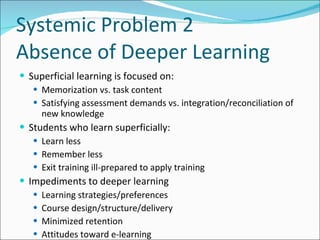
Systemic Problem 2 Absence of Deeper Learning Superficial learning is focused on: Memorization vs. task content Satisfying assessment demands vs. integration/reconciliation of new knowledge Students who learn superficially: Learn less Remember less Exit training ill-prepared to apply training Impediments to deeper learning Learning strategies/preferences Course design/structure/delivery Minimized retention Attitudes toward e-learning
Preference for group learning, lack of interaction Learning Strategies/Preferences “ I feel like I learn better in a group, because there’s more interaction.” “ There’s a potential for [an e-learning] course to just be appealing to one style of learning.” “ Anytime there’s a group of people, you’re going to hear things that are outside of your box of thought.”
Lack of professional networking Learning Strategies/Preferences “ It’s that casual interaction that reinforces some of the learning points that you miss [in e-learning]. ”
Lack of personalized evaluation Learning Strategies/Preferences “ The testing brought you back to really exact things rather than the general idea.”  “ I found that [the testing] really geared to how I needed to learn the concepts.” “ If there was an assignment that I could have picked from and submitted it for peer review, that would have been much more challenging to me.”
Focus on words not concepts Course Design/Structure/Delivery “ It almost felt like a crossword….you start to focus a little too much on the wording and a little too little on the meaning and the comprehension.”
Ease of distraction Course Design/Structure/Delivery “ I think because it’s not a human, it’s easy to get distracted…Your mind tends to wander more.”  “ You’re more maybe prone to multitasking while doing an online training.”
Online delivery medium Minimized Retention “ It’s difficult to really absorb as much through online learning.” “ It’s easy to…skim through and feel like you’ve completed something when really you haven’t gone into too much depth and you probably didn’t retain too much.”
Procrastination followed by cramming Minimized Retention “ When I did my marathon,…I overdid myself.” “ I felt…saturated with information.”  “ I felt rushed…I really wanted to complete [the course] so I was like, okay, I’ll do the bare minimum.” “ To power through the course, I didn’t necessarily try to take advantage of those practical exercises.”
Expectations Attitudes Toward E-Learning “ The stigma might be strong, but not a very positive perception of some of the mandatory online training…And I think sometimes because of that there can be a bit of a groan when we hear about other online training.”  “ I think I understood that…I was going to get the sense of the concepts and not much more, not as deep an understanding.”
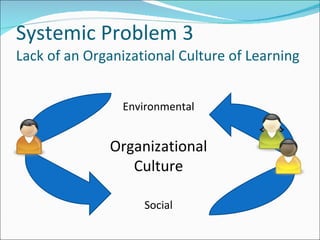
Systemic Problem 3 Lack of an Organizational Culture of Learning Organizational Culture Environmental Social
Learning not prioritized Environmental/Social Factors Affecting/Defining Organizational Culture “ So it’s almost like triage, you come in the office expecting to get stuff done and [learning] just doesn’t happen.  Other things pop up.” “ [online learning] kind of became a priority at work whenever the public wasn’t around.”  “ Someone would swing by and drop 5 words, it might be 30 minutes of my day going to do something real quick.”
Conflicting messages about learning Environmental/Social Factors Affecting/Defining Organizational Culture “ My supervisor said, ‘Yes, you can use work time.’  But I was pretty sure without asking for any clarification that…it was like this, ‘You can do this, you’re not gonna get criticized if you get caught doing this on the job.  But all the things I have for you to do or all the things you know you better be doing have to come first.’”
Prevalence of passive coping strategies Environmental/Social Factors Affecting/Defining Organizational Culture “ Finding time that the physical noise and physical presence of folks in the office was limited, that was basically the only strategy I had.” “ I was hoping that I could…somehow after work find time to do two hours each day and then go home late.  And that just did not work. And then I said, well, I’ll have to do it on my day off.”
Feelings of guilt, reluctance to use work time to learn Environmental/Social Factors Affecting/Defining Organizational Culture “ I kind of felt guilty doing [e-learning] at work even though my boss said I could.” “ It was a continuing education opportunity…So I was more than happy to say, ‘Okay, if the government will give me one hour a week, then if I need to, I’ll spend an hour on my own time to make sure that I complete the course.’”
Inadequate technology Environmental/Social Factors Affecting/Defining Organizational Culture “ My biggest challenge was getting a computer for a length of time.” “ Our typical problem here is not enough bandwidth and during certain times.” “ [The course] did not seem to mesh well with the [agency’s] computer system.” “ I used rotten speakers…they crackle.”
Isolation Environmental/Social Factors Affecting/Defining Organizational Culture “ I think in an academic community, it’s that whole interaction…[It] provides an atmosphere that you’re not able to duplicate on the web.” “ Another aspect…that is missed…is the camaraderie you build…that whole aspect of networking.”
Negative prior experiences with institutional training Environmental/Social Factors Affecting/Defining Organizational Culture Colorful descriptions of required agency online training: “ Eew!” “ universally frustrating”  “ redundant” “ Can the monkey jump through the hoop?” “ I’m sure [my prior experiences] influenced it a lot…The only thing I knew about any online course was those that I had taken.“
Low technical aptitude Environmental/Social Factors Affecting/Defining Organizational Culture “ I personally consider myself almost computer illiterate.” “ I really don’t use [computers] much…it’s only for work….I’d rather not deal with it.”  “ I don’t like computers at all…Like hooking up those speakers to take this class was like a pain in the ass for me, because it was like I had to plug them to that plate of spaghetti behind my desk.  And that was a chore in itself.”
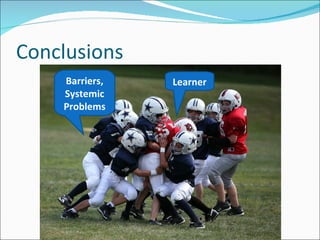
Conclusions Learner Barriers, Systemic Problems
Conclusions E-learning in the wilderness management workplace : Was inconvenient Fostered superficial learning Occurred amid a culture that devalued/minimized learning as part of work
Context Limitations Small sample Specific epistemological setting Focused narrowly on negative aspects Purposely excluded benefits including: Accessibility Efficiency Course quality compared to required agency online trainings
Relevance Job of educators/trainers is to remove barriers to e-learning at work via: Formal training Online courses Informal learning Networks, communities of practice, lessons learned centers Publications, syntheses, research Searchable databases, data centers
Recommendations Responsibility for workplace e-learning is shared by: Employees E-learning training providers Employers
Recommendations for Employees Learners should: Take a more active role in their own learning Set appropriate expectations of learning Read, understand, meet necessary course requirements Enlist support for learning
Recommendations for  E-Learning Training Providers Providers including the Carhart Center should: Offer synchronous/asynchronous/group versions Incorporate interaction/networking Match employees to relevant trainings Rethink course content
Recommendations for Employers Employers including the wilderness management agencies should: Institutionalize/legitimize learning/training at work Provide better learning environments Connect learners after training
References Cited Garland, M. R. (1992). Variable Affecting Persistence in Distance Education in the Natural Resource Sciences.  Dissertation Abstracts International, 54 (6), 2108. (UMI No. NN79731) Ramsden, P. (1992).  Learning to Teach in Higher Education.  London: Routledge. Rubenson, K. (1986). Distance Education for Adults: Old and new barriers for participation. In van Enckevort, G., Harry, K., Morin, P., and Schultze, H. G. (Eds)  Distance Higher Education and the Adult Learner: Innovations in Distance Education  (Vol 1, p. 39-55). Heerlen, Netherlands: Dutch Open University. Schilke, R. A. (2001). A Case Study of Attrition in Web-based Instruction for Adults: Updating Garland's model of barriers to persistence in distance education.  Dissertation Abstracts International, 62 (5), 1684. (UMI No. 3013802)
Questions? Lisa Eidson [email_address] 406-243-6933 (office) 406-396-3607 (cell)

Barriers To E-Learning Job Training Presentation (no sound)

  • 1.
    Government Employee Experiencesin an Online Wilderness Management Course Lisa Eidson Wilderness Information Specialist, http://www.wilderness.net Technology Steward, http://connect.wilderness.net Master’s Student (graduated fall 2009), University of Montana
  • 2.
    Presentation Outline Importanceof e-learning What is e-learning? Research Study details Results Systemic problems Conclusions Recommendations
  • 3.
    Importance of E-LearningE-learning allows government to continue training employees despite: Increasingly restricted travel Shrinking natural resource budgets E-learning represents the future of wilderness training
  • 4.
    E-Learning Defined Correspon-dence courses Video CD-ROM DVD Online learning Inter- active TV WEBTV Mobile/hand-held devices Learning software/ tutorials E-Learning is: Networked Internet-driven Inclusive
  • 5.
    E-Learning Benefits ConvenientAccessible Reliable and universal Accurate Scalable Easy to learn Risk-free Equality of participation Efficient
  • 6.
    E-Learning Trends TrainingMagazine’s 2002, 2003, 2007 Industry Reports ~50% of training offered by Department of Agriculture delivered online Year Percentage of Training Delivered Electronically in Private Sector Companies 2002 19% 2003 26% 2007 30%
  • 7.
    Other E-Learning ResearchE-learning can be as effectively as classroom learning Students generally satisfied Attrition rates higher than in classroom Withdrawing/persisting students experience same barriers Development of categorical frameworks to describe barriers
  • 8.
    Categorical Barrier FrameworkGuiding Study Rubenson (1986), Garland (1992), Schilke (2001) Techno-logical Epistemo-logical Dispositional Institutional Situational E-learning Barriers Barriers that stem from learner's life situation Barriers related to learning institution Barriers related to learner’s personality, nature Barriers associated with course content, structure, design Barriers caused by computer-related problems
  • 9.
    Study Design GoalDescribe barriers to successful e-learning experiences in a wilderness management course Qualitative research Semi-structured interviews Guided by barrier framework 30 students Forest Service (57%), National Park Service (43%) Completed the Wilderness Stewardship Planning Framework online course in spring 2008
  • 10.
    Wilderness Stewardship PlanningFramework Course Offered by the Arthur Carhart National Wilderness Training Center Wilderness training arm of federal government Free to government employees Registration, completion occurred within 6-month timeframe Course requirements included: 8 main modules 30-60 minutes each Choice of PDF or synchronized PPT w/sound Optional application learning exercises Practice tests Final exam
  • 11.
    Screen Snap ofSynchronized PPT w/ Sound Interface Screen snap of course Table of contents Pace, sound, display controls Animated learning content area
  • 12.
    Research Results Illusionof convenience Absence of deeper learning Lack of an organizational culture of learning Workplace barriers Personality trait and preference barriers Course structure/ design barriers Technology barriers Barrier categories Systemic problems Strong contribution to problem Weak contribution to problem
  • 13.
    Systemic Problem 1Illusion of Convenience Recurring and singular events Convenient time chosen, learning begins Available times to learn identified Learning delayed Learning interrupted Lack of sequestration Strategies Maximizing factors Minimizing factors Strategies Caused by Decreased by Exacerbated by Exacerbated by Lack of sequestration Ended by Mitigated by Increased by Cycle Negative inputs Escape routes
  • 14.
    Minimizing Factor: CompetingPriorities Recurring and singular events Convenient time chosen, learning begins Available times to learn identified Learning delayed Learning interrupted Lack of sequestration Strategies Maximizing factors Minimizing factors Strategies Caused by Decreased by Exacerbated by Exacerbated by Lack of sequestration Ended by Mitigated by Increased by “ Learning in the workplace…isn’t the main priority.” “ shoe horn [learning] in“ "work [learning] around…obligations"
  • 15.
    Maximizing Factor: DisplacementRecurring and singular events Convenient time chosen, learning begins Available times to learn identified Learning delayed Learning interrupted Lack of sequestration Strategies Maximizing factors Minimizing factors Strategies Caused by Decreased by Exacerbated by Exacerbated by Lack of sequestration Ended by Mitigated by Increased by “ If I found that I had something to do at work and I couldn’t get to it, I could always do it at my home.”
  • 16.
    Recurring/Singular Learning Interruptions:Workplace Distractions Recurring and singular events Convenient time chosen, learning begins Available times to learn identified Learning delayed Learning interrupted Lack of sequestration Strategies Maximizing factors Minimizing factors Strategies Caused by Decreased by Exacerbated by Exacerbated by Lack of sequestration Ended by Mitigated by Increased by “ continuous interruptions”
  • 17.
    Interruption Mitigation Strategies:Coping Recurring and singular events Convenient time chosen, learning begins Available times to learn identified Learning delayed Learning interrupted Lack of sequestration Strategies Maximizing factors Minimizing factors Strategies Caused by Decreased by Exacerbated by Exacerbated by Lack of sequestration Ended by Mitigated by Increased by “ I just decided even though it might take more time and I might have to restart after distractions, that I was going to slog through.”
  • 18.
    Delaying Learning Recurringand singular events Convenient time chosen, learning begins Available times to learn identified Learning delayed Learning interrupted Lack of sequestration Strategies Maximizing factors Minimizing factors Strategies Caused by Decreased by Exacerbated by Exacerbated by Lack of sequestration Ended by Mitigated by Increased by “ All those things…played into the mix of [the coursework] just getting…pushed further and further back.”
  • 19.
    Strategies to EndProcrastination: Cramming Recurring and singular events Convenient time chosen, learning begins Available times to learn identified Learning delayed Learning interrupted Lack of sequestration Strategies Maximizing factors Minimizing factors Strategies Caused by Decreased by Exacerbated by Exacerbated by Lack of sequestration Ended by Mitigated by Increased by “ Once I procrastinated so long,…I had to force myself to do [the course] all in a very short amount of time.”
  • 20.
    Systemic Problem 2Absence of Deeper Learning Superficial learning is focused on: Memorization vs. task content Satisfying assessment demands vs. integration/reconciliation of new knowledge Students who learn superficially: Learn less Remember less Exit training ill-prepared to apply training Impediments to deeper learning Learning strategies/preferences Course design/structure/delivery Minimized retention Attitudes toward e-learning
  • 21.
    Preference for grouplearning, lack of interaction Learning Strategies/Preferences “ I feel like I learn better in a group, because there’s more interaction.” “ There’s a potential for [an e-learning] course to just be appealing to one style of learning.” “ Anytime there’s a group of people, you’re going to hear things that are outside of your box of thought.”
  • 22.
    Lack of professionalnetworking Learning Strategies/Preferences “ It’s that casual interaction that reinforces some of the learning points that you miss [in e-learning]. ”
  • 23.
    Lack of personalizedevaluation Learning Strategies/Preferences “ The testing brought you back to really exact things rather than the general idea.” “ I found that [the testing] really geared to how I needed to learn the concepts.” “ If there was an assignment that I could have picked from and submitted it for peer review, that would have been much more challenging to me.”
  • 24.
    Focus on wordsnot concepts Course Design/Structure/Delivery “ It almost felt like a crossword….you start to focus a little too much on the wording and a little too little on the meaning and the comprehension.”
  • 25.
    Ease of distractionCourse Design/Structure/Delivery “ I think because it’s not a human, it’s easy to get distracted…Your mind tends to wander more.” “ You’re more maybe prone to multitasking while doing an online training.”
  • 26.
    Online delivery mediumMinimized Retention “ It’s difficult to really absorb as much through online learning.” “ It’s easy to…skim through and feel like you’ve completed something when really you haven’t gone into too much depth and you probably didn’t retain too much.”
  • 27.
    Procrastination followed bycramming Minimized Retention “ When I did my marathon,…I overdid myself.” “ I felt…saturated with information.” “ I felt rushed…I really wanted to complete [the course] so I was like, okay, I’ll do the bare minimum.” “ To power through the course, I didn’t necessarily try to take advantage of those practical exercises.”
  • 28.
    Expectations Attitudes TowardE-Learning “ The stigma might be strong, but not a very positive perception of some of the mandatory online training…And I think sometimes because of that there can be a bit of a groan when we hear about other online training.” “ I think I understood that…I was going to get the sense of the concepts and not much more, not as deep an understanding.”
  • 29.
    Systemic Problem 3Lack of an Organizational Culture of Learning Organizational Culture Environmental Social
  • 30.
    Learning not prioritizedEnvironmental/Social Factors Affecting/Defining Organizational Culture “ So it’s almost like triage, you come in the office expecting to get stuff done and [learning] just doesn’t happen. Other things pop up.” “ [online learning] kind of became a priority at work whenever the public wasn’t around.” “ Someone would swing by and drop 5 words, it might be 30 minutes of my day going to do something real quick.”
  • 31.
    Conflicting messages aboutlearning Environmental/Social Factors Affecting/Defining Organizational Culture “ My supervisor said, ‘Yes, you can use work time.’ But I was pretty sure without asking for any clarification that…it was like this, ‘You can do this, you’re not gonna get criticized if you get caught doing this on the job. But all the things I have for you to do or all the things you know you better be doing have to come first.’”
  • 32.
    Prevalence of passivecoping strategies Environmental/Social Factors Affecting/Defining Organizational Culture “ Finding time that the physical noise and physical presence of folks in the office was limited, that was basically the only strategy I had.” “ I was hoping that I could…somehow after work find time to do two hours each day and then go home late. And that just did not work. And then I said, well, I’ll have to do it on my day off.”
  • 33.
    Feelings of guilt,reluctance to use work time to learn Environmental/Social Factors Affecting/Defining Organizational Culture “ I kind of felt guilty doing [e-learning] at work even though my boss said I could.” “ It was a continuing education opportunity…So I was more than happy to say, ‘Okay, if the government will give me one hour a week, then if I need to, I’ll spend an hour on my own time to make sure that I complete the course.’”
  • 34.
    Inadequate technology Environmental/SocialFactors Affecting/Defining Organizational Culture “ My biggest challenge was getting a computer for a length of time.” “ Our typical problem here is not enough bandwidth and during certain times.” “ [The course] did not seem to mesh well with the [agency’s] computer system.” “ I used rotten speakers…they crackle.”
  • 35.
    Isolation Environmental/Social FactorsAffecting/Defining Organizational Culture “ I think in an academic community, it’s that whole interaction…[It] provides an atmosphere that you’re not able to duplicate on the web.” “ Another aspect…that is missed…is the camaraderie you build…that whole aspect of networking.”
  • 36.
    Negative prior experienceswith institutional training Environmental/Social Factors Affecting/Defining Organizational Culture Colorful descriptions of required agency online training: “ Eew!” “ universally frustrating” “ redundant” “ Can the monkey jump through the hoop?” “ I’m sure [my prior experiences] influenced it a lot…The only thing I knew about any online course was those that I had taken.“
  • 37.
    Low technical aptitudeEnvironmental/Social Factors Affecting/Defining Organizational Culture “ I personally consider myself almost computer illiterate.” “ I really don’t use [computers] much…it’s only for work….I’d rather not deal with it.” “ I don’t like computers at all…Like hooking up those speakers to take this class was like a pain in the ass for me, because it was like I had to plug them to that plate of spaghetti behind my desk. And that was a chore in itself.”
  • 38.
  • 39.
    Conclusions E-learning inthe wilderness management workplace : Was inconvenient Fostered superficial learning Occurred amid a culture that devalued/minimized learning as part of work
  • 40.
    Context Limitations Smallsample Specific epistemological setting Focused narrowly on negative aspects Purposely excluded benefits including: Accessibility Efficiency Course quality compared to required agency online trainings
  • 41.
    Relevance Job ofeducators/trainers is to remove barriers to e-learning at work via: Formal training Online courses Informal learning Networks, communities of practice, lessons learned centers Publications, syntheses, research Searchable databases, data centers
  • 42.
    Recommendations Responsibility forworkplace e-learning is shared by: Employees E-learning training providers Employers
  • 43.
    Recommendations for EmployeesLearners should: Take a more active role in their own learning Set appropriate expectations of learning Read, understand, meet necessary course requirements Enlist support for learning
  • 44.
    Recommendations for E-Learning Training Providers Providers including the Carhart Center should: Offer synchronous/asynchronous/group versions Incorporate interaction/networking Match employees to relevant trainings Rethink course content
  • 45.
    Recommendations for EmployersEmployers including the wilderness management agencies should: Institutionalize/legitimize learning/training at work Provide better learning environments Connect learners after training
  • 46.
    References Cited Garland,M. R. (1992). Variable Affecting Persistence in Distance Education in the Natural Resource Sciences. Dissertation Abstracts International, 54 (6), 2108. (UMI No. NN79731) Ramsden, P. (1992). Learning to Teach in Higher Education. London: Routledge. Rubenson, K. (1986). Distance Education for Adults: Old and new barriers for participation. In van Enckevort, G., Harry, K., Morin, P., and Schultze, H. G. (Eds) Distance Higher Education and the Adult Learner: Innovations in Distance Education (Vol 1, p. 39-55). Heerlen, Netherlands: Dutch Open University. Schilke, R. A. (2001). A Case Study of Attrition in Web-based Instruction for Adults: Updating Garland's model of barriers to persistence in distance education. Dissertation Abstracts International, 62 (5), 1684. (UMI No. 3013802)
  • 47.
    Questions? Lisa Eidson[email_address] 406-243-6933 (office) 406-396-3607 (cell)

Editor's Notes

  • #5 What is e-learning? Subset of distance education Different from technology and computer-based learning 3 Fundamental Elements E-learning is networked E-learning is delivered to the learner via a computer using standard Internet technology E-learning is inclusive of both formal instruction and informal learning
  • #9 Examples Situational: time constraints, study environment Institutional: registration procedures and requirements, cost and availability of technical support services Dispositional: attitudes, motivation, learning style, self-efficacy Epistemological: organization of learning materials, perceived difficulty, relevance, role of prerequisite knowledge Technological: computer and Internet access and downtime, page load times, resource availability
  • #13 Barriers identified by this study fell into 4 categories Handout shows plethora of barriers identified in this study in categories Individual barriers build categories, barriers in categories contribute to systemic problems Arrows show that some categories contribute more strongly to the systemic problems than others (solid vs. dotted lines) Systemic problems aggregate individual barriers together for more complex understanding of student experiences, capture the relationships between barriers in different categories
  • #14 Convenience was one of the benefits of e-learning listed earlier For many this learning experience was inconvenient Figure depicts the collective inconveniences students experienced that meant they couldn’t take advantage of this key benefit
  • #15 Learning was a low priority in the workplace Employees had trouble fitting learning into their workday Competing priorities included: Learning vs. work Emergencies: ex. health and safety, law enforcement Non-emergencies: “problem of the day,” “latest ‘emergency’ of the minute,” non-pressing requests from coworkers, needs of the public Field work: element of seasonality to work, preference for outdoor work Required vs. optional learning Required physical trainings: ex. law enforcement, chainsaw refreshers, wilderness first-aid and CPR Required general, administrative, less relevant, computer-based trainings: ex. information security, privacy, ethics, equal employment, equal rights
  • #16 Displacement is: learning at a different time or location Used as a strategy for reducing influence of conflicting priorities, minimize workplace distractions
  • #17 60% of students complete coursework in the office 70% indicated office was a distracting place to learn Workplace distractions were: Described as continuous: ex. phone calls, email, “peripheral noise,” “multiple conversations,” “people coming and going,” visitor contact and questions Exacerbated by certain physical environments: ex. cubicles, open squad bays
  • #18 To mitigate recurring or singular learning interruptions students coped Coping suggests resigned to conditions, students felt they could do little to alleviate interruptions Most students just tried to focus, slog through despite distractions
  • #19 Once learning was interrupted, students delayed that learning. Procrastination: Is defined as delaying an intended task Was engaged in by 36% of students Was exacerbated by lack of sequestration: “[E-learning courses are] less structured so it’s easier to procrastinate”
  • #20 To end procrastination, students could either cram, complete the course over an extended time period, or drop out. Cramming Cramming is a period of neglect of study followed by a concentrated burst of studying immediately before an exam or deadline Students completed coursework in several consecutive days or in 1 day 2/3 crammed Quote shows link between procrastination and cramming (a well-documented relationship) Cramming was in direct opposition to recommended completion strategy Attrition Attrition is to dropout, withdraw Study didn’t interview/focus on students who withdrew, but attrition rate was 48%
  • #21 Definitions from Ramsden, 1992, p. 48 Superficial learning: “…the focus is on reproducing bits and pieces of memorized material with the intention of satisfying assessment demands.” Deeper learning: “During deeper learning students are focusing on the content of the task. They’re concerned with integrating and reconciling new information with their personal experiences, knowledge and interests.”
  • #22 60% of students preferred learning in a group Students felt self-paced learning catered to one style of learning Lack of interaction was the most mentioned weakness of online learning Student felt interaction facilitates creativity and problem-solving, encourages critical thinking, uses multiple senses, makes learning more stimulating and interesting Interaction is an active learning process, active learning processes in which student engagement is maximized lead to deeper learning
  • #23 Lack of networking also important weakness of online learning Casual interaction reinforces formal learning and facilitates future learning Research shows that strong community leads to deeper learning
  • #24 Students described multiple-choice-question evaluations used as: “ rigid” “ nitpicking” Focusing on obscure details not conceptual understanding Research shows: Learners adapt learning strategies to what is anticipated during evaluation Recall facts = superficial learning Recall conclusion-oriented concepts descriptively = deeper learning Type of testing chosen affects learning strategies Multiple-choice-question examination = superficial learning Other types of testing: essay, peer reviewed assignments, scenarios (that students described as personalized) = deeper learning
  • #25 Like assessment, students felt course focused on: Superficial things not conceptual Terms and remembering what they meant rather than a conceptual understanding of the whole planning process
  • #26 Students felt that e-learning delivery medium lends to: Distraction Interruption Muti-tasking Mind-wandering Deeper learning impeded when learning is disjointed.
  • #27 Students felt that the online delivery medium: Caused them to retain, absorb less Makes superficial learning easy Made it easier to scan, scroll, skim without really learning or retaining anything
  • #28 Research shows that while crammers/non-crammer perform equally well on exams, crammers remember significantly less over time The 2/3 rd of the students who crammed: Felt overdone, saturated, rushed Omitted important learning elements Did the bare minimum Optional application learning exercises were: Completed by only 1 student Not completed by most due to lack of time Important because they were designed to increase retention, stimulate deeper learning
  • #29 Attitudes are related to expectations which are shaped by prior experiences. Because of negative prior experiences, students had low expectations and expected this course to be: Easy Rudimentary Broad General Basic Cursory Shallow Strong stigma associated with other required online trainings through AgLearn or DOILearn can negatively: Affect attitudes towards present and future e-learning Influence perceptions of actual experience
  • #30 Organizational culture is important because it affects organizational learning Learning organizations are the products of learning individuals Individuals shape, are shaped by organizational culture which consists of environmental, social aspects that act upon, change one another
  • #31 Learning was not a priority for students due to: Conflicting priorities Workplace distractions Both have institutional sources.
  • #32 Students perceived that: Learning was sanctioned, but not supported or encouraged Management prioritized the maintenance of status-quo skills instead of learning that would results in better job performance
  • #33 To cope with conflicting priorities, students engaged in spatial and/or temporal displacement: Learning early, late, on weekends, days off 12 students completed part or all of coursework at home 10 students completed part or all of coursework on personal time Displacement is: A passive, evasive coping strategy Suggests institutionalization of tolerance, acceptance of inappropriate existing learning conditions
  • #34 Students: Felt guilty for using work time to learn Considered learning to be a continuing education opportunity that imbued additional personal benefits Example from 2 nd student quoted: Individual supervised a wilderness of substantial size Area was likely to have management plan revised within 4-5 years Course highly relevant, easily justified Yet individual was reluctance to put the time costs of learning solely on the government
  • #35 Students described a variety of technical problems: Difficulty finding an appropriate computer Shared office; didn’t have own computer Remote office w/ low bandwidth Connectivity Office w/ intermittent bandwidth, slow network performance Agency network incompatible w/ course technology Hardware/software audio problems Lacked audio card, working speakers, updated software Technical problems suggested that technological infrastructure: Facilitated work-related activities Was insufficient, inadequate for resource intensive online learning
  • #36 Absence of networking left students feeling isolated. Professional networking: Supports present and future learning Provides atmosphere of community, connection, camaraderie Is generally indicative of an organizational culture that is supportive of learning
  • #37 Students’ prior e-learning experiences: All students had experience with required agency online training courses through AgLearn or DOILearn 43% had additional experience with professional development, technical development, or university online courses ~50% characterized their prior online learning experiences as generally negative Negative experiences fostered negative values, attitudes and expectations of rigor and quality of e-learning Negative prior experiences that have institutional causes can create a culture that is adverse to e-learning.
  • #38 Aversion to e-learning can also come from institutional norms, beliefs or values about technology, such as dislike or discomfort using computers. 25% characterized themselves as technologically challenged Technology use was impatience, limited, forced Overall, like with negative prior experiences, low technical aptitude can make students dismissive of e-learning opportunities.