MOOC and Pedagogy
Where are we heading?
Yves Epelboin
Professor Emeritus
UPMC-Sorbonne-Universités, Paris
Yves.Epelboin@impmc.upmc.fr
Agenda
 A very slow tsunami
 MOOC and pedagogy
 MOOCs and technology
 MOOCs for Europe
 A user-centric approach
 Driving students to success
EUNIS 2015 June 10-12 2015 Y.Epelboin
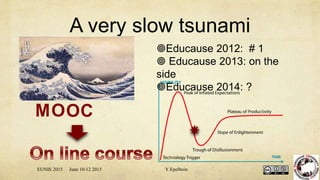
A very slow tsunami
Educause 2012: # 1
 Educause 2013: on the
side
Educause 2014: ?
MOOC
EUNIS 2015 June 10-12 2015 Y.Epelboin
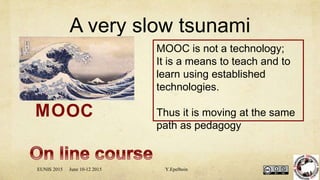
A very slow tsunami
MOOC is not a technology;
It is a means to teach and to
learn using established
technologies.
Thus it is moving at the same
path as pedagogy
MOOC
EUNIS 2015 June 10-12 2015 Y.Epelboin
Growth of MOOCs
https://www.edsurge.com/n/2014-12-26-moocs-in-2014-breaking-down-the-numbers
EUNIS 2015 June 10-12 2015 Y.Epelboin
A very slow tsunami!
Peak not yet reached!
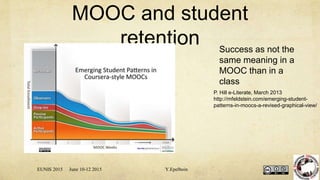
MOOC and student
retention Success as not the
same meaning in a
MOOC than in a
class
P. Hill e-Literate, March 2013
http://mfeldstein.com/emerging-student-
patterns-in-moocs-a-revised-graphical-view/
EUNIS 2015 June 10-12 2015 Y.Epelboin
MOOC
and pedagogy
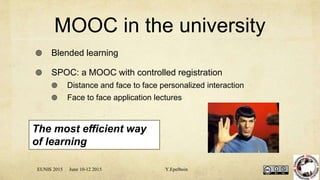
MOOC in the university
 Blended learning
 SPOC: a MOOC with controlled registration
 Distance and face to face personalized interaction
 Face to face application lectures
The most efficient way
of learning
EUNIS 2015 June 10-12 2015 Y.Epelboin
Blended learning
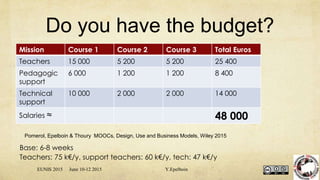
Can we afford?
 Example of a 6 weeks MOOC (SPOC)
 Base: Sciences with Maths equations and graphics
 MOOC being used internally at least 3 times

 Human resources
 Teachers
 Academic support
 Technical support
EUNIS 2015 June 10-12 2015 Y.Epelboin
Do you have the budget?
Mission Course 1 Course 2 Course 3 Total Euros
Teachers 15 000 5 200 5 200 25 400
Pedagogic
support
6 000 1 200 1 200 8 400
Technical
support
10 000 2 000 2 000 14 000
Salaries ≈ 48 000
Base: 6-8 weeks
Teachers: 75 k€/y, support teachers: 60 k€/y, tech: 47 k€/y
Pomerol, Epelboin & Thoury MOOCs, Design, Use and Business Models, Wiley 2015
EUNIS 2015 June 10-12 2015 Y.Epelboin
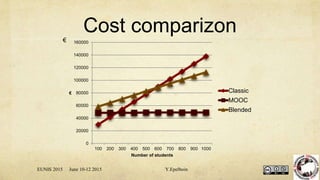
Cost comparizon€
0
20000
40000
60000
80000
100000
120000
140000
160000
100 200 300 400 500 600 700 800 900 1000
€
Number of students
Classic
MOOC
Blended
EUNIS 2015 June 10-12 2015 Y.Epelboin
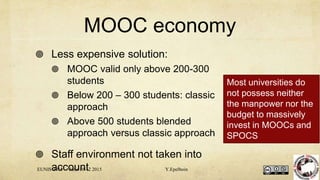
MOOC economy
 Less expensive solution:
 MOOC valid only above 200-300
students
 Below 200 – 300 students: classic
approach
 Above 500 students blended
approach versus classic approach
 Staff environment not taken into
accountEUNIS 2015 June 10-12 2015 Y.Epelboin
Most universities do
not possess neither
the manpower nor the
budget to massively
invest in MOOCs and
SPOCS
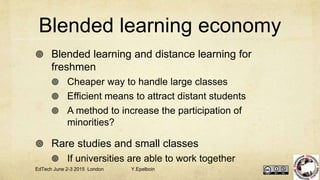
Blended learning economy
 Blended learning and distance learning for
freshmen
 Cheaper way to handle large classes
 Efficient means to attract distant students
 A method to increase the participation of
minorities?
 Rare studies and small classes
 If universities are able to work together
EdTech June 2-3 2015 London Y.Epelboin
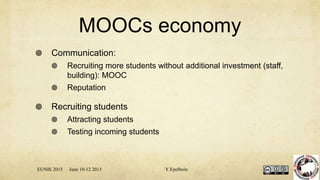
MOOCs economy
 Communication:
 Recruiting more students without additional investment (staff,
building): MOOC
 Reputation
 Recruiting students
 Attracting students
 Testing incoming students
EUNIS 2015 June 10-12 2015 Y.Epelboin
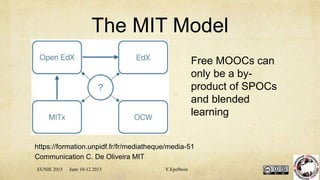
The MIT Model
https://formation.unpidf.fr/fr/mediatheque/media-51
Free MOOCs can
only be a by-
product of SPOCs
and blended
learning
EUNIS 2015 June 10-12 2015 Y.Epelboin
Communication C. De Oliveira MIT
MOOC
and technology
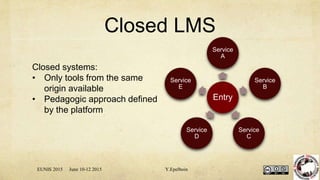
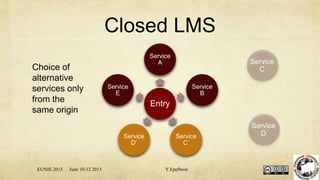
Closed LMS
Entry
Service
A
Service
B
Service
C
Service
D
Service
E
EUNIS 2015 June 10-12 2015 Y.Epelboin
Closed systems:
• Only tools from the same
origin available
• Pedagogic approach defined
by the platform
Entry
Service
A
Service
B
Service
C
Service
D
Service
E
EUNIS 2015 June 10-12 2015 Y.Epelboin
Service
C’
Service
D’
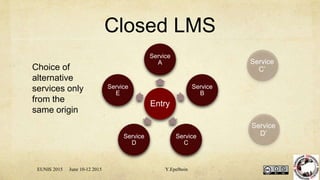
Choice of
alternative
services only
from the
same origin
Closed LMS
Closed LMS
Entry
Service
A
Service
B
Service
C’
Service
D’
Service
E
EUNIS 2015 June 10-12 2015 Y.Epelboin
Service
C
Service
D
Choice of
alternative
services only
from the
same origin
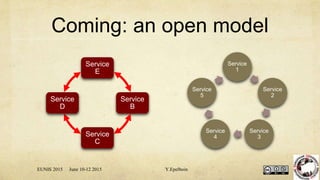
Coming: an open model
Service
E
Service
B
Service
C
Service
D
Service
1
Service
2
Service
3
Service
4
Service
5
EUNIS 2015 June 10-12 2015 Y.Epelboin
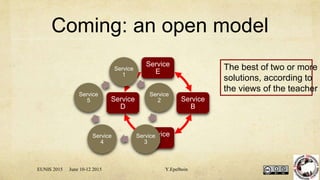
Coming: an open model
Service
E
Service
B
Service
C
Service
D
Service
1
Service
2
Service
3
Service
4
Service
5
The best of two or more
solutions, according to
the views of the teacher
EUNIS 2015 June 10-12 2015 Y.Epelboin
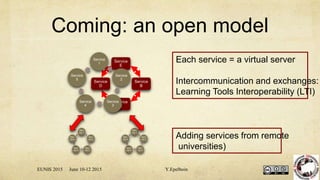
Coming: an open model
Service
E
Service
B
Service
C
Service
D
Service
1
Service
2
Service
3
Service
4
Service
5
Each service = a virtual server
Intercommunication and exchanges:
Learning Tools Interoperability (LTI)
EUNIS 2015 June 10-12 2015 Y.Epelboin
Serv
ice 1
Serv
ice 2
Serv
ice 3
Serv
ice 4
Serv
ice 5
Serv
ice 1
Serv
ice 2
Serv
ice 3
Serv
ice 4
Serv
ice 5
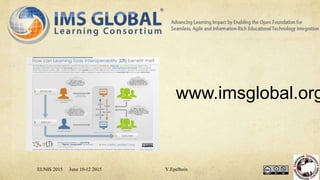
Adding services from remote
universities)
www.imsglobal.org
EUNIS 2015 June 10-12 2015 Y.Epelboin
New skills to come
 Instructional designers: a mix of pedagogy and IT
skills
 Teachers: a mix of knowledge and instructional
design
 Prebuild models
 LMS on demand
 Richer but more complex systems!
EUNIS 2015 June 10-12 2015 Y.Epelboin
A user-centric
approach
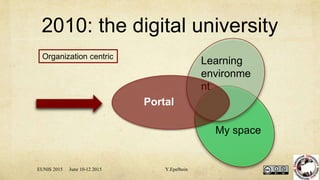
2010: the digital university
My space
Learning
environme
nt
Organization centric
Portal
EUNIS 2015 June 10-12 2015 Y.Epelboin
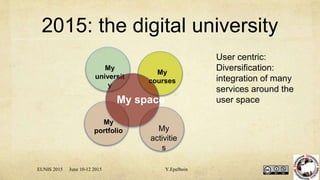
2015: the digital university
EUNIS 2015 June 10-12 2015 Y.Epelboin
My
courses
My
universit
y
My
portfolio My
activitie
s
User centric:
Diversification:
integration of many
services around the
user spaceMy space
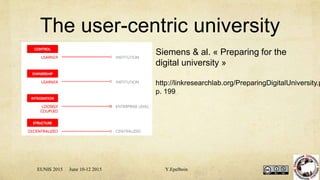
The user-centric university
Siemens & al. « Preparing for the
digital university »
http://linkresearchlab.org/PreparingDigitalUniversity.p
p. 199
EUNIS 2015 June 10-12 2015 Y.Epelboin
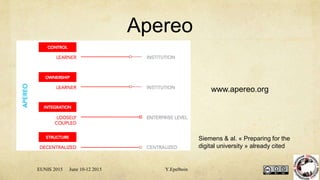
Apereo
Siemens & al. « Preparing for the
digital university » already cited
EUNIS 2015 June 10-12 2015 Y.Epelboin
www.apereo.org
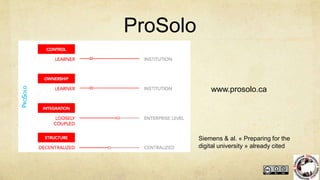
ProSolo
Siemens & al. « Preparing for the
digital university » already cited
www.prosolo.ca
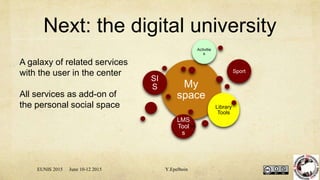
Next: the digital university
My
space
SI
S
Sport
Library
Tools
LMS
Tool
s
Activitie
s
EUNIS 2015 June 10-12 2015 Y.Epelboin
A galaxy of related services
with the user in the center
All services as add-on of
the personal social space
Driving
students to
success
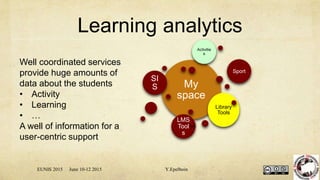
Learning analytics
My
space
SI
S
Sport
Library
Tools
LMS
Tool
s
Activitie
s
EUNIS 2015 June 10-12 2015 Y.Epelboin
Well coordinated services
provide huge amounts of
data about the students
• Activity
• Learning
• …
A well of information for a
user-centric support
Learning analytics
« Learning analytics is the measurement, collection,
analysis and reporting of data about learners and
their contexts, for purposes of understanding and
optimizing learning and the environments in which it
occurs »
G. Siemens http://fr.slideshare.net/gsiemens/learning-analytics-
educause (2011)
EUNIS 2015 June 10-12 2015 Y.Epelboin
Learning analytics
 High potential impact to improve students
success
 Definition of indicators still in progress
 Limitations
 Lack of valid data from many systems
 Privacy of data
 Definition of predictive indicators
EUNIS 2015 June 10-12 2015 Y.Epelboin
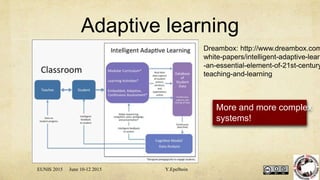
Adaptive learning
Adaptive learning is an educational method which uses
computers as interactive teaching devices, and to orchestrate
the allocation of human and mediated resources according to
the unique needs of each learner. Computers adapt the
presentation of educational material according to students'
learning needs, as indicated by their responses to questions,
tasks and experiences.
Wikipedia
EUNIS 2015 June 10-12 2015 Y.Epelboin
Adaptive learning
Dreambox: http://www.dreambox.com
white-papers/intelligent-adaptive-learn
-an-essential-element-of-21st-century
teaching-and-learning
EUNIS 2015 June 10-12 2015 Y.Epelboin
More and more complex
systems!
Driving students to success
 Blended learning does not rise the rate of
success: “Those who succeed succeed better”
 Adaptive learning allows to best adapt learning to
the capacities and feelings of each person
 Learning analytics is the method to introduce
individual mentoring at a time of mass education
EUNIS 2015 June 10-12 2015 Y.Epelboin
Summary
Conclusion
 An important challenge for the digital university in
the coming years:
 True blended learning must be generalized
 Tools and services will be more and more user-
centric
 The digital environment will be more and more
complex
EUNIS 2015 June 10-12 2015 Y.Epelboin
Will the universities have the human and financial resources?
Yves.epelboin@impmc.upmc.fr
LinkedIn: https://www.linkedin.com/in/yepelboin
Twitter: @yepelboin
Blogs: http://blog.educpros.fr/yves-epelboin/ (French)
http://www.eunis.org/blog/category/erai-2/blogs/ (English)
Discussion

MOOCs and pedagogy: where are we heading?

  • 1.
    MOOC and Pedagogy Whereare we heading? Yves Epelboin Professor Emeritus UPMC-Sorbonne-Universités, Paris Yves.Epelboin@impmc.upmc.fr
  • 2.
    Agenda  A veryslow tsunami  MOOC and pedagogy  MOOCs and technology  MOOCs for Europe  A user-centric approach  Driving students to success EUNIS 2015 June 10-12 2015 Y.Epelboin
  • 3.
    A very slowtsunami Educause 2012: # 1  Educause 2013: on the side Educause 2014: ? MOOC EUNIS 2015 June 10-12 2015 Y.Epelboin
  • 4.
    A very slowtsunami MOOC is not a technology; It is a means to teach and to learn using established technologies. Thus it is moving at the same path as pedagogy MOOC EUNIS 2015 June 10-12 2015 Y.Epelboin
  • 5.
    Growth of MOOCs https://www.edsurge.com/n/2014-12-26-moocs-in-2014-breaking-down-the-numbers EUNIS2015 June 10-12 2015 Y.Epelboin A very slow tsunami! Peak not yet reached!
  • 6.
    MOOC and student retentionSuccess as not the same meaning in a MOOC than in a class P. Hill e-Literate, March 2013 http://mfeldstein.com/emerging-student- patterns-in-moocs-a-revised-graphical-view/ EUNIS 2015 June 10-12 2015 Y.Epelboin
  • 7.
  • 8.
    MOOC in theuniversity  Blended learning  SPOC: a MOOC with controlled registration  Distance and face to face personalized interaction  Face to face application lectures The most efficient way of learning EUNIS 2015 June 10-12 2015 Y.Epelboin
  • 9.
    Blended learning Can weafford?  Example of a 6 weeks MOOC (SPOC)  Base: Sciences with Maths equations and graphics  MOOC being used internally at least 3 times  Human resources  Teachers  Academic support  Technical support EUNIS 2015 June 10-12 2015 Y.Epelboin
  • 10.
    Do you havethe budget? Mission Course 1 Course 2 Course 3 Total Euros Teachers 15 000 5 200 5 200 25 400 Pedagogic support 6 000 1 200 1 200 8 400 Technical support 10 000 2 000 2 000 14 000 Salaries ≈ 48 000 Base: 6-8 weeks Teachers: 75 k€/y, support teachers: 60 k€/y, tech: 47 k€/y Pomerol, Epelboin & Thoury MOOCs, Design, Use and Business Models, Wiley 2015 EUNIS 2015 June 10-12 2015 Y.Epelboin
  • 11.
    Cost comparizon€ 0 20000 40000 60000 80000 100000 120000 140000 160000 100 200300 400 500 600 700 800 900 1000 € Number of students Classic MOOC Blended EUNIS 2015 June 10-12 2015 Y.Epelboin
  • 12.
    MOOC economy  Lessexpensive solution:  MOOC valid only above 200-300 students  Below 200 – 300 students: classic approach  Above 500 students blended approach versus classic approach  Staff environment not taken into accountEUNIS 2015 June 10-12 2015 Y.Epelboin Most universities do not possess neither the manpower nor the budget to massively invest in MOOCs and SPOCS
  • 13.
    Blended learning economy Blended learning and distance learning for freshmen  Cheaper way to handle large classes  Efficient means to attract distant students  A method to increase the participation of minorities?  Rare studies and small classes  If universities are able to work together EdTech June 2-3 2015 London Y.Epelboin
  • 14.
    MOOCs economy  Communication: Recruiting more students without additional investment (staff, building): MOOC  Reputation  Recruiting students  Attracting students  Testing incoming students EUNIS 2015 June 10-12 2015 Y.Epelboin
  • 15.
    The MIT Model https://formation.unpidf.fr/fr/mediatheque/media-51 FreeMOOCs can only be a by- product of SPOCs and blended learning EUNIS 2015 June 10-12 2015 Y.Epelboin Communication C. De Oliveira MIT
  • 16.
  • 17.
    Closed LMS Entry Service A Service B Service C Service D Service E EUNIS 2015June 10-12 2015 Y.Epelboin Closed systems: • Only tools from the same origin available • Pedagogic approach defined by the platform
  • 18.
    Entry Service A Service B Service C Service D Service E EUNIS 2015 June10-12 2015 Y.Epelboin Service C’ Service D’ Choice of alternative services only from the same origin Closed LMS
  • 19.
    Closed LMS Entry Service A Service B Service C’ Service D’ Service E EUNIS 2015June 10-12 2015 Y.Epelboin Service C Service D Choice of alternative services only from the same origin
  • 20.
    Coming: an openmodel Service E Service B Service C Service D Service 1 Service 2 Service 3 Service 4 Service 5 EUNIS 2015 June 10-12 2015 Y.Epelboin
  • 21.
    Coming: an openmodel Service E Service B Service C Service D Service 1 Service 2 Service 3 Service 4 Service 5 The best of two or more solutions, according to the views of the teacher EUNIS 2015 June 10-12 2015 Y.Epelboin
  • 22.
    Coming: an openmodel Service E Service B Service C Service D Service 1 Service 2 Service 3 Service 4 Service 5 Each service = a virtual server Intercommunication and exchanges: Learning Tools Interoperability (LTI) EUNIS 2015 June 10-12 2015 Y.Epelboin Serv ice 1 Serv ice 2 Serv ice 3 Serv ice 4 Serv ice 5 Serv ice 1 Serv ice 2 Serv ice 3 Serv ice 4 Serv ice 5 Adding services from remote universities)
  • 23.
    www.imsglobal.org EUNIS 2015 June10-12 2015 Y.Epelboin
  • 24.
    New skills tocome  Instructional designers: a mix of pedagogy and IT skills  Teachers: a mix of knowledge and instructional design  Prebuild models  LMS on demand  Richer but more complex systems! EUNIS 2015 June 10-12 2015 Y.Epelboin
  • 25.
  • 26.
    2010: the digitaluniversity My space Learning environme nt Organization centric Portal EUNIS 2015 June 10-12 2015 Y.Epelboin
  • 27.
    2015: the digitaluniversity EUNIS 2015 June 10-12 2015 Y.Epelboin My courses My universit y My portfolio My activitie s User centric: Diversification: integration of many services around the user spaceMy space
  • 28.
    The user-centric university Siemens& al. « Preparing for the digital university » http://linkresearchlab.org/PreparingDigitalUniversity.p p. 199 EUNIS 2015 June 10-12 2015 Y.Epelboin
  • 29.
    Apereo Siemens & al.« Preparing for the digital university » already cited EUNIS 2015 June 10-12 2015 Y.Epelboin www.apereo.org
  • 30.
    ProSolo Siemens & al.« Preparing for the digital university » already cited www.prosolo.ca
  • 31.
    Next: the digitaluniversity My space SI S Sport Library Tools LMS Tool s Activitie s EUNIS 2015 June 10-12 2015 Y.Epelboin A galaxy of related services with the user in the center All services as add-on of the personal social space
  • 32.
  • 33.
    Learning analytics My space SI S Sport Library Tools LMS Tool s Activitie s EUNIS 2015June 10-12 2015 Y.Epelboin Well coordinated services provide huge amounts of data about the students • Activity • Learning • … A well of information for a user-centric support
  • 34.
    Learning analytics « Learninganalytics is the measurement, collection, analysis and reporting of data about learners and their contexts, for purposes of understanding and optimizing learning and the environments in which it occurs » G. Siemens http://fr.slideshare.net/gsiemens/learning-analytics- educause (2011) EUNIS 2015 June 10-12 2015 Y.Epelboin
  • 35.
    Learning analytics  Highpotential impact to improve students success  Definition of indicators still in progress  Limitations  Lack of valid data from many systems  Privacy of data  Definition of predictive indicators EUNIS 2015 June 10-12 2015 Y.Epelboin
  • 36.
    Adaptive learning Adaptive learningis an educational method which uses computers as interactive teaching devices, and to orchestrate the allocation of human and mediated resources according to the unique needs of each learner. Computers adapt the presentation of educational material according to students' learning needs, as indicated by their responses to questions, tasks and experiences. Wikipedia EUNIS 2015 June 10-12 2015 Y.Epelboin
  • 37.
  • 38.
    Driving students tosuccess  Blended learning does not rise the rate of success: “Those who succeed succeed better”  Adaptive learning allows to best adapt learning to the capacities and feelings of each person  Learning analytics is the method to introduce individual mentoring at a time of mass education EUNIS 2015 June 10-12 2015 Y.Epelboin
  • 39.
  • 40.
    Conclusion  An importantchallenge for the digital university in the coming years:  True blended learning must be generalized  Tools and services will be more and more user- centric  The digital environment will be more and more complex EUNIS 2015 June 10-12 2015 Y.Epelboin Will the universities have the human and financial resources?
  • 41.
    Yves.epelboin@impmc.upmc.fr LinkedIn: https://www.linkedin.com/in/yepelboin Twitter: @yepelboin Blogs:http://blog.educpros.fr/yves-epelboin/ (French) http://www.eunis.org/blog/category/erai-2/blogs/ (English)
  • 42.