
Roya Azimzadeh
*
*What is E-Learning?
*Why has E-Learning become so important?
*What does E-Learning do for an organization?
*Who benefits from E-Learning?
*Summary
*
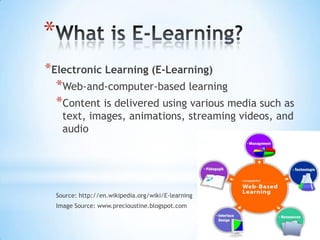
*Electronic Learning (E-Learning)
  *Web-and-computer-based learning
  *Content is delivered using various media such as
      text, images, animations, streaming videos, and
      audio


    Source: http://en.wikipedia.org/wiki/E-learning
    Image Source: www.precioustine.blogspot.com
*
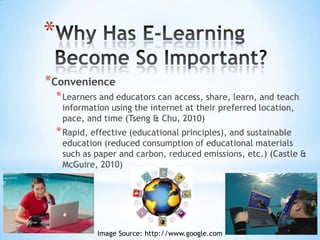
*Convenience
    * Learners and educators can access, share, learn, and teach
     information using the internet at their preferred
     location, pace, and time (Tseng & Chu, 2010)
    * Rapid, effective (educational principles), and sustainable
     education (reduced consumption of paper and
     carbon, reduced emissions, etc.) (Castle & McGuire, 2010)


              Image Source: http://www.google.com
*
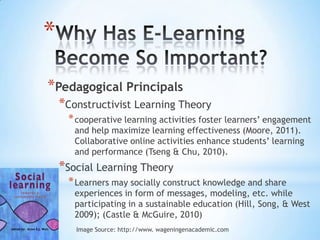
*Pedagogical Principals
    *Constructivist Learning Theory
     * cooperative learning activities foster learners’ engagement
       and help maximize learning effectiveness (Moore, 2011).
       Collaborative online activities enhance students’ learning
       and performance (Tseng & Chu, 2010).
    *Social Learning Theory
     * Learners may socially construct knowledge and share
       experiences in form of messages, modeling, etc. while
       participating in a sustainable education (Hill, Song, & West
       2009); (Castle & McGuire, 2010)
       Image Source: http://www. wageningenacademic.com
*
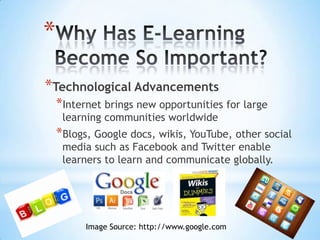
*Technological Advancements
    *Internet brings new opportunities for large
     learning communities worldwide
    *Blogs, Google docs, wikis, YouTube, other social
     media such as Facebook and Twitter enable
     learners to learn and communicate globally.


          Image Source: http://www.google.com
*

    *Accessible, effective, and prompt
     education opportunities for all
    *High quality training for all learners to
     achieve high performance
    *Increased productivity/performance
    *Helps reduce the costs of training (travel
     expenses, materials, etc.)
    *Bottom line: productivity and saving
*
*Learners and Educators
    *Effective learner-centered education at one’s
     preferred location, pace, and time (Tseng &
     Chu, 2010)
    *Access and share resources worldwide
    *Socialize, learn, and teach (Hill, Song, & West
     2009)
*

*Academic Institutions
    *Offering quality world-class education while
     meeting diverse students’ learning needs
     (Jackson, Gaudet, McDaniel, & Brammer, 2009).
    *A successful online program may result in
     increased enrollment and financial improvement
     while empowering a higher institution to lead in a
     competitive market.
*
    *Other Organizations (Corporations)
     *High quality training for employees to achieve
      high performance
     *Accessible, effective, and prompt education
      opportunities for all employees
*
*Electronic learning encompasses the following:
 *Convenience (flexibility of time, location, and speed)
 *Learner-centered, effective, and sustainable
  educational approach
 *Utilizing technology to enhance and facilitate learning
  and performance
 *World-class quality training and improved productivity
  and saving
 *Educational and financial benefits for
  learners, educators, academic institutions, and other
  organizations
                Thank you for your time!
*
Castle, S. R., & McGuire, C. J. (2010). An analysis of student self-assessment of
   online, blended, and face-to-face learning environments: Implications for
   sustainable education delivery. International Education Studies, 3(3), 36-40.
   Retrieved from
   http://search.proquest.com/docview/821817327?accountid=28180


Hill, J. R., Song, L., & West, R. E. (2009). Social learning theory and web-based
    learning environments: A review of research and discussion of implications.
    American Journal Of Distance Education, 23(2), 88-103.
    doi:10.1080/08923640902857713


Jackson, A., Gaudet, L., McDaniel, L., & Brammer, D. (2009). Curriculum
          integration: The use of technology to support learning. Journal Of
          College Teaching & Learning, 6(7), 71-78.
*
Moore, D. (2011). Using collaborative online discussion effectively for teaching.
  Journal of Applied Learning Technology, 1(4), 19-23.


Sharma, K. (2011). Financial implications of implementing an e-learning project.
   Journal of European Industrial Training, 35(7), 658-686. doi:
   10.1108/03090591111160788


Tseng, K., & Chu, S. (2010). Traditional versus online courses, efforts, and
   learning performance. The Journal of Human Resource and Adult
   Learning, 6(1), 115-121. Retrieved from
   http://search.proquest.com/docview/867266471?accountid=28180

The Need for E-Learning

  • 1.
  • 2.
    * *What is E-Learning? *Whyhas E-Learning become so important? *What does E-Learning do for an organization? *Who benefits from E-Learning? *Summary
  • 3.
    * *Electronic Learning (E-Learning) *Web-and-computer-based learning *Content is delivered using various media such as text, images, animations, streaming videos, and audio Source: http://en.wikipedia.org/wiki/E-learning Image Source: www.precioustine.blogspot.com
  • 4.
    * *Convenience * Learners and educators can access, share, learn, and teach information using the internet at their preferred location, pace, and time (Tseng & Chu, 2010) * Rapid, effective (educational principles), and sustainable education (reduced consumption of paper and carbon, reduced emissions, etc.) (Castle & McGuire, 2010) Image Source: http://www.google.com
  • 5.
    * *Pedagogical Principals *Constructivist Learning Theory * cooperative learning activities foster learners’ engagement and help maximize learning effectiveness (Moore, 2011). Collaborative online activities enhance students’ learning and performance (Tseng & Chu, 2010). *Social Learning Theory * Learners may socially construct knowledge and share experiences in form of messages, modeling, etc. while participating in a sustainable education (Hill, Song, & West 2009); (Castle & McGuire, 2010) Image Source: http://www. wageningenacademic.com
  • 6.
    * *Technological Advancements *Internet brings new opportunities for large learning communities worldwide *Blogs, Google docs, wikis, YouTube, other social media such as Facebook and Twitter enable learners to learn and communicate globally. Image Source: http://www.google.com
  • 7.
    * *Accessible, effective, and prompt education opportunities for all *High quality training for all learners to achieve high performance *Increased productivity/performance *Helps reduce the costs of training (travel expenses, materials, etc.) *Bottom line: productivity and saving
  • 8.
    * *Learners and Educators *Effective learner-centered education at one’s preferred location, pace, and time (Tseng & Chu, 2010) *Access and share resources worldwide *Socialize, learn, and teach (Hill, Song, & West 2009)
  • 9.
    * *Academic Institutions *Offering quality world-class education while meeting diverse students’ learning needs (Jackson, Gaudet, McDaniel, & Brammer, 2009). *A successful online program may result in increased enrollment and financial improvement while empowering a higher institution to lead in a competitive market.
  • 10.
    * *Other Organizations (Corporations) *High quality training for employees to achieve high performance *Accessible, effective, and prompt education opportunities for all employees
  • 11.
    * *Electronic learning encompassesthe following: *Convenience (flexibility of time, location, and speed) *Learner-centered, effective, and sustainable educational approach *Utilizing technology to enhance and facilitate learning and performance *World-class quality training and improved productivity and saving *Educational and financial benefits for learners, educators, academic institutions, and other organizations Thank you for your time!
  • 12.
    * Castle, S. R.,& McGuire, C. J. (2010). An analysis of student self-assessment of online, blended, and face-to-face learning environments: Implications for sustainable education delivery. International Education Studies, 3(3), 36-40. Retrieved from http://search.proquest.com/docview/821817327?accountid=28180 Hill, J. R., Song, L., & West, R. E. (2009). Social learning theory and web-based learning environments: A review of research and discussion of implications. American Journal Of Distance Education, 23(2), 88-103. doi:10.1080/08923640902857713 Jackson, A., Gaudet, L., McDaniel, L., & Brammer, D. (2009). Curriculum integration: The use of technology to support learning. Journal Of College Teaching & Learning, 6(7), 71-78.
  • 13.
    * Moore, D. (2011).Using collaborative online discussion effectively for teaching. Journal of Applied Learning Technology, 1(4), 19-23. Sharma, K. (2011). Financial implications of implementing an e-learning project. Journal of European Industrial Training, 35(7), 658-686. doi: 10.1108/03090591111160788 Tseng, K., & Chu, S. (2010). Traditional versus online courses, efforts, and learning performance. The Journal of Human Resource and Adult Learning, 6(1), 115-121. Retrieved from http://search.proquest.com/docview/867266471?accountid=28180

Editor's Notes

  • #4 Technology assisted learning Virtual education and digital collaborationOpportunities to access and learn information online
  • #5 Incorporating E-Learning into instructional activities will eliminate some of the face-to-face class expenses such as place and travel expenses. Furthermore, E-Learning is a quick, effective (educational principles), and sustainable education (environmentally friendly – reduced educational materials such as paper and carbon, reduced emissions caused by cars traveling to schools, etc.) (Castle & McGuire, 2010).
  • #9 Learners and educators both benefit from E-Learning because it offers effective learner-centered education, which can take place at any pace, place, and time. Learners and educators can access and share unlimited information globally. They can also contribute to the existing information. In addition, all learners can socialize, learn, and teach each other virtually.
  • #10 Implementing E-Learning enables academic institutions such as universities and colleges to enhance students’ learning and meet different students’ learning styles. This will result in improving an institution’s reputation; consequently, increased enrollment and financial improvement while empowering an institute to be competitive.