


What is Educational Technology?
 Sometimes termed EdTech;
 Study of ethical practice of facilitating
e-learning.
 It uses digital mediums to enhance teaching
and learning in the classroom and in online
environment.
Competencies in Education
Technology:
 Improves higher-order thinking skills,
 Preparing students for their future in a
competitive global job market.
 Inspiring digital age professional models for
working, collaborating, and decision making.
EdTech Standards:
 Designed to reach across the digital divide
among K-12 schools.
– Realistic classroom activities
– Learning activities are well-suited to learning
environments in which technology is abundant.
EdTech Media:
 Consists of materials and machines to promote
learning.
 It is part of the term – Instructional Technology.
Pros and Cons of using EdTech:
 Exploration
 Lesson Integration
Pros and Cons of using EdTech:
Pros:
Computers allow students to learn
through exploring the internet and doing
research. It keep students engaged in a
project and learning far longer than they
would with a set of encyclopedias.
Pros and Cons of using EdTech:
Cons:
Some students will explore beyond the
bounds and parameters of the project and
become distracted by other activities that
they find on the internet.
Pros and Cons of using EdTech:
Pros:
By incorporating technology into lesson,
students will become more engage in and
excited about the subject at hand.
Pros and Cons of using EdTech:
Cons:
Finding the right materials online to
integrate into a lesson is not always easy.
This means teachers may spend a lot more
time planning lessons and become
overwhelmed and frustrated.
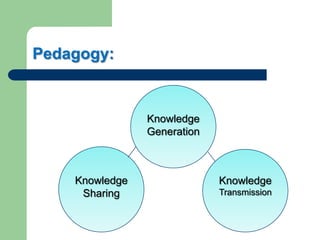
Pedagogy:
Knowledge
Generation
Knowledge
Sharing
Knowledge
Transmission
Pedagogical Skills:
It is established by clear rules and expectations
which provides the students opportunities to
applying learning.
 ICT support teaching and learning.
Instructional Technology
 is "the theory and practice of design, development,
utilization, management, and evaluation of
processes and resources for learning," according to
the Association for Educational Communications and
Technology (AECT) Definitions and Terminology
Committee.
edtech.presentation

edtech.presentation

  • 3.
    What is EducationalTechnology?  Sometimes termed EdTech;  Study of ethical practice of facilitating e-learning.  It uses digital mediums to enhance teaching and learning in the classroom and in online environment.
  • 4.
    Competencies in Education Technology: Improves higher-order thinking skills,  Preparing students for their future in a competitive global job market.  Inspiring digital age professional models for working, collaborating, and decision making.
  • 5.
    EdTech Standards:  Designedto reach across the digital divide among K-12 schools. – Realistic classroom activities – Learning activities are well-suited to learning environments in which technology is abundant.
  • 6.
    EdTech Media:  Consistsof materials and machines to promote learning.  It is part of the term – Instructional Technology.
  • 7.
    Pros and Consof using EdTech:  Exploration  Lesson Integration
  • 8.
    Pros and Consof using EdTech: Pros: Computers allow students to learn through exploring the internet and doing research. It keep students engaged in a project and learning far longer than they would with a set of encyclopedias.
  • 9.
    Pros and Consof using EdTech: Cons: Some students will explore beyond the bounds and parameters of the project and become distracted by other activities that they find on the internet.
  • 10.
    Pros and Consof using EdTech: Pros: By incorporating technology into lesson, students will become more engage in and excited about the subject at hand.
  • 11.
    Pros and Consof using EdTech: Cons: Finding the right materials online to integrate into a lesson is not always easy. This means teachers may spend a lot more time planning lessons and become overwhelmed and frustrated.
  • 14.
  • 15.
    Pedagogical Skills: It isestablished by clear rules and expectations which provides the students opportunities to applying learning.  ICT support teaching and learning.
  • 16.
    Instructional Technology  is"the theory and practice of design, development, utilization, management, and evaluation of processes and resources for learning," according to the Association for Educational Communications and Technology (AECT) Definitions and Terminology Committee.