Introduction of E-Learning
M12W0060
Chen lemin
CONTENTS
Definition of e-learning
How your company might benefit from e-learning
Different e-learning models
E-learning as a business tool
Company with a small budget and e-learning
Classroom courses versus e-learning
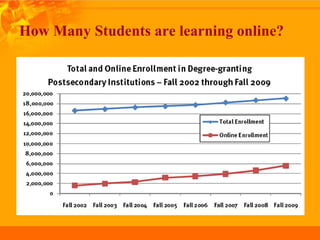
How Many Students are learning online?
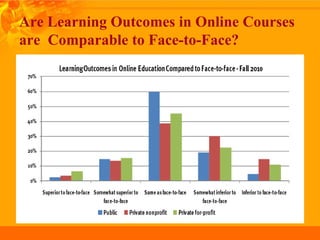
Are Learning Outcomes in Online Courses are Comparable to Face-to-Face?
Classroom training and e-learning
Your employees and e-learning
Student motivation
E-learning instructors
Summary
References
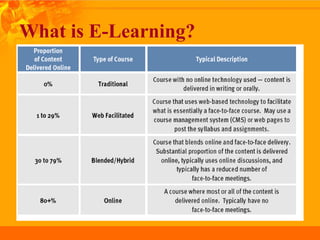
What is E-Learning?
• E-learning (electronic learning) is a term
covering a wide set of applications and
processes, such as Web-based learning,
computer-based learning, virtual classrooms,
and digital collaboration. It includes the
delivery of content mainly via Internet, but
also can be via intranet/extranet (LAN/WAN),
audio- and videotape, satellite broadcast,
interactive TV, CD-ROM, and more.
How Can Your Company
Benefit from e-Learning?
Employees can learn:
• without traveling to class
• at their convenience
• based on their learning styles: Visual,
Auditory, and Kinesthetic & Tactile.
Determine your learning style.
E-Learning Models
New-Job-Role Training —you can teach employees how to
perform a new job role. New managers, “new hires” generally
require new knowledge and new skills. It can be partly self-
study and partly interactive where the students work with an
instructor and/or with other students.
“Update” Training – You can update employees who have
already been trained on the latest state-of-the-art
developments. It can be self-study or instructor-led.
“Tip of the Iceberg” Training – when employee needs to know
“a little” about a topic but doesn’t need to become an expert.
For example, a technical employee can learn the basics of
marketing, a project manager – the basics of database, etc. It
can be self-study or instructor-led.
E-learning as a BusinessTool
For example:
• you teach C++ because your employees need it
to improve their work skills
• teaching negotiation skills your employees
improves your company’s customer support
• learning about the new product helps your
employees to sell your company’s product
better.
Company with a Small Budget and e-
Learning
E-learning doesn't always require a large budget.
If you have a small budget, you should look at
"renting"or "leasing" entire e-learning solution
instead of building one. Or you might consider
"renting" a part of your e-learning solution and
building only part of it.
There are many learning vendors who have e-learning
courseware available from their web sites. You can
contact one of them to deliver e-learning course to
your employees.
Classroom Courses vs. E-Learning
Earlier technologies for learning at a distance
included CD-ROMs, audiotapes, and
videotapes. However, in recent years the
Internet became most popular
e-learning delivery solution because of
accessibility, familiarity, and convenience.
How Many Students are learning online?
What is E-Learning?
Are Learning Outcomes in Online Courses
are Comparable to Face-to-Face?
Classroom training and e-learning
• E-learning (electronic learning) is a term
covering a wide set of applications and
processes, such as Web-based learning,
computer-based learning, virtual classrooms,
and digital collaboration. It includes the
delivery of content mainly via Internet, but
also can be via intranet/extranet (LAN/WAN),
audio- and videotape, satellite broadcast,
interactive TV, CD-ROM, and more.
Your employees and e-learning
Teaching an e-learning course is harder than teaching a
classroom course.
You should take into consideration the following global
considerations:
• Language –students from different countries speak different
languages. You have two choices – translate your course or
adapt it for the foreign students.
• Time zone -- when it’s 8AM in New York, it’s 9PM in
Tokyo. The solution is to emphasize some asynchronous
communication: bulletin board messages, e-mail, etc.
• Cultural differences – for example, humor.
Student motivation
Many people are accustomed to learning only in
traditional classroom environments and find it hard to
learn “on their own.”
Some key student motivations include:
• The course teaches something that is critical to doing
the immediate job.
• The student is working toward a certification or a
degree.
• The student is required by management to prove that
they completed a course.
Summary
Research shows that e-learning works as well as classroom
learning. It is safe to say that in 5-10 years all companies are
good candidates for using e-learning.
The cost of e-learning can vary widely.
You could spend hundreds, or you could spend multimillions.
The cost components for e-learning include the courseware, the
course delivery expenses (including instructors),
marketing/promotional communications with the students,
administration and support expenses.
The size and complexity of your training problem influencing
your e-learning costs.
You can’t avoid risk, but ROI lets you predict the risk.
References
Henderson A. J. (2003). The E-learning
Question and Answer Book. New York,
NY: American Management Association.
The Sloan Consortium, Class Differences:
Online Education in the United States, 2010
Assignment
Create the Module 1 for your e-learning course in PowerPoint (at least
10 slides with images). Don’t forget to include Assignments and
References at the end of your presentation. Create a link to Module 1
on your wiki. Click on EDIT and FILE to upload your PowerPoint on
wikispaces. Please go to our exemplary site to see an example for
Module 1
My position
I am a CEO.
(My company’s name)
Life Style company.
(My company’s brief description)
It is a online shop company that shop in china from the comfort of
your home
(Employees)
since it is a whole new company at now we have only 10 employees
Tltle of the course Funny to learn

Module1

  • 1.
  • 2.
    CONTENTS Definition of e-learning Howyour company might benefit from e-learning Different e-learning models E-learning as a business tool Company with a small budget and e-learning Classroom courses versus e-learning How Many Students are learning online? Are Learning Outcomes in Online Courses are Comparable to Face-to-Face? Classroom training and e-learning Your employees and e-learning Student motivation E-learning instructors Summary References
  • 3.
    What is E-Learning? •E-learning (electronic learning) is a term covering a wide set of applications and processes, such as Web-based learning, computer-based learning, virtual classrooms, and digital collaboration. It includes the delivery of content mainly via Internet, but also can be via intranet/extranet (LAN/WAN), audio- and videotape, satellite broadcast, interactive TV, CD-ROM, and more.
  • 4.
    How Can YourCompany Benefit from e-Learning? Employees can learn: • without traveling to class • at their convenience • based on their learning styles: Visual, Auditory, and Kinesthetic & Tactile. Determine your learning style.
  • 5.
    E-Learning Models New-Job-Role Training—you can teach employees how to perform a new job role. New managers, “new hires” generally require new knowledge and new skills. It can be partly self- study and partly interactive where the students work with an instructor and/or with other students. “Update” Training – You can update employees who have already been trained on the latest state-of-the-art developments. It can be self-study or instructor-led. “Tip of the Iceberg” Training – when employee needs to know “a little” about a topic but doesn’t need to become an expert. For example, a technical employee can learn the basics of marketing, a project manager – the basics of database, etc. It can be self-study or instructor-led.
  • 6.
    E-learning as aBusinessTool For example: • you teach C++ because your employees need it to improve their work skills • teaching negotiation skills your employees improves your company’s customer support • learning about the new product helps your employees to sell your company’s product better.
  • 7.
    Company with aSmall Budget and e- Learning E-learning doesn't always require a large budget. If you have a small budget, you should look at "renting"or "leasing" entire e-learning solution instead of building one. Or you might consider "renting" a part of your e-learning solution and building only part of it. There are many learning vendors who have e-learning courseware available from their web sites. You can contact one of them to deliver e-learning course to your employees.
  • 8.
    Classroom Courses vs.E-Learning Earlier technologies for learning at a distance included CD-ROMs, audiotapes, and videotapes. However, in recent years the Internet became most popular e-learning delivery solution because of accessibility, familiarity, and convenience.
  • 9.
    How Many Studentsare learning online?
  • 10.
  • 11.
    Are Learning Outcomesin Online Courses are Comparable to Face-to-Face?
  • 12.
    Classroom training ande-learning • E-learning (electronic learning) is a term covering a wide set of applications and processes, such as Web-based learning, computer-based learning, virtual classrooms, and digital collaboration. It includes the delivery of content mainly via Internet, but also can be via intranet/extranet (LAN/WAN), audio- and videotape, satellite broadcast, interactive TV, CD-ROM, and more.
  • 13.
    Your employees ande-learning Teaching an e-learning course is harder than teaching a classroom course. You should take into consideration the following global considerations: • Language –students from different countries speak different languages. You have two choices – translate your course or adapt it for the foreign students. • Time zone -- when it’s 8AM in New York, it’s 9PM in Tokyo. The solution is to emphasize some asynchronous communication: bulletin board messages, e-mail, etc. • Cultural differences – for example, humor.
  • 14.
    Student motivation Many peopleare accustomed to learning only in traditional classroom environments and find it hard to learn “on their own.” Some key student motivations include: • The course teaches something that is critical to doing the immediate job. • The student is working toward a certification or a degree. • The student is required by management to prove that they completed a course.
  • 15.
    Summary Research shows thate-learning works as well as classroom learning. It is safe to say that in 5-10 years all companies are good candidates for using e-learning. The cost of e-learning can vary widely. You could spend hundreds, or you could spend multimillions. The cost components for e-learning include the courseware, the course delivery expenses (including instructors), marketing/promotional communications with the students, administration and support expenses. The size and complexity of your training problem influencing your e-learning costs. You can’t avoid risk, but ROI lets you predict the risk.
  • 16.
    References Henderson A. J.(2003). The E-learning Question and Answer Book. New York, NY: American Management Association. The Sloan Consortium, Class Differences: Online Education in the United States, 2010
  • 17.
    Assignment Create the Module1 for your e-learning course in PowerPoint (at least 10 slides with images). Don’t forget to include Assignments and References at the end of your presentation. Create a link to Module 1 on your wiki. Click on EDIT and FILE to upload your PowerPoint on wikispaces. Please go to our exemplary site to see an example for Module 1 My position I am a CEO. (My company’s name) Life Style company. (My company’s brief description) It is a online shop company that shop in china from the comfort of your home (Employees) since it is a whole new company at now we have only 10 employees Tltle of the course Funny to learn