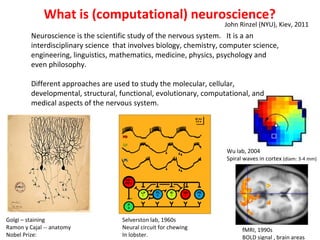
What is (computational) neuroscience? Neuroscience is the scientific study of the nervous system.  It is a an interdisciplinary science  that involves biology, chemistry, computer science, engineering, linguistics, mathematics, medicine, physics, psychology and even philosophy.  Different approaches are used to study the molecular, cellular, developmental, structural, functional, evolutionary, computational, and medical aspects of the nervous system.  Golgi – staining Ramon y Cajal -- anatomy Nobel Prize:  Selverston lab, 1960s Neural circuit for chewing In lobster. Wu lab, 2004 Spiral waves in cortex  (diam: 3-4 mm) fMRI, 1990s BOLD signal , brain areas John Rinzel (NYU), Kiev, 2011
Some current problems, disease-related, under study: experimentally and computationally. Parkinson’s disease – deep brain stimulation (DBS) Positioning of the device Time course of stimulation Tinnitis Epilepsy Prediction of an upcoming episode Breakup the undesired synchrony Hearing loss - cochlear implants  Design Stimulus timing Motor prostheses -  brain machine interface (BMI)
Involved in the control of movement Site of surgical procedures   --  Deep Brain Stimulation  (DBS) Parkinson’s Disease – dysfunction of Basil Ganglia (show video)
 
From McIntyre working group, 2006.  3-D reconstruction + DBS electrode placement + simulation of electric fields
Temporal pattern of pulse delivery …  see P Tass, use of nonlinear dynamical systems
Computational Neuroscience What “computations” are done by a neural system? How are they done? WHAT? Feature detectors, eg visual system. Coincidence detection for sound localization. Memory storage. Code:  firing rate, spike timing. Statistics of spike trains Information theory Decision theory Descriptive models HOW? Molecular & biophysical mechanisms at  cell &  synaptic levels – firing properties, coupling. Subcircuits. System level.
Computational Neuroscience What “computations” are done by a neural system? How are they done? WHAT? Feature detectors, eg visual system.  (Hubel & Wiesel & Sperry: Nobel, 1981) Coincidence detection for sound localization. Memory storage. Code:  firing rate, spike timing. Statistics of spike trains Information theory Decision theory Descriptive models HOW? Molecular & biophysical mechanisms at  cell &  synaptic levels – firing properties, coupling. Subcircuits. System level.
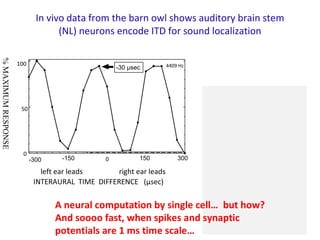
In vivo data from the barn owl shows auditory brain stem (NL) neurons encode ITD for sound localization A B C D E PLACE CODE OUTPUTS DELAY LINE INPUTS DELAY LINE INPUTS C 5 left ear leads  right ear leads INTERAURAL  TIME  DIFFERENCE  (µsec) 100 50 0 4409 Hz 0 -300 -150 150 300 -30 µsec % MAXIMUM RESPONSE A neural computation by single cell…  but how? And soooo fast, when spikes and synaptic potentials are 1 ms time scale…
Dynamics of Excitability and Repetitive Activity Auditory brain stem neurons  fire phasically,  not to slow inputs. w/ Svirskis  et al, J Neurosci 2002
Neuroscience  -- a field with foundational understanding based on mathematical & computational approaches Nobel Prize, 1959 – shared with JC Eccles Wilfrid Rall (starting 1950s) developed ‘cable theory’ for dendrites
Computational Neuroscience What “computations” are done by a neural system? How are they done? WHAT? Feature detectors, eg visual system. Coincidence detection for sound localization. Memory storage. Code:  firing rate, spike timing. Statistics of spike trains Information theory Decision theory Descriptive models HOW? Molecular & biophysical mechanisms at  cell &  synaptic levels – firing properties, coupling. Subcircuits. System level.

What is (computational) neuroscience?

  • 1.
    What is (computational)neuroscience? Neuroscience is the scientific study of the nervous system. It is a an interdisciplinary science that involves biology, chemistry, computer science, engineering, linguistics, mathematics, medicine, physics, psychology and even philosophy. Different approaches are used to study the molecular, cellular, developmental, structural, functional, evolutionary, computational, and medical aspects of the nervous system. Golgi – staining Ramon y Cajal -- anatomy Nobel Prize: Selverston lab, 1960s Neural circuit for chewing In lobster. Wu lab, 2004 Spiral waves in cortex (diam: 3-4 mm) fMRI, 1990s BOLD signal , brain areas John Rinzel (NYU), Kiev, 2011
  • 2.
    Some current problems,disease-related, under study: experimentally and computationally. Parkinson’s disease – deep brain stimulation (DBS) Positioning of the device Time course of stimulation Tinnitis Epilepsy Prediction of an upcoming episode Breakup the undesired synchrony Hearing loss - cochlear implants Design Stimulus timing Motor prostheses - brain machine interface (BMI)
  • 3.
    Involved in thecontrol of movement Site of surgical procedures -- Deep Brain Stimulation (DBS) Parkinson’s Disease – dysfunction of Basil Ganglia (show video)
  • 4.
  • 5.
    From McIntyre workinggroup, 2006. 3-D reconstruction + DBS electrode placement + simulation of electric fields
  • 6.
    Temporal pattern ofpulse delivery … see P Tass, use of nonlinear dynamical systems
  • 7.
    Computational Neuroscience What“computations” are done by a neural system? How are they done? WHAT? Feature detectors, eg visual system. Coincidence detection for sound localization. Memory storage. Code: firing rate, spike timing. Statistics of spike trains Information theory Decision theory Descriptive models HOW? Molecular & biophysical mechanisms at cell & synaptic levels – firing properties, coupling. Subcircuits. System level.
  • 8.
    Computational Neuroscience What“computations” are done by a neural system? How are they done? WHAT? Feature detectors, eg visual system. (Hubel & Wiesel & Sperry: Nobel, 1981) Coincidence detection for sound localization. Memory storage. Code: firing rate, spike timing. Statistics of spike trains Information theory Decision theory Descriptive models HOW? Molecular & biophysical mechanisms at cell & synaptic levels – firing properties, coupling. Subcircuits. System level.
  • 9.
    In vivo datafrom the barn owl shows auditory brain stem (NL) neurons encode ITD for sound localization A B C D E PLACE CODE OUTPUTS DELAY LINE INPUTS DELAY LINE INPUTS C 5 left ear leads right ear leads INTERAURAL TIME DIFFERENCE (µsec) 100 50 0 4409 Hz 0 -300 -150 150 300 -30 µsec % MAXIMUM RESPONSE A neural computation by single cell… but how? And soooo fast, when spikes and synaptic potentials are 1 ms time scale…
  • 10.
    Dynamics of Excitabilityand Repetitive Activity Auditory brain stem neurons fire phasically, not to slow inputs. w/ Svirskis et al, J Neurosci 2002
  • 11.
    Neuroscience --a field with foundational understanding based on mathematical & computational approaches Nobel Prize, 1959 – shared with JC Eccles Wilfrid Rall (starting 1950s) developed ‘cable theory’ for dendrites
  • 12.
    Computational Neuroscience What“computations” are done by a neural system? How are they done? WHAT? Feature detectors, eg visual system. Coincidence detection for sound localization. Memory storage. Code: firing rate, spike timing. Statistics of spike trains Information theory Decision theory Descriptive models HOW? Molecular & biophysical mechanisms at cell & synaptic levels – firing properties, coupling. Subcircuits. System level.