1
Lecture 1: Introduction to Neural
Networks
Kevin Swingler / Bruce Graham
kms@cs.stir.ac.uk
2
What are Neural Networks?
• Neural Networks are networks of neurons, for example, as found in
real (i.e. biological) brains
• Artificial neurons are crude approximations of the neurons found in
real brains. They may be physical devices, or purely mathematical
constructs.
• Artificial Neural Networks (ANNs) are networks of Artificial
Neurons and hence constitute crude approximations to parts of real
brains. They maybe physical devices, or simulated on conventional
computers.
• From a practical point of view, an ANN is just a parallel
computational system consisting of many simple processing
elements connected together in a specific way in order to perform a
particular task
• One should never lose sight of how crude the approximations are,
and how over-simplified our ANNs are compared to real brains.
3
Why are Artificial Neural Networks worth studying?
• They are extremely powerful computational devices
• Massive parallelism makes them very efficient
• They can learn and generalize from training data – so there is no
need for enormous feats of programming
• They are particularly fault tolerant
• They are very noise tolerant – so they can cope with situations
where normal symbolic systems would have difficulty
• In principle, they can do anything a symbolic/logic system can do,
and more
4
What are Neural Networks used for?
There are two basic goals for neural network research:
Brain modelling: The biological goal of constructing models of how real brains
work. This can potentially help us understand the nature of perception,
actions, learning and memory, thought and intelligence and/or formulate
medical solutions to brain damaged patients
Artificial System Construction: The engineering goal of building efficient
systems for real world applications. This may make machines more
powerful and intelligent, relieve humans of tedious tasks, and may even
improve upon human performance.
Both methodologies should be regarded as complementary and not
competing. We often use exactly the same network architectures and
methodologies for both. Progress is made when the two approaches are
allowed to feed one another. There are fundamental differences though,
e.g. the need for biological plausibility in brain modelling, and the need for
computational efficiency in artificial system construction.
5
Learning Processes in Neural Networks
Among the many interesting properties of a neural network, is the
ability of the network to learn from its environment, and to improve
its performance through learning. The improvement in
performance takes place over time in accordance with some
prescribed measure.
A neural network learns about its environment through an iterative
process of adjustments applied to its synaptic weights and
thresholds. Ideally, the network becomes more knowledgeable
about its environment after each iteration of the learning process.
There are three broad types of learning:
1. Supervised learning (i.e. learning with an external teacher)
2. Unsupervised learning (i.e. learning with no help)
3. Reinforcement learning (i.e. learning with limited feedback)
6
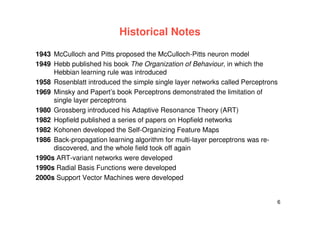
Historical Notes
1943 McCulloch and Pitts proposed the McCulloch-Pitts neuron model
1949 Hebb published his book The Organization of Behaviour, in which the
Hebbian learning rule was introduced
1958 Rosenblatt introduced the simple single layer networks called Perceptrons
1969 Minsky and Papert’s book Perceptrons demonstrated the limitation of
single layer perceptrons
1980 Grossberg introduced his Adaptive Resonance Theory (ART)
1982 Hopfield published a series of papers on Hopfield networks
1982 Kohonen developed the Self-Organizing Feature Maps
1986 Back-propagation learning algorithm for multi-layer perceptrons was re-
discovered, and the whole field took off again
1990s ART-variant networks were developed
1990s Radial Basis Functions were developed
2000s Support Vector Machines were developed
7
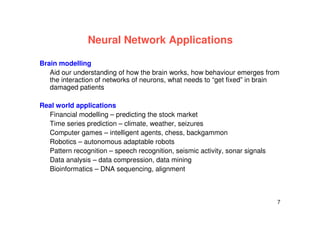
Neural Network Applications
Brain modelling
Aid our understanding of how the brain works, how behaviour emerges from
the interaction of networks of neurons, what needs to “get fixed” in brain
damaged patients
Real world applications
Financial modelling – predicting the stock market
Time series prediction – climate, weather, seizures
Computer games – intelligent agents, chess, backgammon
Robotics – autonomous adaptable robots
Pattern recognition – speech recognition, seismic activity, sonar signals
Data analysis – data compression, data mining
Bioinformatics – DNA sequencing, alignment
8
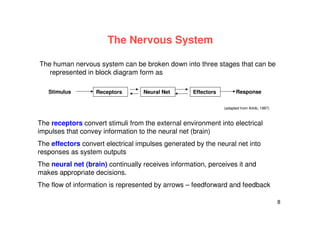
The Nervous System
The human nervous system can be broken down into three stages that can be
represented in block diagram form as
Stimulus Receptors Effectors
Neural Net Response
The receptors convert stimuli from the external environment into electrical
impulses that convey information to the neural net (brain)
The effectors convert electrical impulses generated by the neural net into
responses as system outputs
The neural net (brain) continually receives information, perceives it and
makes appropriate decisions.
The flow of information is represented by arrows – feedforward and feedback
(adapted from Arbib, 1987)
9
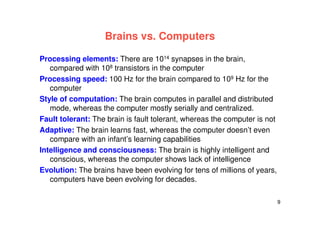
Brains vs. Computers
Processing elements: There are 1014 synapses in the brain,
compared with 108 transistors in the computer
Processing speed: 100 Hz for the brain compared to 109 Hz for the
computer
Style of computation: The brain computes in parallel and distributed
mode, whereas the computer mostly serially and centralized.
Fault tolerant: The brain is fault tolerant, whereas the computer is not
Adaptive: The brain learns fast, whereas the computer doesn’t even
compare with an infant’s learning capabilities
Intelligence and consciousness: The brain is highly intelligent and
conscious, whereas the computer shows lack of intelligence
Evolution: The brains have been evolving for tens of millions of years,
computers have been evolving for decades.
10
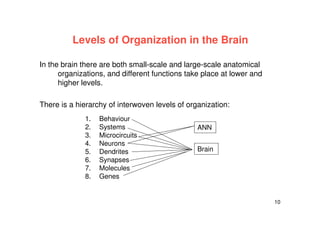
Levels of Organization in the Brain
In the brain there are both small-scale and large-scale anatomical
organizations, and different functions take place at lower and
higher levels.
There is a hierarchy of interwoven levels of organization:
1. Behaviour
2. Systems
3. Microcircuits
4. Neurons
5. Dendrites
6. Synapses
7. Molecules
8. Genes
Brain
ANN
11
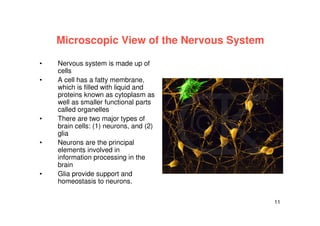
Microscopic View of the Nervous System
• Nervous system is made up of
cells
• A cell has a fatty membrane,
which is filled with liquid and
proteins known as cytoplasm as
well as smaller functional parts
called organelles
• There are two major types of
brain cells: (1) neurons, and (2)
glia
• Neurons are the principal
elements involved in
information processing in the
brain
• Glia provide support and
homeostasis to neurons.
12
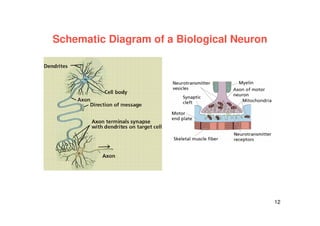
Schematic Diagram of a Biological Neuron
13
Basic Components of Biological Neurons
• The majority of neurons encode their activation or outputs as a
series of brief electrical pulses (i.e. spikes or action potentials)
• The neuron’s cell body (soma) processes the incoming activations
and converts them into output activations
• The neuron’s nucleus contains the genetic material (DNA)
• Dendrites are fibres which emanate from the cell body and provide
the receptive zone that receive activation from other neurons
• Axons are fibres acting as transmission lines that send action
potentials to other neurons
• The junctions that allow signal transmission between the axons and
the dendrites are called synapses. The process of transmission is
by diffusion of chemicals called neurotransmitters across the
synaptic cleft.
14
The McCulloch-Pitts Neuron
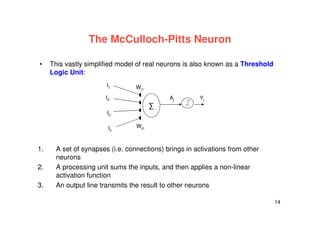
• This vastly simplified model of real neurons is also known as a Threshold
Logic Unit:
1. A set of synapses (i.e. connections) brings in activations from other
neurons
2. A processing unit sums the inputs, and then applies a non-linear
activation function
3. An output line transmits the result to other neurons
I1
∑
Wj1
Wjn
I2
I3
In
Aj Yj
15
How the Model Neuron Works
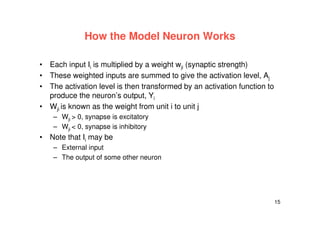
• Each input Ii is multiplied by a weight wji (synaptic strength)
• These weighted inputs are summed to give the activation level, Aj
• The activation level is then transformed by an activation function to
produce the neuron’s output, Yi
• Wji is known as the weight from unit i to unit j
– Wji > 0, synapse is excitatory
– Wji < 0, synapse is inhibitory
• Note that Ii may be
– External input
– The output of some other neuron
16
The McCulloch-Pitts Neuron Equation
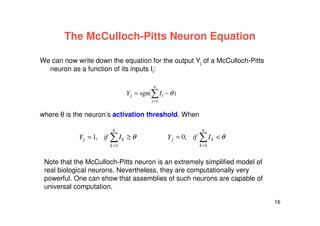
We can now write down the equation for the output Yj of a McCulloch-Pitts
neuron as a function of its inputs Ii:
)
sgn(
1
θ
−
= ∑
=
n
i
i
j I
Y
where θ is the neuron’s activation threshold. When
θ
≥
= ∑
=
n
k
k
j I
if
Y
1
,
1 θ
<
= ∑
=
n
k
k
j I
if
Y
1
,
0
Note that the McCulloch-Pitts neuron is an extremely simplified model of
real biological neurons. Nevertheless, they are computationally very
powerful. One can show that assemblies of such neurons are capable of
universal computation.

IntrotoooooooooooooooooooooooooooooNNetwork.pdf

  • 1.
    1 Lecture 1: Introductionto Neural Networks Kevin Swingler / Bruce Graham kms@cs.stir.ac.uk
  • 2.
    2 What are NeuralNetworks? • Neural Networks are networks of neurons, for example, as found in real (i.e. biological) brains • Artificial neurons are crude approximations of the neurons found in real brains. They may be physical devices, or purely mathematical constructs. • Artificial Neural Networks (ANNs) are networks of Artificial Neurons and hence constitute crude approximations to parts of real brains. They maybe physical devices, or simulated on conventional computers. • From a practical point of view, an ANN is just a parallel computational system consisting of many simple processing elements connected together in a specific way in order to perform a particular task • One should never lose sight of how crude the approximations are, and how over-simplified our ANNs are compared to real brains.
  • 3.
    3 Why are ArtificialNeural Networks worth studying? • They are extremely powerful computational devices • Massive parallelism makes them very efficient • They can learn and generalize from training data – so there is no need for enormous feats of programming • They are particularly fault tolerant • They are very noise tolerant – so they can cope with situations where normal symbolic systems would have difficulty • In principle, they can do anything a symbolic/logic system can do, and more
  • 4.
    4 What are NeuralNetworks used for? There are two basic goals for neural network research: Brain modelling: The biological goal of constructing models of how real brains work. This can potentially help us understand the nature of perception, actions, learning and memory, thought and intelligence and/or formulate medical solutions to brain damaged patients Artificial System Construction: The engineering goal of building efficient systems for real world applications. This may make machines more powerful and intelligent, relieve humans of tedious tasks, and may even improve upon human performance. Both methodologies should be regarded as complementary and not competing. We often use exactly the same network architectures and methodologies for both. Progress is made when the two approaches are allowed to feed one another. There are fundamental differences though, e.g. the need for biological plausibility in brain modelling, and the need for computational efficiency in artificial system construction.
  • 5.
    5 Learning Processes inNeural Networks Among the many interesting properties of a neural network, is the ability of the network to learn from its environment, and to improve its performance through learning. The improvement in performance takes place over time in accordance with some prescribed measure. A neural network learns about its environment through an iterative process of adjustments applied to its synaptic weights and thresholds. Ideally, the network becomes more knowledgeable about its environment after each iteration of the learning process. There are three broad types of learning: 1. Supervised learning (i.e. learning with an external teacher) 2. Unsupervised learning (i.e. learning with no help) 3. Reinforcement learning (i.e. learning with limited feedback)
  • 6.
    6 Historical Notes 1943 McCullochand Pitts proposed the McCulloch-Pitts neuron model 1949 Hebb published his book The Organization of Behaviour, in which the Hebbian learning rule was introduced 1958 Rosenblatt introduced the simple single layer networks called Perceptrons 1969 Minsky and Papert’s book Perceptrons demonstrated the limitation of single layer perceptrons 1980 Grossberg introduced his Adaptive Resonance Theory (ART) 1982 Hopfield published a series of papers on Hopfield networks 1982 Kohonen developed the Self-Organizing Feature Maps 1986 Back-propagation learning algorithm for multi-layer perceptrons was re- discovered, and the whole field took off again 1990s ART-variant networks were developed 1990s Radial Basis Functions were developed 2000s Support Vector Machines were developed
  • 7.
    7 Neural Network Applications Brainmodelling Aid our understanding of how the brain works, how behaviour emerges from the interaction of networks of neurons, what needs to “get fixed” in brain damaged patients Real world applications Financial modelling – predicting the stock market Time series prediction – climate, weather, seizures Computer games – intelligent agents, chess, backgammon Robotics – autonomous adaptable robots Pattern recognition – speech recognition, seismic activity, sonar signals Data analysis – data compression, data mining Bioinformatics – DNA sequencing, alignment
  • 8.
    8 The Nervous System Thehuman nervous system can be broken down into three stages that can be represented in block diagram form as Stimulus Receptors Effectors Neural Net Response The receptors convert stimuli from the external environment into electrical impulses that convey information to the neural net (brain) The effectors convert electrical impulses generated by the neural net into responses as system outputs The neural net (brain) continually receives information, perceives it and makes appropriate decisions. The flow of information is represented by arrows – feedforward and feedback (adapted from Arbib, 1987)
  • 9.
    9 Brains vs. Computers Processingelements: There are 1014 synapses in the brain, compared with 108 transistors in the computer Processing speed: 100 Hz for the brain compared to 109 Hz for the computer Style of computation: The brain computes in parallel and distributed mode, whereas the computer mostly serially and centralized. Fault tolerant: The brain is fault tolerant, whereas the computer is not Adaptive: The brain learns fast, whereas the computer doesn’t even compare with an infant’s learning capabilities Intelligence and consciousness: The brain is highly intelligent and conscious, whereas the computer shows lack of intelligence Evolution: The brains have been evolving for tens of millions of years, computers have been evolving for decades.
  • 10.
    10 Levels of Organizationin the Brain In the brain there are both small-scale and large-scale anatomical organizations, and different functions take place at lower and higher levels. There is a hierarchy of interwoven levels of organization: 1. Behaviour 2. Systems 3. Microcircuits 4. Neurons 5. Dendrites 6. Synapses 7. Molecules 8. Genes Brain ANN
  • 11.
    11 Microscopic View ofthe Nervous System • Nervous system is made up of cells • A cell has a fatty membrane, which is filled with liquid and proteins known as cytoplasm as well as smaller functional parts called organelles • There are two major types of brain cells: (1) neurons, and (2) glia • Neurons are the principal elements involved in information processing in the brain • Glia provide support and homeostasis to neurons.
  • 12.
    12 Schematic Diagram ofa Biological Neuron
  • 13.
    13 Basic Components ofBiological Neurons • The majority of neurons encode their activation or outputs as a series of brief electrical pulses (i.e. spikes or action potentials) • The neuron’s cell body (soma) processes the incoming activations and converts them into output activations • The neuron’s nucleus contains the genetic material (DNA) • Dendrites are fibres which emanate from the cell body and provide the receptive zone that receive activation from other neurons • Axons are fibres acting as transmission lines that send action potentials to other neurons • The junctions that allow signal transmission between the axons and the dendrites are called synapses. The process of transmission is by diffusion of chemicals called neurotransmitters across the synaptic cleft.
  • 14.
    14 The McCulloch-Pitts Neuron •This vastly simplified model of real neurons is also known as a Threshold Logic Unit: 1. A set of synapses (i.e. connections) brings in activations from other neurons 2. A processing unit sums the inputs, and then applies a non-linear activation function 3. An output line transmits the result to other neurons I1 ∑ Wj1 Wjn I2 I3 In Aj Yj
  • 15.
    15 How the ModelNeuron Works • Each input Ii is multiplied by a weight wji (synaptic strength) • These weighted inputs are summed to give the activation level, Aj • The activation level is then transformed by an activation function to produce the neuron’s output, Yi • Wji is known as the weight from unit i to unit j – Wji > 0, synapse is excitatory – Wji < 0, synapse is inhibitory • Note that Ii may be – External input – The output of some other neuron
  • 16.
    16 The McCulloch-Pitts NeuronEquation We can now write down the equation for the output Yj of a McCulloch-Pitts neuron as a function of its inputs Ii: ) sgn( 1 θ − = ∑ = n i i j I Y where θ is the neuron’s activation threshold. When θ ≥ = ∑ = n k k j I if Y 1 , 1 θ < = ∑ = n k k j I if Y 1 , 0 Note that the McCulloch-Pitts neuron is an extremely simplified model of real biological neurons. Nevertheless, they are computationally very powerful. One can show that assemblies of such neurons are capable of universal computation.