www.upc.edu
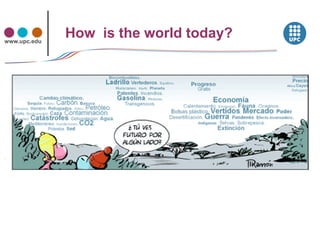
              How is the world today?
www.upc.edu
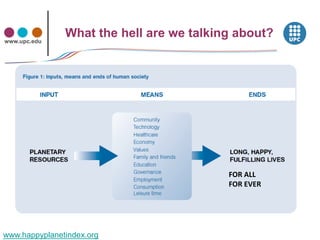
              What the hell are we talking about?


      What is sustainability? What is Sustainable development?
      ????
www.upc.edu
               What the hell are we talking about?


                                          FOR ALL
                                          FOR EVER


www.happyplanetindex.org
www.upc.edu
                   Concepts

      Carrying capacity
          In ecology: carrying capacity in the maximum number of any
           species that a habitat can support along the time
          What happens when the carrying capacity is overcome?
          As humans which is our habitat?
          Which is our carrying capacity as humans in our habitat?
              • It depends on:
               – The humans “needs” to live.
               – The Tech used to fulfill those “needs” in terms of
                 resources/waste/pollution
               – Our social organization and its resilience.
www.upc.edu
              Concepts


      Ecological footprint
          Redefines carrying capacity as the surface of productive
           earth and water needed to maintain a population at a
           certain standard of living. Units: gha.
www.upc.edu
                  Concepts


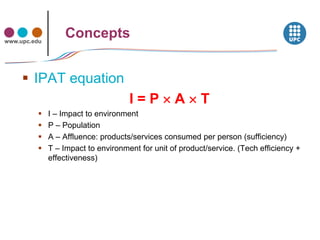
      IPAT equation
                                     I=PAT
             I – Impact to environment
             P – Population
             A – Affluence: products/services consumed per person (sufficiency)
             T – Impact to environment for unit of product/service. (Tech efficiency +
              effectiveness)
www.upc.edu
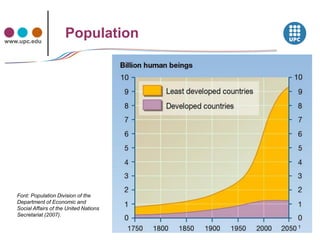
                        Population


   Font: Population Division of the
   Department of Economic and
   Social Affairs of the United Nations
   Secretariat (2007).
www.upc.edu
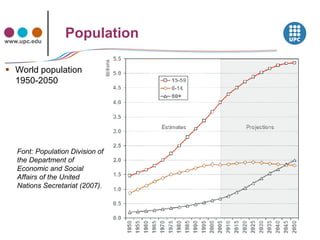
                  Population

 World population
  1950-2050


   Font: Population Division of
   the Department of
   Economic and Social
   Affairs of the United
   Nations Secretariat (2007).
www.upc.edu
                  Població

     Distribució de la població per edats i per regions: projecció mitjana.


    Font: Population Division of the Department of Economic and Social Affairs of the United
    Nations Secretariat (2007).
www.upc.edu
                        Affluence

     Resum


   Font: Population Division of the
   Department of Economic and
   Social Affairs of the United Nations
   Secretariat (2007).
www.upc.edu
                Concepts


      IPAT exercice.
                                I=PAT
          I – Impact to environment in 2050 = 50% of current situation
          P – Population
          A – Affluence: products/services consumed per person
             •  2% annual in “developed” countries (20% population)
             • Developing countries (80% population) the same development as
                “developed” by 2050.
          T – Impact to environment for unit of product/service.

              • ???????
                 – 2 => 50%
                 – 3 => 66%
                 – 4 => 75%
What does the EF measure?
www.upc.edu

            Consumption of food and materials: in relation to the surface of earth and seas
             biologically productive needed to produce that natural resources.
            Consumption of energy: on the basis of the surface necessary to absorb the
             correlatives emissions of CO2.


     •       The measuring is done in “units of surface”. A surface’s unit is equivalent to an hectare of
             world productivity average.
Evaluation Matrix
                            A                         C                                   F
   Ecological Footprint                B                          D            E
                          Fossil                 Agricultural                          Forestry   TOTAL
   [ha/capita]                     Degradation                  Cereals     Pastures
                          energy                  growing                              running
www.upc.edu
  1 ALIMENTATION
   11 Vegetables
   12 Animal
   2 HOUSING
   21 Construction
   22 Operation
   3 TRANSPORT
   31 Private
   32 Public
   33 Of products
   4 CONSUMPTIN GOODS
   41 Packing
   42 Clothing
   43 Furniture
   44 Books/Journals
   45 Tobacco/Alcohol
   46 Personal care
   47 Recreational
   equipment
   48 Others
   5 SERVICES
   51 Government + Army
   52 Education
   53 Health
   54 Social Services
   55 Tourism
   56 Culture
   57 Banking/Financing
   58 Others
   TOTAL
Example: Canada 1991
                                A                         C                                 F
  Ecological Footprint                     B                          D          E
                              Fossil                 Agricultural                        Forestry   TOTAL
  [ha/capita]                          Degradation                  Cereals   Pastures
                              energy                  growing                            running
  1 ALIMENTATION               0.33                     0.02         0.60       0.33       0.02      1.30
www.upc.edu
  11 Vegetables                0.14                     0.02         0.18                  0.01
  12 Animal                    0.19                                  0.42       0.33       0.01
  2 HOUSING                    0.41       0.08          0.002                              0.40      0.89
  21 Construction              0.06                                                        0.35
  22 Operation                 0.35                                                        0.05
  3 TRANSPORT                  0.79       0.10                                                       0.89
  31 Private                   0.60
  32 Public                    0.07
  33 Of products               0.12
  4 CONSUMPTIN GOODS           0.52       0.01                       0.06       0.13       0.17      0.89
  41 Packing                   0.10                                                        0.04
  42 Clothing                  0.11                                  0.02       0.13
  43 Furniture                 0.06                                                        0.03
  44 Books/Journals            0.06                                                        0.10
  45 Tobacco/Alcohol           0.06                                  0.04
  46 Personal care             0.03
  47 Recreational equipment    0.10
  48 Others                    0.00
  5 SERVICES                   0.29       0.01                                                       0.30
  51 Government + Army         0.06
  52 Education                 0.08
  53 Health                    0.08
  54 Social Services           0.00
  55 Tourism                   0.01
  56 Culture                   0.01
  57 Banking/Financing         0.00
  58 Others                    0.05
  TOTAL                        2.34       0.20          0.02         0.66       0.46       0.59     4.27
www.upc.edu
              Global values   Informe Living planet 2010


 World availability per
  capita: 1.8 units
 Word consumption 2,7
  units =>
           50% higher
  than availability
www.upc.edu
              Local Ecological Footprint,

                         Available 4 1/2

                         Available 4

                         Available 3

                         Available 2

                         Available
www.upc.edu


              UA
www.upc.edu
www.upc.edu


              UA
www.upc.edu
www.upc.edu
www.upc.edu
www.upc.edu
              Ecological Footprint evolution
www.upc.edu
              The human development index


  Human development index (HDI) looks beyond GDP to a broader definition of
  wellbeing.
  The HDI provides a composite measure of three dimensions of human
  development:
     • living a long and healthy life (measured by life expectancy),
     • being educated (measured by adult literacy and enrolment at the primary,
       secondary and tertiary level) and
     • having a decent standard of living (measured by purchasing power parity,
       income).
  The index is not in any sense a comprehensive measure of human development.
  It does not, for example, include important indicators such as respect for human
  rights, democracy and inequality. What it does provide is a broadened prism for
  viewing human progress and the complex relationship between income and well-
  being.
www.upc.edu
              The human development index
www.upc.edu
              The human development index
www.upc.edu
              The human development index
www.upc.edu
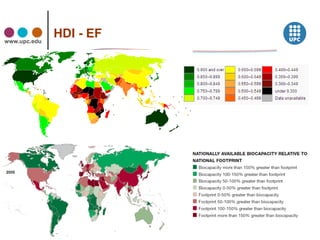
              HDI - EF
From “clasic development” to sustainable development

www.upc.edu                                                                  : chemin du développement "classique"
       Besoins des
       générations                                                           : chemins du développement durable
        actuelles
                                                                /5                  /3
          Indicateur de développement humain –IDH)


                                                      1
                                                     0,9                                                   développement durable
                                                     0,8
                                                     0,7
                                                                                                                         les « chemins »
                                                     0,6                                                                 souhaitables diffèrent
                                                                                                                         mais tentent de susciter
                                                     0,5                                                                 une convergence à long
                                                     0,4                                                                 terme écologiquement
                                                                                                                         viable et politiquement
                                                     0,3                                                                 acceptable.

                                                     0,2
                                                     0,1
                                                      0                                                              Besoins des
                                                           11   10   9   8      7   6    5    4    3   2    1      0 générations
                                                                                                                       futures
                                                                     Empreinte écologique (ha/hab)

      d’après Aurélien Boutaud, ENSMSE, RAE                                                                       C. Brodhag, http://www.brodhag.org
HDI - EF

www.upc.edu
www.upc.edu
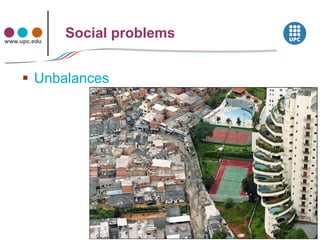
              Social problems


      Unbalances
www.upc.edu
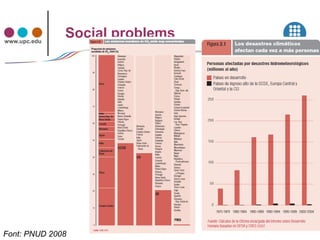
              Social problems


Font: PNUD 2008
www.upc.edu
                Concepts


      Exercise 2
          Evaluate current carrying capacity of the earth. (% of current population)

          Evaluate current carrying capacity if everybody live as a OECD citizen (% of
           current population)
The current world view
www.upc.edu     - relative importance?

                                                     Economy laws are
                                                     ‘inevitable’ - market
                                                     laws
  Environment
                    Environment is used to fulfill
  (‘technology
                    the demands of the Economy
     can fix it’)   laws. (Resources, waste and
                    pollution absorption)
                          Economy
                     (‘inevitable laws’)
                     Society adapts to the
                     inevitable economy laws:
                     As much money as sooner as
          Society    possible.
www.upc.edu


  But this is what we all ultimately
  depend on for life - so...
Engineers provide the interfaces...
www.upc.edu


                                                      Environmental laws are
                                                      ‘inevitable’ - laws of nature.
    Products
                                                      Environment nurtures,
                                                      supports and makes
                                                      possible….
                                                      Society - which has a
                      Economy                         mixture of instinctive and
                                                      learned/cultural laws
                     - invented!
                                                      Society has invented, to
                                                      serve society’s purposes….
                       Society
                   Environment                        Economy - whose rules and
                                                      practices are totally ‘invented’
Infrastructure     - ‘inevitable’                     by society


SO: why do so many regard Economic laws as ‘inevitable’ (globalisation, etc); but
Environmental laws, and limits, as manipulable?
www.upc.edu
              Current trend evolution
www.upc.edu
              Current trend evolution
Energy
www.upc.edu      intensity (J/h)              Activity                     Happiness
                                              Sex                                4,7
                                              Socialising                        4,0
                                              Relaxing                           3,9
       Very low (zero)
                                              Praying/meditating                 3,8
                                              Eating                             3,8
                                              Exercising                         3,8
                                              Watching TV                        3,6
                                              Shopping                           3,2
      Use of appliances:                      Preparing food                     3,2
      medium high                             Talking in phone                   3,1
                                              Taking care of children            3,0
                                              Computer/internet                  3,0
                                              Housework                          3,0
                                              Working                            2,7
      Commuting: high                         Commuting                          2,6


                                   Source: (Holmberg & Nässen 2011) and (Kahneman et al. 2004)

Introducatio SD for enginers

  • 1.
    www.upc.edu How is the world today?
  • 2.
    www.upc.edu What the hell are we talking about?  What is sustainability? What is Sustainable development?  ????
  • 3.
    www.upc.edu What the hell are we talking about? FOR ALL FOR EVER www.happyplanetindex.org
  • 4.
    www.upc.edu Concepts  Carrying capacity  In ecology: carrying capacity in the maximum number of any species that a habitat can support along the time  What happens when the carrying capacity is overcome?  As humans which is our habitat?  Which is our carrying capacity as humans in our habitat? • It depends on: – The humans “needs” to live. – The Tech used to fulfill those “needs” in terms of resources/waste/pollution – Our social organization and its resilience.
  • 5.
    www.upc.edu Concepts  Ecological footprint  Redefines carrying capacity as the surface of productive earth and water needed to maintain a population at a certain standard of living. Units: gha.
  • 6.
    www.upc.edu Concepts  IPAT equation I=PAT  I – Impact to environment  P – Population  A – Affluence: products/services consumed per person (sufficiency)  T – Impact to environment for unit of product/service. (Tech efficiency + effectiveness)
  • 7.
    www.upc.edu Population Font: Population Division of the Department of Economic and Social Affairs of the United Nations Secretariat (2007).
  • 8.
    www.upc.edu Population  World population 1950-2050 Font: Population Division of the Department of Economic and Social Affairs of the United Nations Secretariat (2007).
  • 9.
    www.upc.edu Població  Distribució de la població per edats i per regions: projecció mitjana. Font: Population Division of the Department of Economic and Social Affairs of the United Nations Secretariat (2007).
  • 10.
    www.upc.edu Affluence  Resum Font: Population Division of the Department of Economic and Social Affairs of the United Nations Secretariat (2007).
  • 11.
    www.upc.edu Concepts  IPAT exercice. I=PAT  I – Impact to environment in 2050 = 50% of current situation  P – Population  A – Affluence: products/services consumed per person •  2% annual in “developed” countries (20% population) • Developing countries (80% population) the same development as “developed” by 2050.  T – Impact to environment for unit of product/service. • ??????? – 2 => 50% – 3 => 66% – 4 => 75%
  • 12.
    What does theEF measure? www.upc.edu  Consumption of food and materials: in relation to the surface of earth and seas biologically productive needed to produce that natural resources.  Consumption of energy: on the basis of the surface necessary to absorb the correlatives emissions of CO2. • The measuring is done in “units of surface”. A surface’s unit is equivalent to an hectare of world productivity average.
  • 13.
    Evaluation Matrix A C F Ecological Footprint B D E Fossil Agricultural Forestry TOTAL [ha/capita] Degradation Cereals Pastures energy growing running www.upc.edu 1 ALIMENTATION 11 Vegetables 12 Animal 2 HOUSING 21 Construction 22 Operation 3 TRANSPORT 31 Private 32 Public 33 Of products 4 CONSUMPTIN GOODS 41 Packing 42 Clothing 43 Furniture 44 Books/Journals 45 Tobacco/Alcohol 46 Personal care 47 Recreational equipment 48 Others 5 SERVICES 51 Government + Army 52 Education 53 Health 54 Social Services 55 Tourism 56 Culture 57 Banking/Financing 58 Others TOTAL
  • 14.
    Example: Canada 1991 A C F Ecological Footprint B D E Fossil Agricultural Forestry TOTAL [ha/capita] Degradation Cereals Pastures energy growing running 1 ALIMENTATION 0.33 0.02 0.60 0.33 0.02 1.30 www.upc.edu 11 Vegetables 0.14 0.02 0.18 0.01 12 Animal 0.19 0.42 0.33 0.01 2 HOUSING 0.41 0.08 0.002 0.40 0.89 21 Construction 0.06 0.35 22 Operation 0.35 0.05 3 TRANSPORT 0.79 0.10 0.89 31 Private 0.60 32 Public 0.07 33 Of products 0.12 4 CONSUMPTIN GOODS 0.52 0.01 0.06 0.13 0.17 0.89 41 Packing 0.10 0.04 42 Clothing 0.11 0.02 0.13 43 Furniture 0.06 0.03 44 Books/Journals 0.06 0.10 45 Tobacco/Alcohol 0.06 0.04 46 Personal care 0.03 47 Recreational equipment 0.10 48 Others 0.00 5 SERVICES 0.29 0.01 0.30 51 Government + Army 0.06 52 Education 0.08 53 Health 0.08 54 Social Services 0.00 55 Tourism 0.01 56 Culture 0.01 57 Banking/Financing 0.00 58 Others 0.05 TOTAL 2.34 0.20 0.02 0.66 0.46 0.59 4.27
  • 15.
    www.upc.edu Global values Informe Living planet 2010  World availability per capita: 1.8 units  Word consumption 2,7 units => 50% higher than availability
  • 16.
    www.upc.edu Local Ecological Footprint, Available 4 1/2 Available 4 Available 3 Available 2 Available
  • 17.
  • 18.
  • 19.
  • 20.
  • 21.
  • 22.
  • 23.
    www.upc.edu Ecological Footprint evolution
  • 24.
    www.upc.edu The human development index Human development index (HDI) looks beyond GDP to a broader definition of wellbeing. The HDI provides a composite measure of three dimensions of human development: • living a long and healthy life (measured by life expectancy), • being educated (measured by adult literacy and enrolment at the primary, secondary and tertiary level) and • having a decent standard of living (measured by purchasing power parity, income). The index is not in any sense a comprehensive measure of human development. It does not, for example, include important indicators such as respect for human rights, democracy and inequality. What it does provide is a broadened prism for viewing human progress and the complex relationship between income and well- being.
  • 25.
    www.upc.edu The human development index
  • 26.
    www.upc.edu The human development index
  • 27.
    www.upc.edu The human development index
  • 28.
    www.upc.edu HDI - EF
  • 29.
    From “clasic development”to sustainable development www.upc.edu : chemin du développement "classique" Besoins des générations : chemins du développement durable actuelles /5 /3 Indicateur de développement humain –IDH) 1 0,9 développement durable 0,8 0,7 les « chemins » 0,6 souhaitables diffèrent mais tentent de susciter 0,5 une convergence à long 0,4 terme écologiquement viable et politiquement 0,3 acceptable. 0,2 0,1 0 Besoins des 11 10 9 8 7 6 5 4 3 2 1 0 générations futures Empreinte écologique (ha/hab) d’après Aurélien Boutaud, ENSMSE, RAE C. Brodhag, http://www.brodhag.org
  • 30.
  • 31.
    www.upc.edu Social problems  Unbalances
  • 32.
    www.upc.edu Social problems Font: PNUD 2008
  • 33.
    www.upc.edu Concepts  Exercise 2  Evaluate current carrying capacity of the earth. (% of current population)  Evaluate current carrying capacity if everybody live as a OECD citizen (% of current population)
  • 34.
    The current worldview www.upc.edu - relative importance? Economy laws are ‘inevitable’ - market laws Environment Environment is used to fulfill (‘technology the demands of the Economy can fix it’) laws. (Resources, waste and pollution absorption) Economy (‘inevitable laws’) Society adapts to the inevitable economy laws: As much money as sooner as Society possible.
  • 35.
    www.upc.edu Butthis is what we all ultimately depend on for life - so...
  • 36.
    Engineers provide theinterfaces... www.upc.edu Environmental laws are ‘inevitable’ - laws of nature. Products Environment nurtures, supports and makes possible…. Society - which has a Economy mixture of instinctive and learned/cultural laws - invented! Society has invented, to serve society’s purposes…. Society Environment Economy - whose rules and practices are totally ‘invented’ Infrastructure - ‘inevitable’ by society SO: why do so many regard Economic laws as ‘inevitable’ (globalisation, etc); but Environmental laws, and limits, as manipulable?
  • 37.
    www.upc.edu Current trend evolution
  • 38.
    www.upc.edu Current trend evolution
  • 39.
    Energy www.upc.edu intensity (J/h) Activity Happiness Sex 4,7 Socialising 4,0 Relaxing 3,9 Very low (zero) Praying/meditating 3,8 Eating 3,8 Exercising 3,8 Watching TV 3,6 Shopping 3,2 Use of appliances: Preparing food 3,2 medium high Talking in phone 3,1 Taking care of children 3,0 Computer/internet 3,0 Housework 3,0 Working 2,7 Commuting: high Commuting 2,6 Source: (Holmberg & Nässen 2011) and (Kahneman et al. 2004)