1


www.upc.edu


              Competences in Sustainability in
                   Engineering Education
3


www.upc.edu
              1 Introduction


  Definition:
  Competences represent a dynamic combination of cognitive and
  meta-cognitive knowledge and understanding, interpersonal,
  intellectual and practical skills, and ethical values.
  Fostering competences is the object of educational programmes.
  Competences will be formed in various course units and assessed at
  different stages. (Tunning, 2007)
4


www.upc.edu
                 1 Introduction


   Taxonomies:
        Capacities:
              1. Knowledge and understanding (To know)
              2. Skills and abilities (To do)
              3. Attitudes (To be)
              4. Ethics and Values
        Focus:
              1. Generic
              2. Specific
5


www.upc.edu
              2 Sustainability competences in Engineering


   What competences in Sustainability do you think
   engineers may have when graduating?
6


www.upc.edu
              2 Sustainability competences in Engineering


   Are those competences introduced in you current
   engineering curriculums?
7


www.upc.edu
              2 Sustainability competences in Engineering


   How can/should those competences introduced in
   your curriculum?
8


www.upc.edu
                2 Sustainability competences in Engineering


   Analysis:
     1.National level:
              • UK Standards for engineering (UK)
              • ABET (USA)
              • Criteria for Academic and Master’s Curricula (The Netherlands)
       2.International level:
              • Barcelona Declaration (2n EESD Conference)
              • CDIO (Conceive-Design-Implement-Operate)
9


www.upc.edu
              2 Sustainability competences in Engineering


   Results:
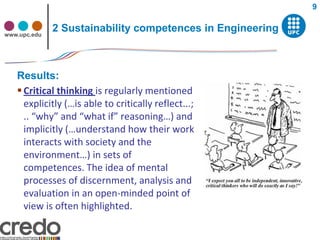
    Critical thinking is regularly mentioned
     explicitly (…is able to critically reflect...;
     .. “why” and “what if” reasoning…) and
     implicitly (…understand how their work
     interacts with society and the
     environment…) in sets of
     competences. The idea of mental
     processes of discernment, analysis and
     evaluation in an open-minded point of
     view is often highlighted.
10


www.upc.edu
              2 Sustainability competences in Engineering


   Results:
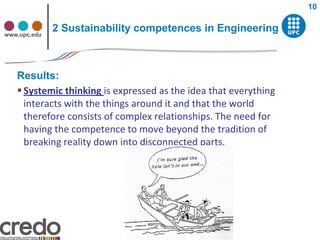
    Systemic thinking is expressed as the idea that everything
     interacts with the things around it and that the world
     therefore consists of complex relationships. The need for
     having the competence to move beyond the tradition of
     breaking reality down into disconnected parts.
11


www.upc.edu
              2 Sustainability competences in Engineering


   Results:
    Inter-trans-disciplinarity is also stated as important for
     SD taking into account both, the participation of different
     professionals to solve problems and stakeholder
     participation in technological processes.
12


www.upc.edu
              2 Sustainability competences in Engineering


   Results:
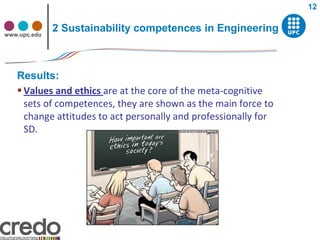
    Values and ethics are at the core of the meta-cognitive
     sets of competences, they are shown as the main force to
     change attitudes to act personally and professionally for
     SD.
13


www.upc.edu
              2 Sustainability competences in Engineering


   Barcelona Declaration in EESD 2004:
   today's engineers must be able to:
    Understand how their work interacts with society and the
      environment, locally and globally, in order to identify potential
      challenges, risks and impacts.
    Understand the contribution of their work in different cultural, social
      and political contexts and take those differences into account.
    Work in multidisciplinary teams, in order to adapt current technology
      to the demands imposed by sustainable lifestyles, resource
      efficiency, pollution prevention and waste management.
14


www.upc.edu
              2 Sustainability competences in Engineering


   Barcelona Declaration in EESD 2004:
   today's engineers must be able to:
    Apply a holistic and systemic approach to solving problems and the
      ability to move beyond the tradition of breaking reality down into
      disconnected parts.
    Participate actively in the discussion and definition of economic,
      social and technological policies, to help redirect society towards
      more sustainable development.
    Apply professional knowledge according to deontological principles
      and universal values and ethics.
    Listen closely to the demands of citizens and other stakeholders and
      let them have a say in the development of new technologies and
      infrastructures.
15


www.upc.edu
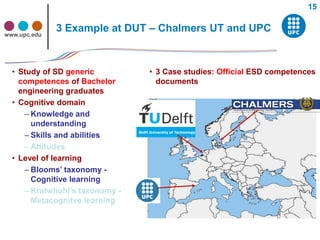
              3 Example at DUT – Chalmers UT and UPC


  • Study of SD generic         • 3 Case studies: Official ESD competences
    competences of Bachelor       documents
    engineering graduates
  • Cognitive domain
     – Knowledge and
       understanding
     – Skills and abilities
     – Attitudes
  • Level of learning
     – Blooms’ taxonomy -
       Cognitive learning
     – Kratwhohl’s taxonomy -
       Metacognitve learning
16


www.upc.edu
                                     3 Example at DUT – Chalmers UT and UPC


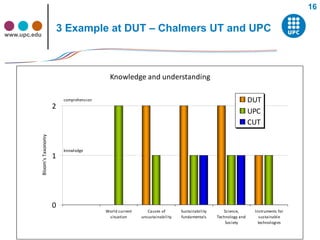
                                                        Knowledge and understanding

                                      comprehension                                                                        DUT
                                 2
                                                                                                                           UPC
                                                                                                                           CUT
              Bloom's Taxonomy


                                      knowledge
                                 1


                                 0
                                                      World current      Causes of       Sustainability      Science,       Instruments for
                                                       situation      unsustainability   fundamentals     Technology and      sustainable
                                                                                                              Society         technologies
17


www.upc.edu
                                 3 Example at DUT – Chalmers UT and UPC


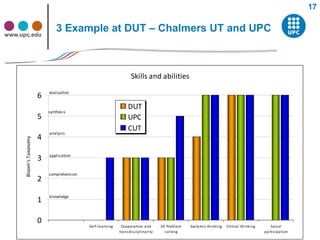
                                                                          Skills and abilities
                             evaluation
                         6
                                                                        DUT
                             synthesis
                         5                                              UPC
                                                                        CUT
                             analysis
                         4
      Bloom's Taxonomy


                             application
                         3
                             comprehension
                         2

                             knowledge
                         1

                         0
                                             Sel f-l ea rni ng    Coopera tion a nd             SD Probl em    Sys temi c thi nki ng   Cri tica l thi nki ng       Soci a l
                                                                 tra ns di s ci pl i na ri ty     s ol vi ng                                                   pa rtici pa tion
18


www.upc.edu
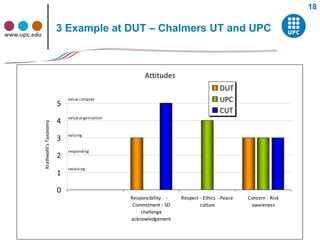
                                     3 Example at DUT – Chalmers UT and UPC


                                                                   Attitudes
                                                                                                  DUT
                                     5
                                         value complex                                            UPC
                                                                                                  CUT
                                         value organization
                                     4
              Krathwohl's Taxonomy


                                         valuing
                                     3
                                         responding
                                     2
                                         receiving
                                     1

                                     0
                                                              Responsibility -   Respect - Ethics - Peace   Concern - Risk
                                                               Commitment - SD           culture             awareness
                                                                  challenge
                                                              acknowledgement
19


www.upc.edu
              3 Example at DUT – Chalmers UT and UPC


                           Cognitive
                                                              Key word                Level of achievement
                            domain
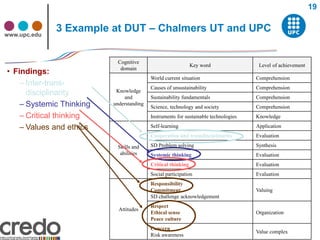
• Findings:
                                          World current situation                    Comprehension
    – Inter-trans-                        Causes of unsustainability                 Comprehension
      disciplinarity       Knowledge
                               and        Sustainability fundamentals                Comprehension
    – Systemic Thinking   understanding
                                          Science, technology and society            Comprehension
    – Critical thinking                   Instruments for sustainable technologies   Knowledge

    – Values and ethics                   Self-learning                              Application
                                          Cooperation and transdisciplinarity        Evaluation

                           Skills and     SD Problem solving                         Synthesis
                            abilities     Systemic thinking                          Evaluation
                                          Critical thinking                          Evaluation
                                          Social participation                       Evaluation
                                          Responsibility
                                          Commitment                                 Valuing
                                          SD challenge acknowledgement
                                          Respect
                            Attitudes
                                          Ethical sense                              Organization
                                          Peace culture
                                          Concern
                                                                                     Value complex
                                          Risk awareness
20


www.upc.edu
              4 UPC Sustainability Competence


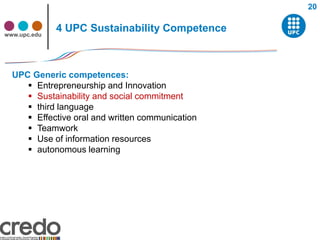
  UPC Generic competences:
      Entrepreneurship and Innovation
      Sustainability and social commitment
      third language
      Effective oral and written communication
      Teamwork
      Use of information resources
      autonomous learning
21


www.upc.edu
               4 UPC Sustainability Competence


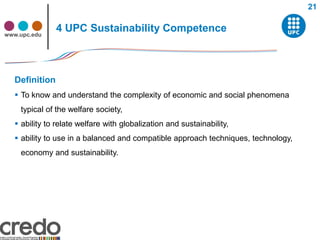
  Definition
   To know and understand the complexity of economic and social phenomena
    typical of the welfare society,
   ability to relate welfare with globalization and sustainability,
   ability to use in a balanced and compatible approach techniques, technology,
    economy and sustainability.
22


www.upc.edu
              4 UPC Sustainability Competence


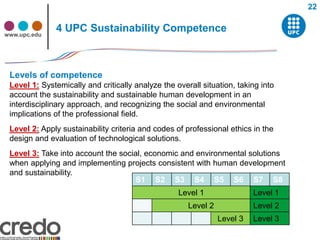
 Levels of competence
 Level 1: Systemically and critically analyze the overall situation, taking into
 account the sustainability and sustainable human development in an
 interdisciplinary approach, and recognizing the social and environmental
 implications of the professional field.
 Level 2: Apply sustainability criteria and codes of professional ethics in the
 design and evaluation of technological solutions.
 Level 3: Take into account the social, economic and environmental solutions
 when applying and implementing projects consistent with human development
 and sustainability.
                                    S1 S2 S3 S4 S5 S6 S7 S8
                                                   Level 1                Level 1
                                                      Level 2             Level 2
                                                                Level 3   Level 3

Competences in sustainability in engineering education

  • 1.
    1 www.upc.edu Competences in Sustainability in Engineering Education
  • 2.
    3 www.upc.edu 1 Introduction Definition: Competences represent a dynamic combination of cognitive and meta-cognitive knowledge and understanding, interpersonal, intellectual and practical skills, and ethical values. Fostering competences is the object of educational programmes. Competences will be formed in various course units and assessed at different stages. (Tunning, 2007)
  • 3.
    4 www.upc.edu 1 Introduction Taxonomies:  Capacities: 1. Knowledge and understanding (To know) 2. Skills and abilities (To do) 3. Attitudes (To be) 4. Ethics and Values  Focus: 1. Generic 2. Specific
  • 4.
    5 www.upc.edu 2 Sustainability competences in Engineering What competences in Sustainability do you think engineers may have when graduating?
  • 5.
    6 www.upc.edu 2 Sustainability competences in Engineering Are those competences introduced in you current engineering curriculums?
  • 6.
    7 www.upc.edu 2 Sustainability competences in Engineering How can/should those competences introduced in your curriculum?
  • 7.
    8 www.upc.edu 2 Sustainability competences in Engineering Analysis: 1.National level: • UK Standards for engineering (UK) • ABET (USA) • Criteria for Academic and Master’s Curricula (The Netherlands) 2.International level: • Barcelona Declaration (2n EESD Conference) • CDIO (Conceive-Design-Implement-Operate)
  • 8.
    9 www.upc.edu 2 Sustainability competences in Engineering Results:  Critical thinking is regularly mentioned explicitly (…is able to critically reflect...; .. “why” and “what if” reasoning…) and implicitly (…understand how their work interacts with society and the environment…) in sets of competences. The idea of mental processes of discernment, analysis and evaluation in an open-minded point of view is often highlighted.
  • 9.
    10 www.upc.edu 2 Sustainability competences in Engineering Results:  Systemic thinking is expressed as the idea that everything interacts with the things around it and that the world therefore consists of complex relationships. The need for having the competence to move beyond the tradition of breaking reality down into disconnected parts.
  • 10.
    11 www.upc.edu 2 Sustainability competences in Engineering Results:  Inter-trans-disciplinarity is also stated as important for SD taking into account both, the participation of different professionals to solve problems and stakeholder participation in technological processes.
  • 11.
    12 www.upc.edu 2 Sustainability competences in Engineering Results:  Values and ethics are at the core of the meta-cognitive sets of competences, they are shown as the main force to change attitudes to act personally and professionally for SD.
  • 12.
    13 www.upc.edu 2 Sustainability competences in Engineering Barcelona Declaration in EESD 2004: today's engineers must be able to:  Understand how their work interacts with society and the environment, locally and globally, in order to identify potential challenges, risks and impacts.  Understand the contribution of their work in different cultural, social and political contexts and take those differences into account.  Work in multidisciplinary teams, in order to adapt current technology to the demands imposed by sustainable lifestyles, resource efficiency, pollution prevention and waste management.
  • 13.
    14 www.upc.edu 2 Sustainability competences in Engineering Barcelona Declaration in EESD 2004: today's engineers must be able to:  Apply a holistic and systemic approach to solving problems and the ability to move beyond the tradition of breaking reality down into disconnected parts.  Participate actively in the discussion and definition of economic, social and technological policies, to help redirect society towards more sustainable development.  Apply professional knowledge according to deontological principles and universal values and ethics.  Listen closely to the demands of citizens and other stakeholders and let them have a say in the development of new technologies and infrastructures.
  • 14.
    15 www.upc.edu 3 Example at DUT – Chalmers UT and UPC • Study of SD generic • 3 Case studies: Official ESD competences competences of Bachelor documents engineering graduates • Cognitive domain – Knowledge and understanding – Skills and abilities – Attitudes • Level of learning – Blooms’ taxonomy - Cognitive learning – Kratwhohl’s taxonomy - Metacognitve learning
  • 15.
    16 www.upc.edu 3 Example at DUT – Chalmers UT and UPC Knowledge and understanding comprehension DUT 2 UPC CUT Bloom's Taxonomy knowledge 1 0 World current Causes of Sustainability Science, Instruments for situation unsustainability fundamentals Technology and sustainable Society technologies
  • 16.
    17 www.upc.edu 3 Example at DUT – Chalmers UT and UPC Skills and abilities evaluation 6 DUT synthesis 5 UPC CUT analysis 4 Bloom's Taxonomy application 3 comprehension 2 knowledge 1 0 Sel f-l ea rni ng Coopera tion a nd SD Probl em Sys temi c thi nki ng Cri tica l thi nki ng Soci a l tra ns di s ci pl i na ri ty s ol vi ng pa rtici pa tion
  • 17.
    18 www.upc.edu 3 Example at DUT – Chalmers UT and UPC Attitudes DUT 5 value complex UPC CUT value organization 4 Krathwohl's Taxonomy valuing 3 responding 2 receiving 1 0 Responsibility - Respect - Ethics - Peace Concern - Risk Commitment - SD culture awareness challenge acknowledgement
  • 18.
    19 www.upc.edu 3 Example at DUT – Chalmers UT and UPC Cognitive Key word Level of achievement domain • Findings: World current situation Comprehension – Inter-trans- Causes of unsustainability Comprehension disciplinarity Knowledge and Sustainability fundamentals Comprehension – Systemic Thinking understanding Science, technology and society Comprehension – Critical thinking Instruments for sustainable technologies Knowledge – Values and ethics Self-learning Application Cooperation and transdisciplinarity Evaluation Skills and SD Problem solving Synthesis abilities Systemic thinking Evaluation Critical thinking Evaluation Social participation Evaluation Responsibility Commitment Valuing SD challenge acknowledgement Respect Attitudes Ethical sense Organization Peace culture Concern Value complex Risk awareness
  • 19.
    20 www.upc.edu 4 UPC Sustainability Competence UPC Generic competences:  Entrepreneurship and Innovation  Sustainability and social commitment  third language  Effective oral and written communication  Teamwork  Use of information resources  autonomous learning
  • 20.
    21 www.upc.edu 4 UPC Sustainability Competence Definition  To know and understand the complexity of economic and social phenomena typical of the welfare society,  ability to relate welfare with globalization and sustainability,  ability to use in a balanced and compatible approach techniques, technology, economy and sustainability.
  • 21.
    22 www.upc.edu 4 UPC Sustainability Competence Levels of competence Level 1: Systemically and critically analyze the overall situation, taking into account the sustainability and sustainable human development in an interdisciplinary approach, and recognizing the social and environmental implications of the professional field. Level 2: Apply sustainability criteria and codes of professional ethics in the design and evaluation of technological solutions. Level 3: Take into account the social, economic and environmental solutions when applying and implementing projects consistent with human development and sustainability. S1 S2 S3 S4 S5 S6 S7 S8 Level 1 Level 1 Level 2 Level 2 Level 3 Level 3