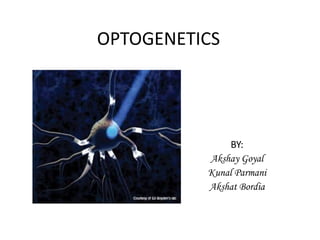
OPTOGENETICS
BY:
Akshay Goyal
Kunal Parmani
Akshat Bordia
INTRODUCTION
• Optogenetics is the integration of optics and genetics
to achieve gain of previous loss of function of events
within cells of living tissue
• Optogenetics (from Greek optos, meaning "visible")
uses light to control neurons which have been
genetically sensitised to light.
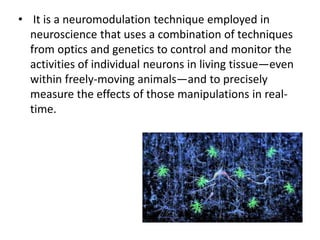
• It is a neuromodulation technique employed in
neuroscience that uses a combination of techniques
from optics and genetics to control and monitor the
activities of individual neurons in living tissue—even
within freely-moving animals—and to precisely
measure the effects of those manipulations in real-
time.
HISTORY
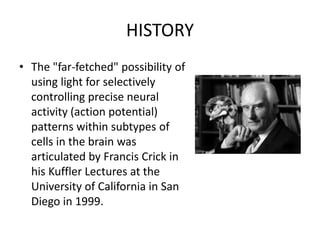
• The "far-fetched" possibility of
using light for selectively
controlling precise neural
activity (action potential)
patterns within subtypes of
cells in the brain was
articulated by Francis Crick in
his Kuffler Lectures at the
University of California in San
Diego in 1999.
• An early use of light to activate neurons was carried
out by Richard Fork and later Rafael Yuste, who
demonstrated laser activation of neurons within
intact tissue, although not in a genetically-targeted
manner.
• The earliest genetically targeted method, which used
light to control genetically-sensitised neurons, was
reported in January 2002 by Boris Zemelman who
employed Drosophila rhodopsin photoreceptors for
controlling neural activity in cultured mammalian
neurons.
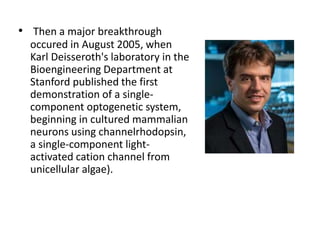
• Then a major breakthrough
occured in August 2005, when
Karl Deisseroth's laboratory in the
Bioengineering Department at
Stanford published the first
demonstration of a single-
component optogenetic system,
beginning in cultured mammalian
neurons using channelrhodopsin,
a single-component light-
activated cation channel from
unicellular algae).
Why study Optogenetics??
• 1-2 billion people worldwide suffer from:
stroke
addiction
chronic pain
anxiety disorders
epilepsy
Parkinson’s
Alzheimer’s ...
And these disorders of brain can be treated via targeted
neuromodulation.
HOW IT WORKS??
• The technique makes use of a certain kind of
reagents which are light-sensitive proteins.
• Like: for Spatially-precise neuronal
control optogenetic
actuators like channelrhodopsin, halorhodopsin,
and archaerhodopsin are used.
• For temporally-precise recordings optogenetic
sensors are used.
MECHANISM
• The genes for light-activated ion channels are
introduced to a population of cells by a human
engineered virus
• Which cells express these light-sensitive
channels depends on the promoter region of
the inserted DNA sequence
• Cells which contain a promoter that can
recognize the promoter sequence will express
these channels while cells that lack a promoter
specific for the sequence will not
• Once the genes have been inserted, it can take 1-
2 weeks for them to be fully expressed
• When studies are ready to be run, a fiber optic
cable is surgically attached to the top of the skull
or inserted near the brain area of interest
depending on how close it is to the surface of
the brain
• The channels, and in turn the neurons in which
they are embedded, can now be controlled by
light from the optic cable
SO THE SIX STEPS OF OPTOGENETICS ARE..
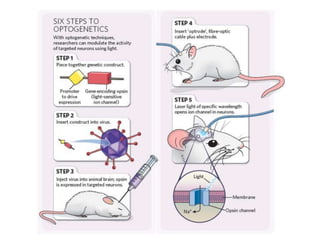
• Create a genetic construct
• Insert construct into virus
• Inject virus into mammal
• Insert optrode: fibreoptic cable+electrode
• Laser light opens ion channels in neurons
• Record behavioual results
CHALLENGES
• Transfection methods
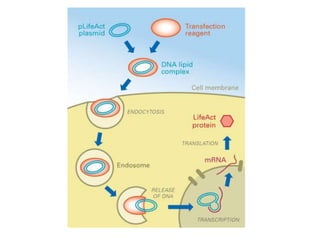
The word transfection is a blend of trans- and infection.
Transfection is the process of deliberately introducing
nucleic acids into cells. Transfection of animal
cells typically involves opening transient pores or "holes"
in the cell membrane to allow the uptake of material.
• Transfection methods are focused on the
construction of vectors and promoters.
The molecular biology aspect is a
challenge, because of the enormous
variety of constructs, which have to be
tested by time consuming screening. The
virus approach is quick and efficient and
has a biomedical implication, whereas the
construction of transgenic animals are
time consuming but have been proven to
be ideal for a variety of different
experiments in basic research.
• Improvement of the optogenetic tools
Although the wild type rhodopsin and
halorhodopsin work quite well, an improved
light sensitivity is important for experiments in
the mammalian brain because of its low
transmittance and because their activity is
influenced by their surroundings.
• Improvement of appropriate light sources
Device like micro pipe lights are sufficient for
light stimulation on the surface of the brain
but for applications on the dense tissue in the
brain, we need better excitation sources to
increase the transmittance.
POTENTIAL BENIFITS
• Research is focused on neurological diseases,
because all the advantages of the light stimulation
contain a promising potential for gene therapy and
other benefits.
• The optogenic approach offers for the future an
enormous potential for basic research, because
nerve excitation and silencing can be performed
simply by light with high precision in a reversible
manner
1. Cell culture, Network analysis
achieved by growing cultured nerve cells on micro
or nano patterned substrates. Cells can be
stimulated or silenced simply by a light-beam with
up to now unknown spatial precision.
2. Mapping of the brain and behavior
ChR2 (Channelrhodopsin- retinylidene proteins,
light-gated ion channels or sensory photoreceptors
) can be used for remote control of neurons. Studies
are possible on which certain areas of the brain are
stimulated via light pipes. Examples : (i) movement
of whisker of rodents; on the olfactory system
where light replaces the ligands, and (ii) on the
movement of animals after stimulation of the
motor cortex.
3. Gene therapy
In the future gene therapy with the optogenetic
tools appears possible. Transduction via Adeno
Associated Viruses (AAV) (does not cause disease) has been
performed successfully on the human eye to
cure Lebers Congenital Amaurosis (dystrophy of retina
due to malnutrition or disease) , by transduction of
cells in the human retina to replace the missing retinal
isomerase. In analogy to this, AAV´s could be loaded
with the microbial rhodopsins and could be used for
gene therapy on the diseases like recovery of vision,
parkinson disease.
4. Recovery of vision
Experiments on photoreceptor deficient mice have
shown that light evokes potentials in the visual cortex
after the transduction of the ON bipolar cells with ChR2
in the retina. This indicates that the retina of the
animals regained photosensitivity, which is transmitted
via the optic nerve to the brain. Trajectories of the
movement of the animals in the dark and in the light
show clearly an increased activity in the light as it is
obtained for wild type animals. It is conceivable that
such an approach might be possible for blind humans,
suffering e.g. the dry or the wet macular (yellowish
central portion of the retina) degeneration.
5. Parkinson disease,
Epilepsy
Deep brain
stimulation
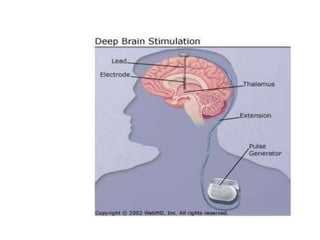
Deep brain
stimulation (or DBS) is a
way to inactivate parts
of the brain that
cause Parkinson's
disease and its
associated symptoms
without purposefully
destroying the brain.
In deep brain
stimulation, electrodes
are placed in the
thalamus (to treat
essential tremor and mul
tiple sclerosis) or in the
globus pallidus (for
Parkinson's disease).
THANK YOU

OPTOGENETICS

  • 1.
  • 2.
    INTRODUCTION • Optogenetics isthe integration of optics and genetics to achieve gain of previous loss of function of events within cells of living tissue • Optogenetics (from Greek optos, meaning "visible") uses light to control neurons which have been genetically sensitised to light.
  • 3.
    • It isa neuromodulation technique employed in neuroscience that uses a combination of techniques from optics and genetics to control and monitor the activities of individual neurons in living tissue—even within freely-moving animals—and to precisely measure the effects of those manipulations in real- time.
  • 4.
    HISTORY • The "far-fetched"possibility of using light for selectively controlling precise neural activity (action potential) patterns within subtypes of cells in the brain was articulated by Francis Crick in his Kuffler Lectures at the University of California in San Diego in 1999.
  • 5.
    • An earlyuse of light to activate neurons was carried out by Richard Fork and later Rafael Yuste, who demonstrated laser activation of neurons within intact tissue, although not in a genetically-targeted manner. • The earliest genetically targeted method, which used light to control genetically-sensitised neurons, was reported in January 2002 by Boris Zemelman who employed Drosophila rhodopsin photoreceptors for controlling neural activity in cultured mammalian neurons.
  • 6.
    • Then amajor breakthrough occured in August 2005, when Karl Deisseroth's laboratory in the Bioengineering Department at Stanford published the first demonstration of a single- component optogenetic system, beginning in cultured mammalian neurons using channelrhodopsin, a single-component light- activated cation channel from unicellular algae).
  • 7.
    Why study Optogenetics?? •1-2 billion people worldwide suffer from: stroke addiction chronic pain anxiety disorders epilepsy Parkinson’s Alzheimer’s ... And these disorders of brain can be treated via targeted neuromodulation.
  • 8.
    HOW IT WORKS?? •The technique makes use of a certain kind of reagents which are light-sensitive proteins. • Like: for Spatially-precise neuronal control optogenetic actuators like channelrhodopsin, halorhodopsin, and archaerhodopsin are used. • For temporally-precise recordings optogenetic sensors are used.
  • 9.
    MECHANISM • The genesfor light-activated ion channels are introduced to a population of cells by a human engineered virus • Which cells express these light-sensitive channels depends on the promoter region of the inserted DNA sequence • Cells which contain a promoter that can recognize the promoter sequence will express these channels while cells that lack a promoter specific for the sequence will not
  • 10.
    • Once thegenes have been inserted, it can take 1- 2 weeks for them to be fully expressed • When studies are ready to be run, a fiber optic cable is surgically attached to the top of the skull or inserted near the brain area of interest depending on how close it is to the surface of the brain • The channels, and in turn the neurons in which they are embedded, can now be controlled by light from the optic cable
  • 12.
    SO THE SIXSTEPS OF OPTOGENETICS ARE.. • Create a genetic construct • Insert construct into virus • Inject virus into mammal • Insert optrode: fibreoptic cable+electrode • Laser light opens ion channels in neurons • Record behavioual results
  • 13.
    CHALLENGES • Transfection methods Theword transfection is a blend of trans- and infection. Transfection is the process of deliberately introducing nucleic acids into cells. Transfection of animal cells typically involves opening transient pores or "holes" in the cell membrane to allow the uptake of material.
  • 14.
    • Transfection methodsare focused on the construction of vectors and promoters. The molecular biology aspect is a challenge, because of the enormous variety of constructs, which have to be tested by time consuming screening. The virus approach is quick and efficient and has a biomedical implication, whereas the construction of transgenic animals are time consuming but have been proven to be ideal for a variety of different experiments in basic research.
  • 16.
    • Improvement ofthe optogenetic tools Although the wild type rhodopsin and halorhodopsin work quite well, an improved light sensitivity is important for experiments in the mammalian brain because of its low transmittance and because their activity is influenced by their surroundings.
  • 17.
    • Improvement ofappropriate light sources Device like micro pipe lights are sufficient for light stimulation on the surface of the brain but for applications on the dense tissue in the brain, we need better excitation sources to increase the transmittance.
  • 18.
    POTENTIAL BENIFITS • Researchis focused on neurological diseases, because all the advantages of the light stimulation contain a promising potential for gene therapy and other benefits. • The optogenic approach offers for the future an enormous potential for basic research, because nerve excitation and silencing can be performed simply by light with high precision in a reversible manner
  • 19.
    1. Cell culture,Network analysis achieved by growing cultured nerve cells on micro or nano patterned substrates. Cells can be stimulated or silenced simply by a light-beam with up to now unknown spatial precision. 2. Mapping of the brain and behavior ChR2 (Channelrhodopsin- retinylidene proteins, light-gated ion channels or sensory photoreceptors ) can be used for remote control of neurons. Studies are possible on which certain areas of the brain are stimulated via light pipes. Examples : (i) movement of whisker of rodents; on the olfactory system where light replaces the ligands, and (ii) on the movement of animals after stimulation of the motor cortex.
  • 20.
    3. Gene therapy Inthe future gene therapy with the optogenetic tools appears possible. Transduction via Adeno Associated Viruses (AAV) (does not cause disease) has been performed successfully on the human eye to cure Lebers Congenital Amaurosis (dystrophy of retina due to malnutrition or disease) , by transduction of cells in the human retina to replace the missing retinal isomerase. In analogy to this, AAV´s could be loaded with the microbial rhodopsins and could be used for gene therapy on the diseases like recovery of vision, parkinson disease.
  • 21.
    4. Recovery ofvision Experiments on photoreceptor deficient mice have shown that light evokes potentials in the visual cortex after the transduction of the ON bipolar cells with ChR2 in the retina. This indicates that the retina of the animals regained photosensitivity, which is transmitted via the optic nerve to the brain. Trajectories of the movement of the animals in the dark and in the light show clearly an increased activity in the light as it is obtained for wild type animals. It is conceivable that such an approach might be possible for blind humans, suffering e.g. the dry or the wet macular (yellowish central portion of the retina) degeneration.
  • 22.
    5. Parkinson disease, Epilepsy Deepbrain stimulation Deep brain stimulation (or DBS) is a way to inactivate parts of the brain that cause Parkinson's disease and its associated symptoms without purposefully destroying the brain. In deep brain stimulation, electrodes are placed in the thalamus (to treat essential tremor and mul tiple sclerosis) or in the globus pallidus (for Parkinson's disease).
  • 24.