Environmental Management
Solid and Hazardous Waste Management
1
R K Kamble
Department of Environmental Science
S P College, Chandrapur, Maharashtra
e-mail: rahulkk41279@yahoo.com
What we have studied so far?
• Definition of solid waste (SW)
• Sources
• Classification
• Characteristics
2
Objective of this lecture
• Factors affecting SW generation rate
• Handling and separation of SW
• Methods of collection
• Need of transfer station
• Types of transfer station
3
Factors affecting SW generation rate
• Geographical locations
• Season of the year
• Cultural factor
• Characteristics of population
• Extent of salvaging and recyling
• Public attitude
4
5
Handling and separation of SW
• Prevent waste material from coming in direct
contact with wind or rain
– Cover with a permanent roof
– If not possible, with temporary covering material
viz. reinforced tarpaulin, polythene, polyurethane,
polypropylene etc.
– Cover dumpsters to prevent rain from washing
out waste materials
6
• Design waste handling and disposal area to
prevent storm water runoff
– Enclose waste handling and disposal area or built
burm around it
– Position roof downspouts to direct storm water
away from waste handling and disposal area
• Design area such a way to contain spills
– Place dumpsters or other receptacles on an
impervious surface
– Construct a berm around the area to contain spills
7
• Keep waste collection area clean
– Use dry method of cleaning e.g. sweeping,
absorbents
– If water needs to be used, collect wastewater and
discharge to the sewer
• Label and store hazardous waste according to
regulation
• Solid waste may be separated as dry and wet
• Glass-injurious to humans-separate at source
• While handling solid waste it should not
pollute other area
8
Methods of collection of SW
• House to house collection
• Curb service
• Alley service
• Set out service
• Set out, set back
• Backyard service
• Block collection
• Community bin
9
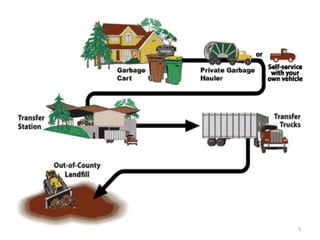
Needs for SW transfer operation
• Collection of house-to-house SW is time
consuming, strenuous, slow speed, holding
capacity of vehicle
• Collection vehicle shall not go for transporting
to the disposal site
• Collection of SW and transportation to
disposal site, two different things, shall not be
combined
10
• If transportation and collection is done by a
truck, major time for collection for one trip,
can’t go for second trip
• Underutilization of high ply load vehicles
• Therefore, necessary to have independent
vehicles for collection and transportation,
hence transfer station is required
11
Objectives of transfer station
• To receive the collected quantity of SW and
make large quantity  loading into
transporting trucks in a short time period
• To relieve collecting vehicles quickly
• To synchronize the receipt and dispatch-
minimum storage facility
• All vehicles always on move-except during
discharge and loading
12
Types of transfer station
• Level site
• Split level site
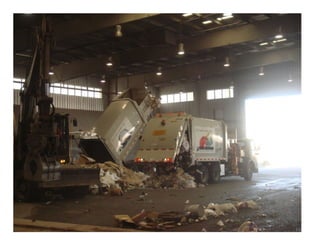
• Level site: Refuse transferred from one vehicle
to another manually. Smaller vehicle unloads
its contents manually transferred. Contents
of hand carts can directly tipped inside
vehicle. Site becomes littered.
13
14
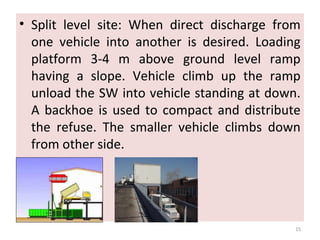
• Split level site: When direct discharge from
one vehicle into another is desired. Loading
platform 3-4 m above ground level ramp
having a slope. Vehicle climb up the ramp
unload the SW into vehicle standing at down.
A backhoe is used to compact and distribute
the refuse. The smaller vehicle climbs down
from other side.
15
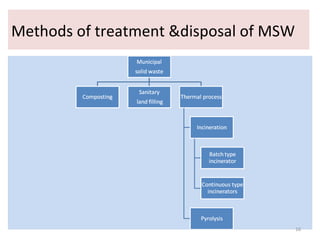
Methods of treatment &disposal of MSW
16
Composting
• Composting is anaerobic and thermophyllic
decomposition of organic matter (OM) by
microorganisms
• OM transformed into stable humus like
substances
• Reaction taking place generates heat,
compost temp. raises during process
17
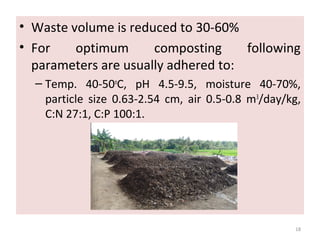
• Waste volume is reduced to 30-60%
• For optimum composting following
parameters are usually adhered to:
– Temp. 40-50o
C, pH 4.5-9.5, moisture 40-70%,
particle size 0.63-2.54 cm, air 0.5-0.8 m3
/day/kg,
C:N 27:1, C:P 100:1.
18
Steps in composting process
1. Separation of refuse into compostable and
non compostable
2. Shredding
3. Blending
4. Digestion
5. Product up-gradation
19
1. Separation of refuse into compostible and
non compostible: SW placed on slow moving
conveyer belt.
Material like corrugated papers are
handpicked and ferrous material by magnetic
separation. The separation of refuse into
compostible and non compostible at source.
2. Shredding: The compostible material is
shredded into small pieces. Sufficient large
area for bacterial action. Size: 20-50 mm.
Hammer mills are used for this purpose
20
3. Blending and composting: Important is C:N. If
it is more than 35 composting is slow.
Optimum C:N is about 1:27, moisture 50%,
temperature 60 o
C.
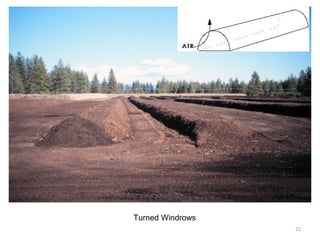
4. Digestion: The mixture are placed in
windrows for 4-6 weeks, turning once or twice
week. Waste is decomposed by thermophyllic
MO.
5. Product up-gradation: Product is up gradated
by operation such as curing, grinding,
screening, palatalizing and bagging.
21
Turned Windrows
22
Sanitary landfilling
• What it is?
• Ideal sanitary landfill site criteria
• Construction
• Reaction
• Advantages
• Disadvantages
23
Sanitary landfilling
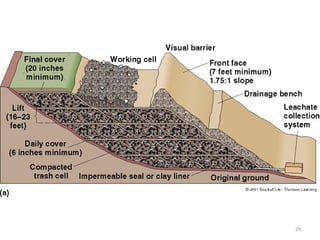
• A method of disposal of refuse on land
without creating nuisance or hazardous to
public health or safety by utilizing the
principles of engineering to confine the refuse
into smallest particle area, to reduce it to
smallest particle volume, and to cover it with
a layer of earth at the conclusion of each days
operation, or at such more frequent intervals
as may be necessary.
24
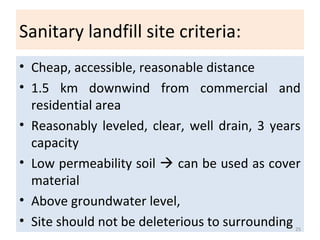
Sanitary landfill site criteria:
• Cheap, accessible, reasonable distance
• 1.5 km downwind from commercial and
residential area
• Reasonably leveled, clear, well drain, 3 years
capacity
• Low permeability soil  can be used as cover
material
• Above groundwater level,
• Site should not be deleterious to surrounding 25
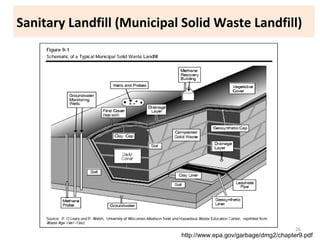
http://www.epa.gov/garbage/dmg2/chapter9.pdf
Sanitary Landfill (Municipal Solid Waste Landfill)
26
27
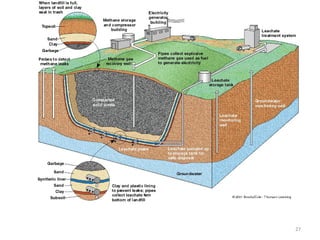
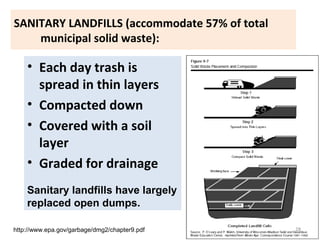
SANITARY LANDFILLS (accommodate 57% of total
municipal solid waste):
• Each day trash is
spread in thin layers
• Compacted down
• Covered with a soil
layer
• Graded for drainage
http://www.epa.gov/garbage/dmg2/chapter9.pdf
Sanitary landfills have largely
replaced open dumps.
28
29
Thank you
30

Waste 2

  • 1.
    Environmental Management Solid andHazardous Waste Management 1 R K Kamble Department of Environmental Science S P College, Chandrapur, Maharashtra e-mail: rahulkk41279@yahoo.com
  • 2.
    What we havestudied so far? • Definition of solid waste (SW) • Sources • Classification • Characteristics 2
  • 3.
    Objective of thislecture • Factors affecting SW generation rate • Handling and separation of SW • Methods of collection • Need of transfer station • Types of transfer station 3
  • 4.
    Factors affecting SWgeneration rate • Geographical locations • Season of the year • Cultural factor • Characteristics of population • Extent of salvaging and recyling • Public attitude 4
  • 5.
  • 6.
    Handling and separationof SW • Prevent waste material from coming in direct contact with wind or rain – Cover with a permanent roof – If not possible, with temporary covering material viz. reinforced tarpaulin, polythene, polyurethane, polypropylene etc. – Cover dumpsters to prevent rain from washing out waste materials 6
  • 7.
    • Design wastehandling and disposal area to prevent storm water runoff – Enclose waste handling and disposal area or built burm around it – Position roof downspouts to direct storm water away from waste handling and disposal area • Design area such a way to contain spills – Place dumpsters or other receptacles on an impervious surface – Construct a berm around the area to contain spills 7
  • 8.
    • Keep wastecollection area clean – Use dry method of cleaning e.g. sweeping, absorbents – If water needs to be used, collect wastewater and discharge to the sewer • Label and store hazardous waste according to regulation • Solid waste may be separated as dry and wet • Glass-injurious to humans-separate at source • While handling solid waste it should not pollute other area 8
  • 9.
    Methods of collectionof SW • House to house collection • Curb service • Alley service • Set out service • Set out, set back • Backyard service • Block collection • Community bin 9
  • 10.
    Needs for SWtransfer operation • Collection of house-to-house SW is time consuming, strenuous, slow speed, holding capacity of vehicle • Collection vehicle shall not go for transporting to the disposal site • Collection of SW and transportation to disposal site, two different things, shall not be combined 10
  • 11.
    • If transportationand collection is done by a truck, major time for collection for one trip, can’t go for second trip • Underutilization of high ply load vehicles • Therefore, necessary to have independent vehicles for collection and transportation, hence transfer station is required 11
  • 12.
    Objectives of transferstation • To receive the collected quantity of SW and make large quantity  loading into transporting trucks in a short time period • To relieve collecting vehicles quickly • To synchronize the receipt and dispatch- minimum storage facility • All vehicles always on move-except during discharge and loading 12
  • 13.
    Types of transferstation • Level site • Split level site • Level site: Refuse transferred from one vehicle to another manually. Smaller vehicle unloads its contents manually transferred. Contents of hand carts can directly tipped inside vehicle. Site becomes littered. 13
  • 14.
  • 15.
    • Split levelsite: When direct discharge from one vehicle into another is desired. Loading platform 3-4 m above ground level ramp having a slope. Vehicle climb up the ramp unload the SW into vehicle standing at down. A backhoe is used to compact and distribute the refuse. The smaller vehicle climbs down from other side. 15
  • 16.
    Methods of treatment&disposal of MSW 16
  • 17.
    Composting • Composting isanaerobic and thermophyllic decomposition of organic matter (OM) by microorganisms • OM transformed into stable humus like substances • Reaction taking place generates heat, compost temp. raises during process 17
  • 18.
    • Waste volumeis reduced to 30-60% • For optimum composting following parameters are usually adhered to: – Temp. 40-50o C, pH 4.5-9.5, moisture 40-70%, particle size 0.63-2.54 cm, air 0.5-0.8 m3 /day/kg, C:N 27:1, C:P 100:1. 18
  • 19.
    Steps in compostingprocess 1. Separation of refuse into compostable and non compostable 2. Shredding 3. Blending 4. Digestion 5. Product up-gradation 19
  • 20.
    1. Separation ofrefuse into compostible and non compostible: SW placed on slow moving conveyer belt. Material like corrugated papers are handpicked and ferrous material by magnetic separation. The separation of refuse into compostible and non compostible at source. 2. Shredding: The compostible material is shredded into small pieces. Sufficient large area for bacterial action. Size: 20-50 mm. Hammer mills are used for this purpose 20
  • 21.
    3. Blending andcomposting: Important is C:N. If it is more than 35 composting is slow. Optimum C:N is about 1:27, moisture 50%, temperature 60 o C. 4. Digestion: The mixture are placed in windrows for 4-6 weeks, turning once or twice week. Waste is decomposed by thermophyllic MO. 5. Product up-gradation: Product is up gradated by operation such as curing, grinding, screening, palatalizing and bagging. 21
  • 22.
  • 23.
    Sanitary landfilling • Whatit is? • Ideal sanitary landfill site criteria • Construction • Reaction • Advantages • Disadvantages 23
  • 24.
    Sanitary landfilling • Amethod of disposal of refuse on land without creating nuisance or hazardous to public health or safety by utilizing the principles of engineering to confine the refuse into smallest particle area, to reduce it to smallest particle volume, and to cover it with a layer of earth at the conclusion of each days operation, or at such more frequent intervals as may be necessary. 24
  • 25.
    Sanitary landfill sitecriteria: • Cheap, accessible, reasonable distance • 1.5 km downwind from commercial and residential area • Reasonably leveled, clear, well drain, 3 years capacity • Low permeability soil  can be used as cover material • Above groundwater level, • Site should not be deleterious to surrounding 25
  • 26.
  • 27.
  • 28.
    SANITARY LANDFILLS (accommodate57% of total municipal solid waste): • Each day trash is spread in thin layers • Compacted down • Covered with a soil layer • Graded for drainage http://www.epa.gov/garbage/dmg2/chapter9.pdf Sanitary landfills have largely replaced open dumps. 28
  • 29.
  • 30.

Editor's Notes

  • #23 The frequency of turning is determined by the ratio of oxygen available to oxygen demand. This is often compromised between need and economic feasibility. The nature of the material including its structural strength and moisture content also determine the frequency. Also the frequency will be determined by the rapidity of decomposition desired. In most cases the rate of composting is directly proportional to frequency of turning.  If the composting mass turns anaerobic and gives off vile odours, it generally requires further turning. Excessive moisture is usually the cause of anaerobiosis. Increasing the frequency of turning to at least once a day results in the disappearance of the odours as it fosters evaporation.