• Vision
– A sustainable world where our natural environment is preserved.
• Mission
– To reduce waste, promote the management of all materials to their
highest and best use.
• Objective
– To encourage the recycling and reuse of C&D debris and inert debris
that may otherwise be disposed in a solid waste disposal facility.
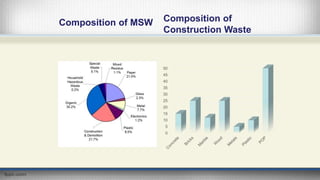
Composition of MSW Composition of
Construction Waste
0
5
10
15
20
25
30
35
40
45
50
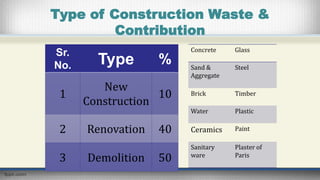
Type of Construction Waste &
Contribution
Sr.
No. Type %
1
New
Construction
10
2 Renovation 40
3 Demolition 50
Concrete Glass
Sand &
Aggregate
Steel
Brick Timber
Water Plastic
Ceramics Paint
Sanitary
ware
Plaster of
Paris
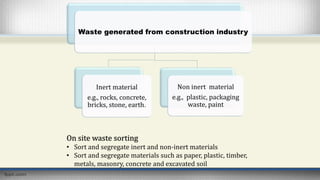
Waste generated from construction industry
Inert material
e.g., rocks, concrete,
bricks, stone, earth.
Non inert material
e.g., plastic, packaging
waste, paint
On site waste sorting
• Sort and segregate inert and non-inert materials
• Sort and segregate materials such as paper, plastic, timber,
metals, masonry, concrete and excavated soil
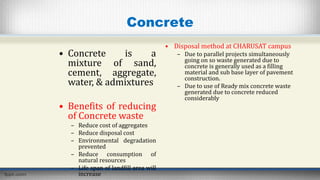
Concrete
• Concrete is a
mixture of sand,
cement, aggregate,
water, & admixtures
• Benefits of reducing
of Concrete waste
– Reduce cost of aggregates
– Reduce disposal cost
– Environmental degradation
prevented
– Reduce consumption of
natural resources
– Life span of landfill area will
increase
• Disposal method at CHARUSAT campus
– Due to parallel projects simultaneously
going on so waste generated due to
concrete is generally used as a filling
material and sub base layer of pavement
construction.
– Due to use of Ready mix concrete waste
generated due to concrete reduced
considerably
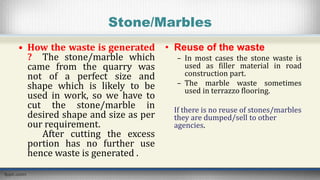
Stone/Marbles
• How the waste is generated
? The stone/marble which
came from the quarry was
not of a perfect size and
shape which is likely to be
used in work, so we have to
cut the stone/marble in
desired shape and size as per
our requirement.
After cutting the excess
portion has no further use
hence waste is generated .
• Reuse of the waste
– In most cases the stone waste is
used as filler material in road
construction part.
– The marble waste sometimes
used in terrazzo flooring.
If there is no reuse of stones/marbles
they are dumped/sell to other
agencies.
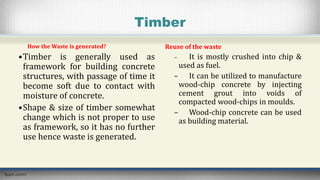
Timber
How the Waste is generated?
•Timber is generally used as
framework for building concrete
structures, with passage of time it
become soft due to contact with
moisture of concrete.
•Shape & size of timber somewhat
change which is not proper to use
as framework, so it has no further
use hence waste is generated.
Reuse of the waste
– It is mostly crushed into chip &
used as fuel.
– It can be utilized to manufacture
wood-chip concrete by injecting
cement grout into voids of
compacted wood-chips in moulds.
– Wood-chip concrete can be used
as building material.
Sand
• How the waste is generated ?
1. The sand which came from the
quarry was not of a perfect size
which is likely to be used in
work, so we have to sieve as per
our requirement.
2. After sieving the remaining
sand has no further use hence
waste is generated.
• Reuse of the waste
1. In most cases the sand waste is
used in road construction.
2. After the use of remaining sand
there is some amount of sand is
mixed with soil so that sand is
useful for garden decoration.
Steel
How steel waste generate ?
1. Most of steel waste is generated
during demolition around 70%
to 80% of all steel waste.
2. Remaining parts of steel rode
during construction stage
3. Due to corrosion
4. Waste in terms of bent Nail
5. Small Pieces of G.I. pipes
Reuse of steel waste
1. For making of stirrup
2. For hidden structure use waste
pieces
Suggestion Given by us
1. Collect at one place & sell for
income.
Brick
How waste generate?
• A brick is a block or a single unit of a
kneaded clay-bearing soil, sand and lime,
or concrete material, fire hardened or air
dried, used in masonary construction
• The Brick Waste is generated in the form
of Bats and Small Pieces
• While loading from the manufacturing
unit to the unloading at the Site , there is
possibility where the Bricks get broken
and turn into bats and the small pieces
• Reuse of the waste
Broken and discraded Bricks can be
used as consturuction infill or as aggregate
for non-structural concrete.
Crushed brick & roof tiles are the
bulk of demolition waste which were
earlier being dumped in landfills , now
they can be recycled into mortar plaster &
building blocks.
Glass
How the Waste Generate?
• Glass Waste is generated in
the form of broken pieces.
• While demolition and
restoration work of any
stucture the glass waste is
generated.
• There is less chance of Glass
waste while any work as care
is taken to remove and place
the Glass , but somehow due
to improper holding and the
handling of the Glass, the
waste is generated.
• Reuse of the waste
• Generally in India the Glass
waste is dumped without taking
any care but the site we visited ,
at that place the authority takes
special care for the disposal of
the Glass which is being sold to
the Junkyard People for the
recycling the Broken , Damaged
Glass.
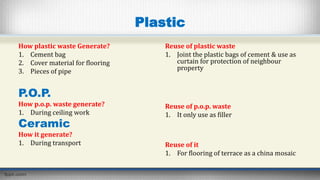
Plastic
How plastic waste Generate?
1. Cement bag
2. Cover material for flooring
3. Pieces of pipe
P.O.P.
How p.o.p. waste generate?
1. During ceiling work
Ceramic
How it generate?
1. During transport
Reuse of plastic waste
1. Joint the plastic bags of cement & use as
curtain for protection of neighbour
property
Reuse of p.o.p. waste
1. It only use as filler
Reuse of it
1. For flooring of terrace as a china mosaic
The important initiatives sited are:
• Promoting separation of C&D waste at source
• Promoting recycling
• Band on land filling of C&D waste
• Developing market for recycled products
• Production of concrete bricks and paving blocks
• Guidelines for using C&D waste
• Developing designs which facilitate ‘deconstruction’ instead
of outright demolition
Conclusion:
• It has been established that materials & components from
demolished buildings are being reused for new construction
works as well as renovation projects, especially by low-income
communities in developing countries like India.
• In developing countries most of the demolition rubble is
dumped, the developed world has now started to recycle it into
aggregate for non-structural concrete.
• It is hoped that recycling waste material for use in the building
will cut down costs of producing new raw materials thereby
reducing consumption of natural resources like energy &
reduces usage of landfills.
Construction and demolition waste

Construction and demolition waste

  • 2.
    • Vision – Asustainable world where our natural environment is preserved. • Mission – To reduce waste, promote the management of all materials to their highest and best use. • Objective – To encourage the recycling and reuse of C&D debris and inert debris that may otherwise be disposed in a solid waste disposal facility.
  • 3.
    Composition of MSWComposition of Construction Waste 0 5 10 15 20 25 30 35 40 45 50
  • 4.
    Type of ConstructionWaste & Contribution Sr. No. Type % 1 New Construction 10 2 Renovation 40 3 Demolition 50 Concrete Glass Sand & Aggregate Steel Brick Timber Water Plastic Ceramics Paint Sanitary ware Plaster of Paris
  • 5.
    Waste generated fromconstruction industry Inert material e.g., rocks, concrete, bricks, stone, earth. Non inert material e.g., plastic, packaging waste, paint On site waste sorting • Sort and segregate inert and non-inert materials • Sort and segregate materials such as paper, plastic, timber, metals, masonry, concrete and excavated soil
  • 6.
    Concrete • Concrete isa mixture of sand, cement, aggregate, water, & admixtures • Benefits of reducing of Concrete waste – Reduce cost of aggregates – Reduce disposal cost – Environmental degradation prevented – Reduce consumption of natural resources – Life span of landfill area will increase • Disposal method at CHARUSAT campus – Due to parallel projects simultaneously going on so waste generated due to concrete is generally used as a filling material and sub base layer of pavement construction. – Due to use of Ready mix concrete waste generated due to concrete reduced considerably
  • 7.
    Stone/Marbles • How thewaste is generated ? The stone/marble which came from the quarry was not of a perfect size and shape which is likely to be used in work, so we have to cut the stone/marble in desired shape and size as per our requirement. After cutting the excess portion has no further use hence waste is generated . • Reuse of the waste – In most cases the stone waste is used as filler material in road construction part. – The marble waste sometimes used in terrazzo flooring. If there is no reuse of stones/marbles they are dumped/sell to other agencies.
  • 8.
    Timber How the Wasteis generated? •Timber is generally used as framework for building concrete structures, with passage of time it become soft due to contact with moisture of concrete. •Shape & size of timber somewhat change which is not proper to use as framework, so it has no further use hence waste is generated. Reuse of the waste – It is mostly crushed into chip & used as fuel. – It can be utilized to manufacture wood-chip concrete by injecting cement grout into voids of compacted wood-chips in moulds. – Wood-chip concrete can be used as building material.
  • 9.
    Sand • How thewaste is generated ? 1. The sand which came from the quarry was not of a perfect size which is likely to be used in work, so we have to sieve as per our requirement. 2. After sieving the remaining sand has no further use hence waste is generated. • Reuse of the waste 1. In most cases the sand waste is used in road construction. 2. After the use of remaining sand there is some amount of sand is mixed with soil so that sand is useful for garden decoration.
  • 10.
    Steel How steel wastegenerate ? 1. Most of steel waste is generated during demolition around 70% to 80% of all steel waste. 2. Remaining parts of steel rode during construction stage 3. Due to corrosion 4. Waste in terms of bent Nail 5. Small Pieces of G.I. pipes Reuse of steel waste 1. For making of stirrup 2. For hidden structure use waste pieces Suggestion Given by us 1. Collect at one place & sell for income.
  • 11.
    Brick How waste generate? •A brick is a block or a single unit of a kneaded clay-bearing soil, sand and lime, or concrete material, fire hardened or air dried, used in masonary construction • The Brick Waste is generated in the form of Bats and Small Pieces • While loading from the manufacturing unit to the unloading at the Site , there is possibility where the Bricks get broken and turn into bats and the small pieces • Reuse of the waste Broken and discraded Bricks can be used as consturuction infill or as aggregate for non-structural concrete. Crushed brick & roof tiles are the bulk of demolition waste which were earlier being dumped in landfills , now they can be recycled into mortar plaster & building blocks.
  • 12.
    Glass How the WasteGenerate? • Glass Waste is generated in the form of broken pieces. • While demolition and restoration work of any stucture the glass waste is generated. • There is less chance of Glass waste while any work as care is taken to remove and place the Glass , but somehow due to improper holding and the handling of the Glass, the waste is generated. • Reuse of the waste • Generally in India the Glass waste is dumped without taking any care but the site we visited , at that place the authority takes special care for the disposal of the Glass which is being sold to the Junkyard People for the recycling the Broken , Damaged Glass.
  • 13.
    Plastic How plastic wasteGenerate? 1. Cement bag 2. Cover material for flooring 3. Pieces of pipe P.O.P. How p.o.p. waste generate? 1. During ceiling work Ceramic How it generate? 1. During transport Reuse of plastic waste 1. Joint the plastic bags of cement & use as curtain for protection of neighbour property Reuse of p.o.p. waste 1. It only use as filler Reuse of it 1. For flooring of terrace as a china mosaic
  • 14.
    The important initiativessited are: • Promoting separation of C&D waste at source • Promoting recycling • Band on land filling of C&D waste • Developing market for recycled products • Production of concrete bricks and paving blocks • Guidelines for using C&D waste • Developing designs which facilitate ‘deconstruction’ instead of outright demolition
  • 15.
    Conclusion: • It hasbeen established that materials & components from demolished buildings are being reused for new construction works as well as renovation projects, especially by low-income communities in developing countries like India. • In developing countries most of the demolition rubble is dumped, the developed world has now started to recycle it into aggregate for non-structural concrete. • It is hoped that recycling waste material for use in the building will cut down costs of producing new raw materials thereby reducing consumption of natural resources like energy & reduces usage of landfills.