Keshav Yadav
Nayan Lokhande
Satwinder Singh
Vivek Yadav
Harpreet Singh
Sources, Types, Composition,
Quantities and Main Elements
in Municipal Solid Waste
(MSW) Management
What Is
Solid
Waste
The term solid
waste means :
Material such as
household
garbage, food
wastes, yard
wastes, and
demolition or
construction
debris
Solid waste are
wastes that are
not liquid or
gaseous
Solid wastes are
all the discarded
solid materials
from municipal,
industrial, and
agricultural
activities
Objective Of Solid Waste
Management
The objective of solid wastes
management to control, collect,
process, dispose of solid wastes
in an economical way consistent
with the public health protection
Definition Of Municipal
Solid Waste (MSW)
Municipal solid waste (MSW) is a
waste type consisting of everyday
items that are discarded by the
public
All wastes, resulting from
population, residential and non
residential buildings, as well as
transport vehicles
Municipal solid waste (MSW)
commonly known as:
trash or garbage
refuse or rubbish
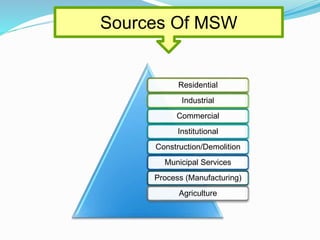
Sources Of MSW
Residential
Industrial
Commercial
Institutional
Construction/Demolition
Municipal Services
Process (Manufacturing)
Agriculture
Type Of
MSW
Industrial
waste
Rubbis
h
Demolitio
n Wastes
Construction
wasteGarbage
Dead
animals
Sewage
treatment
residue
It is estimated that solid waste generated in
small, medium and large cities and towns is
about 0.1 kg, 0.3 – 0.4 kg and 0.5 kg per
capita per day respectively
Total municipal solid waste (MSW) collected in
the country increased every year
The average per capita generation has
increased from 0.67 kg/person/day in 2001 to
0.8 kg/person/day in 2005
In 2008 it is reported increase at 60 – 70 %.
Current MSW generation has reached 1.3
kg/person/day
Quantity Of
Municipal Solid
Waste (MSW) In
Malaysia
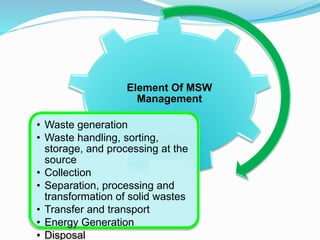
Element Of MSW
Management
• Waste generation
• Waste handling, sorting,
storage, and processing at the
source
• Collection
• Separation, processing and
transformation of solid wastes
• Transfer and transport
• Energy Generation
• Disposal
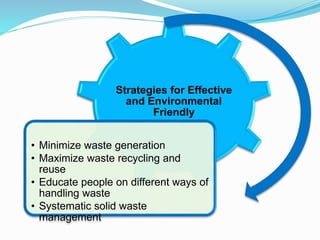
Strategies for Effective
and Environmental
Friendly
• Minimize waste generation
• Maximize waste recycling and
reuse
• Educate people on different ways of
handling waste
• Systematic solid waste
management
Understand The
Characteristics, Composition
and Components of Municipal
Solid Waste (MSW)
Characteristi
c of MSW
Physical
Characteristic
Moisture content :
increase the weight of
solid waste , so the cost
of collection &
transportation will
increasing
Density : used to assess
volume of transportation
vehicle & size of the
disposal facility
Chemical
Characteristic
is essential in
understanding the
behavior of waste all
through the waste
management system
and also in selecting and
determining the
efficiency of any
treatment process
Composition Components
Understand The Process of
Generation and Handling of
Municipal Solid Waste
(MSW))
Waste Generation
Waste generation include activities in which material
identified as no longer being of value and are either
thrown away or gathered together for disposal.
Collection
Elements of collection, includes not only the gathering
of solid waste and recyclable material, but also the
transport of these materials after collection, to the
location where the collection vehicle is emptied.
Factor Influence Generation of
MSW
 Socio-economic background:
 The buying power
 Income level
 Cultural background
 Locality:
 Urban
 Rural setting
Handling and Separating
Municipal Solid Waste
 Waste handling and separation involves activities
associated with waste management until the waste is
placed in storage containers for collection.
 Handling also include the movement of loaded
containers to the point of collection. Separating
different types of waste components is an important
step in the handling and storage of solid waste at the
source.
Understand The Municipal
Solid Waste (MSW)
Collection Activities)
Collection Activities
 The most common collection services are curb/alley,
set out/set back pickup, and backyard pickup.
 The collection services provided to large apartment
buildings, residential complexes, commercial and
industrial activities typically in centered around the
use of large movable and stationary containers and
large stationary compactors.
Curb or Alley Pickup
 The quickest and most economical point of collection.
 Using standard container that has been design by city
council.
Set-out, Set-back Pickup
 Collectors have to enter property.
 Set out crew carries full containers from resident
storage location to curb/alley before collection vehicle
arrives.
 Set back crew return the container to storage area.
Backyard Pickup
 Usually accomplish by the use of tote barrels.
 The collector enter the resident’s property, dumps the
container into a tote barrel, carries it to the trucks and
dumps it.
Transfer and Transport
 Transfer and transport refers to the facilities used to
transfer of wastes from one location to another.
- Small collection vehicles are transferred to larger
vehicles that are used to transport the waste over
extended distances to disposal sites.
Understand The Various Kinds
of MSW Disposal Methods
Such as Land Filling,
Incineration and Organic
MSW Composting
Sanitary Land Filling
 The controlled disposal of solid
waste on the upper layer of the
earth mantle in a manner the
environmental hazards is
minimized.
 Important technical aspects in the
implementation of sanitary landfills
include:
 Site selection.
 Land filling methods and
operation.
 Occurrence of gasses and
leachate.
 Movement and control of gases
and leachate.
Incineration
•The process of burning waste in large
furnaces at high temperature is know
as incineration.
•It is used to dispose of solid liquid and
gaseous waste .Incineration facilities
generally do not require as much area
as landfills.
•At the end of the process all that is
left behind is ash.
Incinerators System
Composting
 Compost Is the product resulting from the
controlled biological decomposition of organic
material.
 The starting material for composting are
commonly referred to a feed stocks
Explain the environmental, social , economical,
and political information available for municipal
solid waste (MSW)
a)The disposal site shall be capable of being characterized
, modeled, analyzed and monitored.
b)The disposal site shall be generally well drained and free
of areas of flooding or frequent bonding.
c)Depend on the type of accommodation, terrace houses ,
flats , commercial area or factories
d)Collection service route
Effect of incineration sanitary landfill and
composting to the environment
 Release hundreds of toxic chemicals into the
atmosphere;
 Disposal of the ash (The toxic substance are more
concentrated in the ash);
 Highly related to the economic condition;
 A classic short-term solution potentially useful
(recyclable or compostable) (it destroys material by
turning it into toxic ash);
Know 4R’s Concept and Justify
Aspects and Issues related to
recycling and composting of
municipal solid waste (MSW)
Describe waste reduction ,reuse, recovery and
recycling concepts.
 Method of waste reduction, waste reuse, and
recycling are the preferred options when
managing waste.
 4R’s stand for:
 Reduction
 Reuse
 Recovery
 Recycling
Reduction
• By reducing, consumer and industry can save natural
resources and reduce waste management costs.
Reuse
• Large production companies such as Electronic, appliances
and gadgets, should establish the collection centre, where
damaged items can be repaired and reuse.
Recovery
• Energy or material can be recovered from waste that are not
reused or recycled
Recycling
• Recycling turns materials that would otherwise become waste
into valuable resources
Identify the impact of reuse /recycle/
reduction on landfill design and operation.
 saves natural resources.
 reduces toxicity of waste.
 reduce cost.
 helps sustain the environment for future
generations.
 reduces the need for land filling and
incineration.
Explain on conventional and innovative
waste utilization /recycling technologies.
1.Conventional
Two types of composting process:
1. Aerobic composting
2. Anaerobic composting
Factor that influence Aerobic composting process :
i. Particle size 25 to 75mm for the optimum chemical reaction to occur
ii. The ratio of C:N (Carbon to nitrogen ratio)
iii. Moisture content should be in the range 50-60%
iv. Temperature the optimum temperature for the composting process is 50 to 70˚C
v. PH control the optimum for micro activity is 6.5-7.5 to prevent loss of nitrogen as ammonia (NH₃) gas , pH
should not exceed 8.5
vi. Mixing process to prevent dehydration on the surface of the compost
vii. Air requirements
2.Innovative
i. Will improve public health and safely achieve
ii. Non-toxic gases, which are created, are stored in special containers (gas cylinders) and used as fuel and
energy creators.
iii. Method takes place in a close system, without releasing ashes, waste remnants, dusts and toxic gases into
environment.
CASE STUDY :
• Garbage
collecting is
not follow
work
schedule
especially
involves
area
housing
CAUSES
ACTION
RESIDENT
S IN THE
AREA
cause the
occupants had to
take the easy way
to remove the
debris and solid
waste in open
areas, including
the roadside and
at major
crossroads on the
road
remove debris and
solid waste in
open area away
from the house
This Is because
garbage and solid
waste loaded in
the barrel, in front
of their homes are
full
THE EFFECTS
animals eat like cats and dogs, garbage lifted late in the barrel at
the front door of his house will be wormy and rotten and then
overflowing into the road shoulder.
not lasting the nauseating smell that permeates the house, every
time you open the door until cause of the health and appetite.
experiencing severe odor pollution as wormy and rotting garbage
in the trash lifted by garbage trucks.
Waste water overflowing from the truck in the road surface.
Affected neighborhoods wedding
contaminate views
raises displeasure
Impacts of
solid waste on
environment
Waste breaks down in
landfills to form
methane, a potent
greenhouse gas
Change in climate
and destruction of
ozone layer due to
waste biodegradable
Garbage disposal,
due to waste
pollutions, illegal
dumping, leaching : is
a process by which
solid waste enter soil
and ground water and
contaminating them
Impacts
of solid
waste
on
health
Nausea and
vomiting
Low birth
weight
Cancer
Chemical
poisoning
through
chemical
inhalation
Increase in
hospitalization
of diabetic
residents
living near
hazard waste
sites
Mercury
toxicity from
eating fish
with high
levels of
mercury
Population
growth
Increase in
industrials
manufacturing
Urbanization
Causes of
increase in
solid waste
Preventive measures
Systematic solid waste management
Involving public in plans for waste
treatment and disposal
Educate people on different ways of
handling waste
Household level of proper segregation of
waste, recycling and reuse
Process and product substitution example
use paper bag instead of plastic bags
garbage collection according to the
schedule set
References
Internet
Wikipedia. Municipal Solid Waste. September 19,
2013, from
http://en.wikipedia.org/wiki/Municipal_solid_waste

Solid waste management with animation

  • 1.
    Keshav Yadav Nayan Lokhande SatwinderSingh Vivek Yadav Harpreet Singh
  • 3.
    Sources, Types, Composition, Quantitiesand Main Elements in Municipal Solid Waste (MSW) Management
  • 4.
    What Is Solid Waste The termsolid waste means : Material such as household garbage, food wastes, yard wastes, and demolition or construction debris Solid waste are wastes that are not liquid or gaseous Solid wastes are all the discarded solid materials from municipal, industrial, and agricultural activities
  • 5.
    Objective Of SolidWaste Management The objective of solid wastes management to control, collect, process, dispose of solid wastes in an economical way consistent with the public health protection
  • 6.
    Definition Of Municipal SolidWaste (MSW) Municipal solid waste (MSW) is a waste type consisting of everyday items that are discarded by the public All wastes, resulting from population, residential and non residential buildings, as well as transport vehicles Municipal solid waste (MSW) commonly known as: trash or garbage refuse or rubbish
  • 7.
  • 8.
  • 9.
    It is estimatedthat solid waste generated in small, medium and large cities and towns is about 0.1 kg, 0.3 – 0.4 kg and 0.5 kg per capita per day respectively Total municipal solid waste (MSW) collected in the country increased every year The average per capita generation has increased from 0.67 kg/person/day in 2001 to 0.8 kg/person/day in 2005 In 2008 it is reported increase at 60 – 70 %. Current MSW generation has reached 1.3 kg/person/day Quantity Of Municipal Solid Waste (MSW) In Malaysia
  • 10.
    Element Of MSW Management •Waste generation • Waste handling, sorting, storage, and processing at the source • Collection • Separation, processing and transformation of solid wastes • Transfer and transport • Energy Generation • Disposal
  • 11.
    Strategies for Effective andEnvironmental Friendly • Minimize waste generation • Maximize waste recycling and reuse • Educate people on different ways of handling waste • Systematic solid waste management
  • 12.
    Understand The Characteristics, Composition andComponents of Municipal Solid Waste (MSW)
  • 13.
    Characteristi c of MSW Physical Characteristic Moisturecontent : increase the weight of solid waste , so the cost of collection & transportation will increasing Density : used to assess volume of transportation vehicle & size of the disposal facility Chemical Characteristic is essential in understanding the behavior of waste all through the waste management system and also in selecting and determining the efficiency of any treatment process
  • 14.
  • 15.
    Understand The Processof Generation and Handling of Municipal Solid Waste (MSW))
  • 16.
    Waste Generation Waste generationinclude activities in which material identified as no longer being of value and are either thrown away or gathered together for disposal.
  • 17.
    Collection Elements of collection,includes not only the gathering of solid waste and recyclable material, but also the transport of these materials after collection, to the location where the collection vehicle is emptied.
  • 18.
    Factor Influence Generationof MSW  Socio-economic background:  The buying power  Income level  Cultural background  Locality:  Urban  Rural setting
  • 19.
    Handling and Separating MunicipalSolid Waste  Waste handling and separation involves activities associated with waste management until the waste is placed in storage containers for collection.  Handling also include the movement of loaded containers to the point of collection. Separating different types of waste components is an important step in the handling and storage of solid waste at the source.
  • 20.
    Understand The Municipal SolidWaste (MSW) Collection Activities)
  • 21.
    Collection Activities  Themost common collection services are curb/alley, set out/set back pickup, and backyard pickup.  The collection services provided to large apartment buildings, residential complexes, commercial and industrial activities typically in centered around the use of large movable and stationary containers and large stationary compactors.
  • 22.
    Curb or AlleyPickup  The quickest and most economical point of collection.  Using standard container that has been design by city council.
  • 23.
    Set-out, Set-back Pickup Collectors have to enter property.  Set out crew carries full containers from resident storage location to curb/alley before collection vehicle arrives.  Set back crew return the container to storage area.
  • 24.
    Backyard Pickup  Usuallyaccomplish by the use of tote barrels.  The collector enter the resident’s property, dumps the container into a tote barrel, carries it to the trucks and dumps it.
  • 25.
    Transfer and Transport Transfer and transport refers to the facilities used to transfer of wastes from one location to another. - Small collection vehicles are transferred to larger vehicles that are used to transport the waste over extended distances to disposal sites.
  • 26.
    Understand The VariousKinds of MSW Disposal Methods Such as Land Filling, Incineration and Organic MSW Composting
  • 27.
    Sanitary Land Filling The controlled disposal of solid waste on the upper layer of the earth mantle in a manner the environmental hazards is minimized.  Important technical aspects in the implementation of sanitary landfills include:  Site selection.  Land filling methods and operation.  Occurrence of gasses and leachate.  Movement and control of gases and leachate.
  • 28.
    Incineration •The process ofburning waste in large furnaces at high temperature is know as incineration. •It is used to dispose of solid liquid and gaseous waste .Incineration facilities generally do not require as much area as landfills. •At the end of the process all that is left behind is ash.
  • 29.
  • 30.
    Composting  Compost Isthe product resulting from the controlled biological decomposition of organic material.  The starting material for composting are commonly referred to a feed stocks
  • 31.
    Explain the environmental,social , economical, and political information available for municipal solid waste (MSW) a)The disposal site shall be capable of being characterized , modeled, analyzed and monitored. b)The disposal site shall be generally well drained and free of areas of flooding or frequent bonding. c)Depend on the type of accommodation, terrace houses , flats , commercial area or factories d)Collection service route
  • 32.
    Effect of incinerationsanitary landfill and composting to the environment  Release hundreds of toxic chemicals into the atmosphere;  Disposal of the ash (The toxic substance are more concentrated in the ash);  Highly related to the economic condition;  A classic short-term solution potentially useful (recyclable or compostable) (it destroys material by turning it into toxic ash);
  • 33.
    Know 4R’s Conceptand Justify Aspects and Issues related to recycling and composting of municipal solid waste (MSW)
  • 34.
    Describe waste reduction,reuse, recovery and recycling concepts.  Method of waste reduction, waste reuse, and recycling are the preferred options when managing waste.  4R’s stand for:  Reduction  Reuse  Recovery  Recycling
  • 35.
    Reduction • By reducing,consumer and industry can save natural resources and reduce waste management costs. Reuse • Large production companies such as Electronic, appliances and gadgets, should establish the collection centre, where damaged items can be repaired and reuse. Recovery • Energy or material can be recovered from waste that are not reused or recycled Recycling • Recycling turns materials that would otherwise become waste into valuable resources
  • 36.
    Identify the impactof reuse /recycle/ reduction on landfill design and operation.  saves natural resources.  reduces toxicity of waste.  reduce cost.  helps sustain the environment for future generations.  reduces the need for land filling and incineration.
  • 37.
    Explain on conventionaland innovative waste utilization /recycling technologies. 1.Conventional Two types of composting process: 1. Aerobic composting 2. Anaerobic composting Factor that influence Aerobic composting process : i. Particle size 25 to 75mm for the optimum chemical reaction to occur ii. The ratio of C:N (Carbon to nitrogen ratio) iii. Moisture content should be in the range 50-60% iv. Temperature the optimum temperature for the composting process is 50 to 70˚C v. PH control the optimum for micro activity is 6.5-7.5 to prevent loss of nitrogen as ammonia (NH₃) gas , pH should not exceed 8.5 vi. Mixing process to prevent dehydration on the surface of the compost vii. Air requirements 2.Innovative i. Will improve public health and safely achieve ii. Non-toxic gases, which are created, are stored in special containers (gas cylinders) and used as fuel and energy creators. iii. Method takes place in a close system, without releasing ashes, waste remnants, dusts and toxic gases into environment.
  • 38.
  • 39.
    • Garbage collecting is notfollow work schedule especially involves area housing CAUSES
  • 40.
    ACTION RESIDENT S IN THE AREA causethe occupants had to take the easy way to remove the debris and solid waste in open areas, including the roadside and at major crossroads on the road remove debris and solid waste in open area away from the house This Is because garbage and solid waste loaded in the barrel, in front of their homes are full
  • 41.
    THE EFFECTS animals eatlike cats and dogs, garbage lifted late in the barrel at the front door of his house will be wormy and rotten and then overflowing into the road shoulder. not lasting the nauseating smell that permeates the house, every time you open the door until cause of the health and appetite. experiencing severe odor pollution as wormy and rotting garbage in the trash lifted by garbage trucks. Waste water overflowing from the truck in the road surface. Affected neighborhoods wedding contaminate views raises displeasure
  • 42.
    Impacts of solid wasteon environment Waste breaks down in landfills to form methane, a potent greenhouse gas Change in climate and destruction of ozone layer due to waste biodegradable Garbage disposal, due to waste pollutions, illegal dumping, leaching : is a process by which solid waste enter soil and ground water and contaminating them
  • 43.
    Impacts of solid waste on health Nausea and vomiting Lowbirth weight Cancer Chemical poisoning through chemical inhalation Increase in hospitalization of diabetic residents living near hazard waste sites Mercury toxicity from eating fish with high levels of mercury
  • 44.
  • 45.
    Preventive measures Systematic solidwaste management Involving public in plans for waste treatment and disposal Educate people on different ways of handling waste Household level of proper segregation of waste, recycling and reuse Process and product substitution example use paper bag instead of plastic bags garbage collection according to the schedule set
  • 46.
    References Internet Wikipedia. Municipal SolidWaste. September 19, 2013, from http://en.wikipedia.org/wiki/Municipal_solid_waste