INTRODUCTION
Waste management refers to the activities connected with the
collection and disposal of wastes. Waste management
comprises the following activities:
a.) Waste collection
b.) Waste transportation
c.) Waste segregation
d.) Waste recycling
e.) Waste disposal
f.) Waste minimization & control
Objective of study
• The main of objective for our
case study is to determine, to
control, collect, process, dispose
of solid wastes in an economical
way consistent with the public
health protection.
SOURCES OF WASTE
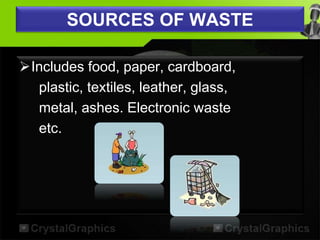
Includes food, paper, cardboard,
plastic, textiles, leather, glass,
metal, ashes. Electronic waste
etc.
Business and Industrial Waste
Includes toxic chemical, oil,
debris from construction site.
packaging waste, ashes, etc.
AGRICULTURE WASTE
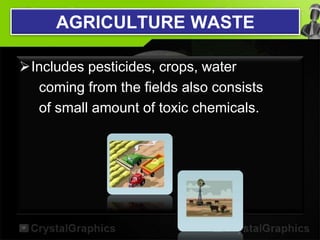
Includes pesticides, crops, water
coming from the fields also consists
of small amount of toxic chemicals.
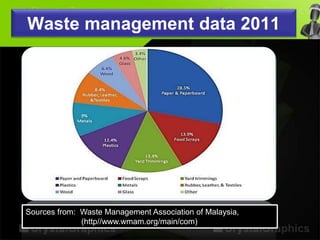
Waste management data 2011
Sources from: Waste Management Association of Malaysia,
(http//www.wmam.org/main/com)
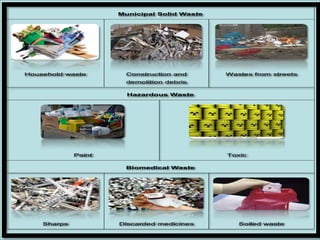
Municipal Solid Waste
Household waste Construction and
demolition debris
Wastes from streets
Hazardous Waste
Paint Toxic
Biomedical Waste
Sharps Discarded medicines Soiled waste
COLLECTING
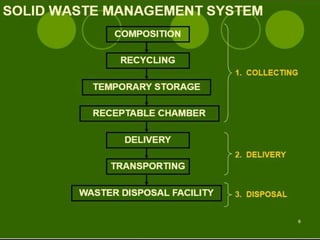
I. In Malaysia, wastes are collected by the local authorities through regular
waste collection or by special collection for recycling such as Alam Flora
Sdn. Bhd. will manage at Kuala Lumpur, Putrajaya, Pahang, Kelantan and
Terengganu.
II. SWM Environment will be conducted at Johor, Malacca and Negeri
Sembilan.
III. Environment Idaman Sdn. Bhd. will be in charge at Selangor, Perak,
Penang, Kedah and Perlis.
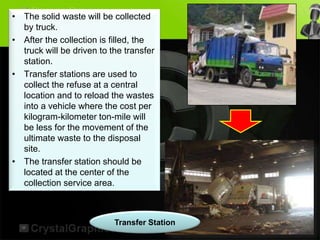
• The solid waste will be collected
by truck.
• After the collection is filled, the
truck will be driven to the transfer
station.
• Transfer stations are used to
collect the refuse at a central
location and to reload the wastes
into a vehicle where the cost per
kilogram-kilometer ton-mile will
be less for the movement of the
ultimate waste to the disposal
site.
• The transfer station should be
located at the center of the
collection service area.
Transfer Station
RECYCLING
• Recycling is a activities includes using a waste material for another
purpose, treating and reusing it in the same process.
• Three types of recycling bins:
1) Blue color only used for paper
2) Brown color used for glass
3) Orange color used for aluminum tins and steel tins
TEMPORARY STORAGE
1. Residential and Public
• An appropriate container should be selected
according to the characteristics of the solid
wastes.
• The characteristic of scheduled wastes shall
be compatible with the type of material used
for the container to prevent any reaction
which will deteriorate the container.
• The quantity of the wastes should be taken
into consideration to estimate the
appropriate size and strength of container to
avoid over spilling or container breakage.
• Usually, all the wastes are deposited
into garbage bins that have been provided
or purchased.
STANDARD OF
RUBBISH BIN
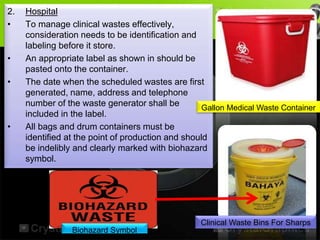
2. Hospital
• To manage clinical wastes effectively,
consideration needs to be identification and
labeling before it store.
• An appropriate label as shown in should be
pasted onto the container.
• The date when the scheduled wastes are first
generated, name, address and telephone
number of the waste generator shall be
included in the label.
• All bags and drum containers must be
identified at the point of production and should
be indelibly and clearly marked with biohazard
symbol.
Gallon Medical Waste Container
Clinical Waste Bins For Sharps
Biohazard Symbol
REFUSE RECEPTACLE CHAMBER
•Refuse receptacle chamber is
construct to kept or placed
receptacles containing solid
wastes.
•Not be kept or placed upon the
street, sidewalk, or other public
place unless such location has
been first approved by the Local
Authority.
•So there is convenient and
safe access for collection
service.
•Provide safe access from any
obstruction to the pick-up point.
•Improper management can give many negative
effects to public also environment:
1) Displeasing to the public either visually or through
odors.
2) Groundwater contamination and air pollution.
REFUSE DELIVERY
SYSTEM
REFUSE DELIVERY SYSTEM
3 types of DELIVERY / OPERATING system
1.GRAVITY (refuse chute – residential)
2.WATER BORNE (waste water pipe network -
grinded items)
3.AIR STREAMS (pneumatic refuse handling
system – vacuum)
REFUSE DELIVERY SYSTEM
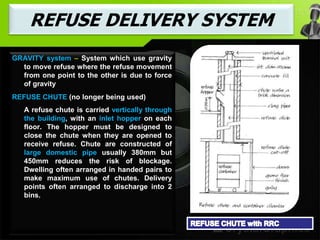
GRAVITY system – System which use gravity
to move refuse where the refuse movement
from one point to the other is due to force
of gravity
REFUSE CHUTE (no longer being used)
A refuse chute is carried vertically through
the building, with an inlet hopper on each
floor. The hopper must be designed to
close the chute when they are opened to
receive refuse. Chute are constructed of
large domestic pipe usually 380mm but
450mm reduces the risk of blockage.
Dwelling often arranged in handed pairs to
make maximum use of chutes. Delivery
points often arranged to discharge into 2
bins.
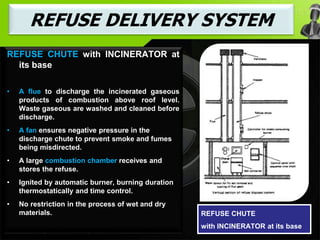
REFUSE CHUTE with INCINERATOR at
its base
• A flue to discharge the incinerated gaseous
products of combustion above roof level.
Waste gaseous are washed and cleaned before
discharge.
• A fan ensures negative pressure in the
discharge chute to prevent smoke and fumes
being misdirected.
• A large combustion chamber receives and
stores the refuse.
• Ignited by automatic burner, burning duration
thermostatically and time control.
• No restriction in the process of wet and dry
materials.
REFUSE DELIVERY SYSTEM
REFUSE CHUTE
with INCINERATOR at its base
WATER BORNE system – system which use water as means of transporting the
refuse. Refuse is deposited into the system and then through a waste pipe
network to a central collection point or waster disposal facility.
SEWER system – food waste is disposed of via the public or private sewer
system as cold water is run into the sink.
The food disposal unit is switched on and food waste is fed into the unit.
The waste falls onto an impeller which revolves at high speed. The food
waste is thrown off the impeller by centrifugal force onto a cutting ring. The
waste is shredded into particles and is carried by the water into the sewer.
The components of the system are:-
a. Food disposal unit
b. Sink or feed hopper with water supply
c. Sewer pipe system
REFUSE DELIVERY SYSTEM
FOOD DISPOSAL UNIT –
SINK GRINDER•Waste grinders / ‘garberators’ comprised
with an electric-powered shredder
•Fitted in the waste pipe of kitchen sink
and can break down food waste so that it
can be flushed into the discharge drain
(40mm waste pipe)
•Not suitable for tins, papers, bottles and
metal waste.
•Care must be taken when sitting and
mounting the grinder to minimize the risk
of noise and for safety reasons.
REFUSE DELIVERY SYSTEM
AIR STREAM system – system that use air streams
to move refuse (pneumatic refuse), which use the blower method
involves the use of compressed air (positive air pressure) to blow
the refuses or vacuum (negative air pressure) to suck waste
through pipe.
REFUSE DELIVERY SYSTEM
REFUSE DELIVERY SYSTEM – pneumatic refuse
With a "Pneumatic waste collection system", waste is carried
through a vacuum-type underground pipe system from each
household to incineration plants or a waste transfer station. This
system was adopted for the first time in Japan in Osaka, as a waste
collection system for high-rise apartments.
REFUSE DELIVERY SYSTEM
PULVERISING
• Grinding (shredder, grinder, crusher, pulveriser)
• To reduce volume
• Neater
COMPACTION
• rolled, broken up
• either in the truck or on the ground
• reduce size remain volume
SCAVENGING
• separators (magnetic, cyclone, vibrator)
• in house required high cost
• encourage recycling
INCINERATION
• Sorting
• combustible material
Scraped motor
vehicle and
metal items are
compressed
and recycled.
Paper and
cardboard can
be shredded
for security,
separated
material is
recycled.
Lubrication oils
must not be
discharged into
drains.
Radioactive
waste requires
long term
storage under
carefully
controlled
conditions.
• Engineered process of Combustion – a flue discharge the incinerated gaseous
products of combustion above roof level
• Fan ensures negative pressure in the discharge chute to prevent smokes and
fumes being misdirected
• Combustion chamber (Oxygen + waste) – ignited by automatic burner – receive
and store refuses
• No restriction on wet and dry materials and glass, metal or plastics may be
processed.
• Duration of burning is thermostatically and time controlled
• Waste gases are washed and cleaned before discharging into the flue - Anti-
pollution devices - smoke separator: scrubber, cyclone cleaner, electrostatic filter
• Hospital, factories application
• Reduce volume, weight
• High cost, explosion possibility uneconomic for wet waste
INCINERATOR
within the building
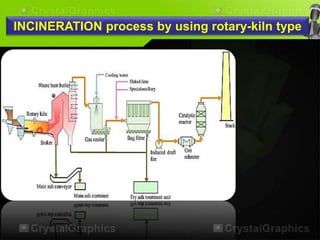
INCINERATION process by using rotary-kiln type
VIDEO
SANITARY LANDFILL
Sanitary landfills are dedicated disposal areas which adopt a
scientific approach to effectively and safely manage and treat waste, thereby
protecting the environment. The Sanitary Landfill is an engineered waste
disposal facility with specific pollution control technologies designed to
minimize potential environmental impacts. New scientific techniques to treat
waste in an environment-friendly way are implemented, guaranteeing
protection of the natural surroundings.
The risk of pollution is also minimized through a strict and
permanent monitoring system. Waste disposal at the Sanitary Landfill is
contained and isolated in a dedicated area, where it is subsequently
compacted and covered with inert materials. After its operating life, the
sanitary landfill will be rehabilitated and reintegrated into its surrounding
environment.
SURROUNDING OF SANITARY LANDFILL
LAYER IN SANITARY LANDFILL
Sanitary landfill – How It Works.
Spreading the waste in
thin layers.
Compacting the waste
layers to reduce its
volume.
Providing a layer of
earth cover to protect
the environment.
CONSTRUCTION LAYER
IN SANITARY LANDFILL
VIDEO
CONCLUSION
WE MUST concern about the side-effects of using each
method such as pollution of groundwater and the air.
Anti-pollution measures are now considered an important
part of any solid waste disposal system.
The major challenge for the future is how to reduce the
amount of solid waste that need to be disposed of and how
to have economic solid waste disposal without polluting
the environment.
THANK YOU

Solid waste management

  • 2.
    INTRODUCTION Waste management refersto the activities connected with the collection and disposal of wastes. Waste management comprises the following activities: a.) Waste collection b.) Waste transportation c.) Waste segregation d.) Waste recycling e.) Waste disposal f.) Waste minimization & control
  • 3.
    Objective of study •The main of objective for our case study is to determine, to control, collect, process, dispose of solid wastes in an economical way consistent with the public health protection.
  • 5.
    SOURCES OF WASTE Includesfood, paper, cardboard, plastic, textiles, leather, glass, metal, ashes. Electronic waste etc.
  • 6.
    Business and IndustrialWaste Includes toxic chemical, oil, debris from construction site. packaging waste, ashes, etc.
  • 7.
    AGRICULTURE WASTE Includes pesticides,crops, water coming from the fields also consists of small amount of toxic chemicals.
  • 8.
    Waste management data2011 Sources from: Waste Management Association of Malaysia, (http//www.wmam.org/main/com)
  • 10.
    Municipal Solid Waste Householdwaste Construction and demolition debris Wastes from streets Hazardous Waste Paint Toxic Biomedical Waste Sharps Discarded medicines Soiled waste
  • 11.
    COLLECTING I. In Malaysia,wastes are collected by the local authorities through regular waste collection or by special collection for recycling such as Alam Flora Sdn. Bhd. will manage at Kuala Lumpur, Putrajaya, Pahang, Kelantan and Terengganu. II. SWM Environment will be conducted at Johor, Malacca and Negeri Sembilan. III. Environment Idaman Sdn. Bhd. will be in charge at Selangor, Perak, Penang, Kedah and Perlis.
  • 12.
    • The solidwaste will be collected by truck. • After the collection is filled, the truck will be driven to the transfer station. • Transfer stations are used to collect the refuse at a central location and to reload the wastes into a vehicle where the cost per kilogram-kilometer ton-mile will be less for the movement of the ultimate waste to the disposal site. • The transfer station should be located at the center of the collection service area. Transfer Station
  • 13.
    RECYCLING • Recycling isa activities includes using a waste material for another purpose, treating and reusing it in the same process. • Three types of recycling bins: 1) Blue color only used for paper 2) Brown color used for glass 3) Orange color used for aluminum tins and steel tins
  • 14.
    TEMPORARY STORAGE 1. Residentialand Public • An appropriate container should be selected according to the characteristics of the solid wastes. • The characteristic of scheduled wastes shall be compatible with the type of material used for the container to prevent any reaction which will deteriorate the container. • The quantity of the wastes should be taken into consideration to estimate the appropriate size and strength of container to avoid over spilling or container breakage. • Usually, all the wastes are deposited into garbage bins that have been provided or purchased. STANDARD OF RUBBISH BIN
  • 15.
    2. Hospital • Tomanage clinical wastes effectively, consideration needs to be identification and labeling before it store. • An appropriate label as shown in should be pasted onto the container. • The date when the scheduled wastes are first generated, name, address and telephone number of the waste generator shall be included in the label. • All bags and drum containers must be identified at the point of production and should be indelibly and clearly marked with biohazard symbol. Gallon Medical Waste Container Clinical Waste Bins For Sharps Biohazard Symbol
  • 16.
    REFUSE RECEPTACLE CHAMBER •Refusereceptacle chamber is construct to kept or placed receptacles containing solid wastes. •Not be kept or placed upon the street, sidewalk, or other public place unless such location has been first approved by the Local Authority. •So there is convenient and safe access for collection service. •Provide safe access from any obstruction to the pick-up point.
  • 17.
    •Improper management cangive many negative effects to public also environment: 1) Displeasing to the public either visually or through odors. 2) Groundwater contamination and air pollution.
  • 18.
  • 19.
    REFUSE DELIVERY SYSTEM 3types of DELIVERY / OPERATING system 1.GRAVITY (refuse chute – residential) 2.WATER BORNE (waste water pipe network - grinded items) 3.AIR STREAMS (pneumatic refuse handling system – vacuum)
  • 20.
    REFUSE DELIVERY SYSTEM GRAVITYsystem – System which use gravity to move refuse where the refuse movement from one point to the other is due to force of gravity REFUSE CHUTE (no longer being used) A refuse chute is carried vertically through the building, with an inlet hopper on each floor. The hopper must be designed to close the chute when they are opened to receive refuse. Chute are constructed of large domestic pipe usually 380mm but 450mm reduces the risk of blockage. Dwelling often arranged in handed pairs to make maximum use of chutes. Delivery points often arranged to discharge into 2 bins.
  • 21.
    REFUSE CHUTE withINCINERATOR at its base • A flue to discharge the incinerated gaseous products of combustion above roof level. Waste gaseous are washed and cleaned before discharge. • A fan ensures negative pressure in the discharge chute to prevent smoke and fumes being misdirected. • A large combustion chamber receives and stores the refuse. • Ignited by automatic burner, burning duration thermostatically and time control. • No restriction in the process of wet and dry materials. REFUSE DELIVERY SYSTEM REFUSE CHUTE with INCINERATOR at its base
  • 22.
    WATER BORNE system– system which use water as means of transporting the refuse. Refuse is deposited into the system and then through a waste pipe network to a central collection point or waster disposal facility. SEWER system – food waste is disposed of via the public or private sewer system as cold water is run into the sink. The food disposal unit is switched on and food waste is fed into the unit. The waste falls onto an impeller which revolves at high speed. The food waste is thrown off the impeller by centrifugal force onto a cutting ring. The waste is shredded into particles and is carried by the water into the sewer. The components of the system are:- a. Food disposal unit b. Sink or feed hopper with water supply c. Sewer pipe system REFUSE DELIVERY SYSTEM
  • 23.
    FOOD DISPOSAL UNIT– SINK GRINDER•Waste grinders / ‘garberators’ comprised with an electric-powered shredder •Fitted in the waste pipe of kitchen sink and can break down food waste so that it can be flushed into the discharge drain (40mm waste pipe) •Not suitable for tins, papers, bottles and metal waste. •Care must be taken when sitting and mounting the grinder to minimize the risk of noise and for safety reasons. REFUSE DELIVERY SYSTEM
  • 24.
    AIR STREAM system– system that use air streams to move refuse (pneumatic refuse), which use the blower method involves the use of compressed air (positive air pressure) to blow the refuses or vacuum (negative air pressure) to suck waste through pipe. REFUSE DELIVERY SYSTEM
  • 25.
    REFUSE DELIVERY SYSTEM– pneumatic refuse With a "Pneumatic waste collection system", waste is carried through a vacuum-type underground pipe system from each household to incineration plants or a waste transfer station. This system was adopted for the first time in Japan in Osaka, as a waste collection system for high-rise apartments. REFUSE DELIVERY SYSTEM
  • 27.
    PULVERISING • Grinding (shredder,grinder, crusher, pulveriser) • To reduce volume • Neater COMPACTION • rolled, broken up • either in the truck or on the ground • reduce size remain volume SCAVENGING • separators (magnetic, cyclone, vibrator) • in house required high cost • encourage recycling INCINERATION • Sorting • combustible material
  • 28.
    Scraped motor vehicle and metalitems are compressed and recycled. Paper and cardboard can be shredded for security, separated material is recycled. Lubrication oils must not be discharged into drains. Radioactive waste requires long term storage under carefully controlled conditions.
  • 29.
    • Engineered processof Combustion – a flue discharge the incinerated gaseous products of combustion above roof level • Fan ensures negative pressure in the discharge chute to prevent smokes and fumes being misdirected • Combustion chamber (Oxygen + waste) – ignited by automatic burner – receive and store refuses • No restriction on wet and dry materials and glass, metal or plastics may be processed. • Duration of burning is thermostatically and time controlled • Waste gases are washed and cleaned before discharging into the flue - Anti- pollution devices - smoke separator: scrubber, cyclone cleaner, electrostatic filter • Hospital, factories application • Reduce volume, weight • High cost, explosion possibility uneconomic for wet waste
  • 30.
  • 31.
    INCINERATION process byusing rotary-kiln type
  • 33.
  • 34.
    SANITARY LANDFILL Sanitary landfillsare dedicated disposal areas which adopt a scientific approach to effectively and safely manage and treat waste, thereby protecting the environment. The Sanitary Landfill is an engineered waste disposal facility with specific pollution control technologies designed to minimize potential environmental impacts. New scientific techniques to treat waste in an environment-friendly way are implemented, guaranteeing protection of the natural surroundings. The risk of pollution is also minimized through a strict and permanent monitoring system. Waste disposal at the Sanitary Landfill is contained and isolated in a dedicated area, where it is subsequently compacted and covered with inert materials. After its operating life, the sanitary landfill will be rehabilitated and reintegrated into its surrounding environment.
  • 35.
  • 36.
  • 37.
    Sanitary landfill –How It Works. Spreading the waste in thin layers. Compacting the waste layers to reduce its volume. Providing a layer of earth cover to protect the environment.
  • 38.
  • 39.
  • 40.
    CONCLUSION WE MUST concernabout the side-effects of using each method such as pollution of groundwater and the air. Anti-pollution measures are now considered an important part of any solid waste disposal system. The major challenge for the future is how to reduce the amount of solid waste that need to be disposed of and how to have economic solid waste disposal without polluting the environment.
  • 41.