Problems of Air Pollution
Rahul Kambe
Objectives
• Smoke
• Smog
• Reactions in fog formation
• Air pollution episodes
• London smog
• Los Angeles smog
How smoke is formed?
Smog
• Smog = Smoke + Fog
• Oxidizing smog or photochemical smog
• The mixture of smoke + fog is characterized by
presence of SO2  reducing smog or
sulphorous smog
Smog forming reactions
• Hydrocarbons from number of chemical and
photochemical reactions  noxious secondary
pollutant and intermediates photochemical
smog.
• Photochemical reactions of Methane (CH4)
CH4 + O  H3C• [alkyl (methyl) radical] + HO•
(hydroxyl radical)
• H3C• + O2 + M (energy-absorbing third body,
usually a molecule of N2 or O2)  H3COO•
(methyl peroxyl radical) + M
• Such radicals participate in a variety of
subsequent chain reactionssmog formation.
• CH4 + HO• (hydroxyl radical)  H3C• (methyl
radical) + H2O
• H3COO• (methyl peroxyl radical) + NO 
H3CO• + NO2
• VOCs + NOx + sunlight Photochemical smog
Air pollution episodes
Location Date Pollutants Effects
Meuse valley,
Belgium
Dec. 1930 SO2 63 excess deaths
Donora PA,
USA
Oct. 1948 SO2 20 deaths
Poza Rica,
Mexico
Nov. 1950 H2S 22 excess deaths
London Dec. 1952 SO2 4000 excess deaths
New York Nov. 1966 SO2 168 deaths
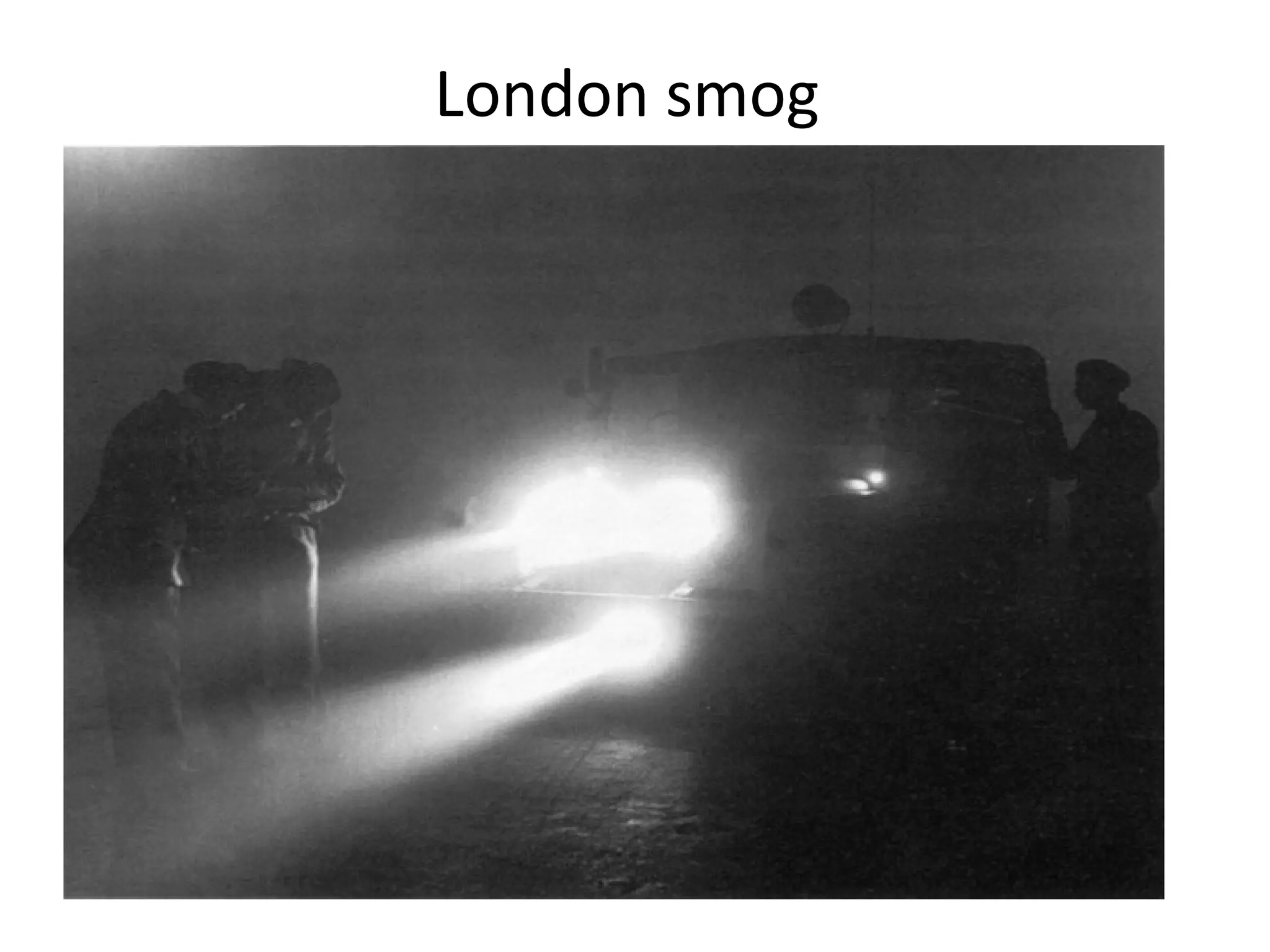
London Smog
• December 5-9, 1952
• Damp and foggy condition in winter, subsidence
inversion
• Fuel use was maximum and air near stagnant
• A white fog was formed
• Coal as a source of fuel for space heating and
electricity production (Sulphur, 1.5%)
• White fog  black fog
• Smoke conc. during fog was five times higher
• SO2 conc. was six times than usual level
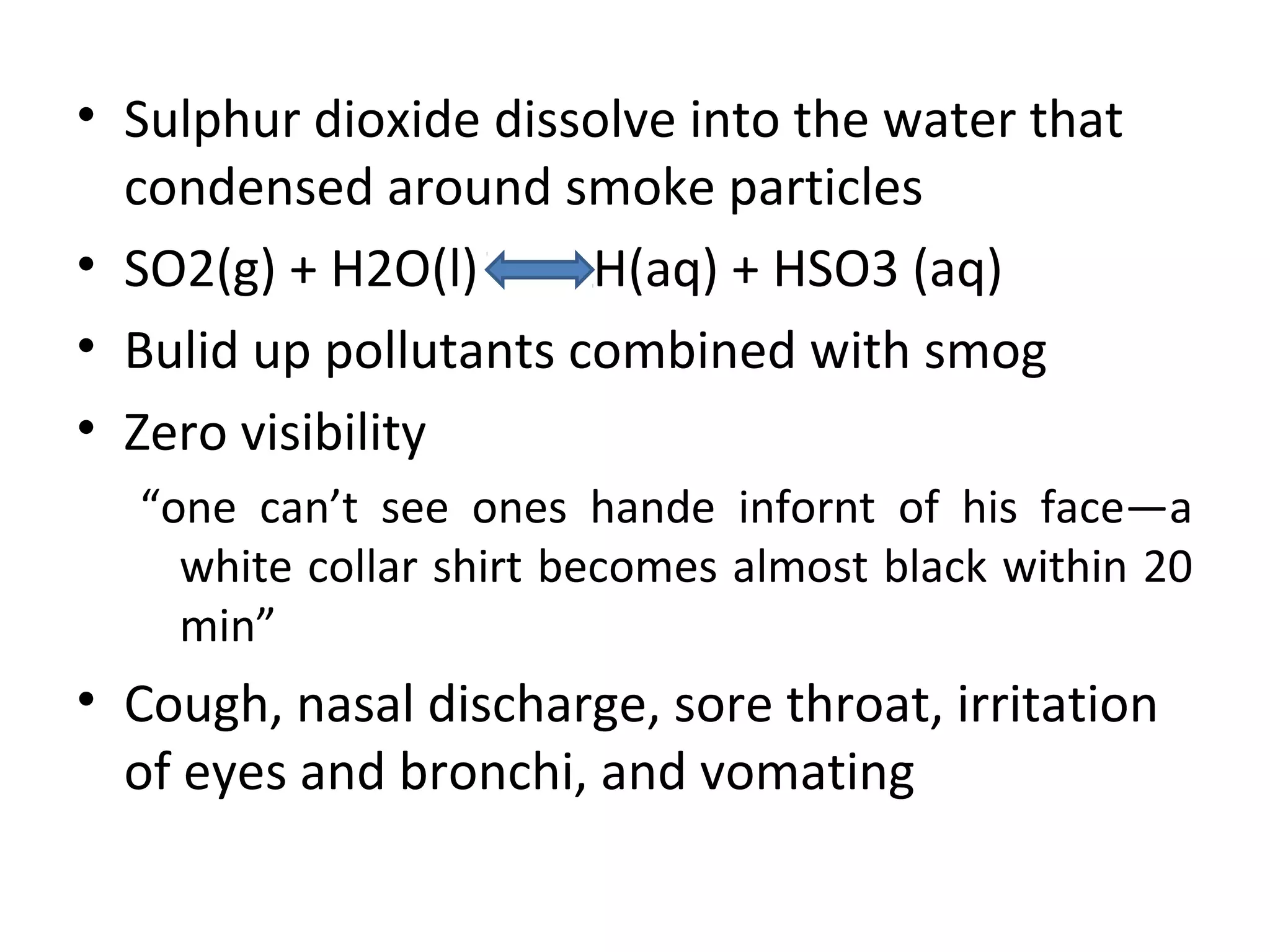
• Sulphur dioxide dissolve into the water that
condensed around smoke particles
• SO2(g) + H2O(l) H(aq) + HSO3 (aq)
• Bulid up pollutants combined with smog
• Zero visibility
“one can’t see ones hande infornt of his face—a
white collar shirt becomes almost black within 20
min”
• Cough, nasal discharge, sore throat, irritation
of eyes and bronchi, and vomating
• Casualties of 4000 people
• Died were of old age and history of chronic
bronchitis, asthma, bronco-pneumonia and
other lung and heart diseases
• Similar but mild air pollution episodes had
occurred previously Dec. 1873, Jan 1880, Feb
1882, Dec 1891, Dec 1892, Nov 1948, Dec
1950 (1000 deaths)
London smog
Los Angeles Smog
• Subsidence inversion was responsible
• Los Angeles has mountains to the north and
the east; horizontal air movement restricted
• This situation acts as a trap for obnoxious
gases from automobiles
• Ozone (ground level) was formed, photo-
chemical reactions of NOx + HC (automobiles)
• Temperature inversion increases the conc. of
exhaust gases and photochemical smog is
formed
• Irritation of eyes, nose and throat
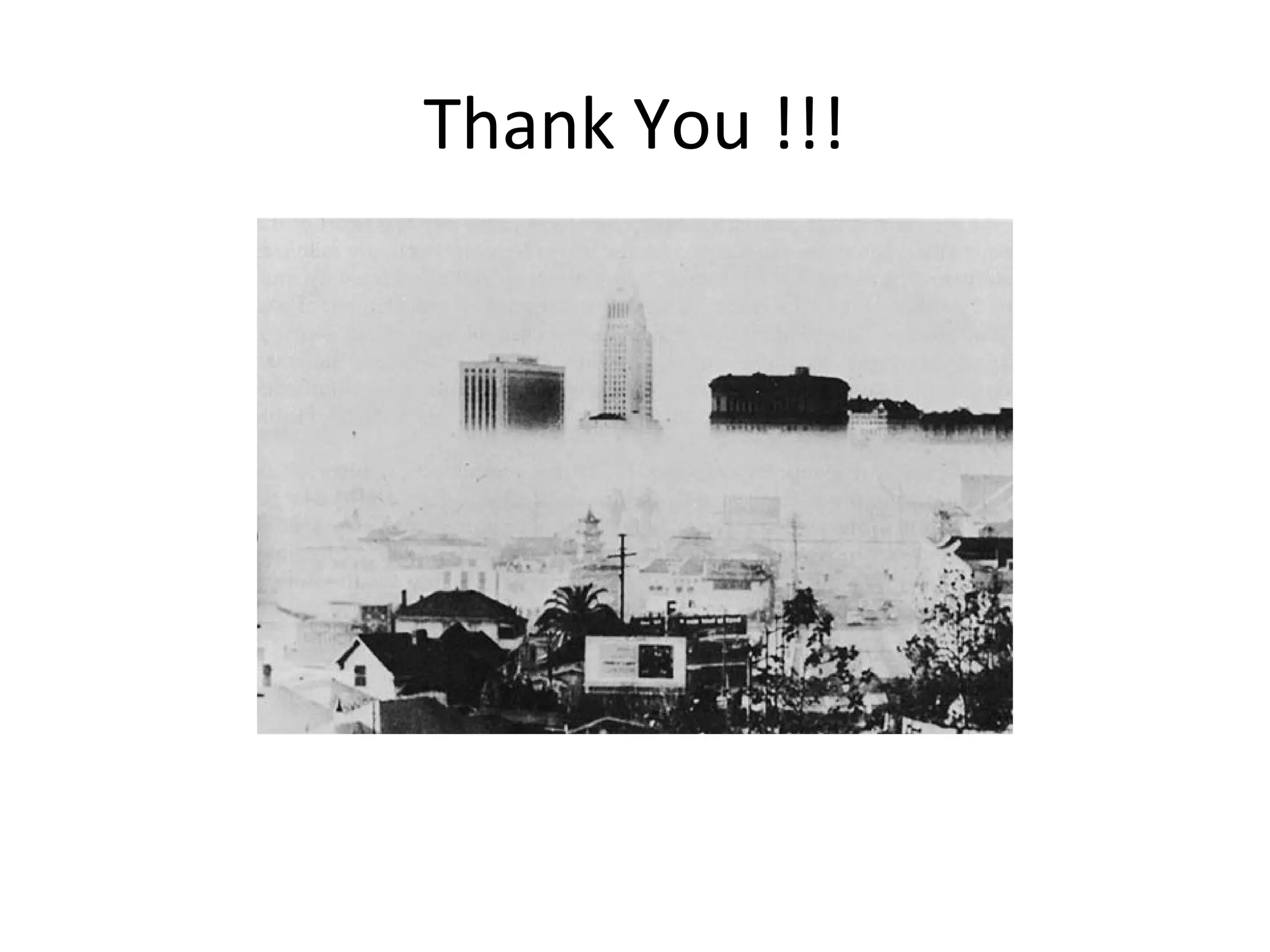
Los Angeles Smog
Thank You !!!

Air pollution 4

  • 1.
    Problems of AirPollution Rahul Kambe
  • 2.
    Objectives • Smoke • Smog •Reactions in fog formation • Air pollution episodes • London smog • Los Angeles smog
  • 3.
    How smoke isformed?
  • 4.
    Smog • Smog =Smoke + Fog • Oxidizing smog or photochemical smog • The mixture of smoke + fog is characterized by presence of SO2  reducing smog or sulphorous smog
  • 6.
    Smog forming reactions •Hydrocarbons from number of chemical and photochemical reactions  noxious secondary pollutant and intermediates photochemical smog. • Photochemical reactions of Methane (CH4) CH4 + O  H3C• [alkyl (methyl) radical] + HO• (hydroxyl radical)
  • 7.
    • H3C• +O2 + M (energy-absorbing third body, usually a molecule of N2 or O2)  H3COO• (methyl peroxyl radical) + M • Such radicals participate in a variety of subsequent chain reactionssmog formation. • CH4 + HO• (hydroxyl radical)  H3C• (methyl radical) + H2O • H3COO• (methyl peroxyl radical) + NO  H3CO• + NO2 • VOCs + NOx + sunlight Photochemical smog
  • 8.
    Air pollution episodes LocationDate Pollutants Effects Meuse valley, Belgium Dec. 1930 SO2 63 excess deaths Donora PA, USA Oct. 1948 SO2 20 deaths Poza Rica, Mexico Nov. 1950 H2S 22 excess deaths London Dec. 1952 SO2 4000 excess deaths New York Nov. 1966 SO2 168 deaths
  • 9.
    London Smog • December5-9, 1952 • Damp and foggy condition in winter, subsidence inversion • Fuel use was maximum and air near stagnant • A white fog was formed • Coal as a source of fuel for space heating and electricity production (Sulphur, 1.5%) • White fog  black fog • Smoke conc. during fog was five times higher • SO2 conc. was six times than usual level
  • 10.
    • Sulphur dioxidedissolve into the water that condensed around smoke particles • SO2(g) + H2O(l) H(aq) + HSO3 (aq) • Bulid up pollutants combined with smog • Zero visibility “one can’t see ones hande infornt of his face—a white collar shirt becomes almost black within 20 min” • Cough, nasal discharge, sore throat, irritation of eyes and bronchi, and vomating
  • 11.
    • Casualties of4000 people • Died were of old age and history of chronic bronchitis, asthma, bronco-pneumonia and other lung and heart diseases • Similar but mild air pollution episodes had occurred previously Dec. 1873, Jan 1880, Feb 1882, Dec 1891, Dec 1892, Nov 1948, Dec 1950 (1000 deaths)
  • 12.
  • 13.
    Los Angeles Smog •Subsidence inversion was responsible • Los Angeles has mountains to the north and the east; horizontal air movement restricted • This situation acts as a trap for obnoxious gases from automobiles • Ozone (ground level) was formed, photo- chemical reactions of NOx + HC (automobiles)
  • 14.
    • Temperature inversionincreases the conc. of exhaust gases and photochemical smog is formed • Irritation of eyes, nose and throat
  • 15.
  • 17.