C H A R A C T E R I S T I C S O F S O L I D W A S T E
Sources,Types,Composition,Sampling
and Characteristics of Solid Waste
Prof.Vaibhav D.Kamble
BE(Civil), ME(Civil- Environmental Engineering)
C H A R A C T E R I S T I C S O F S O L I D W A S T E
Characteristics of Solid
Wastes(MSW)
IS:10158-1982 (Reaffirmed 2003) METHODS OF ANALYSIS OF
SOLID WASTE (Excluding Industrial Solid Waste)
Characteristics of Solid Waste
 Characteristics of MSW vary throughout the world
 Within the same country too – change from place to
place
 social customs, standard of living, geographical location,
climate etc.
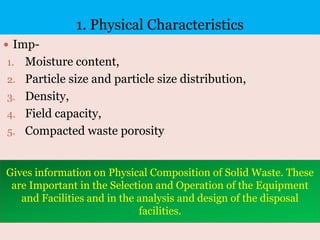
1. Physical Characteristics
 Imp-
1. Moisture content,
2. Particle size and particle size distribution,
3. Density,
4. Field capacity,
5. Compacted waste porosity
Gives information on Physical Composition of Solid Waste. These
are Important in the Selection and Operation of the Equipment
and Facilities and in the analysis and design of the disposal
facilities.
a) Moisture Content
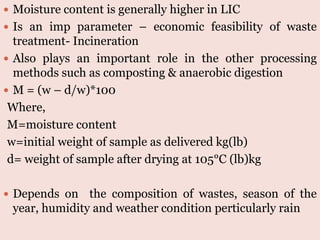
 Moisture content is generally higher in LIC
 Is an imp parameter – economic feasibility of waste
treatment- Incineration
 Also plays an important role in the other processing
methods such as composting & anaerobic digestion
 M = (w – d/w)*100
Where,
M=moisture content
w=initial weight of sample as delivered kg(lb)
d= weight of sample after drying at 105°C (lb)kg
 Depends on the composition of wastes, season of the
year, humidity and weather condition perticularly rain
b) Particle size and particle size distribution
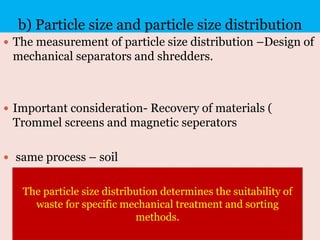
 The measurement of particle size distribution –Design of
mechanical separators and shredders.
 Important consideration- Recovery of materials (
Trommel screens and magnetic seperators
 same process – soil
The particle size distribution determines the suitability of
waste for specific mechanical treatment and sorting
methods.
c) Density( Specific Weight )
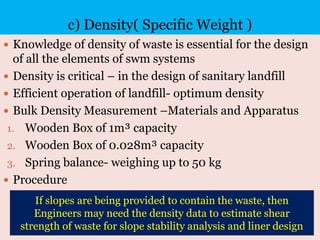
 Knowledge of density of waste is essential for the design
of all the elements of swm systems
 Density is critical – in the design of sanitary landfill
 Efficient operation of landfill- optimum density
 Bulk Density Measurement –Materials and Apparatus
1. Wooden Box of 1m³ capacity
2. Wooden Box of 0.028m³ capacity
3. Spring balance- weighing up to 50 kg
 Procedure
If slopes are being provided to contain the waste, then
Engineers may need the density data to estimate shear
strength of waste for slope stability analysis and liner design
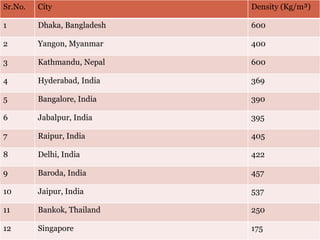
Density of Municipal Solid waste in some cities (NEERI )
Sr.No. City Density (Kg/m³)
1 Dhaka, Bangladesh 600
2 Yangon, Myanmar 400
3 Kathmandu, Nepal 600
4 Hyderabad, India 369
5 Bangalore, India 390
6 Jabalpur, India 395
7 Raipur, India 405
8 Delhi, India 422
9 Baroda, India 457
10 Jaipur, India 537
11 Bankok, Thailand 250
12 Singapore 175
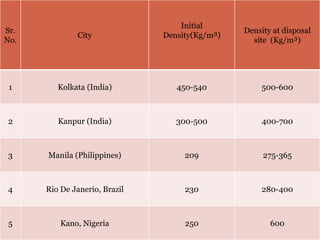
Increase in density between source and disposal site
Sr.
No.
City
Initial
Density(Kg/m³)
Density at disposal
site (Kg/m³)
1 Kolkata (India) 450-540 500-600
2 Kanpur (India) 300-500 400-700
3 Manila (Philippines) 209 275-365
4 Rio De Janerio, Brazil 230 280-400
5 Kano, Nigeria 250 600
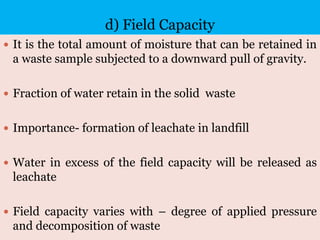
d) Field Capacity
 It is the total amount of moisture that can be retained in
a waste sample subjected to a downward pull of gravity.
 Fraction of water retain in the solid waste
 Importance- formation of leachate in landfill
 Water in excess of the field capacity will be released as
leachate
 Field capacity varies with – degree of applied pressure
and decomposition of waste
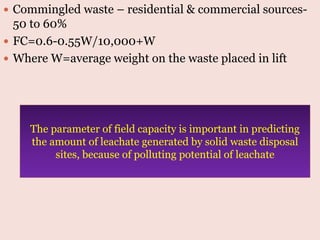
 Commingled waste – residential & commercial sources-
50 to 60%
 FC=0.6-0.55W/10,000+W
 Where W=average weight on the waste placed in lift
The parameter of field capacity is important in predicting
the amount of leachate generated by solid waste disposal
sites, because of polluting potential of leachate
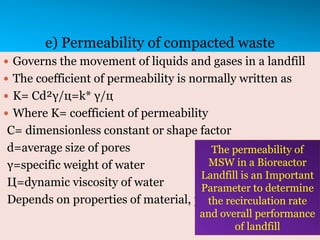
e) Permeability of compacted waste
 Governs the movement of liquids and gases in a landfill
 The coefficient of permeability is normally written as
 K= Cd²γ/ц=k* γ/ц
 Where K= coefficient of permeability
C= dimensionless constant or shape factor
d=average size of pores
γ=specific weight of water
Ц=dynamic viscosity of water
Depends on properties of material, porosity
The permeability of
MSW in a Bioreactor
Landfill is an Important
Parameter to determine
the recirculation rate
and overall performance
of landfill
- K N O W L E D G E I S E S S E N T I A L S E L E C T I N G
A N D D E S I G N I N G T H E W A S T E P R O C E S S I N G
A N D D I S P O S A L F A C I L I T I E S
Chemical Characteristics of solid
waste
Knowledge is essential for estimating the methods of solid waste
elimination through composting, the recycling of metals and of
other recyclable materials
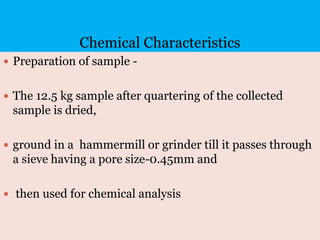
Chemical Characteristics
 Preparation of sample -
 The 12.5 kg sample after quartering of the collected
sample is dried,
 ground in a hammermill or grinder till it passes through
a sieve having a pore size-0.45mm and
 then used for chemical analysis
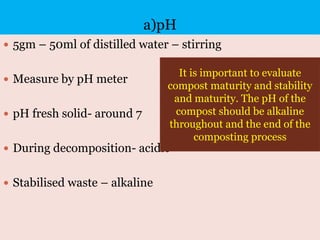
a)pH
 5gm – 50ml of distilled water – stirring
 Measure by pH meter
 pH fresh solid- around 7
 During decomposition- acidic
 Stabilised waste – alkaline
It is important to evaluate
compost maturity and stability
and maturity. The pH of the
compost should be alkaline
throughout and the end of the
composting process
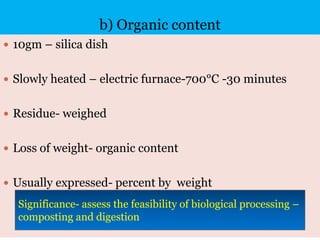
b) Organic content
 10gm – silica dish
 Slowly heated – electric furnace-700°C -30 minutes
 Residue- weighed
 Loss of weight- organic content
 Usually expressed- percent by weight
Significance- assess the feasibility of biological processing –
composting and digestion
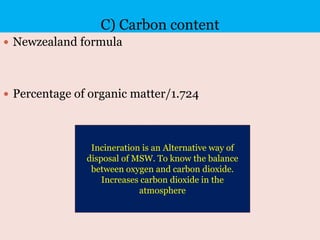
C) Carbon content
 Newzealand formula
 Percentage of organic matter/1.724
Incineration is an Alternative way of
disposal of MSW. To know the balance
between oxygen and carbon dioxide.
Increases carbon dioxide in the
atmosphere
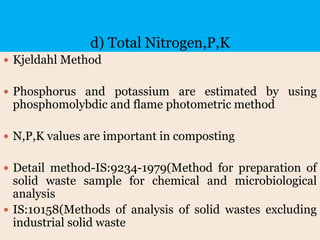
d) Total Nitrogen,P,K
 Kjeldahl Method
 Phosphorus and potassium are estimated by using
phosphomolybdic and flame photometric method
 N,P,K values are important in composting
 Detail method-IS:9234-1979(Method for preparation of
solid waste sample for chemical and microbiological
analysis
 IS:10158(Methods of analysis of solid wastes excluding
industrial solid waste
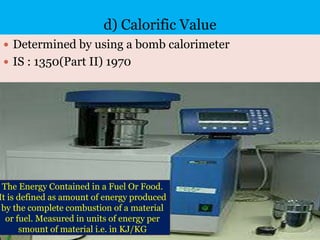
d) Calorific Value
 Determined by using a bomb calorimeter
 IS : 1350(Part II) 1970
The Energy Contained in a Fuel Or Food.
It is defined as amount of energy produced
by the complete combustion of a material
or fuel. Measured in units of energy per
smount of material i.e. in KJ/KG
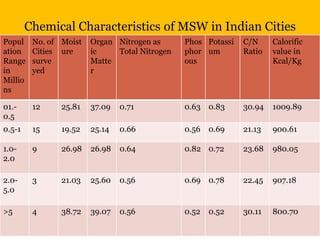
Chemical Characteristics of MSW in Indian Cities
Popul
ation
Range
in
Millio
ns
No. of
Cities
surve
yed
Moist
ure
Organ
ic
Matte
r
Nitrogen as
Total Nitrogen
Phos
phor
ous
Potassi
um
C/N
Ratio
Calorific
value in
Kcal/Kg
01.-
0.5
12 25.81 37.09 0.71 0.63 0.83 30.94 1009.89
0.5-1 15 19.52 25.14 0.66 0.56 0.69 21.13 900.61
1.0-
2.0
9 26.98 26.98 0.64 0.82 0.72 23.68 980.05
2.0-
5.0
3 21.03 25.60 0.56 0.69 0.78 22.45 907.18
>5 4 38.72 39.07 0.56 0.52 0.52 30.11 800.70
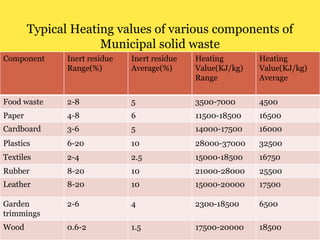
Typical Heating values of various components of
Municipal solid waste
Component Inert residue
Range(%)
Inert residue
Average(%)
Heating
Value(KJ/kg)
Range
Heating
Value(KJ/kg)
Average
Food waste 2-8 5 3500-7000 4500
Paper 4-8 6 11500-18500 16500
Cardboard 3-6 5 14000-17500 16000
Plastics 6-20 10 28000-37000 32500
Textiles 2-4 2.5 15000-18500 16750
Rubber 8-20 10 21000-28000 25500
Leather 8-20 10 15000-20000 17500
Garden
trimmings
2-6 4 2300-18500 6500
Wood 0.6-2 1.5 17500-20000 18500
e) Tests for presence of specific compounds
 Carbohydrates – on decomposition attract flies and rats
 High carbohydrate should not be left exposed
 Iipids- are biodegradable but solubility rate is slow
 Proteins – partial decomposition of protein – unpleasant
odour
 Cellulose- major constituent of wood, paper and textile
 High combustible- high HCV
f) Toxicity
 Includes heavy metals, pesticides, insecticides
 Heavy metals – MSW – waste from small scale
industries
 As some of the heavy metals leach out
 TCLP( Toxicity Characteristics Leaching Procedure )
Test
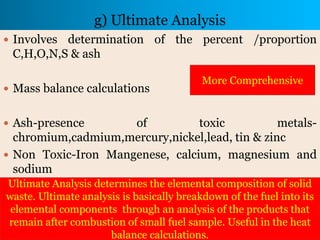
g) Ultimate Analysis
 Involves determination of the percent /proportion
C,H,O,N,S & ash
 Mass balance calculations
 Ash-presence of toxic metals-
chromium,cadmium,mercury,nickel,lead, tin & zinc
 Non Toxic-Iron Mangenese, calcium, magnesium and
sodium
Ultimate Analysis determines the elemental composition of solid
waste. Ultimate analysis is basically breakdown of the fuel into its
elemental components through an analysis of the products that
remain after combustion of small fuel sample. Useful in the heat
balance calculations.
More Comprehensive
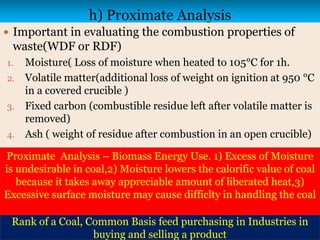
h) Proximate Analysis
 Important in evaluating the combustion properties of
waste(WDF or RDF)
1. Moisture( Loss of moisture when heated to 105°C for 1h.
2. Volatile matter(additional loss of weight on ignition at 950 °C
in a covered crucible )
3. Fixed carbon (combustible residue left after volatile matter is
removed)
4. Ash ( weight of residue after combustion in an open crucible)
Proximate Analysis – Biomass Energy Use. 1) Excess of Moisture
is undesirable in coal,2) Moisture lowers the calorific value of coal
because it takes away appreciable amount of liberated heat,3)
Excessive surface moisture may cause difficlty in handling the coal
Rank of a Coal, Common Basis feed purchasing in Industries in
buying and selling a product
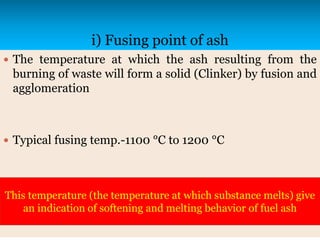
i) Fusing point of ash
 The temperature at which the ash resulting from the
burning of waste will form a solid (Clinker) by fusion and
agglomeration
 Typical fusing temp.-1100 °C to 1200 °C
This temperature (the temperature at which substance melts) give
an indication of softening and melting behavior of fuel ash
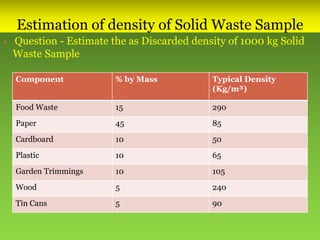
Estimation of density of Solid Waste Sample
 Question - Estimate the as Discarded density of 1000 kg Solid
Waste Sample
Component % by Mass Typical Density
(Kg/m³)
Food Waste 15 290
Paper 45 85
Cardboard 10 50
Plastic 10 65
Garden Trimmings 10 105
Wood 5 240
Tin Cans 5 90
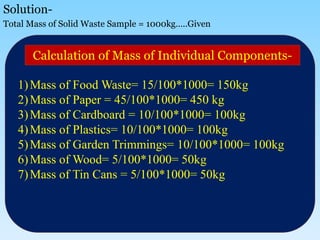
Solution-
Total Mass of Solid Waste Sample = 1000kg…..Given
1)Mass of Food Waste= 15/100*1000= 150kg
2)Mass of Paper = 45/100*1000= 450 kg
3)Mass of Cardboard = 10/100*1000= 100kg
4)Mass of Plastics= 10/100*1000= 100kg
5)Mass of Garden Trimmings= 10/100*1000= 100kg
6)Mass of Wood= 5/100*1000= 50kg
7)Mass of Tin Cans = 5/100*1000= 50kg
Calculation of Mass of Individual Components-
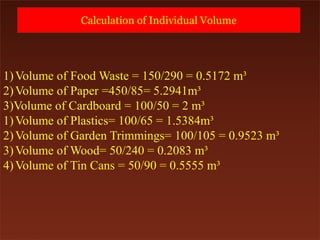
1)Volume of Food Waste = 150/290 = 0.5172 m³
2)Volume of Paper =450/85= 5.2941m³
3)Volume of Cardboard = 100/50 = 2 m³
1)Volume of Plastics= 100/65 = 1.5384m³
2)Volume of Garden Trimmings= 100/105 = 0.9523 m³
3)Volume of Wood= 50/240 = 0.2083 m³
4)Volume of Tin Cans = 50/90 = 0.5555 m³
Calculation of Individual Volume
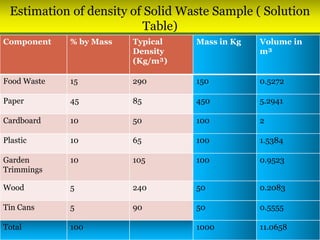
Estimation of density of Solid Waste Sample ( Solution
Table)
 Question - Estimate the as Discarded density of 1000 kg Solid
Waste Sample
Component % by Mass Typical
Density
(Kg/m³)
Mass in Kg Volume in
m³
Food Waste 15 290 150 0.5272
Paper 45 85 450 5.2941
Cardboard 10 50 100 2
Plastic 10 65 100 1.5384
Garden
Trimmings
10 105 100 0.9523
Wood 5 240 50 0.2083
Tin Cans 5 90 50 0.5555
Total 100 1000 11.0658
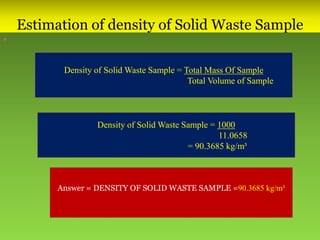
Estimation of density of Solid Waste Sample

Density of Solid Waste Sample = Total Mass Of Sample
Total Volume of Sample
Density of Solid Waste Sample = 1000
11.0658
= 90.3685 kg/m³
Answer = DENSITY OF SOLID WASTE SAMPLE =90.3685 kg/m³
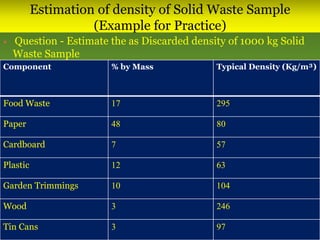
Estimation of density of Solid Waste Sample
(Example for Practice)
 Question - Estimate the as Discarded density of 1000 kg Solid
Waste Sample
Component % by Mass Typical Density (Kg/m³)
Food Waste 17 295
Paper 48 80
Cardboard 7 57
Plastic 12 63
Garden Trimmings 10 104
Wood 3 246
Tin Cans 3 97
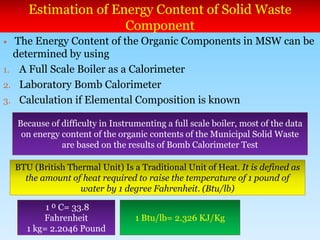
Estimation of Energy Content of Solid Waste
Component
 The Energy Content of the Organic Components in MSW can be
determined by using
1. A Full Scale Boiler as a Calorimeter
2. Laboratory Bomb Calorimeter
3. Calculation if Elemental Composition is known
Because of difficulty in Instrumenting a full scale boiler, most of the data
on energy content of the organic contents of the Municipal Solid Waste
are based on the results of Bomb Calorimeter Test
BTU (British Thermal Unit) Is a Traditional Unit of Heat. It is defined as
the amount of heat required to raise the temperature of 1 pound of
water by 1 degree Fahrenheit. (Btu/lb)
1 ⁰ C= 33.8
Fahrenheit
1 kg= 2.2046 Pound
1 Btu/lb= 2.326 KJ/Kg
Estimation of Energy Content of Solid Waste
Component
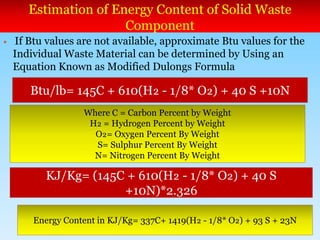
 If Btu values are not available, approximate Btu values for the
Individual Waste Material can be determined by Using an
Equation Known as Modified Dulongs Formula
Btu/lb= 145C + 610(H₂ - 1/8* O₂) + 40 S +10N
Where C = Carbon Percent by Weight
H₂ = Hydrogen Percent by Weight
O₂= Oxygen Percent By Weight
S= Sulphur Percent By Weight
N= Nitrogen Percent By Weight
KJ/Kg= (145C + 610(H₂ - 1/8* O₂) + 40 S
+10N)*2.326
Energy Content in KJ/Kg= 337C+ 1419(H₂ - 1/8* O₂) + 93 S + 23N

Characteristics of solid waste 3

  • 1.
    C H AR A C T E R I S T I C S O F S O L I D W A S T E Sources,Types,Composition,Sampling and Characteristics of Solid Waste Prof.Vaibhav D.Kamble BE(Civil), ME(Civil- Environmental Engineering)
  • 2.
    C H AR A C T E R I S T I C S O F S O L I D W A S T E Characteristics of Solid Wastes(MSW) IS:10158-1982 (Reaffirmed 2003) METHODS OF ANALYSIS OF SOLID WASTE (Excluding Industrial Solid Waste)
  • 3.
    Characteristics of SolidWaste  Characteristics of MSW vary throughout the world  Within the same country too – change from place to place  social customs, standard of living, geographical location, climate etc.
  • 4.
    1. Physical Characteristics Imp- 1. Moisture content, 2. Particle size and particle size distribution, 3. Density, 4. Field capacity, 5. Compacted waste porosity Gives information on Physical Composition of Solid Waste. These are Important in the Selection and Operation of the Equipment and Facilities and in the analysis and design of the disposal facilities.
  • 5.
    a) Moisture Content Moisture content is generally higher in LIC  Is an imp parameter – economic feasibility of waste treatment- Incineration  Also plays an important role in the other processing methods such as composting & anaerobic digestion  M = (w – d/w)*100 Where, M=moisture content w=initial weight of sample as delivered kg(lb) d= weight of sample after drying at 105°C (lb)kg  Depends on the composition of wastes, season of the year, humidity and weather condition perticularly rain
  • 6.
    b) Particle sizeand particle size distribution  The measurement of particle size distribution –Design of mechanical separators and shredders.  Important consideration- Recovery of materials ( Trommel screens and magnetic seperators  same process – soil The particle size distribution determines the suitability of waste for specific mechanical treatment and sorting methods.
  • 7.
    c) Density( SpecificWeight )  Knowledge of density of waste is essential for the design of all the elements of swm systems  Density is critical – in the design of sanitary landfill  Efficient operation of landfill- optimum density  Bulk Density Measurement –Materials and Apparatus 1. Wooden Box of 1m³ capacity 2. Wooden Box of 0.028m³ capacity 3. Spring balance- weighing up to 50 kg  Procedure If slopes are being provided to contain the waste, then Engineers may need the density data to estimate shear strength of waste for slope stability analysis and liner design
  • 8.
    Density of MunicipalSolid waste in some cities (NEERI ) Sr.No. City Density (Kg/m³) 1 Dhaka, Bangladesh 600 2 Yangon, Myanmar 400 3 Kathmandu, Nepal 600 4 Hyderabad, India 369 5 Bangalore, India 390 6 Jabalpur, India 395 7 Raipur, India 405 8 Delhi, India 422 9 Baroda, India 457 10 Jaipur, India 537 11 Bankok, Thailand 250 12 Singapore 175
  • 9.
    Increase in densitybetween source and disposal site Sr. No. City Initial Density(Kg/m³) Density at disposal site (Kg/m³) 1 Kolkata (India) 450-540 500-600 2 Kanpur (India) 300-500 400-700 3 Manila (Philippines) 209 275-365 4 Rio De Janerio, Brazil 230 280-400 5 Kano, Nigeria 250 600
  • 10.
    d) Field Capacity It is the total amount of moisture that can be retained in a waste sample subjected to a downward pull of gravity.  Fraction of water retain in the solid waste  Importance- formation of leachate in landfill  Water in excess of the field capacity will be released as leachate  Field capacity varies with – degree of applied pressure and decomposition of waste
  • 11.
     Commingled waste– residential & commercial sources- 50 to 60%  FC=0.6-0.55W/10,000+W  Where W=average weight on the waste placed in lift The parameter of field capacity is important in predicting the amount of leachate generated by solid waste disposal sites, because of polluting potential of leachate
  • 12.
    e) Permeability ofcompacted waste  Governs the movement of liquids and gases in a landfill  The coefficient of permeability is normally written as  K= Cd²γ/ц=k* γ/ц  Where K= coefficient of permeability C= dimensionless constant or shape factor d=average size of pores γ=specific weight of water Ц=dynamic viscosity of water Depends on properties of material, porosity The permeability of MSW in a Bioreactor Landfill is an Important Parameter to determine the recirculation rate and overall performance of landfill
  • 13.
    - K NO W L E D G E I S E S S E N T I A L S E L E C T I N G A N D D E S I G N I N G T H E W A S T E P R O C E S S I N G A N D D I S P O S A L F A C I L I T I E S Chemical Characteristics of solid waste Knowledge is essential for estimating the methods of solid waste elimination through composting, the recycling of metals and of other recyclable materials
  • 14.
    Chemical Characteristics  Preparationof sample -  The 12.5 kg sample after quartering of the collected sample is dried,  ground in a hammermill or grinder till it passes through a sieve having a pore size-0.45mm and  then used for chemical analysis
  • 15.
    a)pH  5gm –50ml of distilled water – stirring  Measure by pH meter  pH fresh solid- around 7  During decomposition- acidic  Stabilised waste – alkaline It is important to evaluate compost maturity and stability and maturity. The pH of the compost should be alkaline throughout and the end of the composting process
  • 16.
    b) Organic content 10gm – silica dish  Slowly heated – electric furnace-700°C -30 minutes  Residue- weighed  Loss of weight- organic content  Usually expressed- percent by weight Significance- assess the feasibility of biological processing – composting and digestion
  • 17.
    C) Carbon content Newzealand formula  Percentage of organic matter/1.724 Incineration is an Alternative way of disposal of MSW. To know the balance between oxygen and carbon dioxide. Increases carbon dioxide in the atmosphere
  • 18.
    d) Total Nitrogen,P,K Kjeldahl Method  Phosphorus and potassium are estimated by using phosphomolybdic and flame photometric method  N,P,K values are important in composting  Detail method-IS:9234-1979(Method for preparation of solid waste sample for chemical and microbiological analysis  IS:10158(Methods of analysis of solid wastes excluding industrial solid waste
  • 19.
    d) Calorific Value Determined by using a bomb calorimeter  IS : 1350(Part II) 1970 The Energy Contained in a Fuel Or Food. It is defined as amount of energy produced by the complete combustion of a material or fuel. Measured in units of energy per smount of material i.e. in KJ/KG
  • 20.
    Chemical Characteristics ofMSW in Indian Cities Popul ation Range in Millio ns No. of Cities surve yed Moist ure Organ ic Matte r Nitrogen as Total Nitrogen Phos phor ous Potassi um C/N Ratio Calorific value in Kcal/Kg 01.- 0.5 12 25.81 37.09 0.71 0.63 0.83 30.94 1009.89 0.5-1 15 19.52 25.14 0.66 0.56 0.69 21.13 900.61 1.0- 2.0 9 26.98 26.98 0.64 0.82 0.72 23.68 980.05 2.0- 5.0 3 21.03 25.60 0.56 0.69 0.78 22.45 907.18 >5 4 38.72 39.07 0.56 0.52 0.52 30.11 800.70
  • 21.
    Typical Heating valuesof various components of Municipal solid waste Component Inert residue Range(%) Inert residue Average(%) Heating Value(KJ/kg) Range Heating Value(KJ/kg) Average Food waste 2-8 5 3500-7000 4500 Paper 4-8 6 11500-18500 16500 Cardboard 3-6 5 14000-17500 16000 Plastics 6-20 10 28000-37000 32500 Textiles 2-4 2.5 15000-18500 16750 Rubber 8-20 10 21000-28000 25500 Leather 8-20 10 15000-20000 17500 Garden trimmings 2-6 4 2300-18500 6500 Wood 0.6-2 1.5 17500-20000 18500
  • 22.
    e) Tests forpresence of specific compounds  Carbohydrates – on decomposition attract flies and rats  High carbohydrate should not be left exposed  Iipids- are biodegradable but solubility rate is slow  Proteins – partial decomposition of protein – unpleasant odour  Cellulose- major constituent of wood, paper and textile  High combustible- high HCV
  • 23.
    f) Toxicity  Includesheavy metals, pesticides, insecticides  Heavy metals – MSW – waste from small scale industries  As some of the heavy metals leach out  TCLP( Toxicity Characteristics Leaching Procedure ) Test
  • 24.
    g) Ultimate Analysis Involves determination of the percent /proportion C,H,O,N,S & ash  Mass balance calculations  Ash-presence of toxic metals- chromium,cadmium,mercury,nickel,lead, tin & zinc  Non Toxic-Iron Mangenese, calcium, magnesium and sodium Ultimate Analysis determines the elemental composition of solid waste. Ultimate analysis is basically breakdown of the fuel into its elemental components through an analysis of the products that remain after combustion of small fuel sample. Useful in the heat balance calculations. More Comprehensive
  • 25.
    h) Proximate Analysis Important in evaluating the combustion properties of waste(WDF or RDF) 1. Moisture( Loss of moisture when heated to 105°C for 1h. 2. Volatile matter(additional loss of weight on ignition at 950 °C in a covered crucible ) 3. Fixed carbon (combustible residue left after volatile matter is removed) 4. Ash ( weight of residue after combustion in an open crucible) Proximate Analysis – Biomass Energy Use. 1) Excess of Moisture is undesirable in coal,2) Moisture lowers the calorific value of coal because it takes away appreciable amount of liberated heat,3) Excessive surface moisture may cause difficlty in handling the coal Rank of a Coal, Common Basis feed purchasing in Industries in buying and selling a product
  • 26.
    i) Fusing pointof ash  The temperature at which the ash resulting from the burning of waste will form a solid (Clinker) by fusion and agglomeration  Typical fusing temp.-1100 °C to 1200 °C This temperature (the temperature at which substance melts) give an indication of softening and melting behavior of fuel ash
  • 27.
    Estimation of densityof Solid Waste Sample  Question - Estimate the as Discarded density of 1000 kg Solid Waste Sample Component % by Mass Typical Density (Kg/m³) Food Waste 15 290 Paper 45 85 Cardboard 10 50 Plastic 10 65 Garden Trimmings 10 105 Wood 5 240 Tin Cans 5 90
  • 28.
    Solution- Total Mass ofSolid Waste Sample = 1000kg…..Given 1)Mass of Food Waste= 15/100*1000= 150kg 2)Mass of Paper = 45/100*1000= 450 kg 3)Mass of Cardboard = 10/100*1000= 100kg 4)Mass of Plastics= 10/100*1000= 100kg 5)Mass of Garden Trimmings= 10/100*1000= 100kg 6)Mass of Wood= 5/100*1000= 50kg 7)Mass of Tin Cans = 5/100*1000= 50kg Calculation of Mass of Individual Components-
  • 29.
    1)Volume of FoodWaste = 150/290 = 0.5172 m³ 2)Volume of Paper =450/85= 5.2941m³ 3)Volume of Cardboard = 100/50 = 2 m³ 1)Volume of Plastics= 100/65 = 1.5384m³ 2)Volume of Garden Trimmings= 100/105 = 0.9523 m³ 3)Volume of Wood= 50/240 = 0.2083 m³ 4)Volume of Tin Cans = 50/90 = 0.5555 m³ Calculation of Individual Volume
  • 30.
    Estimation of densityof Solid Waste Sample ( Solution Table)  Question - Estimate the as Discarded density of 1000 kg Solid Waste Sample Component % by Mass Typical Density (Kg/m³) Mass in Kg Volume in m³ Food Waste 15 290 150 0.5272 Paper 45 85 450 5.2941 Cardboard 10 50 100 2 Plastic 10 65 100 1.5384 Garden Trimmings 10 105 100 0.9523 Wood 5 240 50 0.2083 Tin Cans 5 90 50 0.5555 Total 100 1000 11.0658
  • 31.
    Estimation of densityof Solid Waste Sample  Density of Solid Waste Sample = Total Mass Of Sample Total Volume of Sample Density of Solid Waste Sample = 1000 11.0658 = 90.3685 kg/m³ Answer = DENSITY OF SOLID WASTE SAMPLE =90.3685 kg/m³
  • 32.
    Estimation of densityof Solid Waste Sample (Example for Practice)  Question - Estimate the as Discarded density of 1000 kg Solid Waste Sample Component % by Mass Typical Density (Kg/m³) Food Waste 17 295 Paper 48 80 Cardboard 7 57 Plastic 12 63 Garden Trimmings 10 104 Wood 3 246 Tin Cans 3 97
  • 33.
    Estimation of EnergyContent of Solid Waste Component  The Energy Content of the Organic Components in MSW can be determined by using 1. A Full Scale Boiler as a Calorimeter 2. Laboratory Bomb Calorimeter 3. Calculation if Elemental Composition is known Because of difficulty in Instrumenting a full scale boiler, most of the data on energy content of the organic contents of the Municipal Solid Waste are based on the results of Bomb Calorimeter Test BTU (British Thermal Unit) Is a Traditional Unit of Heat. It is defined as the amount of heat required to raise the temperature of 1 pound of water by 1 degree Fahrenheit. (Btu/lb) 1 ⁰ C= 33.8 Fahrenheit 1 kg= 2.2046 Pound 1 Btu/lb= 2.326 KJ/Kg
  • 34.
    Estimation of EnergyContent of Solid Waste Component  If Btu values are not available, approximate Btu values for the Individual Waste Material can be determined by Using an Equation Known as Modified Dulongs Formula Btu/lb= 145C + 610(H₂ - 1/8* O₂) + 40 S +10N Where C = Carbon Percent by Weight H₂ = Hydrogen Percent by Weight O₂= Oxygen Percent By Weight S= Sulphur Percent By Weight N= Nitrogen Percent By Weight KJ/Kg= (145C + 610(H₂ - 1/8* O₂) + 40 S +10N)*2.326 Energy Content in KJ/Kg= 337C+ 1419(H₂ - 1/8* O₂) + 93 S + 23N