Course Code :BETCK105F/205F
Course Outcomes (CO):
• CO-01: Apply the basics of solid waste management towards
sustainable development.
• CO-02: Understand waste stream assessment (WSA), waste
generation and composition and waste characteristics.
• CO-03: Apply technologies to process waste and dispose the same.
• CO-04: Design working models to convert waste to energy.
• CO-05: Identify and classify hazardous waste and manage the hazard
Module-1
 The wastes generated from human and animal
activities that are normally solid and are discarded as
useless or unwanted are called solid wastes.
 Any useless unwanted or discarded material that is
not a liquid or a gas is called solid waste.
 Due to rapid increase in production and hence in
consumption process, human society generates and
rejects solid materials regularly from various sectors
such as agricultural, commercial, domestic,
industrial, institutional etc.
 The considerable volume of waste thus generated
and rejected is called SOLID WASTE.
INTRODUCTION TO SOLID WASTE
MANAGEMENT:
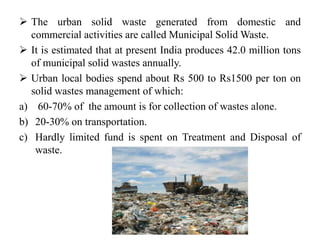
 The urban solid waste generated from domestic and
commercial activities are called Municipal Solid Waste.
 It is estimated that at present India produces 42.0 million tons
of municipal solid wastes annually.
 Urban local bodies spend about Rs 500 to Rs1500 per ton on
solid wastes management of which:
a) 60-70% of the amount is for collection of wastes alone.
b) 20-30% on transportation.
c) Hardly limited fund is spent on Treatment and Disposal of
waste.
Classification of solid wastes
1) Source based classification
 Based on place/location of wastes being generated. It is
classified as follows:
a) Domestic/Residential
b) Industrial
c) Commercial
d) Institutional
e) Construction and demolition
f) Municipal waste/open area street sweeping
g) Processing and manufacturing
h) agriculture
2) Type based classification
 Based on composition/nature of the wastes.
It is classified as follows:
a) Garbage
b) Ashes and residues
c) Combustible and noncombustible wastes
d) Bulky wastes
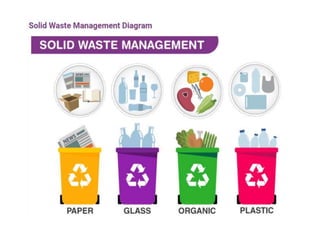
e) Biodegradable and Non-Biodegradable wastes
f) Dead animals
g) Abandoned vehicles.
h) Construction and demolition wastes
i) Hazardous wastes
j) Sewage wastes
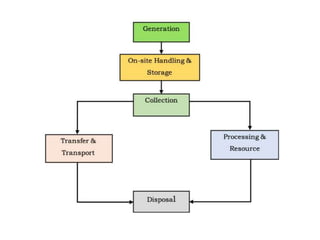
Functional Elements of Solid Waste Management System
comprises of six basic elements including:
 Generation of the solid waste
 On-site handling & storage
 Collection
 Transfer & transport
 Material and resource recovery and
 Disposal
1) Generation
 Generation of solid waste is a result of natural, human and
animal activities.
 Knowledge of generation of solid waste is important in the
planning, designing and operation of solid waste management
system.
 Generation has two aspects: One is the quality of solid waste
and the other is the quantity of solid waste.
 Quality includes the sources, types and typical composition of
solid waste along with its properties whereas the quantity
represents the generation rates and total quantities and
volumes of waste generated.
2) Waste Handling
 Handling refers to activities associated with managing solid
wastes until they are placed in the containers used for their
storage before collection or return to drop-off and recycling
centers.
 The specific activities associated with handling waste
materials at the source of generation will vary depending on
the types of waste materials that are separated for reuse and
recycling and the extent to which these materials are separated
from the waste stream.
 Depending on the type of collection service, handling may also
be required to move the loaded containers to the collection
point and to return the empty container to the point where they
are stored between collections.
3) Waste Storage
 The first phase to manage solid waste is at home level.
 It requires temporary storage of refuse on the premises.
 The individual household or businessman has responsibility
for onsite storage of solid waste.
 For individual homes, industries, and other commercial
centers, proper on-site storage of solid waste is the beginning
of proper disposal, because unkept solid waste or simple
dumps are sources of flies, smells and other hazards.
4) Collection
 The term “collection” includes not only the gathering or
picking up of solid wastes from the various sources, but also
loading of these wastes to the disposal site or transfer station
and unloading there.
 While loading and unloading are similar for most collection
system, the collection or pickup of waste varies with facilities
and locations.
5) Transfer and Transport
 Transfer and Transport refers to the means, facilities, appurtenances used to affect
the transfer of wastes from one location to another, usually more distant location.
 Typically, the wastes from relatively small collection vehicles are transferred to
larger vehicles and then transported to distant locations.
6) Resource Recovery and Processing
 Resource recovery is a partial solid waste disposal and reclamation process.
 It can be erexpected to achieve waste reductions in future landfill volume
requiments. Resource recovery must recognize what is worth recovering and the
environmental benefits.
7) Disposal
 Most of the organic content after segregation may be subjected to bacterial
decomposition with an end product called humus or compost.
 The entire process involving both separation and bacterial conversion is known as
Composting Decomposition of solid waste may be accomplished aerobically or
anaerobically.
Environmentally Sound Solid Waste Management
(ESSWM)
 In any waste or resource management system, we must pay
attention to the interaction between human activities and the
ecosystem.
 We have to recognize that human activities including
consumption of goods/services, production of wastes, etc.,
have a serious impact on the carrying capacity of the
ecosystem.
 This in turn affects human health, as the environment
deteriorates.
 The fundamental principles of ESSWM, which take into
account economic and social issues along with
environmental impact consideration, include the following:
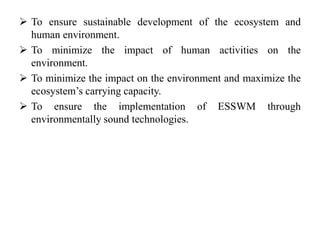
 To ensure sustainable development of the ecosystem and
human environment.
 To minimize the impact of human activities on the
environment.
 To minimize the impact on the environment and maximize the
ecosystem’s carrying capacity.
 To ensure the implementation of ESSWM through
environmentally sound technologies.
Environmentally sound technologies (EST)
 EST refers to cost effective and energy efficient technologies.
 This generally perform better on the environment, as they do
not pollute the ecosystem’s vital components such as air, land or
water and consider the reuse, recycling or recovery of wastes.
 EST can be categorized broadly as follows:
Hard EST: This includes equipment, machines and other
infrastructure with their material accessories to handle waste
products and monitor/measure the quality of air, water and soil.
Soft EST: This supports and complements hard technologies and
include nature-based technologies and management tools.
Nature-based technologies include processes and mechanisms
nature uses within a specific ecosystem and its carrying capacity,
while management tools include system and procedures, policy
and regulatory frameworks, environmental performance standards
and guidelines.
 EST is selected based on the following generic criteria, the
indicators of which may vary depending on the regions in which
they are implemented:
 Affordability: This means low investment, reasonableness,
maintenance free and durability.
 Validity: This refers to effectiveness, easy operation and
maintenance.
 Sustainability: This means low impact, energy saving and
cultural acceptability.
Examples of EST for collection and transfer of Waste
 Set-out container is one of the major factors that most collection
system depends on.
 This is usually a paper or plastic bag, or kraft paper bags in a
metal or wooden frame.
 Set-out containers of rural areas include bags, pots, plastic or
paper bags, baskets, concrete boxes, clay jars, or any kind of
container available.
Factors affecting SWM system
 Many factors influence the decision-making process in the
implementation of a SWM system.
 Some of the factors that need to be considered in developing a SWM
system are listed below:
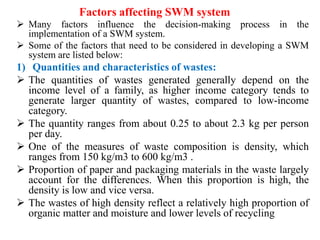
1) Quantities and characteristics of wastes:
 The quantities of wastes generated generally depend on the
income level of a family, as higher income category tends to
generate larger quantity of wastes, compared to low-income
category.
 The quantity ranges from about 0.25 to about 2.3 kg per person
per day.
 One of the measures of waste composition is density, which
ranges from 150 kg/m3 to 600 kg/m3 .
 Proportion of paper and packaging materials in the waste largely
account for the differences. When this proportion is high, the
density is low and vice versa.
 The wastes of high density reflect a relatively high proportion of
organic matter and moisture and lower levels of recycling
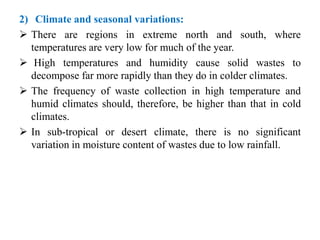
2) Climate and seasonal variations:
 There are regions in extreme north and south, where
temperatures are very low for much of the year.
 High temperatures and humidity cause solid wastes to
decompose far more rapidly than they do in colder climates.
 The frequency of waste collection in high temperature and
humid climates should, therefore, be higher than that in cold
climates.
 In sub-tropical or desert climate, there is no significant
variation in moisture content of wastes due to low rainfall.
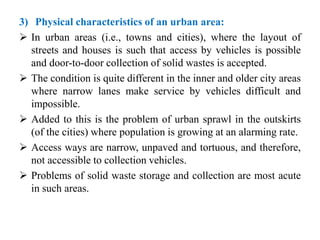
3) Physical characteristics of an urban area:
 In urban areas (i.e., towns and cities), where the layout of
streets and houses is such that access by vehicles is possible
and door-to-door collection of solid wastes is accepted.
 The condition is quite different in the inner and older city areas
where narrow lanes make service by vehicles difficult and
impossible.
 Added to this is the problem of urban sprawl in the outskirts
(of the cities) where population is growing at an alarming rate.
 Access ways are narrow, unpaved and tortuous, and therefore,
not accessible to collection vehicles.
 Problems of solid waste storage and collection are most acute
in such areas.
4) Financial and foreign exchange constraints:
 Solid waste management accounts for sizeable proportions of
the budgets of municipal corporations.
 This is allocated for capital resources, which go towards the
purchase of equipment's, vehicles, and fuel and labour costs.
 Typically, 10% to 40% of the revenues of municipalities are
allocated to solid waste management.
 In regions where wage rates are low, the aim is to optimize
vehicle productivity.
 The unfavorable financial situation of some countries hinders
purchase of equipment and vehicles, and this situation is
further worsened by the acute shortage of foreign exchange.
5) Cultural constraints:
 In some regions, long-standing traditions preclude the
intrusion of waste collection on the precincts of households,
and therefore, influence the collection system.
 In others, where the tradition of caste persists, recruits to the
labour force for street cleaning and handling of waste must be
drawn from certain sections of the population, while others
will not consent to placing storage bins in their immediate
vicinity.
 Social norms of a community more often than not over-ride
what many may consider rational solutions.
 Waste management should, therefore, be sensitive to such
local patterns of living and consider these factors in
planning, design and operation.
6) Management and technical resources:
 Solid waste management, to be successful, requires a wide
spectrum of workforce in keeping with the demands of the
system.
 The best system for a region is one which makes full use of
indigenous crafts and professional skills and/or ensures that
training Programmes to provide a self-sustaining supply of
trained workforce.
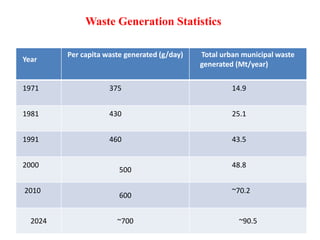
Waste Generation Statistics
Year
Per capita waste generated (g/day) Total urban municipal waste
generated (Mt/year)
1971 375 14.9
1981 430 25.1
1991 460 43.5
2000
500
48.8
2010
600
~70.2
2024 ~700 ~90.5
Progress in MSW (municipal solid waste) management in India
 Rapid industrialization, population growth, economic
development and changes of standard of living have generated
more municipal solid waste in India.
 The quantity of solid waste generation has been increased
many fold over the period.
 In, various studies have been given different statistics about
total quantity of solid waste generation in India.
 For example, Comtroller and Auditor General’s (2009)
estimated 48 million tonnes, Department of Economic Affairs
(2009) estimated 58 million tonnes, Central Pollution Control
Board (CPCB) (2016) assessed 62 million tonnes and
Balasubramanian (2015) observed 100 million tonnes per year.
Indian and global scenario of e-waste
Electronics industry is the world’s largest and
fastest growing manufacturing industry.
The growing quantity of E-waste from
electronic industry is beginning to reach
disastrous proportions.
Electronic waste or E-waste comprises of old,
end-of-life electronic appliances such as
computers, laptops, TVs, DVD players,
refrigerators, freezers, mobile phones, MP3
players, etc., which have been disposed of by
their original users.
Composition of solid waste in India
• According to the waste composition study,
• 46 % of home solid waste is organic waste,
• 11 % is dirt and building debris,
• 10 % is plastics,
• 7 % is glass,
• 6 % is paper and paper products,
• 5 % is metals, and 5 % is rubber and leather.

waste management Module - 1 for vtu students

  • 1.
  • 2.
    Course Outcomes (CO): •CO-01: Apply the basics of solid waste management towards sustainable development. • CO-02: Understand waste stream assessment (WSA), waste generation and composition and waste characteristics. • CO-03: Apply technologies to process waste and dispose the same. • CO-04: Design working models to convert waste to energy. • CO-05: Identify and classify hazardous waste and manage the hazard
  • 4.
    Module-1  The wastesgenerated from human and animal activities that are normally solid and are discarded as useless or unwanted are called solid wastes.  Any useless unwanted or discarded material that is not a liquid or a gas is called solid waste.  Due to rapid increase in production and hence in consumption process, human society generates and rejects solid materials regularly from various sectors such as agricultural, commercial, domestic, industrial, institutional etc.  The considerable volume of waste thus generated and rejected is called SOLID WASTE. INTRODUCTION TO SOLID WASTE MANAGEMENT:
  • 5.
     The urbansolid waste generated from domestic and commercial activities are called Municipal Solid Waste.  It is estimated that at present India produces 42.0 million tons of municipal solid wastes annually.  Urban local bodies spend about Rs 500 to Rs1500 per ton on solid wastes management of which: a) 60-70% of the amount is for collection of wastes alone. b) 20-30% on transportation. c) Hardly limited fund is spent on Treatment and Disposal of waste.
  • 7.
    Classification of solidwastes 1) Source based classification  Based on place/location of wastes being generated. It is classified as follows: a) Domestic/Residential b) Industrial c) Commercial d) Institutional e) Construction and demolition f) Municipal waste/open area street sweeping g) Processing and manufacturing h) agriculture
  • 8.
    2) Type basedclassification  Based on composition/nature of the wastes. It is classified as follows: a) Garbage b) Ashes and residues c) Combustible and noncombustible wastes d) Bulky wastes e) Biodegradable and Non-Biodegradable wastes f) Dead animals g) Abandoned vehicles. h) Construction and demolition wastes i) Hazardous wastes j) Sewage wastes
  • 9.
    Functional Elements ofSolid Waste Management System comprises of six basic elements including:  Generation of the solid waste  On-site handling & storage  Collection  Transfer & transport  Material and resource recovery and  Disposal
  • 11.
    1) Generation  Generationof solid waste is a result of natural, human and animal activities.  Knowledge of generation of solid waste is important in the planning, designing and operation of solid waste management system.  Generation has two aspects: One is the quality of solid waste and the other is the quantity of solid waste.  Quality includes the sources, types and typical composition of solid waste along with its properties whereas the quantity represents the generation rates and total quantities and volumes of waste generated.
  • 12.
    2) Waste Handling Handling refers to activities associated with managing solid wastes until they are placed in the containers used for their storage before collection or return to drop-off and recycling centers.  The specific activities associated with handling waste materials at the source of generation will vary depending on the types of waste materials that are separated for reuse and recycling and the extent to which these materials are separated from the waste stream.  Depending on the type of collection service, handling may also be required to move the loaded containers to the collection point and to return the empty container to the point where they are stored between collections.
  • 13.
    3) Waste Storage The first phase to manage solid waste is at home level.  It requires temporary storage of refuse on the premises.  The individual household or businessman has responsibility for onsite storage of solid waste.  For individual homes, industries, and other commercial centers, proper on-site storage of solid waste is the beginning of proper disposal, because unkept solid waste or simple dumps are sources of flies, smells and other hazards. 4) Collection  The term “collection” includes not only the gathering or picking up of solid wastes from the various sources, but also loading of these wastes to the disposal site or transfer station and unloading there.  While loading and unloading are similar for most collection system, the collection or pickup of waste varies with facilities and locations.
  • 14.
    5) Transfer andTransport  Transfer and Transport refers to the means, facilities, appurtenances used to affect the transfer of wastes from one location to another, usually more distant location.  Typically, the wastes from relatively small collection vehicles are transferred to larger vehicles and then transported to distant locations. 6) Resource Recovery and Processing  Resource recovery is a partial solid waste disposal and reclamation process.  It can be erexpected to achieve waste reductions in future landfill volume requiments. Resource recovery must recognize what is worth recovering and the environmental benefits. 7) Disposal  Most of the organic content after segregation may be subjected to bacterial decomposition with an end product called humus or compost.  The entire process involving both separation and bacterial conversion is known as Composting Decomposition of solid waste may be accomplished aerobically or anaerobically.
  • 15.
    Environmentally Sound SolidWaste Management (ESSWM)  In any waste or resource management system, we must pay attention to the interaction between human activities and the ecosystem.  We have to recognize that human activities including consumption of goods/services, production of wastes, etc., have a serious impact on the carrying capacity of the ecosystem.  This in turn affects human health, as the environment deteriorates.  The fundamental principles of ESSWM, which take into account economic and social issues along with environmental impact consideration, include the following:
  • 16.
     To ensuresustainable development of the ecosystem and human environment.  To minimize the impact of human activities on the environment.  To minimize the impact on the environment and maximize the ecosystem’s carrying capacity.  To ensure the implementation of ESSWM through environmentally sound technologies.
  • 17.
    Environmentally sound technologies(EST)  EST refers to cost effective and energy efficient technologies.  This generally perform better on the environment, as they do not pollute the ecosystem’s vital components such as air, land or water and consider the reuse, recycling or recovery of wastes.  EST can be categorized broadly as follows: Hard EST: This includes equipment, machines and other infrastructure with their material accessories to handle waste products and monitor/measure the quality of air, water and soil. Soft EST: This supports and complements hard technologies and include nature-based technologies and management tools. Nature-based technologies include processes and mechanisms nature uses within a specific ecosystem and its carrying capacity, while management tools include system and procedures, policy and regulatory frameworks, environmental performance standards and guidelines.
  • 18.
     EST isselected based on the following generic criteria, the indicators of which may vary depending on the regions in which they are implemented:  Affordability: This means low investment, reasonableness, maintenance free and durability.  Validity: This refers to effectiveness, easy operation and maintenance.  Sustainability: This means low impact, energy saving and cultural acceptability. Examples of EST for collection and transfer of Waste  Set-out container is one of the major factors that most collection system depends on.  This is usually a paper or plastic bag, or kraft paper bags in a metal or wooden frame.  Set-out containers of rural areas include bags, pots, plastic or paper bags, baskets, concrete boxes, clay jars, or any kind of container available.
  • 19.
    Factors affecting SWMsystem  Many factors influence the decision-making process in the implementation of a SWM system.  Some of the factors that need to be considered in developing a SWM system are listed below: 1) Quantities and characteristics of wastes:  The quantities of wastes generated generally depend on the income level of a family, as higher income category tends to generate larger quantity of wastes, compared to low-income category.  The quantity ranges from about 0.25 to about 2.3 kg per person per day.  One of the measures of waste composition is density, which ranges from 150 kg/m3 to 600 kg/m3 .  Proportion of paper and packaging materials in the waste largely account for the differences. When this proportion is high, the density is low and vice versa.  The wastes of high density reflect a relatively high proportion of organic matter and moisture and lower levels of recycling
  • 20.
    2) Climate andseasonal variations:  There are regions in extreme north and south, where temperatures are very low for much of the year.  High temperatures and humidity cause solid wastes to decompose far more rapidly than they do in colder climates.  The frequency of waste collection in high temperature and humid climates should, therefore, be higher than that in cold climates.  In sub-tropical or desert climate, there is no significant variation in moisture content of wastes due to low rainfall.
  • 21.
    3) Physical characteristicsof an urban area:  In urban areas (i.e., towns and cities), where the layout of streets and houses is such that access by vehicles is possible and door-to-door collection of solid wastes is accepted.  The condition is quite different in the inner and older city areas where narrow lanes make service by vehicles difficult and impossible.  Added to this is the problem of urban sprawl in the outskirts (of the cities) where population is growing at an alarming rate.  Access ways are narrow, unpaved and tortuous, and therefore, not accessible to collection vehicles.  Problems of solid waste storage and collection are most acute in such areas.
  • 22.
    4) Financial andforeign exchange constraints:  Solid waste management accounts for sizeable proportions of the budgets of municipal corporations.  This is allocated for capital resources, which go towards the purchase of equipment's, vehicles, and fuel and labour costs.  Typically, 10% to 40% of the revenues of municipalities are allocated to solid waste management.  In regions where wage rates are low, the aim is to optimize vehicle productivity.  The unfavorable financial situation of some countries hinders purchase of equipment and vehicles, and this situation is further worsened by the acute shortage of foreign exchange.
  • 23.
    5) Cultural constraints: In some regions, long-standing traditions preclude the intrusion of waste collection on the precincts of households, and therefore, influence the collection system.  In others, where the tradition of caste persists, recruits to the labour force for street cleaning and handling of waste must be drawn from certain sections of the population, while others will not consent to placing storage bins in their immediate vicinity.  Social norms of a community more often than not over-ride what many may consider rational solutions.  Waste management should, therefore, be sensitive to such local patterns of living and consider these factors in planning, design and operation.
  • 24.
    6) Management andtechnical resources:  Solid waste management, to be successful, requires a wide spectrum of workforce in keeping with the demands of the system.  The best system for a region is one which makes full use of indigenous crafts and professional skills and/or ensures that training Programmes to provide a self-sustaining supply of trained workforce.
  • 25.
    Waste Generation Statistics Year Percapita waste generated (g/day) Total urban municipal waste generated (Mt/year) 1971 375 14.9 1981 430 25.1 1991 460 43.5 2000 500 48.8 2010 600 ~70.2 2024 ~700 ~90.5
  • 26.
    Progress in MSW(municipal solid waste) management in India  Rapid industrialization, population growth, economic development and changes of standard of living have generated more municipal solid waste in India.  The quantity of solid waste generation has been increased many fold over the period.  In, various studies have been given different statistics about total quantity of solid waste generation in India.  For example, Comtroller and Auditor General’s (2009) estimated 48 million tonnes, Department of Economic Affairs (2009) estimated 58 million tonnes, Central Pollution Control Board (CPCB) (2016) assessed 62 million tonnes and Balasubramanian (2015) observed 100 million tonnes per year.
  • 27.
    Indian and globalscenario of e-waste Electronics industry is the world’s largest and fastest growing manufacturing industry. The growing quantity of E-waste from electronic industry is beginning to reach disastrous proportions. Electronic waste or E-waste comprises of old, end-of-life electronic appliances such as computers, laptops, TVs, DVD players, refrigerators, freezers, mobile phones, MP3 players, etc., which have been disposed of by their original users.
  • 28.
    Composition of solidwaste in India • According to the waste composition study, • 46 % of home solid waste is organic waste, • 11 % is dirt and building debris, • 10 % is plastics, • 7 % is glass, • 6 % is paper and paper products, • 5 % is metals, and 5 % is rubber and leather.