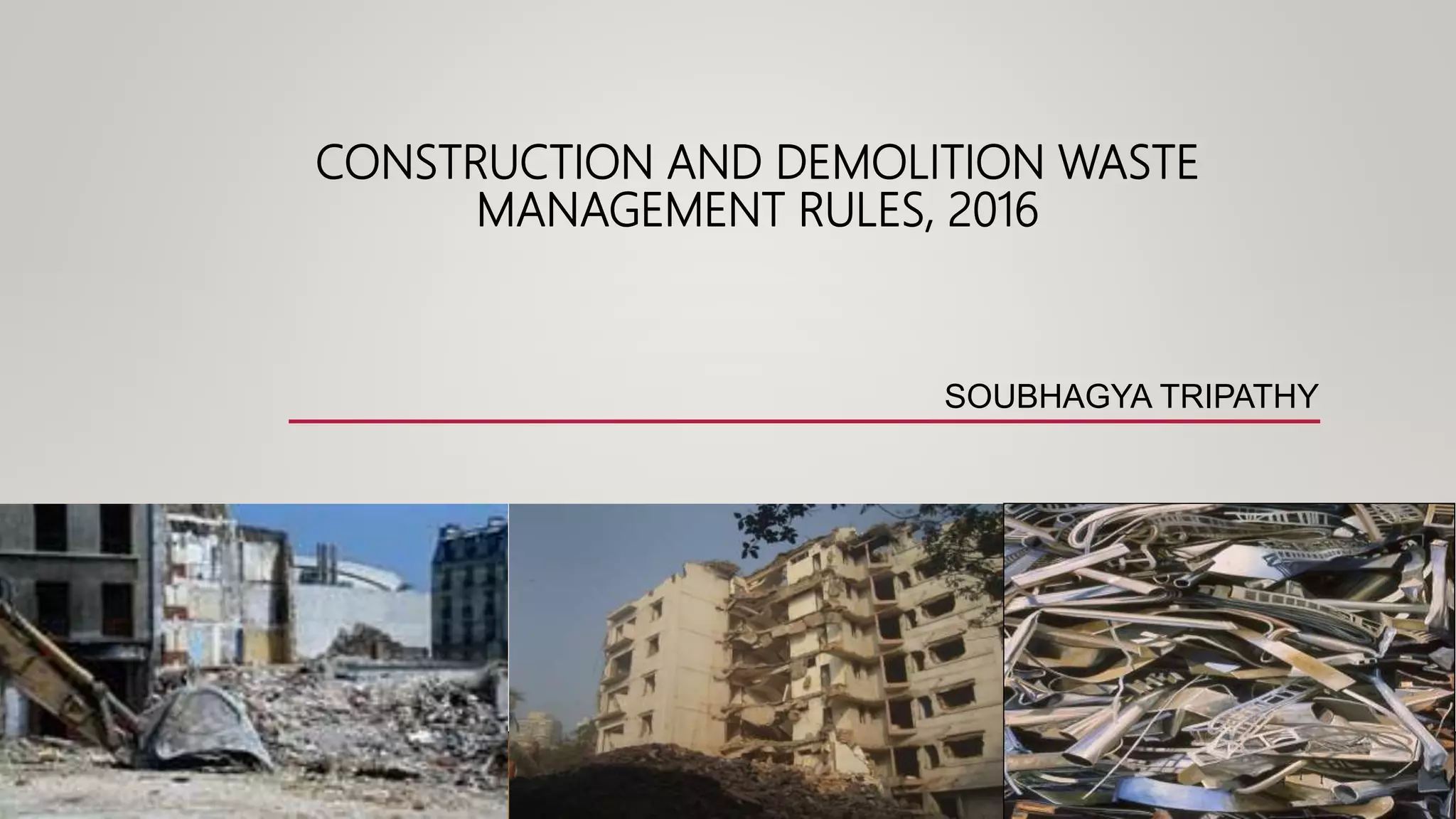
CONSTRUCTION AND DEMOLITION WASTE
MANAGEMENT RULES, 2016
SOUBHAGYA TRIPATHY
BACKGROUND
Municipal Solid Wastes (Management and Handling) Rules, 2000 published on 25th
September, 2000 which provided a regulatory framework for management of Municipal
Solid Waste generated in the urban area of the country.
A draft rule, namely, the Solid Waste Management Rules, 2015 with a separate chapter on
construction and demolition waste were published by the Central Government in the
Ministry of Environment, Forest and Climate Change on 3rd June, 2015 inviting objections
or suggestions from the public within sixty days from the date of publication of the said
notification. The objections or suggestions received within the stipulated period were duly
considered by the Central Government.
Thereafter, in supersession of the Municipal Solid Wastes (Management and Handling)
Rules, 2000, the Central Government notified rules for Management of Construction and
Demolition Waste and these rules are called the Construction and Demolition Waste
Management Rules, 2016.
CONTENTS
• Definition of C&D Wastes and Activities which generates C&D Wastes
• Composition of MSW and C&D Wastes
• Main Issues and Key Requirement of C&D Waste management Plan
• Hierarchy of Waste Management and Environmental Impacts of C&D Wastes
• Sorting Process of C&D Waste
• Waste Generator and Duties of Waste Generator
• Criteria for storage, processing or recycling facilities for C&D waste
• Accident Reporting by C&D Processing facilities
• C & D Waste generation in Life Cycle phases
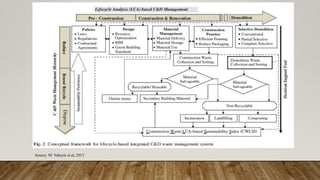
• Lifecycle based integrated C&D waste management
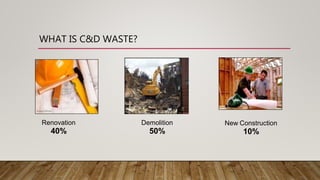
WHAT IS C&D WASTE?
Renovation
40%
Demolition
50%
New Construction
10%
DEFINITION OF C&D WASTE
“C&D Wastes means the waste comprising of building materials, debris and rubble
resulting from construction, re-modelling, repair and demolition of any civil structure
“De-construction” means a planned selective demolition in which salvage, re-use and
recycling of the demolished structure is maximized
“Demolition” means breaking down or tearing down buildings and other structures either
manually or using mechanical force (by various equipment) or by implosion using
explosives
Activities which generate C & D waste in cities / towns are mainly from:
i. Demolition of existing, old dilapidated structures;
ii. Renovation of existing buildings (residential or commercial);
iii. Construction of new buildings (residential or commercial or hotel
etc.);
iv. Excavation/ reconstruction of asphalt/ concrete roads;
v. Construction of new fly over bridges/ under bridges/ sub-ways etc.;
and
vi. Renovation/ Installation of new water/ telephone/ internet/ sewer
pipe lines etc.
vii. Present collection and disposal system.
ACTIVITIES WHICH GENERATE C&D WASTES
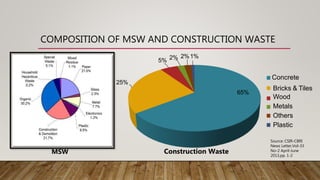
COMPOSITION OF MSW AND CONSTRUCTION WASTE
MSW Construction Waste
65%
25%
5% 2% 2%1%
Concrete
Bricks & Tiles
Wood
Metals
Others
Plastic
Source: CSIR-CBRI
News Letter,Vol-33
No-2 April-June
2013,pp. 1-2
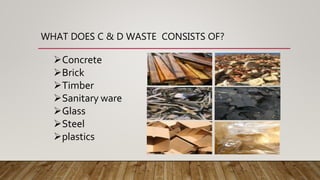
WHAT DOES C & D WASTE CONSISTS OF?
Concrete
Brick
Timber
Sanitary ware
Glass
Steel
plastics
MAIN ISSUES FOR C & D WASTE MANAGEMENT
 Absence of segregation of waste at source
 Lack of appropriately located recycling facilities
 Indifferent attitude of citizens toward waste management due
to lack of awareness.
 Illegal landfill practices done by contractor for saving money.
KEY REQUIREMENT OF C&D WASTE MANAGEMENT PLAN
 Types, quantities and qualities of wastes
 Measures for reducing waste generation
 On-site waste sorting
 On-site and off-site reuse
 Areas for waste storage
 Quantities of wastes requiring off-site disposal
 Monitoring and auditing program
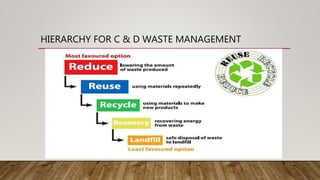
HIERARCHY FOR C & D WASTE MANAGEMENT
ENVIRONMENTAL IMPACTS OF C&D WASTES
• Landfill leaks (plasterboard release H2S)
• C & D makes municipal waste heavy
• Degrade the quality of municipal waste & makes it difficult for
further treatment like composting
• 10-20% finds its way into surface drains, choking them
• Other toxic elements such as lead, asbestos & radioactive materials
that can leak and pollute the water bodies
• Air pollution
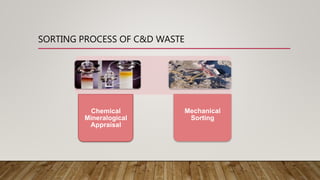
SORTING PROCESS OF C&D WASTE
Chemical
Mineralogical
Appraisal
Mechanical
Sorting
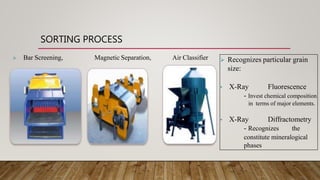
SORTING PROCESS
 Bar Screening, Magnetic Separation, Air Classifier  Recognizes particular grain
size:
• X-Ray Fluorescence
- Invest chemical composition
in terms of major elements.
• X-Ray Diffractometry
- Recognizes the
constitute mineralogical
phases
WASTE GRENERATOR – MEANING
“Waste generator” means any person or association of persons or
institution, residential and commercial establishments including Indian
Railways, Airport, Port and Harbour and Defence establishments who
undertakes construction of or demolition of any civil structure which
generate construction and demolition waste.
Duties of the waste generator –
(1) Every waste generator shall prima-facie be responsible for collection,
segregation of concrete, soil and others and storage of construction and
demolition waste generated, as directed or notified by the concerned local
authority in consonance with these rules.
DUTIES OF WASTE GENERATOR
(2) The generator shall ensure that solid waste does not get mixed with
this waste and is stored and disposed separately.
(3) Waste generators who generate more than 20 tons or more in one
day or 300 tons per project in a month shall segregate the waste into
four streams such as concrete, soil, steel, wood and plastics, bricks and
mortar and shall submit waste management plan and get appropriate
approvals from the local authority before starting construction or
demolition or remodelling work and keep the concerned.
DUTIES OF THE WASTE GENERATOR
Every waste generator shall keep the construction and demolition waste
within the premise
or
get the waste deposited at collection centre so made by the local body or
handover it to the authorised processing facilities of construction and
demolition waste;
and
ensure that there is no littering or deposition of construction and
demolition waste so as to prevent obstruction to the traffic or the public or
drains.
DUTIES OF THE WASTE GENERATOR
Every waste generator shall pay relevant charges for collection,
transportation, processing and disposal as notified by the concerned
authorities;
Waste generators who generate more than 20 tons or more in one
day or 300 tons per project in a month shall have to pay for the
processing and disposal of construction and demolition waste
generated by them, apart from the payment for storage, collection
and transportation.
ESTIMATION OF C&D WASTE
Technology Information, Forecasting and Assessment Council's (TIFAC) has
developed some estimations on C & D waste generation which recognizes
that the generation is project specific as follows:
a. Range 40-60 kg per sq.m of new construction,
b. Range 40-50 kg per sq.m of building repair,
c. Range 300-500 kg per sq.m for demolition of buildings.
FIVE categories of existing C & D waste quantification methodologies are
reported: Site visit method, Waste generation rate method, Lifetime analysis
method, Classification system accumulation method and Variables modelling
method
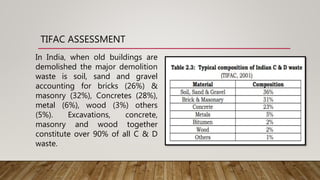
TIFAC ASSESSMENT
In India, when old buildings are
demolished the major demolition
waste is soil, sand and gravel
accounting for bricks (26%) &
masonry (32%), Concretes (28%),
metal (6%), wood (3%) others
(5%). Excavations, concrete,
masonry and wood together
constitute over 90% of all C & D
waste.
CRITERIA FOR STORAGE, PROCESSING OR RECYCLING FACILITIES FOR
CONSTRUCTION AND DEMOLITION WASTE
Construction and demolition waste shall be utilized in sanitary landfill
for municipal solid waste of the city or region. Residues from
construction and demolition waste processing or recycling industries
shall be land filled in the sanitary landfill for solid waste.
The processing or recycling shall be large enough to last for 20-25
years (project based on-site recycling facilities). The processing or
recycling site shall be away from habitation clusters, forest areas, water
bodies, monuments, National Parks, Wetlands and places of important
cultural, historical or religious interest.
PROVISIONS AT THE STORAGE SITES
Utilities such as drinking water and sanitary facilities (preferably
washing/bathing facilities for workers) and lighting arrangements for
landfill operations during night hours shall be provided. In order to
prevent pollution from processing or recycling operations, the following
provisions shall be made, namely:
(a) Provision of storm water drains to prevent stagnation of surface
water;
(b) Provision of paved or concreted surface in selected areas in the
processing or recycling facility for minimizing dust and damage to the
site.
(c) Prevention of noise pollution from processing and recycling plant:
(d) provision for treatment of effluent if any, to meet the discharge norms
as per Environment (Protection) Rules, 1986.
Fines from construction and demolition processed waste having size up
to 2 mm shall be used for daily cover over the fresh waste. During hot
windy days in summer months, some fugitive dust problems may arise.
These can be minimised by mixing with local soil wherever available for
limited period.
Use of construction and demolition fines as landfill cover shall be
mandatory where such material is available. Fresh soil (sweet earth)
shall not be used for such places and borrow-pits shall not be allowed.
Exception – soil excavated during construction of the same landfill.
STORAGE, PROCESSING OR RECYCLING PRACTICES
• The following project shall be exempted from the norms of
pollution from dust and noise as mentioned above:
For construction work, where at least 80 percent construction and
demolition waste is recycled or reused in-situ and sufficient buffer
area is available to protect the surrounding habitation from any
adverse impact.
• Work Zone air quality at the Processing or Recycling site and
ambient air quality at the vicinity shall be monitored.
• The measurement of ambient noise shall be done at the interface of
the facility with the surrounding area, i.e., at plant boundary.
MONITOING FACILITIES AT STORAGE SITES
ACCIDENT REPORTING BY C & D WASTE PROCESSING FACILITIES
In case of any accident during construction and demolition waste processing
or treatment or disposal facility, the officer in charge of the facility in the
local authority or the operator of the facility shall report of the accident in
Form-V to the local authority. Local body shall review and issue instruction
if any, to the incharge of the facility.
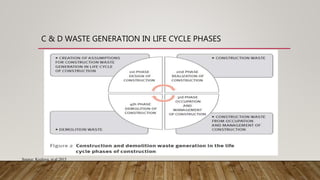
Source: Kozlova, et.al.2015
C & D WASTE GENERATION IN LIFE CYCLE PHASES
Source: M. Yeheyis et.al, 2013
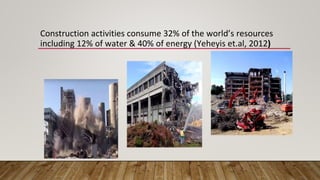
Construction activities consume 32% of the world’s resources
including 12% of water & 40% of energy (Yeheyis et.al, 2012)
The Choice Is Yours
To Landfill To Recycle
THANK YOU

Construction and Demolition Waste Management.pptx

  • 1.
    CONSTRUCTION AND DEMOLITIONWASTE MANAGEMENT RULES, 2016 SOUBHAGYA TRIPATHY
  • 2.
    BACKGROUND Municipal Solid Wastes(Management and Handling) Rules, 2000 published on 25th September, 2000 which provided a regulatory framework for management of Municipal Solid Waste generated in the urban area of the country. A draft rule, namely, the Solid Waste Management Rules, 2015 with a separate chapter on construction and demolition waste were published by the Central Government in the Ministry of Environment, Forest and Climate Change on 3rd June, 2015 inviting objections or suggestions from the public within sixty days from the date of publication of the said notification. The objections or suggestions received within the stipulated period were duly considered by the Central Government. Thereafter, in supersession of the Municipal Solid Wastes (Management and Handling) Rules, 2000, the Central Government notified rules for Management of Construction and Demolition Waste and these rules are called the Construction and Demolition Waste Management Rules, 2016.
  • 3.
    CONTENTS • Definition ofC&D Wastes and Activities which generates C&D Wastes • Composition of MSW and C&D Wastes • Main Issues and Key Requirement of C&D Waste management Plan • Hierarchy of Waste Management and Environmental Impacts of C&D Wastes • Sorting Process of C&D Waste • Waste Generator and Duties of Waste Generator • Criteria for storage, processing or recycling facilities for C&D waste • Accident Reporting by C&D Processing facilities • C & D Waste generation in Life Cycle phases • Lifecycle based integrated C&D waste management
  • 4.
    WHAT IS C&DWASTE? Renovation 40% Demolition 50% New Construction 10%
  • 5.
    DEFINITION OF C&DWASTE “C&D Wastes means the waste comprising of building materials, debris and rubble resulting from construction, re-modelling, repair and demolition of any civil structure “De-construction” means a planned selective demolition in which salvage, re-use and recycling of the demolished structure is maximized “Demolition” means breaking down or tearing down buildings and other structures either manually or using mechanical force (by various equipment) or by implosion using explosives
  • 6.
    Activities which generateC & D waste in cities / towns are mainly from: i. Demolition of existing, old dilapidated structures; ii. Renovation of existing buildings (residential or commercial); iii. Construction of new buildings (residential or commercial or hotel etc.); iv. Excavation/ reconstruction of asphalt/ concrete roads; v. Construction of new fly over bridges/ under bridges/ sub-ways etc.; and vi. Renovation/ Installation of new water/ telephone/ internet/ sewer pipe lines etc. vii. Present collection and disposal system. ACTIVITIES WHICH GENERATE C&D WASTES
  • 7.
    COMPOSITION OF MSWAND CONSTRUCTION WASTE MSW Construction Waste 65% 25% 5% 2% 2%1% Concrete Bricks & Tiles Wood Metals Others Plastic Source: CSIR-CBRI News Letter,Vol-33 No-2 April-June 2013,pp. 1-2
  • 8.
    WHAT DOES C& D WASTE CONSISTS OF? Concrete Brick Timber Sanitary ware Glass Steel plastics
  • 9.
    MAIN ISSUES FORC & D WASTE MANAGEMENT  Absence of segregation of waste at source  Lack of appropriately located recycling facilities  Indifferent attitude of citizens toward waste management due to lack of awareness.  Illegal landfill practices done by contractor for saving money.
  • 10.
    KEY REQUIREMENT OFC&D WASTE MANAGEMENT PLAN  Types, quantities and qualities of wastes  Measures for reducing waste generation  On-site waste sorting  On-site and off-site reuse  Areas for waste storage  Quantities of wastes requiring off-site disposal  Monitoring and auditing program
  • 11.
    HIERARCHY FOR C& D WASTE MANAGEMENT
  • 12.
    ENVIRONMENTAL IMPACTS OFC&D WASTES • Landfill leaks (plasterboard release H2S) • C & D makes municipal waste heavy • Degrade the quality of municipal waste & makes it difficult for further treatment like composting • 10-20% finds its way into surface drains, choking them • Other toxic elements such as lead, asbestos & radioactive materials that can leak and pollute the water bodies • Air pollution
  • 13.
    SORTING PROCESS OFC&D WASTE Chemical Mineralogical Appraisal Mechanical Sorting
  • 14.
    SORTING PROCESS  BarScreening, Magnetic Separation, Air Classifier  Recognizes particular grain size: • X-Ray Fluorescence - Invest chemical composition in terms of major elements. • X-Ray Diffractometry - Recognizes the constitute mineralogical phases
  • 15.
    WASTE GRENERATOR –MEANING “Waste generator” means any person or association of persons or institution, residential and commercial establishments including Indian Railways, Airport, Port and Harbour and Defence establishments who undertakes construction of or demolition of any civil structure which generate construction and demolition waste. Duties of the waste generator – (1) Every waste generator shall prima-facie be responsible for collection, segregation of concrete, soil and others and storage of construction and demolition waste generated, as directed or notified by the concerned local authority in consonance with these rules.
  • 16.
    DUTIES OF WASTEGENERATOR (2) The generator shall ensure that solid waste does not get mixed with this waste and is stored and disposed separately. (3) Waste generators who generate more than 20 tons or more in one day or 300 tons per project in a month shall segregate the waste into four streams such as concrete, soil, steel, wood and plastics, bricks and mortar and shall submit waste management plan and get appropriate approvals from the local authority before starting construction or demolition or remodelling work and keep the concerned.
  • 17.
    DUTIES OF THEWASTE GENERATOR Every waste generator shall keep the construction and demolition waste within the premise or get the waste deposited at collection centre so made by the local body or handover it to the authorised processing facilities of construction and demolition waste; and ensure that there is no littering or deposition of construction and demolition waste so as to prevent obstruction to the traffic or the public or drains.
  • 18.
    DUTIES OF THEWASTE GENERATOR Every waste generator shall pay relevant charges for collection, transportation, processing and disposal as notified by the concerned authorities; Waste generators who generate more than 20 tons or more in one day or 300 tons per project in a month shall have to pay for the processing and disposal of construction and demolition waste generated by them, apart from the payment for storage, collection and transportation.
  • 19.
    ESTIMATION OF C&DWASTE Technology Information, Forecasting and Assessment Council's (TIFAC) has developed some estimations on C & D waste generation which recognizes that the generation is project specific as follows: a. Range 40-60 kg per sq.m of new construction, b. Range 40-50 kg per sq.m of building repair, c. Range 300-500 kg per sq.m for demolition of buildings. FIVE categories of existing C & D waste quantification methodologies are reported: Site visit method, Waste generation rate method, Lifetime analysis method, Classification system accumulation method and Variables modelling method
  • 20.
    TIFAC ASSESSMENT In India,when old buildings are demolished the major demolition waste is soil, sand and gravel accounting for bricks (26%) & masonry (32%), Concretes (28%), metal (6%), wood (3%) others (5%). Excavations, concrete, masonry and wood together constitute over 90% of all C & D waste.
  • 21.
    CRITERIA FOR STORAGE,PROCESSING OR RECYCLING FACILITIES FOR CONSTRUCTION AND DEMOLITION WASTE Construction and demolition waste shall be utilized in sanitary landfill for municipal solid waste of the city or region. Residues from construction and demolition waste processing or recycling industries shall be land filled in the sanitary landfill for solid waste. The processing or recycling shall be large enough to last for 20-25 years (project based on-site recycling facilities). The processing or recycling site shall be away from habitation clusters, forest areas, water bodies, monuments, National Parks, Wetlands and places of important cultural, historical or religious interest.
  • 22.
    PROVISIONS AT THESTORAGE SITES Utilities such as drinking water and sanitary facilities (preferably washing/bathing facilities for workers) and lighting arrangements for landfill operations during night hours shall be provided. In order to prevent pollution from processing or recycling operations, the following provisions shall be made, namely: (a) Provision of storm water drains to prevent stagnation of surface water; (b) Provision of paved or concreted surface in selected areas in the processing or recycling facility for minimizing dust and damage to the site. (c) Prevention of noise pollution from processing and recycling plant: (d) provision for treatment of effluent if any, to meet the discharge norms as per Environment (Protection) Rules, 1986.
  • 23.
    Fines from constructionand demolition processed waste having size up to 2 mm shall be used for daily cover over the fresh waste. During hot windy days in summer months, some fugitive dust problems may arise. These can be minimised by mixing with local soil wherever available for limited period. Use of construction and demolition fines as landfill cover shall be mandatory where such material is available. Fresh soil (sweet earth) shall not be used for such places and borrow-pits shall not be allowed. Exception – soil excavated during construction of the same landfill. STORAGE, PROCESSING OR RECYCLING PRACTICES
  • 24.
    • The followingproject shall be exempted from the norms of pollution from dust and noise as mentioned above: For construction work, where at least 80 percent construction and demolition waste is recycled or reused in-situ and sufficient buffer area is available to protect the surrounding habitation from any adverse impact. • Work Zone air quality at the Processing or Recycling site and ambient air quality at the vicinity shall be monitored. • The measurement of ambient noise shall be done at the interface of the facility with the surrounding area, i.e., at plant boundary. MONITOING FACILITIES AT STORAGE SITES
  • 25.
    ACCIDENT REPORTING BYC & D WASTE PROCESSING FACILITIES In case of any accident during construction and demolition waste processing or treatment or disposal facility, the officer in charge of the facility in the local authority or the operator of the facility shall report of the accident in Form-V to the local authority. Local body shall review and issue instruction if any, to the incharge of the facility.
  • 26.
    Source: Kozlova, et.al.2015 C& D WASTE GENERATION IN LIFE CYCLE PHASES
  • 27.
    Source: M. Yeheyiset.al, 2013
  • 28.
    Construction activities consume32% of the world’s resources including 12% of water & 40% of energy (Yeheyis et.al, 2012)
  • 29.
    The Choice IsYours To Landfill To Recycle THANK YOU