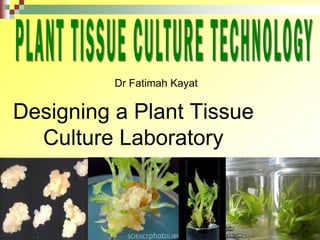
Designing a Plant Tissue
Culture Laboratory
Dr Fatimah Kayat
Outline
 Introduction
 General laboratory design
 Washing & Storage
 Media Preparation
 Instrumentation
 Aseptic transfer area
 Primary growth room
INTRODUCTION
 Certain elements are essential for a
successful operation
 The correct and strategic design helps to
achieve a high standard work.
 Careful planning is an important step
considering the size and location.
 A small lab should be set up first until the
proper techniques and markets are
developed.
 STRATEGIC PLANNING
 Good locations
Isolation from traffic.
No contamination from adjacent rooms.
 Access to water & electricity supply
 Connection to a septic system or sanitary
sewer
CONSIDER
CONSIDER
 Water service
 Air conditioning
 maintain constant temperature
 Electrical service capacity
 equipment, lights and future expansion
 An emergency generator
 to operate essential equipment during
power breakdown
PRIORITY
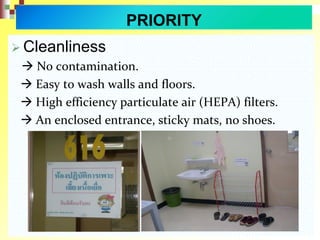
 Cleanliness
 No contamination.
 Easy to wash walls and floors.
 High efficiency particulate air (HEPA) filters.
 An enclosed entrance, sticky mats, no shoes.
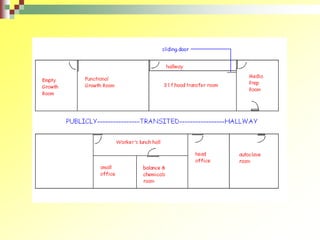
 Traffic pattern and work flow
 The cleanest rooms or areas
 Aseptic transfer area
 Primary growth room
 Could not enter directly from outside.
 Should be enclosed with doors leading to each other
 Media preparation area, washing area, storage
area should be outside these rooms.
 Media preparation area should lead to the
sterilization area
TO CONSIDER
 Washing area located near sterilization and media
preparation area.
 should be equipped with at least one large sink.
 The pipes can be PVC to resist damage from acids
and alkaline
 Hot/cold water sources
 Water distillation and/or deionization devices
 Ovens or hot air cabinets (75 oC) close to the washing
and storage area
WASHING & STORAGE AREA
 Storage area should be close to the washing
area for storage
 Need to be accessible to the media preparation
area
 Dust-proof cabinets can be used in the storage
area
WASHING & STORAGE AREA
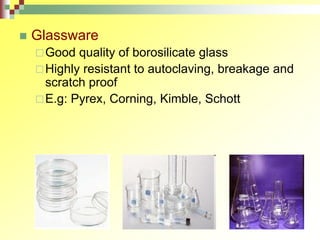
 Glassware
Good quality of borosilicate glass
Highly resistant to autoclaving, breakage and
scratch proof
E.g: Pyrex, Corning, Kimble, Schott
 Water source and storage area should be
convenient to the media preparation area.
 A variety of equipment for media preparation are
generally located in the media preparation area.
MEDIA PREPARATION &
STERILIZATION AREA
BASICS EQUIPMENT
 Refrigerator/freezer
 to store chemicals and stock solutions
(usually in media preparation area)
 High quality water
 Purchasing bottled water is not economical for
mass production
 Distilled water, double distilled water devices
(usually in washing area)
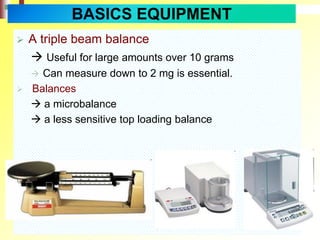
 A triple beam balance
 Useful for large amounts over 10 grams
 Can measure down to 2 mg is essential.
 Balances
 a microbalance
 a less sensitive top loading balance
BASICS EQUIPMENT
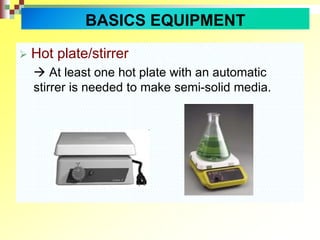
 Hot plate/stirrer
 At least one hot plate with an automatic
stirrer is needed to make semi-solid media.
BASICS EQUIPMENT
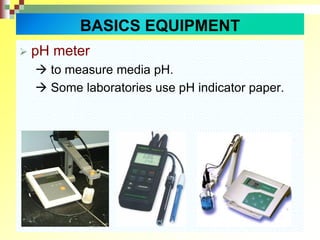
 pH meter
 to measure media pH.
 Some laboratories use pH indicator paper.
BASICS EQUIPMENT
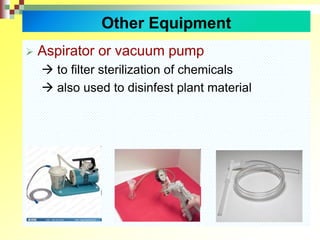
 Aspirator or vacuum pump
 to filter sterilization of chemicals
 also used to disinfest plant material
Other Equipment
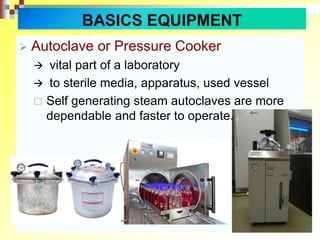
 Autoclave or Pressure Cooker
 vital part of a laboratory
 to sterile media, apparatus, used vessel
 Self generating steam autoclaves are more
dependable and faster to operate.
BASICS EQUIPMENT
 Optional equipment
Microwave oven are convenient for defrosting
frozen stocks and heating agar media
Dissecting microscopes are useful for
dissecting floral and shoot apices, and
observing plant culture growth
Labwashers/dishwashers are useful for
washing and drying glassware (mass
production)
OTHER EQUIPMENT
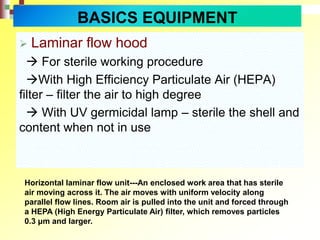
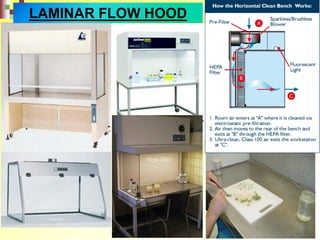
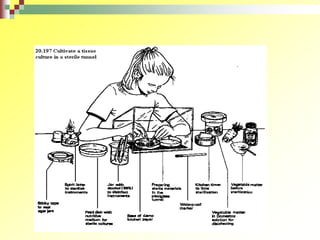
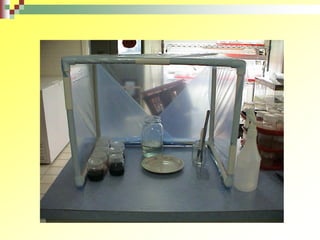
 Laminar flow hood
 For sterile working procedure
With High Efficiency Particulate Air (HEPA)
filter – filter the air to high degree
 With UV germicidal lamp – sterile the shell and
content when not in use
Horizontal laminar flow unit---An enclosed work area that has sterile
air moving across it. The air moves with uniform velocity along
parallel flow lines. Room air is pulled into the unit and forced through
a HEPA (High Energy Particulate Air) filter, which removes particles
0.3 μm and larger.
BASICS EQUIPMENT
LAMINAR FLOW HOOD
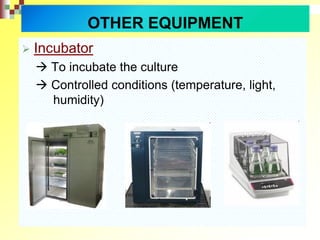
 Incubator
 To incubate the culture
 Controlled conditions (temperature, light,
humidity)
OTHER EQUIPMENT
 Need to be as clean as possible
 Preferably separated from other rooms
 to decreases spore circulation and allows personnel to
leave shoes outside the room.
 Laboratory shoes and lab coats should be worn
 Aseptic working area.
 Ultraviolet (UV) lights are sometimes installed to
disinfect the room (only switched on when people
and plant material are not in the room)
 Safety switches can be installed to shut off the UV
lights.
 air filters are sometimes installed to provide clean air
ASEPTIC TRANSFER AREA
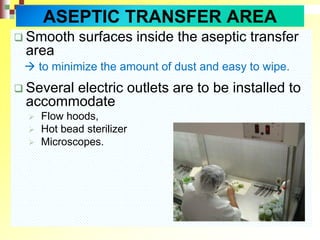
 Smooth surfaces inside the aseptic transfer
area
 to minimize the amount of dust and easy to wipe.
 Several electric outlets are to be installed to
accommodate
 Flow hoods,
 Hot bead sterilizer
 Microscopes.
ASEPTIC TRANSFER AREA
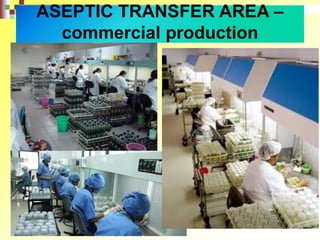
ASEPTIC TRANSFER AREA –
commercial production
PRIMARY GROWTH
ROOM
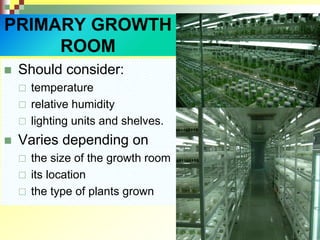
 Should consider:
 temperature
 relative humidity
 lighting units and shelves.
 Varies depending on
 the size of the growth room
 its location
 the type of plants grown
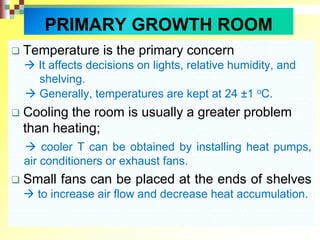
 Temperature is the primary concern
 It affects decisions on lights, relative humidity, and
shelving.
 Generally, temperatures are kept at 24 ±1 oC.
 Cooling the room is usually a greater problem
than heating;
 cooler T can be obtained by installing heat pumps,
air conditioners or exhaust fans.
 Small fans can be placed at the ends of shelves
 to increase air flow and decrease heat accumulation.
PRIMARY GROWTH ROOM
PRIMARY GROWTH ROOM
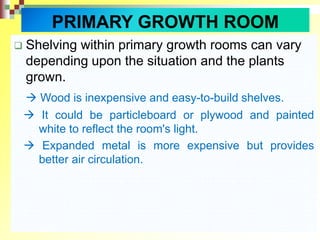
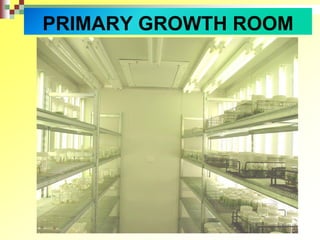
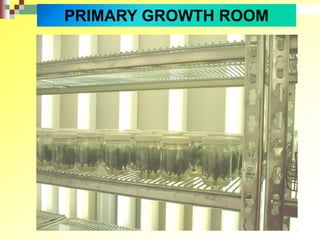
 Shelving within primary growth rooms can vary
depending upon the situation and the plants
grown.
 Wood is inexpensive and easy-to-build shelves.
 It could be particleboard or plywood and painted
white to reflect the room's light.
 Expanded metal is more expensive but provides
better air circulation.
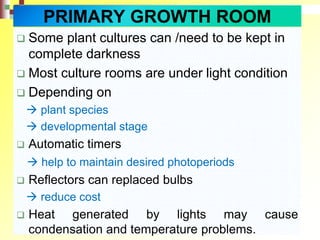
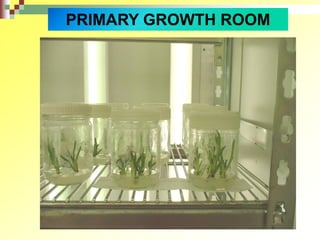
 Some plant cultures can /need to be kept in
complete darkness
 Most culture rooms are under light condition
 Depending on
 plant species
 developmental stage
 Automatic timers
 help to maintain desired photoperiods
 Reflectors can replaced bulbs
 reduce cost
 Heat generated by lights may cause
condensation and temperature problems.
PRIMARY GROWTH ROOM
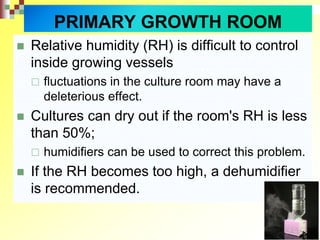
 Relative humidity (RH) is difficult to control
inside growing vessels
 fluctuations in the culture room may have a
deleterious effect.
 Cultures can dry out if the room's RH is less
than 50%;
 humidifiers can be used to correct this problem.
 If the RH becomes too high, a dehumidifier
is recommended.
PRIMARY GROWTH ROOM
PRIMARY GROWTH ROOM
PRIMARY GROWTH ROOM
PRIMARY GROWTH ROOM
Any questions?
W2 lab design_new2

W2 lab design_new2

  • 1.
    Designing a PlantTissue Culture Laboratory Dr Fatimah Kayat
  • 2.
    Outline  Introduction  Generallaboratory design  Washing & Storage  Media Preparation  Instrumentation  Aseptic transfer area  Primary growth room
  • 3.
    INTRODUCTION  Certain elementsare essential for a successful operation  The correct and strategic design helps to achieve a high standard work.  Careful planning is an important step considering the size and location.  A small lab should be set up first until the proper techniques and markets are developed.  STRATEGIC PLANNING
  • 5.
     Good locations Isolationfrom traffic. No contamination from adjacent rooms.  Access to water & electricity supply  Connection to a septic system or sanitary sewer CONSIDER
  • 6.
    CONSIDER  Water service Air conditioning  maintain constant temperature  Electrical service capacity  equipment, lights and future expansion  An emergency generator  to operate essential equipment during power breakdown
  • 7.
    PRIORITY  Cleanliness  Nocontamination.  Easy to wash walls and floors.  High efficiency particulate air (HEPA) filters.  An enclosed entrance, sticky mats, no shoes.
  • 8.
     Traffic patternand work flow  The cleanest rooms or areas  Aseptic transfer area  Primary growth room  Could not enter directly from outside.  Should be enclosed with doors leading to each other  Media preparation area, washing area, storage area should be outside these rooms.  Media preparation area should lead to the sterilization area TO CONSIDER
  • 9.
     Washing arealocated near sterilization and media preparation area.  should be equipped with at least one large sink.  The pipes can be PVC to resist damage from acids and alkaline  Hot/cold water sources  Water distillation and/or deionization devices  Ovens or hot air cabinets (75 oC) close to the washing and storage area WASHING & STORAGE AREA
  • 10.
     Storage areashould be close to the washing area for storage  Need to be accessible to the media preparation area  Dust-proof cabinets can be used in the storage area WASHING & STORAGE AREA
  • 11.
     Glassware Good qualityof borosilicate glass Highly resistant to autoclaving, breakage and scratch proof E.g: Pyrex, Corning, Kimble, Schott
  • 12.
     Water sourceand storage area should be convenient to the media preparation area.  A variety of equipment for media preparation are generally located in the media preparation area. MEDIA PREPARATION & STERILIZATION AREA
  • 13.
    BASICS EQUIPMENT  Refrigerator/freezer to store chemicals and stock solutions (usually in media preparation area)  High quality water  Purchasing bottled water is not economical for mass production  Distilled water, double distilled water devices (usually in washing area)
  • 14.
     A triplebeam balance  Useful for large amounts over 10 grams  Can measure down to 2 mg is essential.  Balances  a microbalance  a less sensitive top loading balance BASICS EQUIPMENT
  • 15.
     Hot plate/stirrer At least one hot plate with an automatic stirrer is needed to make semi-solid media. BASICS EQUIPMENT
  • 16.
     pH meter to measure media pH.  Some laboratories use pH indicator paper. BASICS EQUIPMENT
  • 17.
     Aspirator orvacuum pump  to filter sterilization of chemicals  also used to disinfest plant material Other Equipment
  • 18.
     Autoclave orPressure Cooker  vital part of a laboratory  to sterile media, apparatus, used vessel  Self generating steam autoclaves are more dependable and faster to operate. BASICS EQUIPMENT
  • 19.
     Optional equipment Microwaveoven are convenient for defrosting frozen stocks and heating agar media Dissecting microscopes are useful for dissecting floral and shoot apices, and observing plant culture growth Labwashers/dishwashers are useful for washing and drying glassware (mass production) OTHER EQUIPMENT
  • 20.
     Laminar flowhood  For sterile working procedure With High Efficiency Particulate Air (HEPA) filter – filter the air to high degree  With UV germicidal lamp – sterile the shell and content when not in use Horizontal laminar flow unit---An enclosed work area that has sterile air moving across it. The air moves with uniform velocity along parallel flow lines. Room air is pulled into the unit and forced through a HEPA (High Energy Particulate Air) filter, which removes particles 0.3 μm and larger. BASICS EQUIPMENT
  • 21.
  • 24.
     Incubator  Toincubate the culture  Controlled conditions (temperature, light, humidity) OTHER EQUIPMENT
  • 25.
     Need tobe as clean as possible  Preferably separated from other rooms  to decreases spore circulation and allows personnel to leave shoes outside the room.  Laboratory shoes and lab coats should be worn  Aseptic working area.  Ultraviolet (UV) lights are sometimes installed to disinfect the room (only switched on when people and plant material are not in the room)  Safety switches can be installed to shut off the UV lights.  air filters are sometimes installed to provide clean air ASEPTIC TRANSFER AREA
  • 26.
     Smooth surfacesinside the aseptic transfer area  to minimize the amount of dust and easy to wipe.  Several electric outlets are to be installed to accommodate  Flow hoods,  Hot bead sterilizer  Microscopes. ASEPTIC TRANSFER AREA
  • 27.
    ASEPTIC TRANSFER AREA– commercial production
  • 28.
    PRIMARY GROWTH ROOM  Shouldconsider:  temperature  relative humidity  lighting units and shelves.  Varies depending on  the size of the growth room  its location  the type of plants grown
  • 29.
     Temperature isthe primary concern  It affects decisions on lights, relative humidity, and shelving.  Generally, temperatures are kept at 24 ±1 oC.  Cooling the room is usually a greater problem than heating;  cooler T can be obtained by installing heat pumps, air conditioners or exhaust fans.  Small fans can be placed at the ends of shelves  to increase air flow and decrease heat accumulation. PRIMARY GROWTH ROOM
  • 30.
    PRIMARY GROWTH ROOM Shelving within primary growth rooms can vary depending upon the situation and the plants grown.  Wood is inexpensive and easy-to-build shelves.  It could be particleboard or plywood and painted white to reflect the room's light.  Expanded metal is more expensive but provides better air circulation.
  • 31.
     Some plantcultures can /need to be kept in complete darkness  Most culture rooms are under light condition  Depending on  plant species  developmental stage  Automatic timers  help to maintain desired photoperiods  Reflectors can replaced bulbs  reduce cost  Heat generated by lights may cause condensation and temperature problems. PRIMARY GROWTH ROOM
  • 32.
     Relative humidity(RH) is difficult to control inside growing vessels  fluctuations in the culture room may have a deleterious effect.  Cultures can dry out if the room's RH is less than 50%;  humidifiers can be used to correct this problem.  If the RH becomes too high, a dehumidifier is recommended. PRIMARY GROWTH ROOM
  • 33.
  • 34.
  • 35.
  • 36.