INTRODUCTION TO
PLANT TISSUE CULTURE
TECHNOLOGY
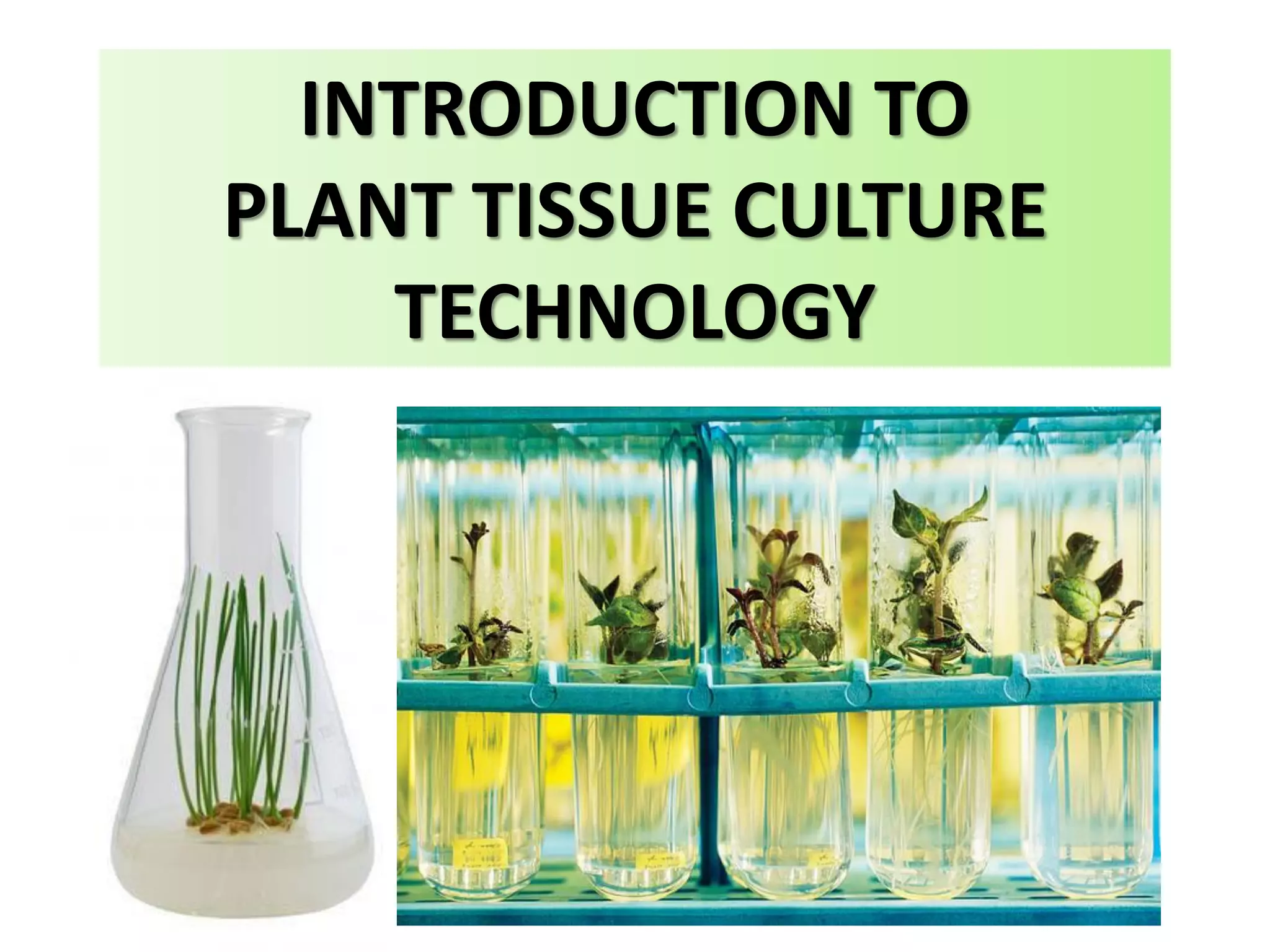
PLANT TISSUE CULTURE ?
Any technique of growing cells/tissues/organs/seeds/
embryos or other plant parts in a controlled environment
on a nutrient medium
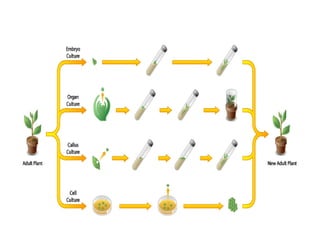
Cultural techniques for regeneration of functional
plants from different tissues/organs/cells/protoplasts
Also known as micropropagation
The growth or maintenance of plant cells, tissues,
organs or whole plants in vitro.
 the science of growing plant cells/tissues/organs
isolated from the mother plant on artificial media.
• Faster propagation  reduce the time
• Speed up the selection process for crop
improvement  save time
• Disease free plants
• Save space  reduce cost
• Pharmaceutical properties
• Conservation of endangered species
• Management of genetic resources
WHY?
WHY?
 Mass propagation/production
 Plant breeding
 selection of somaclonal variants
 mutation selection
 haploid/dihaploid production
 In-vitro hybridization – protoplast fusion
 Genetic manipulation
 Secondary product synthesis
HISTORY – Chronology of Important Development
 1902 (Gottlieb Haberlandt)
 culture isolated, differentiated cells from leaves of various
plants on salt solution (Knop’s) with sucrose.
 maintain cells alive for a period but not divided (lack of
plant hormones).
 continued cell division in explanted tissues on
artificial medium.
 1922 (Robbins & Kotte)  culture of isolated root tips.
 1934 (White)  culture of tomato roots (long period).
 culture tomato meristematic cells on medium containing
salts, yeast extract, sucrose, vitamin B (pyridoxine, thiamine,
nicotinic acid)
 1939 (Gautheret & Nobecourt)  1st long term
callus culture involving cambial tissues of carrot.
 1939 (White)  Callus culture of tobacco tumor
tissues from interspecific hybrid of Nicotina glaucum x
N.longsdorffi.
 1941 (Van Overbeek)  Discovery of nutritional
value
 1942 (White & Braun)  Experiments on crown-
gall and tumor formation in plants, growth of bacteria
free crown-gall tissues.
 1948 (Caplan & Steward)  Use of coconut milk +
2,4-D for proliferation of carrot and potato.
HISTORY-(cont.)
 1950 (Morel)  Culture of monocot tissues using
coconut milk.
 1953 (Muir)  Innoculation of callus in liquid medium.
Development of technique for single isolated cell culture.
 1953 (Tulecke)  Haploid culture from pollen
gymnosperm (Ginkgo).
 1955 (Miller et al.,)  Discovery of cytokinins
(kinetin).
 1955 (Ball)  Culture of gymnosperm tissues (Sequoia).
 1957 (Skoog & Miller)  Hypothesis that shoot and
root initiation in cultured callus is regulated by the
proportion of auzin and cytokinins.
HISTORY-(cont.)
 1960 (Cocking)  Enzymatic isolation and culture of
protoplast.
 1960 (Morel)  Development of shoot apex culture
technique.
 1964 (Morel)  Use of modified shoot apex
technique for orchid proportion.
 1966 (Guha & Maheshwari)  Cultured anthers
and pollen and produce haploid embryos.
 1974 (Nitsch)  Culture of microspores of Datura
and Nicotina to double up the chromosome number.
HISTORY-(cont.)
 1978 (Melchers)  Production of somatic hybrids
from attached to plasmid vectors into naked plant
protoplast.
 1983 (Barton et al.,)  Insertion of foreign genes
attached to plasmid vectors into naked plant protoplast.
 1983 (Chilton)  Production of transformed tobacco
plants following single cell transformation or gene
insertion.
HISTORY-(cont.)
BASIS
• Plant hormones
 Auxin
 Cytokinin
 The ratio can determine plant growth and
development
 Auxin > Cytokinin
 Auxin < Cytokinin
 auxin = Cytokinin
 Totipotency of plant cells
 ability to develop into whole plants/plant
organs in vitro
 not all cells are totipotent
 Differentiated cells can be dedifferentiated
 callus
 callus can be redifferentiated back to
somatic embryo which later regenerate the
entire plant
BASIS/PRINCIPLE
 Growth Media
 minerals, C source, hormones, etc.
 Environmental
 light, T, photoperiod, etc.
 Explant Source
 age, type of organ, etc.
 Genetics
 diff species or genotype have diFf
response
FACTORS
• Adventitious - Developing from unusual points of origin, such as
shoot or root tissues, from callus or embryos, from sources other
than zygotes.
• Agar - a polysaccharide powder derived from algae used to
solidify a medium.
• Aseptic - Free of microorganisms.
• Aseptic Technique - Procedures used to prevent the introduction
of microorganisms into cultures.
• Autoclave - An equipment that provides heat under high steam
pressure for sterilization.
• Axillary bud/shoot - bud/shoot arises from the axil of leaves or
normal origin.
• Callus - An unorganized, proliferate mass of differentiated plant
cells, a natural response of wound.
TERMINOLOGY
• Chemically Defined Medium - A nutritive solution for culturing
cells in which each component is specifiable and ideally of known
chemical structure.
• Clone - Plants produced asexually from a single source plant.
• Clonal Propagation - Asexual reproduction of plants that are
considered to be genetically uniform and originated from a single
individual or explant.
• Contamination - Being infested with unwanted microorganisms.
• Culture - plant growing in vitro.
• Differentiated - Cells that maintain, in culture, all or much of the
specialized structure and function typical of the cell type in vivo.
Modifications of new cells to form tissues/organs with a specific
function.
• Epigenetic changes - persistent changes in phenotype that involve
the expression of particular genes.
TERMINOLOGY
• Explant - Tissue taken from its original site and transferred to an
artificial medium for growth or maintenance.
• Hormones - Growth regulators, generally synthetic in occurrence,
that strongly affects growth (i.e. cytokinins, auxins, and
gibberellins).
• Internode - The space between two nodes on a stem.
• In vitro - isolated from living organism and artificially maintained.
• Media - Plural of medium.
• Medium - A nutritive solution, solid or liquid, for culturing cells.
• Micropropagation - In vitro clonal propagation of plants from
shoot tips or nodal explants, usually with an accelerated
proliferation of shoots during subcultures.
• Organ - a distinct and visibly differentiated part of an organism.
TERMINOLOGY
• Organogenesis - refers to forming organs, in particular both
roots and shoots from callus cells.
• Node - A part of the plant stem from which a leaf, shoot or
flower originates.
• Passage - Transfer or transplantation of cells/tissues with or
without dilution/division, form one culture vessel to another.
• Passage Number - The number of times the cells or tissues in
culture have been subcultured or passaged.
• Pathogen - A disease-causing organism.
• Pathogenic - Capable of causing a disease.
• Petiole - A leaf stalk; the portion of the plant that attaches the
leaf blade to the node of the stem.
• Plantlets - small complete plants that were produced via tissue
culture.
TERMINOLOGY
• Propagules - tissue that is divided and used for further
multiplication.
• Regeneration - a morphogenetic response to a stimulus that
results in the products of organs, embryos, or whole plants.
• Somaclonal Variation - Phenotypic variation, either genetic or
epigenetic in origin, displayed among somaclones.
• Somaclones - Plants derived from any form of cell culture
involving the use of somatic plant cells.
• Somatic - cells/tissues that are vegetative and have the
complete genetic material of the organism (plant).
• Sterile - (A) Without life. (B) Inability of an organism to
produce functional gametes. (C) A culture that is free of viable
microorganisms.
• Sterile Techniques - The practice of working with cultures in
an environment free from microorganisms.
TERMINOLOGY
• Subculture - See “Passage”. The process by which the tissue or
explant is first subdivide, then transferred into fresh culture
medium.
• Tissue Culture - The maintenance or growth of tissue, in vitro,
in a way that may allow differentiation and preservation of
their function.
• Totipotency - A cell characteristic in which the potential for
forming all the cell types in the adult organism are retained.
• Undifferentiated - With plant cells, existing in a state of cell
development characterized by isodiametric cell shape, very
little or no vacuole, a large nucleus, and exemplified by cells
comprising an apical meristem or embryo.
TERMINOLOGY
ADVANTAGES & APPLICATION
 Can grow plant cells in liquid culture on a large
scale
 Shortens the time taken to achieve uniform
homozygous lines and varieties
 Protoplast isolation and somatic fusion of
distantly related species increases the
possibility for the transfer and expression of
novel variation in domestic crops
 Increases the potential number of individuals
in a screening program
 Allows the production of large numbers of
uniform individuals of species from limited
starting material
 Enables very specific information to be
introduced into single cells which can then be
regenerated
 Overcomes seasonal restriction for
germination or cultivation
 Enable conservation, preservation,
international exchange of materials
ADVANTAGES
DISADVANTAGES?

W1 intro plant_tc

  • 1.
    INTRODUCTION TO PLANT TISSUECULTURE TECHNOLOGY
  • 2.
    PLANT TISSUE CULTURE? Any technique of growing cells/tissues/organs/seeds/ embryos or other plant parts in a controlled environment on a nutrient medium Cultural techniques for regeneration of functional plants from different tissues/organs/cells/protoplasts Also known as micropropagation The growth or maintenance of plant cells, tissues, organs or whole plants in vitro.  the science of growing plant cells/tissues/organs isolated from the mother plant on artificial media.
  • 4.
    • Faster propagation reduce the time • Speed up the selection process for crop improvement  save time • Disease free plants • Save space  reduce cost • Pharmaceutical properties • Conservation of endangered species • Management of genetic resources WHY?
  • 5.
    WHY?  Mass propagation/production Plant breeding  selection of somaclonal variants  mutation selection  haploid/dihaploid production  In-vitro hybridization – protoplast fusion  Genetic manipulation  Secondary product synthesis
  • 6.
    HISTORY – Chronologyof Important Development  1902 (Gottlieb Haberlandt)  culture isolated, differentiated cells from leaves of various plants on salt solution (Knop’s) with sucrose.  maintain cells alive for a period but not divided (lack of plant hormones).  continued cell division in explanted tissues on artificial medium.  1922 (Robbins & Kotte)  culture of isolated root tips.  1934 (White)  culture of tomato roots (long period).  culture tomato meristematic cells on medium containing salts, yeast extract, sucrose, vitamin B (pyridoxine, thiamine, nicotinic acid)
  • 7.
     1939 (Gautheret& Nobecourt)  1st long term callus culture involving cambial tissues of carrot.  1939 (White)  Callus culture of tobacco tumor tissues from interspecific hybrid of Nicotina glaucum x N.longsdorffi.  1941 (Van Overbeek)  Discovery of nutritional value  1942 (White & Braun)  Experiments on crown- gall and tumor formation in plants, growth of bacteria free crown-gall tissues.  1948 (Caplan & Steward)  Use of coconut milk + 2,4-D for proliferation of carrot and potato. HISTORY-(cont.)
  • 8.
     1950 (Morel) Culture of monocot tissues using coconut milk.  1953 (Muir)  Innoculation of callus in liquid medium. Development of technique for single isolated cell culture.  1953 (Tulecke)  Haploid culture from pollen gymnosperm (Ginkgo).  1955 (Miller et al.,)  Discovery of cytokinins (kinetin).  1955 (Ball)  Culture of gymnosperm tissues (Sequoia).  1957 (Skoog & Miller)  Hypothesis that shoot and root initiation in cultured callus is regulated by the proportion of auzin and cytokinins. HISTORY-(cont.)
  • 9.
     1960 (Cocking) Enzymatic isolation and culture of protoplast.  1960 (Morel)  Development of shoot apex culture technique.  1964 (Morel)  Use of modified shoot apex technique for orchid proportion.  1966 (Guha & Maheshwari)  Cultured anthers and pollen and produce haploid embryos.  1974 (Nitsch)  Culture of microspores of Datura and Nicotina to double up the chromosome number. HISTORY-(cont.)
  • 10.
     1978 (Melchers) Production of somatic hybrids from attached to plasmid vectors into naked plant protoplast.  1983 (Barton et al.,)  Insertion of foreign genes attached to plasmid vectors into naked plant protoplast.  1983 (Chilton)  Production of transformed tobacco plants following single cell transformation or gene insertion. HISTORY-(cont.)
  • 11.
    BASIS • Plant hormones Auxin  Cytokinin  The ratio can determine plant growth and development  Auxin > Cytokinin  Auxin < Cytokinin  auxin = Cytokinin
  • 12.
     Totipotency ofplant cells  ability to develop into whole plants/plant organs in vitro  not all cells are totipotent  Differentiated cells can be dedifferentiated  callus  callus can be redifferentiated back to somatic embryo which later regenerate the entire plant BASIS/PRINCIPLE
  • 13.
     Growth Media minerals, C source, hormones, etc.  Environmental  light, T, photoperiod, etc.  Explant Source  age, type of organ, etc.  Genetics  diff species or genotype have diFf response FACTORS
  • 14.
    • Adventitious -Developing from unusual points of origin, such as shoot or root tissues, from callus or embryos, from sources other than zygotes. • Agar - a polysaccharide powder derived from algae used to solidify a medium. • Aseptic - Free of microorganisms. • Aseptic Technique - Procedures used to prevent the introduction of microorganisms into cultures. • Autoclave - An equipment that provides heat under high steam pressure for sterilization. • Axillary bud/shoot - bud/shoot arises from the axil of leaves or normal origin. • Callus - An unorganized, proliferate mass of differentiated plant cells, a natural response of wound. TERMINOLOGY
  • 15.
    • Chemically DefinedMedium - A nutritive solution for culturing cells in which each component is specifiable and ideally of known chemical structure. • Clone - Plants produced asexually from a single source plant. • Clonal Propagation - Asexual reproduction of plants that are considered to be genetically uniform and originated from a single individual or explant. • Contamination - Being infested with unwanted microorganisms. • Culture - plant growing in vitro. • Differentiated - Cells that maintain, in culture, all or much of the specialized structure and function typical of the cell type in vivo. Modifications of new cells to form tissues/organs with a specific function. • Epigenetic changes - persistent changes in phenotype that involve the expression of particular genes. TERMINOLOGY
  • 16.
    • Explant -Tissue taken from its original site and transferred to an artificial medium for growth or maintenance. • Hormones - Growth regulators, generally synthetic in occurrence, that strongly affects growth (i.e. cytokinins, auxins, and gibberellins). • Internode - The space between two nodes on a stem. • In vitro - isolated from living organism and artificially maintained. • Media - Plural of medium. • Medium - A nutritive solution, solid or liquid, for culturing cells. • Micropropagation - In vitro clonal propagation of plants from shoot tips or nodal explants, usually with an accelerated proliferation of shoots during subcultures. • Organ - a distinct and visibly differentiated part of an organism. TERMINOLOGY
  • 17.
    • Organogenesis -refers to forming organs, in particular both roots and shoots from callus cells. • Node - A part of the plant stem from which a leaf, shoot or flower originates. • Passage - Transfer or transplantation of cells/tissues with or without dilution/division, form one culture vessel to another. • Passage Number - The number of times the cells or tissues in culture have been subcultured or passaged. • Pathogen - A disease-causing organism. • Pathogenic - Capable of causing a disease. • Petiole - A leaf stalk; the portion of the plant that attaches the leaf blade to the node of the stem. • Plantlets - small complete plants that were produced via tissue culture. TERMINOLOGY
  • 18.
    • Propagules -tissue that is divided and used for further multiplication. • Regeneration - a morphogenetic response to a stimulus that results in the products of organs, embryos, or whole plants. • Somaclonal Variation - Phenotypic variation, either genetic or epigenetic in origin, displayed among somaclones. • Somaclones - Plants derived from any form of cell culture involving the use of somatic plant cells. • Somatic - cells/tissues that are vegetative and have the complete genetic material of the organism (plant). • Sterile - (A) Without life. (B) Inability of an organism to produce functional gametes. (C) A culture that is free of viable microorganisms. • Sterile Techniques - The practice of working with cultures in an environment free from microorganisms. TERMINOLOGY
  • 19.
    • Subculture -See “Passage”. The process by which the tissue or explant is first subdivide, then transferred into fresh culture medium. • Tissue Culture - The maintenance or growth of tissue, in vitro, in a way that may allow differentiation and preservation of their function. • Totipotency - A cell characteristic in which the potential for forming all the cell types in the adult organism are retained. • Undifferentiated - With plant cells, existing in a state of cell development characterized by isodiametric cell shape, very little or no vacuole, a large nucleus, and exemplified by cells comprising an apical meristem or embryo. TERMINOLOGY
  • 20.
    ADVANTAGES & APPLICATION Can grow plant cells in liquid culture on a large scale  Shortens the time taken to achieve uniform homozygous lines and varieties  Protoplast isolation and somatic fusion of distantly related species increases the possibility for the transfer and expression of novel variation in domestic crops  Increases the potential number of individuals in a screening program
  • 21.
     Allows theproduction of large numbers of uniform individuals of species from limited starting material  Enables very specific information to be introduced into single cells which can then be regenerated  Overcomes seasonal restriction for germination or cultivation  Enable conservation, preservation, international exchange of materials ADVANTAGES
  • 22.