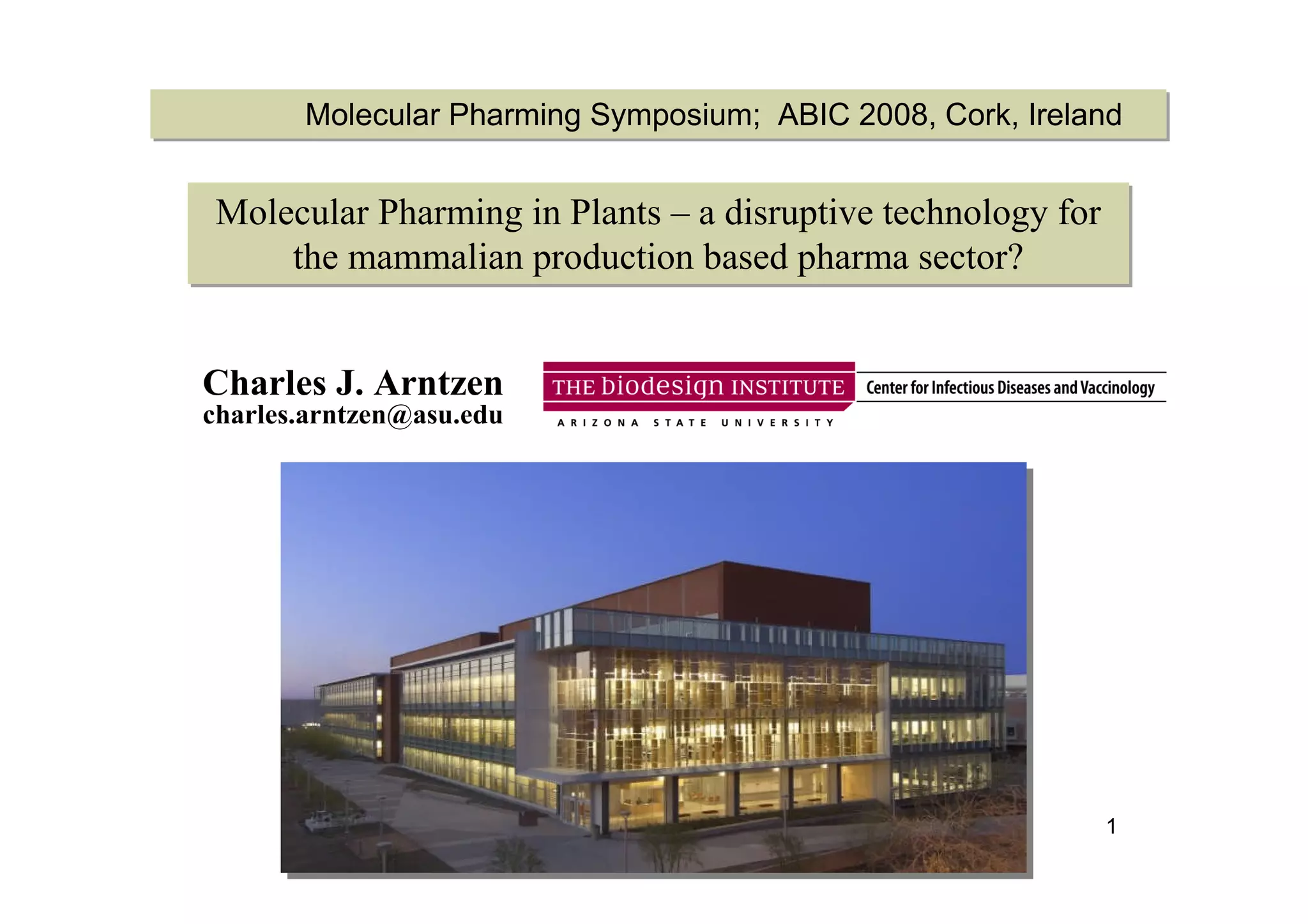
Charles J. Arntzen
charles.arntzen@asu.edu
Molecular Pharming Symposium; ABIC 2008, Cork, IrelandMolecular Pharming Symposium; ABIC 2008, Cork, Ireland
Molecular Pharming in Plants – a disruptive technology for
the mammalian production based pharma sector?
Molecular Pharming in Plants – a disruptive technology for
the mammalian production based pharma sector?
1
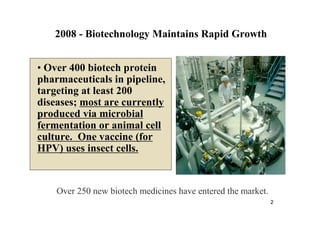
2008 - Biotechnology Maintains Rapid Growth
• Over 400 biotech protein
pharmaceuticals in pipeline,
targeting at least 200
diseases; most are currently
produced via microbial
fermentation or animal cell
culture. One vaccine (for
HPV) uses insect cells.
Over 250 new biotech medicines have entered the market.
2
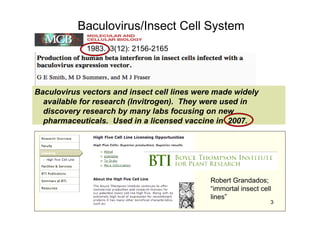
Baculovirus/Insect Cell System
1983. 3(12): 2156-2165
Robert Grandados;
“immortal insect cell
lines”
Baculovirus vectors and insect cell lines were made widely
available for research (Invitrogen). They were used in
discovery research by many labs focusing on new
pharmaceuticals. Used in a licensed vaccine in 2007.
3
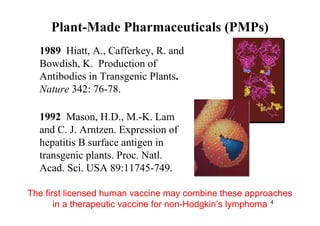
Plant-Made Pharmaceuticals (PMPs)
1989 Hiatt, A., Cafferkey, R. and
Bowdish, K. Production of
Antibodies in Transgenic Plants.
Nature 342: 76-78.
1992 Mason, H.D., M.-K. Lam
and C. J. Arntzen. Expression of
hepatitis B surface antigen in
transgenic plants. Proc. Natl.
Acad. Sci. USA 89:11745-749.
The first licensed human vaccine may combine these approaches
in a therapeutic vaccine for non-Hodgkin’s lymphoma 4
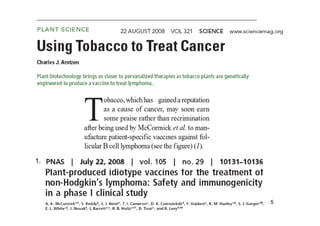
1.
5
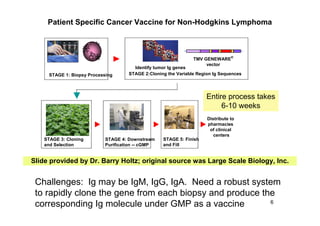
Slide provided by Dr. Barry Holtz; original source was Large Scale Biology, Inc.
Patient Specific Cancer Vaccine for Non-Hodgkins Lymphoma
6
Distribute to
pharmacies
of clinical
centers
STAGE 2:Cloning the Variable Region Ig Sequences
TMV GENEWARE
®
vector
Identify tumor Ig genes
STAGE 1: Biopsy Processing
STAGE 3: Cloning
and Selection
STAGE 4: Downstream
Purification -- cGMP
STAGE 5: Finish
and Fill
Entire process takes
6-10 weeks
Challenges: Ig may be IgM, IgG, IgA. Need a robust system
to rapidly clone the gene from each biopsy and produce the
corresponding Ig molecule under GMP as a vaccine
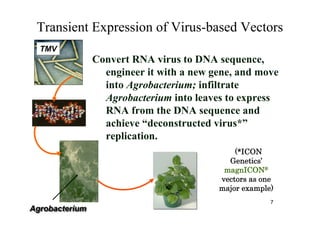
Transient Expression of Virus-based Vectors
AgrobacteriumAgrobacterium
Convert RNA virus to DNA sequence,
engineer it with a new gene, and move
into Agrobacterium; infiltrate
Agrobacterium into leaves to express
RNA from the DNA sequence and
achieve “deconstructed virus*”
replication.
TMVTMV
(*ICON
Genetics’
magnICON®
vectors as one
major example)
7
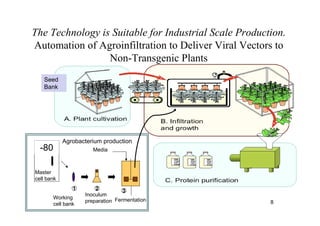
The Technology is Suitable for Industrial Scale Production.
Automation of Agroinfiltration to Deliver Viral Vectors to
Non-Transgenic Plants
Working
cell bank
Inoculum
preparation
2
Fermentation
Media
31
-80
Master
cell bank
Agrobacterium production
Seed
Bank
8
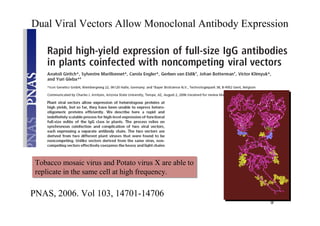
PNAS, 2006. Vol 103, 14701-14706
Dual Viral Vectors Allow Monoclonal Antibody Expression
Tobacco mosaic virus and Potato virus X are able to
replicate in the same cell at high frequency.
Tobacco mosaic virus and Potato virus X are able to
replicate in the same cell at high frequency.
9
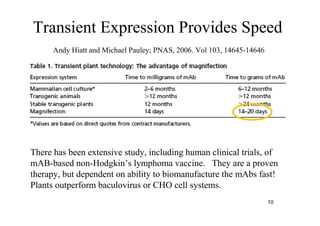
Transient Expression Provides Speed
There has been extensive study, including human clinical trials, of
mAB-based non-Hodgkin’s lymphoma vaccine. They are a proven
therapy, but dependent on ability to biomanufacture the mAbs fast!
Plants outperform baculovirus or CHO cell systems.
10
Andy Hiatt and Michael Pauley; PNAS, 2006. Vol 103, 14645-14646
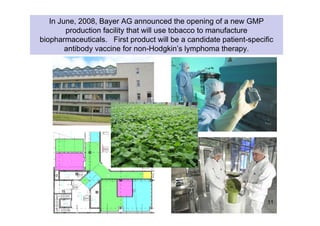
In June, 2008, Bayer AG announced the opening of a new GMP
production facility that will use tobacco to manufacture
biopharmaceuticals. First product will be a candidate patient-specific
antibody vaccine for non-Hodgkin’s lymphoma therapy.
11
Mission: Develop new vaccines and biopharmaceutical
products through integration of academic and private
research and the consolidation of intellectual property
Lead product in development: noroVAXX™ recombinant
norovirus vaccine produced in plants
(www.vaxxinc.com)
Plant-made vaccine opportunities:
Infectious diseases which undergo frequent
genetic variation.
12
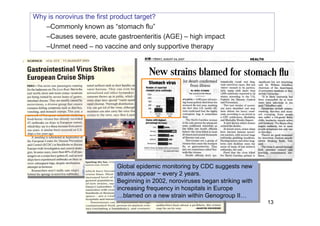
Why is norovirus the first product target?
–Commonly known as “stomach flu”
–Causes severe, acute gastroenteritis (AGE) – high impact
–Unmet need – no vaccine and only supportive therapy
Global epidemic monitoring by CDC suggests new
strains appear ~ every 2 years.
Beginning in 2002, noroviruses began striking with
increasing frequency in hospitals in Europe
…blamed on a new strain within Genogroup II…
Global epidemic monitoring by CDC suggests new
strains appear ~ every 2 years.
Beginning in 2002, noroviruses began striking with
increasing frequency in hospitals in Europe
…blamed on a new strain within Genogroup II…
13
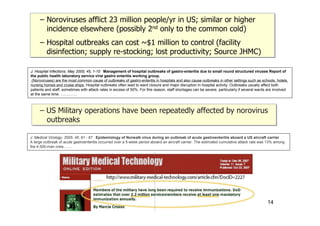
– Noroviruses afflict 23 million people/yr in US; similar or higher
incidence elsewhere (possibly 2nd only to the common cold)
– Hospital outbreaks can cost ~$1 million to control (facility
disinfection; supply re-stocking; lost productivity; Source JHMC)
– Noroviruses afflict 23 million people/yr in US; similar or higher
incidence elsewhere (possibly 2nd only to the common cold)
– Hospital outbreaks can cost ~$1 million to control (facility
disinfection; supply re-stocking; lost productivity; Source JHMC)
J. Hospital Infections. May 2000; 45, 1-10 Management of hospital outbreaks of gastro-enteritis due to small round structured viruses Report of
the public health laboratory service viral gastro enteritis working group.
(Noroviruses) are the most common cause of outbreaks of gastro-enteritis in hospitals and also cause outbreaks in other settings such as schools, hotels,
nursing homes and cruise ships. Hospital outbreaks often lead to ward closure and major disruption in hospital activity. Outbreaks usually affect both
patients and staff, sometimes with attack rates in excess of 50%. For this reason, staff shortages can be severe, particularly if several wards are involved
at the same time. ………….
J. Medical Virology. 2005. 45; 61 - 67 Epidemiology of Norwalk virus during an outbreak of acute gastroenteritis aboard a US aircraft carrier
A large outbreak of acute gastroenteritis occurred over a 5-week period aboard an aircraft carrier. The estimated cumulative attack rate was 13% among
the 4,500-man crew…….
– US Military operations have been repeatedly affected by norovirus
outbreaks
– US Military operations have been repeatedly affected by norovirus
outbreaks
14
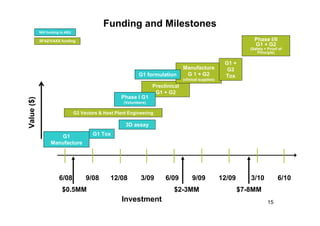
Funding and Milestones
6/08 9/08 12/08 3/09 6/09 9/09 12/09 3/10 6/10
G2 Vectors & Host Plant Engineering
Preclinical
G1 + G2
Phase I/II
G1 + G2
(Safety + Proof of
Principle)
$0.5MM $2-3MM $7-8MM
Value($)
Investment
Manufacture
G 1 + G2
(clinical supplies)
Phase I G1
(Volunteers)
NIH funding to ASU
SFAZ/VAXX funding
G1
Manufacture
G1 Tox
G1 +
G2
ToxG1 formulation
3D assay
15
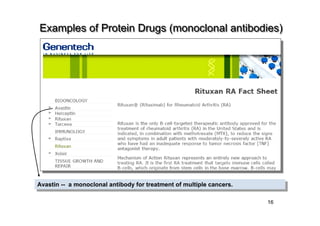
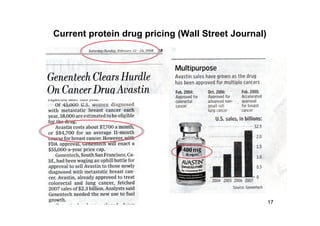
Examples of Protein Drugs (monoclonal antibodies)Examples of Protein Drugs (monoclonal antibodies)
Avastin -- a monoclonal antibody for treatment of multiple cancers.Avastin -- a monoclonal antibody for treatment of multiple cancers.
16
Current protein drug pricing (Wall Street Journal)
17
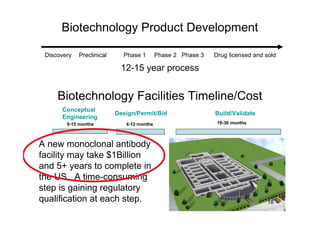
Biotechnology Facilities Timeline/Cost
Conceptual
Engineering
Design/Permit/Bid Build/Validate
4-12 months 18-36 months
A new monoclonal antibody
facility may take $1Billion
and 5+ years to complete in
the US. A time-consuming
step is gaining regulatory
qualification at each step.
Biotechnology Product Development
Discovery Preclinical Phase 1 Phase 2 Phase 3 Drug licensed and sold
12-15 year process
9-15 months
18
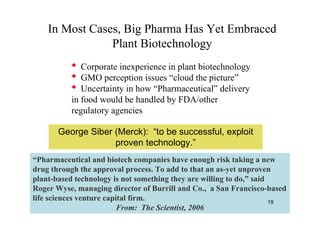
In Most Cases, Big Pharma Has Yet Embraced
Plant Biotechnology
• Corporate inexperience in plant biotechnology
• GMO perception issues “cloud the picture”
• Uncertainty in how “Pharmaceutical” delivery
in food would be handled by FDA/other
regulatory agencies
“Pharmaceutical and biotech companies have enough risk taking a new
drug through the approval process. To add to that an as-yet unproven
plant-based technology is not something they are willing to do,” said
Roger Wyse, managing director of Burrill and Co., a San Francisco-based
life sciences venture capital firm.
From: The Scientist, 2006
George Siber (Merck): “to be successful, exploit
proven technology.”
19
20
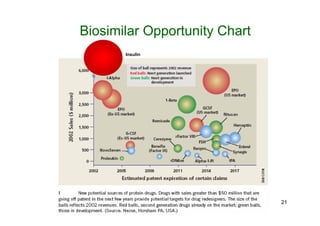
Biosimilar Opportunity Chart
Insulin
21
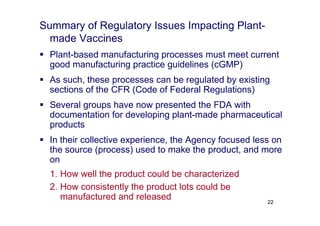
Summary of Regulatory Issues Impacting Plant-
made Vaccines
 Plant-based manufacturing processes must meet current
good manufacturing practice guidelines (cGMP)
 As such, these processes can be regulated by existing
sections of the CFR (Code of Federal Regulations)
 Several groups have now presented the FDA with
documentation for developing plant-made pharmaceutical
products
 In their collective experience, the Agency focused less on
the source (process) used to make the product, and more
on
1. How well the product could be characterized
2. How consistently the product lots could be
manufactured and released 22
Thanks to…
MAPP
Kevin Whaley
Andy Hiatt
Larry Zeitlin
U. Maryland
Carol Tacket
Icon Genetics (Bayer)
Yuri Gleba
Victor Klimyuk
Anatoli Giritch
Sylvestre Marillonnet
ASU
Hugh Mason
Tsafrir Mor
Qiang Chen
Steven Slater
Zhong Huang
Nobuyuki Matoba
Melissa Herbst-Kralovetz
Luca Santi
Barbara Gonzales
Jacki Kilbourne
Brooke Hjelm
Chana Uppalapati
NIH
Liz Rogers
Carolyn Deal
Hagit David 23

Arntzen

  • 1.
    Charles J. Arntzen charles.arntzen@asu.edu MolecularPharming Symposium; ABIC 2008, Cork, IrelandMolecular Pharming Symposium; ABIC 2008, Cork, Ireland Molecular Pharming in Plants – a disruptive technology for the mammalian production based pharma sector? Molecular Pharming in Plants – a disruptive technology for the mammalian production based pharma sector? 1
  • 2.
    2008 - BiotechnologyMaintains Rapid Growth • Over 400 biotech protein pharmaceuticals in pipeline, targeting at least 200 diseases; most are currently produced via microbial fermentation or animal cell culture. One vaccine (for HPV) uses insect cells. Over 250 new biotech medicines have entered the market. 2
  • 3.
    Baculovirus/Insect Cell System 1983.3(12): 2156-2165 Robert Grandados; “immortal insect cell lines” Baculovirus vectors and insect cell lines were made widely available for research (Invitrogen). They were used in discovery research by many labs focusing on new pharmaceuticals. Used in a licensed vaccine in 2007. 3
  • 4.
    Plant-Made Pharmaceuticals (PMPs) 1989Hiatt, A., Cafferkey, R. and Bowdish, K. Production of Antibodies in Transgenic Plants. Nature 342: 76-78. 1992 Mason, H.D., M.-K. Lam and C. J. Arntzen. Expression of hepatitis B surface antigen in transgenic plants. Proc. Natl. Acad. Sci. USA 89:11745-749. The first licensed human vaccine may combine these approaches in a therapeutic vaccine for non-Hodgkin’s lymphoma 4
  • 5.
  • 6.
    Slide provided byDr. Barry Holtz; original source was Large Scale Biology, Inc. Patient Specific Cancer Vaccine for Non-Hodgkins Lymphoma 6 Distribute to pharmacies of clinical centers STAGE 2:Cloning the Variable Region Ig Sequences TMV GENEWARE ® vector Identify tumor Ig genes STAGE 1: Biopsy Processing STAGE 3: Cloning and Selection STAGE 4: Downstream Purification -- cGMP STAGE 5: Finish and Fill Entire process takes 6-10 weeks Challenges: Ig may be IgM, IgG, IgA. Need a robust system to rapidly clone the gene from each biopsy and produce the corresponding Ig molecule under GMP as a vaccine
  • 7.
    Transient Expression ofVirus-based Vectors AgrobacteriumAgrobacterium Convert RNA virus to DNA sequence, engineer it with a new gene, and move into Agrobacterium; infiltrate Agrobacterium into leaves to express RNA from the DNA sequence and achieve “deconstructed virus*” replication. TMVTMV (*ICON Genetics’ magnICON® vectors as one major example) 7
  • 8.
    The Technology isSuitable for Industrial Scale Production. Automation of Agroinfiltration to Deliver Viral Vectors to Non-Transgenic Plants Working cell bank Inoculum preparation 2 Fermentation Media 31 -80 Master cell bank Agrobacterium production Seed Bank 8
  • 9.
    PNAS, 2006. Vol103, 14701-14706 Dual Viral Vectors Allow Monoclonal Antibody Expression Tobacco mosaic virus and Potato virus X are able to replicate in the same cell at high frequency. Tobacco mosaic virus and Potato virus X are able to replicate in the same cell at high frequency. 9
  • 10.
    Transient Expression ProvidesSpeed There has been extensive study, including human clinical trials, of mAB-based non-Hodgkin’s lymphoma vaccine. They are a proven therapy, but dependent on ability to biomanufacture the mAbs fast! Plants outperform baculovirus or CHO cell systems. 10 Andy Hiatt and Michael Pauley; PNAS, 2006. Vol 103, 14645-14646
  • 11.
    In June, 2008,Bayer AG announced the opening of a new GMP production facility that will use tobacco to manufacture biopharmaceuticals. First product will be a candidate patient-specific antibody vaccine for non-Hodgkin’s lymphoma therapy. 11
  • 12.
    Mission: Develop newvaccines and biopharmaceutical products through integration of academic and private research and the consolidation of intellectual property Lead product in development: noroVAXX™ recombinant norovirus vaccine produced in plants (www.vaxxinc.com) Plant-made vaccine opportunities: Infectious diseases which undergo frequent genetic variation. 12
  • 13.
    Why is norovirusthe first product target? –Commonly known as “stomach flu” –Causes severe, acute gastroenteritis (AGE) – high impact –Unmet need – no vaccine and only supportive therapy Global epidemic monitoring by CDC suggests new strains appear ~ every 2 years. Beginning in 2002, noroviruses began striking with increasing frequency in hospitals in Europe …blamed on a new strain within Genogroup II… Global epidemic monitoring by CDC suggests new strains appear ~ every 2 years. Beginning in 2002, noroviruses began striking with increasing frequency in hospitals in Europe …blamed on a new strain within Genogroup II… 13
  • 14.
    – Noroviruses afflict23 million people/yr in US; similar or higher incidence elsewhere (possibly 2nd only to the common cold) – Hospital outbreaks can cost ~$1 million to control (facility disinfection; supply re-stocking; lost productivity; Source JHMC) – Noroviruses afflict 23 million people/yr in US; similar or higher incidence elsewhere (possibly 2nd only to the common cold) – Hospital outbreaks can cost ~$1 million to control (facility disinfection; supply re-stocking; lost productivity; Source JHMC) J. Hospital Infections. May 2000; 45, 1-10 Management of hospital outbreaks of gastro-enteritis due to small round structured viruses Report of the public health laboratory service viral gastro enteritis working group. (Noroviruses) are the most common cause of outbreaks of gastro-enteritis in hospitals and also cause outbreaks in other settings such as schools, hotels, nursing homes and cruise ships. Hospital outbreaks often lead to ward closure and major disruption in hospital activity. Outbreaks usually affect both patients and staff, sometimes with attack rates in excess of 50%. For this reason, staff shortages can be severe, particularly if several wards are involved at the same time. …………. J. Medical Virology. 2005. 45; 61 - 67 Epidemiology of Norwalk virus during an outbreak of acute gastroenteritis aboard a US aircraft carrier A large outbreak of acute gastroenteritis occurred over a 5-week period aboard an aircraft carrier. The estimated cumulative attack rate was 13% among the 4,500-man crew……. – US Military operations have been repeatedly affected by norovirus outbreaks – US Military operations have been repeatedly affected by norovirus outbreaks 14
  • 15.
    Funding and Milestones 6/089/08 12/08 3/09 6/09 9/09 12/09 3/10 6/10 G2 Vectors & Host Plant Engineering Preclinical G1 + G2 Phase I/II G1 + G2 (Safety + Proof of Principle) $0.5MM $2-3MM $7-8MM Value($) Investment Manufacture G 1 + G2 (clinical supplies) Phase I G1 (Volunteers) NIH funding to ASU SFAZ/VAXX funding G1 Manufacture G1 Tox G1 + G2 ToxG1 formulation 3D assay 15
  • 16.
    Examples of ProteinDrugs (monoclonal antibodies)Examples of Protein Drugs (monoclonal antibodies) Avastin -- a monoclonal antibody for treatment of multiple cancers.Avastin -- a monoclonal antibody for treatment of multiple cancers. 16
  • 17.
    Current protein drugpricing (Wall Street Journal) 17
  • 18.
    Biotechnology Facilities Timeline/Cost Conceptual Engineering Design/Permit/BidBuild/Validate 4-12 months 18-36 months A new monoclonal antibody facility may take $1Billion and 5+ years to complete in the US. A time-consuming step is gaining regulatory qualification at each step. Biotechnology Product Development Discovery Preclinical Phase 1 Phase 2 Phase 3 Drug licensed and sold 12-15 year process 9-15 months 18
  • 19.
    In Most Cases,Big Pharma Has Yet Embraced Plant Biotechnology • Corporate inexperience in plant biotechnology • GMO perception issues “cloud the picture” • Uncertainty in how “Pharmaceutical” delivery in food would be handled by FDA/other regulatory agencies “Pharmaceutical and biotech companies have enough risk taking a new drug through the approval process. To add to that an as-yet unproven plant-based technology is not something they are willing to do,” said Roger Wyse, managing director of Burrill and Co., a San Francisco-based life sciences venture capital firm. From: The Scientist, 2006 George Siber (Merck): “to be successful, exploit proven technology.” 19
  • 20.
  • 21.
  • 22.
    Summary of RegulatoryIssues Impacting Plant- made Vaccines  Plant-based manufacturing processes must meet current good manufacturing practice guidelines (cGMP)  As such, these processes can be regulated by existing sections of the CFR (Code of Federal Regulations)  Several groups have now presented the FDA with documentation for developing plant-made pharmaceutical products  In their collective experience, the Agency focused less on the source (process) used to make the product, and more on 1. How well the product could be characterized 2. How consistently the product lots could be manufactured and released 22
  • 23.
    Thanks to… MAPP Kevin Whaley AndyHiatt Larry Zeitlin U. Maryland Carol Tacket Icon Genetics (Bayer) Yuri Gleba Victor Klimyuk Anatoli Giritch Sylvestre Marillonnet ASU Hugh Mason Tsafrir Mor Qiang Chen Steven Slater Zhong Huang Nobuyuki Matoba Melissa Herbst-Kralovetz Luca Santi Barbara Gonzales Jacki Kilbourne Brooke Hjelm Chana Uppalapati NIH Liz Rogers Carolyn Deal Hagit David 23