TERMINATOR GENE
TECHNOLOGY
DEFINITION
 Terminator gene technology refers to plants that have
been genetically modified to render sterile seeds at
harvest.
 It is the genetic modification of plants to make them
produce sterile seeds in second generation.
 Terminator alters the expression of certain genes in
plants so that plants terminate their reproductive switch,
about the embryo and make themselves sterile. Such
plants then produce seed that cannot germinate.
SYNONYM
 Terminator technology
 Traitor technology
 Suicidal seeds
 Genetic use restriction technology (GURT) (is the name
given to proposed methods for restricting the use of GM
plants by activating some genes only in response to
certain stimuli, especially to cause second generation
seeds to be infertile)
HISTORY
 The first patent applications related to a biological switch
mechanism regulated by external inducers date back to
the first years of the 1990s.
 1991, DuPont filed a patent application, granted in 1994
(U.S. 5,364,780), entitled ‘External regulation of gene
expression by inducible promoters’.
 In 1992, Zeneca (today Syngenta) filed a technology
application entitled ‘Improved plant germplasm’.
AIM
To create a cultivar that
would become sterile
only in farmers’ fields by
means of an external
stimulus to protect the
varieties developed by
biotech companies,
preventing farmers from
seed saving.
 The true watershed was marked when
Melvin Oliver, a British researcher, was
assigned (1990) by the USDA to
develop together with the Delta & Pine
Land (DPL) Company a seed-
embedded protection technology.
 The holders of the patent called this
invention ‘Technology Protection
System’ (TPS)
RESTRICTIONS
 As scientists started filing patents for terminator
technology, protest against use of such technologies
increased.
 Disadvantageous and unethical mechanism for poor
farmers, especially in developing countries where saving
seeds is a common practice,
 Advantage for multinational companies that would have
thus increased the dependence of indigenous and rural
communities worldwide on their GM seeds.
 Hence restrictions were imposed on the use of GURT by
CGIAR, CBD, FAO and others.
State of art
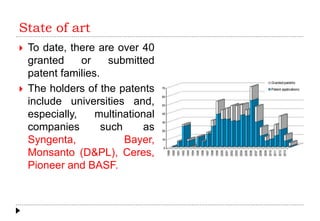
 To date, there are over 40
granted or submitted
patent families.
 The holders of the patents
include universities and,
especially, multinational
companies such as
Syngenta, Bayer,
Monsanto (D&PL), Ceres,
Pioneer and BASF.
TYPES
 V-GURT (VARIETAL GURT)
 T-GURT (TRAIT GURT)
V-GURT
 V-GURT produce sterile seeds, so the seed from the crop
could not be used as seeds, but only for sale as food or
fodder.
 When a plant reaches a given reproductive stage in its
cycle, the process of activating the target gene begins.
 The target gene is known as a disrupter gene, and is
usually a cytotoxin that degrades the DNA or RNA of the
plant.
 This results in a non-functioning seed that cannot grow
into a plant.
T-GURT
(Traits such as
herbicide/cold/drought/stres
s tolerance, pest resistance,
germination, flowering,
ripening, colour, taste and
nutritional qualities of the
plant, defence mechanisms,
or production of industrial or
pharmaceutical
compounds)
 T-GURT is designed to switch on or off
a trait using inducible promoters
regulating the expression of the
transgene through induced gene
silencing (e.g., by antisense
suppression) or by excision of the
transgene using a recombinase.
 In this case, the genetic modification is activated by a
chemical treatment or by environmental factors such as
heat, enabling farmers to maintain the value-added traits
of seeds.
 Crop does not function until the crop plant is treated with
a chemical that is sold by the biotechnology company.
 Farmers can save seeds for use each year. However,
they do not get to use the enhanced trait in the crop
unless they purchase the activator compound.
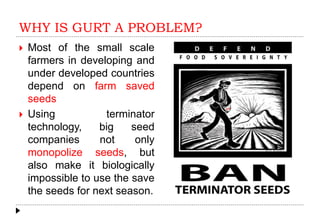
WHY IS GURT A PROBLEM?
 Most of the small scale
farmers in developing and
under developed countries
depend on farm saved
seeds
 Using terminator
technology, big seed
companies not only
monopolize seeds, but
also make it biologically
impossible to use the save
the seeds for next season.
WHO HOLDS PATENT ON TERMINATOR
TECHNOLOGY?
 Delta and Pine Land (DPL), the word’s largest cotton
seed company jointly holds 3 patents along with USDA.
 In October 2005, DPL won patent in Europe and Canada.
 During 2002, Monsanto acquired DPL.
WHAT IS THE NEED FOR TERMINATOR
TECHNOLOGY?
 According to biotech companies
- terminator technology will prevent the
contamination of non GM crop with GM crop,
- if all GM varieties had the terminator trait they
would not be able to spread into the environment,
- so biosafety would be ensured
GENERAL MOLECULAR CONSTRUCTION
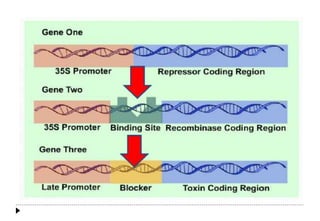
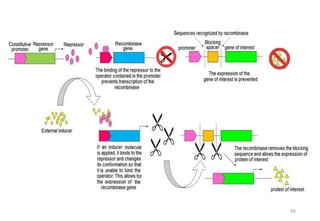
(i) A repressor gene (the gene switch) that is responsive to
an external stimulus
(ii) A recombinase gene (the trait activator gene), the
expression of which is blocked by the repressor
(iii) A target gene
Inducing substance – mostly chemical origin,
biodegradable, indirectly applicable in field or in seeds
THREE GENES
 Gene I
 Gene I is a repressor gene that produces a repressor protein
that interacts with a binding suite near gene II
 Gene II
 Gene II is a recombinase gene (phage P1 site specific
recombinase gene) that is controlled by a promotor, between
the gene and promotor is a binding site for the repressor from
gene I.
 Gene III
 Gene III (terminator gene) produces a toxin (cytptoxic protein-
ribosome inactivating protein-RIP) that is lethal to embryos,
controlled by a late promoter (LEA) expressed during the late
stage of seed development without affecting embryo
 Between toxin gene and late promoter is a piece of DNA called
Blocker, which interfere in turning toxin gene on.
Mechanism for V-GURT
For V-GURT three different mechanisms were proposed
First mechanismFIRST
MECHANISM
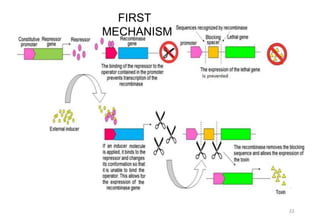
 Before being sold to the farmers the seeds are exposed
to the inducers, that inhibit the function of repressor.
 The recombinase gene is activated which splices the
blocker.
 The gene (toxin) under LEA promoter is activated only
during late embryogenesis, when the seed is
accumulated with storage oil and fats.
 The RIP is expressed leading to abortion of embryo
 Thus the seeds harvested are sterile.
SECOND MECHANISM
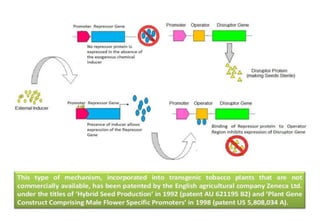
 Reverse process – presence of a gene encoding a distrupter
protein permanently active, making it sterile.
 The gene promoter is under the control of a specific operator
sequence.
 A further repressor protein, whose gene is under control of a
chemically inducible promoter, can bind to the operator,
inhibiting the expression of the disrupter protein.
 In the absence of the exogenous chemical inducer, no
repressor protein is expressed.
 Therefore, the breeder must apply the specific chemical
inducer throughout the process of seed multiplication to
inactivate the disrupter gene that causes sterility, interrupting
the application only at the time of selling the seeds.
THIRD MECHANISM
 Applied to vegetatively reproduced species, such as
tuber and root crops and ornamental plants, or plants
organs such as the cotyledons, leaves and stem, where
growth is prevented during the period in which they are
stored to increase the ‘shelf life’ of the product.
 This mechanism patented by Zeneca (Syngenta) in 2001
involves a permanently active gene able to block the
vegetative growth of the plant, preventing the
multiplication of the seeds.
 This default-expressed blocking gene can eventually be
suppressed by application of a chemical activating a
second gene allowing the plant to develop.
MECHANISM FOR T-GURT
There are two mechanisms by which T-GURT works
FIRST MECHANISM
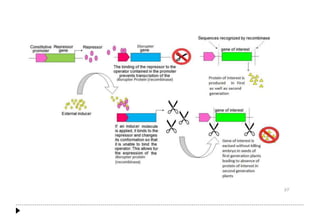
 A gene cassette is expressed in the seed and
programmed so that the gene responsible for the
production of a toxin/disrupter protein is instructed to
undo a particular plant trait of interest, without, however,
killing the embryo.
 Thus, a desirable characteristic may be excised
selectively by applying or withholding chemical
application before being sold to farmers.
 Consequently, the first generation plant is capable of
expressing the trait of interest, but the second generation
is not (e.g. Zeneca patent WO 9403619 titled ‘Improved
Plant Germplasm’)
SECOND MECHANISM
 The gene encoding the trait of interest is kept silent, but it
can be activated by the farmer through the application of
a chemical inducer to the plant or seed.
 In the subsequent fertile generations, the gene is
inherited in the inactive state, so that the chemical must
be purchased each year that farmer needs the trait to be
expressed (Shi, 2006).
 A variant of the latter mechanism has been hypothesized
by Shoemaker et al. (2001) on behalf of the USDA,
providing that the gene of interest can be activated by the
farmer spraying a ‘standing crop’ with an activator only at
the occurrence of an unfavourable event (e.g., a pest
disease)
Rationales behind GURT
INTELLECTUAL PROPERTY
PROTECTION
 The intellectual property protection
granted by GURTs has a double target
as it ensures that farmers cannot
reuse saved seeds or exploit a
valuable trait without purchasing a
(patented) chemical and also prevents
competitor biotech industries from
using seeds in their own breeding
programmes.
TRANSGENE CONTAINMENT
 GURTs may generally prevent unwanted gene flow from
transgenic to nontransgenic varieties (including wild
relatives) because it is argued that pollen carries the
dominant allele of the lethal/inhibiting protein.
 As an indirect effect, GURTs could reduce or remove the
need for buffer zones for gene containment and
drastically limit the eventuality of volunteer plants by
preventing volunteer seeds from germinating (V-GURTs)
or from expressing the GM trait (T-GURTs).
 Additionally, according to Budd (2004), V-GURTs would
be useful to effectively reduce the risk of creating
‘superweeds’ by reducing the presence of the GM crop in
subsequent years.
OTHER POSSIBLE BENEFITS
 Used to switch a desired trait on or off in favourable or
unfavourable situations, such as drought and salt stress
or pest attack (FAO, 2001a)
 V-GURTs could be used to prevent preharvest sprouting
 When combined with apomixis, they could allow seed
uppliers to produce seeds with hybrid vigour at reduced
cost while protecting the investment.
 Helps in containing GE pharma crops producing
therapeutic active compounds
 GURT can be used for induced male sterility system
CONCERS
AGARIAN SISTAINABILITY
 The impacts on biodiversity, sustainable agricultural
development, and farmers’ access to and use of genetic
resources through the inability to save and re-sow seeds.
 GURT-protected varieties would replace the adapted or
selected (possibly less productive) autochthonous cultivars
and wild relative species, resulting in the erosion of genetic
diversity in fields.
 GURT-transformed crops may also produce low quantities of
autotoxic compounds with negative impacts on nontarget
organisms, induce competition with wild species, and
eventually, as food/feed, transfer allergenicity and antibiotic
resistance
 The chemicals used to treat the seeds each year may have
negative impacts on the environment.
SOCIOECONOMIC POV
1. Reduction and limitation of traditional seed exchange
practice and participatory plant breeding
2. Reduction of the traditional knowledge and innovation
capacity for informal crop genetic improvement, local
agrobiodiversity protection and food security
3. Displacement of local farming systems and the social,
cultural and spiritual dimensions associated with them.
RISK OF TRANSGENE ESCAPE
 Drawbacks are related to the real effectiveness of GURTs
in preventing gene flow.
 The inducible expression of the GM trait would require a
100% effective application of a chemical inducer to
prevent the escape of a nonfunctioning transgene via
both seed and pollen.
 Some seeds may not respond or may not take up enough
inducer to activate the recombinase, thereby producing
fertile GM plants able to transmit the inserted trait and
causing exactly the opposite effect to the one intended.
HOW MANY PLANTS WERE RELEASED USING
GURT?
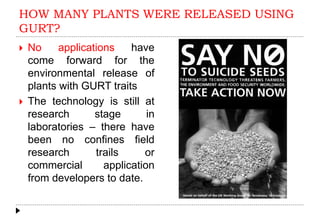
 No applications have
come forward for the
environmental release of
plants with GURT traits
 The technology is still at
research stage in
laboratories – there have
been no confines field
research trails or
commercial application
from developers to date.
REFERENCES
 Hills MJ, Hall L, Arnison PG, Good AG (2007) Genetic
use restriction technologies (GURTs): strategies to
impede transgene movement. Trends Plant Sci 12:177–
183
 Lombardo, L. (2014). Genetic use restriction
technologies: A review. Plant Biotechnology Journal,
12, 995–1005
 Daniell, H. (2002) Molecular strategies for gene
containment in transgenic crops. Nat.
Biotechnol. 20, 581– 586.
THANK YOU

Terminator technology

  • 1.
  • 2.
    DEFINITION  Terminator genetechnology refers to plants that have been genetically modified to render sterile seeds at harvest.  It is the genetic modification of plants to make them produce sterile seeds in second generation.  Terminator alters the expression of certain genes in plants so that plants terminate their reproductive switch, about the embryo and make themselves sterile. Such plants then produce seed that cannot germinate.
  • 3.
    SYNONYM  Terminator technology Traitor technology  Suicidal seeds  Genetic use restriction technology (GURT) (is the name given to proposed methods for restricting the use of GM plants by activating some genes only in response to certain stimuli, especially to cause second generation seeds to be infertile)
  • 4.
    HISTORY  The firstpatent applications related to a biological switch mechanism regulated by external inducers date back to the first years of the 1990s.  1991, DuPont filed a patent application, granted in 1994 (U.S. 5,364,780), entitled ‘External regulation of gene expression by inducible promoters’.  In 1992, Zeneca (today Syngenta) filed a technology application entitled ‘Improved plant germplasm’.
  • 5.
    AIM To create acultivar that would become sterile only in farmers’ fields by means of an external stimulus to protect the varieties developed by biotech companies, preventing farmers from seed saving.  The true watershed was marked when Melvin Oliver, a British researcher, was assigned (1990) by the USDA to develop together with the Delta & Pine Land (DPL) Company a seed- embedded protection technology.  The holders of the patent called this invention ‘Technology Protection System’ (TPS)
  • 6.
    RESTRICTIONS  As scientistsstarted filing patents for terminator technology, protest against use of such technologies increased.  Disadvantageous and unethical mechanism for poor farmers, especially in developing countries where saving seeds is a common practice,  Advantage for multinational companies that would have thus increased the dependence of indigenous and rural communities worldwide on their GM seeds.  Hence restrictions were imposed on the use of GURT by CGIAR, CBD, FAO and others.
  • 7.
    State of art To date, there are over 40 granted or submitted patent families.  The holders of the patents include universities and, especially, multinational companies such as Syngenta, Bayer, Monsanto (D&PL), Ceres, Pioneer and BASF.
  • 8.
    TYPES  V-GURT (VARIETALGURT)  T-GURT (TRAIT GURT)
  • 9.
    V-GURT  V-GURT producesterile seeds, so the seed from the crop could not be used as seeds, but only for sale as food or fodder.  When a plant reaches a given reproductive stage in its cycle, the process of activating the target gene begins.  The target gene is known as a disrupter gene, and is usually a cytotoxin that degrades the DNA or RNA of the plant.  This results in a non-functioning seed that cannot grow into a plant.
  • 10.
    T-GURT (Traits such as herbicide/cold/drought/stres stolerance, pest resistance, germination, flowering, ripening, colour, taste and nutritional qualities of the plant, defence mechanisms, or production of industrial or pharmaceutical compounds)  T-GURT is designed to switch on or off a trait using inducible promoters regulating the expression of the transgene through induced gene silencing (e.g., by antisense suppression) or by excision of the transgene using a recombinase.
  • 11.
     In thiscase, the genetic modification is activated by a chemical treatment or by environmental factors such as heat, enabling farmers to maintain the value-added traits of seeds.  Crop does not function until the crop plant is treated with a chemical that is sold by the biotechnology company.  Farmers can save seeds for use each year. However, they do not get to use the enhanced trait in the crop unless they purchase the activator compound.
  • 12.
    WHY IS GURTA PROBLEM?  Most of the small scale farmers in developing and under developed countries depend on farm saved seeds  Using terminator technology, big seed companies not only monopolize seeds, but also make it biologically impossible to use the save the seeds for next season.
  • 13.
    WHO HOLDS PATENTON TERMINATOR TECHNOLOGY?  Delta and Pine Land (DPL), the word’s largest cotton seed company jointly holds 3 patents along with USDA.  In October 2005, DPL won patent in Europe and Canada.  During 2002, Monsanto acquired DPL.
  • 14.
    WHAT IS THENEED FOR TERMINATOR TECHNOLOGY?  According to biotech companies - terminator technology will prevent the contamination of non GM crop with GM crop, - if all GM varieties had the terminator trait they would not be able to spread into the environment, - so biosafety would be ensured
  • 15.
    GENERAL MOLECULAR CONSTRUCTION (i)A repressor gene (the gene switch) that is responsive to an external stimulus (ii) A recombinase gene (the trait activator gene), the expression of which is blocked by the repressor (iii) A target gene Inducing substance – mostly chemical origin, biodegradable, indirectly applicable in field or in seeds
  • 16.
    THREE GENES  GeneI  Gene I is a repressor gene that produces a repressor protein that interacts with a binding suite near gene II  Gene II  Gene II is a recombinase gene (phage P1 site specific recombinase gene) that is controlled by a promotor, between the gene and promotor is a binding site for the repressor from gene I.
  • 17.
     Gene III Gene III (terminator gene) produces a toxin (cytptoxic protein- ribosome inactivating protein-RIP) that is lethal to embryos, controlled by a late promoter (LEA) expressed during the late stage of seed development without affecting embryo  Between toxin gene and late promoter is a piece of DNA called Blocker, which interfere in turning toxin gene on.
  • 19.
    Mechanism for V-GURT ForV-GURT three different mechanisms were proposed
  • 20.
  • 21.
     Before beingsold to the farmers the seeds are exposed to the inducers, that inhibit the function of repressor.  The recombinase gene is activated which splices the blocker.  The gene (toxin) under LEA promoter is activated only during late embryogenesis, when the seed is accumulated with storage oil and fats.  The RIP is expressed leading to abortion of embryo  Thus the seeds harvested are sterile.
  • 22.
    SECOND MECHANISM  Reverseprocess – presence of a gene encoding a distrupter protein permanently active, making it sterile.  The gene promoter is under the control of a specific operator sequence.  A further repressor protein, whose gene is under control of a chemically inducible promoter, can bind to the operator, inhibiting the expression of the disrupter protein.  In the absence of the exogenous chemical inducer, no repressor protein is expressed.  Therefore, the breeder must apply the specific chemical inducer throughout the process of seed multiplication to inactivate the disrupter gene that causes sterility, interrupting the application only at the time of selling the seeds.
  • 24.
    THIRD MECHANISM  Appliedto vegetatively reproduced species, such as tuber and root crops and ornamental plants, or plants organs such as the cotyledons, leaves and stem, where growth is prevented during the period in which they are stored to increase the ‘shelf life’ of the product.  This mechanism patented by Zeneca (Syngenta) in 2001 involves a permanently active gene able to block the vegetative growth of the plant, preventing the multiplication of the seeds.  This default-expressed blocking gene can eventually be suppressed by application of a chemical activating a second gene allowing the plant to develop.
  • 25.
    MECHANISM FOR T-GURT Thereare two mechanisms by which T-GURT works
  • 26.
    FIRST MECHANISM  Agene cassette is expressed in the seed and programmed so that the gene responsible for the production of a toxin/disrupter protein is instructed to undo a particular plant trait of interest, without, however, killing the embryo.  Thus, a desirable characteristic may be excised selectively by applying or withholding chemical application before being sold to farmers.  Consequently, the first generation plant is capable of expressing the trait of interest, but the second generation is not (e.g. Zeneca patent WO 9403619 titled ‘Improved Plant Germplasm’)
  • 28.
    SECOND MECHANISM  Thegene encoding the trait of interest is kept silent, but it can be activated by the farmer through the application of a chemical inducer to the plant or seed.  In the subsequent fertile generations, the gene is inherited in the inactive state, so that the chemical must be purchased each year that farmer needs the trait to be expressed (Shi, 2006).  A variant of the latter mechanism has been hypothesized by Shoemaker et al. (2001) on behalf of the USDA, providing that the gene of interest can be activated by the farmer spraying a ‘standing crop’ with an activator only at the occurrence of an unfavourable event (e.g., a pest disease)
  • 30.
  • 31.
    INTELLECTUAL PROPERTY PROTECTION  Theintellectual property protection granted by GURTs has a double target as it ensures that farmers cannot reuse saved seeds or exploit a valuable trait without purchasing a (patented) chemical and also prevents competitor biotech industries from using seeds in their own breeding programmes.
  • 32.
    TRANSGENE CONTAINMENT  GURTsmay generally prevent unwanted gene flow from transgenic to nontransgenic varieties (including wild relatives) because it is argued that pollen carries the dominant allele of the lethal/inhibiting protein.  As an indirect effect, GURTs could reduce or remove the need for buffer zones for gene containment and drastically limit the eventuality of volunteer plants by preventing volunteer seeds from germinating (V-GURTs) or from expressing the GM trait (T-GURTs).  Additionally, according to Budd (2004), V-GURTs would be useful to effectively reduce the risk of creating ‘superweeds’ by reducing the presence of the GM crop in subsequent years.
  • 33.
    OTHER POSSIBLE BENEFITS Used to switch a desired trait on or off in favourable or unfavourable situations, such as drought and salt stress or pest attack (FAO, 2001a)  V-GURTs could be used to prevent preharvest sprouting  When combined with apomixis, they could allow seed uppliers to produce seeds with hybrid vigour at reduced cost while protecting the investment.  Helps in containing GE pharma crops producing therapeutic active compounds  GURT can be used for induced male sterility system
  • 34.
  • 35.
    AGARIAN SISTAINABILITY  Theimpacts on biodiversity, sustainable agricultural development, and farmers’ access to and use of genetic resources through the inability to save and re-sow seeds.  GURT-protected varieties would replace the adapted or selected (possibly less productive) autochthonous cultivars and wild relative species, resulting in the erosion of genetic diversity in fields.  GURT-transformed crops may also produce low quantities of autotoxic compounds with negative impacts on nontarget organisms, induce competition with wild species, and eventually, as food/feed, transfer allergenicity and antibiotic resistance  The chemicals used to treat the seeds each year may have negative impacts on the environment.
  • 36.
    SOCIOECONOMIC POV 1. Reductionand limitation of traditional seed exchange practice and participatory plant breeding 2. Reduction of the traditional knowledge and innovation capacity for informal crop genetic improvement, local agrobiodiversity protection and food security 3. Displacement of local farming systems and the social, cultural and spiritual dimensions associated with them.
  • 37.
    RISK OF TRANSGENEESCAPE  Drawbacks are related to the real effectiveness of GURTs in preventing gene flow.  The inducible expression of the GM trait would require a 100% effective application of a chemical inducer to prevent the escape of a nonfunctioning transgene via both seed and pollen.  Some seeds may not respond or may not take up enough inducer to activate the recombinase, thereby producing fertile GM plants able to transmit the inserted trait and causing exactly the opposite effect to the one intended.
  • 38.
    HOW MANY PLANTSWERE RELEASED USING GURT?  No applications have come forward for the environmental release of plants with GURT traits  The technology is still at research stage in laboratories – there have been no confines field research trails or commercial application from developers to date.
  • 39.
    REFERENCES  Hills MJ,Hall L, Arnison PG, Good AG (2007) Genetic use restriction technologies (GURTs): strategies to impede transgene movement. Trends Plant Sci 12:177– 183  Lombardo, L. (2014). Genetic use restriction technologies: A review. Plant Biotechnology Journal, 12, 995–1005  Daniell, H. (2002) Molecular strategies for gene containment in transgenic crops. Nat. Biotechnol. 20, 581– 586.
  • 40.